Buy Tom's Books
  • Great Powers: America and the World After Bush
    Great Powers: America and the World After Bush
    by Thomas P.M. Barnett
  • Blueprint for Action: A Future Worth Creating
    Blueprint for Action: A Future Worth Creating
    by Thomas P.M. Barnett
  • The Pentagon's New Map: War and Peace in the Twenty-first Century
    The Pentagon's New Map: War and Peace in the Twenty-first Century
    by Thomas P.M. Barnett
  • Romanian and East German Policies in the Third World: Comparing the Strategies of Ceausescu and Honecker
    Romanian and East German Policies in the Third World: Comparing the Strategies of Ceausescu and Honecker
    by Thomas P.M. Barnett
  • The Emily Updates (Vol. 1): One Year in the Life of the Girl Who Lived (The Emily Updates (Vols. 1-5))
    The Emily Updates (Vol. 1): One Year in the Life of the Girl Who Lived (The Emily Updates (Vols. 1-5))
    by Vonne M. Meussling-Barnett, Thomas P.M. Barnett
  • The Emily Updates (Vol. 2): One Year in the Life of the Girl Who Lived (The Emily Updates (Vols. 1-5))
    The Emily Updates (Vol. 2): One Year in the Life of the Girl Who Lived (The Emily Updates (Vols. 1-5))
    by Thomas P.M. Barnett, Vonne M. Meussling-Barnett
  • The Emily Updates (Vol. 3): One Year in the Life of the Girl Who Lived (The Emily Updates (Vols. 1-5))
    The Emily Updates (Vol. 3): One Year in the Life of the Girl Who Lived (The Emily Updates (Vols. 1-5))
    by Thomas P.M. Barnett, Vonne M. Meussling-Barnett
  • The Emily Updates (Vol. 4): One Year in the Life of the Girl Who Lived (The Emily Updates (Vols. 1-5))
    The Emily Updates (Vol. 4): One Year in the Life of the Girl Who Lived (The Emily Updates (Vols. 1-5))
    by Thomas P.M. Barnett, Vonne M. Meussling-Barnett
  • The Emily Updates (Vol. 5): One Year in the Life of the Girl Who Lived (The Emily Updates (Vols. 1-5))
    The Emily Updates (Vol. 5): One Year in the Life of the Girl Who Lived (The Emily Updates (Vols. 1-5))
    by Vonne M. Meussling-Barnett, Thomas P.M. Barnett, Emily V. Barnett
Search the Site
Powered by Squarespace
Monthly Archives
12:08AM

Chivers on the competency of the Afghan police

C.J. Chivers story in NYT.

The disturbing lead:

Three months after arriving in the most dangerous area of Afghanistan’s Helmand Province, a contingent of specialized Afghan police officers has logged a mediocre performance while being almost wholly dependent on American supervision and support, Westerners who work with the officers said.

The conduct of Marja’s interim police, from a unit American officials describe as the Interior Ministry’s most promising force, has been undercut by drug use, petty corruption and, at times, a lack of commitment in the face of the ordinary hardships and duties of uniformed life.

When the force first arrived in late winter, entire units refused to stand guard or clean their living areas, several Marines said, and in northern Marja, police shifts often still abandon checkpoints during the sweltering midday heat, disappearing for lunch breaks lasting hours. Some officers have deserted the force.

The police also seem unschooled in rules of engagement, which risks putting their behavior at cross-purposes with Western units trying to earn civilian support. Police officials themselves say they have inadequate equipment and face a complex, dangerous mission.

This early assessment, of a high-profile unit on a much publicized mission, underlined anew the difficulties in creating Afghan forces that can operate independently and be entrusted with the nation’s security — an essential step toward drawing down Western forces after nine years of war.

It also raises questions about any timetable for Afghan self-sufficiency. American officials and contractors say it will take much longer for the units to be nurtured to self-reliance and a higher level of skill. For now, the police in Marja perform limited duties. American units create the space in which they operate, and provide their logistical, medical and military support.

“They are not hopeless,” said Daniel M. Aguirre, a retired police officer from Amarillo, Tex., who works with the police. “But they are at the first or second rung on the ladder.”

Sounds like an honest assessment to me.  Iraq was a governed space before we got there--a brutal regime no doubt, but a governed space, meaning the capacity was there.

The same simply wasn't true of Afghanistan.

We didn't do right by the country for seven years, and now we're trying to cram-course the entire place in a matter of months. Why? Oldest reason in the book: our leadership fears our public.

The damage we do to the "nation" of Afghanistan--along with the region--is one thing.  The damage will do to ourselves globally is another.

But the damage we do to our military by pretending this is a legitimate full-on testing of COIN doctrine is bigger than both.

When, by discrediting U.S. power, you suggest that the world is ungovernable, you put globalization at risk.

12:07AM

The ally we rely upon to save our bacon in Afghanistan

NYT story about Pakistan's vibrant and debilitating conspiracy culture.

America competes with India and Israel as the source of all perceived woes and indignities and injustices in Pakistan--in addition to the wider Muslim world.

This is the country we're betting on to make our withdrawal from Afghanistan work.

Americans may think that the failed Times Square bomb was planted by a man named Faisal Shahzad. But the view in the Supreme Court Bar Association here in Pakistan’s capital is that the culprit was an American “think tank.”

That is seriously infantile thinking from a group one would assume represents the best thought leadership in the country.

But it appears to be perfectly acceptable public dialogue inside Pakistan.

“When the water stops running from the tap, people blame America,” said Shaista Sirajuddin, an English professor in Lahore.

The problem is more than a peculiar domestic phenomenon for Pakistan. It has grown into a narrative of national victimhood that is a nearly impenetrable barrier to any candid discussion of the problems here. In turn, it is one of the principal obstacles for the United States in its effort to build a stronger alliance with a country to which it gives more than a billion dollars a year in aid.

The crux of the problem:

It does not help that no part of the Pakistani state — either the weak civilian government or the powerful military — is willing to risk publicly owning that relationship.

One result is that nearly all of American policy toward Pakistan is conducted in secret, a fact that serves only to further feed conspiracies. American military leaders slip quietly in and out of the capital; the Pentagon uses networks of private spies; and the main tool of American policy here, the drone program, is not even publicly acknowledged to exist.

The sad truth is that we are limited in our interactions with Pakistan to the tools and methods employed by that regime in its governance of the country.

The alternative is India, which has its own psychological peculiarities, like any long-abused colony.

But there are nothing in comparison, and virtually all of India's internal evolutions are trending in the right direction--unlike Pakistan, which seems to be regressing by the day (despite its bright future of just a few years ago).  Some of that dynamic, stretching back decades now, can certainly be blamed upon the United States.

But it would appear that we are past the point of reason with this "ally."

12:06AM

Great thanks to two individuals who sent us medical instruments for orphanages in Ethiopia

Our thanks to the two individuals who sent us medical devices so far.

For anybody interested in donating medical devices or children's clothing (Land's End, Hanna Anderson, Gymboree), click here for instructions.

Thank-you's hundreds of languages found here.

12:05AM

Great piece by Peggy Noonan on the American character

Great WSJ op-ed by Peggy Noonan, whose smart-ass style (look who's talking!) is softened by her beautiful writing style.

The closer:

Here is a fanciful example that is meant to have a larger point. If you, complicated little pirate that you are, find yourself caught in the middle of a big messy scandal in America right now, you can't go to another continent to hide out or ride out the storm. Earlier generations did exactly that, but you can't, because you've been on the front page of every website, the lead on every newscast. You'll be spotted in South Africa and Googled in Gdansk. Two hundred years ago, or even 100, when you got yourself in a big fat bit of trouble in Paris, you could run to the docks and take the first ship to America, arrive unknown, and start over. You changed your name, or didn't even bother. It would be years before anyone caught up with you.

And this is part of how America was born. Gamblers, bounders, ne'er-do-wells, third sons in primogeniture cultures—most of us came here to escape something! Our people came here not only for a new chance but to disappear, hide out, tend their wounds, and summon the energy, in time, to impress the dopes back home. America has many anthems, but one of them is "I'll show 'em!"

There is still something of that in all Americans, which means as a people we're not really suited to the age of surveillance, the age of no privacy. There is no hiding place now, not here, and this strikes me as something of huge and existential import. It's like the closing of yet another frontier, a final one we didn't even know was there.

A few weeks ago the latest right-track-wrong-track numbers came out, and the wrong-track numbers won, as they have since 2003. About 70% of respondents said they thought the country was on the wrong track. This was generally seen as "a commentary on the economy," and no doubt this is part of it. But Americans are more interesting and complicated people than that, and maybe they're also thinking, "Remember Jeremiah Johnson? The guy who went off by himself in the mountains and lived on his own? I'd like to do that. But they'd find me on Google Earth."

I get the angst, but Noonan's description of America's DNA is dead-on, so I also get the reasonable pushback. Toss in a good court system, and I think that, not only will we be fine, but we'll reach the right balance of rules faster and better than anybody else--without prying any guns off anybody's cold dead fingers!

12:04AM

When push comes to shove, US bases remain

WSJ cover story.

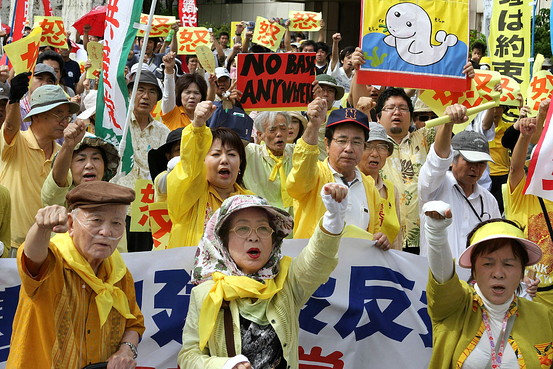
Yes, the NIMBYs have at it, and yes, Hatoyama resigns for breaking campaign promise, but the Marine bases remain.

NorKo drove the reaction this time; in the future China's build-up will be the excuse.  

Point is, America never really has trouble locating new bases when the need arises and only occasionally has trouble holding onto old ones.  When the latter happens, new offers to host inevitably flow.

Why?  All these rising great powers are good for the business of alliance-building and balancing.

There is no surpassing the US Leviathan; there is only triggering regional balancing responses that bolster its presence.

12:03AM

Globalization's great infrastructural buildout: China's grid

WSJ story by Shai Oster.  Pic is of smart-grid demo center in Yangzhou.

GE, Siemens and others all competing fiercely to gain footholds in "one of the world's biggest markets for advanced power transmission and distribution systems."

I remember talking to a GE exec in 2005 in Williamsburg:  he said GE would make the bulk of their future profits on electricity and water alone--in Asia.

At least $100B spent over next decade, comparable to what we're spending for upgrades to our currently, far too dumb grid.  China likewise expected to spend $60-80B per year on gear, but Chinese companies will dominate there, so the smart-grid operation niche is where it's at for the West.  

The BOP (bottom of the pyramid) logic is clear:  

GE says the size of China's expected demand also offers opportunities for economies of scale in smart-grid products.  Long term, that could make products exported to other countries cheaper to produce.  GE said it would expand research facilities it already has in Shanghai.

Right now, China's losses due to bad transmission are roughly tripled that in the West (8% compared to OECD average of 2.5%).

12:02AM

The BRIC car market: zero to 60

chart here

FT front-pager.

Brazilians per car sat at 9.1 in 1997 and is expected to drop to just 4.3 by 2014, meaning by then everybody ought to be able to fit in a vehicle!

VW, GM and Fiat all with about 1/5th shares, Ford at 1/10th.

When Brazil passes Germany (possibly this year), it'll be:


  1. China
  2. US
  3. Japan
  4. Brazil
  5. Germany.

GM expects 5% annual growth for next five years, with some thanks due to World Cup 2014 and Olympics 2016--the kind of things that define New Core membership along with lots more cars.

12:01AM

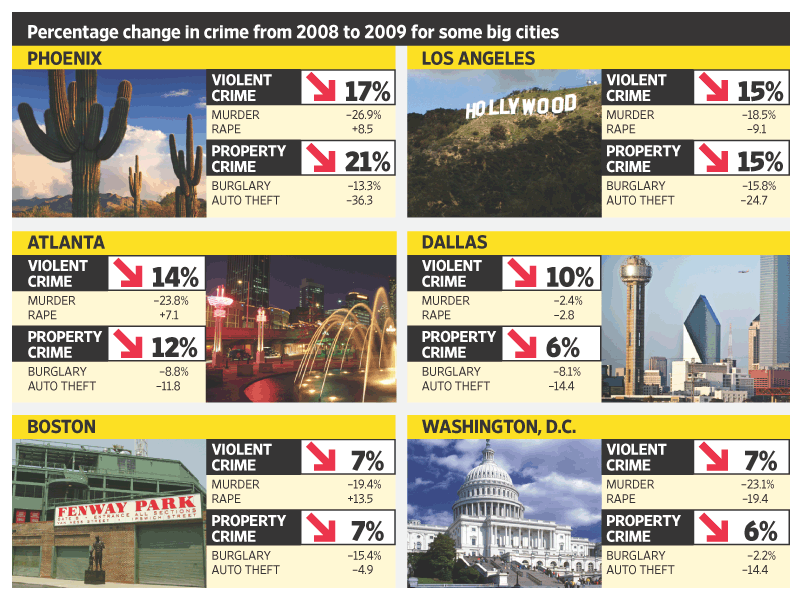
Chart of the day: Crime drop defies multiple predictions for rise

Back in 2004, when I was at the Naval War College, a major metro police chief from New England visited me to talk about Core-Gap dynamics in the seam between the inner city and the suburbs, a topic that still gets presented to me from those quarters.  His prediction struck me as entirely sensible:  all the 3-strikes and tougher sentencing of the 1990s was finally coming home to roost in that America was on the verge of starting to expel more ex-cons than new criminals being sentenced (something like 600k ex-cons hitting the street each year while 500k go in).  Naturally, the prediction was that all of these ex-cons would step right back into the Gap-like conditions of their old neighborhoods and lapse back into criminal behavior.

Then you add in the financial/economic woes since mid-2008, and that seems like a recipe for a big spike in crime, yes?

But instead we get substantial drops in lots of major metros across 2009, with the biggest declines happening in the biggest cities (over one million population).

The credit?  Better policing techniques across the board, plus some staffing help due to the stimulus package.

As a rule, we are told that it takes years for a crime drop to register in the minds of the public.

Then there's concern about chronic long-term unemployment + the end of the stimulus money.

So not all sunny, even as we celebrate this counterintuitive trend.

12:10AM

Nuclear-weapon subs off Iran's coast: Israel's perfectly fine response

pic here

The Times via Michael Smith.

The logic and the signaling are impeccable--and entirely familiar.

Three German-built Israeli submarines equipped with nuclear cruise missiles are to be deployed in the Gulf near the Iranian coastline.

The first has been sent in response to Israeli fears that ballistic missiles developed by Iran, Syria and Hezbollah, a political and military organisation in Lebanon, could hit sites in Israel, including air bases and missile launchers.

The submarines of Flotilla 7 — Dolphin, Tekuma and Leviathan — have visited the Gulf before. But the decision has now been taken to ensure a permanent presence of at least one of the vessels.

The flotilla’s commander, identified only as “Colonel O”, told an Israeli newspaper: “We are an underwater assault force. We’re operating deep and far, very far, from our borders.”

Each of the submarines has a crew of 35 to 50, commanded by a colonel capable of launching a nuclear cruise missile.

The vessels can remain at sea for about 50 days and stay submerged up to 1,150ft below the surface for at least a week. Some of the cruise missiles are equipped with the most advanced nuclear warheads in the Israeli arsenal.

The deployment is designed to act as a deterrent, gather intelligence and potentially to land Mossad agents. “We’re a solid base for collecting sensitive information, as we can stay for a long time in one place,” said a flotilla officer.

The submarines could be used if Iran continues its programme to produce a nuclear bomb. “The 1,500km range of the submarines’ cruise missiles can reach any target in Iran,” said a navy officer.

Apparently responding to the Israeli activity, an Iranian admiral said: “Anyone who wishes to do an evil act in the Persian Gulf will receive a forceful response from us.”

Smart move by Israel, good move for the region, and a harbinger of the balancing to come.

Scary period to navigate, but much better chances for regional peace lie on the other side. 

12:09AM

The shale gas buzz reaches new heights

Gideon Rachman, usually great, in the FT.

Notes that this year the US overtakes Russia as biggest gas producer in the world--first time in a decade that Russia's not #1. Stunning, when you think of it.

The potential is vast:  less coal burned for electricity and less oil use once hybrids go mainstream (just drove another Prius on recent trip and I gotta say, it rides just fine).

The thing is, everybody who needs it most (US, EU, China) are now all finding large to huge deposits.

Rachman wonders, is this the real reason Russia warms up? Other reasons:  Obama's reset on missile defense in Europe, and Medvedev's emergence.

Good news in bad times, says Rachmen.

Amen.

12:08AM

Zoellick on lessons of "lost" decades

FT op-ed

The fear of a lost decade in the Old Core (a la Japan in the 1990s) must be dealt with by seeing the bottom-of-the-pyramid (that neo-Marxism-killing concept) potential staring us in the face.

Again, the Core survives by integrating the Gap and increasing prosperity there.  That's the dominant system impulse right now:  globalization must expand further to keep on prospering.  Shrink the Gap:  there is no alternative.

Zoellick:

Riots, debts and the creeping fear of a looming Lost Decade - no wonder there is pessimism in Europe. But what we are seeing is not just "financial crisis, part two"; it is "sustainable growth challenge, part one". The difference has implications for policy. Get the diagnosis wrong and the wrong treatment will follow.

Stimulus packages buy time--nothing more.

To avoid a decade-long work-out - with political and economic risks - the world needs stronger growth in developing and developed countries. We are seeing a shift towards a new multi-polar global economy, with better prospects in developing countries than in developed ones. The World Bank projects growth in developing economies of about 6 per cent this year and next - more than twice that of high-income countries. Since 2000, developing countries have accounted for more than half the rise in global demand for imports.

This is not about winners taking all. An acceleration of this shift can help developed countries work out their problems while building a better-balanced global system. A dollar spent on investment goods in developing countries can yield 35 cents worth of demand for capital goods produced in high-income countries, precisely the kind of high-value goods that generate well-paying jobs.

As for de-globalization and retreating from connectivity and seeking refuge in more state-ownership? Complete bullshit:

Financial crises can spur reform. Last year as developed economies focused on Keynesian changes in demand, Asia-Pacific economies were advancing reforms - especially in services - to generate higher growth. As developed economies focused on financial regulation and a broader reregulatory movement, Asians were considering how deregulation might foster innovation and jobs.

Developing countries have understood that a sustainable recovery depends on reviving the private sector. Businesses will invest if the policy environment enables them to turn a profit. More governments implemented regulatory reforms to make it easier to do business in 2009 than in any year since 2004, with nearly 300 reforms registered worldwide. Most occurred in developing economies.

In "sustainable growth challenge, part one", it is not about unmitigated austerity, but finding sustainable paths to prosperity. The EU and developed countries elsewhere need more than fiscal stringency, especially if achieved by piling on more taxes. They need to seize opportunities from growth in developing countries to avoid their own lost decade. There is a broader lesson: in 2008, the crisis was US-led; in 2010, it is European. For both the US and Europe, it is developing countries that point to the way ahead. It is time we took note.

As always, the smartest guy in the room.

Nothing confuses like success. We don't realize how successful we've been in institutionalizing--on a global scale, our American System-cum-international liberal trade order-cum-the West-cum-the global economy-cum-globalization.  It is the gift that keeps on giving, and our disciples now outrank us in the ferocity of their beliefs.

These are the best problems we could hope for at this point in history.

Eyes on the prize, boys, eyes on the prize.

12:07AM

Downside analysis of telecoms in India

FT full-page analysis by Joe Leahy, who's always good.

The start:

In late 2007, an elated Arun Sarin, then chief executive officer of Vodafone, was enthusing in a swanky Barcelona hotel about his latest acquisition – Hutchison Essar, India’s third largest mobile operator.

The UK-based multinational had just paid nearly $11bn (€8.8bn; £7.6bn) for a 67 per cent stake in the group, gaining with one move a front row position in the fastest-growing large telecommunications market.

“We are going to learn as much from India as we are going to take to India,” Mr Sarin, who was born and raised in the country, told the Financial Times in an interview. “Prices there are two-and-a-half US cents a minute, and they make a 35 per cent margin. How do you do that?”

Mr Sarin could not have envisaged it but just two-and-a-half years later, Indian tariffs have collapsed to less than one US cent per minute. Rather than a positive learning experience, the country has provided a hard lesson for Vodafone.

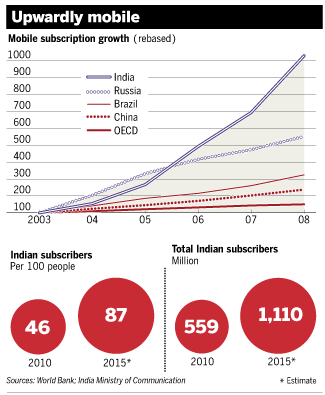
Everybody is just squeaking by in this suddenly fiercely competitive environment, including giant Bharti Airtel. But nobody can ignore the potential: 20m new subscribers per month and a total market expected to reach--get this!--1.1BILLION! by 2015.

Key difference with China:  India welcomes foreign ownership.

The big problem:  paucity of bandwidth, so spotty coverage and service bedevils the industry.  "Incumbent operators claim the situation has been worsened by the government’s decision to sell spectrum cheaply to newcomers and not auction it to the highest bidder."

More scope:

For India, this mobile phone expansion has significance beyond the immediate telecoms industry. It has been touted as the biggest – some say only – spectacular infrastructure success yet, a beacon of what can be achieved in a country that needs to build $1,000bn worth of roads, power plants, ports and airports over the next five years if it is to realise its dream of being a leading global economic power.

The telecoms revolution has also become one of the country’s primary drivers of development. Millions of urban poor and farmers, from Calcutta rickshaw pullers to Himalayan yak herders, now carry mobile phones. The improved communications enables them to do more business and gives them better access to services, such as healthcare. Every 10 percentage point increase in mobile penetration produces 0.81 per cent economic growth, according to a 2009 World Bank study.

“It’s an infrastructure rollout of a magnitude that has not been seen in the global economy for a long time,” says one former senior industry executive. He says the biggest operators in India in the past 12 months have installed as much network as Germany did in the past 15 years. “It’s something that vastly exceeds the rolling out of electricity, or the rolling out of highways in the 1950s in the United States.”

The great obstacle, as usual, are the rules:

But the regulatory system that gave rise to this expansion now finds itself accused of trying to kill the goose that laid the golden egg. Analysts accuse the government of implementing a series of policy switches in the past two-and-a-half years that have led to an influx of new entrants and a scarcity of spectrum – the precious airwaves on which mobile calls are transmitted. In the communications technology era, spectrum is the new black gold, in short supply all over the world but particularly in India, where the defence ministry still controls many frequencies.

The level of international criticism of India’s telecoms policy regime is worrying for a government that prides itself on its ability to court foreign investors at high-profile gatherings such as the World Economic Forum in Davos. One investment research company referred New Delhi’s recent policy actions as “regulatory basketcasery”. In a note on Vodafone, Bernstein Research said: “If you were looking for emerging market exposure to mobile growth, India was probably not a great choice.” The country, it added, “is a competitive mess, and its regulation grows more capricious and nonsensical by the day”.

Such charges are vehemently denied by regulators . . .

Yet no one can dispute that the sector is overcrowded. Some argue that its problems date back to January 2008, when the government sold eight new mobile service licences bundled with spectrum at 2001 prices on a first-come, first-served basis rather than through a bidding process. This sale is now being investigated for allegations of “serious irregularities” ...

The awarding of so many licences ushered in an era of competition even more intense than that witnessed by Mr Sarin. Many of the newcomers sold large stakes to cash-rich foreign operators . . .

As the new entrants and their international partners began operating, a vicious price war set in. Call prices declined rapidly. Telenor’s local unit, Uninor, recently announced a plan that offers calls for as little as Rs0.20 per minute.

Consumers have welcomed the price war but it has had a catastrophic effect on revenue in the industry. Among large operators, average monthly revenue per user as of March 31 fell up to 37.9 per cent compared with a year earlier, according to Macquarie Securities.

Even as the price war bit into profits, the government launched its long-delayed auction of spectrum for third generation mobile services, which allow subscribers access to the internet on their phones. The auction process was lauded as fair and open but some operators complained that the fact that there were only three pan-India allocations on offer to 15 operators drove up prices artificially. The cost of an allocation soared to more than $3.6bn – about 75 per cent more than the highest analyst estimates before the sale ...

Leading operators such as Vodafone and Bharti balked at paying the full cost of a pan-India allocation, and instead ended up with a patchwork of networks in the more important regions. Even in the areas they did win, the allocation was not enough to offer a meaningful increase in the advanced data services typical of 3G, such as internet television and video-conferencing.

“Operators have paid a huge amount of money ostensibly for 3G purposes but in reality this will be used to fill the gaps on 2G networks,” said Rahul Matthan of Trilegal, an Indian law firm.

For India, this could be a blow. The country’s internet penetration, which the most optimistic estimates put at about 70m users, is one of the lowest among the world’s fast-growing emerging markets.

Given the difficulty of building ground-based infrastructure because of high population density, efficient implementation of 3G might have offered India the chance to leapfrog into the internet age. For the government, short-term gains from the sale of resources such as spectrum have to be balanced against the need to create incentives for investment in communications. World Bank calculations show that increasing broadband penetration generates economic growth to an even greater extent than mobile penetration.

Many experts argue that consolidation is the only long-term solution. Existing rules seriously curb mergers and acquisitions. 

Tumultuous boom-and-bust days of network/biz empire-building.  Fascinating to watch and impossible for all these companies not to engage.

Remember the pot of gold that lies at the end of this rainbow: the ability to process all the biz intell that flows through these mobiles.

Excellent piece.  Serious education.  I can't ever see a future where I'm not subscribing to FT.

12:06AM

The Rooseveltian phase in China

Guardian story by way of WPR's Media Roundup.

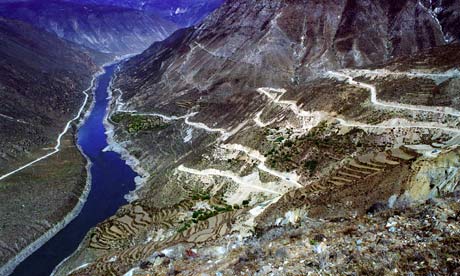
Makes me think of TR's initial stuff and then the huge infrastructure push with FDR, this Hoover Dam-like monstrosity planned for Tibet--the biggest dam in human history (38 gigawatt).  Will save tons of CO2, but will likewise change the environmental landscape big time.

But China feels compelled to network and integrate its western provinces--its great inland bridge to the larger energy and mineral resources in Central  and Southwest Asia.

And frankly, tightening the grip makes sense politically, whereas landlocked states do not.

The key for China:  making all this integration seem like a connectivity bonanza that allows economic development, networking toward the richer and better connected coasts, but also allows for increasing political self-rule--less unitary and more federal.  

That's the only way you make economic development work over such a large terrain.

Almost 30 dams are currently planned or being built along this crucial Tibetan river (Bahmaputra).


12:05AM

Iran's oil production decline: oh mighty sanctions!

FT front-pager, but the facts underwhelm.  When Ahmadinejad became president in 2005, Iran was producing 4.2mbd (million barrels per day).  Now it's down to 3.8 or 3.9, which definitely costs them billions, but as a percentage drop, we're talking only 10% max.  Frankly, I would expect that level of drop anyway because of Iran's wariness on using foreign technology in the first place--a bad habit of NOCs (national oil companies) everywhere. I wonder what PEMEX's drop in production has been the last five years in Mexico.  Subtract PEMEX's percentage drop from Iran's and you might get a clearer sense of the delta caused by the sanctions.

Iran's bigger is also much like Mexico's or Saudi Arabia's:  the domestic use of oil is growing faster than the production, narrowing the margin for export.  The effect of sanctions, I would imagine, pales in comparison, even as it exacerbates the situation.

But back to Bremmer's good point in his book:  state capitalism prioritizes the state over economic efficiency, so this is simply viewed as  the cost of doing politics.

12:04AM

Long-term unemployment in America: the new nasty twist

Scary piece by Clive Crook in the FT noting how the long-term unemployed share of total unemployment is unusually high by historical standards--almost 5m out for 6 months or longer.  They account for something like half the unemployed right now, also something not seen in decades.

Americans have always lost their jobs more frequently than their European counterparts, but we've also tended to find new ones faster while the Euro govs tend to offer better retraining and cushier benefits.

It would seem we enter a new period, hence the need for some new rules on how to handle it.

12:03AM

The sweet potato silver-bullet?

WSJ story on how researchers are trying to achieve a more industry-friendly sweet potato.  Unlike its rather uniform cousin, the russet potato, sweet potatoes come in irregular shapes and with irregular sugar content. There's been a push for years to get a single major fast-food chain to pick up sweet potato fries as a healthier alternative--a goal I first ran into at the Clinton presidential library/graduate school years back (a regional ag improvement scheme that struck me as worthy).  The trick is not getting the fries industry to change its machinery so much as getting the sweet potato sector to change the shape and consistency of its product so that the fries industry can process them with the same speed and sustainability as russet potatoes.

Right now there is some sweet potato fries production, using regular potato machinery, and ConAgra is set to open this fall in Louisiana (coincidentally not far from Little Rock) what it claims will be the first dedicated processing plant generating fries, waffles and other products.

Sweet potatoes are not actually potatoes, but the roots of a plant.  The goal of researchers at places like ConAgra is to modify the vegetable to the point where it consistently grows out into a brick-like shape with more uniform color/sugar content.  One line of breeding already seems close to the goal, suggesting a mass production capacity down the road (optimistic is 3-5 years, pessimistic is 7-10).

12:02AM

China: looking to take next step toward global brands

Usual excellent stuff from WAPO's John Pomfret.

The lead:

Quick: Think of a Chinese brand name.

Japan has Sony. Mexico has Corona. Germany has BMW. South Korea? Samsung.

And China has . . . ?

If you're stumped, you're not alone. And for China, that is an enormous problem.

Last year, China overtook Germany to become the world's largest exporter, and this year it could surpass Japan as the world's No. 2 economy. But as China gains international heft, its lack of global brands threatens its dream of becoming a superpower.

No big marquee brands means China is stuck doing the global grunt work in factory cities while designers and engineers overseas reap the profits. Much of Apple's iPhone, for example, is made in China. But if a high-end version costs $750, China is lucky to hold on to $25. For a pair of Nikes, it's four pennies on the dollar.

"We've lost a bucketload of money to foreigners because they have brands and we don't," complained Fan Chunyong, the secretary general of the China Industrial Overseas Development and Planning Association. "Our clothes are Italian, French, German, so the profits are all leaving China. . . . We need to create brands, and fast."

The problem is exacerbated by China's lack of successful innovation and its reliance on stitching and welding together products that are imagined, invented and designed by others. A failure to innovate means China is trapped paying enormous amounts in patent royalties and licensing fees to foreigners who are.

China's government has responded in typically lavish fashion, launching a multibillion-dollar effort to create brands, encourage innovation and protect its market from foreign domination.

Through tax breaks and subsidies, China has embraced what it calls "a going-out strategy," backing firms seeking to buy foreign businesses, snap up natural resources or expand their footprint overseas.

Domestically, it has launched the "indigenous innovation" program to encourage its companies to manufacture high-tech goods by forcing foreign firms to hand over their trade secrets and patents if they want to sell their products there.

Since 2007, thousands of Chinese businessmen have attended government-sponsored seminars on "going out," learning everything from how to do battle with domineering Americans and Britons during conference calls to why a Chinese boss should think twice about publicly humiliating his wayward foreign workers -- as he'd do to his staff at home.

China has also moved to re-brand China itself. Late last year, when memories of China's poisoned pet food and deadly milk were still fresh, the Ministry of Commerce contracted with the global advertising giant DDB for a $300,000 ad showing a series of high-tech products, from top-of-the-line running shoes to an iPod.

As a guitar wails, a voice intones: "When it says 'Made in China,' what it really means is made in China, made with the world."

This is always the tough stretch that I think about when people start predicting China's inevitable domination of the global economy.  Brands a lot more complex that most prognosticators imagine.  I mean, just look at BP all of a sudden--from "beyond petroleum" to beyond pathetic.  You can hire ad agencies to hawk your stuff, but that's just surface sheen.  The real brand loyalty comes in the ability to offer compelling innovation, excellent services, and the like.  That sort of capacity can't be ordered from above; it has to be nurtured from below.  A bunch of guys sitting around a table in Beijing won't be able to pick winners consistently, and in their failures, legitimacy will be lost, grumbling will ensue, and that much more resources will be wasted on policing people and their dangerous thoughts instead of winning hearts and minds and brand loyalists through modeled behavior.  Single-party states simply aren't cool, and they will never will be.

More excellent analysis:

In recent months, the Western media have hyperventilated with stories about China's going-out strategy and about Chinese firms buying up the globe -- Oil! Gas! Cars! -- and even investing in the United States. In 2000, China had $28 billion in overseas investments; this year, it could break $200 billion.

But a little perspective: Even if China's total foreign direct investment hits $200 billion, it still pales in comparison to smaller economies, such as Singapore's, Russia's and Brazil's. And China has plunked down only about $17 billion in rich countries, equivalent to the overseas assets of a single medium-ranked Fortune 500 company.

The 34 Chinese companies on the Fortune 500 list basically operate in China only. The world's three biggest banks are Chinese, but none is among the world's top 50, ranked by the extent of their geographical spread.

"Moving forward another 10 years," said Kenneth J. DeWoskin, chairman of Deloitte's China Research and Insight Center, "it's hard to see how viable Chinese companies will be if they just stay in China."

China's attempts to fight what it sees as the stranglehold of foreign patents and intellectual property rights have also had hiccups.

China is estimated to have paid foreign firms more than $100 billion in royalties to use mobile telephone technology developed in the West, according to executives of Western communications companies.

So in the late 1990s, it decided to develop its own. But after more than $30 billion in development costs, its unique technology still has fewer than 20 million users in a market of more than 500 million.

Handset makers have told China's government that they won't produce phones equipped with the new technology unless they are given subsidies. And China has resorted to giving away the technology to Romania and South Korea to encourage broader use.

"China is still stuck," said Joerg Wuttke, former president of the European Union Chamber of Commerce in China and a 25-year veteran of doing business in China. "There is a huge disconnect between the money spent in universities and the lack of products."

China also faces enormous challenges to creating globalized firms. Studies of Chinese executives show that they spend far more time with government officials -- who in China are the key to their profits -- than with customers, who are the key to international success.

"Chinese executives like me need to spend a generation outside China to learn how business is done around the world," said Hua Dongyi, who chairs a massive Chinese mining company in Australia but has also built roads in Algeria and infrastructure in Sudan.

Remember that line:  Chinese execs spend far more time with their party bosses than focusing on customers.

In a nutshell, there's the Achilles heel of state capitalism.

And that's not a problem you can fix by throwing more $$$ at it.

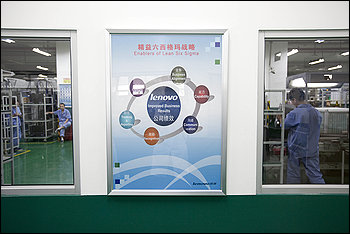
Rest of the story is about how Lenovo's purchase of IBM computer production was a rare success.

As always, Pomfret captures reality in China--absent hype--better than anybody else.

12:01AM

Chart of the day: cranking DNA ever more cheaply

Per all the recent stuff on Venter's breakthrough, a chart from The Economist. More DNA synthesis productivity over time, with the cost declining.  Add in the fact that it used to take tremendous lengths of time to catalogue a species but now it happens in days instead of years, costing thousands instead of millions, and you got a ton of breakthrough developments coming down the pike.

12:10AM

Conservatives embrace "new" idea of SysAdmin's responsibility for "expeditionary economics"!

From the panel reports from a conference jointly put on by the Kaufman Foundation (focus on free enterprise) and the Command and General Staff College Foundation (Leavenworth), via John Richardson at Esquire's The Politics Blog (to whom the ideas here are radical and "new").

First, Richardson quoting from the conference and/or report or just feeling like he should italicize:

Too often, in both the military and the international development spheres, there has been a failure to consider the postwar economy is any strategic sense. Military doctrine has usually treated operations other than war as secondary matters to be handed off to other agencies. These agencies, USAID in particular, have rarely conceived of their work as part of  a larger strategy for the country in question or for promoting U.S. interests. One-off projects and bureaucratic delays — due in no part to congressional constraints on USAID - have created the impression that dependence and subsistence are the inevitable future for countries such as Afghanistan. Economic growth is rarely even considered a posible goal ... yet economic growth plainly is a positive force in society and for governments; it is no coincidence that most conflicts today, most of which are civil wars, occur in countries with weak or stagnant economies.

Dare we say, "disconnected" from the global economy?

From the future panel report:

Most people agree that the concept of “expeditionary economics” needs to play a greater role and be incorporated into doctrine in future stabilization and reconstruction efforts in post-conflict countries. The questions are “How do we get there?” and “Who should do it?” Answers to these questions vary. While there is a general consensus that the United States is not adequately nurturing economic development in places where security and engagement requires it and that we are not adequately stimulating the entrepreneurial dynamism that has produced global economic prosperity, there is audible disagreement over whether these responsibilities should fall to the military.


Key Takeaways:

• In an ideal world, economic development in post-conflict situations lies within the purview of civilian organizations such as the World Bank, IMF, USAID, and Department of State. Unfortunately, for a variety of reasons, these institutions often lack the requisite resources and capacity for post-conflict economic development. As a result, responsibility for the economic dimension has fallen to the armed forces; yet, the military also lacks a guiding doctrine for such work. For future operations, we must develop doctrine for both the military and civilians, as well as consider new ways of implementing expeditionary economics.

• The primary objective of a stability operation is different than that of a development imperative. When you build a water plant, the secondary objective is to bring clean water to people in the town. The primary objective is the psychological change that reduces violence as a result of building the plant. But if we are not measuring for and evaluating the right things, we can’t determine if the $50 billion that’s been spent in Iraq could have been better spent. We’re scratching our heads because we haven’t won over hearts and minds, and we don’t know why. We need to find better ways to measure the psychological impact of stability operations and, more specifically, economic development efforts.

• When assessing the economy of a country in which we might engage, we can’t fall into the pattern of merely looking at the absences. We must pay attention to the assets that do exist—natural, physical, and human assets that can anchor future economic growth. Moreover, our view must be a regional one as opposed to just local or national. In considering how to stabilize failed states, we need to consider what is the right balance between the state, the market, and civil society 

• When considering who needs to lead to economic development in failed states, the tendency is to look to the State Department and USAID. But the Overseas Private Investment Corporation and the Export-Import Bank of the United States also should play a major role in investing in and underwriting risk.

• The U.S. preference is to separate political, economic, and military concerns when dealing with states abroad. An imperial approach is well understood, and less complicated than our democratic approach. However, it’s more difficult when the objective is to leave once enduring conditions are set so we don’t have to intervene again. Rather than continuing our tendency to view things in a two- to three-year thought cycle, we need a longer-term approach.

• In war, just as there are human casualties, there also are financial casualties, and we need to accept this reality. Some dollars will be misappropriated, and some will go to the enemy, to criminal networks, to ineffective local leaders, and to bad projects. This doesn’t make it okay, but we need a productive dialogue to determine what is a reasonable level of these financial casualties.

• The Foreign Assistance Act of 1961 defined foreign aid as a State Department function because it was a tool of public diplomacy geared toward poverty alleviation and moral good. But the problem with public diplomacy as an imperative is there’s a need to take credit and ensure people know about it. In Iraq and Afghanistan, however, we’ve learned this can generate ill will and be counterproductive. We need to sacrifice public diplomacy to be more effective at counterinsurgency and long-lasting and effective development.

• One proposal is to create a FEMA-like agency with a very modest staff, 100-150 people, that would spring into work when there’s a stability operation. The office would report jointly to the Secretary of Defense and Secretary of State and would have a limited, circumscribed role. It would coordinate with the chief of mission on the ambassador side and the commander general on the military side.

• It’s important to concentrate planning efforts before a crisis arises. If you are not engaged in long-term strategy and planning, you will not get it right.

• How does the military put expeditionary economics into practice? Meeting the economic needs of the populace in an area of operations is an essential task in stability operations, and the best way to do that is with business formation. An example: If a neighborhood lacks dependable electricity, a commander could provide generators to local entrepreneurs, and give them the ability and responsibility to keep them running. This eliminates the insurgent’s ability to generate public support by attacking municipal power grids and then blaming the government or occupational forces; any attack on the power supply thus becomes an attack on individual families and locally owned businesses.

• It is essential to tie the concept of expeditionary economics to the military security mission. How can the military foster economic growth to establish security? The military needs competence with expeditionary economics tools to get through the “golden hour”—the early days of a conflict when the civilian agencies have minimal or no presence, and it’s up to the military to execute.

• Some disagree that economics is not a soldier’s job. Yet, economics is required to win, and a soldier’s job is to win. The military has no choice but to use economics as a weapon in stability operations, so let’s be as good as possible at it. What we need to be thinking is, “What are the appropriate economic principles we can teach military leaders so they can use them to accomplish their mission?”

• The military lacks a doctrine to use economic development in conjunction with other elements of a counterinsurgency effort—information, security, and stability operations. The easiest way to change doctrine is by Department of Defense or commander’s mandate, but there are other requirements: A new doctrine must be proven workable and should demonstrate added value, longevity for application, and it must foster those traits the military sees as important.

• One area of debate is over the constraints on the use of Commander’s Emergency Response Program (CERP) Funds. Those on the ground maintain that a ten-day approval process makes CERP less useful—commanders need to make investments on the spot or at worst within twenty-four hours. This assumes commanders have a high level of ability and economic literacy that sometimes isn’t there because it’s such a complicated task that requires complete attention.

• Economic development and stability is also an intelligence problem. Almost no attention is given to economic intelligence analysis. Threat Finance Cells are for threat targeting—a different function—but if you don’t understand the economies and then intervene, you are not going to be successful.

• USAID and the State Department staff are not properly trained—there is poor investment in level- and role-specific training and education, and senior leaders could be selected for their qualifications in economic development and entrepreneurship.

A call for a Department of Everything Else-like entity that reports to both SECDEF and SECSTATE and somehow bridges the "expeditionary economics" responsibilities that bind them in failed-state or postwar interventions.  

Plus, an almost exact description of Enterra's diagnostic approach in Kurdish Iraq (a focus on critical assets, creating entrepreneurial opportunities and counterparty capacity locally for deal-execution), right down to the regional focus we used in bringing in the Monitor Group to do a competitive assessment. This is Development-in-a-Box in a nutshell.  That's why I penned the self-promoting (for Enterra) section on DiB in "Great Powers."

In short, none of this is new, and much was proven our or templated in the field by Steve DeAngelis.

The SysAdmin's economic responsibilities; the need for a Department of Everything Else that focuses on the postwar reconstruction; the market-based diagnostic focus of Development-in-a-Box, which lives on in Enterra's collaboration with Pacific Command's Center for Excellence in Disaster Management and Humanitarian Assistance--all good stuff.

At first the ideas are ridiculed, then violently opposed, then accepted as conventional wisdom.

Patience and perserverance are the keys, and a willingness to be told to your face--for years on end--that your ideas are bullshit, naive, and completely impracticable--never gonna happen!

Because these are not theories but inevitabilities.  There are only questions of who and when.

There is no credit sought because there is no credit to be assigned.  Everybody comes around to these realities eventually, and until enough do, it's just vision without a budget--otherwise known as an hallucination.

But yes, there is a useful role for consistent hallucinators.

12:09AM

The SysAdmin's civilian-soldier ratio climbs

WAPO story on Army's deputy assistant secretary for procurement, Edward Harrington.

The government's contracting out for services is nothing new, as Harrington's office notes. Its "Contractors on the Battlefield" chart outlines the number of contractors compared with the number of soldiers since the American Revolution. Back then, the ratio of contractors to soldiers was 1:6. World War I, 1:20. Vietnam, 1:6. Gulf War, 1:60. Iraq, 1:1. Afghanistan, 2:1.

An evolution toward SysAdmin operations that has created a rule-set gap:

These days, Harrington points out, the job is tougher because the government's workforce to write, manage and oversee the contractors has shrunk dramatically. The office estimates that as the workload has increased 1,000 percent since 1987, the government's contracting workforce has decreased by 25 percent.

It's why I believe it inevitable that a new bureaucratic center of gravity is created between Defense and State--the Department for Everything Else notion.

It's a serious requirement that's yet to be treated seriously in a bureaucratic revamp.