Buy Tom's Books
  • Great Powers: America and the World After Bush
    Great Powers: America and the World After Bush
    by Thomas P.M. Barnett
  • Blueprint for Action: A Future Worth Creating
    Blueprint for Action: A Future Worth Creating
    by Thomas P.M. Barnett
  • The Pentagon's New Map: War and Peace in the Twenty-first Century
    The Pentagon's New Map: War and Peace in the Twenty-first Century
    by Thomas P.M. Barnett
  • Romanian and East German Policies in the Third World: Comparing the Strategies of Ceausescu and Honecker
    Romanian and East German Policies in the Third World: Comparing the Strategies of Ceausescu and Honecker
    by Thomas P.M. Barnett
  • The Emily Updates (Vol. 1): One Year in the Life of the Girl Who Lived (The Emily Updates (Vols. 1-5))
    The Emily Updates (Vol. 1): One Year in the Life of the Girl Who Lived (The Emily Updates (Vols. 1-5))
    by Vonne M. Meussling-Barnett, Thomas P.M. Barnett
  • The Emily Updates (Vol. 2): One Year in the Life of the Girl Who Lived (The Emily Updates (Vols. 1-5))
    The Emily Updates (Vol. 2): One Year in the Life of the Girl Who Lived (The Emily Updates (Vols. 1-5))
    by Thomas P.M. Barnett, Vonne M. Meussling-Barnett
  • The Emily Updates (Vol. 3): One Year in the Life of the Girl Who Lived (The Emily Updates (Vols. 1-5))
    The Emily Updates (Vol. 3): One Year in the Life of the Girl Who Lived (The Emily Updates (Vols. 1-5))
    by Thomas P.M. Barnett, Vonne M. Meussling-Barnett
  • The Emily Updates (Vol. 4): One Year in the Life of the Girl Who Lived (The Emily Updates (Vols. 1-5))
    The Emily Updates (Vol. 4): One Year in the Life of the Girl Who Lived (The Emily Updates (Vols. 1-5))
    by Thomas P.M. Barnett, Vonne M. Meussling-Barnett
  • The Emily Updates (Vol. 5): One Year in the Life of the Girl Who Lived (The Emily Updates (Vols. 1-5))
    The Emily Updates (Vol. 5): One Year in the Life of the Girl Who Lived (The Emily Updates (Vols. 1-5))
    by Vonne M. Meussling-Barnett, Thomas P.M. Barnett, Emily V. Barnett
Search the Site
Powered by Squarespace
Monthly Archives
12:08AM

Arizona: The right experiment to run

USA Today front-pager.

Best thing about America is that we’ve got 50 simultaneous experiments in government going on, with people able to vote with their votes, their feet, their checking accounts, etc.

Arizona wants to change the paradigm on enforcement of legal alien laws, and in doing so, they’ll definitely scare off a lot of Latinos, in addition to taking various degrees of heat.

But it’s a good experiment to run, because if it works, and AZ likes it that way, the ideas will spread.  And if it doesn’t or costs too much, then AZ will be made to pay in various ways.

But at least the state is trying, however imperfectly, and that’s how it’s supposed to work.

But yes, I’d love to have more than 50 experiments running, including some all-Mexican ones. Time to open up this HOA, because this gate community thing ain’t working.


12:07AM

China, the true heavyweight

artwork here

Bloomberg BusinessWeek snapshot article.

The most immediately visual evidence of China’s one-child policy is the chubby male kid tended to by multiple adults (those two parents and six grandparents) as he waddles down the street. 

When I was in China for the first time (our adoption trip), I almost felt like I was part of some magical character parade in a Miyazaki film (you know, those floating fat spirit characters from “Spirited Away”) because, compared to the Chinese, we Americans were huge.   Most of the guys weighed over 250lbs and most of the women were over 150.  The disparity was stunning.

Until you spotted that overweight “little emperor” be tended to so gently by the doting grandparents.  Thirty percent of Chinese adults are now overweight, and their numbers lean toward the younger ones—the initial products of the one-child policy going back to the early 1980s.  Just six years ago the share was 25%.  The share will keep rising:  40% of Beijing boys are overweight.

In America, roughly 2/3rds of adults are considered overweight.

The story starts with a suitable poster child:  26-yeard-old Shanghai man, 5-9 and 220 lbs.  He remembers being “plied with dumplings, ice cream, and Kentucky Fried Chicken by his parents and grandparents.”  Now he fears an early heart attack.

This is a tricky issue in a country that has as many uninsured people as we’ve got people (300m), thus the gov is spending $125 to get everyone covered by 2020.  Type 2 diabetes numbers now approach 100m and are sure to rocket far higher.

Bottom line:  anybody who does healthcare, weight control, and fitness has a future in China—a very BEEEG future!

12:06AM

The equally important superpower

WSJ article.

Former finance chief says Japan’s relationship with the US is key, which is code for, “I won’t break my predecessor’s basing deal.”

But then he’s quick to add that China is “equally important.”

When Japan tells you that, understand that’s as good as the world telling you that.

What that tells you is that there is no such thing as “hedging” against China’s rise anymore—except in a purely internal sense.  We can gear up all we want, say, militarily, and we’ll certainly find friends in that process, but there will be no political nor economic equivalent, and that means bluster without bulk.

Obama & Co. seem to have made that adjustment mentally, which sure beats anybody unable to make that adjustment.  But that understanding is just the beginning of the new relationship, and that’s where I sense there’s no there there with this crew.  And I’m beginning to believe that, given everything on their plate right now, this is the best we can expect.

That would say one-term to me, except I cannot, for the life of me, imagine right now who the Republicans would successfully mount from amidst their Tea Party-infused base, which, quite frankly, strikes me as mostly angry without answers.

But maybe that’s my stagnant disposable income talking . . ..

12:05AM

Sharing the painโ€”politically

pic here

Bloomberg BusinessWeek piece that makes the compelling point that income growth—or the lack thereof—is the best predictor of change in looming elections.  On a longer-term scale, this is Benjamin Friedman’s argument in his book, “The Moral Consequences of Economic Growth”:  rising income makes a happy polity and a happy polity tends to beget a generous legislature (i.e., more Dem).

The bad news for Obama:  disposable income has remained stagnant since Jan 09, so the underlying sense of his administration for most people is, no progress in their lives but rather treading water at best. 

I would argue the same thing could be said in foreign policy:  balls kept juggled all right, but no obvious sense of progress.

So you get the same effect in both realms:  people’s sense of anxiety is no longer rising, but it’s not falling either.

One might call it a malaise.

For the record, average per capita disposable income today is roughly what it was in mid-2007 ($32,600), with a drop-spike-drop-spike-drop-inching up pattern since then.

12:04AM

Pollution in China: the recovery trumps the reduction

pic here

WSJ piece by always good Shai Oster.

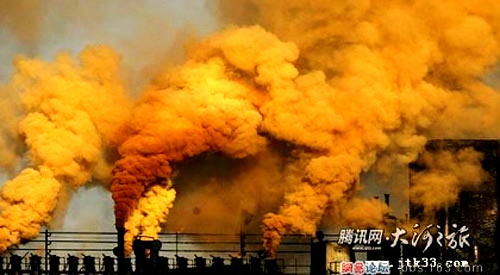
Despite tougher government measures, pollution in China rebounds right along with the economy. There had been hopes that China turned a corner last year when emissions dropped, but thank the financial crisis for that.

Still, only the first quarterly rise in SOx emissions since 2007, so some props in order.

No surprise here:  reductions took a back seat to recovery.

Remember all the Great-Depression-leading-to-World-War-III nonsense in the BS-osphere?

Well, it was worth it.

12:03AM

Slowly grind the gears at Basel

WSJ front-page headline, though now a week old. 

But the nice thing about this rule-set reset is that it drags on with all the urgency usually mounted by bankers when it comes to unpleasant change.  So it’s hard to fall behind the curve much.

The gist: large multinational banks will be forced to raise “vast sums to cushion any future losses.”

The give:  the new rules won’t go into effect for a bit.

The “race” as it is called:  to hammer out the new rules by year’s end.

The two main players are the G-20, whose financial ministers met this week in Seoul, and the usual Basel Committee on Banking Supervision.

In many ways, the new rules will simply update the old Basel package initially set up in the late 1980s.

Perhaps it will be known as Basel III (a previous revamp years ago was dubbed Basel II).  I guess these are becoming like GATT-cum-WTO trade rounds.

Always tricky stuff to negotiate, so naturally drawn out.

12:02AM

You cool the market--you cool it too good!

WSJ article by Andrew Batson—a favorite.

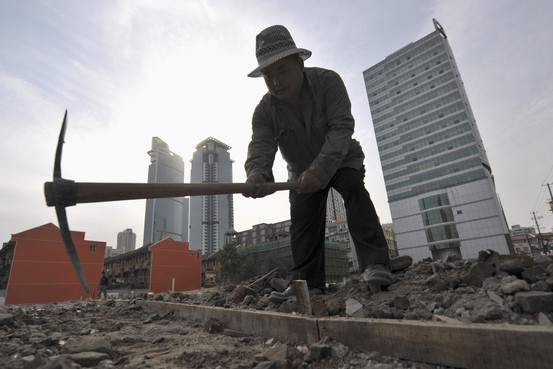
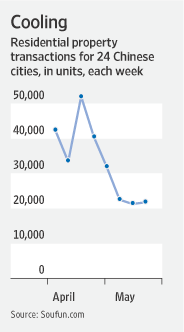
China’s government has spent a lot of effort pouring cold water on the red-hot real estate market, and it has apparently succeeded.

Now experts cite a “period of paralysis that some industry executives say will last for months, weighing on global growth prospects already battered by Europe’s turmoil.”

Hmm.  Be careful what you wish for, I guess.

The rebound in real estate was considered a prime driver of China’s successful recovery from the global financial freeze.

Still, something had to give with China’s unreal growth this year.  People are describing a 20% haircut in prices—stretched out over months.

Not so bad.

12:01AM

Chart of the day: the Koreas trade

Pretty clear picture of the lift-off separation achieved by South Korea vis-a-vis its northern cellmate since Cold War's end.

  • NorKo per cap income flat (and even that's probably a complete statistical lie);
  • SouKor per cap increases around five-fold; and thus,
  • NorKo's income as a % of SouKo's basically collapses.
The NorKo powerbrokers (mostly the military) will want to keep their loot. ย So be it. ย But they'll also need an out eventually when the public senses just how ephemeral the Kim dynasty is once the little nut passes, and that's where the bargain is struck--hopefully by a sensible Beijing that decides to limit its losses to just money--and the accompanying global moral outrage once the many sins of the Kim clan invariably come to light.

12:10AM

The IED killer we've been waiting on?

USA Today article with very good news:  “The military has developed technology that uses a high-tech beam to detonate hidden IEDs . . ..”

The only downside: it seems to operate on a wide space, revealing the bombs in the process and—under the right conditions—puts locals in danger IF they’re not forewarned about such countering operations (you know, a blaring voice in the local language announcing that in the next five minutes, everybody should stay clear of roads).

US Marine Corps general James Mattis says, “This is an offensive capability that will change the face of this war.”

I wouldn’t call it “offensive” but resiliently defensive—in effect, we tell the enemy, “All your long and hard and stealthy work gets negated by the flip of our switch, meaning you kill nobody in the process.”

But the “offensive” part comes in the beam’ ability to trigger IEDs while insurgents/terrorists are potentially carrying them or even when they’re under construction.

Mattis advocates putting the technology on aircraft (presumably drones too) and having them sweep areas proactively.

Naturally, the Pentagon announces the capability while providing no details, as countering tactics will invariably ensue.  To what effect?  We shall see.

But this is indeed good news and a development that bears close watching.

The Office of Naval Research is credited with the development.

12:09AM

Learning a thing--but not two--from Kazakhstan on banking

FT column.

Call-out text states it plainly enough:

Until recently it was generally assumed that when a bank ran into problems it would either be bailed out or go spectacularly bust.

Well, unlikely Kazakhstan provides a better example:  getting the creditors to suffer the pain. They absorb all or most of the losses, keeping the bank a going concern.

Says Tett, “In America, there is every chance that the future financial reform bill will contain some features that would impose creditor losses in the future.”

The big question?  Is this discipline imposed by a central 3rd party or the courts.

Investment groups hate the notion, but Tett calls it the least bad option.

How democratic.

Meanwhile, she laments the alternative that Europe seems to be pursuing:  “a system based on ever tighter bank rules and implicit taxpayer bail-outs.”

12:08AM

More Russian outreach on modernization

FT article.

Russia co-producing strategic airlift with the US, buying naval surface combatants from France, trading cheap fuel for basing rights in Ukraine, and now building ships with South Korea out in Vladivostok.

Quite the rising challenger, huh?

Russia’s state-owned shipbuilder teaming up with South Korea’s King-Kong shipbuilder Daewoo—a modernizing alliance all right.

12:07AM

China: the labor revolution has begun

pic here

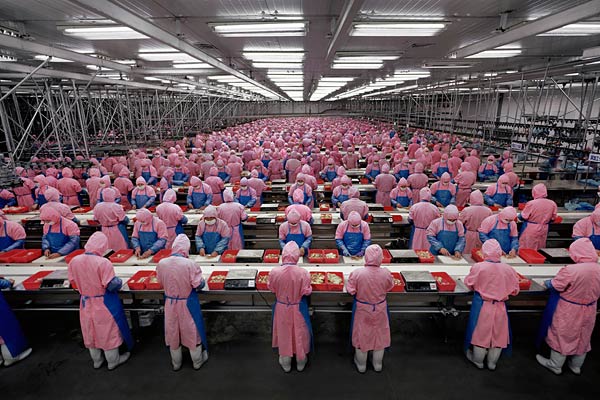
FT article and editorial on the recent spate of Western companies giving into local Chinese labor demands for higher wages.  The FT says “Chinese workers are now in revolt”!

Believe it or not, but these are the next-best set of problems for both China and the global economy.

As the FT editorial argues: “Higher wages are a goal of successful development.”

These wage hikes are just the beginning; the Chinese labor force is starting to understand its own power in this ongoing struggle.  The FT editorial says:

The remarkably low share of wages and salaries in GDP makes China the most “capitalist” large economy in history.

What will Chinese and Western firms do?  They will be forced to move ever inland—a self-limiting prospect in terms of profit (longer overland transpo costs), and yet, this is the best possible trend for China itself—the harmonization of development coastal-versus-inland.

Then there’s the larger reality that the numbers of youth entering the workforce will slowly decline over the long-term, raising their bargaining power ever more.

Doesn’t mean China declines rapidly as a manufacturing power.  It just means this playing field evens out progressively over time.

All good stuff that shows how China pays the globalization “price” just as much or more than the world suffers the “China price.”

Nothing magical about China’s state capitalism; the same leveling market dynamics work their wonderful magic here as anywhere else.

12:06AM

"When we want cheap, we go for China"

pic here

Yet another FT on Africa.

From the explosion of mobile telephony to bulging profits of beer companies, evidence of expanding consumer markets in Africa abounds.

Nice.

Hear the African middle-class consumer speak:  “When we want cheap, we go for China.”  Estimates are that 90% of appliances in the major local retail shops are from China, because their prices are about 75% cheaper than the foreign competion and 50% cheaper than the local producers’ stuff.

12:05AM

There's gold in them thar mobiles!

ad found here

Another FT on Africa.

How mobiles fuel banking in infrastructure-hostile environments in Africa:  Better to pay over the phone than carry the cash or waste time going to branches that do not exist.  All sorts of everyday transactions are suddenly greased to the point of actual convenience!

That growth in e-banking, in turn, fuels the ambition of local banks to expand services locally and expand the reach of their operations geographically—an incredibly virtuous trend generated primarily by sheer connectivity.

The key dynamic is the spread of banking services to the previously “underbanked.” The extension of short-term credit to individuals makes capitalism work—as in, I will gladly pay you by mobile for a hamburger today.

Credit to ODA (official developmental aid) where it is due:

Vodafone, the British telecoms company, with a local partner and the backing of Britain’s Department for International Development, launched one of the most celebrated mobile banking initiatives: M-Pesa of Kenya.

This is basically telecoms moving into banking.


12:04AM

What hath teleGod wrought?

Pic here

More FT on Africa as part of the World Cup focus.

The explosion of mobiles across Africa is described as the most important economic development of the last half century, revolutionizing lives and transforming society in ways all that official developmental aid never did. 

No surprise, all that rising individual-level connectivity coincides with dramatic growth in GDP and sweeping new public attitudes toward business.

Ah, but what did Barnett’s “connectivity” ever do for poor people?!?

Plenty, it turns out.

But doesn’t it just piss them off when they realize they can’t be rich like the West?

Apparently, not as much as it jazzes them to exploit new opportunities.

And we’re talking an Africa that’s still only in the 40-50% mobile penetration rate.  The continent as a whole is predicted to pass the 50% mark this year, with at least 8 nations bragging about a 100% penetration level!

Turns out the poor are not to poor for mobiles to be significantly empowering—and profitable—for everybody involved.

The FT piece:

Such success has revealed the continent’s entrepreneurial flair—when the dead hand of the state is lifted—and revived other sectors, particularly banking and consumer industries.

You know that bit about the Indian farmer choosing a mobile over an indoor toilet?  Well, a lot of Africans will pick the mobile over that much additional food.

Why?  Connectivity breeds opportunity.  Along with the mobile penetration, we see foreign direct investment balloon for both oil & gas nations and non-O&G economies.  Both groups attracted about a billion in 1989.  Both now attract in the range of $4B annually now.

12:03AM

Big Oil to BP: No, you're the problem!

Artwork here

FT piece.

BP, naturally, keeps selling the Deepwater Horizon disaster as indicative of industry-wide problems, while the rest of Big Oil says otherwise—also to no surprise.

Other firms want deep-water drilling to continue, stating that their practices are better.

What I found interesting about the chart showing where everybody is drilling in the Gulf:  Deepwater’s water depth is listed as 5200 feet, but of the 18 other rigs listed, 8 are equally deep or a lot deeper (in the 7-8,000 ft range).  Companies drilling at that deeper depth include Shell, Chevron, Anadarko and Noble.

Of the 33 rigs left idle by Obama’s ban, we’re talking costs of about $12m a day.

The industry plans to invest about $170B in deep-water drilling tech and gear between now and 2014, or something on the order of $30-35B a year.

Naturally, BP’s massive screw-up (less the original accident, I would wager, than the incredibly incompetent response since) will perturb the entire industry, because America’s new rules on the subject will have global impact.

12:02AM

Latinos leaning more Democratic

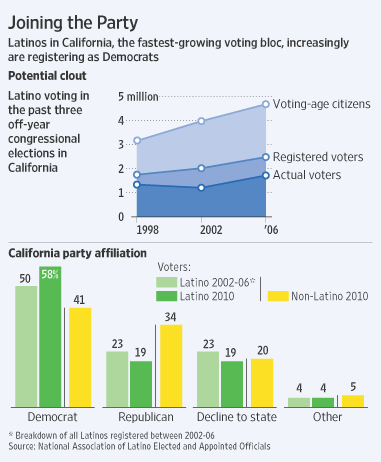
WSJ story saying that Hispanics who registered to vote since the last midterm are significantly less likely to vote GOP than those who registered 4 years earlier.

The fastest-growing bloc of voters in the country is trending Dem.

GOP affiliation fell from a bit from 23% to 19%, while the Dem share rose from 50% to 58%.  Fewer independents.

The driver is no mystery: anti-immigrant fervor is more identified with the GOP.

The good news for Dems is somewhat balanced by the new non-Latino voters, who favor the Dems over the GOP by a lesser margin (41% to 34%).

12:01AM

Chart of the day: How much aid is too much?

Click smaller one below to enlarge.

Experience says once a country gets above approximately 15% of the GDP in aid, they're in trouble (it's a diversionary effect that also allows the government to care less what its public thinks).

This slide shows net aid as a percentage of government expenditures, where the percentages are naturally going to stand far higher.

What stands out:  

1) the single-digit crowd of North Africa and the southern cone (Morocco, Algeria, Tunisia, Libya, Egypt, South Africa) and the outlier of Equatorial Guinea; and 

2) the 100-plus-% crowd of Guinea-Bissau, Sierra Leone, Liberia, C.A.R., Congo, Mozambique, Malawi, Rwanda, Ethiopia and Uganda (98%).

12:10AM

The Politics Blog: 5 Things You Didn't Know About the Next Al Qaeda

Two Jersey boys by the names of Carlos Eduardo Almonte and Mohamed Mahmood Alessa were arrested over the weekend at JFK Airport as they sought to begin their jihadist pilgrimage to Somalia via Cairo. Before getting on the plane, they had dutifully lifted weights, played paintball, and — unfortunately for them — unwittingly bragged to the Feds about their dreams of killing Americans. Their training was to be completed by al Shabaab, the infamous hardcore "youth" militia that owns south-central Somalia. Because al Shabaab made our State Department's terrorist organization list in 2008, these lost boys face enough "conspiring to..." terror charges to land them in jail for the rest of their lives.

Setting aside your natural fears that America is suddenly crawling with any number of Islamic sleepers, here's five things you should know about al Shabaab.

Read the full post at Esquire.com's The Politics Blog.

NOTE:  Got this assignment Monday morning as I flew out to Baltimore.  Vonne pushed cites to me, and I wrote it on my laptop while sitting alongside the Pentagon on a beautiful sunny day.  Sent it off that night and it went up yesterday morning, while my travels continued.

12:09AM

The "retreat" from assimilation isn't all that it's splintered up to be

WSJ story.

Recent study suggests that Hispanics are less often marrying non-Hispanic whites, hence the fear of lessening assimilation.

The trend of past decades for both Hispanics and Asians immigrants was that successive generations married outside their race in ever higher percentages.  So are we seeing a reversal!

Clearly, social taboos on interracial marriage have faded dramatically over my lifetime (almost 5 decades), but here’s the trick with the last two decades seeing a serious upsurge in Asian and Hispanic immigrants:  now there’s a lot more of them available in the marriage pool, so, what was assimilation in the past due to limited choice, is now lessened. 

As a “retreat from intermarriage” goes, this one is fairly defensible and hardly anything to get worked up about.  I mean, Hispanic women now marry outside the pool in the range of 15-20% (2000s) versus 20-25% (1990s).

The benefits seem clear enough for the individuals in question: 

The massive influx of new immigrants from Latin America and Asia has not only fueled the opportunity to marry one’s co-ethnics, but also revitalized ancestral and cultural identity.

So says a researcher.

Meanwhile, we’re told that the rate of Asian women marrying white men “stagnated” at 40% between 1980 and 2008.  Oh my!

Long-term, though, experts expect plenty of inter-marrying.  Why? Workplaces are far more integrated than in the past.

Still, plenty of anti-immigrant feeling post-9/11 and with the hard economic times, so the current “retreat,” such as it is, underwhelms me.