Buy Tom's Books
  • Great Powers: America and the World After Bush
    Great Powers: America and the World After Bush
    by Thomas P.M. Barnett
  • Blueprint for Action: A Future Worth Creating
    Blueprint for Action: A Future Worth Creating
    by Thomas P.M. Barnett
  • The Pentagon's New Map: War and Peace in the Twenty-first Century
    The Pentagon's New Map: War and Peace in the Twenty-first Century
    by Thomas P.M. Barnett
  • Romanian and East German Policies in the Third World: Comparing the Strategies of Ceausescu and Honecker
    Romanian and East German Policies in the Third World: Comparing the Strategies of Ceausescu and Honecker
    by Thomas P.M. Barnett
  • The Emily Updates (Vol. 1): One Year in the Life of the Girl Who Lived (The Emily Updates (Vols. 1-5))
    The Emily Updates (Vol. 1): One Year in the Life of the Girl Who Lived (The Emily Updates (Vols. 1-5))
    by Vonne M. Meussling-Barnett, Thomas P.M. Barnett
  • The Emily Updates (Vol. 2): One Year in the Life of the Girl Who Lived (The Emily Updates (Vols. 1-5))
    The Emily Updates (Vol. 2): One Year in the Life of the Girl Who Lived (The Emily Updates (Vols. 1-5))
    by Thomas P.M. Barnett, Vonne M. Meussling-Barnett
  • The Emily Updates (Vol. 3): One Year in the Life of the Girl Who Lived (The Emily Updates (Vols. 1-5))
    The Emily Updates (Vol. 3): One Year in the Life of the Girl Who Lived (The Emily Updates (Vols. 1-5))
    by Thomas P.M. Barnett, Vonne M. Meussling-Barnett
  • The Emily Updates (Vol. 4): One Year in the Life of the Girl Who Lived (The Emily Updates (Vols. 1-5))
    The Emily Updates (Vol. 4): One Year in the Life of the Girl Who Lived (The Emily Updates (Vols. 1-5))
    by Thomas P.M. Barnett, Vonne M. Meussling-Barnett
  • The Emily Updates (Vol. 5): One Year in the Life of the Girl Who Lived (The Emily Updates (Vols. 1-5))
    The Emily Updates (Vol. 5): One Year in the Life of the Girl Who Lived (The Emily Updates (Vols. 1-5))
    by Vonne M. Meussling-Barnett, Thomas P.M. Barnett, Emily V. Barnett
Search the Site
Powered by Squarespace
Monthly Archives
12:07AM

Balkans: the remapping isn't done?

Economist piece.

The US and EU want no redrawing of borders between Serbia and Kosovo, and no diplos on either side makes the case publicly yet.

And yet, expectations are rising that a slice of Serb-heavy northern Kosovo will get handed over in the ongoing custody battle.  Why?  Something like half of Kosovo's Serbs are found there.

The EU warns Serbia that it's jeopardizing its admission application, and yet, nobody wants a new Cyprus.

Very familiar dynamic: small population tied to neighbor is trapped inside border; that nation's government can't really extend its writ there; so the upshot is continued unrest and non-resolution, because the would-be-breakaway region can neither break away or come under stabilizing rule.

Custody decisions get revised all the time.  This one should too.

12:06AM

The Chinese take a page from my Irish ancestors

WAPO story.

The gist:

The Chinese government has begun ramping up research, production and training related to the humble spud, and hopes are high that it could help alleviate poverty and serve as a bulwark against famine.

The challenge of feeding a growing nation on a shrinking supply of arable land while confronting severe water shortages has long been a major concern here. China has to feed one-fifth of the world's population on one-tenth of its arable land, and the nation's expanding cities are consuming farmland at breakneck speed. China estimates that by 2030, when its population is expected to level off at roughly 1.5 billion, it will need to produce an additional 100 million tons of food each year.

That statistical reality could change eating habits here. Potatoes need less water to grow than rice or wheat, and they yield far more calories per acre. 

Makes you wonder why the Irish got so heavy into potatoes, because there's no shortage of water there.  Must be the tough growing season.

But the pattern is clear enough:  cut back on water-intensive crops and move into more hardier fare (rice to potatoes).  Obviously, rice isn't going anywhere, but as one Chinese ag expert put it, "Rice, wheat, corn -- we've gone about as far as we can go with them. But not the potato."

Some perspective on this shift:  China actually ALREADY produces and consumes more potatoes than any other in the world. But when it comes to consumption, because we're talking such a huge population, the Chinese lag in per capita terms, eating only one-third the amount of potatoes that Russians do and two-thirds the amount Americans eat.

If I could get every Chinese to eat a potato a day . . ..

12:05AM

SOCOM turned loose by Obama administration

WAPO story by DeYoung and Jaffe.

Key point:

Beneath its commitment to soft-spoken diplomacy and beyond the combat zones of Afghanistan and Iraq, the Obama administration has significantly expanded a largely secret U.S. war against al-Qaeda and other radical groups, according to senior military and administration officials.

Special Operations forces have grown both in number and budget, and are deployed in 75 countries, compared with about 60 at the beginning of last year. In addition to units that have spent years in the Philippines and Colombia, teams are operating in Yemen and elsewhere in the Middle East, Africa and Central Asia.

Commanders are developing plans for increasing the use of such forces in Somalia, where a Special Operations raid last year killed the alleged head of al-Qaeda in East Africa. Plans exist for preemptive or retaliatory strikes in numerous places around the world, meant to be put into action when a plot has been identified, or after an attack linked to a specific group.

The surge in Special Operations deployments, along with intensified CIA drone attacks in western Pakistan, is the other side of the national security doctrine of global engagement and domestic values President Obama released last week.

One advantage of using "secret" forces for such missions is that they rarely discuss their operations in public. For a Democratic president such as Obama, who is criticized from either side of the political spectrum for too much or too little aggression, the unacknowledged CIA drone attacks in Pakistan, along with unilateral U.S. raids in Somalia and joint operations in Yemen, provide politically useful tools.

Obama, one senior military official said, has allowed "things that the previous administration did not."

'More access'

Special Operations commanders have also become a far more regular presence at the White House than they were under George W. Bush's administration, when most briefings on potential future operations were run through the Pentagon chain of command and were conducted by the defense secretary or the chairman of the Joint Chiefs of Staff.

"We have a lot more access," a second military official said. "They are talking publicly much less but they are acting more. They are willing to get aggressive much more quickly."

So the soft-on-terror bit doesn't hold with Obama.

I approve of this message:  I see no reason why my trigger-pullers should not stay trigger-happy.  They are good at what they do, and I prefer to take the fight to its sources.

Doesn't obviate the nation-building realities of the international security landscape, where we definitely need to swap out Old Core allies for New, but it demonstrates our commitment to waging the Long War on its own terms.

So a solid course from this White House that earns my respect.

12:04AM

Gates getting even tougher--and more realistic--on the budget

NYT piece by Thom Shanker.

Gates turns the budgetary screws a bit tighter:

Defense Secretary Robert M. Gates has ordered the military and the Pentagon’s civilian bureaucracy to find tens of billions of dollars in annual savings to pay for war-fighting operations, senior officials said Thursday.

His goal is $7 billion in spending cuts and efficiencies for 2012, growing to $37 billion annually by 2016.

Every modern defense secretary has declared war on Pentagon waste and redundancy. And there have been notable, but relatively narrow successes, in closing and consolidating military bases or in canceling a handful of weapons systems.

But if Mr. Gates’s sweeping plan is fully enacted, none of the armed services or Pentagon civilian agencies and directorates would be immune from the pain of annual cost-cutting, which would become institutionalized across the Defense Department.

The spending guidelines were delivered orally to senior military officers and civilian officials before Mr. Gates’s departure this week for an Asian security conference in Singapore, and the official signed guidance will be issued over coming days.

The goal is to force all of the Defense Department agencies and organizations, and all of the armed services, to save enough money in their management, personnel policies and logistics to guarantee 3 percent real growth each year, beyond inflation, in the accounts that pay for combat operations.

Current budget plans project growth of only 1 percent in the Pentagon budget, after inflation, over the next five years.

“Given the nation’s fiscal situation, there is an urgency to doing this, rather than shifting more of the nation’s resources toward national defense,” William J. Lynn III, the deputy defense secretary, said in an interview.

Mr. Gates’s spending orders offer a considerable incentive to the armed services. Each dollar in spending cuts found by a military department would be reinvested in the combat force of that branch, and not siphoned away for other purposes.

The last bit is the smartest.  The services always fear that answering the call on budget discipline is a zero-sum game.

A grim reminder that contingency operations are not good for the defense establishment's bottom line--at least once the splurge mentality is curbed.

12:03AM

A sense of just how risk averse the Chinese single-party state is

NYT story on China's first astronaut orbital space flight back in 

The point:

As the nation held its collective breath, China’s first astronaut, Yang Liwei, floated back to the motherland, having orbited Earth 14 times in the Shenzhou 5, or Divine Capsule.

It was October 2003, and the national broadcaster CCTV carried live coverage of the momentous event, from Mr. Yang’s famous pleasantries uttered in space — “I feel good” — to the instant that workers opened the capsule door to reveal the pale but smiling face of a hero, offering irrefutable evidence that China’s maiden manned space voyage had gone off without a hitch.

Or had it?

In a lecture he gave to a group of journalism students last month, a top official at Xinhua, the state news agency, said that the mission was not so picture-perfect. The official, Xia Lin, described how a design flaw had exposed the astronaut to excessive G-force pressure during re-entry, splitting his lip and drenching his face in blood. Startled but undaunted by Mr. Yang’s appearance, the workers quickly mopped up the blood, strapped him back in his seat and shut the door. Then, with the cameras rolling, the cabin door swung open again, revealing an unblemished moment of triumph for all the world to see.

The content of Mr. Xia’s speech, transcribed and posted online by someone who attended the May 15 lecture at Tianjin Foreign Studies University, has become something of a sensation in recent days, providing the Chinese a rare insight into how their news is stage-managed for mass consumption.

Titled “Understanding Journalistic Protocols for Covering Breaking News,” the speech was intended to help budding journalists understand Xinhua’s dual mission: to give Chinese leaders a fast and accurate picture of current events and to deftly manipulate that picture for the public to ensure social harmony, and by extension, the Communist Party’s hold on power.

My point:  China's ruling party is beyond conservative.  They cannot afford defeats or losses or embarrassments or anything that suggests loss of control.

So long as China remains a one-party state, it cannot be a serious global leader.  To lead is to risk failure, and the CCP has no taste for that.  The bums cannot be thrown out, so they cannot risk anything truly significant.

12:02AM

First rule of commitment: if you have to say it, it ain't there

Wash Times piece by way of WPR's Media Roundup.

The gist:

The Obama administration is deeply committed to its relationship with India despite concerns to the contrary, a senior State Department official said on Tuesday.

William J. Burns, under secretary of state for political affairs, tackled a prevalent belief in India that the Obama administration is less committed to a relationship with India than his predecessor, George W. Bush.

Mr. Burns, who previously served in the Bush administration, said there was bipartisan commitment in Washington to the U.S.-India relationship.

My, what a vessel and what a message.  You just know it has to be true.

12:01AM

Chart of the day: Oil spills in historical perspective

To me, just some fascinating perspective.  The difference this time is the depth of release, as the graphic notes.

Sorry for the scan.  Just could not find it online at Newsweek for some reason.

12:10AM

Two recent mentions overseas: China (People's Daily) and Italy (Il Tempo) 

Two recent overseas pieces reference the blog and the vision.  The first is an op-ed in the English-language version of the People's Daily Online, the Chinese Communist Party's mainline publication.  The authors provide this dual biography:

John Milligan-Whyte is called the "new Edgar Snow" and the "21st century Kissinger" and is the only non-Chinese to be elected the winner of the Social Responsibility Award from the China Business Leaders Summit. John Milligan-Whyte and Dai Min are the executive producers and co-hosts of the Collaboration of Civilizations television series adapted by the eight books they wrote in the America-China Partnership Book Series published in English and Mandarin in 2009-2010 that created the "New School of America-China Relations." They founded the America-China Partnership Foundation and Forum in 2008 and the Center for America-China Partnershipin 2005, which was recognized in 2009 as "the first American think tank to combine and integrate American and Chinese perspectives providing a complete answer for America and China's success in the 21st century."

 I am rightfully accused of being a peace-monger on China in a column titled, "Thomas Barnett recommends US never go to war with China."  Tripping through the piece:

Peaceful coexistence has today become both all that the US can afford militarily and economically and essential for US economic and national security. The Iran and North Korea crises are becoming impossible for the US to defuse without long over due new US policies towards China. The limitations of American military and economic power are unfortunately dangerously self-evident. The US military is already over extended and bogged down in two long wars. The US financial, economic, unemployment and government solvency crises are relentlessly entering even more dangerous stages. It is easy for the US to start or be forced into new wars that are impossible for anyone to win given the potential speed and economic impact of major wars. The world has changed. Conventional American policies and policymakers' mindsets must change faster than they can. 

Fortunately, President Obama recognizes the need for and is now urgently searching for unconventional policies capable of bring the US back from the brink of economic collapse and unbearable humiliation or catastrophic wars with Iran and North Korea that can overnight engulf the Middle East, Asia and the world in economic, social and political collapse . . . 

What is China to do? New American policies towards China are essential for the US and China to be able to solve the America's economic and the North Korea, Iran and other national security crises. Conventional American policies exacerbate rather than solve these crises for the reasons explained by the Center for America China Partnership's books and articles and now fortunately by Thomas P.M. Barnett. 

On June 2, 2010 Thomas Barnett stated that China: "can now legitimately claim to be working on behalf of the global economic security as much or more than America. In short, it can claim that 'what is good for China is good for the world,' an argument to which only America could lay serious claim in past decades. This is why we're never going to war with China; codendency on globalization is profound." 

US News & World Reports describes Thomas Barnett as "one of the leading strategic thinkers of our time." Barnett has seen and understood the world from his roles of senior advisor to the US Secretary of Defense, Chief of Staff, Central Command, Special Operations, and led the five-year NewRulesSet.Project for the U.S. military. He is the author of two books that have been profoundly influential: The Pentagon's New Map: War and Peace in the 21st Century and Blueprint for Action: A Future Worth Creating. Barnett's comments were posted on his website,http://www.thomaspmbarnett.com/globlogization/tag/china, in response to an article in the Financial Times on May 24, 2010, http://www.ft.com/cms/s/0/de337ab6-66ca-11df-aeb1-00144feab49a.html.

The Financial Times article titled "The way to increase America's exports to China" was published as the second round of the Strategic and Economic Dialogues began by Dr. Huo Jianguo, president of the Chinese Academy of International Trade and Economic Cooperation, a subsidiary of China's Ministry of Commerce, and John Milligan-Whyte, chairman of the Center for America China Partnership. Barnett quoted five paragraphs from the article stating that they are a "nice summary of China's thinking regarding our bilateral economic relationship" and "an excellent and hard-to-refute summary argument" . . . 

Thomas Barnett has an extraordinarily American reputation and track record of successfully prompting American policymakers to realize that profound changes in US military strategic thinking are required. Today the US's conventional economic and national security policies have not provided either economic or national security although the US economy is by far the largest in the world and US military spending is over half of all nations . . . 

Then we get some Paul Kennedy--not exactly my favorite take.

Then this interesting twist:

Chinese policymakers have understood for thirty years, as Thomas Barnett stated this week, that America and China must never go to war. President Obama implementing that advice requires healthy changes America's whole relationship with China. China's military spending is 12 percent of the US, although its population is 500 percent larger. China has been at peace with all nations since 1979 and had the fastest growing economy in the world because it's policymakers adopted Deng Xiaoping's policies of opening up to foreign investment and peaceful coexistence with America and all other nations. America must now reciprocate Deng Xiaoping's policies. President Obama must become America's Deng Xiaoping.

For 60 years there has been a fundamental core problem in US-China relations that only President Obama can and needs to change now: US policymakers and policies have not accepted the legitimacy of the Chinese government. Chinese policymakers were optimistic when President Obama was elected with the promise and mandate for change at a time of profound American economic and national security crises. It has been 60 years since the birth of modern China and resulting outbreak of the Korean War, which never formally ended as the sinking of a South Korean naval vessel reminded us. The views of Thomas Barnett quoted above support an unconventional perspective for American policymaking: that America should accept peaceful coexistence with the 22 percent of mankind and the legitimacy and success of their indigenous government. It has been very successful in managing sustained economic growth, social and political stability, peaceful foreign and defense policies, and reform and opening up to American investment .  .  .

The cool twist was the reverse imaging on Deng-Obama.  The second para oversells the lack of legitimacy argument, but I suppose that's a backhanded reference on Taiwan, because that's where the text goes next.

A bit down the road:

American policymakers wonder what has changed, since they are merely continuing conventional US policies of selling arms to Taiwan irrespective of China's national security needs? Everything has changed. American policymakers do not understand sufficiently that the US's relationship with China has abruptly and prematurely forever entered a new 21st century era when the US Federal Reserve Chairman Bernanke and Treasury Secretary Paulson told the world that the US financial system and economy would collapse without immediate government bail out of insolvent American banks and insurance companies. Now America is itself, like many nations, insolvent. What has changed is what Paul Kennedy feared would happen in The Rise and Fall of Great Nations published in 1987. Hopefully, President Obama will agree with Thomas Barnett's recommendations . . . 

A bit of Chinese hubris, I might argue.

Better bit, which I argue with wholly:

The third question is does President Obama believe that many existing American policies towards China undermine America's economic and national security? The White Paper cites as an example, that US policy is to prevent Chinese oil companies from buying American oil companies, prevent China from interfering with America's sources of oil and acquiring oil from nations America disapproves of such as Iran. This approach seeks to be win-win only for America and is not realistic. America and China, the two largest economies, consume more oil than they produce. Many US policymakers today believe that this makes war between the two nations inevitable. 

It means exactly the opposite. The two nations that consume 42 percent of the world's oil must be both economic and military allies, aligning their economic and national security in a new era of peaceful coexistence, or neither will have the oil they require. It benefits no nation for oil to vary in price from 47 to 147 US dollars a barrel. Collaborating America and China could stabilize the price of oil at a price of 65 to 70 US dollars a barrel benefiting all nations and militarily and economically ensure the peace that is essential for steady oil production and transportation globally. The US and China entering a new era of really collaboration, because they both recognized they will never go to war, would change the Iran and other issues profoundly.

In a style typical for People's Daily, a certain listing of grievances packs the piece, which ends with a near-term reference to the slighting of Gates.

In summary, Chinese policymakers refusing the US Defense Secretary's request to visit China signals President Obama personally that conventional American policymaking will not be effective in the Iran and North Korea crises. It signals President Obama personally that Chinese policymakers need the US to accept the legitimacy and success and reciprocate the peaceful coexistence policies of China's indigenous government, and to reciprocate and open up to Chinese companies investing, and thus creating US and Chinese economic and employment growth. That breakthrough is what is essential to make the world governable.

Overall, pretty interesting to watch a fellow peace-monger work the argument from the other side, clearly operating within certain sensitivities (e.g., all pertinent grievances must be aired--very Chinese).  To my knowledge, this guy is the only American I've ever heard of--maybe even the only foreigner--ever to have a foreign affairs column at the People's Daily, so he's certainly in a fascinating category--whatever it is.  Upon sending him an email, he sent me back a long reply that catalogues all the content he's running through their system as a one-man content empire, so once I get his most recent tome, I'll either review it here or at WPR, because it's all certainly indicative of something worth commenting on.

Anyway, something to remember:  Christianity is all about sin, so it's all about repentance equating to salvation. Confucianism deals with the problem of disorder, so the solution is all about harmony leading to social order. In other words, the old justice-versus-order conundrum.  There is a middle ground upon which the two sides can meet, but we have to have to understand how differently the Chinese view the world and its dangers.  We will accept a lot of disorder in the name of justice; they will not.  Somewhere between lies globalization's path for a long time to come.

Second reference comes in Il Tempo.

Piece about PM Berlusconi and his foreign policy ambitions in Africa, with a special notion of taming Gaddafi.

My left-over Romanian is such that I can just about understand the reference to the libro PNM.

Non a caso la Cina sta investendo miliardi di dollari in Africa e gli Stati Uniti hanno deciso di rilanciare la loro politica di cooperazione e sviluppo nell'area. Il continente dimenticato, in un mondo che si fa sempre più stretto e affollato, diventerà molto presto la scacchiera dove le grandi potenze si contenderanno il primato. In fondo la storia anche in questo caso ama ripetersi. Fu così anche nell'epoca coloniale, quando gli imperi decisero di allargare i loro confini. Fu una delle tappe della globalizzazione. Gli effetti sono quelli di una società connessa che ha le sue aree di crisi e di guerra dove è disconnessa. Quest'ultimo è un concetto sviluppato da un pensatore strategico di nome Thomas P.M. Barnett che in un libro intitolato «La nuova mappa del Pentagono» spiega come siano le società disconnesse (dalle relazioni internazionali, dall'economia, dalla rete) a creare focolai di crisi pericolosi per la stabilità mondiale. Pensateci bene, per lungo tempo anche la Libia è stato un Paese disconnesso, fuori dal network internazionale, isolato e, purtroppo, terrorista.

The piece seems to argue that Berlusconi is pursuing a strategy of heightened connectivity with North Africa. How very Roman.

12:09AM

Arms spending is up! Among the rich and rising great powers--quelle surprise!

I'm too sexy for my hurt

A Guardian story by way of WPR's Media Roundup.

SIPRI, the arms-spending-tracking think tank out of Stockholm, says global defense spending is up almost 50% over the past decade, so a more dangerous world right?

Except when you examine the details, it's all so underwhelming.

Global defense spending peaked in the late 1980s and then dropped dramatically over the 1990s, picking back up around the turn of the century and eventually equally the late 1980s total in the latter years of the last decade. That means we spent two decades getting back to the late Cold War total. 

How did we do this as a planet?  Well, the bulk of that additional spending was by the U.S. (more than half). The rest was almost all by rising powers like India, China, Turkey, etc.--nothing out of the historical norm there.

So you look at the top spenders and unless you can sustain the fantasy of America taking on its banker (China), this is simply a cash of the rich getting richer.

Meanwhile, the 65-year moratorium on great-power non-war holds as steady as ever, despite our collective navigation of the worst financial crisis in modern globalization's history.  State-on-state war remains historically low, and our primary problems remain terrorists and civil strife.

SIPRI's report admits as much:

Only six of the biggest armed conflicts last year concerned territority, with 11 fought over the nature and makeup of a national government, according to Sipri's report. It said that only three of the 30 big conflicts over the past decade were between states.

My, what a dangerous world.  Rich, largely uninvolved rising great powers are bulking up their militaries, while rich-but-aging Western powers are spending precious coin on COIN.  All that tells me is that we need to get the free-riders to pay for their ride.

12:08AM

Brezhnevian Iran: obsessing with the surface

WAPO piece that highlights an uptick in "morality police" activity.  

Gist:

Iranian authorities have begun police patrols in the capital to arrest women wearing clothes deemed improper. The campaign against loose-fitting veils and other signs of modernism comes as government opponents are calling for rallies to mark the anniversary of the disputed presidential election, and critics of the crackdown say it is stoking feelings of discontent.

But hard-liners say that improper veiling is a "security issue" and that "loose morality" threatens the core of the Islamic republic.

This is so pathetically transparent that it would laughable absent all the other nasty stuff that Tehran's ruling militarized government does to serious dissidents.  But it gives you the same sense I had as a budding Sovietologist when I lived a summer in Leningrad in 1985. The government made this huge effort to maintain the appearance of control over a fairly sophisticated population whose hearts and minds it has lost long ago (maintaining the loyalty really only among the isolated rural folk who knew no better), but the compromise was clear: you pretend to obey in public and we pretend to rule over all.  The more obsessed you see the government become with appearances, the less control it really has.  It's all just the Potemkin village effort that everybody, on both sides of the power equation, engages in.

I know a lot of people see Iran's reach for nukes as a grand culmination of a threat, but I view more as the last gasp of a failed revolutionary movement.  Yes, just like the Brezhnev crowd, the Revolutionary Guard crew harbor all manner of beyond-border ambitions. That's just part of the fantasy.

12:07AM

Asian integration: an appreciation


Very solid piece in World Politics Review by an American U. (DC) prof, Amitav Acharya, who's clearly spent a good chunk of his career building up this expertise.

I trip through the piece as so:

To begin, it might help to quickly summarize some of the most familiar criticisms of Asian regional institutions (while noting that I find some to be more accurate than others). The first is that they have not played a role in the major and longstanding regional conflicts, especially those that are holdovers from the Cold War period, such as the PRC-Taiwan conflict, or those between North and South Korea, and India and Pakistan. Neither have they mattered in the management of maritime territorial disputes, such as the Spratly Islands dispute involving China, Taiwan, Vietnam, Malaysia, Philippines, and Brunei. Similarly, territorial disputes between China and Japan over the Senkaku/Daoyutai islands, or between Korea and Japan over Takeshima/Tokdo islands, have not been addressed by any of the regional groupings.

A second criticism relates to their failure to make use of available instruments of conflict-prevention and resolution . . . 

Third, the failure of regional trust-building, which is supposed to have been brought about by regional groups like the ASEAN or ARF, is reflected in the emergence of what seems to be a significant arms race across the region . . . 

Fourth, on the economic front, there has been no regional free-trade area under the auspices of APEC, which was created partly with that objective in mind. Instead, bilateral trade arrangements have flourished . . . 

Fifth, while the region is regularly visited by natural calamities, there is no standing regional humanitarian and disaster assistance mechanism in place, despite periodic attempts to create one . . .

Finally, on human rights and social issues, Asia continues to lag behind other regions, including Africa and Latin America, not to mention Europe, in developing regional human rights promotion and protection mechanisms . . . 

Yet, skepticism about Asia's fledgling regionalism should not obscure its contributions to regional order. One major contribution has been the socialization of China. In the early 1990s, China was wary of regional multilateral cooperation. It viewed regional institutions like ARF or ASEAN as ways for the region's weaker states to "gang up" against Chinese interests and territorial rights. Yet, China significantly revised its view of Asian regionalism and has now become a key player driving it. 

Without engagement in this nascent regionalism, China would have had little option but to deal with its neighbors on a strictly bilateral basis, which would have given it far more leverage and coercive ability over its individual neighbors at a time of rapidly expanding national wealth and power. In that event, China's re-emergence as a great power might have been much rougher and more contentious. Many Chinese analysts agree that involvement in Asian regional institutions was a major learning experience for China with regards to wider international cooperation . . .

Skeptics may argue that the Chinese "charm offensive" that flowed in conjunction with its participation in regional multilateral institutions is little more than a "time-buying" tactic, until such time as China has built up its economic and military muscle to show its true aggressive colors . . .

But such skepticism can be challenged. Which country would totally eschew bilateralism in its foreign affairs? And which country, great power or not, would forsake aspirations to some sort of a leadership role in the international arena, at least over some key issue areas? And while China may have initially made some strategic calculations about its interest in regional participation, it is not immune to the logic of socialization and learning fostered through the habits of dialogue and continuous interaction. Chinese policymakers are aware of the costs of switching from a policy of engagement to a posture of confrontation . . .

Asian regional groups are not problem-solving or law-enforcing mechanisms, but norm-making and socializing agents. In this respect, they do conform to the general model of international organizations, which generally lack coercive enforcement power, but act as instruments of socialization and legitimation. 

Asian regionalism is often compared, mostly unfavorably, with the European variety. Yet, even the much-vaunted European Union is not without significant shortcomings. Compare, for example, the EU's approach to Russia with Asia's approach to China . . .

. . . the relationship between U.S. military presence and alliance structure in the region and the development of multilateral institutions in Asia is not a zero-sum situation. Indeed, in recent years, U.S. military assets in Asia and the Pacific have been increasingly used for addressing common regional challenges, such as natural disasters like the Indian Ocean Tsunami in 2004. U.S. military exercises, like Cobra Gold, have expanded beyond their original missions (in this case, of supporting Thailand) to include a range of other regional countries, serving as a platform for multilateral coordination. Multilateral cooperation featuring American forces and those of non-allied nations, such as Malaysia and Indonesia, has also been on the rise in efforts to ensure maritime security in vulnerable parts of Asia, such as the Straits of Malacca. The rationale for regional security institutions need not conflict with U.S. military alliances. Rather, the two can be mutually supportive. 

None of the above assertions would imply that Asian regionalism is in no need of reform and change. To be more meaningful and relevant, Asian institutions need to address four challenges.

The first is the challenge to overcome the 19th-century mindset of sovereignty and non-intervention . . .

Second, Asia needs to reconcile competing proposals for regional architecture that have cropped up . . . 

Third, Asian institutions need to move beyond the ASEAN Way of informal, strictly consensus-driven cooperation, to adopt greater institutionalization and legalization . . . 

Finally, Asian regional institutions should widen their focus to embrace transnational issues, and move beyond being forums for consultations and dialogue to become instruments for problem-solving . . .

To sum up, criticisms of Asian regionalism and regional institutions are not without merit. Yet, they do not warrant the view that investing in Asian regionalism is a waste of resources and time, or that the Asian institutions have not made positive contributions to regional stability and prosperity. Much depends on what sort of yardstick we use to judge their performance. In general, the benefits of regionalism and continued institution-building far outweigh its costs, and the region would be a more dangerous and uncertain place without them.

Very nice piece.

12:06AM

Word count on Obama's national security strategy

WPR piece by Miles E. Taylor that does the usual word count, but does it well.

First off:

More-astute observers have had a difficult time characterizing the strategy document, mainly because it is quite long compared to past national security policy declarations and, in many regards, appears similar to them in substance. But when you drill down into the text, word by word, it becomes clear that the NSS reveals a lot both in what it doesn't say on important subjects, as well as in what it does say on others.

Agreed.  Most such docs are gloriously collections of nouns and modifiers like "interests" and "vital."  This one has all the usual boilerplate in spades, to a mind-numbing degree really.  It has the lawyer's feel all over it.

Now for the what's up and what's down:  American values and democracy and terrorism and actual enemies are down, cyber and education and healthcare are up.

Predominate signal in my mind?  We are healing our nation.  The rest of you please go about your business.

Honest, I guess, but perhaps too much so.

12:05AM

The Obama mistake is choosing Pakistan over India

Reuters wire piece via Our Man in Kabul.

The gist:

The Obama administration is grappling with how to balance India's role in Afghanistan as arch-rival Pakistan also jostles for influence there ahead of Washington's planned troop withdrawal to start in mid-2011.

U.S. strategy in Afghanistan is set to be included on the agenda in U.S.-India talks this week in Washington -- with Delhi seeking clarity over rival Pakistan's role, particularly in reconciliation plans with the Taliban.

The Obama administration has so far sent mixed signals over the kind of role it wants India to play in Afghanistan, leaving an impression at times, say experts, that Pakistan's strategic interests could have more weight.

"I don't think this (U.S.) administration or the previous one knows how to balance our legitimate interests in both Pakistan and India effectively," said Christine Fair, assistant professor at Georgetown University and a South Asia expert.

While U.S. diplomats have praised the $1.3 billion India has pumped into reconstruction work in Afghanistan since 2001, military commanders have voiced concern that muscle-flexing by India could provoke Pakistan and stir up regional tensions.

"Increasing Indian influence in Afghanistan is likely to exacerbate regional tensions and encourage Pakistani countermeasures in Afghanistan or India," wrote U.S. General Stanley McChrystal, who is in charge of U.S. and NATO forces in Afghanistan, in a leaked assessment of the war last September.

The implication of McChrystal's view, said expert Lisa Curtis, was that India's approach was not viewed as helpful and Pakistan's strategic interests were more in play.

"That sent the wrong signal," said Curtis. "The U.S. should instead positively reinforce the political and economic activities of engagement by India (in Afghanistan)," added Curtis, who is with the Heritage Foundation.

"The idea that we would somehow ask India ... to draw back from Afghanistan to placate Pakistan which is still harboring Afghan Taliban leadership is very short-sighted and frankly makes no strategic sense," said Curtis.

Couldn't agree more with the Heritage Foundation:  our long-term bet has to be on India, because it will fuel globalization's advance and consolidation in South Asia--pure and simple.  You dance with them that brung ya.

Giving into Pakistan on the Taliban/Pashtun role in/control over Afghanistan is to buy yourself repeat visits. India represents a more dangerous path, no doubt, and a harder one.

But it's a permanent fix because it includes some solution on Kashmir.

We need India going forward.  Do not forget that under any circumstances.

12:04AM

Brazil targets Africa . . . with media!

Outgoing Brazilian president Lula da Silva announces that TV Brasil, a Portuguese-language network will target former Portuguese colonies in Africa (there are a bunch) via rebroadcast through Mozambique.  In all, 49 nations will be targeted (out of 55 on the continent or on neighboring islands).  

Lula presents this as a pure soft-power play:

I want a channel that speaks well of the country, that can show Brazil as it really is.

The biggest draws will be Brazilian soccer and soap operas, which already have a large following there. These two are big media draws in the Western hemisphere as well.

12:03AM

Greece learning from Turkey? Have pigs started flying?

Bloomberg BusinessWeek piece stating that when PM Recep Erdogan and the AKP took over Turkey in 2001, the "Turks were worse off than Greeks--and the IMF cure worked."

The logic?

Erdogan and Babacan [finance minister] used the IMF's tough regimen as an excuse for doing things that previous Turkish governments had avoided for decades.

A biggie?  The gov stepped up tax collection from under-reporters, something you just know is a huge problem in Greece.

Point being, the Turks could have defaulted then, just like Greece considers now.  But that would have been dealing only with the most painful symptom of the moment.

12:02AM

Canada takes its economic cues from China now?

Bloomberg BusinessWeek piece.

The "China club" of countries whose economies are increasingly driven by China's demand for raw materials are Australia, Brazil, Malaysia and Peru.  All have been forced to raise interest rates to tamp down hot growth caused by China.

Now experts expect Canada to join that club and raise rates instead of doing the usual, which is to follow our Fed's lead.  Canada feels forced to because of the growth created by China, India, Korea and other Asian economies' demand for minerals and energy and food.

Scary for some to think Canada no longer takes it cues from us, but great for anybody who wanted pillars of demand outside of the US consumer, because while that worked wonders for two decades following the fall of the Berlin Wall--fueling the rise of hundreds of millions of people out of poverty in Asia, now it's Asia's turn to help out.

So this is good, but new and therefore disturbing to many.

12:01AM

Chart of the day: Obama and the oil spill

From the Economist.

Approval/disapproval poll on Obama WRT the oil spill.

Does Obama really have much to do with that?  Not really, but the perceived passiveness has hurt.

About a quarter see no connection.

About 30% say he's doing a decent job.

About 45% say otherwise.

Maureen Dowd, quoted in the piece, sees this as part of a "pattern of passivity, detachment, acquiescence and compromise."

You get this sense of the defendant yelling at his counsel, "You're my lawyer, damn it, do something!" 

9:42AM

WPR's The New Rules: Obama's Strategic Patience

A lot of national security experts would like a lot more fire -- and firepower -- from our president. Op-ed columnists across America worry that our friends no longer trust us and that our enemies no longer fear us. President Barack Obama's quest for more-equitable burden-sharing among great powers seems to be getting us nowhere, so why bother with more-equitable benefit-sharing?
Read the column in full at World Politics Review.
12:39AM

Afghanistan's minerals deposits now super-sized by U.S. geologists

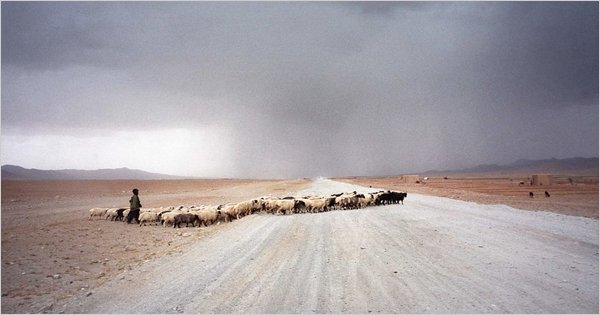
Beneath the sheep be lithium

NYT story via Michael Smith and David Damast and HuskerInLA.

I know the temptation for crowing here is intense, but I would suggest going very easy on the cascading assumptions.  There are a lot of reasons why this news has remained unknown this deep into globalization's expansion.

The "shocker" here is that U.S. geologists have confirmed what has been long suspected: Afghanistan's mineral riches are significant. Just like with Iraq, once outside experts got some free range, a lot more reserves were found.  Frankly, that'd be true for any Gap nation that's remained largely cut-off from the outside world for reasons of too much dictatorship or not enough law. Hell, it was true for Russia on oil.

This is being presented as a game-changer, but I think the overselling is premature.

First off, understand that the mining world doesn't exactly get turned upside down on this basis.  This is great news and potentially game-changing for Afghanistan if a lot of things go right--for a long time, but it will not alter any larger realities in the global marketplace (where China is the demand center of the global mining industry), except to end this nonsense notion that somehow Bolivia controls the bulk of the world's lithium (Whew! Dodged that would-be superpower!).  There is lithium being found in plenty of places, trust me.  The same discounting can now be applied to China's alleged cornering of the entire rare earth market--also a vastly oversold fear.

Mineral riches in the range of $1T certainly shove Afghanistan into the big-boy category (past estimates said Afghanistan was Syria-sized in oil and had just enough minerals to qualify as resource-cursed--a line I've used to very ho-hum effect in the brief for two years now, suggesting that no American audience I've ever come across would suddenly jump and say, "Yeah baby, this changes everything!") , but the primary reason why the place has never been sufficiently checked out before now has been the security situation/lack of governance, and that doesn't exactly change overnight on the basis of this information. Nor will it change--I suspect--the Obama administration's unwillingness to sign up for a significant combat presence that drags into the next election at anywhere near the level to maintain enough security to get balls seriously rolling.  "Blood for lithium" doesn't exactly ring the average American citizen's bell.  It also won't likely make the Taliban any less fierce in their fighting--anything but.  If you don't believe me, then please remember that the Naxalite Maoists in India do best in areas where mining deals strikes the local as inequitable.

Most importantly (and this is what Enterra learned in our Development-in-a-Box work in Kurdish Iraq), the discovery doesn't change but only reveals the lack of counterparty capacity in Afghanistan--as in, plenty of outside parties willing to engage in the transaction, but Afghanistan's government is nowhere near capable of playing the counterparty.  And yeah, it takes two to tango.  Remember the first thing Jed Clampett did after he moved to Beverly Hills:  he got himself a Mr. Drysdale.  There will be a lot of entities vying for that role in Afghanistan, and in many ways, it would be better if that role wasn't hogged by the Americans.

Finally, don't assume any of this is a big surprise to the Chinese, whose overly-generous 30-year deal on the Anyak copper mine now looks like the start of a beautiful and logically far larger relationship.  China, after all, has a border with Afghanistan (76 clicks long); we don't.  The basic pattern long cited here of Americans doing the Leviathan heavy-lifting while the Chinese reap the SysAdmin winnings isn't exactly snapped by this news--anything but.

So as before, I think the key remains getting a whole lot more rising great powers deeply--and I mean DEEPLY--interested in helping secure Afghanistan for the long haul.  Mining isn't a slam-dunk but years upon years upon years of stability required for the riches to flow, and then they have to flow with some transparency and positive popular impact, otherwise you can find yourself in an endemic conflict situation that's just Afghanistan-the-failed-state-as-we've-known-it now supercharged by a fungible source of funding for any side willing to kill enough to control its resulting wealth.

Before anybody gets the idea that somehow the West is the winner here, understand that we're not the big draw on most of these minerals--that would be Asia and China in particular.  What no one should expect is that the discovery suddenly makes it imperative that NATO do whatever it takes to stay and win and somehow control the mineral outcomes, because--again--that's now how it works in most Gap situations like Africa.  We can talk all we want about China not "dominating" the situation, but their demand will drive the process either directly or indirectly.  There is no one in the world of mining that's looking to make an enemy out of China over this, and one way or another, most of this stuff ends up going East--not West.

If anything, this news should be used to leverage more of a security contribution out of regional great powers--to include China.  So less of a game changer than perhaps a very welcome game accelerator--as in, China is a lot better positioned to reap the mineral rewards that is Afghanistan, with the question being, "How long does it take for China to step up security-wise and stop low-balling its effort there?"  Certainly, the notion that we turn Afghanistan and all its minerals over to Karzai's cronies, Pakistan's ISI and the Taliban strikes me as truly cracked, but the truth remains:  we and our Western allies aren't enough to make the security situation happen on our own--not for the long timelines required.  If it were that easy, these discoveries would have been made decades ago.

I'm not trying to diminish the importance of the findings here (although, again, whenever an isolated place like this finally gets checked over, the "stunning" surprise is the same--as in, there's lots more than anybody knew previously); I'm just saying the macro dynamics aren't all that altered.

So again, less a game-changer than potentially a tremendous game-accelerator.  China is now that much more incentivized to accelerate its penetration, and it would be nice to see that happen on a timetable that helps us while effectively drawing Beijing into more explicit partnership.

Or we can pretend this is going to remain a NATO-dominated show that somehow achieves Afghanistan's potential as a long-term supplier of important minerals to the global economy.

If I've said once in the brief, I've said it a thousand times (literally!):  Americans cannot integrate a nation-state on the other side of the planet into the global economy all on our own.  Our Leviathan can rule any battlespace, but the SysAdmin's victory is necessarily a multilateral one.

Here's the simplest reality test I can offer you:  if we're just at the initial discovery phase now, we're talking upwards of a decade before there will be mature mines.  Fast-forward a decade in your mind and try to imagine the US having a bigger presence in Afghanistan than China.  I myself cannot.

Start with that realization and move backward, because exploring any other pathway will likely expose you to a whole lotta hype.

12:08AM

McChrystal hinting at a more realistic timeline

AP story by way of Our Man in Kabul that reminds us that two timelines are out of synch:

The commander of NATO and U.S. forces stressed Sunday that progress toward real stability in Afghanistan will be slow as international troops painstakingly try to win over a population that includes its enemies and has little trust in the government.

The NATO push in Afghanistan has long been running on two timelines: one in which officials call for years of patience to establish peace in the war-wracked nation, and one in which President Barack Obama promises to begin drawing down troops in July 2011.

McChrystal hinting at the truth:  "Progress will be measured in months, rather than days."