Buy Tom's Books
  • Great Powers: America and the World After Bush
    Great Powers: America and the World After Bush
    by Thomas P.M. Barnett
  • Blueprint for Action: A Future Worth Creating
    Blueprint for Action: A Future Worth Creating
    by Thomas P.M. Barnett
  • The Pentagon's New Map: War and Peace in the Twenty-first Century
    The Pentagon's New Map: War and Peace in the Twenty-first Century
    by Thomas P.M. Barnett
  • Romanian and East German Policies in the Third World: Comparing the Strategies of Ceausescu and Honecker
    Romanian and East German Policies in the Third World: Comparing the Strategies of Ceausescu and Honecker
    by Thomas P.M. Barnett
  • The Emily Updates (Vol. 1): One Year in the Life of the Girl Who Lived (The Emily Updates (Vols. 1-5))
    The Emily Updates (Vol. 1): One Year in the Life of the Girl Who Lived (The Emily Updates (Vols. 1-5))
    by Vonne M. Meussling-Barnett, Thomas P.M. Barnett
  • The Emily Updates (Vol. 2): One Year in the Life of the Girl Who Lived (The Emily Updates (Vols. 1-5))
    The Emily Updates (Vol. 2): One Year in the Life of the Girl Who Lived (The Emily Updates (Vols. 1-5))
    by Thomas P.M. Barnett, Vonne M. Meussling-Barnett
  • The Emily Updates (Vol. 3): One Year in the Life of the Girl Who Lived (The Emily Updates (Vols. 1-5))
    The Emily Updates (Vol. 3): One Year in the Life of the Girl Who Lived (The Emily Updates (Vols. 1-5))
    by Thomas P.M. Barnett, Vonne M. Meussling-Barnett
  • The Emily Updates (Vol. 4): One Year in the Life of the Girl Who Lived (The Emily Updates (Vols. 1-5))
    The Emily Updates (Vol. 4): One Year in the Life of the Girl Who Lived (The Emily Updates (Vols. 1-5))
    by Thomas P.M. Barnett, Vonne M. Meussling-Barnett
  • The Emily Updates (Vol. 5): One Year in the Life of the Girl Who Lived (The Emily Updates (Vols. 1-5))
    The Emily Updates (Vol. 5): One Year in the Life of the Girl Who Lived (The Emily Updates (Vols. 1-5))
    by Vonne M. Meussling-Barnett, Thomas P.M. Barnett, Emily V. Barnett
Search the Site
Powered by Squarespace
Monthly Archives
12:02AM

Brief Reminder: A booming export market for the SysAdmin (1970s-1990s)

Old PNM-era slide (and pre-PNM, actually, so used probably 2001-2004) where I showed the rise in combined contingency response days for the four services.  For the 1970s, I exclude the obvious war in Vietnam (mega-contingency, I guess), then show how the rise in the 1980s was Mideast-centric, and then show how Iraq, Yugoslavia, Somalia and Haiti account for all the subsequent elevation in the 1990s.

Naturally, the 2000s then left the chart in terms of overall volume.

Point of the slide: showing the growing global market for SysAdmin-type operations.

12:01AM

Blast from my past: PNM's "New Rules for a New Crisis"

[NOTE:  As I slowly rebuild old pages from the old site, I will use this weekly feature for that purpose.]


Deleted Scene #22

Chapter Five: The New Ordering Principle

The Missing Section Entitled: "New Rules for a New Crisis"


Commentary: This twenty-second "deleted scene" was the originally planned third section of the chapter (coming after "The Rise of System Perturbations" and before "The Greater Inclusive"), which Mark Warren cut simply to reduce the size of the chapter. My sense was that he felt the chapter already had more than enough theoretical material and did not need this long detour on rule sets. I include the section here because I really do like the material quite a bit, even as tough as it is to lay out before the reader without lapsing into theoreticalspeak. Plus, this section was my sole capture from the one workshop I ran for the Office of Force Transformation during my stint there, so I feel like the bits of wisdom I pulled from that effort (and all those big brains that attended) should find a home somewhere!


I should note who were the attendees at that workshop in March of 2002. Here's the list:

1) Arthur Cebrowski, Office of Force Transformation
2) John Garstka, Joint Chiefs of Staff C4 Directorate 
3) Stuart Umpleby, George Washington University 
4) Douglass Carmichael, Big Mind Media 
5) John Petersen, The Arlington Institute 
6) David Gordon, National Intelligence Council 
7) Stephen Schlaikjer, Political Advisor to Chief of Naval Operations 
8) Shane Deichman, JFCOM 
9) Ahmed Hashim, Naval War College 
10) Daniel Pipes, Middle East Forum/N.Y. Post 
11) Jeff Cares, Alidade Consulting 
12) Richard Landes, Center for Millennial Studies 
13) Kori Schake, National Defense University 
14) Joshua Epstein, Brookings Institution 
15) Mitzi Wertheim, The CNA Corporation 
16) Tony Pryor, International Resources Group 
17) Hank Gaffney, Center for Strategic Studies 
18) Yaneer Bar-Yam, New England Complex Systems Institute 
19) Lee Buchanan, consultant 
20) Bill Halal, George Washington University 
21) Adam Siegel, Northrop Grumman 
22) Cdr. John Dickman, CNO Strategic Studies Group 
23) John Landry, National Intelligence Council 
24) Jerry Hultin, Stevens Institute of Technology

Here is the agenda of the workshop:

AGENDA FOR 19 MARCH SYSTEM PERTURBATIONS WORKSHOP

0730-0800
Check-in and continental breakfast

0800-0900
Barnett briefs the System Perturbation slide package

0900-0915
GroupSystems warm-up
INSTRUCTIONS: The scenario is this: you are asked by the Mayor of New York City to pen a paragraph on the significance of 9/11 for inclusion in a time capsule to be buried beneath the permanent memorial being erected at Ground Zero in lower Manhattan. In the next 5 minutes please enter your thoughts on the laptop in front of you. At the end of five minutes, you will be encouraged to read the entries of others and enter additional comments on those texts.

0915-1000
SESSION I: Does 9/11 serve as existence proof for the concept of System Perturbations as a identifiable category of international crisis?
INSTRUCTIONS: After some introductory slides on this notion, you will be asked to participated in a GroupSystems brainstorming activity of approximately 5-7 minutes, answering the question, "Please give us examples of System Perturbations in history and explain what each example tells us about this concept." Following that activity, Dr. Barnett will lead a discussion on this question for approximately 30 minutes. At the end of that discussion, you will be asked another GroupSystems brainstorming question, "What are the lasting perturbations to the global system from 9/11?" You will be asked to enter your ideas into 6 separate "buckets": 

  1.  Economics
  2.  Politics
  3.  Technology
  4.  Environment
  5.  Cultural/media
  6.  Security.


1000-1015
Coffee break

1015-1100
SESSION II: Can/should System Perturbations serve as a new ordering principle for U.S. national security?
INSTRUCTIONS: After some introductory slides on potential outcome scenarios for the Global War on Terrorism (GWOT), you will be asked to participated in a GroupSystems brainstorming activity of approximately 5-7 minutes, answering the question, "Give us your description of the defining global conflict paradigm for the next 10-to-20 years." You will be given four, admittedly overlapping "buckets" to choose from in terms of placing your entry:

  1.  Division by competency/success
  2.  Division by culture/civilization
  3.  Division by great power-led camps
  4.  Division by ideology.


Following that activity, Dr. Barnett will lead a discussion on this question for approximately 30 minutes. At the end of that discussion, you will be asked another GroupSystems brainstorming question, "What are the new rule sets that emerge as a result of 9/11 and the ongoing GWOT?"You will be asked to enter your ideas into 3 separate "buckets":


  1.  Security within our borders
  2.  Security at our borders
  3.  Security beyond our borders.


1100-1200
SESSION III: Who are the dominant crisis trigger agents in the current global era?
INSTRUCTIONS: After some introductory slides on potential downstream institutional consequences for DoD as a result of 9/11 and the GWOT, you will be asked to participated in a GroupSystems brainstorming activity of approximately 5-7 minutes, answering the question, "What will future enemies of the U.S. learn from 9/11 and the GWOT?" You will be given three "buckets" to choose from in terms of placing your entry:

  1.  Super-empowered individuals
  2.  Transnational networks
  3.  Nation-states.
Following that activity, Dr. Barnett will lead a discussion on this question for approximately 40 minutes. At the end of that discussion, you will be asked another GroupSystems brainstorming question, "What are the long-term institutional ramifications of the home game/away game dichotomy?" You will be asked to enter your ideas into 3 separate "buckets":
  1.  A future Department of Homeland Security will someday rival DoD in importance
  2.  DoD will remain the predominant national security player in all spheres
  3.  DoD will bifurcate into a classic warfighting force and a constabulary force
 (Back to the pre-WWII future).


1200-1300 Lunch break (served in the conference room)

1300-1500
SESSIONS IV-IX: Building the System Perturbation model piece by piece
INSTRUCTIONS: After some review slides on the six proposed categories of the System Perturbation, you will be asked to participate in 6 sequential 20-minute sessions exploring each category. Each 20-minute session will begin with a 5-minute GroupSystems brainstorming activity where you will be asked to offer new or better definitions, examples, analogies, etc. for the category. Following that, you will participate in a facilitated discussion for 15 minutes before moving on to the next category. The six proposed categories are:

  1.  Agents
  2.  Triggers
  3.  Medium
  4.  Transmission
  5.  Barriers
  6.  Consequences.


1500-1515 Coffee break

1515-1645
SESSIONS X-XII: What is to be done by whom?
INSTRUCTIONS: After some introductory slides on the concept of burden-sharing and new linkages with regard to System Perturbations, you will be asked to participate in 3 sequential 30-minute sessions exploring three broad questions:

  1.  In responding to future System Perturbations, how much responsibility falls to DoD versus the rest of the US Government?
  2.  How much falls to the public sector versus the private sector?
  3.  How much falls to the United States versus the rest of the world?
Each 30-minute session will begin with a quick GroupSystems vote, followed by approximately 20 minutes of facilitated discussion, and ending with another GroupSystems brainstorming activity where you will be asked to suggest useful steps the US Government could take in the coming years to meet the challenges associated with future System Perturbations such as 9/11.


1645-1700
SESSION XIII: The Elevator Drill
INSTRUCTIONS: You will be given an opportunity for one last comment, the scenario for which will be revealed at this time.

1700
ADJOURN

Here are the slides that resulted from the workshop:

Finally, here is the deleted scene itself ….

Deleted Scene: Barnett's Rules on System Perturbations

[TEXT BEGINS]

Since I am constantly going on about "rules," it only seems fitting that, along with this definition of a new crisis type, I offer some rule sets regarding how it unfolds and what are good strategies to deal with it. Truth be told, what I will offer here are more observations than rules, but in keeping with my rule that no audience likes a wishy-washy visionary ("Oh, I dunno, it could sort of be like that"), let me display the usual arrogance of the grand strategist and pretend what I am about to tell you are hard rules.

How did I come about these rules? I did the usual thing one does in my business: I held a workshop and invited all my friends, plus some newbies to shake things up. You invite your friends because you want a good conversation, and because you know what they are capable of in terms of big ideas. These are the people that will not fight your ideas and premises tooth and nail because you have a reputation with them. But you do not want a lovefest. Although I always say my workshops are all about making me smarter, you do not want to go overboard in that arena, like it is some communist party congress and your brilliant observations are constantly interrupted by [stormy applause]. No, you want some agitators in the group, or some people who will, by their very nature, anger plenty of others in the room.

The agitators need to be serious experts in the field you are stealing from. I say "stealing from," because I do not pretend to generate original thought, by and large. As my mentor Art Cebrowski likes to describe me, I am a true synthesist, which is a polite way of saying I never really come up with any ideas of my own. But Art is right: I basically weave ideas and concepts together from other sources, other fields, other cultures. I am a concept arbitrager, who learned this skill less from any one field of study than from simply learning a number of languages over the course of my life (French, Russian, German, and Romanian). Can I speak any of them today? Not really. But what I can do almost instinctively is learn new languages quickly -- I mean really plunge into a field and come back out with enough terminology and understanding to manage a dangerous version of its spoken language. I say "dangerous" because, inevitably, my use of that language angers the purists, which is my snotty way of saying people truly expert in the field. That gets me back to the agitators.

I invited a few people truly conversant in complexity and chaos theory to the workshop, knowing that my use of System Perturbation would offend their sensibilities. I mean, they already have loads of fairly firm rules about their ideas, and both these terms (system and perturbation) have specific meanings to them. I wanted to respect their expertise, but only up to a point, because I am engaging in conceptual arbitrage here -- moving concepts from one field to another. Since my field, political science, is essentially a bastard science with almost no good rule sets, it is hard to offend anyone in my neck of the woods. But when I start talking System Perturbations and using words like medium, transmission, etc., I invariably anger the complexity guys, because they believe that, by using their tools, you really can explain the world and how it works -- almost from A to Z. Of course, most of their computer models tend to zero out human emotions, reducing everything to rational choices by rational people, but since I have never really visited their world of rational people always acting rationally, I think I can only do so much damage with a few of their concepts.

Now, the rules I will present here really are not based on complexity or chaos theory, but based on observations I arrived at after listening to a bunch of social scientists discuss the concept of System Perturbation as a new definition of security crisis, with a smattering of complexity theory types in the room to goad and taunt them about their lack of true expertise in the subject-matter. Naturally, I conducted such a deviously designed workshop inside the Beltway, which such behavior is considered quite normal.

What I got from the workshop was a ton of disparate ideas about how vertical and horizontal scenarios play out among vertical and horizontal political systems. That was the weird thing about this workshop: I introduced the concept of vertical and horizontal scenarios and pretty soon everyone in the room was talking about vertical and horizontal societies or political systems. I like those phrases better than "authoritarian" and "democratic," because those phrases come with so much baggage and are so all-inclusive, whereas my workshop participants seemed to use the phrases vertical system and horizontal system with far greater freedom. For example, both China and Russia could be described as having far more horizontal economic systems than political systems, meaning their economies are increasingly built more around ties among firms and among individuals thanbetween the political leadership and firms, or the more vertically arranged patterns of authority and activity under past communist rule. Their political systems may still be quite vertically arrayed, from top to bottom, but their economic systems are far more horizontal.

You might ask, Why not just call them authoritarian market economies? Clearly I could do just that, but I prefer referring to vertical and horizontal systems because, that way, I can talk about how different aspects (i.e., economic versus political, or social versus security) of China might respond to a System Perturbation differently. I think China's economy and society are more horizontal in form than vertical, but I believe the Communist Party and People's Liberation Army remain extremely vertical in form, so a System Perturbation hitting China hits different sectors differently. Why is that important? Well, here I go back to the dinosaurs and mammals notion: a System Perturbation may disrupt or destroy different aspects of different systems across China. For example, SARS was more challenging for the political leadership than for the economy, which in the end proved awfully resilient whereas the Party looked awfully stiff. The mass media displayed a surprising amount of horizontal form, whereas the military assumed its usual stonewall stance. You get the idea. I just want more flexible concepts because I am still fumbling my way around this new strategic concept.

Before I give you the rules, let me spin out this description of vertical and horizontal systems a bit more by offering a series of examples. I will say horizontal systems tend to be replete with elites, meaning they possess multiple types of powerful people: political, business, military, technology, mass media, cultural icons and heroes, and so on. Vertical systems, on the other hand, really only have one elite -- the political leadership. You can tell you are in a vertical system when the political leader is also the military leader, is also the richer landowner, is also guiding hand of the economy, and so on. In vertical systems, you have to join the government to have power and wealth, but in horizontal systems, you typically have to leave the government to get wealth.

A second difference I have touched upon before: horizontal systems rotate leaderships with routine regularity, while vertical systems tend to have permanent leaderships. As such, horizontal systems tend to feature market-dominated economies, while vertical systems tend to feature state-dominated economies.

A third package of differences concerns the nature of communications and dialogue. In the horizontal system, you tend to see universal networks, where everyone can connect up to everyone else. This facilitates a question-based dialogue, where basically all subjects are on the table. The government in a horizontal system tends not to make any effort to steer that discourse, but only to deal with downstream behavior that may result. You want to yell "fire" in a crowded theater and people get hurt in the resulting stampede? Well then, you are going to be in trouble.

Vertical systems are just the opposite on communication. Their networks tend to be drill-down networks, or connectivity that runs from the leader to the led. Instead of letting any and all conversations occur, vertical systems typically feature upstream content control, because the dialogues that are permissible are severely restricted in terms of taboos. In short, it is a world of "don't go there, girlfriend!" I use the feminine here with purpose, since far more of the taboos involve women and restrict their behavior. What do young Iranian women do overwhelmingly when they get on the Internet? They race to Yahoo chat rooms to discuss sex, dating and marriage? Why do they have to go to such effort? These subjects are not discussable in public Iranian society under the mullahs. So what do you talk about in a country like Iran? You mostly talk about what you cannot talk about. That is what I did in the Soviet Union when I lived there briefly: I had lots of conversations with Russians where we talked about all the subjects you could not talk about. We did not actually discuss those subjects, we just talking about Russians' inability to talk about them. Vertical systems are a sort of strange, Seinfeldian universe in that way: all of your conversations really are about nothing.

Now that I have explained my terminology, let me lay out the five questions I seek to answer with these rules:

1) Who's really in charge during a System Perturbation? For example, is the agent which triggers the vertical shock really running the show?

2) What's really at risk during a System Perturbation? Are all systems equally at risk of disruption and crisis?

3) Where are the boundaries of a System Perturbation? Where do these horizontal waves tend to dissipate? What are the natural barriers to transmission?

4) When do we gain the upper hand in a System Perturbation? Which is another way of saying, How do you come out on top after one?

5) How do we deal with other states during a System Perturbation? Who naturally tend to be our friends and who are our natural enemies?

Let me assigns three rules to each of those five questions, starting with question 1 and working my way down.

Who's really in charge during a System Perturbation? 

Rule #1: Super-empowered individuals may rule vertical scenarios, but nation-states still rule horizontal scenarios. I got this one from a senior personal aide to the Secretary of Defense, who made the observation during a brief I gave him and a slew of his colleagues. His point was simple: a terrorist like Osama bin Laden can put together the people, money, and logistics to hijack three planes and fly them into buildings, but that vertical shock will trigger significant long-term responses from the threatened nation-states. The responses from these states are true horizontal scenarios that stretch on for years, like the global war on terrorism. A serious campaign like that takes an enormous amount of resources, which really only nation-states can muster. So, a super-empowered individual like Bin Laden can certainly pull off a "heist" here and there, but the "police" are able to spend years hunting him down. As my old boss Art Cebrowski likes to say, the terrorist has few resources, but lots of will, whereas the state tends to have lots of resources, but difficulty maintaining will, or vigilance. So it is a cat-and-mouse sort of game over the long run: he has to be shifty, we have to be relentless.

Rule #2: Vertical scenarios choose us, but we choose horizontal scenarios. This concept stems from an observation made by an historian of millenarian movements, or groups with apocalyptic agendas. Richard Landes of Boston University says, look back through any nation's history and you will find defining moments, or what he calls "chosen trauma." These events shape the ethos of the society because people there have chosen to mark them as key turning points in their collective history. In the United States, our chosen trauma include the Boston Tea Party, the Battle of Gettysburg, the attack on Pearl Harbor, and now 9/11. Not every bad thing that happens triggers this response. America could have chosen to respond to the 1993 bombing of the World Trade Center to launch a global war on terrorism, but we did not. In general, a chosen trauma can be summarized by the phrase, "Remember the ______!" So Americans "Remember the Alamo!" and "Remember the Maine!" But we do not really chose to remember Columbine or Oklahoma City in the same way. The point of this rule is simply to remind us that we have the ability to say no to responding to a vertical scenario, and that when we do decide to respond, like with a global war on terrorism, that is not a choice forced upon us, but one we make freely -- thus signifying control. It is one of those things we all learned in kindergarten: anyone can hurl an insult or a rock, but you only have to fight when you want to.

Rule #3: Once the vertical scenario plays itself out, control reverts back to nation-states, so long as they stay on the offensive. You could say this one also comes from the Office of the Secretary of Defense, because that has been the basic philosophy they have advocated in America's global war on terrorism. In other words, once the dust cleared after 9/11, it was America's task to keep hounding Bin Laden and Al Qaeda until they are completely destroyed as a threat. Our enemy's goal is clear: they need to keep hitting us with vertical shocks that cumulatively depress our stock of rules, our collective sense of individual security, and our belief in the stability of our system. A vertical shock like 9/11 immediately creates a sense of rule-set void: people are thinking, "We are clearly short of the right rules because if we had had them, this disaster never would have happened in this way." If an Al Qaeda can maintain a certain frequency of shocks, America never really fills that void back in with new rules, because we would be constantly scrambling to understand -- yet again -- "how something like this could happen?" But if we maintain a constant pressure on the enemy, those vertical shocks are few and far between, allowing us to fill in any voids created by our original sense of shock and horror. This is the essential difference between America and Israel since 9/11: we have never been hit again, but Israel keeps suffering the vertical shocks of suicide bombings, thus Israeli society suffers systematic brutalization and thus responds more brutally with time. My point: you take the offensive, you limit the need for brutality in your response. You get the bad stuff over as quickly as possible.

What's really at risk in a System Perturbation?

Rule #4: In response to System Perturbations, horizontal systems tighten up vertically, but vertical systems tighten up horizontally? After 9/11, a horizontal system like the United States will tighten up its rule sets by forging more comprehensive cooperation between local, state and federal agencies, or along vertical lines of authority. Horizontal systems like the U.S. naturally fear that their distributedness is their weakness, when in reality, it is their strength. But tightening up along vertical lines only makes sense, sort of defense-in-depth philosophy that is more logical than, say, states coming together per se. In a vertical system you tend to see the opposite sort of response: when the Great Leader finds his rule under attack, he starts reining everyone in because he is never quite sure who to trust. So you see crackdowns on untrustworthy groups and more palace guards. That was basically Saddam Hussein's tack across the nineties after the U.S. booted Iraq out of Kuwait: he kept creating new, ever more trustworthy troops to surround him, and he put those troops under his most trusted relatives. More generally in response to 9/11, we saw plenty of vertical political systems around the world use the excuse of the global war on terrorism to target dissidents, separatists, and the like, reclassifying everyone as a terrorist and seeking the U.S.'s blessing for that designation. So what is at risk here is basically the civil rights of citizens the world over, because a vertical shock can easily send even the most horizontal systems over the top in their search for security.

Rule #5: Vertical scenarios scare horizontal systems more, while horizontal scenarios scare vertical systems more. People living in horizontal systems typically enjoy significantly larger amounts of freedom, and so it is easier to slap a vertical scenario like a terrorist attack on an open society than a closed one. Naturally, people living in more horizontal systems understand that vulnerability and fear vertical scenarios, or the bolt-from-the-blue, far more than horizontal scenarios, or some slow-developing problem against which you can mobilize your network of resources. 9/11 really shocked America, even though the death total was fairly small when you compare it, say, to deaths from car accidents each year (40 to 50 thousand), but those death unfold in small increments, spread out across the land, whereas 9/11's victims died all at once. Plus, Americans understand the risks of driving; we know those rule sets. But 9/11 triggered the response of "People just shouldn't have to die that way," meaning it offended our sense of rules regarding warfare. Bolts-from-the-blue like 9/11 tend to haunt U.S. strategic planners, because we know there is little we can do to prevent an enemy from getting that first sucker-punch in on America, whereas in a long, knockdown drag-out fight, we are very confident that we will prevail. Vertical systems tend to fear horizontal scenarios more, say, like the slow build-up of resistance to rule. Soviet Russia went nuts over individual dissidents like Andrei Sakharov, because they feared he would slowly "poison" the minds of an entire generation, making both rule and reform impossible. They were right to be afraid. Similarly, the political leadership in China runs scared when a Falun Gong movement develops secretly on its own, using the network connectivity of the Internet to spread its gospel. When several thousand Falun Gong disciples showed up one morning on Tianammen Square, what was frightening to the Chinese leadership was less their non-violent protest than the their obvious self-organizing capabilities. So if horizontal systems fear political assassinations, vertical systems live more in fear of grass roots movements. 

Rule #6: Vertical scenarios harm vertical systems more, while horizontal scenarios harm horizontal systems more. This rule simply says that Rule #5 is basically wrong, despite what people in both systems tend to believe. In reality, vertical strikes can do little damage to truly distributed systems. If someone wipes out the White House, Congress and the Supreme Court one afternoon, nothing would really change in our country in terms of our ability to maintain rule. Yes, it would be a huge shock, but it would not be hard to replace all those leaders rather quickly. I could find you 535 ex-senators and representatives living within a ten-mile radius of the Capitol itself who could easily step back into rule, tell me how hard it would be to find nine lawyers in Washington who think they are smart enough to sit on the Supreme Court! But even beyond those facile examples lies the reality that we have 50 "farm teams" around the country, each complete with their own set of executives, supreme courts, and legislative branches. You if you wipe out our national leadership you do not really kill our capacity for leadership, because we have got more political leaders than we can count! What really stresses out horizontal systems like the U.S. are the horizontal scenarios that never seem to end, like a Great Depression, which really only ended when the vertical shock of Pearl Harbor put the country on another pathway. In contrast, vertical systems like Saddam Hussein's regime can really be dismembered quite profoundly simply by taking out the leadership. Remember the "most wanted" deck of cards? That said we really needed to nail only about 50 bad actors in Iraq and we would have eliminated the bulk of the Baath party rule.

Where are the boundaries in System Perturbations?

Rule #7: Vertical scenarios are always preceded by horizontal scenarios that generated the preconditions for system shock. This one I definitely stole from the complexity guys. Their basic point is that no vertical shock occurs in a vacuum. With 9/11, there were a host of horizontal scenarios on our side that led to all that lax security and our government's downplaying the threat from Al Qaeda. So looking for that one "smoking gun" is always an illusion, despite the fact that we always pretend to ourselves that we have really found one, like the FBI "Phoenix Memo." To believe that one little memo should have turned the tides on all those long-term horizontal scenarios is just fantasy. You cannot turn conventional wisdom on its head without a serious shock. On Al Qaeda's side, 9/11 was the culmination of a slow build-up of capabilities and demonstrated strikes over the years. This group did not appear out of nowhere, nor did their grievances.

Rule #8: Vertical scenarios are invariable followed by horizontal scenarios that generate preconditions for future shocks. This one sort of says, "Be careful what you wish for." Japan attacks Pearl Harbor and hopes it will shock the U.S. into rapid defeatism. Instead, we respond with the Pacific Campaign, or a methodical dismantling of Japan's empire. Hitler thought Germany might conquer Russia with the same blitzkrieg that overwhelmed Poland and France, and he got the Battle of Stalingrad and the Siege of Leningrad instead. Al Qaeda thought America would be shocked into isolation after 9/11, and got a Bush Adminstration hell-bent on transforming the Middle East. Of course, as part of that transformation, we invaded Iraq and toppled Saddam Hussein's regime. That was the "big bang" America put on the Middle East as a whole. But that vertical shock invariably creates its own horizontal scenarios like leaving tens of thousands of U.S. troops trapped in Iraq for the long haul, pulling in jihadists from all over the world to try and kill the "infidels," and forcing the U.S. into an accommodation with the UN it had long sought to avoid regarding postwar Iraq. What new vertical shock comes out of that maelstrom of horizontal scenarios? Good question.

Rule #9: The potential for conflict is maximized when states with differing rule sets are forced into collaboration/collision/clashes. This rule basically defines America's dilemma in pursuing this global war on terrorism: we will constantly be getting into bed with countries whose rule sets do not go well with our own, like Egypt, Saudi Arabia, or even Syria. How does America cooperate with essentially non-democratic states to spread democracy? Then again, if you want converts, you better work among the sinners, yes? But even tougher questions abound in response to 9/11. You could say, for example, that in pursuing this war on terror, America is basically adopting the Israeli approach of an-eye-for-an-eye, which is problematic for most Americans. Israel may, for religious and cultural reasons, be comfortable with that Old Testament approach, but America is basically a New Testament-style democracy, where the "golden rule" of "do unto others as you would have them do unto you" drives most of our rule sets. As I stated earlier, I think the Core-Gap division forces some genuine bifurcation in our security rule sets, and yet, there is no pasting over the reality that this war on terror will cause very profound rule set clashes within America itself.

When do we gain the upper hand in System Perturbations?

Rule #10: A strong offensive strategy can force a certain amount of structure on the most asymmetrical of enemies. Because I believe state-on-state wars are fundamentally a thing of the past, I have strong expectations that the enemies -- whatever form they take -- will be both fairly distributed in their organizational structure and seek to wage war on us in the most asymmetrical means. This enemy could be an Al Qaeda, or a SARS, or an anti-American intifada in Iraq. In these situations, defensive strategies inevitably fail, because all the initiative is left to your enemy. Some might say, "But if you cut off one head of the Hydra, then ten more with appear!" But to be perfectly blunt, I hate arguments that take you down the path of saying in effect: "Whatever we do, let's not piss off the terrorists." If you don't take the fight to the enemy, the enemy brings the fight to you, so we can do this in Manhattan or in Iraq -- and I prefer Iraq. You can counter with, "But what all those soldiers dying in Iraq?" Those lives are no more, nor any less precious than the almost 3,000 we lost on 9/11. But the big difference is that there are soldiers, not civilians. Taking the fight to the enemy forces that enemy to adapt himself to whatever offensive strategy you pursue. If you shoot on sight, then he will hide. If you track him across networks, then he will have to stay mostly off-grid. If you plant yourself in Iraq and Afghanistan, then you will fight him in Iraq and Afghanistan, not New York and Washington.

Rule #11: Our individual plays unfold with utmost speed, but in ignoring any "game clock," we remember that our strength is our inevitability. America's strategic tempo in this global war on terrorism must be deliberate, not rash. We need to line up allies before we strike, not be forced to bribe them afterwards. We want to make clear every time we act, what rule sets we are upholding or proposing. In sum, it is a "rash" U.S. military establishment the advanced world fears most: reckless, trigger-happy, and prone to unilateralism. An inevitable military Leviathan, on the other hand, is what the global system needs most: decisive in its power projection, precise in its targeted effects, and thorough in its multilateralism. So while we will strike with amazing speed, and coordinate our operations with eye toward rapidly dominating any enemy we take on, our strategic choices must be made with great care. Living in an interconnected world, America must understand that almost any time it intervenes militarily overseas, it sets off a series of horizontal scenarios both good and bad. The rest of the Core will invariably have to live with all those resulting scenarios, so they cannot just be forewarned, these countries must be consulted, enlisted, and convinced to the best of our abilities, and that takes effort up front. So tactical and operational speed are doubleplusgood because they save our soldier's lives¸ but strategic speed is fundamentally bad because of its negative effect on the global security rule sets we seek to enhance with every intervention we undertake.

Rule #12: Our efforts to dissipate horizontal scenarios will invariably trigger unintended consequences that take on a life of their own. In the Y2K scenarios, we called this the "Iatrogenic Zone." Iatrogenic refers to "unexpected side-effects that result from treatment by a physician." People who own computers know this one instinctively, whether they realize it or not. Iatrogenic is when you try to download this nice little program from the web to fix this itsy-bitsy problem on your computer, and three hours later you are looking at a complete wipe of your hard drive for your troubles. America's occupation of post-Saddam Iraq places the global war on terrorism in the Iatrogenic Zone. The USA Patriot Act, in many critics' minds, places the Justice Department squarely in the Iatrogenic Zone, where they fear the new powers to fight terrorism will represent a cure worse than the disease. But again, while I cite this rule I see no need to slavishly submit to its logic. All "slippery slope" arguments end up pushing you toward inaction versus action, defense versus offense, and disparate tactics instead of real strategy, so you do not want to go too far with this one.

How do we deal with other states during System Perturbations? 

Rule #13: There is no statute of limitations on cultural blowback, so avoid providing future foes with chosen trauma. Middle East experts will tell you 9/11 is twenty years of blowback from Afghanistan and the mujaheddin we supported there, half a century of blowback from the creation of the state of Israel, and even eight centuries of blowback from the Crusades. Like in your marriage, no "past sins" are ever forgotten, so it is crucial that in our responses to any System Perturbation, we do not simply plant a host of new historical grievances in the hearts of those we hope ultimately win over and integrate into the Core. This is, of course, the great danger of the Big Bang strategy of toppling Saddam Hussein's regime. My Muslim colleagues from that part of the world have told me repeatedly that, immediately following 9/11, America had the chance to win over not just a small percentage of the Muslim world, but a very large one -- depending on its response. These same friends tell me now that that share of potentially winnable Muslims is far smaller, and far more difficult to win, precisely because we have provided them with a newchosen trauma. What is our solution now? As Thomas Friedman likes to argue, America's best hope now is to do whatever it takes to make Iraq a beacon of freedom and progressive change in the Middle East. In effect, we need to turn that chosen trauma into a chosen triumph -- not ours, mind you, but the Iraqi people's.

Rule #14: In response to vertical scenarios, horizontal systems naturally come together, as do vertical systems. This one we saw in spades following 9/11, as the world's free states rushed to our support and joined our substantial multinational coalition that toppled the Taliban's rule in Afghanistan. Horizontal systems naturally saw a common threat in the attacks, meaning something that could just as easily happen to them. But vertical systems, in general, saw something very different in 9/11. First, since many such states are not our friends, they saw America receiving her comeuppances for past sins. Second, since a few of these states have long been identified as state sponsors of terrorist groups, they knew they could soon be on receiving end of any general U.S. response. Of course, when President Bush identifies an "axis of evil" by name, then the U.S. simply drives this countries even closer together, furthering their collective disconnectedness from the rest of the world. I do not see anything wrong with that, because I believe in calling a spade a spade. It is just that once you generate such a list, expectations are immediately raised about what you intend to do about that list, so follow-through is crucial. In that way, you could say that the "axis of evil" is a self-declared "domino theory" for the global war on terrorism: America sets itself up for having to deal with the entire lot to demonstrate significant milestones in the war. Is this an aggressive approach to shrinking the Gap? You bet.

Rule #15: Transitional states are forced to choose during System Perturbations, and their choices reveal which direction they are truly heading. By this I mean that the world is full of states trapped somewhere between truly vertical and horizontal system status -- China, Russia, Iran, to name a few. For these states, a System Perturbation represents a real moment of truth: to which "side" do they move? This is what Thomas Friedman describes as the choice between the "Lexus world" and the "olive tree world," and it is what I call the choice between the Core and the Gap, or -- most fundamentally -- a choice between connectedness and disconnectedness. I think we learned plenty about Russia, China, India, and several other New Core members following 9/11. In the case of those three countries, despite the fact that the Pentagon had more than a few nasty things to say about each prior to 9/11, all came down firmly on the U.S. side following this huge loss in our security. They chose. How did Iran choose? Saudi Arabia? Here I fear we are talking about states moving in the wrong direction, although there are better signs from Riyadh following the fall of Saddam Hussein. With SARS, China clearly had a choice to make, and it did so clearly, again reinforcing the perception that the nation is moving deeper into the Core. With our Big Bang in Iraq, America has forced a lot of countries to choose all over again, and we will know the outcomes according to the uniforms that ultimately appear in any UN-sponsored peacekeeping force for Iraq.

* * *

One of the main reasons why I think we are far enough along in our understanding of System Perturbations to start identifying some of the rule sets is because 9/11 was not just an existence proof for the concept, it started a whole new discussion on -- even a whole new lexicon for describing -- the nature of system-level security crises. Look at how the phrase "9/11" has become a touchstone for shocks that remake rule sets. The Chinese have repeatedly referred to SARS as "our 9/11." Australia suffers a great loss of life due to terrorist strike against its citizens touring in Bali, the biggest number of Australians killed in one hostile act since World War II, and they refer to it as "our 9/11." India's Parliament is bombed by terrorists, and many Indiana refer to it as "our 9/11." Russia is confronted by terrorists holding a theater full of hostages in Moscow, and its tragic outcome is described by many Russians as "our 9/11." In each instance, people are talking about security suddenly revealed as inadequate, rule sets suddenly sent into flux, and political systems deeply perturbed.

Understanding how System Perturbations unfold is crucial, in my mind, for understanding war within the context of everything else. This understanding is not only good for helping us stabilize the Core progressively over time, but also in shrinking the Gap, a process that is likely to be regularly punctuated by significant System Perturbations perpetrated by the United States itself, the most revolutionary country the world has ever known. To that end, the Pentagon needs to rethink its ordering principle, as does the entirety of the U.S. national security establishment. The wars we wage and the peace we win across the 21st century will be shaped decisively by how America comes to define crisis in the age of globalization.

[TEXT ENDS]

1:21PM

The blog strikes again!

Just our luck:  a longtime reader with the exact Ethiopian experience we're looking for--Sidamo.

She and her husband are willing to talk to us tomorrow.

Detail freak that I am, I am eager for the data dump.

Long live the blog!

12:10AM

Our frustration with Iran is borne of our obsession with nukes

WAPO story.

A year ago, Iran was on its way to becoming a pariah state. Dozens of governments accused Iranian leaders of stealing the presidential election and condemned the brutal crackdown on protesters that followed. The country faced sanctions and international scorn over its controversial nuclear program.

Now, even as the U.N. Security Council prepares to impose its fourth round of sanctions on Iran with a vote slated for Wednesday, Tehran is demonstrating remarkable resilience, insulating some of its most crucial industries from U.S.-backed financial restrictions and building a formidable diplomatic network that should help it withstand some of the pressure from the West. Iranian leaders are meeting politicians in world capitals from Tokyo to Brussels. They are also signing game-changing energy deals, increasing their economic self-sufficiency and even gaining seats on international bodies.

Iran's ability to navigate such a perilous diplomatic course, analysts say, reflects both Iranian savvy and U.S. shortcomings as up-and-coming global players attempt to challenge U.S. supremacy, and look to Iran as a useful instrument.

Honestly, the first word out of my mouth at reading the opening paras of the piece was "bullshit"--at least regarding the line of America's "shortcomings as up-and-coming global players attempt to challenge U.S. supremacy, and look to Iran as a useful instrument."

I do think the Iranians are savvy, and that we shoot ourselves in the foot every time we reduce them to some caricature of irrational religious nutcases.  I see Ahmadinejad as a very clever fellow, who piously led his Revolutionary Guards right into a successful and impressively bloodless military putsch, effectively giving the president his goal of a party-based dictatorship that supplants the theocracy in too many ways to count. His veterans of the Iran-Iraq war feel they've earned their dictatorship, and all the economic earnings that go with it. In that way, they remind me plenty of Brezhnev's grubby, unimaginative crew.  And like Brezhnev's bunch, they know full well that getting nuclear weapons is a huge credentializing signpost.

I stipulate all that.

I also stipulate that rising great powers, when forced to by our singular obsession with nukes, will take advantage of Iran's equally laser-like focus on nuclear weapons.  But none of these powers want Iran in that position, don't kid yourselves, because it does nothing for them and rising great powers tend to be about as unsentimental and ungenerous as they come about potential rivals.

What drives this whole show more than anything else is our insistence that damn near everything in our foreign policy agenda take a back seat to the all-crucial goal of preventing that which will not be prevented.  We made/make our effort in Iraq take a backseat to it.  Ditto for Afghanistan.  Ditto for our lackluster attempts in recent years to do anything about the Palestinians. We hold a good chunk of our relationships with a host of crucial rising great powers hostage to this dynamic--all of this to no avail.

In the end, we'll be forced down the path that was always there: we'll simply greet Iran's achievement with a clear promise to liquidate the entire place if they ever choose to be so stupid as to launch one of those missiles or expect that some bomb passed to others will not be traced back to them.

And then we let those jackasses live with their "amazing, world-changing achievement" that will earn them nothing.

Or we can continue pretending that all this effort has real meaning and impact, when neither is true.

I've said it before and I will repeat it endlessly: there is nothing magical or unprecedented about a "Shiite bomb." They work like all the rest. We have the only history of using them.

We shouldn't forget that now, much less go all wobbly over such a peon power. If Russia was revealed by history and globalization as just Upper Volta with nukes, what exactly does that make Iran?

And don't tell me the oil and gas make it different, or the religious ideology. This is all about power; when we imagine otherwise we insult everybody's intelligence.

12:06AM

Turkey steps into the breach left by our lack of strategic imagination

World Bulletin piece via Our Man in Kabul.

Turkish Foreign Minister Ahmet Davutoglu said Monday the tripartite mechanism between Turkey, Afghanistan and Pakistan would make efforts to hold the Istanbul Forum meeting, one that involves businesspeople of the three countries, in Kabul, Afghanistan. 

Davutoglu held a tripartite meeting with Afghan Foreign Minister Zalmay Rassoul and Pakistani Foreign Minister Shah Mehmood Qureshi at Ciragan Palace in Istanbul as part of the Third Summit of Heads of State and Government of the Conference on Interaction and Confidence-building Measures in Asia (CICA). 

Speaking at a press conference following the tripartite meeting, Davutoglu said that they wanted to contribute to the "normalization process" in Afghanistan by showing that Kabul was not a city in which only security meetings took place but also a city in which economic meetings could take place. 

Turkey will indeed try our patience in its regional ambitions, but there is far more positive force than negative friction created by this push, so I say, bring it on in spades!

Regional powers stepping in to let Afghanistan know it's not on its own once NATO leaves is a very good thing. The more those signals are sent, especially from nations with established reputations of defending their regional interests vigorously, the faster we move the Taliban to a sense of inevitability--as in, the world is coming and it's never leaving, so get used to it.

12:05AM

A post-American Wal-Mart

Chart comes from Wal-Mart itself.

The top of the pyramid is crammed with stores, the bottom awaits, and the middle is filling up fast.  I will never forget my first time in a gigantic, 6-floor Wal-Mart in Nanchang, Jiangxi, China, and the fabulous escalators for carts!

A WAPO story that explores, from within via interviews, how Wal-Mart sees its future growth lying overwhelmingly beyond US borders.

The opening says it all:

The company that began as a five-and-dime in rural northwest Arkansas opened its annual shareholder meeting last week with Bollywood-style dancers, Asian balancing acts and Brazilian martial artists representing some of the 14 foreign countries in which Wal-Mart operates. Last year, its international division topped $100 billion in sales for the first time and this year it is expected to surpass the United States in number of stores.

This is the next phase of Wal-Mart domination. It built its business in small towns and suburbs across the United States, but now international sales are growing at almost nine times the rate of domestic sales.

Wal-Mart already was facing stalled growth at home after saturating the market, and that has been exacerbated by the weak labor market and high gas prices, which have battered the chain's core customers and depressed sales. That means the company has become increasingly reliant on the appetites of international shoppers to pick up the slack and drive growth, mirroring a broader global shift in purchasing power.

"The U.S. consumer is tired," said Dean Junkans, chief investment officer for PNC Wealth Management. "I think it's very possible that you can kind of have the global consumer kind of take the baton."

But dethroning the American shopper can be a risky proposition, as no one country has the replacements quite ready.

Have no doubt, Wal-Mart's arrival is even more of a socio-economic revolution in developing markets than it was/is in rural American markets: all of the local mom-and-pops either adapt to their newfound niche, somehow winning customer loyalty in ways that justify the higher prices, or they are gone.

And Wal-Mart's penchant for revolutionizing the local landscape extends far beyond the competition.  There's all the suppliers, shippers, the local ag industry--damn near everything is impacted even if only peripherally.  Just the experience of working for Wal-Mart will change the attitudes of local labor.  Even just working with Wal-Mart will alter how governments view their roles and responsibilities.

So yeah, this is a sign of globalization's next phase, and it likely to be just as tumultuous or more so than the recent decade.

12:04AM

The demographic explanation for the Eurozone's woes

NYT biz-page profile of yet another economist "doomster" who correctly called the recent woes. Naturally, the man is now considered a seer of the highest order, but the fellow, Edward Hugh, seems to be taking it well enough.

And I say that with some empathy: whenever I was introduced in years past as somebody who "foresaw 9/11," I felt that sort of hype was completely misplaced.  I foresaw types of things happening, and if you line up enough "bad" predictions, I guarantee you, you'll eventually become a celebrated seer--for a bit. But once you start lapping that crap up, you're finished as a thinker and you just start chasing celebrity, something Hugh seems bemusedly detached from as a life goal.

His main point is a simple one, which is why it's so robust: a eurozone that combined aging saver societies with demographically younger, credit-friendly populations was doomed to have a rough marriage. It's almost the globalization-integration equivalent of the stingy old rich guy marrying the spendthrift younger wife, except this "marriage" didn't come with the sanctity of political integration. So go figure, when the first credit crisis hits, these two sides turn on each other--the microcosm being nasty old frugal Angela Merkel shaking her finger at those crazy young Greeks and Irish and Spainairds!

Very cool and transmittable concept.

Rest of the story is how he's a suitably hot blogger with a--now--almost cliched unconventional career path. The stirring victory of the non-conformist!

But note how he's hard up for money. 

Good to have the day job, and that old PhD sometimes proves handy in that regard.

My point: a lot of us monkeys all over the planet banging away in our blogs, hoping this stay-at-home venue brings us great riches. And yeah, get enough monkeys and enough typewriters and somebody will bang out "War and Peace" on a regular basis. You just can't count on that as a viable career path.

12:03AM

The New Core not doing what they're told!

I want you to frickin' behave!Pair of NYT articles about "pliable ally" Turkey now playing "thorn" and China's PLA types being all blunt in their criticism of U.S. foreign policy and perceived meddling (always, the Taiwan thing!).

Naturally, the NYT frets: these are signs of America's diminished power.

Boo hoo! say I.  Integrating rising great powers into a stable system ain't for sissies or whiners or the self-doubting types.

The fear and the reality:

Turkey is seen increasingly in Washington as “running around the region doing things that are at cross-purposes to what the big powers in the region want,” said Steven A. Cook, a scholar with the Council on Foreign Relations. The question being asked, he said, is “How do we keep the Turks in their lane?”

From Turkey’s perspective, however, it is simply finding its footing in its own backyard, a troubled region that has been in turmoil for years, in part as a result of American policy making. Turkey has also been frustrated in its longstanding desire to join the European Union.

“The Americans, no matter what they say, cannot get used to a new world where regional powers want to have a say in regional and global politics,” said Soli Ozel, a professor of international relations at Bilgi University in Istanbul. “This is our neighborhood, and we don’t want trouble. The Americans create havoc, and we are left holding the bag.”

Turkey’s rise as a regional power may seem sudden, but it has been evolving for years, since the end of the cold war, when the world was a simple alignment of black and white and Turkey, a Muslim democracy founded in 1923, was a junior partner in the American camp.

Twenty years later, the map has been redrawn.

Washington does want everybody in their lane all right; it's a very old habit born of a superpower rivalry.  And now, there are so many types in DC who are desperate to recast China's rise in the same manner.  So when China doesn't start being more American right quick, we get nervous.  And those fears expand that much more when previous strategic employees like Turkey start acting like they think they're actual partners--as in people who balance each other's interests instead of just obeying!

Turkish foreign minister Ahmet Davutoglu seems to have a head on his shoulders:

“Economic interdependence is the best way to achieve peace,” he said at his home in Ankara last weekend. “In the 1990s we had severe tension all around us, and Turkey paid a huge bill because of that. Now we want to establish a peaceful order around us.”

Nations sharing economic interdependencies do get meddlesome in their neighbors's affairs.  For a long time, the biggest dependencies for most nations were bilateral ones with the US or a former colonial power. Nowadays, these interlocking relationships are all over the place, so rising powers are taking all sort of cues from all sorts of players, meaning America's voice, while awfully important, no longer drowns out everybody else's.

And so we better get used to being lectured to by powers who expect to do their sharing of lecturing--in addition to the usual receiving of lectures from us.

As for Chinese flag officers getting more forceful in public and closed-door sessions with US officials, understand two things (and no, I don't direct the following rant particularly at the general who made the forceful comments in front of Gates at the recent Asian security gathering, because his comments struck me as pretty routine in their grievance airing):

First, way too many of these guys are political and economic retrogrades, like they are most everywhere else on the planet (yes, there's been huge, beyond-evolutionary improvement in our ranks these past two decades but I do remember the Cold War dinosaurs well). Yes, they know their own business well enough, but almost to a man, these guys have no normal-world experience outside a life lived exclusively in the military. Put a mike in front of them and they will make some of the stupidest economic and political statements you've ever heard.  We've gotten used to a whole new generation of flag officers in the West who are so smooth in these circumstances that they sound like PR machines (minus any ideological DNA), but these skills don't yet exist in places like China, where they will utter the most foolishly bold comments with little sense as to how they are perceived (or what bullshit they're spouting).  And even when they speak in more military terms, their lack of awareness of any connectivity between their dreams of warfare and that big old world of economics out there is just stunning.  They will brag on all sorts of capabilities with almost no understanding of the real-world limits of those capabilities. They're blowhards--pure and simple.

And yeah, our experts and our media tend to lap it up big-time: "Oh my God! Did that Chinese general just say/write that!"). Why? The usual self-serving reasons.

Second, also understand that Chinese general have almost no experience in international or bilateral venues. Most of these guys have been kept under wraps for their entire careers. When I've spoken at military conferences in recent years, it's not unusual to find out that such-and-such an event was only the first or second time the PLA has ever participated, so the experience base just isn't there. These guys therefore tend to be a strange combo of loose cannons and overly-scripted.  The more we interact with them and the more they interact with the world, this experience gap will fade, and I've met plenty of mid-level PLA officers (my age) who impress the hell out of me for their superbly sophisticated minds and better skills at expressing themselves, so we won't be waiting for long.

Per the embedded link above to the WAPO story about a Chinese navy admiral voicing the opinion that all that's good in US-Chinese relations is due to them and all that's bad is due to America, I have no doubt that this sort of blunt one-sided is truly thrilling for Chinese officials to witness.  They do feel like they're doing all they can and they do harbor significant--and hardly irrational--fears that America will inevitable make them its primary enemy--just out of habit.  We will witness plenty such, getting-it-off-their-chest bravado in coming years, and we should take it stride--just like the Brits did with us a century ago.  The Chinese have--quite frankly--no idea what they're getting themselves into with assuming more of a global leadership role.  So let their arrogance lead them into situations that their wisdom will eventually rescue them from.  You can't force socialization on this scale; the Chinese will be who they imagine themselves to be for as long as possible, refusing to change--again, just like we acted for a very long time (arguably, the Chinese will have no such luxury in this rapidly evolving globalization era). 

Primary point of this admittedly snotty rant: don't get wrapped around the hype.  Countries, just like people, grow into roles. Whether they're "ancient civilizations" or not, their current rise puts them in unfamiliar territory, and no, there ain't no ancient Chinese secrets for what lies ahead.  Everybody is making it up as they go along, because a global landscape with multiple rising, prosperous, and strangely peaceful great powers is completely unprecedented.

But it was bought with your US tax dollars, so show some pride and act--as they say in the NFL--like you've been in the great-powers' endzone before.  As always: play up to potential and not down to the competition, but respect the competition.

12:02AM

The terrific strains caused by a rising car culture in emerging economies

NYT story on rising traffic fatalities in India, where, like China, the car culture explodes.

It is a little-known truth that when you travel in the Gap or in New Core pillars even, the biggest danger you face is not illness or bad water-food or terrorism.  The most likely route to death is a car accident.

This totally corresponds to all the travel I've done in my life (almost forty countries in all, about 2/3rds New Core/Gap): the illnesses and the security stuff were nothing to the routine dangers of automobile travel.

And yeah, I think of that as we contemplate our travels around Ethiopia in coming weeks (thanks for that third donated otoscope, though!).

But India's got it bad:

India overtook China to top the world in road fatalities in 2006 and has continued to pull steadily ahead, despite a heavily agrarian population, fewer people than China and far fewer cars than many Western countries.

See, the Chinese can't be #1 in everything!

But it's not just a size-matters argument, because a lot of New Core/emerging economies are seeing car fatalities level off or even decline as they upgrade fleets and roads and technology, but not India:

While road deaths in many other big emerging markets have declined or stabilized in recent years, even as vehicle sales jumped, in India, fatalities are skyrocketing — up 40 percent in five years to more than 118,000 in 2008, the last figure available.

The World Health Org says India's government is slow to wake up to the issue, but even hearing that is kind of amazing to me:  the notion that rising India needs to focus more government attention on such prosaic things when, of course, it could be waging resource wars across the planet, right?

Ah, the details of globalization's advance.

Certain biases don't help:  new car drivers seems to despise motorcyclists, pedestrians, etc. (not exactly an Asia-specific bias, I might add); helmet laws for motorcyclists are only for men, as women are apparently expendable; etc.  But if you've spent any time being driven or driving in places like China and India, you're probably like me and have to squint a lot so as to not flinch constantly at all the close calls with those not wearing wrap-around steel. 

So as the BRIC continue to balloon their domestic car fleets, expect these tensions to rise, triggering greater government responses.

The world stands at the bottom of a very steep curve.  About a century to get the first billion cars; maybe 1/4 that to get the second!

12:01AM

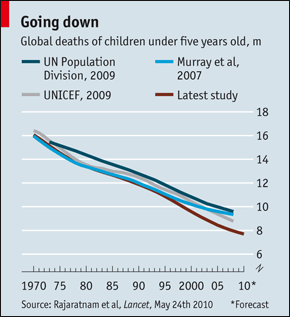
Chart of the day: under-five global deaths since 1970

Economist article on public health citing what one Aussie expert calls "undoubtedly the biggest advance in mortality measurement in four decades!"  

This guy, Alan Lopez of Queensland U, presented a study on infant death trends in Washington in late May (later published by Lancet), and the Economist readily excused his hyperbole, because it's a stunning trend.

As the Economist chart showed, everybody was tracking the incredible decline over the past four decades.  What Lopez's work showed was that they were all underestimating the drop.

Setting aside methodological controversies that naturally ensue, along with the fear of charities that such revisions rob them of donations, the real point of this chart is the overwhelming agreement on the curve, with only minor disagreements (to the layman, that is) regarding degrees of steepness.  

You want to sell me that crap that says globalization is bad for the weakest and the poorest on this planet?  Well, infant mortality is a great measure, and there seems to be an amazing correlation between globalization's explosive spread since the early 1970s (when this globalized world was truly born) and the cutting in half--in absolute terms--of infant mortality globally--EVEN AS THE WORLD POPULATION ALMOST DOUBLED FROM 3.6B TO 6.6B!

So factoring in the population growth, babies today are really roughly four times more likely to make to five than those born in 1970.

Put that in your pipe and smoke it.

1:24AM

Choosing my girls over the Global Forum

Original generic-but-copyrighted photo found here (not the international adoption agency we're using).  

I blanked out the faces lest anyone think I was posting actual pictures of the two girls we're adopting, because there are hugely strict privacy rules involved.  So consider the shot, which is beautiful (alas, not as beautiful as the two girls we're adopting!), as a placeholder until the legal proceedings are completed later this month.

Well, Monday afternoon we got word that our referred case now has a court date in Addis Ababa in late June. Although I had long considered the odds of that date interfering with the Time/CNN/Fortune Global Forum to be quite low, it managed to force an untenable choice:  I could make the court date but would miss the long trek south by car to first meet them in person.  Absent the meeting, a whole different visa pathway would ensue.

That's the technical issue.  

The personal issue would have been not being with my spouse on such an important trip deep in the middle of Africa. Remembering what it was to go to Nanchang and meet Vonne Mei alongside Vonne, I decided I simply could not miss this moment in my life as a husband and father.  The Global Forum would have been fabulous, and very good for my career, but lying on my deathbed decades from now, I won't be saying, "If only I got that one extra fab speaking gig!"  I'll be remembering beautiful moments like the first time I laid my eyes on my African daughters.

So an easy decision to make, if hard to execute.  This is only the second gig in about 15 years that I've ever cancelled (the other being over kidney stones--another birth-like process!), and I have gone on stage no matter what through more sinus infections and migraines than I can count (thank God those days are over). But again, you're not who you say you are, you're what you actually do or choose to be through your actions, and I choose husband-father when push comes to shove simply because I dig those roles so much more than my career.

Details:

  • Thanks again to the three individuals who sent us otoscopes from Amazon.  If you want to help us out with donations, there's still plenty of time before we take the second/bringing-them-home trip in July/August. See the FAQ page for details on how to send us donations.
  • I will be building up the blog queue for the duration of the trip, so it'll be a bit more latent than usual (understanding that this is not a breaking-news blog). I will not attempt to keep the usual frequency of posts, because there is just too much to do in the few days before we leave.  I will have my biz manager Jenn handle approving comments while I'm gone, because the access over there will be spotty and I don't want to spend my days there working the blog.
  • I will try to tweet here and there, understanding that any pics will be generic travel photos and I won't be sharing any details on the girls or our time with them.
  • I will likely make a trip post when I get back, although that too may be awfully generic for privacy issues.

That's all I can think of for now.  We are gearing up mightily, as we leave in a matter of days now.

1:23AM

The Gaza blockade mostly empowers Hamas

Some tough-love advice from The Economist to Israel:  the Gaza blockade makes you weaker and strengthens Hamas's ability to keep a firm grip on power in Gaza.

As usual, a strategy of disconnecting your enemy from the outside world empowers those ruling elements who prefer a firm grip over the masses to their individual empowerment.

More prosaically, the blockade has failed in all of its goals:  the Israeli solder taken hostage is still a hostage, weapons galore still make their way into Gaza via tunnels, Israel is becoming more isolated diplomatically while Hamas is winning sympathy and still overshadowing the far more quiet and more competent West Bank Palestinian leadership.  In short, all trends are heading south.

Obama is under fire here for "ruining" the relationship, but it's hard to see how he's guilty of anything more than simply realizing Netanyahu is no friend of the US and has no intention to pursue peace.  So Obama cuts his losses and the relationship suffers.  To me, that's a sensible choice given all he has on his plate regionally. And if that logic pushes Israel to bomb Iran, then so be it, because that'll just be another regional dynamic that he cannot control--especially when the Saudis collude to make it possible.

All of this is presented as tragedy, because Israel is the best thing about the Middle East in just about every other way.  It is a connectivity hub in all relevant forms. It is, putting aside the Palestinian questions, the most admirable nation-state in the region--by far.

Where to go? Obama is encouraged to get Hamas back to the negotiating table. I see that as a useless proposition.

Given the losing hand it holds right now, I can foresee Israel making the logical leap to pounding Iran. Not much to lose and better dynamics to trigger. And I say this believing quite deeply that most of Israel's leadership knows they are heading--unavoidably--to a nuclear standoff with Iran that will soon be joined by others.

Given the situation Israel finds itself in now, I would say that migrating events down that path and establishing its tough profile on that subject would make a lot of sense.

1:21AM

How much has Obama preserved America's connectivity?

Last piece by outgoing Lexington at The Economist.

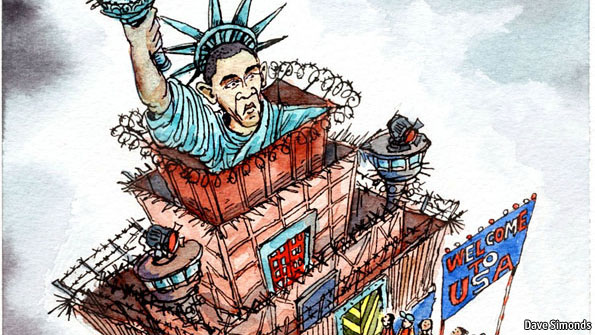
In it, Lex provides summarizing judgment on Obama's success to date in keeping America an open and connected society/economy.

The record is decidedly mixed:  no progress on an immigration bill combined with politically-insipid shows of military force along the border (the 1,200 guardsmen just sent); no great trade barriers but also no serious efforts to move free trade pacts on the books (Colombia, South Korea).  A Cato expert is quoted as saying the Obama administration seems to view trade policy as a way to advance environmental and social goals and nothing more. Our border bureaucracy is described as the worst in the advanced world (I guess I would agree).

Larger downstream argument advanced: US military dominance is waning in the sense that we can no longer play Leviathan to everyone and assume all the SysAdmin jobs that result. Suggestion is that we need to recalibrate alliances to account for rising great powers.

Good news is that US soft-power exports remain world-class.

China is contrasted:  one-fifth of college grads say they want to emigrate, but few peasants do.

Piece ends with call for Obama to stand up more for openness.

Kind of a sad finale for this Lexington.  He doesn't seem to be finding much improvement on this score from Obama.

I think we're going to see a lot more such arguments from big-thinking types regarding the importance of America standing up for its cherished ideals.  Obama's too-lawyerly approach does not inspire like his speeches, and the gap is becoming noticeable.

1:21AM

The more Pakistan goes after the frontier extremists, the more they seem to penetrate Pakistan's interior

The victims of terrorists bury their dead

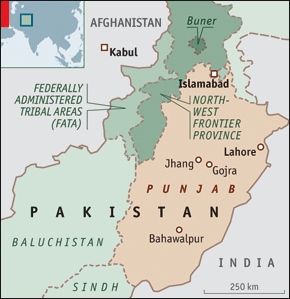
Economist story that argues the extremists are growing strong in the more advanced areas of Pakistan--in effect, spilling out of the frontier into what most would consider to be Pakistan proper.

Vibe: the more the Pakistan military/security forces go after the extremists (Pak/Pashtun Taliban, Afghan Taliban in refuge, al Qaeda & other militants) in the FATA and NW Frontier Province, the more those groups retaliate by spreading eastward and southward into previously stable areas--returning the favor, so to speak.

Corollary argument is that whenever the same happens, radical elements are driven over border into Afghanistan, something that, as a rule, Islamabad is okay with, because it prefers Pashtun dominance in the north (the "strategic depth" argument).

Upshot being, this is why Islamabad in general likes to take a hands-off approach to the FATA and NW province: the hornet's nest stirred up is bad for Pakistan's usually more stable areas.

Story highlights a recent gunmen attack on the Ahmadis in Lahore.  They are a religious minority often persecuted as heretics by fundamentalist Muslims.  Over 90 were killed, and the shocking events retriggered a debate about how pervasive the Taliban are across the country as a whole.  Gov says there ain't no such thing as Punjabi Taliban, but local police in Lahore argue otherwise, saying they were behind recent Ahmadi assault.

There have always been Sunni Muslim extremist outfits in the settled areas, typically banned yet tolerated (and even supported by Pakistan's ISI [Inter-Services Intelligence]), especially if they proved useful vis-a-vis India in the Kashmir "olive-tree" fight (like the most publicized player, Lashkar-e-Taiba, responsible for the 2008 Mumbai assault).  Conventional wisdom has long said that these groups were distinct from the Taliban in the NW; now many are saying that's no longer true. More and more these groups decry the "foreign domination" of the US, so everything seems to be increasingly mushed together in that nasty "stew" you keep hearing about.

Conclusion of piece:  the more the US pushes Islamabad to work the Taliban issue in the NW, the more likely we end up pushing them to address militants throughout the country.  In short, either a comprehensive element or the usual whack-a-mole selectivity on Islamabad's part will become too apparent to hide from all interested parties.

This analysis falls in with the arguments you see more and more in the community that our focus in South Asia should be Pakistan, not Afghanistan.  That dovetails with my choose-India-first arguments.

Inevitably, I think this is how events are funneled. 

12:07AM

Training of Afghan security forces: close but no SIGAR

FT story by way of Our Man in Kabul.

Key findings to be released at the end of June:

To be sure, there's a lot of political pressure applied regarding a hoped-for declaration of progress by July 2011.

As usual, the military's best defense regarding such SysAdmin ops is a strong inspector general.

12:05AM

While Gaza gets all the attention, the West Bank actually starts to work

Nice Friedman argument that we're missing the actual advances in Palestinian governance in the West Bank.

Key second half:

You see, there are two models of Arab governance. The old Nasserite model, which Hamas still practices, where leaders say: “Judge me by how I resist Israel or America.” And: “First we get a state, then we build the institutions.” The new model, pioneered in the West Bank by Abbas and Fayyad is: “Judge me by how I perform — how I generate investment and employment, deliver services and pick up the garbage. First we build transparent and effective political and security institutions. Then we declare a state. That is what the Zionists did, and it sure worked for them.”

The most important thing going on in this conflict today is that since 2007 the Palestinian Authority, Jordan and the U.S. have partnered to train a whole new West Bank Palestinian security force in policing, administration and even human rights. The program is advised by U.S. Lt. Gen. Keith Dayton — one of the unsung good guys. The Israeli Army has become impressed enough by the performance of the new Palestinian National Security Force, or N.S.F., under Abbas and Fayyad that those forces are now largely responsible for law and order in all the major West Bank towns, triggering an explosion of Palestinian building, investment and commerce in those areas.

Here are highlights: the Jordanians have trained and the Palestinian Authority deployed and equipped five N.S.F. battalions and one Presidential Guard unit, some 3,100 men. Plus, 65 Palestinian first-responders have been trained and are being equipped with emergency gear. A Palestinian National Training Center, with classrooms and dorms, is nearing completion in Jericho so the Palestinians themselves can take over the training. The Palestinian Authority is building a 750-man N.S.F. camp to garrison the new N.S.F. troops — including barracks, gym and parade ground — near Jenin. At the same time, the Palestinian security headquarters are all being rebuilt in every major Palestinian town, starting in Hebron. An eight-week senior leadership training course in Jericho — bringing together the Palestinian police, the N.S.F. and Presidential Guards — has graduated 280 people, including 20 women.

A course for captains and below in how to handle everything from crowd control to elections has also begun. The reinvigorated Palestinian Ministry of Interior is leading the Palestinian security sector transformation, and the Canadians are helping to set up Joint Operations Centers across the West Bank so all Palestinian security services can coordinate via video conferencing. The Canadians are also helping the Palestinians to build a logistics center. Parallel with all this, Prime Minister Bibi Netanyahu has reduced Israel’s manned checkpoints in the West Bank from 42 to 12.

This won’t be politically sustainable for Abbas and Fayyad, though, unless Israel begins to turn full authority over to the Palestinians for their major cities — so-called area A — in the West Bank. Palestinians have to see their new security services as building their state, not cushioning Israel’s occupation. There could be a moment of truth here for Israel soon, but at least it will be based on something real.

In sum, this dynamic — Palestinians building real institutions from the ground up and getting Israel to cede to them real authority — is the ballgame. Make it work across the West Bank and find a way to transfer it to Gaza (how about reopening the Israel-Gaza border and letting the new Palestinian N.S.F. control the passages to Israel?) and a two-state solution is possible. Let it fail, and we’ll have endless conflict. Everything else is just a sideshow.

A nice refocusing of strategic attention.

Is it enough of an argument to prevent Israel from taking its swipe against Iran over the nuke program? Only way we get definitive evidence is when the bombs start falling.

But a great argument from Friedman.

12:01AM

Chart of the day: Why China will survive a real estate bubble burst

Economist story subtitled, "China's economic boom can survive a property bust.

First reason is the fact that most Chinese mortgages are for less than half the house's value, so hard to go "underwater" (unlike in US, where the habit became, between first and second mortgages, one of being 100% in debt, so any drop in prices immediately put a lot of people underwater--i.e., owing more than the house was now worth).

Second reason shown in the chart:  why the yuan value of all mortgages in China is skyrocketing, as a percentage of GDP, the total still remains quite low (less than 16%).  In the US, the share is more like 80%, so a lot more potential impact when a bubble bursts.

Good news for China and the global economy.

12:10AM

Winning in Iraq: What else do you call it?

The periodic chart in the NYT that tracks trends over the years in Iraq and Afghanistan and now Pakistan too.

Unsurprisingly, the numbers are inconclusive in the latter two, reflecting the previous neglect and now the heightened effort.

The only numbers here that jump out are from Iraq.

Somehow we go down from 153k US troops to just 95k, while the Iraqis go up from 445k to 665k and EVERYBODY'S deaths go down dramatically--ours and theirs (to include their civilians).  

Hard not to call that victory, and that's important to remember. Bush-Cheney screwed up the postwar, and then spent years resisting the move to serious COIN, finally giving in after the 2006 election rebuff. When the generals really took over and did what their own hearts and minds told them was right, we got success.  Didn't come in a flash and it cost plenty, but we got success.

That's where the rush job now on Af-Pak strikes me as destined to fail--and prove nothing, especially when we doom ourselves by aligning with Pakistan.

Where I was wrong on Iraq:  I did not believe that the COIN would be enough absent a regionalization effort that included some cool-down on Iran.  I still think we'd have a much more stable Iraq with such an effort, but I clearly underestimated our ability to stabilize Iraq and put the civil war dynamics on the backburner. Iran's domestic troubles have helped in this regard, but we are still a long ways away from engaging Iran more sensibly on the nukes.  There I see a postwar generation of leaders not unlike the Brezhnev crew in the USSR (in relation to the Great Patriotic War) that are brutal enough in their repression but clearly calculating in their brinkmanship with the West and essentially obsessed with getting their revolution historically recognized by the West in the form of admitting their "power" achievements--to include nukes that protect them from regime change.  In sum, I don't view Iran as irrational.  We've been down this pathetic path before and we know how to handle it.  So the regionalization logic, while deferred, still awaits Iran's clear achievement of nuclear weaponization, which is coming.

On Afghanistan, I will stick to the same regionalization logic, because Pakistan's interests here are so strong in seeing Kabul dominated by a Pashtun/Taliban dynamic in the south.  As with Iraq, I see a larger player (India) that must be satisfied on some level if we want true regional security to emerge (and guess what, it's basically another unofficial nuclear power, as is its rival Pakistan). 

In the end, both of these regional efforts at security regimes will resemble what we did in Europe following WWII, and yes, even there it took about 30 years to work itself out, but our patience and our engagement and our military resolve all paid out magnificently.

12:09AM

Gates: a 5GW warrior working a wedge

PLA Daily photo.

WAPO piece by way of WPR's Media Roundup.

The gist:

Defense Secretary Robert M. Gates accused China's military on Thursday of impeding relations with the Pentagon, taking exception to its unwillingness to invite him to Beijing during his trip to Asia this week.

Gates told reporters that there is a clear split between China's political leaders, who he said want a stronger military connection with Washington, and the People's Liberation Army, which he said does not.

"I think they are reluctant to engage with us on a broad level," he said. "The PLA is significantly less interested in this relationship than the political leadership of China."

Beijing's political and economic relations with Washington have gradually improved in recent years, as the emerging global superpower and the established one have tried to come to terms with each other. But military cooperation has lagged, a source of frustration for Pentagon officials.

They say that communication with the People's Liberation Army needs to improve to deal with regional crises, such as South Korea's accusation that a North Korean submarine torpedoed one of its warships in March, to broader strategic issues, such as the long-term buildup of China's military forces. Washington also has been seeking China's support -- without much success -- in trying to deter Iran from developing nuclear weapons.

We make our choices on things like Taiwan arms sales and military aid to Pakistan, and these choices allow hardliners in the Chinese and Indian militaries to make their case against stronger cooperation with us. At some point, we decide other things like North Korea and Iran really are more important, or we keep with these yin-yanging relationships that never quite come to fruition. You have to remember:  we're the established superpower, and they are the risers, so sensitivities must be observed, just like the Brits did with rising America a century ago. It's just the cost of doing business.

But I like Gates' explanation here, because it's a truthful one: the PLA can't afford too much comity with the US military, because it undercuts their own Leviathan funding and pushes the nation down the path of assuming more responsibility for its expanding global economic network ties, which will bog down the PLA in all sorts of SysAdmin work.

But in Fifth Generation Warfare terms, this is how we do it.

12:08AM

Man-bites-dog story: New cyber command chief says US completely invulnerable!

Okay, so I lied.  The WAPO piece really stated that Gen. Keith Alexander, new head of US Cyber Command, warned that the US was vulnerable to such attacks and that evidence exists that rivals and enemies plan to do just that in the event of wars/terrorism.

Then again, what do you expect the new head of a new command to say on the subject?

Don't get me wrong:  the command makes sense.  DOD nets receive 6 million hacking attempts a day.  Then again, Bank of America receives something in the same range.

I just find the coverage a bit rote.