Buy Tom's Books
  • Great Powers: America and the World After Bush
    Great Powers: America and the World After Bush
    by Thomas P.M. Barnett
  • Blueprint for Action: A Future Worth Creating
    Blueprint for Action: A Future Worth Creating
    by Thomas P.M. Barnett
  • The Pentagon's New Map: War and Peace in the Twenty-first Century
    The Pentagon's New Map: War and Peace in the Twenty-first Century
    by Thomas P.M. Barnett
  • Romanian and East German Policies in the Third World: Comparing the Strategies of Ceausescu and Honecker
    Romanian and East German Policies in the Third World: Comparing the Strategies of Ceausescu and Honecker
    by Thomas P.M. Barnett
  • The Emily Updates (Vol. 1): One Year in the Life of the Girl Who Lived (The Emily Updates (Vols. 1-5))
    The Emily Updates (Vol. 1): One Year in the Life of the Girl Who Lived (The Emily Updates (Vols. 1-5))
    by Vonne M. Meussling-Barnett, Thomas P.M. Barnett
  • The Emily Updates (Vol. 2): One Year in the Life of the Girl Who Lived (The Emily Updates (Vols. 1-5))
    The Emily Updates (Vol. 2): One Year in the Life of the Girl Who Lived (The Emily Updates (Vols. 1-5))
    by Thomas P.M. Barnett, Vonne M. Meussling-Barnett
  • The Emily Updates (Vol. 3): One Year in the Life of the Girl Who Lived (The Emily Updates (Vols. 1-5))
    The Emily Updates (Vol. 3): One Year in the Life of the Girl Who Lived (The Emily Updates (Vols. 1-5))
    by Thomas P.M. Barnett, Vonne M. Meussling-Barnett
  • The Emily Updates (Vol. 4): One Year in the Life of the Girl Who Lived (The Emily Updates (Vols. 1-5))
    The Emily Updates (Vol. 4): One Year in the Life of the Girl Who Lived (The Emily Updates (Vols. 1-5))
    by Thomas P.M. Barnett, Vonne M. Meussling-Barnett
  • The Emily Updates (Vol. 5): One Year in the Life of the Girl Who Lived (The Emily Updates (Vols. 1-5))
    The Emily Updates (Vol. 5): One Year in the Life of the Girl Who Lived (The Emily Updates (Vols. 1-5))
    by Vonne M. Meussling-Barnett, Thomas P.M. Barnett, Emily V. Barnett
Search the Site
Powered by Squarespace
Monthly Archives
1:40PM

"Runaway general"? Hardly. Runaway mouths?  Definitely

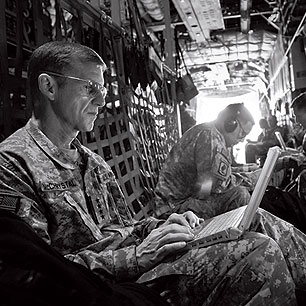
I just read the Rolling Stone piece and found the tone of disrespect somewhat stunning.  The media immediately references my piece on Fox Fallon from 2008, but I'm more impressed with the differences than similarities-- as in, Fallon disagreed with the president on substance while McChrystal's gripes strike me as stylistic (e.g., Obama struck him as uncomfortable before brass) and superficial.

Fallon never said anything disrespectful of his superiors in front of me, nor did his staff.  The admiral just fundamentally disagreed on the possibility of going to war with Iran and wasn't shy about sharing that opinion in the press, which he did repeatedly prior to my piece (which he later said misrepresented his views while quoting him accurately--to the tune of over 1,500 words).

Here, McChrystal does just the opposite:  never really disagreeing with his superiors while openly disrespecting them.  I say "openly" because he and his staff did it repeatedly in front of a reporter they knew was there to report on what he saw and heard--just like I did.  

Is that enough to get him fired?  That's Obama's call.  The fact that McChrystal is quoted both directly and in a secondary manner (through his staff) making truly derogatory remarks about so many principals (VP, NS adviser, our AMB in-country, Holbrooke) is problematic going forward, but firing the right guy for the right job when he agrees with your policy is likewise a hard choice for the president.

In the end, it all comes down to the relationship itself.  A magazine story can damage such a relationship but it cannot define it. Fallon was on thin ice with the White House when my story appeared, making it the final nail in the coffin. If Obama's relationship with McChrystal is solid, the Rolling Stone story won't be enough to trigger his sacking. But if it was already fragile/strained, then it may become the excuse.  But my guess is that McChrystal and Obama-Biden are on an entirely different trajectory over Af-Pak than Fallon and Bush-Cheney were over Iran.

12:10AM

The PNM-Wikistrat connection

Got email a while back from Joel, Australia-born, now living in Israel after some schooling there.  He says he has all the books, reads everything I write online, and brags that he's seen the brief well over a hundred times (none live).  

Then he explains how he and three other twentysomethings have created a start-up company (incorporated 6 months ago) that seeks to adapt the Wiki platform to a competition-of-the-fittest-style generator of strategic planning within organizations (companies, government agencies, etc.).  After two successful pilots using mostly Israeli intell types, the company moves toward marketizing the offering.  In some ways, it reminds me of using GroupWise in the Naval War College economic security exercises I led atop the World Trade Center with Cantor Fitzgerald pre-9/11 and in other ways it reminds me of when email first starting hitting command post exercises at combatant commands in the mid-1990s (creating this fascinating individual-based work-around and highly competitive intellectual network that quickly trumped the formal thought-gathering processes).  In both instances, you escape the limits of hierarchical conversations (often broadcasts by the most authoritative figure in the room) and tap into the wisdom of crowds under conditions of much tighter latency (less time involved to reach effective decisions after weighing alternative pathways).  In a sense, a way to both speed up (under the necessary scenarios) and improve the usual pick-option-B mentality that prevails.

What attracted me was Joel's description of how the company has used my vertical-versus-horizontal-scenarios thinking to customize the system with all manner of prompts to analysts to think in both dimensions--so highly interdisciplinary.

The basic conceit is, unlike traditional wikis, we're talking more than one page per analytic target--hence a competitive environment.  What often happens in these decision-making environments is that a core group is assembled to put together the options PPT package, and a tremendous amount of poorly thought-out necking down of pathways ensues.  By creating a more horizontal playing field, freed from hierarchical bias (i.e., the guy with the most stars on his shoulder boards must be the smartest, right?), the primary intellectual traction points become the linkages between the competing options pages.

That's a thumbnail description that does not do the effort justice.  Go the company's site to see more in-depth presentations.  

Two ways this interests me:

1) Strategic consulting in the private sector requires--more than ever--some connectivity to solution-delivery, meaning almost nobody is paying the old top-dollar for PPT slide decks and reorg charts--only.  Instead, companies want your interaction to come with some technology solution that simultaneously empowers them to deal with the issue in question.  Advice just isn't enough anymore.

2) Governments as a whole struggle with these problems, and are always looking for new tools to empower individual workers while connecting them to the wisdom of crowds, whether it be fellow bureaucrats (where a tremendous amount of wisdom truly resides) or with the citizenry (their natural counterparty).

So check out the site if you're interested.  I am happy to connect anybody to Joel (although I'm sure his site has a contact function) for whatever can be arranged in demos/dialogue.

Naturally, I got a kick hearing about how the vertical/horizontal scenarios-&-thinking stuff resonated so nicely with someone in the private sector, so I'm happy these young fellas out.

Plus, does it get much cooler that seeing your ideas expressed in an Israeli start-up?

12:06AM

Why engaging Iran on the nuclear program makes more sense now than ever


Charles Kupchan, almost always a terrifically reasonable fellow, in the Moscow Times on the need to talk with Iran.  Item found via WPR's Media Roundup.

Highlights:

With diplomacy having failed to curb Iran’s nuclear ambitions, critics of engagement charge, it is time to resort to coercion before Iran crosses the nuclear Rubicon. A rising chorus of voices now forswears engagement with Iran’s rulers, insisting that it is time for the regime to go.

But closing off dialogue with Iran would be a precipitous and dangerous mistake. Even fierce adversaries can settle their differences through negotiation. The United States and its allies should keep the door open to dialogue until the 11th hour for four compelling reasons.

First, tighter sanctions make sense only as a diplomatic tool, not as a blunt instrument of coercion . . .

Second, the costs of abandoning diplomacy are so high that continued engagement makes sense even as Iran refuses to budge . . .

A military strike would likely have worse consequences. Even if a strike were an operational success, it would only set back Iran’s nuclear program by several years, while giving the regime a new incentive to acquire a nuclear deterrent and build better hidden and defended nuclear facilities . . .

The third reason for pursuing dialogue is that factional infighting and political intrigue within the Iranian regime make for considerable political fluidity . . .

Finally, even as stalemate continues on Iran’s uranium enrichment, continued engagement may offer a roundabout means of arriving at a bargain on the nuclear issue. Dialogue with the United States could focus on areas, such as Iraq and Afghanistan, where the two parties share a measure of common ground. Joint efforts to combat drug trafficking in Afghanistan, for example . .

With Iran having spurned Obama’s offers of compromise, it is tempting for the U.S. administration to turn its back on dialogue. But the stakes are too high to abandon engagement.

Basically agree, but simply caution that I believe the impetus for talking will only get stronger once Iran inevitably fields those nuclear weapons in a way that's recognized by the world.

No, I don't think talking will stop this, but I think the practice is worthwhile, whether or not Israel strikes or not. The challenge cannot be wished away or bombed away or ignored. Practice will never make perfect here, but it will build up some semblance of a dialogue, and that matters when the alternative is isolating and demonizing a new nuclear power.

Would I prefer Iran without nukes?  Who wouldn't?  But this isn't about our preferences anymore; it's about dealing with a reality that rushing toward us while we prefer to engage in a lot of diplomatic escapism.

12:05AM

By virtue of Obama's vigorous use of drones, he needs to establish the rule-set cover for their operators

WAPO story by way of WPR's Media Roundup.

The essential danger/challenge:

On The Post's op-ed page Sunday, Treasury Undersecretary Stuart Levey called the killing of Yazid a "major blow" to al-Qaeda because "Yazid has essentially served as al-Qaeda's 'chief financial officer,' coordinating the group's fundraising and overseeing the distribution of money essential to its survival." By the ACLU's reasoning, this would make the strike that killed Yazid illegal. Does the ACLU want to see the Predator operator who took out al-Qaeda's third in command prosecuted for murder? The ACLU has already gone after CIA interrogators -- surreptitiously photographing these covert operatives and sharing the images with al-Qaeda terrorists in Guantanamo. CIA drone operators may soon be in for similar treatment.

The Obama administration has put the Predator operators at greater risk by dramatically narrowing the legal underpinnings for their actions. State Department legal adviser Harold Koh -- a harsh critic of the Bush administration -- explained in a March 25 speech that the Obama administration was no longer invoking the president's Article II authority as commander in chief to justify many of its policies in the war on terrorism. But Koh said that drone attacks were lawful because "Congress authorized the use of all necessary and appropriate force through the 2001 Authorization for the Use of Military Force (AUMF)."

The problem -- as Koh's predecessor, John Bellinger, told The Post last week -- is that Congress authorized the use of force against those who "planned, authorized, committed, or aided" the attacks of Sept. 11, 2001. And many of those currently targeted -- particularly outside Afghanistan -- had nothing to do with those attacks.

You have to think that if Obama lays out his case, however classified the presentation, to the Congress and says, "I'm taking the fight to them where they hide and I need this legality question settled for the long haul of this Long War," that he'd get the fix the CIA needs and deserves.

The longer the administration delays this inevitable step, the more jeopardy to which operators will be subjected.

Pretending this fight can be prosecuted in a neat, country-by-country basis, with all i's dotted in advance by Congress, is dangerous.  Better to clear the air and incentivize the operators. No reason to be mealy-mouthed about it or hide behind "interpretations."  Most Americans will see this as a very reasonable extension of Executive Branch writ.

12:04AM

"Cable" comes to the cancer ward

WSJ story describing recent claims by researchers of notable advances in treating cancer, the focus being on targeted therapies that employ advanced genetic-based technologies.

Naturally, all of this is expensive.

This will be a constant theme of the bio-gen revolution that unfolds over coming decades:  the tech will be there, but the question will be one of who gets access.  I expect that access to such medical technologies, especially those involving the significant extension of life, will become the primary human rights struggle of the century.

But what caught my eye here was the following bit:

"Cancer is like cable television," says George Sledge, a breast-cancer expert at Indiana University and newly elected president of the American Society of Clinical Oncology, which hosted the cancer meeting. "Thirty years ago you had three channels. Now you have 500."

The guy's point:  the more we learn and the better we target, the more target-complex becomes the battlespace.  Cancer, over time, will be revealed to be almost as complex and varied as the human experience. Since it is primarily a disease of aging, the longer we extend life, the more we will view it as our primary medical challenge.  For most of us who will enjoy this life-lengthening age, cancer will be less the dead-end and more the accepted right of passage.

But yeah, who plays gatekeeper will be crucial.

12:03AM

Energy subsidies worldwide (biggest developing economies) = $550B+ annually

Pic here

FT front-pager.

The stunner is less the number (what's a half-trillion across a global economy?) than the fact that the new IEA estimate is 75% higher than previously though.

IEA says recent G20 agreement to phase out subsidies would trigger vast savings in consumption (due to higher prices) and likewise in CO2 emissions.

Past efforts to reduce consumption have failed, says the FT, because of the generous subsidies offered by many governments to keep fuel cheap (like American gas).

The figure of $557B was derived from just 37 large developing countries.  Old figure guessed at $300B.

Atop the list sit all risers:  Iran, Russia, Saudi Arabia, India and China.  Phase out those subsidies and it's like taking most of Europe offline--CO2 wise.

One tough sell, I must say. Energy subsidies in these countries are a huge political issue due to the still large numbers of impoverished folk (vast numbers in India and China), so I wouldn't expect this number to go down without plenty of fights.

12:02AM

The iPhone makes Apple a global player, but only if it can dominate outside the US

WSJ story that exemplifies the bottom-of-the-pyramid reality of the global marketplace once Asia's billions sign on.

Apple is rolling out the latest version of its iPhone more rapidly to 88 countries beyond its already saturated American market, reducing the lag time exhibited by previous versions.

Why?  Apple's growth in recent quarters is skyrocketing in Asia/Japan and it's even significantly bigger in Europe already than in America.  Comparison: March 2010Q sees growth rate of about 25% in the Americas, but almost 200% in developing Asia.

So no choice: go global or go stagnant.

12:01AM

Chart of the day: a single-party democracy in South Africa

Economist special report on South Africa.

I always like to remind myself that the ANC were a prime client of the Sovs during the Cold War, appearing in my PhD diss in that role. Why take Sov support? The West wasn't offering any. Fortunately when given the chance to rule, the ANC has done so democratically--more or less.

But like most revolutionary parties, it has ruled in a singular, dominating sense. Pretty easy to do because of the original giants, like Mandela.

But hopefully it gets harder over time.

9:37AM

WPR's The New Rules: When Technology Becomes More Human

Oddly enough, people tend to trust computers' seeming infallibility more than nature's trial and error. But at the same time, people fear a more highly technologized future, because they assume it will be less natural. In truth, technology, including computing, will evolve more in the direction of nature than the other way around, and will fuse with it increasingly on the latter's terms.

Read the entire column at World Politics Review

12:07AM

Alterman on the underlying challenge posed by globalization's embrace of the Middle East

Great Jon Alterman piece in World Politics Review.

It is not surprising that discussions with government officials from member states of the Gulf Cooperation Council often dwell heavily on security threats. Terrorism remains a persistent concern of theirs even if some of the urgency they feel has passed. A conventionally armed Iran is a constant source of worry. And the prospect of a nuclear-armed Iran is an unending nightmare.

Yet, among the most-senior leadership, there is also some perspective. The terrorism threat no longer feels existential, as a combination of effective security initiatives, internal cooptation and international cooperation have made their mark. On Iran, there is a sense of fatalism: The Gulf has relied on external guarantors to keep the Iranians at bay since the days of the Portuguese empire, and the Iranians have sufficiently agitated the world to ensure that external guarantors, in some form or another, will remain.

But in private conversations with senior GCC royals last month, it was clear that one security concern does indeed loom large. It is one not of physical security, but of human security. Their nations can almost certainly survive the other threats they face. But unless they can create dynamic, hard-working and creative populations over the long term, these countries will fail.

For the last half-century, the GCC's human security story has been a positive one. After World War II, today's gleaming Gulf capitals were impoverished collections of reed huts. Schooling was uncommon, and fresh water was scarce. Traffic-clogged roads did not exist, because traffic did not exist. Radios were a rarity, in contrast to the ubiquity of the satellite dishes that now deliver more than 500 channels in Arabic. Life expectancies doubled in the 20th century. Malnutrition and the endemic diseases of the 1950s have disappeared, and the diseases of the 2010s -- heart disease, kidney disease and diabetes -- are all diseases, not of poverty, but of plenty. For Gulf Arabs who came of age in the 1960s, the contrast between their youth and their adulthood could not be starker.

What will the future look like for today's youth? It is hard to imagine that they can enjoy a jump in living conditions similar to the one their parents and grandparents experienced, especially as oil and gas markets seem unlikely to expand as much over the next half-century as they did over the last. Much of it comes down to a basic problem of mathematics: Per capita income increased a hundredfold, from $500 in 1960 to $50,000 in 2010; it cannot increase another hundredfold, to $5 million, in the 50 years to come. 

Even more importantly, what might drive future growth? There is a growing recognition that oil has wrought about all that it can.

The GCCs are the natural lead geese on this evolution of thinking, so every step they consider or take is worth watching. Because when the world moves beyond oil, all the Middle East is left with are the people as a resource.  Nothing that's happened in the past decade has altered that reality; indeed, most of what's happened has accelerated it.

Excellent article.

12:06AM

Chivers on what Marja means--so far

NYT piece by the always astute C.J. Chivers.

As NATO and Afghan forces flow into neighboring Kandahar Province, where for the next many months the latest high-profile effort to undo the Taliban’s hold will unroll, the continuing fighting in Marja can be read as a sign of problems in the American-led surge. It can also be read as something less worrisome: a difficult period in a campaign always expected to be hard.

A prevailing assessment among officers on the ground is this: The outcome is too soon to call.

“Right now it’s gray,” said Maj. Lawrence Lohman, the operations officer for Third Battalion, Sixth Marines, which operates outposts in northern Marja.

Those who deem the Marja offensive a disappointment, or even a failure, point to the daily violence and to the signs that Afghans have been leaving the area, at least temporarily, to avoid the fighting. They also point to Taliban intimidation of residents, a still limited government presence, and the continued reliance of Afghan police officers and soldiers on American supervision and logistics. These, they say, are ill-boding signs.

But the signals are contradictory.

Most of Marja’s civilians returned after moving away ahead of the initial assault. Most of them remain. Compounds that were empty in February are inhabited. Roads once quiet are busy. Fields are thick with crops. Shops in some bazaars have reopened. Afghan units participate visibly in dangerous missions.

Lt. Col. Brian Christmas, the battalion’s commander, noted that some of Marja’s residents had begun providing information on the Taliban, including sharing the names and locations of fighters. Many civilians have been seeking aid and a few have sought contracts for small scale development projects, the early steps in engagement.

“I’ve seen good growth and good progress,” the colonel said. He added: “There is still a lot to be done.”

The Marines point to what they clearly hope is a Helmand pattern, apparent in other districts, including Nawa, where the Taliban were strong and fighting was initially intense. The pattern, they said, is this: With time and resources, the insurgents’ position erodes, villages become secure, and engagement and the Afghan government presence expand.

Pursuing this goal, Marine companies have been sending out constant small patrols.

Time and patience and skills, we seem to have a plenty--at least on the military's side.

More and more we hear generals voicing out loud their thought that Afghanistan will take longer--the implied follow-on being ". . . than President Obama wants."

Obama will reach a Bush moment on Afghanistan, and he will either fold or play on.

12:05AM

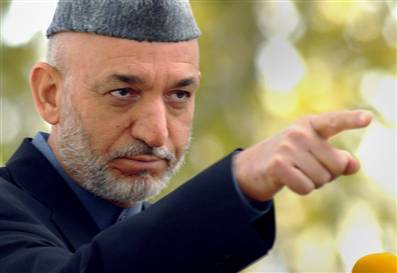
Karzai has already cast his lot with Pakistan

Subtitle of Guardian piece (via WPR Media Roundup) says it all:

Afghanistan's former head of intelligence says President Hamid Karzai is increasingly looking to Pakistan to end insurgency

Even with the evolution of our tactics, it's hard to blame Karzai for the choice. Obama gives him all indication of bailing before 2012, and the rushed effort in the south seems increasingly bogged down thanks to a very patient and brutal response from the Taliban.

There's been no effective regionalization of the solution set, leaving Pakistan the looming large neighbor of note, so what else do we expect of Karzai?

He's covering his bets.

12:03AM

Don't call it an "offensive"

NYT story that emphasizes the surge in the south is far more civilian than portrayed in the press:

The prospect of a robust military push in Kandahar Province, which had been widely expected to begin this month, has evolved into a strategy that puts civilian reconstruction efforts first and relegates military action to a supportive role.

The strategy, Afghan, American and NATO civilian and military officials said in interviews, was adopted because of opposition to military action from an unsympathetic local population and Afghan officials here and in Kabul.

There are also concerns that a frontal military approach has not worked as well as hoped in a much smaller area in Marja, in neighboring Helmand Province.

The goal that American planners originally outlined — often in briefings in which reporters agreed not to quote officials by name — emphasized the importance of a military offensive devised to bring all of the populous and Taliban-dominated south under effective control by the end of this summer. That would leave another year to consolidate gains before President Obama’s July 2011 deadline to begin withdrawing combat troops.

In fact, there has been little new fighting in Kandahar so far, and the very word “offensive” has been banished.

“We cannot say the term offensive for Kandahar,” said the Afghan National Army officer in charge here, Gen. Sher Mohammad Zazai. “It is actually a partnership operation.”

The commander of NATO forces in southern Afghanistan, Maj. Gen. Nick Carter, insisted that there never was a planned offensive. “The media have chosen to use the term offensive,” he said. Instead, he said, “we have certainly talked about a military uplift, but there has been no military use of the term offensive.”

Whatever it is called, it is not happening this month. Views vary widely as to just when the military part will start. General Zazai says it will begin in July but take a break for Ramadan in mid-August and resume in mid-September. A person close to Tooryalai Wesa, the governor of Kandahar, says it will not commence until winter, or at least not until harvests end in October. He spoke on the condition of anonymity because he was not authorized to talk to the press.

American officials, on the other hand, say it has already begun, not with a bang, but with a steady increase of experts from the United States Embassy and NATO and aid workers — a “civilian surge” — accompanied by a quiet increase in American troops to provide security for them. The Americans strongly deny that they planned an offensive they are now backing away from.

Whereas in Marja the plan was to carry out a military assault to oust the Taliban, followed by rapid delivery of government services, in Kandahar the approach is now the opposite. Civilian aid workers, protected by an increased military force, will try to provide those services first, before any major military action.

“This is not going to be a door-to-door military campaign,” said one American civilian official, who requested anonymity in line with his agency’s policy. “You’ll see more Afghan National Police checkpoints, but it’s not going to be an aggressive military campaign. They’ve looked at it and realized it wouldn’t work.”

That is some serious learning being applied.  Gratifying to see.

With all the reports coming back either glass-half-full or half-empty, it is hard to gain any comprehensive sense of what's possible, but you get the distinct feeling that both sides are pulling out all stops--just on opposite sides of the kinetic/non-kinetic divide (i.e., they kill civilians and we lead with them).

12:02AM

NorKo: breaking point for masses, yes, but not for Kim clan

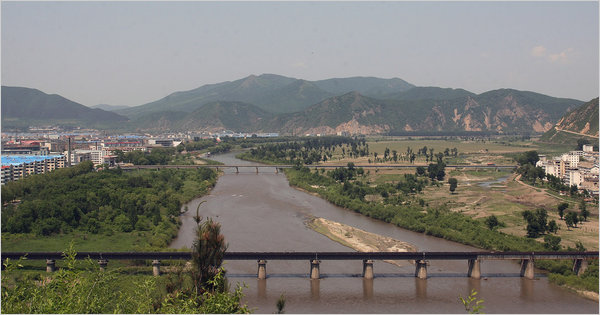
North Korean border with China:  guess which side is China's.

NYT story that does the usual with scant interview-based info from recent escapees:

Like many North Koreans, the construction worker lived in penury. His state employer had not paid him for so long that he had forgotten his salary. Indeed, he paid his boss to be listed as a dummy worker so that he could leave his work site. Then he and his wife could scrape out a living selling small bags of detergent on the black market.

It hardly seemed that life could get worse. And then, one Saturday afternoon last November, his sister burst into his apartment in Chongjin with shocking news: the North Korean government had decided to drastically devalue the nation’s currency. The family’s life savings, about $1,560, had been reduced to about $30.

Last month the construction worker sat in a safe house in this bustling northern Chinese city, lamenting years of useless sacrifice. Vegetables for his parents, his wife’s asthma medicine, the navy track suit his 15-year-old daughter craved — all were forsworn on the theory that, even in North Korea, the future was worth saving for.

“Ai!” he exclaimed, cursing between sobs. “How we worked to save that money! Thinking about it makes me go crazy.”

North Koreans are used to struggle and heartbreak. But the Nov. 30 currency devaluation, apparently an attempt to prop up a foundering state-run economy, was for some the worst disaster since a famine that killed hundreds of thousands in the mid-1990s.

Interviews in the past month with eight North Koreans who recently left their country — a prison escapee, illegal traders, people in temporary exile to find work in China, the traveling wife of an official in the ruling Workers’ Party — paint a haunting portrait of desperation inside North Korea, a nation of 24 million people, and of growing resentment toward its erratic leader, Kim Jong-il.

What seems missing — for now, at least — is social instability. Widespread hardship, popular anger over the currency revaluation and growing political uncertainty as Mr. Kim seeks to install his third son as his successor have not hardened into noticeable resistance against the government.

NorKo remains an amazing experiment in pushing captive masses past the limits of human endurance.  It is the closest thing to a country-as-concentration-camp as the world has ever seen.

12:01AM

Chart of the day: Misery index returns

Bloomberg Businessweek chart, that presents a nice bookend feel to the 1990s/2010s.

But before you lapse into thinking it was all a mirage, be grateful that only four of those years saw us up above 9% combined for unemployment and inflation. Globalization has been one tumultuous ride for all concerned, and our ride has been relatively smooth compared to the rest of the planet.

For comparison's sake, remember that the misery index ran much higher in the 1970s--when it lived and breathed between 10 and 20 percent.

See the 60-year-slide for some appreciation--from this child of the 1960s who came of age in those tense times (economically-speaking, far more tense than the 1960s).

My point?  Don't sign yourself up just yet to the Most Suffering Generation list.

12:04AM

Hollowing out Afghanistan's local government

The governor of Kandahar--staying alive

NYT story that reminds us of the Taliban's grim determination to kill however many necessary to thwart any nation-building by NATO:

The Taliban have been stepping up a campaign of assassinations in recent months against officials and anyone else associated with local government in an attempt to undermine counterinsurgency operations in the south.

Government assassinations are nothing new as a Taliban tactic, but now the Taliban are taking aim at officials who are much more low-level, who often do not have the sort of bodyguards or other protection that top leaders do. Some of the victims have only the slimmest connections to the authorities. The most egregious example came Wednesday in Helmand Province, where according to Afghan officials the insurgents executed a 7-year-old boy as an informant.

As the coalition concentrates on trying to build up the Afghan government in the southern province of Kandahar, a big part of that strategy depends on recruiting capable Afghan government officials who can speed delivery of aid and services to undercut support for the Taliban. The insurgents have just as busily been trying to undermine that approach, by killing local officials and intimidating others into leaving their posts.

“They read the papers; they know what we are doing,” said a NATO official here, who spoke on condition of anonymity in line with his government’s policy. “It’s very much game on between the coalition and the Taliban.”

The assassinations have been effective in slowing recruitment of government officials, he said. “Am I going to live through the workweek? No one should have to ask that question.”

Just since March, according to reports compiled by The New York Times from the police, military sources, witnesses and local government officials, there have been at least 11 assassinations in Kandahar, mostly of low-level officials. These reports, which are not complete, do not include police officers or other officials killed in more indiscriminate attacks, like suicide bombings.

In John Robb's formulation, the Taliban are proving quite effective at "hollowing out" the local government, keeping Kabul's reach limited to the capital city--a classic failed-state situation.  Doesn't mean they will ever effectively rule the country, but they can prevent outsiders from trying to encourage the same with non-Taliban leadership/governance.

And that won't change any time soon, it would seem--unless overwhelming economic presence is achieved by regional elements.

And that's where the discovery of mineral wealth can be a game-accelerator. 

12:03AM

The parish festival: the face-painter goes incognito

The guy who always helps me face paint likes to do himself up big-time. He's not all there, but he's a sweet man. Bit of a sci-fi nut.

12:02AM

Deep Reads: Ayn Rand's "The Fountainhead" (1943)

I actually watched  the movie first on video, sometime in the early 1990s, and found it intriguing enough for its iconoclastic view of human creativity, but it really didn't connect.

Then my first-born was diagnosed with an advanced-stage cancer at two years of age, and after a few months of heavy drinking, I recomposed myself as father and re-engaged the subsequent battle more fully (as my wife had to step back due to her pregnancy).  During that epic year, I got ahold of the book and read it like my life depended on it.

I won't tell you I'm a Howard Roark or anything. I will just say that this book, along with a couple of others, really saved my life back then.

Upon reading it, I also knew that someday I would write fiction.

I guess the book's primary impact was that it made me feel proud to be me, no matter who didn't understand what being me was all about.

Toward that end, I was reborn as a writer and thinker from Emily's long struggle, beginning with "The Emily Updates" that I currently am reworking with Warren for eventual publication.

12:01AM

Movie of My Week: Moulin Rouge (2001)

I love all Baz Luhrmann movies like I love all Danny Boyle movies, although I will confess that I have yet to see "Australia"--his homeland epic. Vonne was so impressed with "Moulin Rouge" that she subsequently went to see Luhrman's Broadway staging of the opera "La boheme," which thrilled her to no end.

I just re-watched this with my older daughter and my mom, who got up about ten minutes into the viewing and said, "I thought this was the one with Jose Ferrer!" and then stomped out.  My daughter Em loves the movie so much she can sing almost the entire soundtrack, which I can find annoying in the home theater.

Anyway, what I love:

  • I love Jim Broadbent in the ringmaster role; I smile every second he's on screen;
  • I think this was the one that Nicole Kidman should have won her Oscar for; she was perfect here;
  • I like Ewan McGregor in almost all things (the great Boyle-Luhrmann bridge!), but found him especially appealing here--to include his heartfelt singing.
  • But most of all, I loved how Luhrmann re-imagines the modern musical as a sampler of recent songs and I especially loved all his cinematographic trickery here; he is a showman of the highest order--Sergei Diaghilev caliber.

I hope the guy never gets bored with film.

12:05AM

Kim's leadership shuffle in NorKo: the regent selected

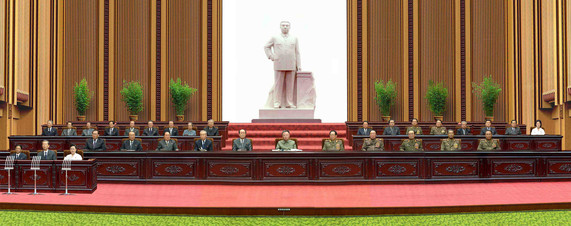
WSJ story on recent leadership shake-up in NorKo that's clearly designed to clear the path for the third generation in the Kim dynasty.

Kim moved his brother-in-law Jang Song Taek into the #2 spot. He will apparently act as idiot son #3's sherpa in the planned upward glidepath to the top spot upon Kim Jong-Il's death.  Jang is 64 years old, and is believed to be the #3 son's top supporter.