Buy Tom's Books
  • Great Powers: America and the World After Bush
    Great Powers: America and the World After Bush
    by Thomas P.M. Barnett
  • Blueprint for Action: A Future Worth Creating
    Blueprint for Action: A Future Worth Creating
    by Thomas P.M. Barnett
  • The Pentagon's New Map: War and Peace in the Twenty-first Century
    The Pentagon's New Map: War and Peace in the Twenty-first Century
    by Thomas P.M. Barnett
  • Romanian and East German Policies in the Third World: Comparing the Strategies of Ceausescu and Honecker
    Romanian and East German Policies in the Third World: Comparing the Strategies of Ceausescu and Honecker
    by Thomas P.M. Barnett
  • The Emily Updates (Vol. 1): One Year in the Life of the Girl Who Lived (The Emily Updates (Vols. 1-5))
    The Emily Updates (Vol. 1): One Year in the Life of the Girl Who Lived (The Emily Updates (Vols. 1-5))
    by Vonne M. Meussling-Barnett, Thomas P.M. Barnett
  • The Emily Updates (Vol. 2): One Year in the Life of the Girl Who Lived (The Emily Updates (Vols. 1-5))
    The Emily Updates (Vol. 2): One Year in the Life of the Girl Who Lived (The Emily Updates (Vols. 1-5))
    by Thomas P.M. Barnett, Vonne M. Meussling-Barnett
  • The Emily Updates (Vol. 3): One Year in the Life of the Girl Who Lived (The Emily Updates (Vols. 1-5))
    The Emily Updates (Vol. 3): One Year in the Life of the Girl Who Lived (The Emily Updates (Vols. 1-5))
    by Thomas P.M. Barnett, Vonne M. Meussling-Barnett
  • The Emily Updates (Vol. 4): One Year in the Life of the Girl Who Lived (The Emily Updates (Vols. 1-5))
    The Emily Updates (Vol. 4): One Year in the Life of the Girl Who Lived (The Emily Updates (Vols. 1-5))
    by Thomas P.M. Barnett, Vonne M. Meussling-Barnett
  • The Emily Updates (Vol. 5): One Year in the Life of the Girl Who Lived (The Emily Updates (Vols. 1-5))
    The Emily Updates (Vol. 5): One Year in the Life of the Girl Who Lived (The Emily Updates (Vols. 1-5))
    by Vonne M. Meussling-Barnett, Thomas P.M. Barnett, Emily V. Barnett
Search the Site
Powered by Squarespace
Monthly Archives
12:07AM

Castro: I was misquoted, and, oh yeah, you're all fired

Naturally, Castro now says The Atlantic misquoted his alleged admittance that Cuba socialism was a failure, but actions speak louder than words.

This WSJ front-pager declares "Cuba unveils huge layoffs in tilt toward free market."  How that gets spun as a non-admission of model failure is beyond me, but Fidel is a master liar.

Castro can declare America bankrupt, but we did it the natural way.  His version was just a willful pursuit of a known bad and corrupt strategy.

We've long known that little bro Raul wanted to start down this path years ago.  Now, Castro gets to watch the dismantling of his system while still breathing air, because job creation in Cuba's tiny private sector simply won't match the need unless the system is radically redrawn.

Not everybody gets to watch their funeral, but Fidel will.  No wonder he's suddenly so philosophical.

12:06AM

CCP opens complaint line

FT and WSJ stories on new online bulletin board where ordinary Chinese can leave messages to senior party leaders--at some personal risk, of course.

A good sign, of course, but mostly a defensive one:

 . . . the internet has diluted the state media's traditional information monopoly.  Corruption, abuse of power and the other ills of one-party rule are now being revealed online every day.

So yeah, an exercise in PR, but one that reveals the party's largely reactive mode and demonstrates their fear of popular unrest--and that alone represents a certain responsiveness to the public.

12:05AM

Basel III--the directors' cut

FT, a while back, ran a full-pager analysis that said Basel III?  Ho hum, as the banking industry's regulators were cowed by the efforts of industry lobbyists into diluting the new rule-set package.

Still, when the deal was done last weekend, a lot of pubs hailed its historic nature.  So yeah, higher capital standards for banks, but not so high that most don't already meet them.  As for smaller banks?  Tougher row to hoe

Basel III is described as being different from what the US did under Obama:  "prescriptive rules to steer U.S. banks away from past errors."  Instead, Basel III allows the risky behavior to continue so long as the banks set up bigger capital cushions to absorb losses.

As rule-set resets go, a sort of reversal of the usual philosophies, with the global rules being more passive while ours are more active.   

The big thing, of course, is that some global rule-set package was agreed upon in the first place.

And yeah, markets around the world seemed to like that.

Is the reset finished?  Mebbe . . . mebbe not.  Some banks fear their national regulators will now step in with tougher standards, leading to "regulatory arbitrage" whereby banks seek out the locales with the loosest rules and shun those with the toughest.

A never-ending struggle . . ..

12:04AM

Get used to this headline, because the Chinese will

NYT story by the always impressive Simon Romero.

Gist:

In its worldwide quest for commodities, China has scoured South America for everything from Brazilian soybeans to Guyanese timber and Venezuelan oil. But long before it made any of those forays, China put down stakes in this desolate mining town in Peru’s southern desert.

The year was 1992. Chinese companies had begun to look abroad. One steelmaker, the Shougang Corporation of Beijing, set its sights on an iron ore mine here and bought it in a move that seemed particularly bold. At the time, Peru was still plagued by attacks by the Maoist guerrillas of the Shining Path.

But the hero’s welcome for Shougang soon faded. Workers at the mine, which was founded by Americans in the 1950s and nationalized by leftist generals in the 1970s, began fomenting the unexpected: a revolt that has endured to this day, marked by repeated strikes, clashes with the police and even arson attacks against their nominally Communist bosses from China.

“We quickly realized that we were being exploited to help build the new China, but without seeing any of the rewards for doing so,” said Honorato Quispe, 63, a longtime union official at the mine, where workers have held three strikes this year alone, including an 11-day stoppage last month.

The long-festering conflict with Shougang over wages, environmental pollution and Shougang’s treatment of residents of this company town does not square well with China’s celebratory vision of its rising profile in Latin America, in which everyone benefits and a “win-win” is “the consensus.” Latin America, as this idea of so-called South-South cooperation goes, sells China raw materials like copper, oil or iron; in return, the region buys goods like cellphones, cars and cheap plastic toys.

The tension in Marcona, one of the most conflict-ridden towns in a country increasingly prone to conflict over mining and energy projects, suggests that China’s engagement in the region — like that of the United States, Britain and other powers that preceded it in Latin America — is not without pitfalls.

While not the dominant theme in the region’s relations with China, a wariness is crystallizing in some countries over the booming trade with China.

Reactions to this surge largely focus on cheap Chinese imports or on China’s assertive efforts to win access to energy reserves. In both Brazil and Argentina, for instance, manufacturers accused Chinese companies of unfairly dumping Chinese products in their markets, prompting new tariffs against some Chinese imports.

The backlash on China's penetration of the Gap is just beginning, and it'll be led by fellow New Core pillars ike Argentina and Brazil, who will have the guts to push back.

Having spent some time talking with China's extractive industry execs, I know that they know that their model isn't what it should be WRT to the win-win notion.  But the truth is, it'll take a build-up of experience and the accompanying backlash to force Chinese companies--and the government that stands behind them--to improve their approach.  Plenty of Western multinationals learned this the hard way, like Honda and Toyota here in the States years ago:  if you want to sell globally, you have to source and manufacturer and R&D locally too.  You become, in Sam Palmisano's terminology, a globally integrated enterprise.

This is the key evolution for Chinese national companies, and it will stress them out considerably--especially in their diverging (in terms of goals) relationship with the Chinese government/single-party state.  But the only way to get from here to there is more connectivity leading to more tension leading to more change.

So I say to Chinese business, bring [the connectivity] on!"

And I also say to the locals, "Don't give up anything without a fierce fight."

12:03AM

What the Leviathan taketh away, the SysAdmin better provide

Great NYT piece on "shadow war" (the usual term of art when your Leviathan ops--meaning kinetic--are conducted by your special ops guys here and there).  The gist:

At first, the news from Yemen on May 25 sounded like a modest victory in the campaign against terrorists: an airstrike had hit a group suspected of being operatives for Al Qaedain the remote desert of Marib Province, birthplace of the legendary queen of Sheba.

But the strike, it turned out, had also killed the province’s deputy governor, a respected local leader who Yemeni officials said had been trying to talk Qaeda members into giving up their fight. Yemen’s president, Ali Abdullah Saleh, accepted responsibility for the death and paid blood money to the offended tribes.

The strike, though, was not the work of Mr. Saleh’s decrepit Soviet-era air force. It was a secret mission by the United States military, according to American officials, at least the fourth such assault on Al Qaeda in the arid mountains and deserts of Yemen since December.

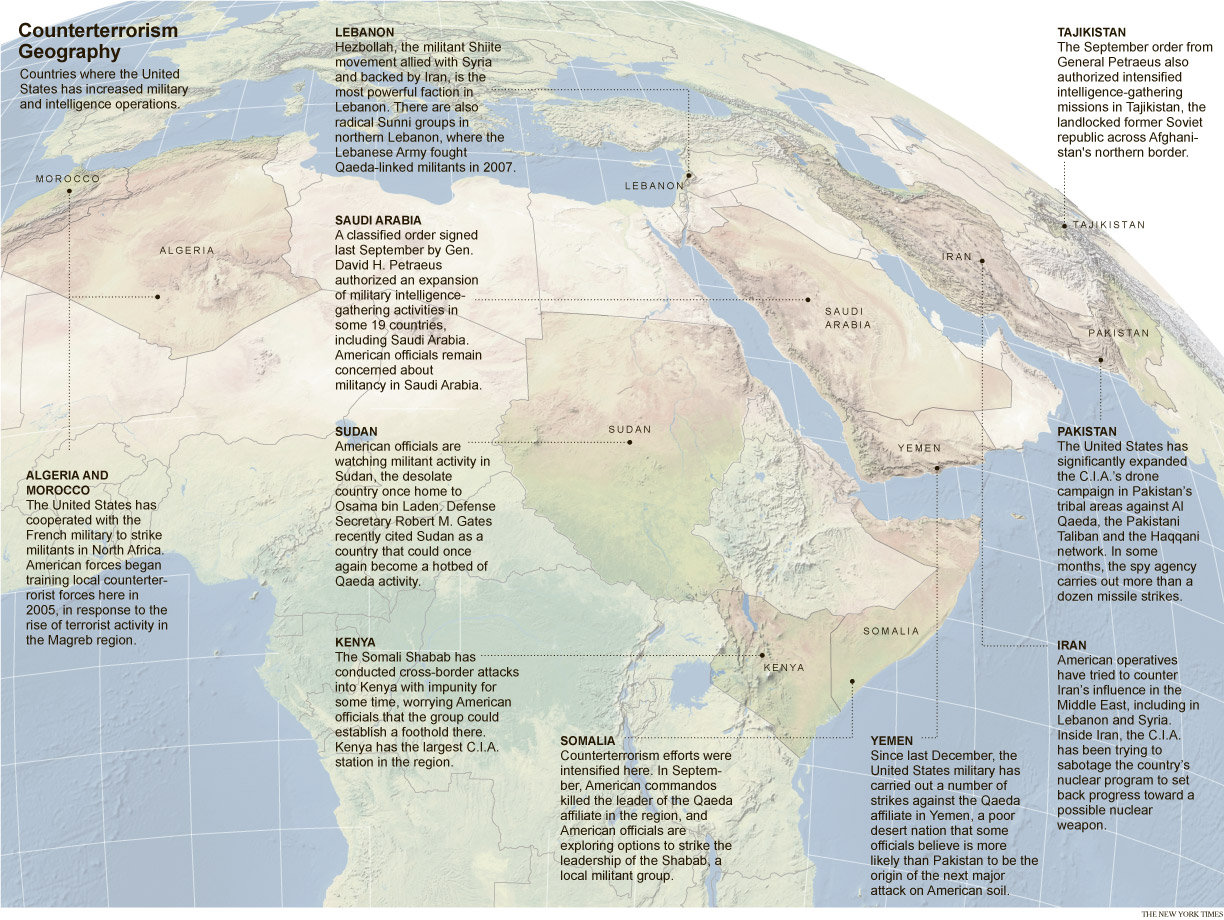
The attack offered a glimpse of the Obama administration’s shadow war against Al Qaeda and its allies. In roughly a dozen countries — from the deserts of North Africa, to the mountains of Pakistan, to former Soviet republics crippled by ethnic and religious strife — the United States has significantly increased military and intelligence operations, pursuing the enemy using robotic drones and commando teams, paying contractors to spy and training local operatives to chase terrorists.

The White House has intensified the Central Intelligence Agency’s drone missile campaign in Pakistan, approved raids against Qaeda operatives in Somalia and launched clandestine operations from Kenya. The administration has worked with European allies to dismantle terrorist groups in North Africa, efforts that include a recent French and Mauritanian strike near the border between Mauritania and Mali. And the Pentagon tapped a network of private contractors to gather intelligence about things like militant hide-outs in Pakistan and the location of an American soldier currently in Taliban hands.

While the stealth war began in the Bush administration, it has expanded under President Obama, who rose to prominence in part for his early opposition to the invasion of Iraq. Virtually none of the newly aggressive steps undertaken by the United States government have been publicly acknowledged.

This is why, when I divide up the "kids" between Leviathan and SysAdmin in the brief, I put the SOF triggers pullers with the Leviathan but shove the Unconventional Warfare guys (a misleading label because they're really the hearts-and-minds/milk-mil training crowd) into the SysAdmin pile.  My excuse:  I don't care to explain publicly what the trigger-pullers do--and neither does the USG.

But the larger point:  fine to do the nasty work on the nasty types, but that needs to be publicly balanced with highly transparent SysAdmin efforts, otherwise the shadow war starts to feel like a cynically maintained shadow empire of the "escape-from-New-York" variety--as in, we put a fence around bad countries and enter them at will primarily for the kinetics/killing.  

That is a defense but not a solution.  It's also morally unsustainable.

Obama has shown an amazing toughness on the kinetic side, acting far beyond his words.  But he's also shown a strong desire to "come home" when the SysAdmin stuff--in all its magnificent difficulty and frustrations--drags on to long.  That second instinct, when coupled with the USG's continued lack of strategic imagination regarding new allies and serious regionalization strategies (like in Afghanistan) makes us look still too unilateral and too cynical in our approach.

12:02AM

Connectivity creates boom market in outlier fatwas in Saudi Arabia

Too many opinionated, helping hands in the Kingdom, according to this WAPO story.

The details:

Abdullah has tried to curtail some of the powers of conservatives, including the religious scholars, and taken cautious steps to improve the situations of women and of Shiite Muslims, a religious minority in Saudi Arabia.

In June, however, the Saudi public was startled by a fatwa advocating that women breast-feed unrelated men to establish "maternal relations" and thus get around the Islamic prohibition on the mixing of the sexes. A few months earlier, another scholar had urged the killing of anyone who facilitated the mixing of men and women in workplaces and universities.

Those are extreme examples of a torrent of rulings on all aspects of life by Saudi scholars making the most of their recently acquired access to much wider audiences.

"Fatwas have become a huge problem, especially after satellite TV and the Internet," said Hamza al-Mozaini, a liberal newspaper columnist. "It has become something like a business for religious scholars, and they race to outdo each other."

As with any sudden onset of connectivity, the crazies quickly predominate--largely discrediting themselves in their aggregate nonsense. But the fear market is likewise there early on, so the King is right to move on this.

12:01AM

Chart of the day: India needs spectacular growth no less than China

WSJ front-pager.

Point to remember:  India needs to score in that magic 8 percent ranger to continue cranking enough new jobs--just like China.

In the West, I think we just don't appreciation what a grind that it for them, since we haven't been in that phase of growth for decades now (having matured).  But this is a huge deal for the planet:  between China and India we're talking about a billion and a half poor people that the West doesn't need to worry about--by and large.  They may be poor, but things are improving and there's no great unrest.  Absent the government efforts to make that fabulous growth happen, we could easily end up owning that aggregate problem on some level (aid or worse).

Something to remember as we contemplate our duty in helping run this world:  a huge chunk of responsibility has been taken off our plate by India's and China's rise, and all we have to do is shape their trajectory for the betterment of the world.

And these are good problems/challenges to have--as in, they beat the hell out of the alternative, especially since India and China joining the global economy gave it its critical mass over the pass couple of decades.

So I say, always err on the side of letting them have their way while they're pursuing this unbelievable collective good for the planet.  Push where we can, but always keep in mind what a win their twin rise represents for our international liberal trade order-cum-globalization.

12:10AM

Quelle surprise! State now freaks out over its just-assumed--and huge--SysAdmin job in Iraq

Unremarkable, I-told-you WAPO story about State realizing that it is unprepared for the SysAdmin role it's stepping into in Iraq.

Sad to say, but this may be the failure we're looking for in terms of eventually birthing the Department of Everything Else.

People always ask me what good thing needs to happen to bring it into existence, and my answer is always that it'll take the right bad thing.

Waiting on State's evolution here is a fool's errand.  I need my good cop (State) and I will always treasure my bad cop (DoD), but I need somebody in between to play midwife across the Gap as globalization remaps a lot of fake states (thank you Europe and Uncle Joe!).

State will freak out and then backtrack in its ambitions to the point of dissipating a great deal of what's been achieved with blood and treasure since the end of 2006, and that level of tragedy will trigger some intense debate.

I can hope for better from State and from the Iraqis themselves, but I am not optimistic.

And so the search for seriousness continues . . ..

12:09AM

Pakistan's government: always quick to blame the world for its inadequacies

WAPO story on how Pakistan (canubelieveit!) complains that the world's aid response to the recent flooding is inadequate. Granted, it's the nation's worst disaster, but it's also a clear sign of the government's near-failed-state status.  The clearest sign of a competent government is its ability to handle a system-perturbing event of this magnitude, and Pakistan is a lot closer to helpless than help-able.

I'm not saying Pakistan isn't correct, because, by recent measures (like Haiti's earthquake), it is being shortchanged, but I suspect a certain amount of that stinginess comes from the sense that Pakistan is an incompetent, ungrateful, hate-filled place as far as the West is concerned.  How much of that is true is obviously up for debate, but the argument cannot be dismissed out of hand--and yeah, those dynamics limit the love that comes back to you in your moment of need.

Of course, the US military steps up (a generosity that will be instantly forgotten) and--as usual--the lack of helos is the long pole in the SysAdmin tent.

I will naturally be accused of blaming the victim here, but when the victim is so willing to blame the responder, that sort of feedback is to be expected.  Nobody deserves this level of pain, but people, I have learned, tend to suffer and die the same way they love and live.  That's not karma; it's human nature.  A let's-all-pull-together place goes down fighting, while a let's-point-fingers place just goes down.  Granted, you can always blame the Brits for Pakistan's fake-state status, and you can always blame us for abusing the place plenty ever since, but Pakistan--in pockets--is a place of highly inventive and ambitious people who are nonetheless trapped in a nation-state cell with a collection of Gap populations that will not be dragged into the future without a huge fight.  America was once that state:  an ambitious and go-getting East simultaneously saddled with a crazy West that needed to be tamed.  We were fairly brutal in the latter process, and succeeded dramatically on that basis.  We were lucky to be relatively isolated from threats--unlike Pakistan, but that nation faces a very similar choice on which it has punted for decades now, preferring to nurture its hatred toward India and the West in general (the source of all its woes [at least those beyond that created by nefarious India], according to the nation's unreal conspiratorial mindset), and yeah, that narrow mindset comes back to haunt the place at moments like this--which is shameful for all sides but a cruel fact.

One can only hope the disaster pushes ordinary Pakistanis to expect better from their own government and not instinctively ask what the world owes it, because, quite frankly, the world is not in a good mood right now with regard to Pakistan, and to me, that's the real tragedy here.

12:08AM

The counter-argument: Pakistan's image in the West is a perversion of reality

To be fair to Pakistan after my mini-rant above, try this column from the Guardian (WPR Media Roundup).

The gist:

Compare and contrast: within days of the 2004 tsunami, £100m had poured into Oxfam, the Red Cross and other charities, and by February 2005 when the Disasters Emergency Committee (DEC) closed its appeal, the total stood at £300m. The Haiti earthquake appeal closed with donations of £101m. The DEC total for the Pakistan floods appeal has just reached £10m. .

The reasons for this disparity aren't complex. There has been a slow steady drip of negative media coverage of Pakistan since the 1980s, and if it lessened a little in the 90s as civilian governments went in and out of administration, it became inevitably tougher with the return of a military government, 9/11, the "growth" of Islamic extremist organisations in Pakistan, and the ins and outs of apparent ISI-sponsored terrorism in both Mumbai and Afghanistan. At home, Pakistan's image has been affected by debates about burqas, the bombings in London in 2005 and the country's perennial linguistic association with "terror".

Some good perspective at an angry moment in an angry relationship.

12:07AM

A good measure of social stress in China--and rising expectations

Great reporting piece in the NYT.

The guts:

Forget the calls by many Chinese patients for more honest, better-qualified doctors. What this city’s 27 public hospitals really needed, officials decided last month, was police officers.

And not just at the entrance, but as deputy administrators. The goal: to keep disgruntled patients and their relatives from attacking the doctors.

The decision was quickly reversed after Chinese health experts assailed it, arguing that the police were public servants, not doctors’ personal bodyguards.

But officials in this northeastern industrial hub of nearly eight million people had a point. Chinese hospitals are dangerous places to work. In 2006, the last year the Health Ministry published statistics on hospital violence, attacks by patients or their relatives injured more than 5,500 medical workers.

“I think the police should have a permanent base here,” said a neurosurgeon at Shengjing Hospital. “I always feel this element of danger.”

In June alone, a doctor was stabbed to death in Shandong Province by the son of a patient who had died of liver cancer. Three doctors were severely burned in Shanxi Province when a patient set fire to a hospital office. A pediatrician in Fujian Province was also injured after leaping out a fifth-floor window to escape angry relatives of a newborn who had died under his care.

Over the past year, families of deceased patients have forced doctors to don mourning clothes as a sign of atonement for poor care, and organized protests to bar hospital entrances. Four years ago, 2,000 people rioted at a hospital after reports that a 3-year-old was refused treatment because his grandfather could not pay $82 in upfront fees. The child died.

Such episodes are to some extent standard fare in China, where protests over myriad issues have been on the rise. Officials at all levels of government are on guard against unrest that could spiral and threaten the Communist Party’s power.

Doctors and nurses say the strains in the relations between them and patients’ relatives are often the result of unrealistic expectations by poor families who, having traveled far and exhausted their savings on care, expect medical miracles.

But the violence also reflects much wider discontent with China’s public health care system. Although the government, under Communist leadership, once offered rudimentary health care at nominal prices, it pulled back in the 1990s, leaving hospitals largely to fend for themselves in the new market economy.

By 2000, the World Health Organization ranked China’s health system as one of the world’s most inequitable, 188th among 191 nations. Nearly two of every five sick people went untreated. Only one in 10 had health insurance.

Over the past seven years, the state has intervened anew, with notable results. It has narrowed if not eliminated the gap in public health care spending with other developing nations of similar income levels, health experts say, pouring tens of billions of dollars into government insurance plans and hospital construction.

The World Bank estimates that more than three in four Chinese are now insured, although coverage is often basic. And far more people are getting care: the World Bank says hospital admissions in rural counties have doubled in five years.

“That is a steep, steep increase,” said Jack Langenbrunner, human development coordinator at the World Bank’s Beijing office. “We haven’t seen that in any other country.”

Still, across much of China, the quality of care remains low. Almost half the nation’s doctors have no better than a high school degree, according to the Organization for Economic Cooperation and Development. Many village doctors did not make it past junior high school.

Primary care is scarce, so public hospitals — notorious for excessive fees — are typically patients’ first stop in cities, even for minor ailments. One survey estimated that a fifth of hospital patients suffer from no more than a cold or flu. Chinese health experts estimate that a third to a half of patients are hospitalized for no good reason.

Once admitted, patients are at risk of needless surgery; for instance, one of every two Chinese newborns is delivered by Caesarean sections, a rate three times higher than health experts recommend.

Patients appear to be even more likely to get useless prescriptions . . ..

There are plenty of such Marxian dynamics on the road of rapid development--when rising expectations outstrip the ability of the state to respond.

And when that state is non-democratic, the public tends to go to extremes to express its displeasure.

12:06AM

SWFs as a way to protect national resource wealth from the government

Intriguing argument from a CSM op-ed:  African nations taking cue from Arab sovereign wealth funds. Argument: better to secretively stash the cash in a SWF that is kept distant from the bureaucrats' and politicians' corrupt hands.

The key logic:

The continent’s top oil exporters, and even some of its newcomers like Ghana, are taking advice from similarly resource-endowed countries that run state revenues through SWFs, many of them in the Middle East and Asia.

Some of Africa’s oil exporters, like Nigeria, have wrestled for decades on how to safeguard resource revenue at a distance from venal bureaucrats.

Other, more nascent oil powers, like Ghana, are simply trying to get their system right from the get-go.

Middle Eastern oil giants – whose money managers often tuck away state earnings in safe, if not transparent, investments – may be an example for the continent. "The model works well because they're relatively secretive. You can't say transparency is a golden ticket," Gary Smith, head of central banks, supranational institutions and SWF business at BNP Paribas Investment Partners, recently told Reuters in an analysts of Africa's entry into the SWF market.

A $3 trillion industry

An SWF is essentially a massive, state-held investment fund – something like a 401k for the Nigerian people – that invests in a smorgasbord of assets, whether they be property, currency, sacks of gold, or Goldman Sachs shares.

The one thing they don’t do – and this is where the controversy erupts – is invest that money at home. After all, the Ghanaian cedi, the Ghanaian interest rate, the competitiveness of Ghanaian exports, and the average price of a Ghanaian home, are all wed in sickness and health to the Ghanaian economy. Piping some of that oil money toward a far-off market is a way for the country to protect its revenue far from the vagaries of its national economy.

On one hand, a sad admission of a sad state of government affairs.  On the other, whatever gets the development train moving is a good thing.

For now, judgment withheld.  Africa doesn't have a good history of secretive money stashes overseas.

12:05AM

Central Asia's silk roads re-spun by China

image here

Nice sensible piece by Parag Khanna in the NYT.

Gist:

The fate of the massive deposits of lithium recently discovered in Afghanistan is destined to be no different from that of landlocked Central Asia’s other natural resources: tapped by the West, and eventually controlled by the East.

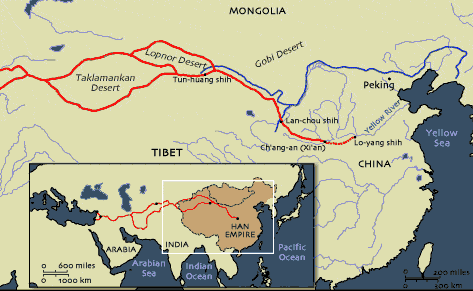
Siberian timber, Mongolian iron ore, Kazakh oil, Turkmen natural gas and Afghan copper are already channeled directly to China through a newly built East-bound network that is fueling the rapid development of the world’s largest population.

China’s head-start in building roads, railways and pipelines across Central Asia creates an opportunity for the West — and the region itself. Rather than engaging in a high-stakes competition for Central Asia’s valuable resources — a new round of the 19th century Great Game — the West should support China’s initial steps by coaching local governments on how to expand textile and agricultural exports and avoid the resource curse that blights many developing, one-commodity nations.

China has paved the way to finally open up landlocked Central Asia, and the West should build on its success, creating a new, oil-fueled, East-West Silk Road.

Oil pipelines from the Caspian Sea across Kazakhstan, the recently opened gas pipeline from Turkmenistan via Uzbekistan and Kazakhstan, and other planned roads and railways across Russia as well as down to the deep sea port of Gwadar in Pakistan are all part of China’s effort to turn Central Asia from a region of buffer states into a transit corridor between East and West. Beijing’s leaders have rightfully looked to Eurasia as a rich source of natural resources to fuel their booming economy.

Rather than think of China’s moves into Central Asia — and into Africa — as a suspicious form of neocolonialism, Western countries should focus on how to use Chinese-built roads and railways to make their own floundering regional strategy a success. This means cooperation rather than competition, and it can happen through heavy infrastructure investment, building new lines on the map that transcend arbitrary borders and bring real economic value.

As a longtime argument of mine (globalization:  "the last in, the next [phase of frontier integration] to begin"), I couldn't agree more.  I still spend a good chunk of my current brief arguing that we need to widen our perspective on potential allies in shrinking the Gap.  Lotsa times, I feel stupid still making this arguments almost a decade after I started using the slides, but this is still somewhat radical thinking in a US national security establishment that prefers its China as a threatening near-peer competitor. Why?  No China threat, no good argument on keeping the Leviathan fat dumb and happy in acquisitions while continuing to starve the SysAdmin.

12:05AM

A defining indication of Old Core evolution: women PhDs outnumber males

image here

WAPO story on new report that says, for the first time in history, the number of PhDs being granted to women outnumber those of men.

I've made this citation in the past:  when women outnumber men in big industries (like the law or medicine), then your economy has truly reached the apex of mature development.

My mom was pregnant ten times in the first twenty years or so of marriage with my dad.  When the babies stopped, she went on to three sequential careers in county social services, then the law, and finally (and still at 85) as an author.  Now, her long life gives her that amazing productivity (on both scales) and that surprising balance (two decades of cranking babies and four decades of work), so she's an avatar of what comes next (and this is a great point that George Friedman makes in "The Next 100 Years"): women go from maybe 50-70% of their adult lives being consumed by children-making and rearing--in the blink of an historical eye--to a fantastically lower child burden (like maybe as little as 10% of their possible working life since they have 1-2 kids and work for so long into their later years).  Just releasing all that potential is a social revolution in and of itself, and American-style globalization has an amazing ability to trigger that development.  

Any smart economist will tell you that the "miracle" of any nation's rapid rise ALWAYS involves turning the women onto labor opportunities outside the home.  That process is the most comprehensive nugget of a social revolution tale that you can locate in modernization/industrialization/globalization.

And when you reach the far-side accomplishment like the one cited here, you know you've basically completed the journey in terms of making opportunity balanced by gender.

I keep having to tell my kids that women lived very different and subordinate lives from about 10,000BC until around the time of my childhood (early 1960s) and then everything changed!  That alone makes this the most amazing time in human history, and thus, the best time in human history to be someone who tracks systemic change and thinks systematically about the future.

As a side note, that's why I find watching "Mad Men" so fascinating, because it captures all this in the before and edge-of-transformation sense.

And that's also why I'm a happy guy with two sons and four daughters.  I've always said that there is nothing in this life (save lifting heavy objects and fighting) that I'd rather do with guys than with women.

To sum up:  the journey from the Gap to the Core is one of demographic aging and feminization of leading service industries (like law, education, medicine).

12:03AM

The sheer discovery that is simply analyzing all this new connectivity

Cool Economist piece on the social web in its Technology Quarterly, but it's really about business intelligence, a field that is skyrocketing in its ability to monitor, analyze and create new marketing strategies from the wealth of info that is naturally captured by online behavior.  Similar thing is coming down the pike in the healthcare industry with the advent of electronic medical records--huge bonanza.

In the first instance, a lot of biz intell used to simply keep existing customers by making them happier.  The most sophisticated stuff will be used to sniff our fraud and criminal behavior.

A classic example of an old concept of mine--actually the heart and soul of the "new map":  with connectivity comes circumscribed behavior because each connection reveals you to others, but in return you are offered fabulous access and efficiencies and the more tailored meeting of your desires.  It is a transaction: the more you reveal, the more respondents can predict your needs and wants and behaviors--both good and bad.

And the mapping technology (like my wonderful Google maps on my Motorola Droid) only kicks that process into high gear.

An amazing amount of new rules to work out on all of this--a fascinating process to witness in coming years.

12:02AM

Rapid connectivity creates more suspicions than understanding

Old strawman given another good beating:  connectivity doesn't instantly heal all wounds!

Economist story on how social media doesn't change people over night by exposing them to different people and creating instant wisdom.

(sigh!)

It turns out, research shows, that "people are online what they are offline: divided, and slow to build bridges."

I'm actually more pessimistic than that:  I believe that rapid connectivity gains generally create more unrest than peace at first.   That's why I called it the "Pentagon's new map."

Piece concludes that the Internet is just a tool, and as such, does nothing on its own.

My take:  sheer connectivity on its own does not trump real-world experience or generational weight, so expect the change to be gradual versus instant.  The Millennials will not be the Boomers, but they will not replace them overnight thanks to social media, and each country's version of the first-all-digital-generation will make its influence and thinking felt on a different timescale.

In other words, even in this connected age, change typically arrives no faster than we can handle it, because if it comes too fast, we simply ignore it and render its impact meaningless.

12:01AM

Chart of the Day: the growing problem of Saudi joblessness

FT story on growing domestic backlash to the guest worker economy there:

When a survey by HSBC bank revealed that expatriates working in Saudi Arabia were among the world's wealthiest, with disposable incomes allowing them to buy luxuries such as yachts, many citizens of the kingdom were furious.

Newspaper columnists, readers and social media users lamented the money that they believed foreigners were skimming off Saudis, portraying expatriates as wallowing in luxury while the country struggles with unemployment.

"We are not surprised,  Foreigners control all retail business, grocery stores . . . They are given facilities and priority, killing all job prospects for Saudis," wrote Rashid al-Fawazan in Riyadh, a newspaper.  "Nine million foreigners are bleeding the country dry.  We don't even have real industry which forces investors to train our young people."

Lot of hype here, as most guest workers early about $150--a month! (must be toy yachts), but here's a $375b economy, the biggest in the Arab world, and it still has official unemployment of 10-11 percent (I would bet the underemployment is far larger).

Two-thirds of Saudis are under 30, indicative of the larger demographic wave working its way into its working years all across the Middle East and North Africa, where the standard prediction is the need for job creation on the scale of 100m jobs over the next two decades.

Meaning . . . this is just the tip of the social unrest iceberg--unless the job creation follows.

The youth bulge of the Middle East inevitably becomes the middle-age bulge of the Middle East, meaning a lot of certain types of behaviors (crime, terror, restlessness) should naturally go down IF the job creation absorbs those numbers.  Saudi Arabia shoots itself in the foot by having two labor rule sets:  one for Saudis (hard to fire, for example) and one for foreigners.  Then there's the issue of unrealistic expectations among new Saudi college graduates, who feel they deserve a management slot from the get-go.  The entitlement mindset going back to the original oil booms persists, say observers.  And let's not forget the ban on women and men working together--a huge obstacle.

As one local banker/economist put it:  "How can you create jobs for Saudis if they do not want to join the private sector, and the private sector does not want them?"

The gov keeps telling the private sector to hire more Saudis, but it seems to be unrealistic in its expectations, given the lack of social change and accompanying rule-sets.  Abdullah needs to pick up the pace.

8:34AM

Crowdsourcing request: interview subjects for cyber governance

For a side writing project I'm working on, I'm looking to do some interviews (either by email or phone) on the subject of cyber governance.

What interests me:  What are the models out there in the real world for doing this?  What's the experience base of success and failure?  What are the major schools of thought?  Where is this debate heading and what does the future of cyber governance look like--especially as we migrate from the early perceptions of a totally free Web to something more fenced off?

You can either submit a comment or just email me at thomaspmbarnett@mac.com.

Trying to wrap this up quickly, so speak up if you want a conversation.  Nobody needs to know everything; just make sure you've got something to say or can get me someone with an interesting perspective/experience base.

Likewise, if you know of some great citation on the subject, pass it along.

12:10AM

State on top! No, Big Business back on top! No, tougher state rules!

So much back and forth on who's ruling the universe--states or big business.

Strong arguments that states take the upper hand as a result of the global financial crisis (like Bremmer's book, "The End of Free Markets"), but now that the dust settles (to include, apparently, last-minute changes to Basel III that make that new banking rule-set seem more robust), we get arguments saying that not all that much has changed.

From an FT full-pager analysis by Patrick Jenkins and Edward Luce:

On some level, it seems the best of both worlds:  pols confident of their new rules and bankers not feeling too unduly hemmed in.

Only time will tell, but clearly, not nearly the great or permanent shift predicted by many--meaning Bremmer's actual conclusions inside the book hold up better than the bold title on the cover.

Still, I would expect perceptions of who's "winning" to shift back and forth repeatedly in the months ahead, with all sorts of conflicting analysis--meaning only time will tell.

12:09AM

Japan: apparently no de-globalization as it ages?

Special FT insert on Japan's business climate.

Two things I took note of:  Gov seeks to lure foreign investors (not a usual headline re: Japan) because it realizes "that the country has come to rely on the outside world to support growth"; and banks looking to expand externally to counter stagnate growth at home.

Point being: Japan's demographic decline isn't making its business climate less open but just the reverse.  The biz community and government see an even more compelling logic for deeper connection with the global economy.