
Buy Tom's Books
  • Great Powers: America and the World After Bush
    Great Powers: America and the World After Bush
    by Thomas P.M. Barnett
  • Blueprint for Action: A Future Worth Creating
    Blueprint for Action: A Future Worth Creating
    by Thomas P.M. Barnett
  • The Pentagon's New Map: War and Peace in the Twenty-first Century
    The Pentagon's New Map: War and Peace in the Twenty-first Century
    by Thomas P.M. Barnett
  • Romanian and East German Policies in the Third World: Comparing the Strategies of Ceausescu and Honecker
    Romanian and East German Policies in the Third World: Comparing the Strategies of Ceausescu and Honecker
    by Thomas P.M. Barnett
  • The Emily Updates (Vol. 1): One Year in the Life of the Girl Who Lived (The Emily Updates (Vols. 1-5))
    The Emily Updates (Vol. 1): One Year in the Life of the Girl Who Lived (The Emily Updates (Vols. 1-5))
    by Vonne M. Meussling-Barnett, Thomas P.M. Barnett
  • The Emily Updates (Vol. 2): One Year in the Life of the Girl Who Lived (The Emily Updates (Vols. 1-5))
    The Emily Updates (Vol. 2): One Year in the Life of the Girl Who Lived (The Emily Updates (Vols. 1-5))
    by Thomas P.M. Barnett, Vonne M. Meussling-Barnett
  • The Emily Updates (Vol. 3): One Year in the Life of the Girl Who Lived (The Emily Updates (Vols. 1-5))
    The Emily Updates (Vol. 3): One Year in the Life of the Girl Who Lived (The Emily Updates (Vols. 1-5))
    by Thomas P.M. Barnett, Vonne M. Meussling-Barnett
  • The Emily Updates (Vol. 4): One Year in the Life of the Girl Who Lived (The Emily Updates (Vols. 1-5))
    The Emily Updates (Vol. 4): One Year in the Life of the Girl Who Lived (The Emily Updates (Vols. 1-5))
    by Thomas P.M. Barnett, Vonne M. Meussling-Barnett
  • The Emily Updates (Vol. 5): One Year in the Life of the Girl Who Lived (The Emily Updates (Vols. 1-5))
    The Emily Updates (Vol. 5): One Year in the Life of the Girl Who Lived (The Emily Updates (Vols. 1-5))
    by Vonne M. Meussling-Barnett, Thomas P.M. Barnett, Emily V. Barnett
Search the Site
Powered by Squarespace
Monthly Archives
12:06AM

Explaining China's growing reliance on national flagship companies

NYT story by Michael Wines notes World Bank data saying the China's state sector, after years of declining share of the national economy, is starting to edge back up:

During its decades of rapid growth, China thrived by allowing once-suppressed private entrepreneurs to prosper, often at the expense of the old, inefficient state sector of the economy.

Now, whether in the coal-rich regions of Shanxi Province, the steel mills of the northern industrial heartland, or the airlines flying overhead, it is often China’s state-run companies that are on the march.

As the Chinese government has grown richer — and more worried about sustaining its high-octane growth — it has pumped public money into companies that it expects to upgrade the industrial base and employ more people. The beneficiaries are state-owned interests that many analysts had assumed would gradually wither away in the face of private-sector competition.

New data from the World Bank show that the proportion of industrial production by companies controlled by the Chinese state edged up last year, checking a slow but seemingly inevitable eclipse. Moreover, investment by state-controlled companies skyrocketed, driven by hundreds of billions of dollars of government spending and state bank lending to combat the global financial crisis.

Besides the obvious explanation of the huge stimulus package, I would cite three other key trends:

1) the push to jump-start industrial development of the second-tier cities;

2) Beijing's fears about access to raw materials means it's pushing national companies to lock-in a lot of assets while it has the bank account to do so; and 

3) the shift to trying to rely more on domestic demand has incentivized Beijing to champion national flagship companies (however "red" their affiliation) at home so as to be able to dominate expanding market spaces.

These are all great temptations and normal strategies for this point in China's developmental trajectory.  Will they overcome the general trend toward more reliance on markets?  Perhaps for a while but then these strategies will contribute to an overall stagnation of growth simply because they favor the inefficient over the more efficient.

But here the thing to remember:  most development paths consist of two steps forward and one step back. Linear projections are always wrong.

12:05AM

The one-and-a-half state solution continues to emerge

image here

We're seeing this same story again and again over recent months: Israel is internally conflicted on how to make peace with Palestine in general and clearly has plenty of reason to resist any accommodation with Hamas in Gaza, and yet, a viable state and partner continues to emerge in the West Bank:

Rather than cursing the Israeli occupation, Palestinian Prime Minister Salam Fayyad, a former World Bank executive, has shifted the focus to building up the Palestinian state. Fayyad's government has improved security -- as Israeli army generals have acknowledged -- and the rule of law while also introducing far-reaching reforms in education, health and the economy. In its annual report on assistance to the Palestinian people, the U.N. Conference on Trade and Development estimates that gross domestic product in the occupied territories rose 6.8 percent in 2009. The recently unveiled second-year phase of this plan is titled "home stretch to freedom."

Palestinians have launched a public relations campaign, "I am a partner," aimed at the Israeli public. Featuring key Palestinian negotiators, it seeks to debunk the myth that there are no peace partners on the Palestinian side.

Geographically split states just don't work--outside of federated, networked America, that is.  At some point, it just seems to make sense that Israel will cut some deal with the WB and reduce its Palestinian problem to just Gaza.  The West Bank, by most accounts, is doing everything possible to make this an inevitability through internal development that'll need just some reasonable accommodation from Israel to make it far more robust.

So the question becomes, What does it take for Israel to split that difference for good?  Forget the big outline. Just tell me how this thing works in the WB.

12:04AM

Basel III derided further

Ft full-pager says Basel III et al will have the cumulative impact of driving investment money from banks to non-banks.  The killer quote from an expert on financial regs:  "It's now one-third more expensive to do business with banks, a powerful incentive to use non-banks" like hedge funds and other entities.

So the question becomes, how much of the money will escape "sectoral regulation."

A found description of non-bank lending:

Non-Bank Lending

Non-banks are ordinary intermediaries.  They act as a conduit between those with funds to lend and those in need of funds.  By pooling the funds of investors from whom they borrow, they can then lend in various amounts and periods.  For their service they charge a fee, usually in the form of periodic interest payments.  Their borrowing and lending increases the total credit market debt but has no direct effect on the money supply.  Non-banks simply intermediate the transfer of funds from the bank accounts of the original investors to the bank accounts of the ultimate borrowers.  

Non-banks usually borrow short-term at lower rates to lend longer term at higher rates.  That means a non-bank must be able to roll over its short-term debt at favorable rates.  It must also be able to borrow on short notice to manage any cash flow problem.  For that reason it must maintain an excellent credit rating, or it may not be able to borrow at all.  

A general rule:  for every crisis there is a new rule set, the response to which (either going overboard or escaping its grasp) usually sets the table for the next crisis.  Such is life.

Martin Wolf is among those unimpressed by Basel III, describing it as "the mouse that did not roar" (a great Peter Sellers' film):

To celebrate the second anniversary of the fall of Lehman, the mountain of Basel has laboured mightily and brought forth a mouse. Needless to say, the banking industry will insist the mouse is a tiger about to gobble up the world economy. Such special pleading – of which this pampered industry is a master – should be ignored: withdrawing incentives for reckless behaviour is not a cost to society; it is costly to the beneficiaries. The latter must not be confused with the former. The world needs a smaller and safer banking industry. The defect of the new rules is that they will fail to deliver this.

His basic complaint is that the amount of equity required is "far below" the levels markets would naturally demand if there was no chance of government bailout--so bad pricing of risk.  He then makes a case for much higher levels that he says wouldn't crimp the industry as much as feared.

12:03AM

Obama's stealthy education reform?

Jonathan Alter in Newsweek making the case that "U.S. education reform has made more progress in the last year than in the previous 10" and "how the president is driving the effort."

Cheesy start (the movie "Jackass" as feeble straw man) mars the piece.

The cited "engine of reform" is Obama's Race to the Top program.  Small pot of money but successful, says Alter, in establishing national standards and lifting state caps on charter schools.

Other details covered, but political case made is that it took a "Nixon" (liberal Dem) to effectively do battle with teachers' unions.

To be watched . . ..

12:02AM

Brief Reminder: The eternal quest for system equilibrium

As I remember, the concluding slide of my original, fully-formed Office of Force Transformation brief.

A twin-pitch:  understand that our national security establishment is now all about handling (and sometimes delivering) shocks to the system in which the kinetics are typically vastly subordinate to sheer disruption (business continuity is king) and understanding that our bodyguarding role WRT globalization is NOT about stopping structure-changing flows but enabling them in the right, evening-out mix.

12:02AM

Blast from my past: "Mr. President, Here's How to Make Sense of Our Iraq Strategy" (2004)

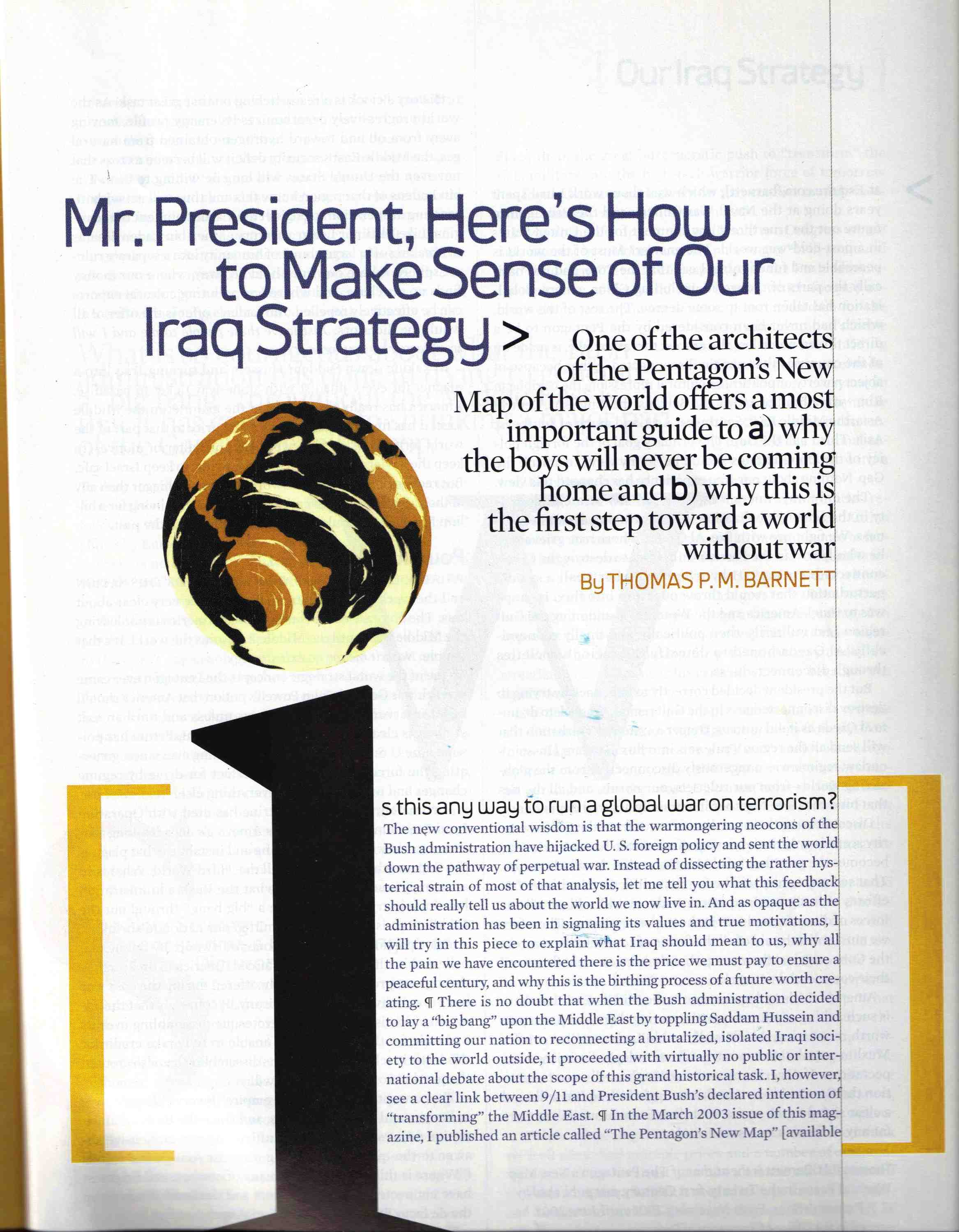
Mr. President, Here's How To Make Sense Of Our Iraq Strategy

One of the architects of the Pentagon’s New Map of the world offers a most important guide to a) why the boys will never be coming home and b) why this is the first step toward a world without war

By Thomas P. M. Barnett

EsquireJune 2004, pp. 148-54


Is this any way to run a global war on terrorism? The new conventional wisdom is that the warmongering neocons of the Bush administration have hijacked U. S. foreign policy and sent the world down the pathway of perpetual war. Instead of dissecting the rather hysterical strain of most of that analysis, let me tell you what this feedback should really tell us about the world we now live in. And as opaque as the administration has been in signaling its values and true motivations, I will try in this piece to explain what Iraq should mean to us, why all the pain we have encountered there is the price we must pay to ensure a peaceful century, and why this is the birthing process of a future worth creating.

There is no doubt that when the Bush administration decided to lay a “big bang” upon the Middle East by toppling Saddam Hussein and committing our nation to reconnecting a brutalized, isolated Iraqi society to the world outside, it proceeded with virtually no public or international debate about the scope of this grand historical task. I, however, see a clear link between 9/11 and President Bush’s declared intention of “transforming” the Middle East.

In the March 2003 issue of this magazine, I published an article called “The Pentagon’s New Map” [available at Esquire.com/barnett], which was about work I had spent years doing at the Naval War College and the Pentagon to figure out the true threat environment for the United States in a post-cold-war world. The answer? Most of the world is peaceable and functioning. I call that the Core, and it is basically the parts of the world, including China, where globalization has taken root to some degree. The rest of the world, which had never been considered by the Pentagon to be a direct threat, much less the gravest threat we face, is made up of the countries that remain disconnected, either because of abject poverty or political or cultural repression: the Caribbean Rim, virtually all of Africa, the Balkans, the Caucasus, Central Asia, the Middle East, Southwest Asia, and much of Southeast Asia. This I call the Gap. The primary goal of the foreign policy of the United States should be, in my view, to shrink the Gap. Nothing about our Iraq experience has changed this view.

The only way America can truly achieve strategic security in the age of globalization is by destroying disconnectedness. We fight fire with fire. Al Qaeda, whose true grievances lie wholly within the Persian Gulf, tried to destroy the Core’s connectedness on 9/11 by triggering what I call a system perturbation that would throw our rules into flux. Its hope was to shock America and the West into abandoning the Gulf region first militarily, then politically, and finally economically. Al Qaeda hoped to detoxify the region’s societies through disconnectedness.

But the president decided correctly to fight back by trying to destroy disconnectedness in the Gulf region. We seek to do unto al Qaeda as it did unto us: trigger a system perturbation that will send all the region’s rule sets into flux. Saddam Hussein’s outlaw regime was dangerously disconnected from the globalizing world—from our rule sets, our norms, and all the ties that bind the Core together in mutually assured dependence.

Disconnecting the great disconnector from the Gulf’s security scene is only the beginning of our effort, because now Iraq becomes the great battle field for the soul of the whole region. That second victory will be far more difficult to achieve. Our efforts to integrate Iraq into a wider world will pit all the forces of disconnectedness in the region against us. Therefore we must enlist the aid of all the forces of connectedness across the Core—not just their troops but their investment flows and their commercial networks.

America needs to demonstrate to the Middle East that there is such a thing as a future worth creating there, not just a past worth re-creating, which is all the bin Ladens will ever offer Muslim populations—a retreat from today’s diminished expectations. If America cannot muster the will—not to mention the Core’s aid—to win this struggle in Iraq, we will send a clear signal to the region that there is no future in the Core for any of these states, save Israel.

History’s clock is already ticking on that great task. As the world progressively decarbonizes its energy profile, moving away from oil and toward hydrogen obtained from natural gas, the Middle East’s security deficit will become a cross that not even the United States will long be willing to bear. The bin Ladens of that region know this and thus will act with increasing desperation to engineer our abandonment of the region. Like Vladimir Lenin a century earlier, bin Laden dreams of breaking off a large chunk of humanity into a separate rule-set sphere, where our rules hold no sway, where our money finds no purchase, and where our polluting cultural exports can be effectively repelled. Bin Laden’s offer is the offer of all would-be dictators: Just leave these people to me and I will trouble you no further.

By taking down Saddam Hussein and turning Iraq into a magnet for every jihadist with a one-way ticket to paradise, America has really thrown down the gauntlet in the Middle East; it has finally begun exporting security to that part of the world for real. In the past, we always had ulterior motives: to keep the Soviets out, to keep the oil flowing, to keep Israel safe. But reconnecting Iraq to the world is so much bigger than any of those goals. It is about creating a future worth living for a billion Muslims we could just as easily consign to the past.

Powell Doctrine, R.I.P.

What does this new approach mean for this nation and the world over the long run? Let me be very clear about this: The boys are never coming home. America is not leaving the Middle East until the Middle East joins the world. It’s that simple. No exit means no exit strategy.

One of the worst strategic concepts the Pentagon ever came up with was General Colin Powell’s notion that America should never intervene militarily overseas unless and until an exit strategy is clearly defined. The legacy of that dictum has poisoned the U. S. military’s strategic planning ever since, generating the force we have today—perfect for drive-by regime changes and understaffed for everything else.

Fortunately, the Powell doctrine has died with Operation Iraqi Freedom, and with it dies America’s decades-long tendency to blow off all the suffering and instability that plagues the Gap, or what we used to call the Third World. What is so amazingly courageous about what the Bush administration has done in trying to generate a “big bang” throughout the Middle East is that it has committed our nation to shrinking a major portion of the Gap in one fell swoop. By doing so, I believe this administration has forced America to finally come through on promises repeatedly offered during the cold war but never delivered upon. The irony, of course, is that the administration is guilty of such grotesque dissembling over its rationale for the war that it is unable to fully take credit for this historic achievement. And its dissembling has also aroused the passions of the empire crowd.

The concept of an “American empire” is very chic right now in literary and academic circles, and since the Bush administration never seems to offer a sufficiently comprehensive answer to the question weighing on most Americans’ minds (“Where is this all leading?”), many of our best and brightest have connected the relevant dots and declared Washington the de facto Rome of a new imperial age.

This is all nonsense and bad history to boot. Empires involve enforcing maximal rule sets, in which the leader tells the led not just what they cannot do but what they must do. This has never been the American way of war or peace and does not reflect our system of governance. We enforce minimum rule sets, carefully ruling out only the most obviously destructive behavior. Our goal must be to extend the Core’s security rule set into the Gap and, by doing so, shrink the Gap progressively over time. This is not about extending America’s rule but about extending the genuine freedom that collective security provides. All this talk about empire mistakenly seeks to impose a nineteenth-century simplicity upon a twenty-first-century complexity. In short, this era’s version of globalization comes with rules, not a ruler. To deny that achievement is to discount the vast improvement America brought to the system administration of globalization following World War II compared with earlier, deeply flawed efforts by Europe’s monarchies—Britain included.

There is no doubt that many governments in the Core still view the world system as a balance of powers, and so any rise in U. S. influence or presence in the Middle East is seen as a loss of their influence or presence there. Too many of these “great powers” are led by small minds who prefer America’s failures to the Core’s expansion, because they perceive their national interests to be enhanced by the former and diminished by the latter. They prefer the Gap’s continued suffering to their own loss of prestige, and they should be ashamed of their selfishness.

But America is far from alone in this great historical quest. As we realign our global military-basing structure to better reflect our continuing role as military Leviathan throughout the Gap, we leave behind old friends in Western Europe and embrace new ones in Eastern Europe. We increasingly trust East Asia to police itself while we export security to West Asia. We even go so far as to imagine and work toward future bases sprinkled throughout the African continent, a region long abandoned by the West to suffer decades of endemic conflict and disease.

The New Strategic Paradigm: Disconnectedness Defines Danger, or, Kiss Those Dictators Goodbye

So, why all the dissembling on the part of our political leadership? Well, the truth is, we are just coming to terms with a new grand strategy for the United States, the historical successor to containment, and our government doesn’t yet have the words to explain this vision to the world. So we come off as dishonest, which is a terrible mistake, because this vision describes a future worth creating: making globalization truly global. This is something to be proud of, not something to run from.

The defense community spent the entire post-cold-war period scanning the strategic horizon, desperately searching for the fabled “near-peer competitor” that would someday replace our late beloved foe, the Soviet Union. About eight years ago, most defense strategists fell in love with China, convincing themselves that here was an enemy worth plotting against. Since then, the great bureaucratic push to “transform” the U. S. military into the high-tech warrior force of tomorrow has focused almost exclusively on that conflict model—basically China’s invasion of Taiwan in 2020.

It was a beautiful dream, one easily sold to a Congress whose only interest in national-security planning is “Will you build it in my district?” It also corresponded to the Bush administration’s view of the world prior to 9/11, which focused exclusively on great powers while expressing disdain for the Clinton administration’s feeble attempts at nation-building in Third World wastelands. Frankly, it made everyone in Washington happy, because casting China as the future enemy provided the national-security establishment with a familiar villain: big, bad, and communist.

Naturally, the defense and intelligence communities reshaped themselves for this “new” challenge. We hired China experts by the barrelful and scripted all our war games to feature a large, unnamed Asian land power with an unhealthy interest in a small island nation off its coast. You want to know why we don’t have a clue about what goes on inside the Gap? Because our military strategists spent a decade dreaming of an opponent that would not arise, for a war that no longer existed. We’re the drunk looking for his lost car keys under the streetlamp instead of near his car a block away, because “the light’s better over here.”

The new rule set here is a simple one: We need to refocus all of our war-planning and intelligence systems from the Core to the Gap. This doesn’t mean we still don’t maintain a hedge against possible Chinese mischief. It just means a new strategic paradigm rules the roost: Disconnectedness defines danger. You want to locate the real danger in the system? Focus on those countries or regions most disconnected from the global economy, not those desperately working to integrate themselves with the outside world—like China.

What the intelligence failures on Iraq and al Qaeda should tell the Bush administration (and any that follow) is that it’s time to get explicit with the American people and the world about how there are simply two very different security rule sets in the world today: one that corresponds to the stable and overwhelmingly peaceful Core, and another that corresponds to the violence-ridden and increasingly unstable Gap. What scares most people about the Iraq war is the sense that the Bush administration lied to them in order to whip up sufficient popular support for taking down Saddam Hussein. The White House comes off like the cop who yells out, “He’s got a gun” and then airs out the “suspect” with a barrage of shots, only to discover later that he was just pulling out his wallet.

Without reopening the entire debate on Saddam, who I think we’ll all admit had multiple priors and a number of outstanding warrants for his arrest, just take a minute and ask yourself why this administration felt it needed to hype its case for “present danger” to such an unseemly degree. The majority of Americans had already expressed support in polls for removing Saddam simply because of all the bad things he had done and continued to do to his people. So why all the unnecessary drama?

I’ll tell you why. The international system today lacks any sort of recognized institutional rule set for processing a politically bankrupt state. We have one for economically bankrupt states, and it’s called the IMF bailout and rehab process. We may argue incessantly about that rule set, but at least we’ve got one. So when an Asian financial “flu” disabled a number of states in 1997, the system processed that entire crowd within a couple of years.

What do we have for the Saddams and Mugabes and Kim Jong Ils of the world? Just a toothless UN Security Council whose only “weapon” is sanctions that inevitably kill innocent civilians while doing nothing to change the behavior of the regime. The UN is at best a legislative branch for the global community, whereas the U. S. is clearly the closest thing we have to an executive Leviathan able to prosecute criminal actors across the system.

The new rule set on this one is relatively straightforward but difficult to achieve; we need an IMF-like international organization that is set up to process dangerous Gap leaders who have ruled beyond their expiration date. It’s not a long list, but imagine how much better a world we’d have if we could somehow manage to ditch all these dictators in a manner the entire Core could buy into—even the French.

As for the American public, what the intelligence failure on Iraq should translate into is a new and frank understanding of the limits of arms control. Again, different worlds (Core, Gap) require different rule sets on security. Getting any state from the Gap into the Core means, first and foremost, getting that state to accept the Core’s fairly clear rule on security with regard to WMD—basically “just say no.” I know it’s hypocritical for nuclear powers to tell smaller states to “Do as I say, not as I do,” but on WMD I think that it’s better to err on the side of order over justice.

What Americans need to understand about the potential (and real) proliferation of WMD inside the Gap is that all the arms-control treaties in the world won’t do a damn thing to stop it. All such treaties reflect the conventional wisdom of life inside the Core, where mutually assured destruction has basically ended great-power war. That logic, or that security rule set, simply does not penetrate the Gap. So when states or transnational actors inside the Gap make moves in the direction of acquiring WMD, the new security rule set called preemptive war not only makes sense, it is imperative. If the Core lets the Gap’s lawlessness on WMD infect our long-standing stability on nuclear, chemical, and biological weapons, then we will be doing nothing less than throwing away the cold war’s most important peace dividend.

Pentagon vs. Pentagon: Why We Will Soon Have Two Militaries, Not One

The second reason why so much of the world is unhappy with the current state of affairs in Iraq is that it’s now clear that the Bush administration did a terrible job of thinking beyond Saddam’s takedown. In effect, it is guilty of planning for war within the context of war when it should have been planning for war within the context of everything else. This is an acute and continuing problem for President Bush himself, who has gone so far as to color his reelection campaign with the imagery of his being a “war president,” when both the public and the world at large clearly want evidence that his administration isn’t myopically focused on this global war on terrorism but instead has learned to locate that much-needed security effort within the larger political, social, and economic context of globalization’s advance—or everything else.

Don’t get me wrong. I don’t lay all the blame for this sad state of affairs on the Bush administration alone. The Pentagon has spent the last decade and a half willfully ignoring its growing workload throughout the Gap. We’ve spent the entire post-cold-war period engaging in what are derisively known throughout the defense community as “military operations other than war” (MOOTW, or Moo-twah to insiders), and yet we have adamantly refused to rebalance our forces—especially our National Guard and Reserves—to account for this dramatic uptick in the Gap’s demand for our services. Simply put, we currently have a military that can do two or three Saddam-style takedowns every year but cannot pull off even one Iraq-style occupation.

But that is changing rapidly, and for the better. Already, senior Defense Department leaders are pushing for the creation of a “stabilization force” component within the U. S. military. A year ago, such a proposal would have been summarily rejected, but today it strikes most serious defense analysts as a crucial task of defense transformation. In this new era, our military interventions will be judged primarily by whether or not we leave the country more connected to the outside world than we found it, not whether we generate an instant democracy or win the war in record time.

The importance of this new direction within the Pentagon cannot be overstated, because it signals a “back to the future” outcome that will return America’s national-security establishment to the structure that served our nation so well prior to the historical aberration known as the cold war. Before we created the all-encompassing Department of Defense in 1947, America had two very distinct security establishments at its disposal: a Department of War and a department of everything else called the Department of the Navy. The War Department served as the “big stick” force that we busted out as required, while the Navy Department (especially the embedded Marines) served primarily as the “baton stick” force that we employed around the world on a regular basis.
Why did America fuse these two entities into a unified whole? As the cold war was beginning, defense strategists correctly foresaw a decades-long hair-trigger standoff with the Soviets over nuclear weapons. In effect, national defense (War Department) and international security (Navy Department) became interchangeable and virtually indistinguishable; to defend America was to deter the threat of global nuclear Armageddon.

As one small part of humanity that survived the madness of the cold war, let me be the first to applaud that historic decision. But let’s be clear: The dangers to system stability that we face today do not involve global nuclear war among great powers; they involve undeterrable rogue regimes and transnational actors located exclusively inside the Gap, with the exception of the cold-war tailbone known as North Korea.

What the Iraq occupation is making clear throughout the defense community is that we currently have a Department of War and a Department of Everything Else—the latter underfunded and overworked—coexisting uncomfortably inside the Department of Defense. Over time, a great divorce will occur because no house divided against itself can long stand. This progressive bifurcation of the U. S. military into a Leviathan force focused on waging wars and a System Administrator force focused on winning the peace has been years in the making, but it took the painful lessons of Iraq to really get the ball rolling.
What this splitting of the force will mean to future presidential administrations is clear: greater flexibility in dealing with the world as we find it. The Leviathan force will remain your father’s military: testosterone-fueled, lethal, and not subject to civilian law. The Sys Admin force will end up being more your mother’s military: supportive, nonlethal, and willing to submit to recognized authorities such as the International Criminal Court and the UN—Teddy Roosevelt meets Woodrow Wilson.

What this bifurcation offers the rest of the world is twice as many opportunities to contribute to America’s current scattershot efforts to export security throughout the Gap. The Leviathan is the classic come-as-you-are coalition of the willing, and since this flies-on-eyeballs crowd will feature Special Operations Forces as the pointy end of its spear, any nation able and willing to contribute its own small contingent of tough hombres can join this bandwagon on a first-come, first-to-serve basis.

But contributing to the war-fighting half of the pie won’t be the only way to gain a seat at the table, because the follow-on Sys Admin effort will allow those nations unwilling to field combat forces in certain situations to nonetheless participate in the peacekeeping force that must necessarily stand watch over the longer haul. Having both forces is crucial for this reason: There is a strong temptation for any administration—especially the pointlessly vindictive Bush White House—to tell allies that if they do not join in the war effort, they cannot participate in the rebuilding that follows. What having both forces means is that we will be able to tell potential allies not only to “come as you are” for the war but also to “come when you can” for the peacekeeping.

As we have learned in Iraq, America can lose about 150 soldiers in six weeks of combat and/or lose about 500 soldiers to terrorism to date in the ensuing occupation. Either way, it hurts just the same. If any country is willing to help out on one side of the war-peace equation, we should simply be grateful for the sacrifice offered, not picky about the timing.

Here’s what this splitting of the U. S. military means to the American people: The National Security Act of 2005 tentatively sits on the far side of this national election. I fully expect that if Bush is reelected, this piece of legislation will be profound, moving America down the pathway of seriously reordering its national-security establishment for the better. Does that mean a Kerry administration wouldn’t do the same? Not at all. In fact, that administration may well be the far better choice to pull off such a dramatic reorganization, given the growing distrust of many Americans and the world regarding the Bush administration’s integrity on matters of security.

My point is not to tell you how to vote, but simply to make sure you ask the right questions. If you think “preemptive war” and all that violence in the Gap are going to go away simply by voting Bush-Cheney out of office, you’re kidding yourself. The next administration is going to have its hands full with international-security issues no matter how much it may want to focus on other things. So don’t let either ticket off the hook on how it proposes to reshape our national-defense establishment for the big tasks that lie ahead.

As Americans seeking to choose our next president, we all need to understand better the stakes at hand, for it is not the danger just ahead that we underestimate but the opportunity that lies beyond—the opportunity to make globalization truly global. America stands at the peak of a world historical arc that marks globalization’s tipping point from a closed club of the privileged few to a planetwide reality. Making that strategic vision—that happy ending—come true will end war as we know it.

America has made this effort before and changed the world. Now is the time to rededicate this nation to a new long-term strategy much as we did following World War II, when we began exporting the security that has already made war only a memory for more than half the world’s population, enabling hundreds of millions to lift themselves out of poverty in the last couple of decades alone. It is our responsibility and our obligation to give peace the same chance in the rest of the world.

Thomas P.M. Barnett is the author of The Pentagon’s New Map: War and Peace in the Twenty-First Century, just published by G.P. Putnam’s Sons. From November 2001 until June 2003, he served in the Office of the Secretary of Defense.

8:28AM

Girl (nickname), interrupted

From the girls' front:  third round of antibiotics seems to do the trick on Abebu's stubborn ear infection.

Both are now on a lengthy round of a specific antibiotic compound to kill the specific giardia (small intestine infection caused by parasites discovered in secondary tests--the first test missed these apparently) they suffer from.  A lot of their bad times struck us as gut related, so Vonne insisted on rerunning the tests and--sure enough--they both clearly had it.

With the help of these antibiotics, then, all of that is settling down reasonably over time.

The English is coming, but they still speak to each other a lot in Sidama, their local southern Ethiopia tongue. We know that capacity gives the pair a lot of mutual comforting in their new and somewhat confusing lives (they will often talk each other to sleep at night), and it'll be sad to see it go and be replaced, even as we'll readily welcome the easier communications. But the language is so obscure (less than 2m speakers) and there are no language training assets beyond a fairly crude english-amharic-sidamo dictionary we picked up in Awassa, that we don't see how we can preserve much of anything (language is a muscle, you use it or you lose it). Still, they delight in picking up the english because they like the feeling of making their ideas and feelings known.

The relations with our three other kids is going amazingly well. Hardly nirvana, but like Billy Preston or Eric Clapton sitting in with the quarrelsome Beatles, everybody is suddenly on their best behavior because it's like we've got these permanent house guests. Everybody is trying so hard to get along. But it is stressful in a macro sense. Everybody likewise feels like they're putting out as much as possible and limits are frequently reached, but little traditions are emerging in spots--here and there. We may not have any lyrics yet, but melodies are appearing. We escape the house regularly, but only is small spurts with the girls, who find all such trips simultaneously exciting and very intimidating. Everybody we meet is fascinated by them and showers them with attention, which they like but are simultaneously overwhelmed by. Still, as the GI issues disappear, the tendency to retreat into dark moods likewise lessens. I think the giardia left the girls with only the thinnest veneer of good spirits that was easily disrupted. As their health solidifies, you can see the resiliency expand exponentially.

One tidbit:  when we got the girls, they had dark lines across their otherwise good-looking teeth (almost no sugar in their diet and a decent amount of calcium judging by their love of yogurt).  The cause of the dark lines:  using twigs to clean the teeth.  As we use regular toothbrushes, those lines quickly disappeared and their teeth look good (special trips to the special peds dentist await, and we expect some trouble but hopefully not too much).  Better yet, no gum bleeding, so compared to Vonne Mei coming from China, this is looking pretty good for now.

The trick of this new family (and yeah, it does suddenly feel like a new family with Emily off to college and near-twin girls roaming the house) is this:  while plenty smart, introducing the pair into our home is suddenly like having a pair of babies thrown into the scrum:  they need a lot of care and you have to translate their needs, but their capacity for mischief is way out of proportion. These are "babies" who can open doors and exit the house and take off down the street if the mood hits.  So we scramble to set up the rules by which we collectively monitor them even as we know everything will evolve quite rapidly--i.e., they'll "grow up" into their actual ages in a matter of weeks and months, not months and years.  

Fortunately, Kev, Jerry and Vonne Mei have all elevated their game considerably in response, which has been a joy to watch.  Kev is suddenly the eldest now that Em is gone and he's stepped into that role with surprising grace.  Jerry has always been a great older brother and is experienced with taking somebody in under his wing. And Vonne Mei is suddenly no longer the baby but the supervising older sister.  Meanwhile, the cats are all taking a pass on this for now.

So like any family crisis (and while this is all good, it does make sense to adopt a crisis mindset which promotes the notion of rapidly changing conditions, rules and outcomes), this involves a lot of intense parenting, or concentrated, precedent-setting, with-lotsa-downstream-impact interactions.  And these are exhausting for everybody.  Days seem to go on forever.  We can't believe they've only been here three weeks, because it seems like forever.  Again, all very exciting but likewise all very exhausting. You find yourself allowing more slack in the system because--yeah--we're in crisis mode and so we let some things slide so we can concentrate on others.  But likewise, you find yourself feeling the need to make special efforts with the "incumbent" children, or the "vets" forced to take in the "rookies."  So a lot of bonding experiences whether you want them or not; you simply find yourself bumping into them.

Decisions flow in rapid succession . . .

One clear casualty is the notion of nicknaming Abebu "Abby." Because Metsuwat is going as Metsu, Abby just seems too Americanized--too out of the blue for our (now) third brown-eyed girl (Vonne Mei still owns the top bunk on that score). Everybody likes calling her Abebu (ah-BAY-boo) and the only person who employs a nickname is Metsu herself, who calls her little sister Abu (ah-BOO) much of the time.

So Abby is retired and Abu emerges.  And everybody seems pretty good with that.

We've finally set new birthdays for the girls, discarding the loose estimates we were provided by the orphanage in Awassa (their two b-days were suspiciously close to the day they entered the orphanage).  Metsu will be 4 in late October (my aunt's birthday--she too was adopted) and Abu will be 3 next February--my mom's birthday. We wanted to connect each of the girls to strong women in our lives.

These birthdays will be legally set when we re-adopt the girls in US courts, and then they'll populate their officials records (US birth certificates, SSNs, passports, etc.).

UPDATING FRIDAY 6PM:  just-in test results said that both girls had hepatitis-A as well, now finished.  So when we took custody, they both were with upper-respiratory infections, ear-infected, Hep-A and giardia--and still they were awfully lovable most of the time, even if they were cranky as hell overnight and were terrors on the toilet.

12:10AM

Lomborg's U-turn on global warming? Complete nonsense

Readers know how much I like Bjorn Lomborg and how much his stuff has influenced--nay, bolstered my existing--optimism on questions of resource consumption, disaster hype, global warming, and the overall progress of humanity.  My current brief shows the faces of only two authors:  Lomborg and C.K. Prahalad. I don't advertise other people's books lightly, since I'm always trying to move my own product! But that gives you some sense of my respect for the man.

So you can imagine how many people sent me messages about Lomborg's alleged U-turn on global warming. Actually, on first, second and third blushes, I interpreted that possibility to be a lot more important--on any number of scales--than Fidel Castro's similarly hyped confession.

But deep down, I knew it was false and just a matter of misinterpretation. 

Lomborg lays out all his logic here in a nice summary piece. Basically, he's never "denied" anything with global warming. He simply argues that cranking hard on the C02 "knob" isn't our best choice for dealing with this world across this century.  He sees money better put elsewhere, and he makes stunning convincing arguments to that effect.

I heartily endorse his thinking on the subject: global warming is real and we will be forced to deal with it, but it's not the central reality of our age and it must compete for our efforts and attention with a host of other issues where--dollar-wise--more gain can be had more rapidly for more of humanity.

But what Lomborg has also advocated for years now is an R&D push of serious money (tens of billions) on green techs and geo-engineering to deal with the rising impact of global warming (which he consistently says is reasonably mitigated by humanity). 

Well, he made that pitch again recently to some--apparently--clueless Guardian reporter who jumped on Lomborg's statement that global warming is "one of the chief concerns facing the world today" as evidence of a U-turn.

That's it, a leap-frogging conclusion from a reporter who obviously has never read any of Lomborg's books.

So simmer down, now!

12:09AM

Has power changed Erdogan for the worse?

Readers know me as a big fan of both Turkey's foreign policy and the main man behind it, PM Recep Tayyip Erdogan, but this Newsweek profile contains some troubling bits worth filing away.

First, about his gut motivations:

Politics tends to be personal for Erdogan. “He has not forgotten that he grew up poor in the slums of Istanbul,” says an AKP strategist, declining to be named analyzing his boss’s psyche. “That’s more central to his philosophy than anything.”

Okay, hard to criticize that too much.  Actually, it makes him quite appealing in his populism.

This is worse, because it suggests that, like everybody who spends more and more time at the top of the power pyramid, he's starting to confuse his destiny with the country's:

But sometimes it gets too personal. Like Russia’s Vladimir Putin, Erdogan has a street fighter’s instincts. Last year, in a ruling widely viewed as payback for years of negative coverage, Turkey’s largest media conglomerate, the Dogan Group, was slapped with a $2.5 billion tax bill. “He doesn’t listen to anyone anymore,” complains CNN Türk anchor Mehmet Ali Birand, the dean of Turkish media commentators. “He used to be a prime minister who liked the media, joked around with opponents, argued, and at times asked for their opinion. Today, he wants to destroy a huge media group with thousands of employees, silence the opposition, and create his own media.”

Politics watchers say Erdogan is becoming aloof and arrogant. Journalist Burak Bekdil has catalogued a half-dozen cases of ordinary citizens who have been arrested, beaten, and imprisoned for daring to heckle the prime minister or shout slogans in his presence. “Before the [AKP’s] creeping counterrevolution, the judiciary was somewhat slow, corrupt, partisan in all possible ways,” Bekdil complains. “Now it will feature slowness, corruption, favoritism, and partisanism in absolute favor of the ruling party.”

But here I take note that economics is driving a lot of Erdogan's strategy:

In fact, however, Turkey’s foreign--policy agenda is driven more by the country’s business interests than by Islamic identity. “Turkey’s growth is coming not from Europe but from Russia, Central Asia, the Gulf,” says [Ian] Lesser [of the German Marshall Fund in the US]. “There is no strategic decision to turn east.” Germany’s Angela Merkel and France’s Nicolas Sarkozy have made clear their antipathy toward Turkey’s full membership of the European Union. The rejection has hit Erdogan hard, say people close to him. Having invested so much political capital to implement EU--dictated reforms, Erdogan now “feels a deep sense of personal betrayal,” says the longtime backer. The prime minister himself recently told diplomats: “If the motivation of the Turkish people for full membership in the EU decreases, it’s because of EU policies toward Turkey.”

This is the flag following trade.

But here's why I still admire the man:

Erdogan, says [Brit expert Grenville] Byford, “seeks a fundamental change in [Turkey’s] relationship” with the West, to “an ally but not a subordinate.” He takes pride in the fact that Turkey has emerged strongerthan ever from the economic crisis, says the former AKP M.P. Now his No. 1 goal is to make the people rather than generals the real arbiters of Turkey’s future. Those people will doubtless in time vote him down for arrogance and for his clumsy attempts to silence opposition. But if by that time Turkey is more at peace with itself and with its neighbors, then Erdogan’s gamble will have paid off handsomely.

Erdogan will go down in history as the guy who enabled Turkey to grow up and into serious great power-dom, and that is a real gift to the entire world, given its strategic importance.

Excellent piece by Owen Matthews, who is consistently impressive.

12:08AM

Why Hollywood loves sequels

Variety story on summer box office 2010, up nearly a billion from just a decade earlier.

But what caught my eye was that divot in 2005.  It made me wonder, what caused that?  Not an economic downturn or some military calamity, and the summer itself was pretty normal.

Then I found a follow-on set of slides that seemed to explain it:  only one fewer major release that summer (36 vice 37), but a huge drop in sequels with their guaranteed audiences (from 15 sequels in 2003 to 9 in 2004 to a mere 3 in 2005.

And that's why Hollywood needs sequels.  In terms of BO, they attract the summer baseload demand.  Track that V from 2003 through 2007 and you see that the reduced flow of sequels certainly seems to have caused it.  Would seem to indicate that, if Hollywood had its druthers, it would always tee up 9-10 sequels every summer.

12:07AM

Iran's oil exports not choked, but redirected eastward

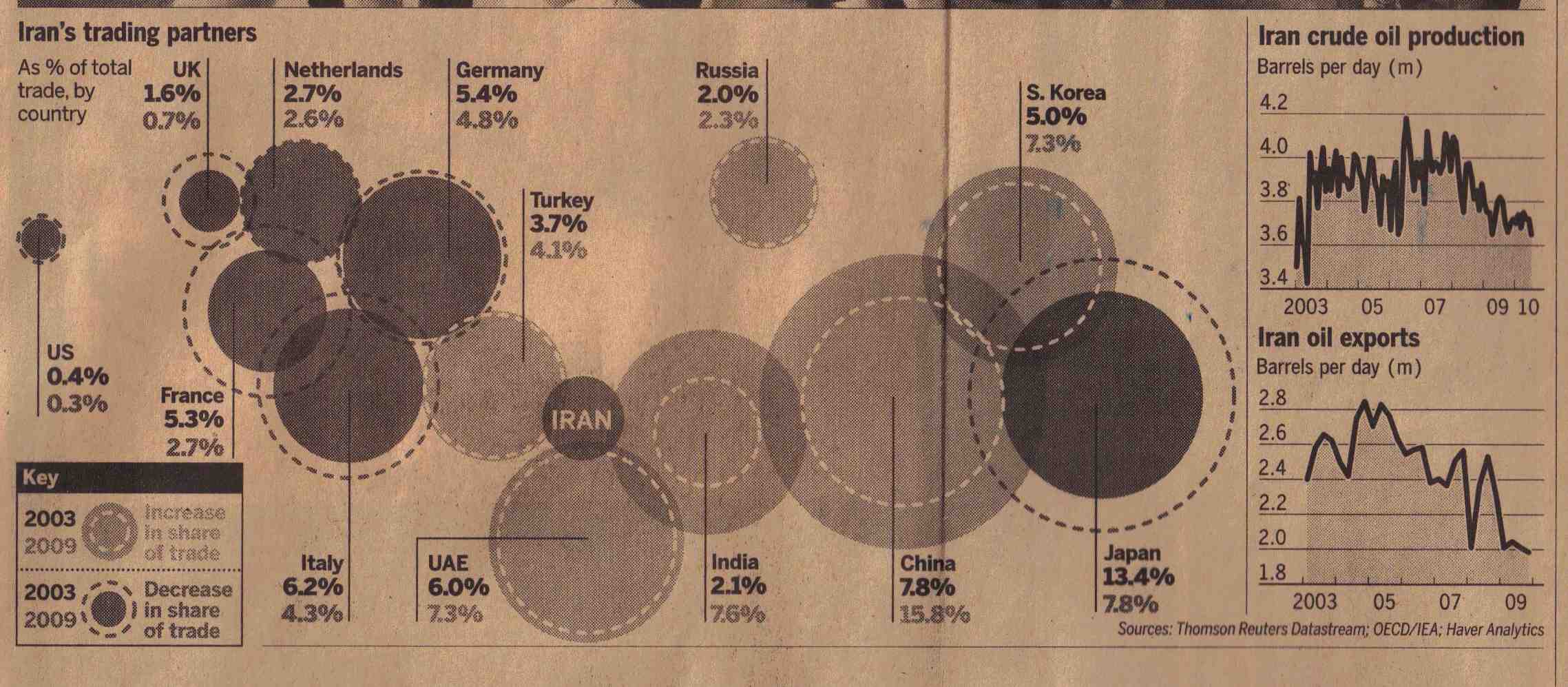
Our sanctions are described as "choking" Iran's exports.  But what I see is an export level dropping in concert with production, where the sanctions may be having significant impact, but probably not as much as claimed. 

Clearly, what the sanctions etc. has done is redirect Iranian oil exports from Europe & Japan to "rising" Asia. Eventually, the investment profile will change to reflect that, meaning the energy investments Iran attracts will likewise be shifted from West to East.  It just takes longer.  

Naturally, the Obama administration wants to shut down that possibility as well, but I suspect it'll be far less successful simply because rising Asia needs oil and gas from EVERYBODY, and can't afford our WMD qualms.

And frankly, why should they when we shield our best-boy in the region on the same subject?

Scary, I know, but eventually Iran's nukes gets Israel the strategic security it needs.  Frightening journey, yes, but I've yet to see an alternative pathway of any serious plausibility.

12:06AM

Everybody's got a definition of what was won and lost in Iraq

"There’s a guy selling fish. He’s got a fish cart. He’s cooking fish. And there’s a watermelon stand and then there’s an electronic store right next to it, and people are everywhere. And I’m sitting in traffic and I’m going, ‘Man, this is unbelievable.’ That’s a victory parade for me."


--COL. ROGER CLOUTIER, on conditions in Baghdad.

See the excellent Steven Lee Myers story on the combat pullout from Iraq.

One reasonable description of what just happened:

The invasion has left behind a democracy in an autocratic part of the world, but a troubled young one with uncertain control over its security and destiny.

I have yet to see a young democracy start in any other way.  It's a very American story.

12:05AM

Obama to Russia: Bring it on! . . . to Afghanistan

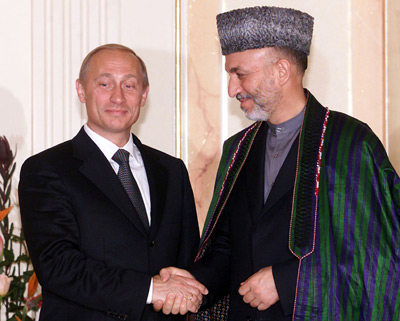
Putin and Karzai in 2002, so why did it take so long?

NYT story on Russians coming back to Afghanistan, economic connectivity in tow.

Twenty years after the last Russian soldier walked out ofAfghanistan, Moscow is gingerly pushing its way back into the country with business deals and diplomacy, and promises of closer ties to come.

Russia is eager to cooperate on economic matters in part by reviving Soviet-era public works, its president, Dmitri A. Medvedev, said Wednesday during a summit meeting with the leaders of Afghanistan, Tajikistan and Pakistan, the second such four-way meeting organized by Russia in the past year.

In fact, Russia has already begun a broad push into Afghan deal-making, negotiating to refurbish more than 140 Soviet-era installations, like hydroelectric stations, bridges, wells and irrigation systems, in deals that could be worth more than $1 billion. A Russian helicopter company, Vertikal-T, has contracts with NATO and the Afghan government to fly Mi-26 heavy-lift helicopters throughout the country.

The Kremlin is also looking to blunt Islamic extremism in Central Asia, which poses a threat to Russia’s security, particularly in the Caucasus, and to exploit opportunities in the promising Afghan mining and energy industries.

The Kremlin’s return to Afghanistan comes with the support of the Obama administration, which in retooling its war strategy has asked Afghanistan’s neighbors — including Russia, whose forces the United States helped oust — to carry a greater share of the burden of stabilizing the country.

As someone who's complained about the lack of this in our foreign policy, credit must be given to Team Obama. All I can say is, we need a whole lot more of the same, to include the encouragement of efforts by India, China, Turkey and Iran.  Otherwise we get the bed (Pakistan) we made for ourselves.

12:04AM

Why negotiating with the Taliban will backfire

Images of the stoning of a woman found here

NYT story on why we won't be able to stomach the prospective deal:

The Taliban on Sunday ordered their first public executions by stoning since their fall from power nine years ago, killing a young couple who had eloped, according to Afghan officials and a witness.

The punishment was carried out by hundreds of the victims’ neighbors in a village in northern Kunduz Province, according to Nadir Khan, 40, a local farmer and Taliban sympathizer, who was interviewed by telephone. Even family members were involved, both in the stoning and in tricking the couple into returning after they had fled.

Mr. Khan said that as a Taliban mullah prepared to read the judgment of a religious court, the lovers, a 25-year-old man named Khayyam and a 19-year-old woman named Siddiqa, defiantly confessed in public to their relationship. “They said, ‘We love each other no matter what happens,’ ” Mr. Khan said.

The executions were the latest in a series of cases where the Taliban have imposed their harsh version of Shariah law for social crimes, reminiscent of their behavior during their decade of ruling the country. In recent years, Taliban officials have sought to play down their bloody punishments of the past, as they concentrated on building up popular support.

“We see it as a sign of a new confidence on the part of the Taliban in the application of their rules, like they did in the ’90s,” said Nader Nadery, a senior commissioner on the Afghanistan Independent Human Rights Commission. “We do see it as a trend. They’re showing more strength in recent months, not just in attacks, but including their own way of implementing laws, arbitrary and extrajudicial killings.”

The stoning deaths, along with similarly brazen attacks in northern Afghanistan, were also a sign of growing Taliban strength in parts of the country where, until recently, they had been weak or absent. In their home regions in southern Afghanistan, Mr. Nadery said, the Taliban have already been cracking down.

“We’ve seen a big increase in intimidation of women and more strict rules on women,” he said.

Perhaps most worrisome were signs of support for the action from mainstream religious authorities in Afghanistan.

The Taliban are not going to change, not when they think time is on their side.  The only way to prevent an outcome we cannot abide--even if just on humanitarian grounds--is to convince them otherwise, and that means creating permanent connectivity between Afghanistan and the outside world that keeps the spotlight on such activity and penalizes for it in a way that makes it cost prohibitive to pursue.

And the ones who will never abide by such change?  Inevitably you hunt these men down and kill them all, with your justification being their sheer evolutionary backwardness.  They want no future in our globalized world and they deserve none.

There are graceful exits out of Afghanistan in the short run, just no shameless ones.

12:03AM

What India is getting wrong on the Kashmir

Guardian column says India's policies in the Kashmir account for the recent unrest, despite New Dehli's claims to the contrary:

In an echo of Iran's lost "green revolution", the youthful protesters organised using text messaging and social media such as Facebook and YouTube. Their wrath focused in particular on the so-called "black laws", otherwise known as the Armed Forces Special Powers Act, that authorises Indian security forces to stop, search, arrest and shoot suspects with impunity. As the beatings, detentions and curfews made matters worse, chief minister, Omar Abdullah, elected in 2008 as Kashmir's bright new hope, fell back on an old expedient – requesting army reinforcements from Delhi.

Despite plenty of evidence that the unrest was both spontaneous and rooted in decades of neglect, discrimination and repression of Jammu and Kashmir's Muslim majority, the Indian government has also stuck to an old story: blaming Pakistan. Delhi has repeatedly accused Islamabad of covertly backing efforts by militant Islamist groups such as Lashkar-e-Taiba, held responsible for the 2008 Mumbai attacks, to destabilise Kashmir. Now it says that Pakistan, switching tack, is at it again.

The longer-term indictment is that India works the political disconnect too much and the economic reconnect too little:

But Delhi's blinkered Kashmir policy since partition in 1947 – ignoring UN demands for a self-determination plebiscite, rigging elections, manipulating or overthrowing elected governments, and neglecting economic development – lies at the heart of the problem, according to Barbara Crossette, writing in the Nation.

The violence "is a reminder that many Kashmiris still do not consider themselves part of India and profess that they never will," she said. "India maintains a force of several hundred thousand troops and paramilitaries in Kashmir, turning the summer capital, Srinagar, into an armed camp frequently under curfew and always under the gun. The media is labouring under severe restrictions. Torture and human rights violations have been well documented." Comparisons with Israel's treatment of Palestinians were not inappropriate.

India's failure to win "hearts and minds" was highlighted by a recent study by Robert Bradnock of Chatham House. It found that 43% of the total adult population of Kashmir, on both sides of the line of control (the unrecognised boundary between Indian and Pakistan-administered Azad Kashmir), supported independence for Kashmir while only 21%, nearly all of whom live on the Indian side, wanted to be part of India. Hardly anyone in Jammu and Kashmir wanted to join Pakistan.

The problem with this path, of course, is that proud India is strong enough to prevent any such splitting.  Fine and dandy, as the economic viability of any such breakaway state is likely very low.  But that reality doesn't obviate making the locals happy, and India has failed at this for reasons unrelated to Pakistan's meddling.

12:02AM

Industry stewardship of the genetic code

Reuters @ Yahoo via my spouse, Vonne.

An interesting public-private partnership here:

Candy maker Mars Inc., computer company IBM Corp. and the U.S. Department of Agriculture have mapped the cacao genome in an effort to improve cocoa crop quality and sustain the world's supply of the key ingredient for chocolate.

The companies and the USDA's Agricultural Research Service (USDA-ARS) on Wednesday released the preliminary genome sequence for the cacao tree, which produces cocoa beans used to make chocolate.

The goal:

The results of this collaborative project -- delivered three years early due to Mars' scientific leadership, advances in genome technology and constant real-time collaboration -- marks a significant scientific milestone that is already starting to benefit millions of farmers, particularly in West Africa, where more than 70 percent of the world's cocoa crop is produced.

"The collaboration with Mars and the USDA-ARS leverages more than a decade of IBM Research's experience in computational biology, as well as the power of the Blue Gene supercomputer," said Ajay Royyuru, senior manager, IBM Computational Biology Center.

The kicker:

The results of the research will be made available to the public with permanent access via the Cacao Genome Database www.cacaogenomedb.org.

To me, that's a counter-intuitive choice by Mars, a privately held company.  I'll be curious to see if this precedent encourages other private sector gifts of this size to the scientific community, because, in my opinion, this is what sustainable resource utilization is all about.

A much bigger global middle class will want to consumer a whole lot more chocolate.  Mars will logically seek to capture as much of that growing market as possible, but it took the time and effort here to make this downpayment on our collective future.

And I admire that.

12:01AM

Chart of the Day: Year(s) of the (energy) pig

Pretty easy to hit high growth numbers if you're tossing everything into the boiler.  This is extensive growth defined:  anything that burns is considered fuel.

12:10AM

I speak @ California State U-San Marcos on 9/24

Find the announcement here at California State University-San Marcos

Global Trade Symposium: Strategy for the Tumultuous 21st Century


~ CSUSM Partners with San Diego WORLD TRADE CENTER for Unique Event ~

FOR IMMEDIATE RELEASE (Download Release - PDF)

August 25, 2010


Global Trade Symposium will discuss the future of global competition and what it means for businesses and organizations.

Who: “Competitors are emerging from more countries,” explains Camille Schuster, Professor of Marketing for California State University San Marcos. “Compliance issues are stressing IT capabilities. Experts are saying companies need to engage in collaboration. With so much change most companies have all they can do to react to the marketing challenges. Thus, I think it would benefit us all to spend a morning at CSUSM to consider the future – the trends, the new pressure points, the new opportunities, the coming challenges – and engage in a discussion of how to prepare to ride the waves of change.”
 

Speakers:
 

Thomas P.M. Barnett, is the New York Times-bestselling author of “The Pentagon’s New Map, Blueprint for Action” and “Great Powers: America and the World after Bush”. He is a nationally known public speaker who's been profiled on the front-page of the Wall Street Journal. He is in high demand within government circles as a forecaster of global conflict and an expert of military transformation, as well as within corporate circles as a management consultant and conference presenter on issues relating to international security and economic globalization. Barnett will speak on 2025: A Future Worth Creating.
 

Ralph Jacobson, is the Global Consumer Products Industry Marketing Executive for IBM. He is responsible for marketing IBM Consumer Products Industry Solutions to clients in areas including business strategy, operations and the consumer experience. Ralph has worked in The CP and Retail Industries for thirty years. For more than a decade, Ralph has consulted to more than one-hundred clients around the globe, from Shanghai to Saudi Arabia. Jacobson will speak on Global Hunger: Distribution and Safety.

Sponsors:
North County Transit District
Sony Corporation of America

What: This half-day symposium will outline the challenges we face today in the global marketplace with new global competitors, political strains, major economic swings, and increasing customer demands. Speakers will address the question of how to create a successful strategy to navigate the dynamic marketplace, and what global completion means for your business and organization.

When: Friday, September 24, 2010
8:00 a.m. to 12:00 noon
Attendees will enjoy a continental breakfast and are invited to attend a book signing at the conclusion of the symposium.
 
Where: California State University San Marcos, McMahan House, 333 S. Twin Oaks Valley Road, San Marcos, CA 92096

For more information and/or to register for the “Global Trade Symposium”, visit www.csusm.edu/el/gts or call (760) 750-4020. Registration fees for San Diego WORLD TRADE CENTER (WTC) Members is $75 and $95 for Non-WTC Members.
        
Directions & Parking
CSUSM is located at 333 S. Twin Oaks Valley Road in San Marcos. For more information or directions to the campus, visit http://www.csusm.edu/guide. Parking is available in campus lots for an additional fee.

12:09AM

The delicate dance: EU carmakers and PRC wheelmakers

WSJ story on how European rim makers (not the tires but the metal wheels) want antidumping protection from China, whereas European car makers fear they'll get caught up in the fray and lose market share there.

Good quote that captures China's rapid move up the production chain:

"Trade disputes with China used to be about bras, T-shirts, shoes and ironing boards," says Simon Evenett, a professor of trade economics at the University of St. Gallen in Switzerland.  "Now they're moving downstream, and increasingly, they're going to be about cars."

America coming out of the Civil War sold basic consumers goods like that overseas (shoes were a biggie), but by the end of the century, we were likewise elevated to complex manufactured goods, thus increasingly the complexity of our trade relations with the world.

12:08AM

Good cop "Uncle Wen" makes nice @ WEF event

WSJ coverage of World Economic Forum event in Tianjin, where Chinese premier Wen Jiabao went out of his way to combat the nation's growing image as inhospitable to foreign business.

Naturally, a WEF event in China is going to feature a certain amount of self-censorship by foreign businesses, thus allowing Wen's comeback to basically go unchallenged.

Still, the key is he acknowledged policy missteps by China.

It will--for a very long time--remain a tricky balancing act for China:  trying to divert continued economic growth inland while not being too stingy on foreign penetration.