Buy Tom's Books
  • Great Powers: America and the World After Bush
    Great Powers: America and the World After Bush
    by Thomas P.M. Barnett
  • Blueprint for Action: A Future Worth Creating
    Blueprint for Action: A Future Worth Creating
    by Thomas P.M. Barnett
  • The Pentagon's New Map: War and Peace in the Twenty-first Century
    The Pentagon's New Map: War and Peace in the Twenty-first Century
    by Thomas P.M. Barnett
  • Romanian and East German Policies in the Third World: Comparing the Strategies of Ceausescu and Honecker
    Romanian and East German Policies in the Third World: Comparing the Strategies of Ceausescu and Honecker
    by Thomas P.M. Barnett
  • The Emily Updates (Vol. 1): One Year in the Life of the Girl Who Lived (The Emily Updates (Vols. 1-5))
    The Emily Updates (Vol. 1): One Year in the Life of the Girl Who Lived (The Emily Updates (Vols. 1-5))
    by Vonne M. Meussling-Barnett, Thomas P.M. Barnett
  • The Emily Updates (Vol. 2): One Year in the Life of the Girl Who Lived (The Emily Updates (Vols. 1-5))
    The Emily Updates (Vol. 2): One Year in the Life of the Girl Who Lived (The Emily Updates (Vols. 1-5))
    by Thomas P.M. Barnett, Vonne M. Meussling-Barnett
  • The Emily Updates (Vol. 3): One Year in the Life of the Girl Who Lived (The Emily Updates (Vols. 1-5))
    The Emily Updates (Vol. 3): One Year in the Life of the Girl Who Lived (The Emily Updates (Vols. 1-5))
    by Thomas P.M. Barnett, Vonne M. Meussling-Barnett
  • The Emily Updates (Vol. 4): One Year in the Life of the Girl Who Lived (The Emily Updates (Vols. 1-5))
    The Emily Updates (Vol. 4): One Year in the Life of the Girl Who Lived (The Emily Updates (Vols. 1-5))
    by Thomas P.M. Barnett, Vonne M. Meussling-Barnett
  • The Emily Updates (Vol. 5): One Year in the Life of the Girl Who Lived (The Emily Updates (Vols. 1-5))
    The Emily Updates (Vol. 5): One Year in the Life of the Girl Who Lived (The Emily Updates (Vols. 1-5))
    by Vonne M. Meussling-Barnett, Thomas P.M. Barnett, Emily V. Barnett
Search the Site
Powered by Squarespace
Monthly Archives
12:05AM

Kims back in the driver's seat

NYT John Pomfret reporting that America and its allies in Asia are working to reopen talks with North Korea, afraid that the ongoing succession process could send the whole relationship down the path to war.

Score one for the Kims and so much for Team Obama's "strategic patience" (tough talk and shows of force and letting the Kims stew in their own paranoid juices).  I had thought the White House had settled on a solid path of not caving in, but Obama seems to have chickened out rather quickly:

Anxiety is rising on both sides of the Pacific that tightened sanctions and joint military exercises - what U.S. officials have called "strategic patience" - could, if continued indefinitely, embolden hard-line factions in the North to strike out against South Korea or to redouble efforts to proliferate weapons of mass destruction.

Ooh!  So NorKo sinks a South Korean military ship and we better back off, lest they strike out against South Korea!  Gotta love that logic.

So we basically say to Kim the Younger:  do as Daddy has done and you will be both respected and rewarded.

Spineless.

Our breakthrough demand?  NorKo doesn't have to admit it sunk the ship, just express condolences for the loss of life.

The US State Department sources describe a three-legged stool of sanctions, mil exercises and talking with NorKo.  If we only do the first two, we risk war!

And so the same old, same old is pursued with the usual vigor.  Non-change I can believe in.   Because the last thing we want to risk is a conflict that consumes this war criminal regime.  Kim's strategy of achieving firm deterrence against the US has been a complete success, telling similar regimes around the world to get themselves a nuke for similar, air-tight protection from US pressure.

12:04AM

9/15 trumps 9/11

Great piece by Gideon Rachman, a regular FT columnist who sometimes stretches too hard to make his overarching points but drives this one home deftly.

The symmetry of imagery here is haunting:  ten years ago the WTC towers collapse (9/11) and two years ago Lehman Brothers collapses (9/15).

The first event reveals, in sequence, the limits of US military power, but the second quickly exposes the relative economic decline of the US vis-a-vis rising China.

On many levels, I find the need to designate forever-marking tipping points to be a bit much.  America discovered the limits of its Leviathan force in Iraq and Afghanistan, and now builds something very different. Is any other great power out there moving further down that curve than we are? Hardly. China chases our Leviathan's tale in a fabulous waste of force structure that does nothing to actually address its strategic shortfall globally (which is growing at a magnificent rate).

Does 9/15 signal the permanent eclipsing of the US by China? Depends on how you view the long-term prospects of each. China's debts are massive, if hidden, and their demographics bottom out this year, as old people stack up from here on out and the economy loses 100m workers by 2050 (we add 35m and remain remarkably young by comparison).  A lot of experts are sticking with their linear projections of China's advance, but I see a large number of very painful and destabilizing (for single-party rule, that is) transformations laying in wait.  America's necessary transformations, by comparison, will be both faster and easier to swallow.

But I do buy, in a general sense, Rachman's notion that the economic restructuring of the world dramatically trumps the downshifting of violence represented by 9/11 (from nation-states to mere non-state actors), so I admire the piece.

12:03AM

Does China rebalance the world economy in its search for resources?

FT full-pager analysis definitely worth a read.

It explores the notion that China's reach for raw materials around the planet is creating such a self-sustaining bond between Asia and Latin America/Africa as to constitute a real rebalancing in the works--truly post-American consumer, so to speak.

China's outbound FDI was about $5B in 2003.  By 2013 it could be $100B, with two-thirds staying in Asia (a pattern found among all Asia states), one-sixth going to LATAM and presumable most of the rest going to Africa.  On this basis, China comes out of nowhere to become Brazil's biggest trade partner and--next year--its biggest foreign investor (filling up all those CHINAMAX mega ships with iron ore and what not).

Meanwhile, with China experimenting through Hong Kong with letting foreign companies hold and thus settle their business with China in yuan, Beijing is described--accurately I think--as rerunning the same strategy they pursued with the US over the previous three decades:  recycling the trade surplus back into the partner's financial nets so as to stimulate further demand of Chinese exports.  In effect, that means China will run up trade surpluses with a lot of poor countries just like it did with rich America.  We'll see how that works in terms of triggering a political backlash.  My guess is that it won't run three decades before China feels the friction.

And yet, is this not what we asked for?

Well, not exactly.  What we really wanted was for Asia's stubborn trade surplus with America (ably consolidated by China over the past two decades) to shift over into something far more even. This isn't happening, in large part because China seeks to have its cake (surplus with America) and eat it too (replicate it across the Gap).

The one good thing:  by slowly increasing the circulation of the yuan, Beijing progressively loses control of its exchange and interest rates, meaning it becomes harder to "cheat" through monetary means.

12:02AM

CIVETS to replace N11 to replace BRIC: it's a mad, mad mad men world!

FT "big picture" piece that explores the great Wall Street competition to package the next darling of global investment. The BRIC concept succeeded the more generalized buzz phrase "emerging markets"--itself a brilliant bit of packaging for the post-1987 crash investment audience (no one wants to invest in developing economies, the logic went, but emerging sounds so much better!).

Goldman Sachs' creation of the BRIC notion just concentrated the idea, a somewhat lumpy lumping of the four best investment opportunities of the time.  Naturally, the BRICs have outperformed any other confection since that time--as cherry-picked collections are wont to do.

Then came the Next 11 (another Jim O'Neill creation), a complete hodgepodge that fell, in theory, in emerging markets 5 through 15--a "collection of mini-Indias" one hawker claims.  The sale is simple:  this is the next ground floor of globalization, offering early-entry investment opportunities no longer found in the BRICs.

Alas, just like Malcolm Gladwell's success with "Tipping Point" and "Blink" triggered a whole crop of copycat volumes, all sporting the same white cover with the would-be iconic image dead center ("Look, a one-word book!  I should be able to maintain my attention through that!"), these quaint packages spawn their own competitors, the funkiest of the new crop being the CIVETS!  This comes from HSBC, which is naturally drawn to awkward acronyms.

[I myself have long favored the TPMB, for Turkey, Poland, Malaysia and Brazil.]

CIVETS stands for Colombia, Indonesia, Vietnam, Egypt, Turkey and South Africa--a crew that just naturally gloms together. Allegedly, the bond is their expensive type of coffees produced. But that may just be a running joke.

We can laugh at such packaging, but compared to the GWOT or the Axis of Evil or Axis of Diesel, these notions all actually capture a lot more of globalization's ongoing reality than those dreamed up by Pentagon planners.

12:01AM

Charts of the Day: World Economic Forum survey on US competitiveness

Annual WEF "most competitive country ranking," where US now drops to fourth after Switzerland, Sweden and Singapore.

Of course, my usual counter is to say we're comparing a multinational state of 50 members to unitary states, so just as reasonable to see where those three stack up against our 50 individuals members as the other way around, but I quibble.

What's interesting is checking out the details, as in, when you see where we're still near the very top (innovation, labor market, business sophistication, higher education, infrastructure, technology--almost all in the private realm) versus where we've fallen lowest (public spending, public debt, national savings rate--more in the political realm).

So the question begs: What is really "broken" in America?  Capitalism or the political system?

7:20PM

The first test missed it

Both girls have tapeworms.

As they say in the sitcom world: . . .  and hilarity ensues.

Well, at least their bizarre food intake levels make sense now.  For a while there, I half-expected Sally Struthers to walk into my kitchen one night, turn to the camera and plead, "Won't you spend just a few extra dollars and feed them just a little bit more?"  I mean, these two eat like their lives depend on it, and now we know they were eating for themselves and maybe a dozen or two inside friends.

Bad days to follow with giant pills, but these too shall pass--literally.

Had to go with the gag pic; the real stuff is just too godawfully gross.

So, to sum up, when we got them they had: 1) bronchitis 2) ear infections 3) giardia 4) hepatitis A, and 4) tapeworms.

And people wonder why your average kid in Africa might not summon up all the mental strength required to score as high as their northern brethren on IQ tests.  Well, if you spent that much of your body's energy every day fighting that array of stuff, you'd have less power to your brain too.  It's as simple as that.

I have to tell you, these are two tough little kids.

8:37AM

WPR's The New Rules: China Still Needs U.S. in Global Security Role  


When Europe ran the world, trade followed the flag, meaning that globalization in its initial expression -- otherwise known as colonialism -- grew out of the barrel of a gun, to paraphrase Mao Zedong. On this subject, Franklin Roosevelt and Vladimir Lenin agreed, even if that conclusion led them to embrace diametrically opposed strategies: FDR's realization that "the colonial system means war" drove him to erect an international liberal trade order following World War II that doomed the vast colonial systems of his closest European allies. Roosevelt's success not only enabled America to contain and ultimately defeat the soul-crushing Soviet alternative, it laid the initial groundwork for today's American-style "open door" globalization, itself a nod to cousin Theodore. In the end, that "traitor to his class," as Roosevelt was often labeled, should rightfully be acknowledged as the single-most successful anti-imperialist revolutionary leader of the 20th century.

Read the entire column at World Politics Review.

I just participated--this morning--in my first virtual meeting of the Geopolitical Risk Global Agenda Council of the World Economic Forum as led by Eurasia Group CEO Ian Bremmer.  I wrote this piece in anticipation of that, in effect offering my definition of the biggest geopolitical risk I could imagine: "declining" or "retreating" America + rising-but-pol-mil-weak China = a system whose revealed risk could suddenly spike.  How so? Some scenario comes along that confirms US impotence or unwillingness to step into any new breaches, while likewise confirming the "paper tiger" nature of the PLA (shiny weapons + no experience makes Wang a tentative soldier).  Then the question is, what or who steps into this breach?  Rising secondary powers? Underpowered and/or atrophied international organizations? Or, most likely, is that breach simply left wide open, revealing the true macro geopol risk in the system--namely, that we stand astride a transition from an overburdened and overleveraged superpower to an inexperienced and lacking-in-will-and-political resilience newcomer?  And what is the possibility of alliance between the two at this time?  Poor indeed. You pile that geopol "revealed risk" on top of a fragile global recovery, and that's a dangerous mix.

12:09AM

IBM follows Bharti Airtel into Africa

You remember my WPR telecom special feature a while back, where I highlighted Indian firm Bharti Airtel's purchase of Kuwaiti firm Zain's mobile customer base in Africa.  In that piece, I noted the Bharti model of subcontracting most of the basics while concentrating on expanding the customer base.  

Here, in an NYT blog, we see how Bharti is pulling along longtime partner IBM to the tune of a $1.5B investment:

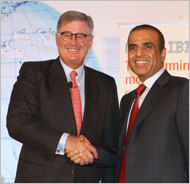
Samuel J. Palmisano, I.B.M.’s chief executive, doesn’t jet around the world to make an appearance every time the technology giant wins a services contract. But the announcement Friday morning in Nairobi is different, says I.B.M.

[Bharti Airtel Samuel J. Palmisano, I.B.M.’s chief executive, left, with Sunil Bharti Mittal, the chairman of Bharti Airtel.]

I.B.M. will supply the computing technology and services for an upgraded cellphone network across 16 nations in sub-Saharan Africa. Its customer is India’s largest cellphone operator, Bharti Airtel, which paid $9 billion a few months ago for most of the African assets of Kuwait’s Mobile Telecommunications Company, or Zain.

Under the 10-year agreement, I.B.M. will handle customer service for Bharti and provide the hardware, software and services to run everything from billing and call-traffic management to delivering new services like music and video. The deal takes the broad partnership between Bharti and I.B.M., begun in 2004, beyond India. I.B.M. is not disclosing the dollar size of the deal, but analysts estimate it at more than $1.5 billion over the decade-long span.

The Bharti contract also punctuates I.B.M.’s Africa strategy. The company’s presence in Africa dates back 50 years, but in the last five years I.B.M. has invested $300 million in the region to build data centers, add country offices and foster technology training programs — and it plans to expand aggressively in the region.

“This is a huge step forward for I.B.M. in what we think is the next major emerging growth market — Africa,” said Bruno Di Leo, general manager for growth markets for I.B.M.

Though it looms small in the global technology market today, Africa is primed for growth, according to Frank Gens, an analyst at IDC. “And I.B.M. is, as it’s done before, getting in on the ground floor,” Mr. Gens said.

The company’s strategy calls for the growth markets — not only the well-known BRIC countries, Brazil, Russia, India and China, but also dozens of others — to increase as a share of I.B.M.’s revenue from 19 percent to 25 percent by 2015. That is the equivalent of $1 billion in new sales a year.

In these nations, I.B.M. is targeting the linchpin industries of economies including telecommunications, banking, transportation, health care and energy.

Same logic Enterra brought to our Development-in-a-Box work in northern Iraq: focus on the fastest connections to be built.

A serious example of how seriously multinationals (nay, globally integrated enterprises--to quote Palmisano) are beginning to appreciate Africa's growth trajectory.

12:08AM

How inscrutable China pre-empts possibility of "resource wars"

Guardian piece via WPR's Media Roundup.

Top of the story:

Blades slicing through the morning heat, the helicopter rose from the tarmac and swept into a cobalt sky, high above Rio's Guanabara Bay.

It powered north-east over deserted beaches, dense Atlantic rainforest and fishing boats that bobbed lazily in the ocean below. Then finally, 80 minutes on, the destination came into view: a gigantic concrete pier that juts nearly two miles out into the South Atlantic and boasts an unusual nickname: the Highway to China.

Dotted with orange-clad construction workers and propped up by dozens of 38-tonne pillars, this vast concrete structure is part of the Superporto do Acu, a £1.6bn port and industrial complex that is being erected on the Rio coastline, on an area equivalent to 12,000 football pitches.

Reputedly the largest industrial port complex of its type in the world, Açu is also one of the most visible symbols of China's rapidly accelerating drive into Brazil and South America as it looks to guarantee access to much-needed natural resources and bolster its support base in the developing world.

When Acu opens for business in 2012, its 10-berth pier will play host to a globetrotting armada of cargo ships, among them the 380-metre long Chinamax – the largest vessel of its type, capable of ferrying 400,000 tonnes of cargo.

Millions of tonnes of iron ore, grain, soy and millions of barrels of oil are expected to pass along the "Highway" each year on their way east, where they will alleviate China's seemingly unquenchable thirst for natural resources.

"This project marks a new phase in relations between Brazil and China," Rio's economic development secretary, Julio Bueno, said during the recent visit of about 100 Chinese businessmen to the port complex, which is being built by the Brazilian logistics company LLX and should receive billions of dollars of Chinese investment.

This new phase of engagement with Brazil and South America, is part of China's "going out strategy" – an economic and, some say, diplomatic push for Chinese companies, many of them state-run, to invest abroad, snapping up access to minerals, energy and food by pouring the country's colossal foreign reserves into overseas companies and projects.

Ah, I thought we were going to fight the Chinese for access to all these resources, when it turns out China can just buy them and Brazil is more than happy to sell them in bulk on long-term contracts.

Where do they come up with these devious tricks?

"What, no f--king assassin's mace?"  A.J. whines to Carm and Tony.  Disgusted, he surfs off the History Channel over to MTV.

And an entire continent falls to the Chinese, because, as everyone in America knows, if you're the biggest buyer of South American commodities, everybody down there obeys your every wish and command!

12:07AM

Enter Boeing, and hopefully a new "space race" begins

NYT story on Boeing announcement:

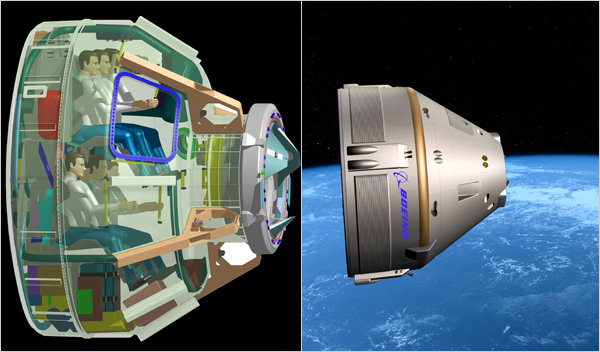
Boeing said Wednesday that it was entering the space tourism business, an announcement that could bolster the Obama administration’s efforts to transform the National Aeronautics and Space Administration into an agency that focuses less on building rockets and more on nurturing a commercial space industry.

The flights, which could begin as early as 2015, would most likely launch from Cape Canaveral in Florida to the International Space Station. The Obama administration has proposed turning over to private companies the business of taking NASA astronauts to orbit, and Boeing and Bigelow Aerospace of Las Vegas won an $18 million contract this year for preliminary development and testing of a capsule that could carry seven passengers.

Current NASA plans call for four space station crew members to go up at a time, which would leave up to three seats available for space tourists. The flights would be the first to give nonprofessional astronauts the chance to go into orbit aboard a spacecraft launched from the United States. Seven earlier space tourists have made visits to the space station, riding in Russian Soyuz capsules.

“We’re ready now to start talking to prospective customers,” said Eric C. Anderson, co-founder and chairman of Space Adventures, the space tourism company based in Virginia that would market the seats for Boeing.

Boeing and Space Adventures have not set a price, although Mr. Anderson said it would be competitive with the Soyuz flights, which Space Adventures arranged with the Russian Space Agency. Guy Laliberté, founder of Cirque du Soleil, paid about $40 million for a Soyuz ride and an eight-day stay at the space station last year. But the prospects that anyone buying a ticket will get to space on an American vehicle hinge on discussions in Congress about the future of NASA.

As the era of the space shuttle winds down — two, perhaps three shuttle flights remain — a clash of visions over what should come next has kept the space agency adrift for much of the past year. An authorization bill written by the House Science and Technology Committee to lay out the direction of NASA for the next three years would largely follow the traditional trajectory for human spaceflight. It calls on NASA to build a government-owned rocket — likely the Ares I, which NASA has been working on for five years — for taking astronauts to the space station and then a larger one for missions to the Moon, asteroids and eventually Mars.

The competing vision, embodied in President Obama’s 2011 budget proposal for NASA, focuses instead on investing in companies like Boeing that want to develop the space equivalent of airlines. NASA would then just buy seats on those rockets to send its astronauts to the International Space Station.

Competition, the thinking goes, would drive down the costs of getting to space, leading to a profitable new American industry and freeing more of NASA’s budget for deep-space missions.

 I am firmly behind the Obama administration on this one, and wish Boeing the best on this endeavor.

I am still firmly committed to dying off-Earth!

12:06AM

What does mass blogging in China tell us?


image here

Thomas Friedman column on blogging in China becoming the true voice of the people at 70 million strong.

Positive or negative trend?  Because you're talking relatively successful people in a fast rising country, the overall voice is going to be one of nationalistic pride--even hubris, leading Friedman to hypothesize that aggressive bloggers are already becoming yet another source of populism that Beijing is both scared and mindful of in its decision-making.

Already, notes Freidman, the US ambassador is hosting big-time bloggers in an effort to get out America's message to the people with less official filtering.

Key point and a cool bit from Friedman:

“China for the first time has a public sphere to discuss everything affecting Chinese citizens,” explained Hu Yong, a blogosphere expert at Peking University. “Under traditional media, only elite people had a voice, but the Internet changed that.” He added, “We now have a transnational media. It is the whole society talking, so people from various regions of China can discuss now when something happens in a remote village — and the news spreads everywhere.” But this Internet world “is more populist and nationalistic,” he continued. “Many years of education that our enemies are trying to keep us down has produced a whole generation of young people whose thinking is like this, and they now have a whole Internet to express it.”

Watch this space. The days when Nixon and Mao could manage this relationship in secret are long gone. There are a lot of unstable chemicals at work out here today, and so many more players with the power to inflame or calm U.S.-China relations. Or to paraphrase Princess Diana, there are three of us in this marriage.

I see an advantage for us in all of these developments: our system is much more comfortable processing such popular pressures than China's is--and a lot more experienced to boot.

A lot of strategists on our side salivate at the notion that China will be forced into military confrontations with the West by all this rising nationalistic spirit, but the truth is just the opposite: fear of enraging the population by accepting any form of defeat keeps the Chinese leadership very keen to avoid any scuffle with the U.S. that it cannot control.

12:05AM

You there! Innovate!  Now!


Moscow Times op-ed by a biz strategist consultant (via WPR's Media Roundup).

Great rundown here that encapsulates a lot of Russian history:

Eminent Western speakers put forward seemingly logical ideas on modernization and what Russia needs to do to modernize at the Global Policy Forum, which was held in Yaroslavl on Thursday and Friday. But most of them were not Russia experts as such and were thus naively overoptimistic on the country’s willingness and ability to implement change.

Applying Western logic to Russia is a risky business since things here are often the opposite of how things happen in the West. Will this modernization effort be any different from numerous others in Russia’s history?

The problem has always been implementation. Russia has been modernizing on and off since Peter the Great founded St. Petersburg in 1703. Periodically aware of the huge developmental gap with the West, it has never caught up.

As Russian history has shown, Western-style reforms invariably get blown off course by exogenous or endogenous shocks that necessitate short-term crisis management. After that, a conservative reaction sets in because of the fear of losing power after reform attempts fail and are discredited by the people.

Most Russian reform efforts are reactive and short-term, rather than proactive and structural. The result is a country that for centuries has been scraping along the bottom and failing to fulfill its colossal potential.

The government’s strong modernization campaign is concentrating on high technology, and yet it has not even plucked the low-

hanging fruit that would do so much to improve the country’s low productivity, such as radically cutting the number of bureaucrats and amount of red tape.

The Kremlin also has a poor understanding of science, technology and innovation, hence its piecemeal policies on modernization. “Innovation by decree” is one of the least effective models for modernization.

Now try remembering that when it comes to China's much vaunted state capitalism.  The author ends the piece by noting that China's authoritarianism is much more flexible, but the point remains the same: you cannot innovate by decree and if you let real innovation happen, you cannot control it by decree either--and still reap its economic rewards.

12:04AM

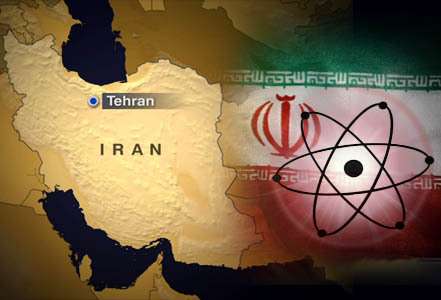
What a serious containment of nuclear Iran would demand of US

cool graphic here

Nice op-ed in The Daily Star by way of WPR's Media Roundup.

Author is Middle East expert at Jamestown Foundation, an unusually solid source of common sense.

After laying out the realism that is accepting Iran will get nukes, Ramzy Mardini addresses what a serious containment strategy would require:

Three crucial features must be included in any containment approach. First, the US must strive for a coherent foreign policy vis-à-vis the Islamic Republic, with interests pegged to regional stability, not democracy and regime-change. Secondly, the US should be prepared to play a pacifying role in the region: restricting Iran, but simultaneously working to minimize dangerous escalations involving local allies, particularly when it involves Israel.

Finally, the US must offer a degree of certainty to its allies in the region – building on, reiterating, and implementing promises of active engagement in containing Iran. The growing uncertainty about Washington’s commitment will dramatically increase the incentive for regional states to seek self-assurance, and hence, indigenous nuclear deterrents of their own. Egypt, Turkey, and Saudi Arabia are among those who might seek this form of reassurance.

Without the necessary diplomatic arrangements and American leadership, the danger is that a containment strategy may be both amorphous and fragile. Tehran could easily engage uncertain actors interested in hedging their bets and, consequently, erode the cohesiveness of the coalition aligned against it.

American prudence and recognition of the limitations of power should not be confused with weak and ineffective policymaking. Given the uncertainties involved when it comes to Iran, Washington should emphasize realpolitik in addressing Iranian nuclear ambitions.

Pretty solid list, in my opinion. 

And despite all the brave talk, I think the Obama administration is actually moving down this path with a lot of care--and genuine success.

12:03AM

A Chinese naval build-up that deeply impresses me

NYT story on Chinese making substantial if beginning effort on deep-sea exploration--naturally for mineral resources.

Seabed control!

It'll be interesting to see how hard the Chinese go after this in coming years.  I would expect a pretty strong push given the volume requirements.

As for military conflicts stemming from this?  Let's just say disrupting seabed control is probably a lot easier and cheaper than you think, so let's remember which economy in this equation is becoming the most resource-dependent on the planet.

Because it ain't America.

A general on this would seem to be:  the deeper you go, the more you rely on a peaceful international security environment.

12:02AM

China confronts the green-eyed monster abroad

I've been preaching this one directly to the Chinese on trips going back to 2004: as you become the face of globalization, you will run into all the same hatreds that America has long endured--and then you'll want a different military than the one you've been wasting your money on.

From a WAPO piece earlier this month via reader David Emery:

In a spasm of violence this spring, an angry mob toppled the Kyrgyzstan president, torched his office and ransacked other buildings associated with his hated authoritarian regime. The crowd then turned on a less obvious target: a popular Chinese-owned shopping mall stuffed with cheap clothes and electronics from China.

An easy dynamic to spot, and even easier for me to have predicted years ago:

As China pushes beyond its borders in search of markets, jobs and a bigger voice in world affairs, a nation that once boasted of "having friends everywhere" increasingly confronts a problem long faced by the United States: Its wealth and clout might inspire awe and wary respect, but they also generate envy and, at times, violent hostility.

The "ugly Chinese" will compete, side by side, with the "China model"--bet on it.

Yes, no question that Central Asia's future is a whole lot more Chinese than Russian.  Just don't expect it to be a cake walk for anybody.

With great power comes great responsibility--and great envy.

12:01AM

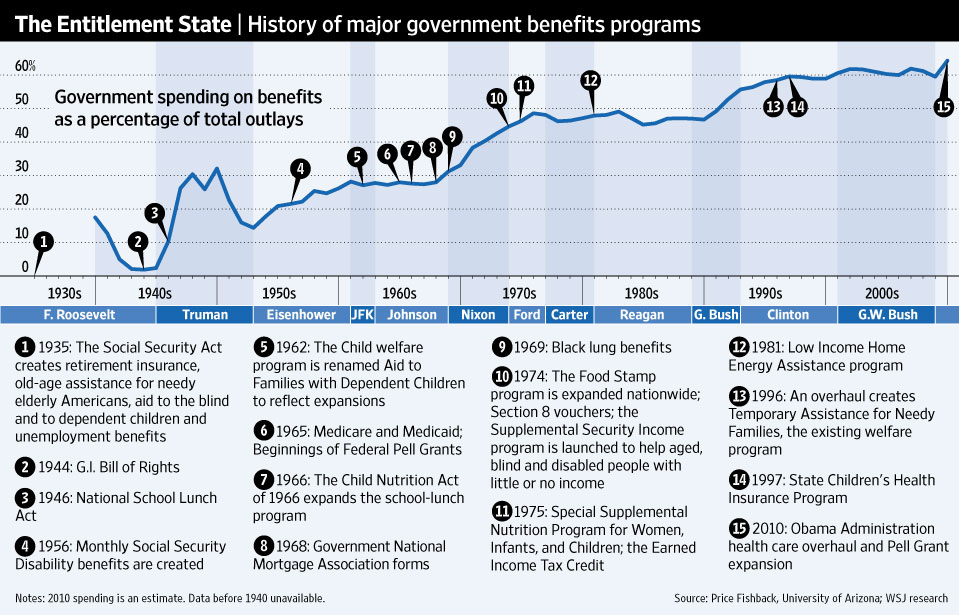
Charts of the Day: a nation on entitlements

WSJ story on "obstacles to deficit cutting."

Tempting to look at administrations and spot oddities (Ike and Nixon and GW Bush--all up! but JFK and LBJ barely rise!), but you know it can't be all that simple (time lags for new policies to take effect, other more important factors like demographic changes).  

Still, an undeniable trend.  Automatically bad?  I always like to point out that states that send more tax dollars to DC and receive less tend to shade Blue while states that eat more tax dollars than they provide tend to tint Red, so I'm always reticent to assume political identification--and thus corresponding judgment--on this basis.

I suspect that, in order of magnitude, it's the aging factor first, then the healthcare burden and then breakdown of the family.  

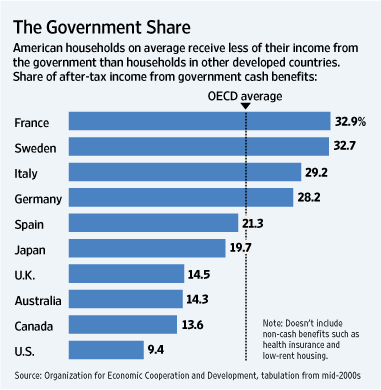
So are we as "socialist" as we imagine ourselves to be?

Check out this second chart:

Oh well, I suppose we can always try harder.

As the "virus" of socialism goes, it appears we have the swine flu variety:  spread widely but thinly.

12:04AM

Why China will continue to disappoint as a "near-peer" rival

NYT's Keith Bradsher in early Sept regarding a visit by Larry Summers in Beijing:

Top Chinese officials are calling for quiet discussions instead of open friction with the United States, after a summer marked by bilateral disagreements over the value of China’s currency, American military exercises off the Korean Peninsula and American efforts to resolve territorial disputes in the South China Sea.

State media showed China’s president, Hu Jintao, meeting Wednesday with Lawrence H. Summers, the director of the National Economic Council, and Thomas E. Donilon, the deputy national security adviser. American and Chinese officials have been trying to lay the groundwork for a state visit to the United States this winter by the Chinese president.

Wednesday’s meeting with Mr. Hu followed earlier talks this week in Beijing by the two American officials that were aimed not at fashioning new pacts, but at maintaining a dialogue that had been strained at times in recent months.

“Strategic trust is the basis of China-U.S. cooperation,” said Dai Bingguo, a Chinese state councilor who met with them, the official Xinhua news agency reported.

Prime Minister Wen Jiabao told the two Americans that China and the United States should not view themselves as rivals, according to the Chinese state news media.

Part of the dynamic we witness in elite US circles right now is an attempt to redirect our fears away from non-state actors and back toward the rising "near-peer"--an old Pentagon code phrase for China.  It is seen as part and parcel of admitting our need to get our own economic house in order, pull back from "empire" and keep our powder dry for the real threat down the road.

For many, this is a highly tempting path.

But the problem with it is, the Chinese will continue to disappoint.  They simply will not maintain sufficient counter-party status to sustain a truly hardened competition.  There will never be an opportunity for a true American shove because the Chinese will always be careful enough to avoid the push necessary to trigger that. They simply have too many stakes in the fire to ever fully give themselves--and their future--over to America and its tendency to go overboard in "crusades." Yes, we can chase them around that block for quite some time, but it will not give us the economy nor the military power we need for the future; it will just give us familiar detours from the changes we ultimately must make.

Meanwhile, vast collective problems will remain poorly addressed, because so long as Sino-American strategic partnership remains stunted, a critical mass of great-power cooperation will remain out of reach.  And no, I'm not being unrealistic about what that partnership may entail.  China and the US have vastly different economic needs:  China has no choice but to shrink the Gap economically while the US has little choice but to continue working the Gap militarily.  There is vast strategic overlap there that provides both sides missing assets, so long as both sides can become far more realistic about what cooperation would entail and yield.

Both sides currently lack the leadership to make this happen, I fear, especially in combination with even more unrealistic and uninformed domestic constituencies standing behind them.  But the efforts to foster such links will and must continue, even if we're collectively just killing time.

There is no faster nor surer path for America and China to become second-tier powers than for rivalry to fester into conflict. That's the real lesson to take from Britain and German in the first half of the 20th century.

Our present success in fostering an American-style globalization vastly outpaces Britain's success in establishing its colonial-style globalization of the late 19th and early 20th centuries, so the strategic risks we face is sharing power are completely different, no matter how slowly China has evolved toward something more pluralistic in terms of their politics.  We have won all the major battles worth winning in getting China's buy-in on markets and globalization, securing a fifth-generation-warfare victory that--yes--may still take a good two decades to unfold.  

The greatest danger we face today is our own desire to self-sabotage that delayed win, primarily because we are led by too many people lacking the strategic imagination to see it in the distance.

But fear not, our numbers are growing--and not just in business circles.

12:03AM

The "great wall of America" masks boiling points on both sides

LA Times column via WPR's Media Roundup.

Whenever I feel the urge to criticize Israel's security fence, I usually put down my brick when I realize what a glass house we live in back here in the States.

The opening:

Between cynicism and hypocrisy lies the 2,000-mile U.S.-Mexico border. America is raising a wall in the desert to separate Mexican drug exporters from American drug consumers, to separate Latin American peasants who will work for low wages from the Americans who would hire them.

The Great Wall of America, straddling less than half the length of the border, descends into canyons and across the desert floor. For the Mexican, it represents a high hurdle. For the American, it is an attempt to stop the Roadrunner's progress with an Acme Border Sealing Kit.

In some places the wall is made of tennis-court-style cyclone fencing or dark mesh of the sort used for barbeque grills in public parks. In other places the wall is a palisade of 20-foot-tall bars that make a cage of both sides. The most emphatic segments are constructed of graffiti-ready slabs of steel.

Richard Rodriguez, the author, adeptly compares our fence to Israel's, but the larger point is that we should be expanding our definition of America, not contracting it.

On patriotism-for-profit talk radio and television, the illegal immigrant is, by definition, criminal. She comes to steal the American dream. But in my understanding, the dream belongs to the desperation of the poor and always has. The goddess of liberty in New York harbor still advertises for the tired and the poor, the wretched refuse. I tell you, there is an unlucky man in the Sonoran Desert today who will die for a chance to pluck dead chickens in Georgia or change diapers in a rest home in Nevada.

Great empires expand beyond their own borders. Empires in decline build walls.

Nicely stated.

I watched Robert Rodriguez's "Machete" last week.  It captures, glancingly, some of the intense, thoroughly righteous anger from the other side (albeit with rather fantastic expressions of gratifying violence), and when you examine the economic roots of that anger, it's not all that different from that of the Palestinians vis-a-vis Israel.

12:02AM

Deep Reads: "The Lexus and the Olive Tree" (1999)


Still by far my favorite Thomas Friedman book, it's easily the one that's had the biggest overall impact on my career, because when it came out I had been trying, for about half a decade at that point, to cast myself as a "globalization expert."  It was tough going in the sense that a lot of established experts pooh-poohed the notion even as the concept became ascendant.  Friedman's book really put it over the top and, by doing so, turned my quest from seemingly pathetic to seemingly prophetic.  For me, then, this was an immensely empowering book that helped enable the most important career evolution of my life to date.

When people send me emails about "The Pentagon's New Map" altering their life-paths, I truly appreciate the notion, because this is the book that did the same thing for me.  

12:01AM

Movie of My Week: "Men Who Hate Women [Swedish]" (2009)

I know we supposedly must all wait on the Hollywood version to fully appreciate Stieg Larssons' book ("The Girl with the Dragon Tattoo") and to see his amazing character of Lisbeth Salander be realized in an Oscar-winning perf by some plucked-from-obscurity actress, but the Swedish original is absolutely fabulous, with a thoroughly Oscar-worthy performance by Swedish actress Noomi Rapace (just given the female counter-lead in "Sherlock Holmes 2"), who played the character in all three of the "Millennium" trilogy films.  We definitely plan to see the other two Swedish originals, which also star a favorite actor of mine, Michael Nyqvist, although his character recedes quite a bit in the latter two novels.

Worth watching on the DVD is the interview with Rapace, who really transformed herself for the role.

What I liked about it is what I imagine most people liked about the book (which I haven't read): an intriguing pairing of sleuths, a "Twin Peaks"-like death of an innocent that must be investigated, and a well-paced process of discovery with great twists and turns and a very satisfying end.

I will probably read the original book on this basis.

The movie's Swedish title is "Men who hate women."  The backstory on Larssons' need to create the character is a whopper: in his youth he witnesses the gang rape of a girl named Lisbeth by three friends and is haunted--for the rest of his life (he dies before his trilogy is published)--by his inaction at that moment, thus his character of Lisbeth is supremely empowered to defend herself through a set of unusual talents--on full display in this sometimes very disturbing movie.