Buy Tom's Books
  • Great Powers: America and the World After Bush
    Great Powers: America and the World After Bush
    by Thomas P.M. Barnett
  • Blueprint for Action: A Future Worth Creating
    Blueprint for Action: A Future Worth Creating
    by Thomas P.M. Barnett
  • The Pentagon's New Map: War and Peace in the Twenty-first Century
    The Pentagon's New Map: War and Peace in the Twenty-first Century
    by Thomas P.M. Barnett
  • Romanian and East German Policies in the Third World: Comparing the Strategies of Ceausescu and Honecker
    Romanian and East German Policies in the Third World: Comparing the Strategies of Ceausescu and Honecker
    by Thomas P.M. Barnett
  • The Emily Updates (Vol. 1): One Year in the Life of the Girl Who Lived (The Emily Updates (Vols. 1-5))
    The Emily Updates (Vol. 1): One Year in the Life of the Girl Who Lived (The Emily Updates (Vols. 1-5))
    by Vonne M. Meussling-Barnett, Thomas P.M. Barnett
  • The Emily Updates (Vol. 2): One Year in the Life of the Girl Who Lived (The Emily Updates (Vols. 1-5))
    The Emily Updates (Vol. 2): One Year in the Life of the Girl Who Lived (The Emily Updates (Vols. 1-5))
    by Thomas P.M. Barnett, Vonne M. Meussling-Barnett
  • The Emily Updates (Vol. 3): One Year in the Life of the Girl Who Lived (The Emily Updates (Vols. 1-5))
    The Emily Updates (Vol. 3): One Year in the Life of the Girl Who Lived (The Emily Updates (Vols. 1-5))
    by Thomas P.M. Barnett, Vonne M. Meussling-Barnett
  • The Emily Updates (Vol. 4): One Year in the Life of the Girl Who Lived (The Emily Updates (Vols. 1-5))
    The Emily Updates (Vol. 4): One Year in the Life of the Girl Who Lived (The Emily Updates (Vols. 1-5))
    by Thomas P.M. Barnett, Vonne M. Meussling-Barnett
  • The Emily Updates (Vol. 5): One Year in the Life of the Girl Who Lived (The Emily Updates (Vols. 1-5))
    The Emily Updates (Vol. 5): One Year in the Life of the Girl Who Lived (The Emily Updates (Vols. 1-5))
    by Vonne M. Meussling-Barnett, Thomas P.M. Barnett, Emily V. Barnett
Search the Site
Powered by Squarespace
Monthly Archives
1:00AM

Movie of my Week: "Let the Right One In" (2008, Swedish)

Was considered the best horror film out of Sweden in years, and it lived up to its billing.  Plenty of creepy vibe throughout (that almost eternal northern winter dark is perfect!), lots of good character study of the European sort, bits of campy fun (a hilarious cat sequence), and an underlying sense of pathos and loneliness that's really quite haunting. What I've always found most interesting about vampires is the notion of immortality combined with non-growth (you live forever--by most canon--at the age at which you were "turned" or "made").  "True Blood" does a great job of this on HBO, especially in terms of lasting vampire relationships ("[We've been married for] almost 700 years, but sometimes, it feels like 7,000!"). But here you have the most basic problem of necessary companionship for a tweener vamp, otherwise how can she function as a minor in society?  On the surface, that seems like not much of a plot, but it works beautifully here, especially since the two young actors are so exquisitely good.  The ending is a grabber, in a great, low-key horror-film way.  

As a rule, I like Nordic horror second only to Korean and Japanese.  These people are still in touch with their monsters and spirits, while we mostly seem fascinated with serial killers and mass murderers of the gun-everybody-down sort.  We have lost the horror vibe here in the States (save for literature), which is why most of our horror films today are remakes, like the one coming out within days on this with my new favorite young actress Chloe Moretz (Hit Girl from "Kick Ass").  Inevitably I will see it again (this film), but I doubt it will be any better, because this one was that good.

[POSTSCRIPT:  Reading Variety's review late last night confirmed my suspicion:  an almost scene-for-scene homage that adds more gore and--sadly--cuts out the killer cats!  It's judgment: why did Hollywood bother? Save yourself some bucks and rent this instead.]

12:50PM

Israel plays start-up to China's big firm

Tweeted this one earlier this week, but want to post as well.

WSJ technology columnist Peter Stein noting how Israeli private equity firm is specializing in marketing intellectual property from small local high-tech companies to big Chinese manufacturing firms.

You read Baumol et. al's "Good Capitalism, Bad Capitalism," and you come away with the argument that the best mix is to have big go-to-market firms surrounded by a sea of small, innovative high-tech firms that feed the beasts. The authors claimed that America was basically there, in terms of that evolution, having added the high-tech small firms with the IT revolution energizing our innovation base in a number of industries.  Their addition evolved our economy past the big-firm era that marked the post-WWII decades through the difficult 1970s.  The authors also argued that big-firm China was trying to make a similar evolution happen and was succeeding somewhat.

Now with the Great Recession, we get two counter-arguments coming to the fore:  1) globalization is slowly robbing America of its industrial base through off-shoring of manufacturing and losing the proximity between innovation and manufacturing is making us less competitive; and 2) China's increasing reliance on/championing of national flagship companies signals a retreat from further marketization.

My sense is always that linear projections usually fail, so waxing and waning is the norm.  You go too fast down one path, so you pull your foot off the pedal for a period.  I think some American companies in some sectors are recognizing the need to more closely tie innovation with manufacturing.  But in others, like automotive, you don't have a whole lot of choice given the market expansion going on in Asia and Latin America.  

In general, I'm a big believer in IBM CEO Sam Palmisano's notion of a globally-integrated enterprise that sources local, R&Ds local, hires local, manufactures local and sells local--just all over the world.  It's the truly globalized or truly distributed version of the old multinational.  I think companies that do that will fare best over the long haul, understanding that, as countries "rise," they're naturally going to want to carve out space in their expanding domestic market for national flagship companies.  To me, this is China's path right now, along with a firm desire to lock-in access to raw materials around the world through their state-run extractive industries and farm land leasing/purchases.  I think that mindset is a bit 20th century (supply risk oriented versus price risk oriented), but there you have it when a single-party state remains in power.  

Now how China seeks to extend its evolution toward that big firm/small firm mix is to force foreign companies who seek entry into its expanding domestic market to turn over their technologies in joint ventures, something that's naturally going to create a lot of friction.

Less friction filled is what this Israeli private-equity firm is doing. Infinity Group is simply treating China like one giant big firm to which new technologies can be sold, with it playing matchmaker. The process reminds some of when Silicon Valley did the same for Taiwan way back when. Like Taiwan, China wants--nay, NEEDS--to move up the food chain rapidly in order to bring similar development to its better-than-a-half-billion interior rural pool that it has to-date achieved with the urbanized coastal provinces. Then there's China's demographic clock ticking, reflected in the long-term loss of 100m workers by 2050 and the piling up of 400m-plus elders by then.

To me, this is a next, natural phase for globalization, with smart small countries becoming more Israel-like and big, labor-filled developing countries emulating China's strategy, which, quite frankly, isn't unique whatsoever and really is just an updating of what Japan did (the Michael Pettis argument).  If China were to achieve the same per capita GDP growth that Japan did, it could grow rapidly for another quarter century, says Martin Wolf, but . . .

The most interestingly pessimistic view comes from Michael Pettis of Peking University’s Guanghua School of Management. The characteristic of Chinese growth is that it is “unbalanced”, as Mr Wen notes: it is highly dependent on investment as a source of demand and driver of supply (see charts). It is, in a sense, the most “capitalist” economy ever.

Thus, between 1997 and 2009, gross investment rose from 32 per cent to 46 per cent of GDP, while household consumption fell from 45 per cent of GDP to a mere 36 per cent. This must be the lowest share of consumption in any significant economy ever. In a country with hundreds of millions of poor people, it is even shocking. Meanwhile, the rising investment rate has been the main driver of growth. In the early 2000s, “total factor productivity” – increases in output per unit of input – were also important. But the contribution of higher efficiency has been waning.

This, Prof Pettis argues, is a “souped-up version” of the Asian development model we saw in Japan and South Korea in earlier decades. The characteristics of this production-oriented approach are:

  • transfers from households to manufacturing, via low interest rates on savings
  • repressed wages and a depressed exchange rate
  • very high investment
  • rapid growth of exports; and 
  • high external surpluses. 
China is “Japan plus”: its investment rate is higher, trade surpluses larger, rate of consumption lower and exchange rate intervention bigger.


This has been an extraordinarily successful development model, but, notes Prof Pettis, it eventually runs into the constraints of “massive over-investment and misallocated capital”. He continues: “In every case I can think of it has been very difficult to change the growth model because too much of the economy depends on hidden subsidies.” Moreover, China’s scale will shift the price of imports, particularly raw materials, against it, so accelerating the decline in profits.

In China, a rising rate of investment is needed to maintain a given rate of economic growth. At some point, investment will stop rising and growth will slow. China will then face the Japanese challenge: how to sustain demand as the required rate of investment collapses. If, for example, the gross investment needed to sustain a 10 per cent rate of growth is 50 per cent of GDP, then the rate of investment required to sustain 6 per cent growth might be just 30 per cent of GDP. With its massive dependence on investment as a source of demand, any decline in expected growth threatens a huge recession.

One answer would be another government-driven investment surge, however low the returns. The more attractive answer is faster growth of consumption. There is evidence of that during the past two years. But, as Prof Pettis notes, for consumption to grow consistently faster than GDP, household disposable income must also do so. Yet if this is to happen, income must be shifted from the corporate sector. That implies a squeeze on profits, through higher interest rates, higher real wages or a higher exchange rate. But that increases the risk of an investment collapse, with dire consequences for demand. As Prof Pettis argues, in China “growth is high ... because consumption is low”. Rebalancing the economy towards household consumption could undermine the ability to sustain growth itself. If so, China is on an investment treadmill.

Old story:  there ain't no such thing as a free lunch.  How China has grown makes it harder--with each passing year--to get off the investment treadmill. But that investment level, and the requirements of a trade surplus to feed it, creates it own negative feedback look, which China is just beginning to encounter.  Can it run a huge trade imbalance with the developing world like it did with the West, using renminbi this time around?  Pretty tall order considering its resource draw.  Pettis's point isn't that China can't rebalance, just that it won't be a smooth journey.

But I can't help thinking that the work of Infinity Group is a big plus on this score:  helping move China up for the production/labor wage chain by outsourcing the start-up function to a certain extent while it slowly builds that capacity at home.  Naturally, if you're already a big firm and have amassed a lot of IP, you don't want to hand it over to China as price of admission, but if you're a start-up high-tech firm who needs a go-to-market partner, I can see you being indifferent on the nationality, meaning I think we'll see this become a significant trend in the global economy.  Like Baumol et. al's preferred model, I think we'll see something similar in terms of small and large states.  In a globalized world, tech firms in small states have no choice but to go global because the domestic market is so small (why Israel is such a high-tech incubator).  

On that basis, I become even more convinced that the "clash of civilizations" will end up being a big nothing in retrospect, meaning merely a fraidy-cat capture of when globalization starting truly opening up previously-closed civilizations, triggering a totally natural uptick in cultural friction.  But you look at an Israel making this happen with China and you say to yourself, in a clash-of-civilization world, this shouldn't work--yes?  And yet it does, because Israel needs to do this and China needs to do this and that economic logic surmounts all.

8:34AM

Woodward's latest makes the Rolling Stone piece look tame by comparison

Reading through the excerpts, about the only people who come off as calculating and restrained are Clinton, Gates and Petraeus. Obama and his civilians, to including his retired generals, all come off as rather interpersonally nasty, quick to panic, quick to point fingers, etc.

You read the Rolling Stone piece now and you can understand why there was/is so much enmity on the military side.

As always, we're stunned to hear what figures are willing to say to Woodward, but this makes Team "no-drama" Obama look awfully disunified.

My take-away: if voters don't like or don't trust Obama on the domestic/economic side, then this book does a number on any perceived salvation to be found in his foreign policy.

Heads rolled for the RS piece and frankly this seems a lot worse at first glance--like the crew as a whole is more interested in turning on each other than making something work in Afghanistan.

What I still don't get: if there is this level of in-fighting and pessimism with the current track, why aren't we speaking and dealing more plainly with regional powers, all of whom grow increasingly more concerned and seem willing (not eager) to step in and salvage something better while our troops are still on the ground? If there is this much pessimism and seeming political desperation, why aren't we seeing a more daring and aggressive foreign policy to regionalize the solution?  Where are the bold steps, the secret diplomacy, the break-through agreement?

I see a lot of energy being directed toward this book by insiders eager to be viewed positively by history (although none will on this score), but I don't see any of that anguish leading to any innovation.

Instead, we get the same tired tracks from Bush-Cheney on Israel-Palestine, NorKo, and Iran, plus relying too much on Pakistan, and the sum effect of those choices means we appear unable to generate any breakthrough diplomacy with Turkey, Iran, Russia, India and China--all of whom are naturally tapped for a suitably successful wind down of this conflict.  All of them will be forced by various circumstances to enter this arena directly or via proxies if and when we pull out under duress, so you know they'd all be interested in slipping into it while we're still making some effort because it would avail themselves of additional selfish opportunities.  But we don't see to be drawing them in on any serious level, preferring to keep everybody on their separate tracks with their separate issues and--sure--inviting them to open their wallets at donor conferences but not much else.

I just don't get this hesitancy and lack of strategic imagination and boldness if everybody is really as panicky as Woodward's book makes them sound.  These people need to get their inner Nixon on and start acting on their desperation instead of simply running to Woodward to complain.

It is a self-defeating mix to tell the world that "America can't do it all" and then act like that's the case in Afghanistan.  We get this picture of an Obama administration eager to bail on the country but not eager (can anybody point me to anything on this score?) to go to regional powers and say baldly, "Listen, I'm failing here with my small coterie of friends and this thing is going to be a disaster that we'll walk away from unless we can agree on whatever it takes to get your public help and support.  Tell me what it will take to get you inside Afghanistan, making something work for the long haul, and I will deliver it."

Because what is the alternative?  "Standing firm" on all these bilateral issues with these countries, going down the toilet in Afghanistan, and then . . . what exactly?  Somehow getting our way on these bilateral issues with these players because now we seem so much weaker and in political disarray?

Right now all we're signaling is that we want out but we're not going to compromise at all to make it happen, and for the life of me I cannot see how strategists inside this administration think that's going to work out for Team Obama politically.  The comparisons to the arrogant inflexibility of the Carter administration are apt. Listening to Obama lecture yesterday at the UN was disappointing in the extreme; he seems content to play professor while his date with history is asking the waiter for the check.

We've heard this question asked time and again, "Who is the Kissinger in this crew who's going to push the president to make the tough foreign policy calls and lead when he has to?"  And there doesn't seem to be anybody--just a lot of egos versus sycophants.  "Amateur hour" is not too harsh a phrase.  We keep receiving this image of Obama being so self-confident in his own judgment that he's not receptive to that kind of dynamic, but a book like this begins to help us understand how much that hubris limits his action and his imagination. It just seems like he keeps waiting on the world to recognize the genius of his unassailable logic--buttressed by his Nobel.

And it ain't working.  Not at all.

And frankly, at some point, Clinton needs to start thinking about what's good for her country and not just this administration, because she's big enough to force the issue.

Time to stop being satisfied with "keeping all the balls in the air," Madame Secretary.  Time to issue some ultimatums--as in, "Either we get bold on this or I get gone and make my own case to the American people."

Woman-up, Hillary.  Because you will be judged severely for not doing more.

2:52PM

Less absolutely, a deep reduction in flow/change in philosophy and a redirect to Twitter

Two triggers for yesterday's declaration:

1) interview with Canadian journalist (Globe and Mail; nice guy) where I found myself, as always, defending the SysAdmin concept from its usual caricatures (all military, all US or at best all West, and all public spending).  And you know, I just get tired of repeating myself after seven years, reminding everyone that I said from the start: more civil than mil, more USG than DOD, more rest-of-world than just US or West, and--duh!--overwhelming private-sector funded.  So what does Afghanistan tell us about Canada's future choices with its military?  It tells us that the West and the US in particular still myopically chooses to view the SysAdmin task as overwhelmingly military-centric, DoD-centric, NATO-centric, USG-centric, and official developmental aid-centric, and guess what? None of that, even piled on top of itself, constitutes a quorum for Afghanistan. The only package that works there will be heavy on Indians, Iranians, Turks, Russians and Chinese--in addition to the Pakistanis.  It will involve those countries building and defending networks and markets. Victory won't involve the creation of a democracy--at least not one we'd recognize any time soon. Instead, as usual, given our vast costs sunk thanks to our stubborn unilateralism and government-firstism, we'll view any such outcome along the lines of "We fought the war, but the X won!"  It's a stupid and petty mindset and eventually enough frustration with outcomes will drive it out of us, but such change tends to come generationally--go figure.  Anyway, I go on a long riff with this guy and I wonder why I'm still making these arguments in broadcast fashion to an audience that's apparently unready for it, when there are so many private-sector actors and non-US governments moving down this path with a vengeance--meaning better clients.  Why not run with them and pull back from this evangelical path here in the States, somewhat embodied in the time-intensive blog?

[As a side-rant, let me skewer the inane stupidity that says, "Barnett's SysAdmin concept was doomed from the start" by pointing you in the direction of Africa, where SysAdmin "forces" and "functions" are in evident display all over the place.  And guess what?  The vast majority of the work is being done by non-military, private-sector-funded non-Westerners, and IT WORKS JUST FINE DUMBASS!  But sure, if you want to reduce that force/function in all its complexity and breadth within globalization's advance to a small-unit operation in some remote Afghanistan valley and ask the question, What was Barnett thinking when he said a bunch of US Marines with guns could somehow "connect" Afghanistan to the world?  Then yes, all my vision was completely invalidated by that one apocryphal firefight!  Meanwhile, while you stare at your most American of belly-buttons, globalization continues to penetrate the Gap with stunning speed and integrating effect--and never the twain shall conceptually meet.  But understand this, I don't sell theory; I sell observed reality, which I name.  You can wallow in your caricatures and claim my defeat, and I will shake my head at your complete inability to read what I write and hear what I say--in every single brief I've ever delivered.

But I regress . . .]

2) As I move down this path, I run into days where I find the blogging requirement crowds out too much good personal and professional stuff.  Today I spent a long block of time thinking through cyber governance issues and it was great.  If I have the blog on the usual high-volume sked, that's impossible, as is a certain amount of parenting. Plus, after seven years of being in the evangelical mode, I simply want to move on.

Still, I like the site that I've built, and I like having a place to centralize certain things in terms of presentation and archiving.  I also want to put certain things out there regularly, like announcing latest columns and posts at Esquire and other stuff I write and publish.  Then there's always that simple desire to express myself and to record, diary-style, certain things I do (like a planned trip to China in October).

So I know I'm going to finally cave into my wife on the time-lost-to-the-blog complaint (there's the two new kids impact), especially since my career evolution (different role at Enterra as it matures and thus wider network of activities, which was my norm until a couple of years ago) demands both more focus and concentrated efforts and involves a lot of partners who are, as I stated yesterday, not much interested in this broadcast mode but desire more exclusive content more exclusively delivered.  And when I realize that my most circulated stuff on the Web is what I write for WPR and Esquire, then why maintain the blog at such a high level?  Simply put, it strikes me an outdated model:  I started it as pure analytical diary and it became too much the formal presentation as the field was quickly crowded by mainstream venues re-establishing their natural hierarchy (so every mag now has a blog and most bloggers of note operate within organized structures).

[Second side rant:  Why did I talk myself or let myself get talked into this pathway of formalizing the blog? Too many people complaining that I didn't take myself or my legacy seriously enough, which I think I do in my formal writings.  I just don't think I should have to adhere to that level of formality here.  I didn't in the beginning, and I'd like to go back to that and screw all the references and some of the visuals and instead go back to the analytic diary and pure self-therapy of writing for release.  Too many times in recent months I've found myself staring at the blog entry screen, saying to myself, "Type something profound, damn it!"  And you know what?  As soon as you say that you're doomed to be boring and trite and predictable. Plus it takes so long.]

So the question becomes, why not drop out from the old model and go to something more relaxed--as in, write what I want when I want, and shift the quick-and-dirty recording of semi-interesting articles via Twitter, where the lack of visual requirements and the restrictions on text length guarantees a modicum of effort and no more?

And so that is what I will do, and I'll see how that goes.  What I know is this: I don't want to fill this space like I used to.  I find myself needing to retreat mentally from that level of broadcasting/sharing.  I've spent 7 years doing the evangelic thing and it's been fun, but having done it, I will admit to a certain level of boredom with it--the usual seven-year-itch that seems to regularly relocate me in a geographic sense (from Wisconsin to New England to mid-Atlantic to New England back to the Midwest and now plotting a return to the mid-Atlantic).  I'm about seven years having left my job at the Naval War College (I really left in 2001 when I went to OSD, then again in 2003 when I left OSD, and finally--truly--in 2005, so let's split the difference) and I can feel the reinvention coming, which corresponds nicely to Enterra's nifty maturation and settlement into three core areas of exploitation (healthcare, supply-chain management of consumer products, and supplier-chain management of complex sustainment efforts in the defense sector).  So as things are simultaneously settling down and expanding and blowing up, I find that natural itch to reinvent and recast and rebalance.

And so that is the way it will be:  irregular posts here on stuff I really, truly, absolutely want to archive, with the rest going via Twitter, where I will limit myself--poetically--to as few syllables as possible (I thought I did pretty well today).  I will continue the archiving of formal pubs, along with their announcements here, and I will likely archive travel and other special stuff.

But I will abandon the volume standard that I settled into (totally self-imposed) and let the rest migrate to Twitter (the pointing dog stuff).  That just doesn't interest me like it used to; been there, done that--done. Plus, when I compare my original posts from the spring of 2004 to now, I realize that, back then, I mostly riffed and made scant reference to MSM materials (just using them as launching points), and now the bulk of my text are excerpts, which feels like I'm playing fact checker. [Another triggering realization: I had a lot of fun riffing on that Andy Krepinevich piece recently, but I hardly go long like that any more in the blog; instead, I spend too much time cataloguing--and reminding--and watching what I say.  But again, what gets reposted mostly is the more careful, edited stuff I write on WPR and Esquire, so why not go back to the casual standard here--as in, I write-for-myself-so-f@3k-off!  Because that stuff I can write very fast when I choose to, meaning no real burden.

Anyway, I had long feared/hoped this would happen when I finished the Great Trilogy, and that day has finally arrived.

So I kill the formal blog and reclaim the diary, my debt to society and history fulfilled in the dead-tree Trilogy.

But yeah, I will still rant mostly about globalization, because it's the most interesting thing I know.

8:42AM

Hiatus for now, decisions to follow

I'm going to shut down this blog for the foreseeable future.

My career and workload have evolved significantly since the recession hit, and I just find that I can't justify the time and effort required to keep the blog running.  Other opportunities/responsibilities beckon, and that array doesn't value/support this endeavor, so while I've enjoyed it, this is simply an adjustment I need to make.

I will keep the site up for now.

I will continue to keep writing at places that can pay.  I just realize that I've come to the end of a career model that says I can play LoneWolf@eponymous.com and make that work.  A bit sad, as it's been fun, but as someone who hates to repeat himself and loves to always move onto the next experience/model, I likewise enjoy the pressure to reinvent myself.  I just can't move down that path while simultaneously maintaining the old one--not enough hours in the day. And while I will always do the reading and thinking, the market I'm encountering wants my content tailored and exclusive, and I simply have to respect and match that trend, as there are family responsibilities to be met.

12:10AM

The primary question today

FT column by Philip Stephens that asks the question, "To what degree will the big powers locate their foreign policies in a shared understanding of collective security?"

The Old Think says this is impossible, and that national interests demand zero-sum competition--especially over raw materials. The New Think understands international economics in the age of globalization, meaning globally integrated production chains rule out zero-sum competition over resources ("I'm going to fight you tooth and nail for resources, pissing you off incredibly, and THEN expect to conduct relatively free trade with you that monetizes my victory?"  "Aha," says the Cold Warrior.  "They will somehow enslave their regions to accept this long-term unfavorable transaction, scaring them into become economic vassals with their military might!"--I know, it's almost too stupid to even type but there it is.).

Stephens here, unfortunately, feels the need to resurrect a bad historical analogy: the 19th century Congress of Vienna (ah yes, pre-nuclear analogies for an increasingly post-nuclear world). Naturally, Stephens fears a world of uncontrolled nuclear proliferation, because that's such a standard scare tactic ("Look! Over there, two dozen new nuclear powers!"). Stephens knows this is just around the corner because he went to an IISS conference where State's James Steinberg and Henry Kissinger both said so (the "dangerous game changer"!).

Then he moves onto the intelligent stuff, which he likewise credits to both Steinberg and Kissinger (apparently, the usual credo of proliferation cited, both speakers moved onto to reality): the rise of economic interdependency accompanied by environmental and resource interdependencies.

Naturally, everybody laments that rising Asia seems stuck in myopic nationalism--a good critique.  Their rise forces them to grow up very quickly, without the benefits and wisdom afforded by Eurasia's World Wars.

Nonetheless, the IISS, in a new study, feels comfortable enough to lecture rising Asia to pick up the pace and realize that "interdependence should be driving demand for more collective action."

Then Stephens hits the nail on the head:  the pol-mil cooperation venues haven't kept pace with the rising network and economic connectivity--my primary theme of the need for new rules in PNM. Within that observation I locate the crux of the matter: China and America's pol relationship remains stunted because of the mil residual called Taiwan--thus my call in Blueprint to "lock in China at today's prices" (and yes, as I warned back then, that price has gone up since!).

Stephens whines on a bit about the lack of improvement in transatlantic relations as promised by candidate Obama.  I couldn't care less.

12:09AM

Learning from the yen

FT column by Gillian Tett says to read journalist-cum-banker Taggart Murphy's history of the yen to understand the way ahead on the renminbi, also considered to be held to artificially low value by its government.

But what caused the trade imbalance, argues Murphy was: 1) the US Fed deficit structurally built into the body politic by Reagan, and 2) the Japanese "development state" system of national leverage, centralized credit allocation and credit risk socialization (the govs stood behind banks).

That's all ancient history now, and Japan's gov today intervenes to weaken the strong yen.  

Tett says just read the book and swap out Japan for China and it all makes sense all over again.

This has been my argument in the brief for a couple of years now--a grand strategic choice by America that enabled export-driven growth in Asia while allowing us to: 1) be a military superpower and 2) ask for no sacrifice from society because money remained so cheap.

How did Japan escape the grind?  Not well.  (And the same can be said for us today.)  Japan worked to spur domestic demand while keeping exports strong, and that paved the way "for a crazy bubble, followed by a bust, and more currency instability in subsequent years."

Murphy's point:  "Changing the units of account had not the slightest chance of dealing with these fundamentals.  But they made for a more unstable world."

In other words, be careful what you wish for.

This is a consensus argument I find:  it's not the pegging that hurts us but the sterilization of the foreign currency won in the process (i.e., China's continued insistence of controlling its allocation in a macro sense).

What went wrong with Japan is that it outgrew the need for central control of capital allocation via a state-dominated banking system.  It outgrew that system like a child outgrows shoes, says Tett.  But it waited too long to reform the system--the same danger that awaits China, one imagines.

And yet, China claims to be growing up its system as fast as possible.  Tett says the pace remains too slow.

Macro lesson of Murphy's book:  the twin dangers of rapid revaluation and too slow reforms.  In between lies the sweet spot of making capital allocation more marketized and efficient, letting in a reasonable amount of inflation but not too much.

Old story I would add:  centralized and authoritarian works for extensive growth under conditions of scarce capital, as centralized allocation allows the state to direct growth.  But once the economy matures or "complexifies" sufficiently, the system outgrows the crudity of that initial system and needs the wisdom of crowds larger than can be assembled in one room in Beijing.

12:08AM

How the Old Core profits from China's rise: the example of Germany

The basics:

As Americans fret over high unemployment and the prospect of another recession, an economic renaissance is putting Germans back to work and propelling the economy at a pace not seen since the fall of the Berlin Wall.

Ask a German executive why, and you are likely to get the same one-word answer that slips like silk off Gunter Scheipermeier's tongue: "China."

Vilified in the United States as a great sucking sound on the American economy, China is courted here as a revered client. Fast-growing demand from Asia's giant is helping to fuel the strong German recovery, and Germany now stands as proof that a rich nation can profit off China's rise.

China passed the United States last year as the No. 1 overseas market for big-ticket German machinery, with Teutonic titans from Siemens to Volkswagen - which so far this year has sold 1.3 million cars in China, five times as many as it has in the United States - ramping up production and payrolls to fill Chinese orders.

More important, China is driving growth at smaller German manufacturing firms like Scheipermeier's Nobilia that form the true backbone of Europe's largest economy. A family-run company making modular kitchens in a half-mile-long factory, where free-roaming robots work alongside humans on the most advanced assembly line of its kind in the world, Nobilia is treating nouveau riche Chinese like Americans of the 1950s - when nothing said success such as a sparkling, modern kitchen.

At the same time, the company is aiding Germany's domination in the surging Chinese market for imported household goods. Through alliances with other German companies, Nobilia is selling kitchens to the Chinese that fit standard European-size appliances, 24-inch-wide ovens, for example. These kitchens do not accommodate the larger ovens commonly made by U.S. manufacturers and built for American families cooking Thanksgiving turkeys and Sunday rib roasts.

Overdependence on China for exports growth, many here say, could hurt Germany as the economy there eventually cools. And German companies, like their American and Japanese counterparts, are facing increasingly sophisticated piracy threats from a nation where blackmarketeers can copy an entire BMW roadster or Mercedes sedan.

But with showrooms in 17 cities and sales surging 40 percent this year alone, Nobilia now sells more kitchens in China than all but two domestic Chinese manufacturers, with no American challengers in the top 10.

"China is vital to Germany's future," Scheipermeier said. If he has his way, he said, "Chinese duck will be cooked in kitchens more like those designed for German chickens than American turkeys."

A trade competition

One thing is for sure: When it comes to building a healthy trading relationship with China, Germany is cooking America's goose. U.S. exports to the world's second-largest economy surged 25 percent in the second quarter of this year, but German sales to China grew twice as fast. Overall, German exports have jumped 17 percent this year, driven in large part by a 55 percent rise in China of imports. Although the United States still exports more to China in total dollar terms, adjusted for the size of their economies, Germany is now out-exporting the United States to China by a factor of three to one.

How has this been achieved?  A commitment to excellence:

In recent decades, as countries including the United States and Britain put greater emphasis on financial services and property values, the Germans have hyper-focused on the art of manufacturing. Even relatively small German companies have grown into global market leaders for the products Chinese want, from drilling equipment to optical mirrors to prefabricated kitchens. Exports now account for more than one-third of Germany's national output, more than double the rate in the United States, with Germany's $1.2 trillion in annual exports roughly equal to the entire gross national product of India.

Lessons clearly to be learned.

12:07AM

USA-EU differences on role of PRC

FT piece on polling that says Euros take more pessimistic view of China possibly showing global leadership in years ahead than Americans do.  Oddly enough, the Germans were the most pessimistic.  Why odd?  Germany is doing so well economically WRT China.

Polling by German Marshall Fund.

Data says Americans to the tune of 91% predict China will exert strong leadership within next five years.  That may just be our ennui talking.  Only two-thirds of Euros think this.

I think the Euros are being more realistic, as I think China global leadership will be underwhelming for a long time.  Bluster will go up, as will hubris, but serious visionary leadership?  Not China's style nor comfort level--not yet.  In a single-party state, people who go out on ledges get pushed off.

12:06AM

Chart of the day (1): Federal budget as % GDP

From WSJ op-ed by George Shultz and others.

It is said that a truly socialist European country has a government outlay above 40% of GDP--a fate projected here for the 2040s.

The thing is, you know a lot of that is demographic aging, which will likely take off dramatically in coming decades thanks to new technologies.

So redefine old age and Social Security?  We would seem to have no choice.

A problem of success, no doubt, but a challenge of transformational scope nonetheless.

12:05AM

The ability of foreign banks to tap into China's market remains stunted

Gist of WSJ article:  foreign bank profits took sharp fall last year while Chinese banks posted double-digit percentage gains.

The problem:

Foreign banks have long struggled to build a business of any scale, since they are reined in by Chinese regulatory limits on how much local banking operations can lean on foreign parents.

The local logic?  Insulating the economy from foreign financial shocks.  But this means foreign banks can't open much in the way of new branches--thus offering local banks better competition, which presumably would aid the Chinese consumer.

All of this from KPMG report which ferrets this stuff out, because foreign banks do not disclose much about their ops in China, and rarely speak critically of the government.

12:04AM

Explaining the surge's successes

WSJ weekend interview with General Odierno, once the poster boy for a shoot-em-up Army ill-suited for SysAdmin work, now the longest serving general in Iraq and the poster boy for COIN done well enough.

Good quotes:

[The surge] shows we learned to adapt, to change.  We changed our organization, we changed how we were equipped, and we changed how we did our operations--all while in contact [with the enemy].  That's an incredible feat.


In 2007 I would go out and Americans would show up in a community where they hadn't been in a while. For the first three days, no one would talk to any of the Americans.  But as soon as they started setting up their base—usually meaning they put T-walls around a couple buildings—[Iraqis] would come out of the woodwork. Why? Because when they saw the T-walls go up they knew it was gonna be somewhat permanent, that [the Americans] were going to stay . . . not just gonna come through here for a few days and leave us and we'll be slaughtered.


Everybody I talk to, I mean every political leader, every military leader, every citizen—and if you're there living and reading their newspapers and what they're saying—it's very clear they want to be their own country. They don't want anybody—the United States, Iran, anybody—telling them what to do.


A strong, democratic Iraq with a developing economy could really be a game-changer in the Middle East.


It's going to be three to five years [after 2011] for us to figure out if this is going right and if it's what we want. There's a real opportunity here that I don't think the citizens of the United States realize. I really truly believe there's an opportunity we might never get again.

Good interview.

12:03AM

Saving the Cold War--for posterity

Interesting FT weekend piece on Cold War relics, asking the question, Should they be dismantled or preserved.

Reminds me of being in Berlin years ago and realizing how the city missed out on a huge tourist attraction in The Wall.  Yes, exciting and fun to pull it all down, but a great big section should have been preserved for history and tourism.

So the simple answer is this:  save enough for a critical mass effect on tourism and save the best ones for history's sake--whenever feasible. But err on the side of tourism, because if no one comes visit, then the money won't be there for preservation.

12:02AM

The Great North as globalization's future economic hot zone

WSJ weekend full-pager by Laurence Smith, prof of geography at UCLA, and it's pulled from an upcoming book, "The World in 2050."  Get used to seeing such analysis: exploring global warming's upside--geographically speaking.

A lot of good, fertile land sitting with technologically advanced and relatively wealthy populations will come into play, along with a lot of transportation connectivity made possible or kicked into year-old exploitation.  

This article focuses on the Arctic (above the Circle), and flips Jared Diamond on his head, asking not what makes civilizations perish but what allows them to grow?   His answer:  

First and foremost will be economic incentive, followed by willing settlers, stable rule of law, viable trading partners, friendly neighbors and beneficial climate change.

Point being, you toss in the beneficial climate change and the northern states have all the mixings.

Now, the guy does rightfully call out Russia an an outlier, but my expectation is, Russia will see this as a godsend and fall into the misguided notion of having to dominate to flourish because its geography and experience base will put it in good stead.

Right now the Arctic is a welfare state of sorts: deeply subsidized economic activity that centers on extractive industries (the Core's version of the Gap sans the violence).

Will these wastelands get settled?  Did the barren desert of America's southwest?

The close:

I imagine the high Arctic, in particular, will be rather like Nevada--a landscape nearly empty but with fast-growing towns. Its prime socioeconomic role in the 21st century will not be homestead haven but economic engine, shoveling gas, oil, minerals and fish into the gaping global maw.

Sidenote:  here's another slew of countries China will need to be friends with due to its extreme resource dependencies.

Just thank God we bought Alaska while we could.

While not exactly on topic WRT this piece, it raises the question of whether or not buyers of certain ag commodities could exploit global warming to shift production from current locations to better ones--as in, safer, more stable, easier to control, etc.

12:01AM

Chart of the day (2): global infrastructure spending over the next two decades

FT graphic.

You can see my first impression scribbled on the paper:

1) LATAM bigger than NorthAm; and

2) Asia equal to NorthAm and Europe combined.

Surprising to me:  only $2T for the rest of the Gap.

Reminds me of talking to a GE exec a few years back and him saying they could make all the money they need on just water and electricity in Asia--a $13T chunk of business in total.

Amazing.

8:34AM

Esquire's Politics Blog: 5 Reasons Ahmadinejad Might Just Be Good for the World

Ah, U.N. Week — that time of year when Fox News sounds the alarm bells and The National Review starts making musical-theater references to impending speeches from Dictators with an Important Audience. And when the rest of us realize that Thursday's session with Iranian president Mahmoud Ahmadinejad will be quite the opposite: another round of comic relief sure to sabotage his own attempts to be taken seriously, followed by another round of (mostly) effective sanctions. The Obama administration already rolled one eye on Monday by refusing a detainee swap, so let's see just how far one man's stubbornness can be leveraged, shall we?

Read the entire post at Esquire's The Politics Blog.

12:09AM

The challenge of bounding federal cybersecruity

WAPO piece on the search for federal cybersecurity by way of reader David Emery.  

A wonderfully summarizing segment:

Indeed, one sign of the private sector's engagement is an increase in the number of leading technology firms that, spurred by government contracting rules, have adopted a common lexicon to describe computer configurations and vulnerabilities. The increasing adoption of these protocols by firms such as Symantec, McAfee and Microsoft is making more feasible the automated monitoring of networks to detect and patch vulnerabilities more rapidly, officials say.

The Department of Homeland Security - which is responsible for protecting civilian government systems and helping to secure commercial networks - would like to see such "continuous monitoring" applied across the entire federal government and beyond, said Phil Reitinger, deputy undersecretary of the National Protection and Programs Directorate.

"We certainly want to build out a fundamentally more secure ecosystem that can be adopted by the private sector as well," he said.

Despite such advances, experts say that DHS remains beset by bureaucratic challenges, a lack of authority to demand results from civilian agencies, and a plethora of other priorities - including combating domestic terrorism, securing the borders and enforcing immigration laws.

DHS has struggled to implement Einstein 3, a program that is supposed to detect and block malicious software before it enters government networks.

More than a year after the department said it was moving forward, the program remains in pilot mode, in part because DHS has been unsure whether to use technology from private industry or from the ultra-secret National Security Agency. The agency has powerful electronic surveillance capabilities, but its involvement might raise privacy concerns.

You have everything here in microcosm:  the positive role of creating a common pubic/private-sector language, a great role for the government to play; the difficult choice of militarizing (intelligencizing?) the technology to go for more security or keeping it commercial to better manage boundary conditions with the private-sector-dominated critical infrastructure?; the privacy fears; the unclear rules; etc.

Nice piece.

12:09AM

Obama to Petraeus: I cede your win--pre-emptively--on Afghanistan

Karen DeYoung preview piece in WAPO that says Obama has already decided the Petraeus strategy in Afghanistan is solid enough that no major changes are expected in the end-of-year White House review.

This resolve arises amid a flurry of reports from outside experts and former officials who are convinced that the administration's path in Afghanistan is unsustainable and its objectives are unclear. Lawmakers from both parties are insisting that they be given a bigger say in assessing the war's trajectory.

The White House calculus is that the strategy retains enough public and political support to weather any near-term objections. Officials do not expect real pressure for progress and a more precise definition of goals to build until next year, with the approach of a July deadline President Obama has set for decisions on troop withdrawals and the beginning of the 2012 electoral season.

I would say that Petraeus won that round a bit too easily, suggesting Team Obama is keen to avoid a profile-enhancing--for the general, that is--fight.

And I must admit, I consider that a bit of an abdication of responsibility for civilian oversight, not on the level of Bush-Cheney's damn near complete outsourcing of the Iraq effort to the generals in 2007--but same zip code.

It speaks to Petraeus' enormous standing--a national asset in the Long War.  But I see a great risk in this for the US military: Obama does nothing more than Bush did to regionalize the solution set and that lack of progress, more so than defects in the COIN approach, dooms the project to an outcome just bad enough for Obama to wash his hands just before the 2012 election cycle gets serious.

12:07AM

COIN: It may work in the real world, but does it work in theory?

A serious piece, I am sure, in the Washington Quarterly that explores the "impossible trilemma" of counterinsurgency.  Got it via WPR Media Roundup.

This was the para that caught my eye.

While at present there is general agreement on how to carry out counterinsurgency,3 a clear analysis of the tradeoffs that all counterinsurgents have to deal with is still lacking. While challenges within the field remain, counterinsurgency still faces numerous challenges in theory. Neither scholars nor practitioners have developed a theoretical framework that has been able to explicitly specify the existing tradeoffs among the three typical goals involved in this doctrine.

Only an academic could write that with a straight face.

I guess I don't see the challenge lying primarily in the realm of theory but rather in fieldable technology (e.g., tagging, facing recog, sensors, etc.).

But, by all means, if it doesn't work in theory, we should back off!

12:06AM

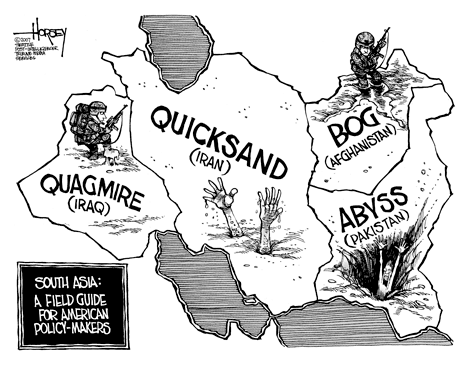
Good instinct, bad linkage on Iran-Afghanistan

Ignatius piece in WAPO that starts out promisingly:

Iran is signaling that it wants to join regional efforts to stabilize Afghanistan -- presenting President Obama with an interesting diplomatic opportunity. He had solicited just such help from Tehran last month, but the administration has not yet responded to the Iranian feelers.

And then replays past mistakes:

U.S. policy is still in flux, but the administration appears ready for a limited dialogue with Iran about Afghanistan, perhaps conducted through the two countries' embassies in Kabul. This position has not been communicated to the Iranians, in part because Washington is waiting to see whether Iran will return soon to negotiations about its nuclear program with the "P-5 plus 1" group.

Thus we see yet again what our mania with nukes costs us in the Long War.  Sadder still, but telegraphing our conditions in such a rote fashion, we cede all initiative and put Tehran in the driver's seat on both scores.

Unimpressive.