Buy Tom's Books
  • Great Powers: America and the World After Bush
    Great Powers: America and the World After Bush
    by Thomas P.M. Barnett
  • Blueprint for Action: A Future Worth Creating
    Blueprint for Action: A Future Worth Creating
    by Thomas P.M. Barnett
  • The Pentagon's New Map: War and Peace in the Twenty-first Century
    The Pentagon's New Map: War and Peace in the Twenty-first Century
    by Thomas P.M. Barnett
  • Romanian and East German Policies in the Third World: Comparing the Strategies of Ceausescu and Honecker
    Romanian and East German Policies in the Third World: Comparing the Strategies of Ceausescu and Honecker
    by Thomas P.M. Barnett
  • The Emily Updates (Vol. 1): One Year in the Life of the Girl Who Lived (The Emily Updates (Vols. 1-5))
    The Emily Updates (Vol. 1): One Year in the Life of the Girl Who Lived (The Emily Updates (Vols. 1-5))
    by Vonne M. Meussling-Barnett, Thomas P.M. Barnett
  • The Emily Updates (Vol. 2): One Year in the Life of the Girl Who Lived (The Emily Updates (Vols. 1-5))
    The Emily Updates (Vol. 2): One Year in the Life of the Girl Who Lived (The Emily Updates (Vols. 1-5))
    by Thomas P.M. Barnett, Vonne M. Meussling-Barnett
  • The Emily Updates (Vol. 3): One Year in the Life of the Girl Who Lived (The Emily Updates (Vols. 1-5))
    The Emily Updates (Vol. 3): One Year in the Life of the Girl Who Lived (The Emily Updates (Vols. 1-5))
    by Thomas P.M. Barnett, Vonne M. Meussling-Barnett
  • The Emily Updates (Vol. 4): One Year in the Life of the Girl Who Lived (The Emily Updates (Vols. 1-5))
    The Emily Updates (Vol. 4): One Year in the Life of the Girl Who Lived (The Emily Updates (Vols. 1-5))
    by Thomas P.M. Barnett, Vonne M. Meussling-Barnett
  • The Emily Updates (Vol. 5): One Year in the Life of the Girl Who Lived (The Emily Updates (Vols. 1-5))
    The Emily Updates (Vol. 5): One Year in the Life of the Girl Who Lived (The Emily Updates (Vols. 1-5))
    by Vonne M. Meussling-Barnett, Thomas P.M. Barnett, Emily V. Barnett
Search the Site
Powered by Squarespace
Monthly Archives
12:04AM

There is no alternative to Obama--for now

That is one superior cartoon, and I assume you can name the trio of cartoonish characters left to right. The "nonsense 24/7" is especially cute.

Economist editorial lamenting the state of the Right.

First the ambivalence on Obama:

Mr Obama deserves to be pegged back. This newspaper supported him in 2008 and backed his disappointing-but-necessary health-care plan. But he has done little to fix the deficit, shown a zeal for big government and all too often given the impression that capitalism is something unpleasant he found on the sole of his sneaker. America desperately needs a strong opposition. So it is sad to report that the American right is in a mess: fratricidal, increasingly extreme on many issues and woefully short of ideas, let alone solutions.

Fair enough.  Now the plea:

This matters far beyond America’s shores. For most of the past half-century, conservative America has been a wellspring of new ideas—especially about slimming government. At a time when redesigning the state is a priority around the world, the right’s dysfunctionality is especially unfortunate.

I couldn't agree more.  The progressivism, just like at the beginning of the 19th century, is more likely to arise from the GOP than from the Dems.  

And yet:

The Republicans at the moment are less a party than an ongoing civil war (with, from a centrist point of view, the wrong side usually winning). There is a dwindling band of moderate Republicans who understand that they have to work with the Democrats in the interests of America. There is the old intolerant, gun-toting, immigrant-bashing, mainly southern right which sees any form of co-operation as treachery, even blasphemy. And muddying the whole picture is the tea-party movement, a tax revolt whose activists (some clever, some dotty, all angry) seem to loathe Bush-era free-spending Republicans as much as they hate Democrats. Egged on by a hysterical blogosphere and the ravings of Fox News blowhards, the Republican Party has turned upon itself.

Some say this is the vigorous debate begun.  I--and The Economist--lament the lack of rising stars worthy of the designation.

Ah well, we can only hope that the saviors will emerge from obscurity, replacing the current American "idols."

12:03AM

Another take on cleaning up Brazil's favelas with better policing

Economist story.

Starts with "City of God" (2002) film reference to Rio's rundown Cidade de Deus housing project, where a gang of drug traffickers kept 60k residents in lives of constant fear.  The film cemented Rio's reputation for lawless favelas (a Brazilian term for tightly-packed slums), as well as its sad decay after the country moved the capital to Brasilia in 1960.

With the Olympics teed up for 2016, Rio now seems to be undergoing a renaissance:

Last year the police tool control of Cidade de Deus--this time for keeps, they say.  A force of 318 officers, backed by 25 patrol cars, is based in a new community-police station in a side street between two fetid, litter-strewn drainage channels.  The result has been dramatic.  IN 2008 there were 29 murders in Cidade de Deus.  So far this year there has been just one . . . Other crime has fallen too.

A key factor:  getting all levels of government to chip in and double the salaries of front-line cops. The focus: to formalize the existing economic activity with legality and infrastructure.

Sounds like your basic COIN, yes?

The external driver:  Rio becomes the hub for off-shore oil development of that huge oil field just found, plus there's those Olympics and all the construction triggered.

Rio has a ways to go, but the trend is positive.

12:02AM

The Gap's most cruel--and irreversible--chastity belt

Economist story that neglects the Kurds still doing this in northern Iraq.

Some stunning facts:

Cutting girls’ genitals is still common in 28 mostly African countries and among their migrants abroad. The World Health Organisation (WHO) estimates that 100m-140m women have been subject to the practice and thinks that some 3m girls are at risk each year of one of four forms of cutting, ranging from the symbolic to life-ruining. In countries such as Somalia, Egypt and Guinea, over 95% of women have undergone some version of it.

Some see it as a matter of hygiene, others as a rite of passage into womanhood. Its Muslim, Christian and animist defenders all cite religious grounds. Where the practice is a prerequisite for marriage, economic factors play a role too.

Attempts to stamp out the practice have gathered pace since the 1980s. Now 18 African countries have banned it, although laws are patchily observed. Nawal El Saadawi, an Egyptian who suffered mutilation and has campaigned against it for more than 50 years, says that education is needed, not just prohibition. A mixed approach probably works best. Burkina Faso has a hotline to the police for girls who feel they are in danger. Tasaru Ntomonok Initiative, a group in the Narok district in Kenya, has a safe house for girls fleeing their families. Maendeleo ya Wanawake Organisation, a Kenyan women’s NGO, offers “circumcision through words”, an alternative rite of passage without the bloodshed.

A bigger trend is medicalisation. In the past the procedure was typically performed by a local woman using anything from a razor blade to a piece of broken glass, sometimes even using battery acid to stop the bleeding. More families now ask doctors to carry out the cut, in the hope that this will make it safer. A study in Kenya in 2000 showed that using sterile razors, anti-tetanus shots and antibiotics cut the risk of immediate complications by 70%. Such thinking led to the debate in America about whether using doctors was the lesser of two evils. But campaigners against cutting say the use of professionals undermines efforts to end the practice, as making it safer may encourage more parents to inflict it on their daughters.

The weird argument is hygiene, because the comparison to circumcision is bizarrely inappropriate.  It's also strange to see it justified by multiple religions.

To me, the whole thing seems like an crude attempt to control the sexuality of women (Ayaan Hirsi Ali's point), by essentially depleasurizing it.  To call it anything else seems like a lie.

I always have a hard time convincing my kids that women basically had no rights in human history until very recently (with most coming in my lifetime, frankly).  I also have a hard time convincing them that such conditions are basically unchanged still today in many parts of the world--all Gap. 

12:01AM

Chart of the day: Buddy, got $40T to spare?

Caught it first in FT special overview of infrastructure, but then went to source for chart.

Of the $40T to be spent by 2030, $6.5 in North America, $9.2T in Europe writ large, $7.5T in LATAM, $1.1T in Africa, $0.9T in Mideast, and $15.9T in Asia.

Per the Core Gap map, light in the middle and thicker along the edges.

Breaking it down by category, it's $22.6T in water, $9T in electricity, $7.8T in road and raid, and $1.6T in air & sea.

A lot will be internal improvements, but plenty will be external improvements, i.e., improving linkages between states and regions.

Hardly the picture of a world de-globalizing, yes?

12:11AM

Good globalization = $20T in annual trade; bad globalization = $130B in annual criminal trade

Fabulous chart in FT story meant to disconcert you: global crime gangs' muscle growing--yet another thing for me to fear!

So I look through the article for the summing up dollar figure and get $130B, with $105B of that being drugs.

Then I check the size of the global economy, because the number I have stuck in my head from my NewRulesSets.Project days with Cantor at the start of the 2000s is $30T.  Well, the global economy is now twice that size, or about $60T, and despite conventional wisdom, all that money didn't go into the pockets of Goldman Sachs (about $12B in profit in 2009).

Of that global economy, about 1/3rd is traded ever year.  For example, in 2008 (and 2010's numbers will be roughly similar after recovering from 2009) the global merchandise trade (stuff) came to $16T and the service trade was almost $4T, so a total of $20T (see this WTO report).  So you put $130B over $20T and get rid of all those matching zeros, and your equation becomes 130 over 20,000 (please catch any mistakes here), and when I reduce it further, I come up with 65 over 10,000, then 13 over 2,000, and then 1 over about 150.

And then my heart rate slows and I don't feel so freaked out. Global crime equals less than 1% of global trade?

Now let's assume the UN calculations are way off, and the global crime numbers are 5 times larger!

So I start with $650B and I come up with a fraction more like 1/30. Does anyone expect to live in a world where there isn't crime that equals 3% of legal economic trade (understanding that means the UN stats miss 80% of all global crime)

Again, please tell me where my math is wrong.

Does it sound to you like criminal gangs are running the world?

Yes, there are aggregate estimates of illicit activity that run higher than the UN's focus here, and they're always bulked up overwhelmingly by estimates of illegal financial flows (for example, there are credible estimates of $1T a year of illicit financial flows from developing to developed markets). If you want to run with such aggregate estimates, fine, but the UN's record on statistics is pretty good, and here I'm comparing apples (smuggling stuff and people) to apples (legal trade in merchandise and services), not adding in money flows and then comparing that fantastically boosted total to just global trade--a typical misleading trick of those who like to scare people. Because if you add up global financial flows, you're into a whole new scale and if you engage in legitimate apples-to-apples comparisons there, your percentages will yield the same small fractions.

12:10AM

The end of the Third World?

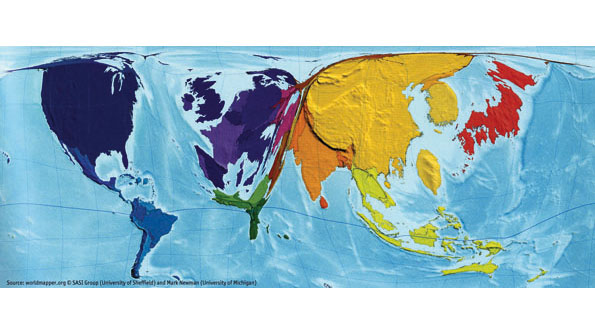
A map of the world distorted to depict projected shares of global GDP in 2015.

Economist piece.

Bob Zoellick, World Bank pres., says "2009 saw the end of what was known as the third world"--meaning the end of a distinct, separate part of the world that is aid-dependent and unimportant.

Is this a plausible notion? asks The Economist:

While the rich world stumbles out of recession, Asia, Africa and Latin America are accelerating and contributing more than ever to world output. Two fast-growing countries, Turkey and Brazil (“powers of the future”, says Iran’s president), struck a deal in May that was intended to break the deadlock over Iran’s nuclear programme. Though less than meets the eye, the agreement was still an intriguing case of emerging-nation diplomacy. And the football World Cup gets under way this week in South Africa, arguably the poorest country to host the event.

Yet at the same time, Mr Zoellick’s bank is not in any danger of going out of business. 

The simpler argument, says the paper, is that the Third World dies when the division between First and Second Worlds ends in 1989 ("end of history").

But the world is still "binary," says the paper, noting that 1B ("bottom billion" live on less than $1.25 a day (basically one half of the one-third of the world's population in my Gap).

Can we at least still buy the dependency theory?  Not when south-south trade (and south-BRIC trade) rises twice as fast as global trade.

But aren't these nations hopelessly in debt?  Public debt in emerging economies is 40% of GDP and flat, while Old Core public debt was 75% of GDP in 2007 and rising toward 110% by 2015, says the IMF.  So South Africa has a better credit rating than Greece.

Nice conclusion:

In 1826 the British foreign secretary, George Canning, boasted that he had “called the new world into existence to redress the balance of the old.” Now the third world has come into its own to redress the imbalances of the old. Canning and others also helped to transform the diplomatic architecture of Europe after the end of Napoleon. Far less has been done—in international financial institutions, in patterns of aid-giving and in diplomatic habits—to reflect the reality of the third world’s end.

As I've long argued:  dependency theory turned on its head, and if that's not the end of history, then it's the end of Leninism.

12:06AM

The strange "boom town" that is Deepwater Horizon

Bloomberg Businessweek story on how the Deepwater Horizon disaster births its own booming, side economy of disaster management, recovery and remediation (to include all those lawsuits). 

The dichotomy:  the same hotels and motels that should be filled with tourists are now filled with response workers.

It is a standard of the System Perturbation that the losses created by the Vertical Scenario (disaster) are oddly balanced by the stupendous economic activity triggered by the resulting Horizontal Scenario (aftermath).

I mean, look at the losses created by 9/11, and then compare that to all the economic activity triggered by Homeland Security and the War on Terror.

Makes you wonder about all those return-on-investment calculations by the terror experts (who do pretty well in the resulting Horizontal Scenarios, BTW).

12:05AM

Anti-ship cruise missiles: dominant threat of tomorrow--as always

Economist Technology Quarterly story on a bugaboo I've been hearing about since the early 1990s: anti-ship cruise missiles will rule the naval warfare landscape of tomorrow.

I've always been fuzzy on how this would work.  Great power navies firing missile at each other and somehow not triggering unwanted escalation toward nuclear exchanges?  Or maybe it's regional rogues who nail a great-power ship or two and, on that basis, win the larger conflict?  Or the lucky shot by terrorists that changes the global correlation of forces?

Every scenario I've ever come across has this fait accompli logic: we're denied "access" to some fight because our ships can't get in close out of fear of anti-ship missiles and then the baddies win the entire day--lightning quick.

If this sounds an awful lot like the Taiwan scenario, you've been paying attention.  

Then there's the whole closing-the-Straits-of-X scenarios, where cruise missiles shut down major lanes of global trade for days/weeks/months on end, but these get too fantastic almost from the start.  If it takes 10 or more subsonic missiles to sink a well-defensed warship (a standard cited in the piece), then imagine how many it would take to sinker a big-ass tanker.

Then there's the transnational swarmers easily defeating a nation-state foe, with the big example being Hezbollah firing a subsonic missile in 2006 at an Israeli corvette and killing four sailors. This is held up as a stellar example of "poor man's way" of sea power (a STRATFOR comment that reflects that for-profit company's typically clever fear-mongering).

In this way, we are meant to be impressed to Iran's growing seapower of fast boats and so on.  

But whenever I read these scary reports, I'm always impressed by the fact that all the relevant technology is being developed by great powers and then exporting to medium sized powers, who buy the weapons primarily out of fear of the same great powers. So in the end, we've got a lot of navies getting all excited--in weird isolation from the world around them--about the possibility that they're going to get to sink each other's ships like crazy in coming, dreamt-of naval battles.

Oh, and then there's the Iranians shutting down Hormuz or Hezbollah ruling . . . I dunno, the Eastern Med for 20 mins some afternoon.

So you're left with globalization's major-economy navies worrying about the residual possibilities of great-power warfare (the 65 year moratorium looks stronger than ever), medium powers worrying about great powers, great powers worrying about "poor man's" sea-power-seeking navies built around fast boats, and that old lucky-shot-by-terrorists scenario.  And all this is meant to scare me into what, exactly?

I guess it should scare me into stop building my fleet primarily around huge platforms and start moving toward swarm mentalities.  

Or I can continue building tricked-out capital ships and have my industrial complex sell missiles abroad and then fret about the chances that those trends will eventually collide--undoubtedly with Trafalgar-like, world-empire-shattering impact. US Navy ships are so easy to sink, that's why they drop like flies all the time.

Is it just me?  Or does naval thinking seemed trapped in some strange land of yesteryear?  I mean, how far back do we have to go to find significant naval battles to justify this seemingly brain-dead thinking? When you get down to citing Iran and Hezbollah in your article on "peril on the sea," doesn't it seem like the conversation has gone stale?  Here we live though the great age of globalization, and the state of imaginative thinking in naval strategy is running around with your hair on fire over cruise missiles.

Ah, but I neglect the great Sino-American battles to come. Those should play well on major financial markets.

Then again, I am so naive.

12:04AM

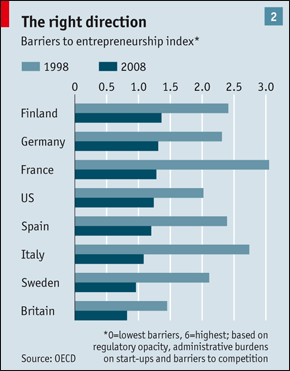
The EU's "terrible" rules: better or worse for entrepreneurship?

Economist story lauding the "blooming" environment of Europe's tech entrepreneurs.

The EU is derided as biz-unfriendly with all its rules and regs. But the chart suggests otherwise.

So yes, a small entrepreneurial pool compared to Silicon Valley America, but moving in the right direction and hardly damaged by the EU integration process per se.

12:03AM

Taking Turkey seriously

 FT column by Philip Stephens.

The conventional narrative says Turkey has traded in western democracy for Islamism.

Stephens sees it a bit more subtly:

In any event, the message I took from policymakers and business leaders at a recent conference in Istanbul convened by Chatham House was far more subtle than the present discourse in the west. Far from turning its back on Europe, the government hopes that the country’s rising regional influence will strengthen its claim for admission.

It is not often these days that you hear anyone praise the EU. Turkish politicians are the exception. The Union, one of Mr Erdogan’s ministers told the conference, had been a “greatest peace project in the history of mankind”. Securing Turkey’s membership remained a “national and a strategic” objective.

In sum, no breach with West, but a rational attempt to boost Turkey's negotiating hand.

12:01AM

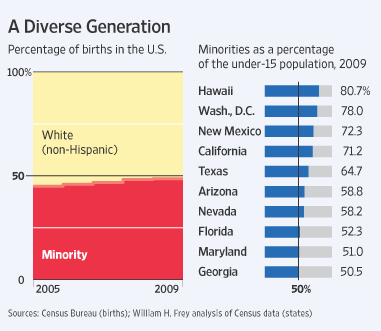
Chart of the day: The post-Caucasian era is birthed--right here in America!

OMG! 

What will America do in a post-Caucasian world?

Hmmm.

I guess we'll just go on being Americans in a very American world.

12:10AM

Arizona may be on the front-lines, but the Latinization of these United States is a much deeper phenomenon

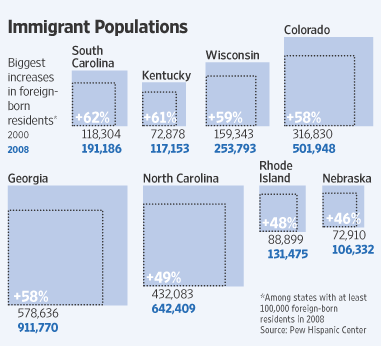
WSJ story about a small town in Nebraska that's coming apart at the seams over a proposed, AZ-like tough law on illegal immigrants.  The town (Fremont) is almost exclusively European, with most residents of Swedish and German background. A substantial meatpacking company presence has--unsurprisingly--boosted the Hispanic presence recently (around 1k out of 25k total population), leading to the tension. Naturally, such a potentially divisive law attracts a lot of outside players joining the fight.

I was just more attracted to the chart, which details the biggest increases of foreign-born residents in states with more than 100k foreign-born already.  I mean, look at the spread that includes the mid-Atlantic/south with the two Carolinas and GA, New England with RI, the plains (NE), the north (WI), Appalachia (KY), and the mountainous West (CO). This is hardly just a SW America issue, thus the rule-set clash currently being played out in Arizona is but a harbinger of a large struggle to come.

My point: welcome the experimentation by states. Some will bad and some will be good, but the churn will help us collectively find the right mix over time.

12:06AM

China: moving ahead with yuan-settled trade

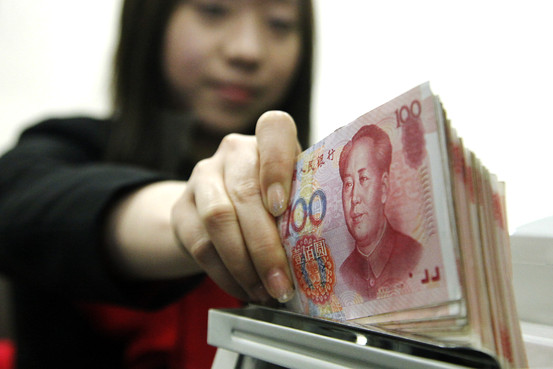
WSJ story noting that "China government will expand a trial program for settling trade deals in yuan to most of the country . . . in an effort to accelerate the internationalization of the Chinese currency after a slow start."

The program started just last July, replacing the long-held norm of denominating trade deals using dollars or other foreign currencies.  Until now, only Shanghai and Guangdong-province companies could settle in yuan and only with companies based in Hong Kong, Macau and a few foreign nations.  Now the program grows to 20 provinces and major cities.

The goal?

... to gradually make its currency more important internationally, and reduce is reliance on the dollar, which [Chinese officials] have said leads to outsize impact from U.S. economic policy on China and other countries.

The fear is natural enough:  ". . . U.S. deficits could lead to inflation that weakens the value of the dollar."

This shift will be slow, because as China proceeds, it moves into an undiscovered territory.  But it's a good thing and an inevitable shift. Frankly, we need China to make the dollar less relevant as a global reserve currency.  It won't stop being one--ever.  But it should not dominate as it has in the past, because that reality allows us too much freedom for fiscal irresponsibility.

As I have said here many times, I would like a future global economy where the euro and the yuan (or some "asia" that includes the yuan) can, in combination, overshadow the dollar and force its corrections in value. This is the next, most natural iteration of the global economy, and however China moves itself and us collectively down that path, we must welcome the evolution, as unsettling as it may seem to us in the here-and-now.

Do not fall into the fallacy of thinking this shift only benefits China and only penalizes us. The discipline we gain is much needed, and China will find itself ever more constrained by this new financial connectivity.

12:05AM

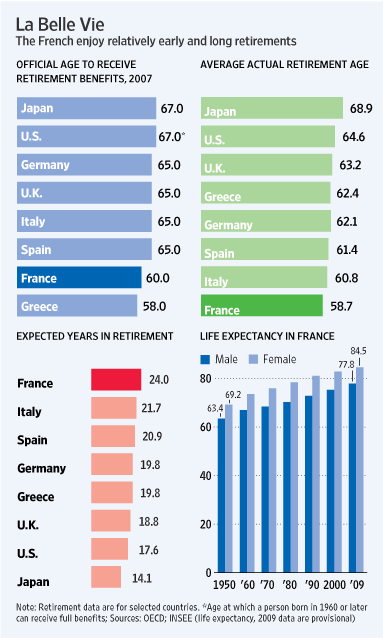
France raises it retirement age from 60 to 62

WSJ story.

Of course, we'll see this headline countless times in coming years as the rest of Europe moves in a similar direction as all those Euro Boomers head into retirement age.

I mean, really France, 58?

I think people my age should expect to work to at least 70 and probably 75.  My kids should add a decade to those numbers.

Why? As more people make it into their 60s in solid health, the actual life expectancy for that cohort extends much farther than the norm.

In fact, I foresee more intra-generational tension over that divergence than inter-generational.

12:04AM

Iran getting by with black-market gas

WSJ story that suggests the 4th round of sanctions won't be as "crippling" as the administration suggests, citing a "shadowy network of Middle East gasoline suppliers is already undermining" our efforts.

By definition, a Gap region has sophisticated black markets.  It's a primary reason why sanctions don't work, even as they drive up the prices, which Tehran can then blame on the West.

But we continue with sanctions because they make us feel good, and they appeal to our obey-the-rules mentality, which is good, of course, but kind of meaningless when applied to rogue regimes inside the Gap.

12:03AM

Africa: the stronger hand this time around?

FT special report on African oil & gas.  The somewhat optimistic but seemingly justified vibe:  this time around Africans hold a stronger hand:

African countries with oil and gas reserves have grown accustomed to hearing how exciting they are. Less explored and than the Middle East, possessed of sweeter crude than Latin America and in no position to imitate Russia’s strongarm tactics, they are, energy experts keep telling them, the future.

Explorers have opened up new swathes of the continent, from Lake Albert in the east to the 1,100km offshore frontier discovered in the Gulf of Guinea. Ghana and Niger are due to pump their first barrels in the coming months.

Billions of dollars have poured into deepwater and natural gas developments in Nigeria and Angola, the industry’s linchpins.

“In the past 10 years, African oil producers have become the beautiful brides,” says Charles Ukeje, an international relations specialist at Nigeria’s Obafemi Awolowo University. “We are witnessing a new scramble.”

But crude is trading at roughly three times the average of the previous two decades and African governments have begun to respond to the surge of interest by asking with increasing vehemence: “What’s in it for us?”

Their hand is certainly strengthening. US dependence on African crude is projected to hit 25 per cent by 2015. Late last year, Nigeria surpassed Saudi Arabia as the third biggest supplier of crude to the US.

In April, China imported more oil from  Angola than anywhere else. Europe is hoping a gas pipeline across the Sahara will reduce its dependence on Russian oil – and was rattled when Gazprom tried to muscle in on the project. 

But the days when international institutions exhorted African countries to offer incentives to lure investment at all costs are gone.

“African states are entitled to receive a fair deal for the exploitation of their natural resources,” said the authors of a survey of the continent’s economies last month by the African Development Bank (AfDB) and the Organisation for Economic Co-operation and Development.

Oil investors’ ability to strike workable bargains in Africa will go some way to deciding whether what are believed to be the world’s biggest untapped hydrocarbon stocks will remain in the ground or whether the region will shoulder a greater share of global production.

Nigeria, home to 60 per cent of sub-Saharan Africa’s proven oil reserves and 70 per cent of its gas, although hampered by graft and mismanagement, has been the most abrasive battleground for this renewed reckoning.

While I will still maintain our Africom has nothing to do with this: the big oil producers for the US are in West Africa, whereas all the AQ activity is to the north and east.  Plus, quite frankly, the oil flows out of Angola and Nigeria no matter the level of violence--sad fact (although the truth is that Angola, after all those years of violence, is amazingly stable right now).

More to the point: the bulk of the new suitors are Asian--not American.

The difference this time for Africa?  In the past, the Western interest was always defined by boom-and-bust mechanics, whereas the Asian demand this time around will be substantial and sustained.  America's long efforts to encourage marketization and integration in Asia have helped create this historic opportunity. That's why Africom's primary focus, in my opinion, should be in enabling this "scramble" by improving local capacity for security provision (yes, target the baddies, such as they appear, but focus most on making this good happen in a sustainable fashion).

There is no question that social tensions will be created, and that governments in Africa will respond sub-optimally, but this is a huge opportunity not to be screwed up, and a perfect locale for Sino-American strategic partnership to emerge.

12:02AM

Saudis success rate at militant rehabilitation? About 90% normally, dropping to 80% with the toughest cases.

Reuters by way of Michael Smith, who I know wants me to focus on the 20% versus the 80%:

Around 25 former detainees from Guantanamo Bay camp returned to militancy after going through a rehabilitation program for al Qaeda members in Saudi Arabia, a Saudi security official said on Saturday.

The United States have sent back around 120 Saudis from the detention camp at the U.S. naval base in Cuba, set up after the U.S. launched a "war on terror" following the September 11 attacks by mostly Saudi suicide hijackers sent by al Qaeda.

Saudi Arabia, the world's top oil exporter, has put the returned prisoners along with other al Qaeda suspects through a rehabilitation program which includes religious re-education by clerics and financial help to start a new life.

The scheme, which some 300 extremists have attended, is part of anti-terrorism efforts after al Qaeda staged attacks inside the kingdom from 2003-06. These were halted after scores of suspects were arrested with the help of foreign experts.

Around 11 Saudis from Guantanamo have gone to Yemen, an operating base for al Qaeda, while others have been jailed again or killed after attending the program, said Abdulrahman al-Hadlaq, Director General of the General Administration for Intellectual Security overseeing the rehabilitation.

He pinpointed strong personal ties among former prisoners but also tough U.S. tactics as the reason why some 20 percent of the returned Saudis relapsed into militancy compared to 9.5 percent of other participants in the rehabilitation program.

But honestly, I read the piece and I have to agree with the Saudis calling the program "a success," a claim pretty much mocked throughout the US press.  We're talking probably the most committed (the ones we went after) and the ones with the biggest resulting gripes (time in Guantanamo) and the Saudis still got 4 out of every 5 to walk away from the cause?  To me, that's a pretty amazing success rate.  Good God, I'd take that for the average American convict (more like half go right back to crime once out of prison), so I guess I don't see where we get off pointing fingers on this one.

I think we're awfully unrealistic on this score (indeed, one version of this story in NY state proclaimed that "scores" of Saudi terrorists were back at work, because apparently 25 equals "scores").  Any program that sidelines 90% of a population (only those returned by America scored a mere 80%, as the Saudi standard is 9 out of 10 successfully rehabilitated) has to be deemed a serious success.  I doubt we get that share in most of our efforts in Af-Pak right now, so retract the finger!

12:01AM

Chart of the day: % Indian population living on less than $1.25/day

From WSJ story where India is considering whether or not to liberalize its welfare rolls by lowering the threshold definition of poverty.

But what caught my eye here is the clear trend.  We can argue about what the cut-off for welfare should be, but it gets hard to make the case that globalization and marketization has impoverished Indians.

12:10AM

They left the Carolinas, then the Caribbean, then Mexico, and now China?

WSJ story:

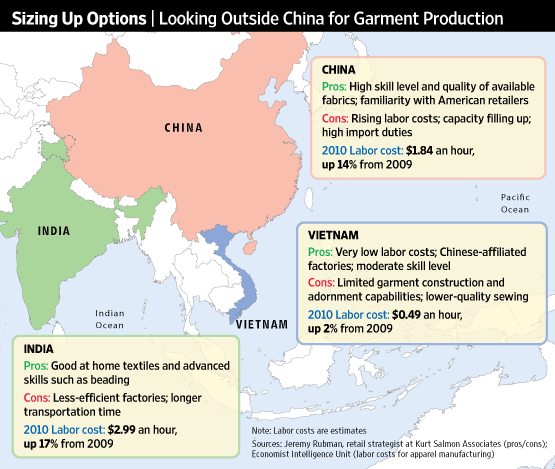
Rising labor costs in China are forcing U.S. apparel and accessories retailers, such asAnnTaylor Stores Corp. and Coach Inc., to consider relocating at least some of their production to countries with cheaper work forces. But doing so could risk increasing other expenses, such as shipping.

"We are looking to move production into lower-cost geographies, most notably Vietnam and India," Mike Devine, Coach's chief financial officer, said at a conference last week. The luxury-handbag retailer already produces goods in those countries, but plans to increase its presence in both of them.

Guess Inc. is thinking along similar lines. Dennis Secor, the fashion brand's chief financial officer, said in an interview that Guess is looking to build its production capabilities in Vietnam, Cambodia and Indonesia.

JC Penney says its apparel makers have been leaving China for Indonesia, Vietnam, India and Bangladesh for the past five years.

Nobody can sit still on the production chain, and China, with its rapidly aging population, has to move faster than most.

12:06AM

One thing to chase the race leader, another thing to lead the race

Nice Fareed Zakaria piece in Newsweek.

The quote below struck me:

A Chinese businessman said to me over lunch in Beijing, “In many ways the financial crisis and the discrediting of the American model has been bad for us. You see, we don’t really have an ideology anymore. We don’t know what we believe in. We used to think it was some version of the American Dream—liberalize, open up, grow. But then you had your crisis. We can say, it proves we’re strong. But where do we go now?”

Leading a race is VERY hard, because you're never quit sure how fast to run.