Buy Tom's Books
  • Great Powers: America and the World After Bush
    Great Powers: America and the World After Bush
    by Thomas P.M. Barnett
  • Blueprint for Action: A Future Worth Creating
    Blueprint for Action: A Future Worth Creating
    by Thomas P.M. Barnett
  • The Pentagon's New Map: War and Peace in the Twenty-first Century
    The Pentagon's New Map: War and Peace in the Twenty-first Century
    by Thomas P.M. Barnett
  • Romanian and East German Policies in the Third World: Comparing the Strategies of Ceausescu and Honecker
    Romanian and East German Policies in the Third World: Comparing the Strategies of Ceausescu and Honecker
    by Thomas P.M. Barnett
  • The Emily Updates (Vol. 1): One Year in the Life of the Girl Who Lived (The Emily Updates (Vols. 1-5))
    The Emily Updates (Vol. 1): One Year in the Life of the Girl Who Lived (The Emily Updates (Vols. 1-5))
    by Vonne M. Meussling-Barnett, Thomas P.M. Barnett
  • The Emily Updates (Vol. 2): One Year in the Life of the Girl Who Lived (The Emily Updates (Vols. 1-5))
    The Emily Updates (Vol. 2): One Year in the Life of the Girl Who Lived (The Emily Updates (Vols. 1-5))
    by Thomas P.M. Barnett, Vonne M. Meussling-Barnett
  • The Emily Updates (Vol. 3): One Year in the Life of the Girl Who Lived (The Emily Updates (Vols. 1-5))
    The Emily Updates (Vol. 3): One Year in the Life of the Girl Who Lived (The Emily Updates (Vols. 1-5))
    by Thomas P.M. Barnett, Vonne M. Meussling-Barnett
  • The Emily Updates (Vol. 4): One Year in the Life of the Girl Who Lived (The Emily Updates (Vols. 1-5))
    The Emily Updates (Vol. 4): One Year in the Life of the Girl Who Lived (The Emily Updates (Vols. 1-5))
    by Thomas P.M. Barnett, Vonne M. Meussling-Barnett
  • The Emily Updates (Vol. 5): One Year in the Life of the Girl Who Lived (The Emily Updates (Vols. 1-5))
    The Emily Updates (Vol. 5): One Year in the Life of the Girl Who Lived (The Emily Updates (Vols. 1-5))
    by Vonne M. Meussling-Barnett, Thomas P.M. Barnett, Emily V. Barnett
Search the Site
Powered by Squarespace
Monthly Archives
12:02AM

Brief Reminder: Vertical and horizontal scenarios

Just a straightforward rundown I used to do of the key differences between vertical and horizontal scenarios.  I used these slides primarily in the first two years after 9/11 to explain some of the asymmetry between the way nonstate actors like to fight (drawn-out horizontal conflicts) and how organized militaries prefer to fight (the clearly-defined, short war of lightning strikes).  

12:01AM

Blast from my past: Wall Street Journal front-page profile

At The Pentagon, Quirky PowerPoint Carries Big Punch: In a World of 'Gap' States, Mr. Barnett Urges Generals To Split Forces in Two;
 Austin Powers on Soundtrack

Wall Street Journal
May 11, 2004 
Pg. 1

By Greg Jaffe, Staff Reporter Of The Wall Street Journal


In 1998, Thomas Barnett, an obscure Defense Department analyst, teamed up with senior executives at the Wall Street firm Cantor Fitzgerald LP to study how globalization was changing national security.

One scenario they studied was a meltdown caused by the Y2K computer bug followed by terrorist attacks designed to exploit the chaos. Mr. Barnett posited that Wall Street would shut down for a week. Gun violence, racially motivated attacks and sales of antidepressants would surge. The U.S. military would find itself embroiled in brushfire conflicts across the developing world.

His theories were met with skepticism. "People began referring to me as the Nostradamus of Y2K," Mr. Barnett says.

Then came the Sept. 11 terrorist attacks. Suddenly Mr. Barnett didn't look so crazy.

At the urging of his Pentagon bosses, Mr. Barnett overhauled the concept to address more directly the post-9/11 world. The result is a three-hour PowerPoint presentation that more resembles performance art than a Pentagon briefing. It's making Mr. Barnett, 41 years old, a key figure in the debate currently raging about what the modern military should look like. Senior military officials say his decidedly controversial ideas are influencing the way the Pentagon views its enemies, vulnerabilities and future structure.

Mr. Barnett's military is a far cry from the shape of today's armed forces. Instead of a single force to wage wars and rebuild nations, Mr. Barnett envisions two. The first, which he dubs "Leviathan," would be hard-hitting, ready to take on conventional foes such as Saddam Hussein on a moment's notice. The second, more unconventional force of "System Administrators" would focus on bringing dysfunctional states into the mainstream through the type of nation-building operations seen in Iraq, the Balkans and Eastern Africa. It wouldn't only mop up after wars but would travel the world during peacetime building local security forces and infrastructure.

This blueprint for America's defense force comes wrapped in a presentation devised by Mr. Barnett that samples the "ching ching" sound effect from the television series "Law & Order," borrows lines from the Sopranos and features the voice of movie character Austin Powers calling out "Oh yeah, baby!" to punctuate a key idea. At one point, upsetting some, Mr. Barnett refers to 9/11 as the "first live-broadcast, mass snuff film in human history."

"Tom polarizes people with his brief. They either love it or they hate it," says retired Navy Capt. Bradd Hayes, a professor at the Naval War College, where Mr. Barnett also teaches.

With the military struggling in Iraq and Afghanistan, it's possible the American public could lose its appetite for anything that smacks of intervening in troubled states. But it's precisely these problems that are prompting senior officials to listen more closely to the pitch. A group of strategic planners from the Pentagon's Joint Staff invited him to kick off a two-day retreat in April for senior officers. Afterward they told Mr. Barnett they wanted him to brief a more senior group. The Navy's top admiral recently e-mailed an essay written by Mr. Barnett to the service's top brass.

Rep. Mac Thornberry, a Republican and a senior member of the House Armed Services Committee, says Mr. Barnett has shaped his view on China, global trade, foreign aid and national defense.  "Since the fall of the Soviet Union we haven't had a global strategy with bipartisan appeal that can survive changes in administration and in Congress," the lawmaker says. He thinks this could fit the bill.

Mr. Barnett conjured up his vision at the urging of Retired Vice Adm. Arthur Cebrowski. After 9/11, Defense Secretary Donald Rumsfeld tapped the admiral to run a new office in the Pentagon, dubbed the Office of Force Transformation, focusing on changing the military, one of Mr. Rumsfeld's pet projects. Adm. Cebrowski turned to Mr. Barnett because he first wanted a better idea of what a post-9/11 military was supposed to do. During the Cold War it was designed primarily to contain Communism. "The Soviet Union was the principal designer of our force," the admiral says.

Adm. Cebrowski, a 61-year-old former naval aviator, flew 158 combat missions in Vietnam and commanded an aircraft carrier in the Persian Gulf War. He's a devout Catholic who attends Mass every day and raves about Mel Gibson's "The Passion of the Christ."

Mr. Barnett, by contrast, studied at Leningrad State University in the mid-1980s, taught Marxism among other subjects at Harvard, and voted for Al Gore for president. He maintains his own Web page (thomaspmbarnett.com) that features his wife's poetry, a eulogy he wrote on his father's death and a book-length chronicle of his eldest daughter's successful battle with cancer.

For much of the 1990s, Mr. Barnett worked for the Center for Naval Analyses, a federally funded research center. He is currently a senior professor in the Warfare Analysis department of the Naval War College in Rhode Island, where Adm. Cebrowski served as president until 2001.

In Mr. Barnett's world, countries are divided into two categories. His "core" countries are part of a global community linked by trade, migration and capital flows. Europe, the U.S., India and China fall into this group. Then there are "gap" countries that either refuse to join the global mainstream (such as Saudi Arabia and Iran), or are unable to because they have no central government or are struggling with debilitating crises (such as Iraq, Afghanistan, Somalia, and much of sub-Saharan Africa).

"The "gap" is a petri dish of grief, repression, terrorism and disease," says Adm. Cebrowski. "And 9/11 shows we can't wall ourselves off from it."

To join those worlds together, Mr. Barnett envisions two different military forces. The Leviathan force consists of stealthy submarines, long-range bombers and highly trained soldiers who are "young, unmarried and slightly p----- off," Mr. Barnett says.

The System Administrator force is named for the technology wonks who run corporate computer networks. This force is focused on training "gap state" security forces, stamping out insurgencies and rebuilding basic infrastructure such as legal systems and power grids.

That force would include lightly armored soldiers, the Marine Corps and officials from the State, Justice and Commerce departments along with the U.S. Agency for International Development. Its troops would be older and more specialized than the Leviathans. The purpose of the System Administrators would be to bring order to a country, but the force would also be strong enough to defend itself.

This concept relies on a key assumption: The power of the U.S.'s nuclear and conventional arms, plus increasing global economic interdependence, has made war between superpowers a thing of the past. It also assumes that wars with less-powerful states are less likely to occur.

Instead, the U.S. is more likely to find itself embroiled in dysfunctional parts of the world battling terrorists and rebuilding failed states, something it doesn't do very well. "You guys can do two or three Iraq wars a year, no problem," Mr. Barnett recently told a group of senior officers from the Joint Staff. "But you can't do one occupation."

It's not clear what Mr. Rumsfeld thinks of Mr. Barnett's vision. Adm. Cebrowski has briefed the Pentagon chief on key aspects as recently as last month and says he got a warm reception. A Pentagon spokesman says the press office wasn't able to determine Mr. Rumsfeld's reaction to the briefing.

Many worry Mr. Barnett's concept leaves the U.S. unprepared to fight a big war with countries such as China and North Korea. "What if we are misreading China's intentions the way we misread radical Islam?" asks Michael Vickers, a national-security analyst and former CIA officer who does consulting work for the Pentagon.

Mr. Barnett bets that advanced technologies will allow the U.S. to fight wars with smaller, high-tech formations. Some military analysts, such as retired Marine Corps Lt. Gen. Paul Van Riper, think that's naive. Gen. Van Riper, who plays the enemy in Pentagon war games, says enemies could too easily hide from the Leviathan force's sophisticated surveillance. He also thinks the System Administrator force wouldn't be strong enough to defend itself in places such as Fallujah.

"I admire Adm. Cebrowski," he says. "But this is absolute nonsense from folks who are thinking about war as they want it to be, not as it actually is. War is a terribly nasty, brutish business."

The Pentagon has a history of taking intellectual cues from unexpected sources. In the 1970s and 1980s Andrew Marshall, a low-profile Pentagon analyst who runs an office similar to that of Adm. Cebrowski, argued that wars could be revolutionized by precision bombs, unmanned planes and wireless communications that would allow the U.S. to destroy enemies from a distance.

Mr. Marshall, who cultivated a network of prominent military officers and civilians, rarely spoke in public and almost all his papers are classified. But his ideas have informed the way the U.S. military fought high-intensity wars in Iraq and Afghanistan. "Andy Marshall's kind of like a rabbi," says Mr. Barnett.

Mr. Barnett has delivered his brief some 150 times since 9/11. Pearson PLC's Penguin Group published it earlier this year as a book, "The Pentagon's New Map," and Mr. Barnett penned a shortened version for Esquire magazine.

On a spring day in Washington, Mr. Barnett stepped into a room full of generals, admirals and colonels from the Pentagon's Joint Chiefs of Staff. His job was to kick off a two-day retreat where the military would debate his ideas.

In the room was the deputy director of operations for the U.S. Central Command. A few seats away sat the Army colonel whose battalion led the famous "Thunder Run" into Baghdad that toppled Saddam Hussein. Seated across the room was an Air Force brigadier general -- one of only a handful of U.S. fighter pilots to have shot down an enemy plane in combat over the past two decades. Mr. Barnett recognized none of them.

The lights dimmed and Mr. Barnett, clad in a dark turtleneck and khakis, launched into his brief. He soon flashed up on a screen a picture of a mock personal ad that he found taped to a Pentagon wall in the late 1990s.

"ENEMY WANTED: Mature North American Superpower seeks hostile partner for arms racing, Third World conflicts and general antagonism. Must be sufficiently menacing to convince Congress of military financial requirements...Send note with pictures of fleet and air squadrons to CHAIRMAN JOINT CHIEFS OF STAFF/PENTAGON."

In the early days of the current Bush administration, senior Pentagon officials thought China, with its growing arsenal of ballistic missiles and increasingly sophisticated submarine fleet, might fill this role.

Mr. Barnett's work with Cantor Fitzgerald, which stemmed from a long-standing relationship between the firm and the Naval War College, convinced him otherwise. China was buying U.S. debt, angling to join the World Trade Organization and growing increasingly dependent on foreign direct investment. "China isn't the problem, it's the prize," he told the officers.

He displayed a map of the sprawling "gap," which includes most of Africa, Central Asia, the Middle East and a big chunk of Central and South America. "This is globalization's ozone hole," he said.

In the past, Mr. Barnett's pitch for a System Administrator, or nation-building force, was often greeted with howls of disapproval from military crowds. A year of faltering progress in Iraq has made his ideas more palatable. One Army colonel in the audience compared the Iraq nation-building mission to a screw that needs to be driven into a wall. "Right now all we've got is a hammer and we are driving that screw into the wall with our hammer as best we can. But it won't set right. What we really need is a screwdriver," he said.

An Air Force general suggested the bifurcation of the force recommended by Mr. Barnett was already quietly happening. The Army National Guard, a force comprising part-time soldiers, used to be indistinguishable from the regular Army. Today, it's trading weaponry used in high-intensity conflicts for military-police units to restore law and order.

One Army colonel balked at the presentation, suggesting it might not be possible to save some societies, such as Saudi Arabia, or even Iraq and Afghanistan.

"Aren't you assuming the people in the 'gap' think like you and want the same things as you?" he asked.

"Everyone wants a better future for their kids," said Mr. Barnett.

"I've been around a lot of people who don't think like us," the officer replied.

After the meeting, the group—led by a team of one- and two-star admirals and generals—decided to recommend that Mr. Barnett brief the military's most senior four-star generals at a retreat later this year.

It's not likely that the Pentagon will officially split the military into a Leviathan force and a System Administrator force. But acceptance for the general concept is growing. "I used to be afraid to pitch the Sys Admin force," Mr. Barnett said after his speech to the Joint Staff officers. "I literally would worry that I'd get laughed off the stage."

12:07AM

Mattis becomes Central Command boss

That makes two of my three "monks of war" (Esquire 2006--reposted again on the site) in the two most important military positions right now: Petraeus running Af-Pak and Mattis running CentCom as his boss.

Can I pick 'em or what?

Just goes to show that not every flag officer I profile gets immediately relieved of duty!  Most have done just fine.

I really had a blast writing that piece, as I combined the interviews with addresses to the student bodies at both Leavenworth and Quantico (Marine Corps U, which I do again next month).  They weren't hard picks to make, even in late 2005, when I started the story.  You just knew both would end up on top somehow--just a surfeit of the right experience and vision.

No need to worry about who "overshadows" whom, because they're old friends, true believers in the COIN and world of SysAdmin (Mattis being of the "Jobs! Jobs! Jobs!" mindset), and they've worked successfully for each other and with each other in the past.

A very solid choice by the Administration.

My favorite personal Mattis stories:

1) first time we met on the Rumsfeld piece, he tells me he's been an Esquire subscriber all his adult life and that he read my "Pentagon's New Map" in his tent the night before he leads his troops into Iraq in 2003; and 

2) after I called him "casually profane" in the subsequent "monks" piece, he sent me an email asking me something to the effect of "where the hell do you get off saying anything like that about me?" because, "God damn it man, my mother's going to read that!"  I remember that when I read his email, I just about gagged on my coffee because I started laughing so hard.

Mattis really is just about the funniest general I've worked with (Marine Tom Wilkerson is a close second--now head of the US Naval Institute), and the best read too.  Guy can quote any historical figure you care to name--at the drop of a hat.  The whole "monks" theme was built around the fact that many of the Marine officers who've served under him consider him the ultimate warrior monk, in part because he makes them read like maniacs. The guy has no definition of downtime--just blade sharpening.

I couldn't be happier for him.  He truly deserves this as the epitome of a great career.

12:06AM

American Idol, Malaysian Imam

WSJ front-pager on American Idol-like show in Malaysia where young imams compete for an all-expenses-paid trip to Mecca—not the usual route for Haj.  The winner also gets a job at a Kuala Lampur mosque and a scholarship to a religious school in Saudi Arabia.

Ten contestants start out, and yes they are forced to sing as well as interpret the Koran.  Every night of the show, one gets booted off.

Makes you wonder how an Osama bin Laden might respond to such shows, aping as they do Western TV.

12:05AM

Facebook targets the East

FT story on Mark Zuckerberg declaring at a recent conference in France that Facebook is targeting major expansion in China, Japan, South Korea and Russia, hoping to become the first social network with 1B members. These four are all nations where Facebook is not the #1 social network.

Each of the four countries features entrenched local players, like QQ in China. Then there’s China’s record with Google, ostensibly over censorship but really over market share/domination by foreigners(!).

Zuckerberg sees mobile usage as the future for Facebook, noting that India just tipped over from more web users than mobile users to more mobiles users than web users.  He sees that happening everywhere soon enough.

Globalization’s connectivity shows no signs of slowing down.

12:04AM

Car market robust enough that Ford investing in tumultuous Thailand

Pic here

WSJ story on Ford dropping $450m into a new car plant in Thailand, one that will crank the Focus, a mid-size model so much in demand across Asia.

Get this:  already Thailand exports more pickup trucks than any country in the world and produces more than any outside of the US.

So Thailand attracts FDI despite its restive citizenry, and over time, all those factory jobs will only make the citizenry more demanding.

Not exactly a circle, but virtuous nonetheless.

12:03AM

Africa on the upswing

WSJ story of McKinsey & Company report released 24 June in Johannesburg concerning Africa’s burgeoning economic growth.  The report (“Lions on the Move”) states that “global businesses cannot afford to ignore the potential,” in part because it’s much more widespread than popularly realized.

Some factoids:  the continent now has more mobiles than the US (316m), Africa’s billion people spend more ($860B in 2008) than India’s 1.2B, and Africa grew twice as fast in the 00s than in the 80s and 90s.  Only Asia and Africa grew through the Great Recession.

China’s role is recognized in infrastructure development:  its investments in that sector now outpace those of the World Bank.

Most important one to remember:  the average annual number of conflicts in which 1k or more die in a year declined from just under 5 in the 1990s to 2.6 in the 00s (basically cut in half).  Again, my one regret from “The Pentagon’s New Map” was my undue pessimism on Africa.

Also impressive:  the non-resource-blessed countries grew almost as fast as the resource-heavy ones (4.6% annually in the 00s compared to 5.4%).  Inflation also dropped across the continent from an average of 22% in the 90s to 8% in the 00s.  FDI shot up from $8b in 2000 to $62B in 2008.  The demographics, despite AIDS, are decent:  by 2040 Africa will have 1.1B working-age people—more than either India or Africa.

The great Achilles heel long term?  Poor education systems, but here again I suspect the Chinese and Indians will move in, because both know how to teach at that socio-economic range.

12:02AM

Finally, some common sense on residents' hours in hospitals

WSJ story on new plan from Accreditation Council for Graduate Medical Education to place limits on the hours worked by residents in hospitals.

Finally!

A 2004 report found that first-year residents working all-night shifts were responsible for half of preventable “adverse events.”

In 2003, the council limited resident work weeks to no more than 80 hours, down from the previous unbelievable norm of 120.  The new guidelines say the youngest residents shouldn’t work more than 16-hour shifts while the more experienced ones can go 24.  The current limit for all is 30 hours.

After the experiences we had with Emily’s long cancer fight in the mid-1990s, I learned to ask any doctor I met on a hospital floor or in an ER how long they had been on the shift, and if anybody said more than 20 hours, then you treated them with kid gloves, because extreme fatigue impairs thinking much like alcohol—you just get stupider with each hour just like with each drink.

Long overdue new rule set.

12:01AM

Chart of the day: the surge in capital flight outta Afghanistan

WSJ story.  Not a pretty sight.  

More than $3b "openly flown out of Kabul International Airport in the past three years."  Our gov suspects our aid is simply being diverted by Afghan officials.  Duh!  Who else is getting their hands so quickly on $3B USD during the surge?

My God, they take the stuff out in pallets!  Since it's declared it's considered legal, but you have to wonder how the USG can't track, by frickin' serial number or something, its own aid money.  Ditto for NATO's money, which spent about $14B in Afghanistan last year alone.

Of course, some of this is opium money, but you know the bulk is simply corruption.

This is how well we track our SysAdmin spending almost a decade in.

12:07AM

A connectivity strategy based on infrastructure, transit, IT? Some crazy stuff, my friends.

I've been using this slide for two years in the brief, and made the argument in "Great Powers."

Similar minds reaching similar conclusions:  Central Asia hands at Johns Hopkins, as cited by David Ignatius in a recent WAPO column, sent on to me by Our Man in Kabul.

See if this sounds familiar:  a regionalization strategy that emphasizes economic connectivity over kinetics.

From Ignatius:

The most useful analysis I've seen recently is "The Key to Success in Afghanistan: A Modern Silk Road Strategy." It was prepared by the Johns Hopkins School of Advanced International Studies and the Center for Strategic and International Studies. It also had major input from the U.S. Central Command, which oversees the war.

The Silk Road study tries to visualize the kind of Afghanistan that might exist after U.S. troops begin coming home in July 2011. Instead of being a lawless frontier, this post-conflict Afghanistan would be a transit route for Eurasia, providing trade corridors north and south, east and west.

To make this transport-led strategy work, Afghanistan would need to build more roads, railways and pipelines. A hypothetical railway map shows routes that connect Iran with India, Russia with Pakistan, China with the Arabian Sea. It knits together the rising powers of this region and makes Afghanistan a hub rather than a barrier.

I first heard discussion of this modern Silk Road idea from Ashraf Ghani, a former Afghan finance minister. He made a powerful analogy to America's own development: What secured our lawless Wild West frontier was the transcontinental railroad in 1869. With trade and economic growth came stability.

Comparing nation-building in Afghanistan to the settling of the American West?  Who comes up with such crazy stuff!

You know, when I first started briefing that Wild West stuff about five years ago, people just shook their heads like it was nonsense to compare the integration of the United States to the integration of globalization.  

Now it's the smartest analysis seen in a while by someone as astute at Ignatius.

I love the report from Johns Hopkins, which comes with a dedicating quote from Petraeus.  

I mean, check this out from the table of contents:

III. What the United States Should Do Now: An Initiative to Reconnect Afghanistan with East and West .............................................................................. 32 

Promoting Afghanistan‘s Role in Road Transit and Trade ........................ 33 

Connecting Afghanistan by Rail ................................................................... 37 

Connecting Afghanistan through Information Technology ..................... 40 

Reconnect east and west, promote road transit and trade, connect by rail, connect by IT.

Smart stuff indeed.  We can only hope Petraeus gets the freedom and resources and time to make it happen to whatever extent is possible.

12:06AM

Keynesianism comes with the same dangers for state capitalists

WAPO story detailing the "genius" that is economic planning in the obviously superior Chinese economic model.

Unlike in the United States -- where President Obama's large stimulus plan became the subject of protracted congressional wrangling and was shaped to include tax cuts and aid to states -- Chinese leaders followed a simple mandate: Spend and build.

Forget the tax cuts; in China, it was infrastructure, infrastructure and more infrastructure.

China was already awash in big-ticket construction projects. The stimulus allowed China to speed up some projects, begin digging on others and extend the building boom to less-developed areas in the country's west and north. The result, 18 months after the stimulus was introduced, is an astonishing frenzy of building -- highways, subways, airports, bridges, high-speed rail lines and even new cities constructed, literally, in the middle of nowhere.

Hmmm.  Impressive.

Now the truly scary parts.  First, what do we know of these economic "geniuses"?

Several economists said it was difficult to determine the worth of all the spending because there is no official, centralized list of projects -- making it difficult to untangle whether projects are funded from stimulus loans, from local governments floating bonds or from some combination of the two.

"It's a black box financed by black laws," said Xu Xiaonian, an economics professor with the China Europe International Business School. "There's not enough information to make any sensible judgment."

Second, our stimulus was set up by federal spending.  In China, cities and provinces aren't allowed to take out loans like that, so they set up dummy investment entities that assume the loans. The result, despite this infinite cleverness (indeed, is it not a NEW ECONOMIC MODEL?):

As a result, economists said, local governments are now sitting on a total potential debt bomb of 7 trillion to 11 trillion yuan.

"There's tens, or hundreds, of Dubais waiting in the pipeline," said Xu, referring to the debt-laden Persian Gulf emirate. "It was a panicked reaction to the global crisis. So they rushed out to spend money wherever they could. They borrowed from me -- and from every Chinese." He added another ancient proverb: "You eat your dinner at noon, you have to starve at night."

No question the stimulus worked both here and there, but the price tags are similar--as is the Keynesian "genius."

Ain't no such thing as a free lunch, I believe Prof. Xu said.

12:05AM

The SysAdmin needs loitering capacity, the Leviathan needs pure strike

WPR piece by David Axe.

The seminal opening bit:

The past year has been a pivotal period for one of the world's most important strategic industries. In 2009 and early 2010, the military aerospace industry marked key turning points: For the first time, the U.S. Air Force -- the world's most important aerospace customer -- bought more unmanned aircraft than manned aircraft. In the same time-span, the Air Force refused to extend production of its exclusive, world-beating F-22 fighter beyond the 187 units it has already ordered, instead opting to develop the smaller, potentially cheaper-per-unit and exportable F-35 Joint Strike Fighter. 

No 9/11 and this does not happen--except maybe waaay down the road.  Ditto on the Long War.

When I wrote in Esquire seven years ago that going into Iraq would force the US into assuming serious strategic ownership of that region (and the Gap in a larger sense), I had this kind of change in mind--a massive and irreversible reformatting of the structure of the force and hence how we use it.

Great piece, worth the subscription.

12:04AM

State with its own mini-army? Tell me we don't need a Department of Everything Else!

AP story details how State is now building its own mini-army to guard itself inside Iraq once US troops leave.

The gist:

The State Department is quietly forming a small army to protect diplomatic personnel in Iraq after U.S. military forces leave the country at the end of 2011, taking its firepower with them.

Department officials are asking the Pentagon to provide heavy military gear, including Black Hawk helicopters, and say they also will need substantial support from private contractors.

The shopping list demonstrates the department's reluctance to count onIraq's army and police forces for security, despite the billions of dollars the U.S. invested to equip and train them. And it shows that PresidentObama is having a hard time keeping his pledge to reduce U.S. reliance on contractors, a practice that flourished under the Bush administration.

In an early April request to the PentagonPatrick Kennedy, the State Department's undersecretary for management, is seeking 24 Black Hawks, 50 bomb-resistant vehicles, heavy cargo trucks, fuel trailers, and high-tech surveillance systems. Mr. Kennedy asks that the equipment, worth hundreds of millions of dollars, be transferred at "no cost" from military stocks.

Contractors will be needed to maintain the gear and provide other support to diplomatic staff, according to the State Department, a potential financial boon for companies such as the Houston-based KBR Inc. that still have a sizable presence in Iraq.

"After the departure of U.S. forces, we will continue to have a critical need for logistical and life-support of a magnitude and scale of complexity that is unprecedented in the history of the Department of State," says Mr. Kennedy's April 7 request to Ashton Carter, theDefense Department's undersecretary for acquisition and technology.

Old story:  State is built for the Core--not the Gap.  And when situations get even somewhat dicey inside the Gap, it's basically "show's over" for State--unless it outsources the function.  

We need something built for frontier integration in all its complexity, and it's not quite DoD and it's not quite State but something in between--something for the everything else.

Just wait until these guys kill some locals, because if I'm an insurgent or terrorist, I simply engineer that scenario time and again until I get the disastrous outcome that serves my purposes.

12:03AM

Turkey don't need no stinkin' badges!

The National by way of WPR's Media Roundup.

The gist:

Turkey has embarked on the road to a “Middle Eastern Union” as an alternative to the European Union, according to some observers, after Ankara unveiled its vision for a giant free-trade zone spanning from the Bosphorus to Sudan and Morocco.

The country has taken the first step towards forming the bloc by signing an agreement with three southern neighbours – a move being viewed in some quarters as further evidence that Ankara is losing interest in joining the EU.

“Turkey’s new aspiration: Middle Eastern Union,” the Milliyet daily newspaper trumpeted on its front page after the signing of a free-trade agreement between Turkey, Syria, Lebanon and Jordan during a Turkish-Arab forum in Istanbul last week. According to the agreement, the four countries will drop all trade and visa restrictions between them.

Ahmet Davutoglu, Turkey’s foreign minister, said this was only the beginning. His country was in favour of strengthening co-operation within a region spanning from Turkey to equatorial Africa, he said. “We want to turn this region into a security region, into a region of economic integration.”

Mr Davutoglu did not present any concrete proposals to make that giant new trade zone a reality, and there was no sign that his statement had been coordinated in advance with any of the two dozen countries that would make up a bloc reaching from the Black Sea to the Gulf of Guinea. Neither did Mr Davutoglu address the question of how realistic the chances are to create a regional pact that would bring together sworn enemies like Iran and Israel.

This should be our foreign policy, quite frankly, because it serves our strategic interests to no end.

But since we seem incapable of such strategic imagination anymore, why the hell not support Turkey in such ambition--no matter what china gets broken in the process?

Even with the recent shenanigans over the Gaza flotilla, I say it's a proud time to be a Turk.  They are talking and they are walking, while we merely keep balls in the air, occasionally patting ourselves on the back between tosses.

12:02AM

Pakistan's active terror inside Afghanistan to stem Indian influence

NYT story simply makes clear what's been suspected by damn near everybody--and known by plenty--up to now:

A Pakistani-based militant group identified with attacks on Indian targets has expanded its operations in Afghanistan, inflicting casualties on Afghans and Indians alike, setting up training camps, and adding new volatility to relations between India and Pakistan.

The group, Lashkar-e-Taiba, is believed to have planned or executed three major attacks against Indian government employees and private workers in Afghanistan in recent months, according to Afghan and international intelligence officers and diplomats here. It continues to track Indian development workers and others for possible attack, they said.

Lashkar was behind the synchronized attacks on several civilian targets in Mumbai, India, in 2008, in which at least 163 people were killed. Its inroads in Afghanistan provide a fresh indication of its growing ambitions to confront India even beyond the disputed territory of Kashmir, for which Pakistan’s military and intelligence services created the group as a proxy force decades ago.

Officially, Pakistan says it no longer supports or finances the group. But Lashkar’s expanded activities in Afghanistan, particularly against Indian targets, prompt suspicions that it has become one of Pakistan’s proxies to counteract India’s influence in the country.

They provide yet another indicator of the extent to which Pakistani militants are working to shape the outcome of the Afghan war as the July 2011 deadline approaches to begin withdrawing American troops.

Recently retired Pakistani military officials are known to have directed the Mumbai attacks, and some Lashkar members have said only a thin line separates the group from its longtime bosses in the Pakistan security establishment.

How such behavior separates Pakistan from Iran is beyond me. They've got the bomb and they shared it indiscriminately for cash. They actively support terror groups that target our troops and our allies in a next-door war zone.  Worse, they take our money--and lots of it--to do it.

I bet Pakistan would love to see us get embroiled with Iran, but frankly, one of the reasons why I'm adamantly opposed to such logic is my sense that we eventually mix it up with Pakistan directly.

Because when the next 9/11 happens, that is where we will trace it to.

I choose India.

12:01AM

Chart of the day: Taiwan-China trade

Economist chart gives you some sense of why Taiwan's leadership, if not its people, was so eager to sign the Economic Cooperation Framework Agreement.  Taiwan's exports top its imports by roughly 4-to -1.

Yes, it's always been the case that Taiwan had a trade surplus with the mainland, but the explosive growth in exports over the past decade changes things quite a bit.

First, Taiwan came to realize how big the China opportunity is for its export-driven growth as an island economy. Second, Taiwan needed to move to protect that slice as China enters into free-trade agreements with others in Asia.

Taiwan simply could not be left behind.

12:07AM

The Russian moles: buried too deep

Two International Herald Trib stories (really NYT) and one WSJ.

The whole “mole” strategy does strike me as grossly outdated.  It made sense in a world hermetically sealed between East and West (with a struggle over the “Third World”), but in today’s connected reality, it just seems a poor return on investment.

But like a lot of things in the old Sov-cum-Russian system (and in the US national security establishment), it continued on sheer momentum, like some aging Japanese soldier holding down his cave fort on some God-forsaken Pacific island for decades after the empire fell.

The clincher: the “suburban spy suspect didn’t feel appreciated by mother country handlers.”

Ah, score one for suburban angst!

12:06AM

Kyrgyzstan in historical perspective: I blamma Uncle Joe!

A notion I’ve employed in the brief for the last three years or so:  Paul Collier’s “bottom billion” is found overwhelmingly in the interior, landlocked fake states set up by colonizing outsiders (Europeans WRT central Africa, and Stalin WRT Central Asia). 

As the Economist editorial states: 

Faced with the difficulty of ruling a region as tumultuous as Central Asia, Stalin divided it into a patchwork of states whose borders were designed to fracture races and smash nationalism.  He succeeded in preventing ethnic groups from uniting against him, and also in ensuring that each state is a hotbed of ethnic rivalry.

The latest victims?  Kyrgyzstan’s Uzbeks.  Hundreds killed and hundreds of thousands put on the run—meaning a slow-mo kill.  The trigger is typical enough:  lotsa poverty and radical Islam.

Observers fear a wider conflagration. Dmitri Medvedev already calls is a possible “second Afghanistan.”

Despite all the bullshit analysis on the so-called great game, no outsider powers seem willing to step in. 

The Economist says such hesitancy must be put aside, otherwise we’re looking at bloodshed that “will take generations to heal.”

Ah, but the Core is weary of interventions inside the Gap, and if you’re focused only on the supply-side of the equation, then our conversation is done.  But as I like to argue WRT globalization:  demand rules, not supply. 

There is no demand for the Leviathan, but the demand for SysAdmin services continues to grow.

12:05AM

How afraid of the Chinese people is the CCP? Let me get back to you on that, sir!

Interesting Economist story on how the Party uses the press to do all sorts of special reporting on the masses that only the Party elite gets to read.  So Xinhua journalists are simultaneously real journalists and spies on their own readers. 

From the story:

Many of China’s main newspapers also have classified versions covering news considered too sensitive for public consumption.

In America, the press publishes classified stuff and love leaks.  In China, it’s the reverse.

Which is a superior system?  Do I even have to ask?

Great closing line from the newspaper: 

In the realm of the censored, half-censored content is king.

12:04AM

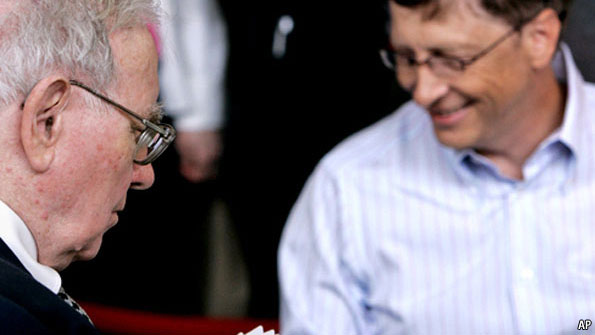
In an age of network building and globalization's rapid expansion, the "robber baron" philanthropists are required to hold off the populists

Economist story that just reminds me that, in globalization terms, we are living through an age of great “robber barons” and their subsequent personal guilt expressed in their laudable but somewhat quixotic attempts to fix the world with their wealth.

Gates cannot become Gates without globalization, nor can Buffett.  But globalization, with its capacity to make a huge world seem that much smaller, makes the disparity between fantastic wealth and the rest of us all that much more apparent 

The last time we saw this sort of progressive largesse?  Naturally, it was during the microcosmic globalization that was America’s sectional economies being knitted together into a continental one following our Civil War.  Swap out Carnegie for Gates, and the song remains the same—just on a grander, truly global scale.

Natural and good, it’s just not enough.  The populism must be followed by the progressivism, so I understand the reach for Obama, who is perceived as being as anti-business and wealth as Theodore Roosevelt was.