Buy Tom's Books
  • Great Powers: America and the World After Bush
    Great Powers: America and the World After Bush
    by Thomas P.M. Barnett
  • Blueprint for Action: A Future Worth Creating
    Blueprint for Action: A Future Worth Creating
    by Thomas P.M. Barnett
  • The Pentagon's New Map: War and Peace in the Twenty-first Century
    The Pentagon's New Map: War and Peace in the Twenty-first Century
    by Thomas P.M. Barnett
  • Romanian and East German Policies in the Third World: Comparing the Strategies of Ceausescu and Honecker
    Romanian and East German Policies in the Third World: Comparing the Strategies of Ceausescu and Honecker
    by Thomas P.M. Barnett
  • The Emily Updates (Vol. 1): One Year in the Life of the Girl Who Lived (The Emily Updates (Vols. 1-5))
    The Emily Updates (Vol. 1): One Year in the Life of the Girl Who Lived (The Emily Updates (Vols. 1-5))
    by Vonne M. Meussling-Barnett, Thomas P.M. Barnett
  • The Emily Updates (Vol. 2): One Year in the Life of the Girl Who Lived (The Emily Updates (Vols. 1-5))
    The Emily Updates (Vol. 2): One Year in the Life of the Girl Who Lived (The Emily Updates (Vols. 1-5))
    by Thomas P.M. Barnett, Vonne M. Meussling-Barnett
  • The Emily Updates (Vol. 3): One Year in the Life of the Girl Who Lived (The Emily Updates (Vols. 1-5))
    The Emily Updates (Vol. 3): One Year in the Life of the Girl Who Lived (The Emily Updates (Vols. 1-5))
    by Thomas P.M. Barnett, Vonne M. Meussling-Barnett
  • The Emily Updates (Vol. 4): One Year in the Life of the Girl Who Lived (The Emily Updates (Vols. 1-5))
    The Emily Updates (Vol. 4): One Year in the Life of the Girl Who Lived (The Emily Updates (Vols. 1-5))
    by Thomas P.M. Barnett, Vonne M. Meussling-Barnett
  • The Emily Updates (Vol. 5): One Year in the Life of the Girl Who Lived (The Emily Updates (Vols. 1-5))
    The Emily Updates (Vol. 5): One Year in the Life of the Girl Who Lived (The Emily Updates (Vols. 1-5))
    by Vonne M. Meussling-Barnett, Thomas P.M. Barnett, Emily V. Barnett
Search the Site
Powered by Squarespace
Monthly Archives
12:07AM

Another food giant shifts to bottom-of-the-pyramid selling

WSJ story on how the French food company Danone, of yogurt fame, is now focusing on market expansion in emerging and developing economies.

Danone has ruled the high-end healthy products niche for a while, making it one of the fastest growing food companies in the world.

But momentum is slowing in the company’s traditional, rich-world markets in North America and Western Europe.

And so it’s moving into the Gap big time, meaning “Danone is among a vanguard of Western multinational staking much of their future on the world’s poor.”

A decade ago, Danone got 6% of its revenue from emerging markets.  Today it’s 42%

Digging deeper, the company is now trying to target customers who live on dollar-a-day food budgets.

Danone’s CEO says “the objective is to do business not just with the top of the pyramid.”

“GLOBALIZATION MARCHS ON!” cries the newsreel announcer.

12:06AM

The China model of crime spreads

pic here

Wherever the Chinese go globally, they tend to enclave themselves far more than any other nationality.  That kind of closed community-atmosphere is perfect for criminal activity, making it all that much harder for the local cops to penetrate illicit networks—as Italian cops are discovering.

With the mafia still entrenched in Sicily and the southern portion of Italy, it’s the Chinese triads who have moved into central and northern Italy, where previously the mob was decimated through effective prosecution.

You know that old bit about “carrying coal to Newcastle?”  Well, it don’t get any better than exporting mafia to Italy.

It’ll be interesting to see how the Italian police go after the triads.  They certainly have the experience and will, so maybe they’ll teach the world a thing or two about how to do this right.

12:05AM

Another stunning victory in the "great game" for . . . Kyrgyzstan!

WSJ story on the recent Kyrgyzstan vote on a new constitution that reduces the power of the president, legitimizes the country’s interim leadership, and strengthens the parliament.

This constitution will make Kyrgyzstan “the first of Central Asia’s former Soviet republics to shed a tradition of strong presidential rule.”

Ninety percent of the population endorsed the new constitution.  Uzbeks voted for the constitution as well, seeing more protection in a parliamentary system.

So much for the “great game” whereby the Russians allegedly battle the Americans and the Chinese to decide how things evolve in the region.  Little Kyrgyzstan has simply stood up for itself.

12:04AM

The Turkey-Iran rivalry comes to the fore

FT story noting that Turkey’s moves as of late have nothing to do with Islamic ideology and everything to do with expanding the nation’s influence in the Middle East vis-à-vis competitor Iran.

Yeah, Turkey said no to the US on invasion plans WRT Iraq, but as soon as Saddam fell, Iraq was crawling with Turkish contractors.  So the big refusal was a case of having one’s cake and devouring it too.

I made the same argument on the Esquire blog recently regarding Turkey’s reorientation WRT Israel, the tipping point being the Gaza flotilla show.

The whole package can’t be viewed as some fit of pique regarding the EU, nor a turn east, says the FT, and I agree wholeheartedly. 

That is the behaviour of a regional power with a long-term view of its strategic interests, not of a country veering towards Islamist activism.

The author Gardner then makes the argument that Turkey, Iran and Israel and locked in a three-way fight to dominate the region.  I agree with Turkey v Iran and certainly see Saudi Arabia v Iran, but tossing Israel into that dynamic is mistaken.  Tellingly, after Gardner makes the statement, he spends the rest of the piece focusing on Iranian and Turkish moves to that effect, except to note that Israel might strike Iran over its nukes in coming months.  Gardner believes this would leave Turkey’s strategic approach in tatters, but I think that overstates the notion by a ways.

If Israel strikes, then Turkey will demonize it further—for its purposes.  Turkey will also be able to portray Iran as a nutcase that creates regional instability, whereas it represents growth and development and stability and solid relations both East and West.

Frankly, I don’t see how Turkey can lose in any kinetics between Iran and Israel.  Both sides will be weakened and Turkey will simply be that much stronger as a result.  Also, Saudi Arabia will look weak for having the “Jews” do its dirty work.

12:03AM

Got a protest in Egypt? ElBaradei is on the scene!

graphic here

WSJ story on late June protests in Alexandria Egypt over the beating death of a man by police who claimed he died trying to swallow drugs as officers came upon him.

Like so many other things in Egypt today, it becomes “an unexpected rallying cry for many Egyptian opposition supporters.”

And, as is the norm now, Mohamed ElBaradei showed up at one such protest and spoke.  ElBaradei is now saying that he would run for president against Mubarek if the necessary electoral changes were made to allow him to do so—something I speculated would be true here in the blog months ago.

I’ve got to tell you, an Egypt presided over by ElBaradei would be a revolution in the region.  It would be the scariest thing to happen to the region’s autocrats since we took down Saddam.

12:02AM

The virtual "combat zone"

FT story on a long-overdue rule-set reset:  the fencing off of the web for porn.  It reminds me of Boston’s efforts in the 1980s to put all the city’s porn and strip clubs and prostitution (and—implicitly—drug sales) into a recognized downtown section known as the “combat zone.”

The .xxx domain is one of hundreds of new suffixes being created by ICANN, the International Corporation for Assigned Names and Numbers.

The word “sex” accounts for a quarter of all searches on the web.

The porn industry has been lukewarm to the idea, which a US-based company spent the last seven years fighting ICANN to create.  Why?  It fears a ghettoization effect, just like what happened with the combat zone in Boston, which eventually faded away to a much smaller space.

On a more prosaic but more important note, ICANN also just allowed the introduction of Chinese script to top-level domain names.

Less worry of ghettoization there.

12:01AM

Chart of the Day: More acidic oceans


From The Economist. 

Basic chemistry:

As carbon dioxide levels go up, pH levels come down.  Acidity depends on the presence of hydrogen ions (the H in pH) and more hydrogen ions mean, counterintuitively, a lower pH.  Expose the surface of the ocean to an atmosphere with ever more carbon dioxide, and the gas and waters will produce carbonic acid, lowering pH on a planetary scale.  The declining pH does not actually make the waters acidic (they started off mildly alkaline).  But it makes them more acidic, just as turning up the light makes a dark room brighter.

Additionally, more hydrogen ions mean more bicarbonate ions and fewer carbonate ions, the latter of which is used by corals and shellfish.  So fewer carbonate ions means slower coral growth and thinner shells.

The increasing acidification of the world’s oceans is referred to as global warming’s evil twin, because the rapid change is expected to wreak all sort of havoc with sea life.

12:01AM

WPR Feature: A Divided 'Rest' Leaves America the Enduring Superpower 

Reports of the imminent death of U.S. hegemony in world affairs go at least as far back as the Nixon administration, and to date, they have all disappointed. While challengers have risen and fallen, none have managed to make themselves full-spectrum superpowers capable of both diplomatic leadership and global military reach, in combination with indisputable economic heft and soft-power appeal. 

Now, with the "rise of the rest" -- concentrated in, but not limited to, the so-called BRIC package of Brazil, Russia, India and China -- we are presented with the argument of a collective challenge to American world leadership. Let me count down 10 good reasons why that notion will likewise prove disappointing.

Read the rest of the feature article (posted 7/13) at World Politics Review.

12:01AM

Swimming with the whale sharks

I was going to make the posts happen today, somewhere along my family's vacation day around Atlanta.  We were going to spend 4-5 hours at the Georgia Aquarium, then maybe hit the Cyclorama and then be back at the mountain resort community where we're staying (thanks to a friend) for some swimming and then I'd have some portion of the eve to make some posts happen.

But while we were in the tunnel under the main tank at the aquarium, I spotted a worker holding a clip-board announcing dives and swims in the main tank--a gargantuan space about 50 ft deep and covering a footprint equivalent to a football field.  Well, after spotting the huge manta rays and whale sharks (biggest fish on the planet and much larger than great white sharks), I just had to step off the conveyer belt and inquire.  I was told there was only one "swim" space left for the late afternoon swim.  There was just no way we'd wait around that long so only one of us could swim, even though I knew how much my wannabe marine biologist Emily, still smarting from that missed family vacation on Kona in Hawaii where we snorkeled at length, really wanted to do it.  So I passed and got back on the conveyer belt.

Then the woman tracked us down later in the exhibit.  There were now two spots open.  So we decided to let Em (over 18) and Kev go, because any minor needed to be accompanied by an adult. The price was stiff, but we were cut a significant break for same-day reservations.  I was a bit hesitant, but after our day down in Andersonville/Plains was sort of slow (Sunday, following our great time at Stone Mountain all day Saturday), I was looking for that something special to highlight our last family-of-six vacation before the girls show up in late August (I will not be returning for the second trip, as my mother-in-law will accompany Vonne).  So I said yes and had the woman take us to the relevant counter to sign up.

When we got there, we found out that three spaces were available, so Vonne asked me to go and keep an eye on the kids.   Hmm, I thought to myself, swim in a giant tank full of all sorts of sharks and other magical sea creatures?  I said yes after a beat or two.

So we decided to make the aquarium a full day, because our swim drill would go on for a couple hours after the place closed.  We had lunch and then explored the rest of the place in a leisurely fashion.  It really is the greatest aquarium I have ever visited, and I've pretty much been to all the big ones in the U.S. Worth every penny and every hour.

The "swim" itself was quite the drill.  First a seminar on the process, safety, gear, etc.  Then to the locker room, where, waiting for us (since we provided dimensions) we find full wet suits with boots.  Then to the gigantic space over the huge tank--a scene right out of "The Abyss."  We put on "life vests" that contain a small scuba tank/regulator set-up, and then get our fins, gloves, and masks.  After more drilling, we go out to the floating dock in the middle of the huge pool, gear up the rest of the way, and then push off into the tank, quickly assuming the position of lying flat on the surface lest one of the big whale sharks come skimming by and smack into us.  Once all eight swimmers were readied in that manner, we took off in our formation:  lead guide, then 2 by 2s, followed by rear guide.  A third employee with full scuba set-up swam all around us taking video throughout.  So we took a big tour of the tank, staying along the surface and gazing downward.  No use of the fins, we were supposed only to swim with our arms in a breast-stroke motion.  Whenever the lead guide made a signal with her hands, we were supposed to freeze in anticipation of either the whale sharks or the pair of giant manta rays to skim right beneath us, sometimes so close that the fins would stroke us.  No touching, because a spooked whale shark can make for a bad swim.

No real fear of attacks, because the whale shark doesn't bit anything too big (small throat), but plenty of other sharks in the tank who would be willing, under the right circumstances. But again, no real danger.

Still, whenever one of these filter-feeding (thank God!) behemoths would glide at us and then swoop just below us, it was breath-taking--as in, tank or no, I couldn't draw a breath!  I would say that the whale sharks were almost 3 times my length and who knows how heavy. The mouths are frighteningly large, like swallowing your entire body would be a cinch.  And yeah, you know that ain't going to happen, but when that face comes out of nowhere and you seem him looking you over and then notice that super-wide head and mouth, you are plenty intimidated.

We swam in that manner for about 40 minutes, getting to wave to family members and onlooking visitors at various spots (the tunnel, and the great, two-story-high transparent wall).  All in all, a truly thrilling experience that had us buzzed for the entire ride back home to the mountain north of Atlanta.  

And now, three Stella Artois later, stuffed with ribs we still had left over from last night's feast in Atlanta, I've decided to watch a stupid horror film with my kids and skip trying to make the posts happen.

There will be a WPR feature up soon though, to tide things over.

No promises for Wednesday, and no apologies either.  My friend who let us have this place for the week warned me that this might happen.

9:04AM

WPR's The New Rules: America's Demographic Edge in 'Post-American' World

A growing population had long been considered a prime determinant of national strength -- at least until the “population bomb” crowd commandeered the dialogue almost a half-century ago and declared such growth to be a threat to human existence.  But since then, with globalization’s rapid expansion encompassing the bulk of the developing world -- and specifically demographic behemoths India and China -- we’ve seen industrialization and urbanization work their usual magic on female fertility. As a result, humanity is now projected to top out as a species sometime mid-century and likely decline thereafter.

Read the entire column at World Politics Review.

Find the Kotkin book here.

12:06AM

Chinese gamers--unite!

pic here

Bloomberg Businessweek technology blurb.

China has 400m internet users, with at least a quarter of them avid gamers.

But the government is wary of such activity that it cannot easily control or understand, and so it's trying to limit individual activity, pushing rules to limit perceived "unhealthy" activity.  

This was tried in 2005 WRT minors playing online, but kids just got around that by using the IDs of older friends.  Now the new rules say gamers must register using their real names.

None of this, of course, helps Chinese companies trying to muscle their way into the global gaming biz, so each time the gov announces such rules, big Chinese gaming companies like Tencent and Perfect World and Shanda Games lose share price.

Beijing can't have it both ways:  trying to regulate individuals' activities in the industry while trying to promote local flagships.  But it will try, as in so many other spheres of activity, despite the obvious self-limiting outcomes.  If you want a creative population, you've got to let them explore and stop playing nanny all the time.

12:05AM

The case for NOT punishing BP too much

Bloomberg Businessweek article.

Simply put, BP plays too big a role in the US market to let it go under.  If it does, the loss will compromise what little energy security we possess.  

So Obama backing off some, saying on 16 June that "BP is a strong and viable company, and it is in all of our interests that it remain so."

BP's skill in negotiating its way into strategically important regions--like post-Saddam Iraq--is considered a serious US national security asset.

12:04AM

The Russian dream

Pic here.

Bloomberg Businessweek piece.

It is one of the great memories of living in the USSR in 1985:  everybody was in apartments and nobody really to have a house, unless you were rich or connected and had the dacha.

Well, here's Medvedev bitching about the same almost two decades later, noting that 77% of the country's 142 million live in apartment blocks.  

So here's the modern equivalent of Lincoln's land give-away (the Homestead Act), as Russia has amassed almost 2.5m acres to "seed the land with single-family homes."

Says the guy who runs the government's fund to promote housing:  "The person who has something to defend is a different kind of person."

Amen.

12:03AM

The buy/sell on US-China trade

Bloomberg Businessweek story on how to move forward with China on trade.

The five ways?

#1) really crack down on the China trade a la Krugman;

#2) declare an emergency a la Nixon 1971;

#3) use the WTO on China big time;

 #4) keep up the jaw-jaw-jaw on as many fronts as possible; and 

#5) get our own house in order.

My sense?  It will be a combination of all five in some measure.

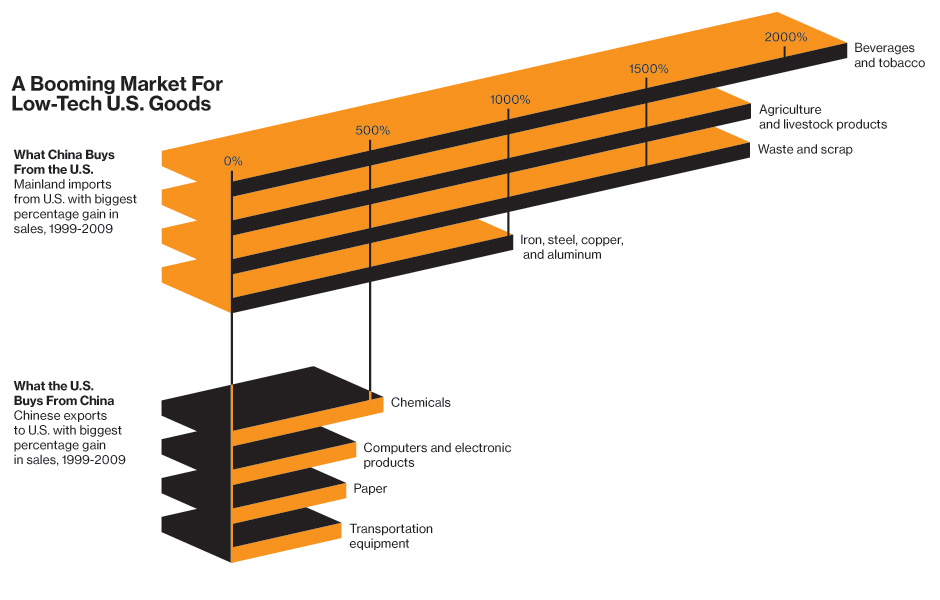
What really attracted me to the piece was the weird chart above and realizing what a strangely low-tech trade we have with China--in terms of what's been growing the most over the last decade.  We send beverages and tobacco, ag and livestock, waste and scrap and some basic industrial commodities.  They send chemicals, computers and electronic products, paper and transportation equipment.  Pretty basic really.  I mean, when the growth is highlighted, what's the big difference our trade with China and Brazil's trade with China?

12:02AM

Do as I say, not as I do

Economist piece on China’s proposed sale of nuclear reactors to Pakistan, the argument being it will only intensify a nuclear rivalry.

Our problem:  by winning an exemption from the Non-Proliferation Treaty for India under Bush-Cheney, we’re now not in the position to do anything about China’s supplier relationship with Pakistan.

America argued that India had a spotless non-proliferation record (it doesn’t) and that brining it into the non-proliferation “mainstream” could only bolster global anti-proliferation efforts (it didn’t).  The deal incensed not just China and Pakistan but many others . . .

What particularly riles outsiders is that American did not get anything much out of India in return . . . India has since designated some of its reactors as civilian, and open to inspection, but other still churn out spent fuel richly laden with weapons-usable plutonium . . .

Pakistan suffers no such uranium shortage and is determined to match India . . .

China is trying a legalistic defence of the sale of the third and fourth reactors at Chasma.  But its real point is this:  if America can bend the rules for India, then China can break them for Pakistan.

Pakistan hopes that it will eventually get a deal like India’s.

I personally would describe such a scenario as just this side of crazy-town, but I wouldn’t rule it out either.  Some in the Obama administration are said to favor this, to win Islamabad’s help on the Taliban.  You just know how such a deal would work out:  nice show from Pakistan as they continue to build nuclear devices and buy fighter jets—or pretty much what the Pakistanis have done to us since 9/11 triggered the great money flow.

Again, I choose India every single time I can in this equation—not to hedge against China but simply to do the right thing.

Or we continue to pretend we can make two fake countries (Af-Pak) become real ones, stiffing New Delhi in the process.

Obama seems to be traveling down that second path, and I think we’ll all regret it soon enough.

12:01AM

Chart(s) of the day: Old Core debt at WWII-era levels

Two from The Economist on Old Core debt.

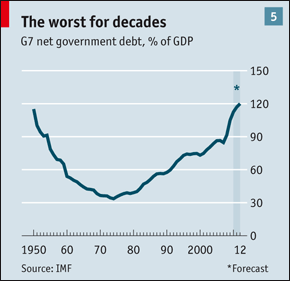
First one shows how we’ve collectively returned to the public debt levels, as a percentage of GDP, that we had coming out of World War II—roughly 120%.

Well at least it took the biggest global economic crisis since the Great Depression to achieve it.

Why it may prove much harder this time to whittle it down:  personal and industrial and financial sectors are much more indebted now.

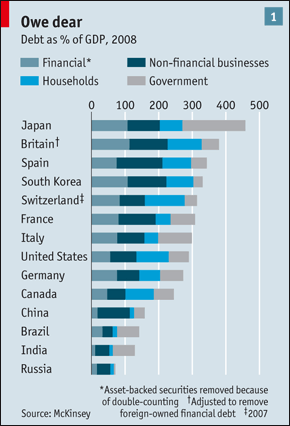
When all of those sectors are added together, the US is in the middle of the pack, as the second chart shows, behind Japan, Britain, Spain, South Korea, Switzerland, France and Italy.  Collectively, the nation owes 3 times its annual GDP.

On households, I’m assuming they’re only counting the “underwater” portion of mortgages (the non-asset-backed portion). 

The usual underlying logic on assuming debt that’s not asset-backed is that future growth will allow you to pay it off.  But as The Economist warns, that’s perhaps a very poor bet in societies experiencing profound aging.

12:03AM

The grandfather of the West Coast offense

WSJ obit on Don Coryell of “Air Coryell” fame.  The San Diego Chargers of the late 1970s and early 1980s revolutionized the game and blazed the path for the 49ers fabled “West Coast offense” in the later 1980s.  We’re talking Dan Fouts, Kellen Winslow and company, who lead the league in offense for six of 7 years starting in 1978.  Coryell learned at the knee of the great Sid Gillman, a previous coach of the Charges, while he coached at San Diego State U in the late 1960s.

Coryell’s stint with the Chargers coincided with rule-set tweaks by the NFL in 1977 to juice up what was becoming a too boring game. 

Coryell’s innovations included passing on first down consistently, a far bigger receiving role for tight ends, and letting the quarterback choose between a variety of receivers on any one play (the “checking down” you hear so much about today as the QB looks through his sequence of possible targets before choosing the one that looks best).   Thus began the rise of the 4,000-yard passer, which happened only once before Fouts started doing it regularly.  Now, a good share of NFL passers do it each year.

Coryell was a huge reason why the NFL became so popular over the past 30 years.  He never got enough credit because he did not win a championship like Bill Walsh did four times.

12:02AM

Deep Reads: "Gone with the Wind"

An easy book to cite, but it’s typically forgotten in favor of the all-time classic movie.  It is definitely worth losing yourself in.

I did during my daughter Emily’s long cancer fight in the 1990s, and I became a huge fan of Scarlett’s ability to compartmentalize her worries from one day to the next. There were many days in that struggle when I said to myself, “Oh, I can’t worry about that anymore today or I’ll go crazy.  I’ll just think about that tomorrow.”

I recall just now because we're taking a mini-family vacation in the Atlanta area.

12:01AM

Movie(s) of my week: The "Futurama" oeuvre


My kids and I have been watching and rewatching this quartet of “Futurama” movies as we waited for the resumption of my favorite TV series on Comedy Central.  To me, “Futurama” is much better than “The Simpsons” and beats the crap out of “Family Guy,” which has gone way downhill lately (while “The Simpsons” is still great).  “Futurama” is, of course, made by the same guys who do “The Simpsons.”  I just like the characters so much better and think the writing is just a bit sharper and more bitingly political.  I especially love how “Futurama” can basically have anybody from history on in the form of a preserved “head.”

Of the characters, I like Bender least (too crass) and perhaps Dr. Zoidberg and Farnsworth the best in terms of good lines.  Fry is pretty good, but generally plays the neutral center.  I love the women especially (Amy Wong and Turanga Leela), and will confess a deep thing for the one-eyed pilot, in part because she’s hot as all get out and in part because I love Katey Sagal’s voice (going all the way back to her back-up singing days with Bette Midler).

This is how much I love Futurama:  my trick for relearning how to fall asleep after my years of sinus infections consists of watching episodes over and over again on my iPod til I doze off.  I am therefore the world’s leading expert on the first 5-10 minutes of each episode of the entire series.

I have the entire 72 episodes from 1999 through 2003 (the last 16 comprise the four movies released from 2007 to 2009) on my iPod and plot to get the new episodes on as well.   My maven-son Kevin turned me on to “Futurama” (and “Lost” and . . . ), so it’s a passion we share.

Naturally, we are in hog heaven with the resumption of the series.

The movies are all great, but I like the last one the best.

12:03AM

Today the rat's lung, tomorrow yours

WSJ story on latest in a series of “groundbreaking experiments in the burgeoning field of regenerative medicine,” involving the creation in a lab of lungs for a rat (and I mean a real rat and not some Wall Street banker!).

Described as a “small but tantalizing step,” you have to think that doing this for a rat can’t be all that different than for a human—scale yes, but complexity not so much.  When transplanted into the rates, the lungs exchanged oxygen for CO2 just like they’re supposed to do.

Impressive.

Other labs have already done livers and hearts, to varying degrees of success.

Right now over 100k Americans are on waiting lists for organ transplants (kidneys #1, then livers, then lungs). 

To me, this is the most crucial part of life-extending technologies—not so much the super-extension of a few but the rescuing of a lot of people cut down in the primes and thus allowed to live far longer lives than they otherwise would have been able to.