Buy Tom's Books
  • Great Powers: America and the World After Bush
    Great Powers: America and the World After Bush
    by Thomas P.M. Barnett
  • Blueprint for Action: A Future Worth Creating
    Blueprint for Action: A Future Worth Creating
    by Thomas P.M. Barnett
  • The Pentagon's New Map: War and Peace in the Twenty-first Century
    The Pentagon's New Map: War and Peace in the Twenty-first Century
    by Thomas P.M. Barnett
  • Romanian and East German Policies in the Third World: Comparing the Strategies of Ceausescu and Honecker
    Romanian and East German Policies in the Third World: Comparing the Strategies of Ceausescu and Honecker
    by Thomas P.M. Barnett
  • The Emily Updates (Vol. 1): One Year in the Life of the Girl Who Lived (The Emily Updates (Vols. 1-5))
    The Emily Updates (Vol. 1): One Year in the Life of the Girl Who Lived (The Emily Updates (Vols. 1-5))
    by Vonne M. Meussling-Barnett, Thomas P.M. Barnett
  • The Emily Updates (Vol. 2): One Year in the Life of the Girl Who Lived (The Emily Updates (Vols. 1-5))
    The Emily Updates (Vol. 2): One Year in the Life of the Girl Who Lived (The Emily Updates (Vols. 1-5))
    by Thomas P.M. Barnett, Vonne M. Meussling-Barnett
  • The Emily Updates (Vol. 3): One Year in the Life of the Girl Who Lived (The Emily Updates (Vols. 1-5))
    The Emily Updates (Vol. 3): One Year in the Life of the Girl Who Lived (The Emily Updates (Vols. 1-5))
    by Thomas P.M. Barnett, Vonne M. Meussling-Barnett
  • The Emily Updates (Vol. 4): One Year in the Life of the Girl Who Lived (The Emily Updates (Vols. 1-5))
    The Emily Updates (Vol. 4): One Year in the Life of the Girl Who Lived (The Emily Updates (Vols. 1-5))
    by Thomas P.M. Barnett, Vonne M. Meussling-Barnett
  • The Emily Updates (Vol. 5): One Year in the Life of the Girl Who Lived (The Emily Updates (Vols. 1-5))
    The Emily Updates (Vol. 5): One Year in the Life of the Girl Who Lived (The Emily Updates (Vols. 1-5))
    by Vonne M. Meussling-Barnett, Thomas P.M. Barnett, Emily V. Barnett
Search the Site
Powered by Squarespace
Monthly Archives
11:58AM

The uncertainty principle divides Obamaโ€™s achievements from his political reality

NOTE:  No World Politics Review column today, so I offer this up as replacement.

President Obama’s sour relationship with American business is much in the news these days, with even the usually staid U.S. Chamber of Commerce publicly voicing the private sector’s growing concern that he’s “anti-business.”  Despite several significant legislative achievements in his first 18 months in office (e.g., the stimulus, healthcare, higher education, financial regulations—next up, energy), all of which demonstrated the president’s tremendous responsiveness to the political challenges of the day, Obama is losing the center of the electorate to the GOP for precisely the same reason he’s losing the business community:  he’s introduced too much uncertainty in a time already fraught with it.

In my day job I help run a technology firm that capitalizes on such sentiment by providing business solutions as a service (e.g., making supply chains more transparent, improving patient flow in major medical centers, securing critical infrastructure), so from my selfish perspective, I don’t mind additional uncertainty—especially when it’s created by more complex regulatory schemes.  But my company also needs businesses to be aggressive about tackling that complexity, trusting that today’s investments will better position their companies for tomorrow’s competitive landscape.   And here’s where too much uncertainty sabotages economic decision making and business planning:  unsure of the longer payoff, too much of the private sector—and its money—is staying on the sidelines of this “statistical recovery.”

That trillion-dollar tentativeness across the private sector helps explain the persistently high unemployment rate of almost 10 percent, with one out of six work-seeking Americans saying they’re underemployed.  But don’t forget about the other five-sixths of the workforce, who certainly are being overworked to achieve that recovery—such as it is.   That middle class (and political middle) wants nothing less from its government than protection from economic uncertainty: it has achieved a decent lifestyle and wants to pass it on to its children with slight but steady improvements—a long-term trend that disappeared this last decade.  Spook that herd and it will come thundering down on incumbents of all political stripes.  No wonder so many Democrat-leaning pundits are calling for a renewed Keynesian push. 

But more importantly, remember that, prior to the crash, we spent six long years enduring all new manner of fears on the previously stable national-security side of the ledger, so all this recent individual economic uncertainty has been piled on top of that baseline anxiety.  Obama’s “big government” answers on the economy haven’t really been all that much bigger than Bush-Cheney’s efforts were on national security (check out the Washington Post’s recent series on “Top Secret America”), but again, there’s that cumulative difference between piling up and piling on.  Obama suffers the distinct misfortune of coming late to what New York Times columnist David Brooks has dubbed the “technocracy boom” of the last decade.

Obama now needs American capitalism to rescue his depressed presidency, even as his political language remains harsh in that direction.  Like a Theodore or Franklin Roosevelt, Obama presents himself as a protector of the “little man” against the moneyed interests, but rhetorically choosing Main Street over Wall Street is pure theater.  Frankly, it’s like the surgeon asking the patient if he likes his heart better than his lungs.  Good example:  by cracking down on derivatives (originally known as “crop futures”) in its massive financial reform bill, the administration has introduced vast uncertainty into the otherwise strong agricultural industry, where your average mid-sized farmer hedges most of his annual crop through such “nefarious” financial instruments.

And unlike either Roosevelt, Obama can’t even be cast—however unflatteringly—as a “traitor to his own class.”  Having never been a businessperson, his re-regulating of core industries—after three decades of de-regulation, mind you—has invariably earned him the “socialist” label from a slight majority of Americans in one recent poll.  And in a nation that’s roughly split, 70-to-30, between those who favor retaining American-style capitalism over European-style socialism, those negative numbers can only go up—unless perceptions are dramatically changed.

Of course, the easiest way to improve presidential poll numbers is for the economy to improve in time for the 2012 elections (forget about this November, when the GOP should grab at least the House).  But, again, with smart guys like David Brooks predicting a “nasty crawl” when it comes to income growth, we should expect an even nastier, impatient and intolerant electorate.  Read Benjamin Friedman’s book, “The Moral Consequences of Economic Growth,” where he explores the consistency of that political causality across America’s many decades.

So how does Obama improve his standing before 2012?  The temptation is always to turn to foreign affairs when domestic constraints abound, but even here, Obama faces a narrow menu of options, all of which demand great exertion while promising little popular credit.  Take Afghanistan:  running with Robert Blackwill’s tempting logic, Obama can “give the south to the Taliban” and hope such “reconciliation” holds through the election.  But as the Times Square bomber demonstrated, the Af-Pak’s pool of violent fundamentalists can re-capture the president’s national security agenda at will.

Indeed, plenty of people within both Washington’s national security community and New York City’s first-responder community choose—with utmost realism—to view the Times Square incident as less a legitimate attempt and more a calculated probe.  The new buzz phrase in both communities is improvised nuclear device (IND), or what most experts call the “dirty bomb” because the blast is less frightening and/or damaging than the dispersal of radioactive material.  Again, the whole point of such an attack would be to spook America’s middle ranks into an even greater sense of uncertainty by despoiling its favorite town square.  Like so many things we seek to understand today, like the new financial regulations, the full impact of such an attack wouldn’t be known for years. 

Wall Street Journal columnist Peggy Noonan opines that “American politics is desperately in need of adult supervision”—her sideways suggestion that we currently lack great “statesmen” with sufficiently white hair.  Perhaps so.  With this great confluence of uncertainties we surely need more leaders who can confidently say, “I’ve seen it all before”—even if they haven’t.  Because one thing is for certain:  the combination of an unpopular president, a dysfunctionally partisan Congress, and a reluctant business community is no way to move forward.

1:19AM

Pentagon's New Map available for download--again


Prompted by a teacher facing the start of his class, I'm pleased to re-announce (as I did back in 2006) that the digital version of the PNM map is still available for free download.

You can download the map as a PDF in high-resolution format (17 or so MB) or low-resolution format (around 300 KB).

The downloadable maps will remain accessible via the top mast navigation (above) under the header "download."

12:09AM

Don't forget Kosovo!

map here

NYT “Washington memo” reminding us that roughly 1,500 US troops still help keep the peace in the Balkans, along with 8k other troops (mostly European).

And still Kosovo wobbles, 11 years after Milosevic fell and two years after the small nation declared its independence—the last of the breakaways.  The recent International Court of Justice approval of that declaration pissed off Serbia and Russia, but so be it.

The key thing is that:

Kosovo, at least, is largely free of the violence that tore it apart two presidents ago, and Mr. Obama can afford to leave it to his vice president or secretary of state, both of whom played a role in the 1999 war.  But it remains unnerving to those in Washington with their eyes on larger problems that the impasse continues to defy efforts to move on.

Oh boo-hoo.  Recovery and full resolution is a generational affair—quelle surprise!

What's clear to me: the fight over the kids ain't over.  Check out the Serb-heavy slice to the north.  If Kosovo wants the clean break, it needs to break off that chunk and send it on its way.

12:08AM

US farmers: China's rise is good

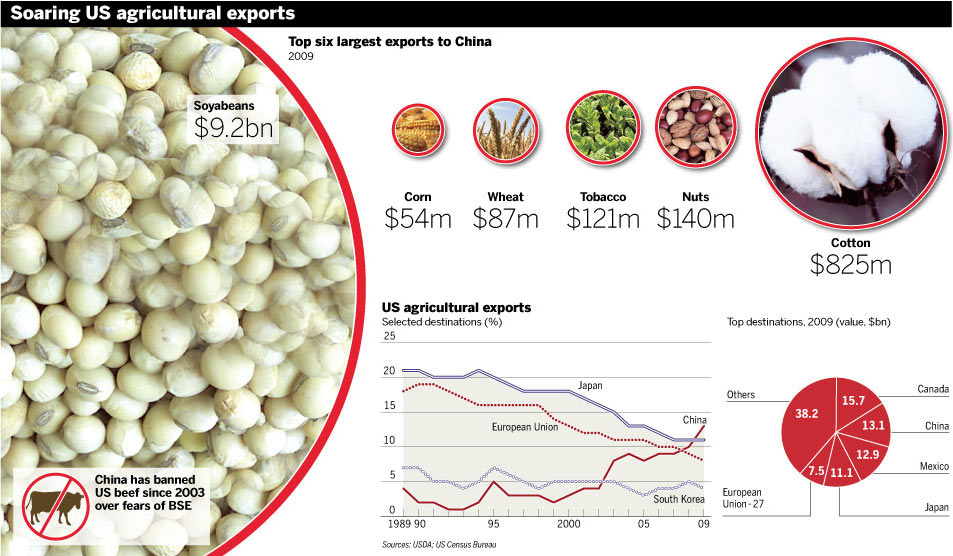
Nice FT story with charts on how “US farmers cash in on China demand.”

US ag exports to China now surpass those to Japan, the EU and South Korea, all of which are declining while China’s imports come out of nowhere in 2000 to almost a five-fold increase since.

Biggest flows are soybeans (Indiana’s reason to live) at almost $10B, then cotton (under a billion), then nuts (peanuts at just $140m), tobacco, wheat and corn.

The bad spot:  China bans our beef since the minor BSE scare in 2003 that sent our beef exports plummet from $1.3T to about $.3T overnight (still hasn’t recovered).

Sign of the times:  the first US grain export depot built in 25 years since on the West coast, so say goodbye to a bunch of those barges heading down to the Big Easy on the Mississippi.

As US politicians lose sleep over the trade deficit with China and the dollar-renminbi exchange rate, American farmers are eyeing a record $14bn in exports there this year.  So naturally the logistical landscape is being reformatted.

Hyped this one a while back in a column, and yeah, exports “exploded” after the Chinese joined the WTO in 2001.  One expert says that one-third of the price on the Chicago Board of Trade is determined by China.

For now, US dairy exports held up, awaiting new Chinese certification reqs. Our poultry faces a lot of “antidumping” obstacles, so work to be done.

China’s government has made self-sufficiency in ag production a national goal, but that’s a dream at best, given how much of China’s breadbasket is located at or below the 35th parallel, meaning more and lengthier droughts as global warming kicks in more extensively.

We are likely to have China over a breadbasket soon enough, my friends, despite Beijing’s attempts to buy up farmland all over the Gap.

For now, Canada remains the top destination for US ag exports (which I find stunning!) at $16B, then China at $13B, then Mexico at $13, then Japan at $11b, the EU at $8B and the ROW at $38B.

That’s a heap of billions—almost 100!

12:07AM

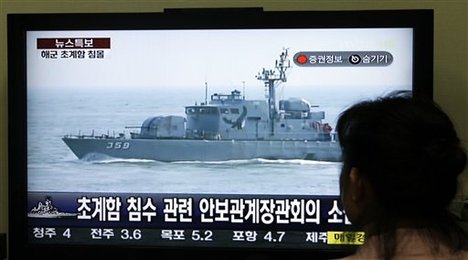
US-SouKo naval exercise: I say, stick it to the new emperor!

pic here

WSJ on the message that was sent by the US-South Korea large-scale naval exercise, despite China’s objections and NorKo’s pathetically over-the-top threats of raining down nukes on the whole proceedings.

China fears nothing about the exercise in a direct sense. It’s just Beijing worrying that the US and SouKo intending to pressurize the new kid on the block—Kim Jong Un.

Coincidentally, that is exactly what I would advocate.

Anything else lets Beijing off its self-created hook and gives Idiot Son #3 the wrong impression (i.e., that he’s anything but a historical placeholder).  If we feed that numbskull’s ego, we will regret it in spades (like the kind you use to dig mass graves).

12:06AM

The "technocracy boom" reflects a more complex era

NYT’s David Brooks on what he’s calling the “technocracy boom,” or the double-whammy intrusion of government in national security beyond the normal boundaries (the whole Priest-Arkin series in WAPO) since 9/11 (blame it on Bush-Cheney) and in the economy since the financial crisis began (blame it on Obama-Biden). In sum, just a ginormous growth in government activity that assumes all this expertise is usefully applied and not a similarly huge waste of resources.

Yes, it’s unfair for Obama to take the bulk of the heat for the twin developments, but politics is all about timing and timing is often a matter of luck—good and bad.

Still, hard to argue against our government getting smarter in this increasingly complicated age.

12:05AM

Beijing floats the notion of a basket value-setter for the yuan

A good and hopeful sign announced in a WSJ story: 

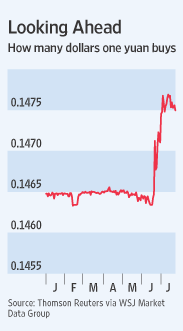
China will consider publishing a so-called effective exchange rate for the yuan against a range of other currencies in an effort to de-emphasize its value against the dollar, a further indication of how Beijing plans to manage the yuan since effectively decoupling it from the U.S. currency.

Last bit seems a bit kind: China announced a decoupling and we go a nice little spike there right off the bat, but a bit pokey since.

Still, this is a good and smart and inevitably move by Beijing, and something I’ve been arguing for going back several years:  the need for an “asia” to join the euro in balancing the dollar. We all know the yuan will be its center of gravity, just like China will play Germany in an Asian Union, and so I chose—not too naively, I believe—to interpret this as a small step in that direction.

The basket of currencies is expected to be based on the host of major currencies of countries/union with whom China has the most trade.

Skeptics cite the vagueness of the description from the vice governor of the People’s Bank of China, and no doubt there will be zigging and zagging and nothing done with any great speed.  The point is just the floating of the concept for now.

A strict linking of the yuan to a basket of currencies is unlikely in the near term, analysts say, as it would mean the yuan could fall against the dollar when the greenback is rising against other currencies, which could enrage parties in the U.S. calling for yuan appreciation.

So, for now, experts describe the announcement as part of an “education campaign” designed to get parties both inside and outside China used to thinking about its inevitability.

Again, a good, smart move by China.

12:04AM

Big Oil plans its Big Spill Force

D’oh!  Big Oil didn’t have a rapid-response force for deepwater disasters before Deepwater Horizon!?!?!

Well, they do now, so their industry was perturbed enough to create a rule-set where previously none was thought worthy enough to exist.

Exxon, Chevron, ConocoPhillips and Shell all pitch in a quarter billion to make it happen. Goal is capacity to capture and contain up to 100k bpd at 10k feet below the surface.  Deepwater’s numbers were 60k bpd at 5k depth.

New system will feature several oil-collection ships and other subsurface gear will, coincidentally enough, resemble the ad hoc package that BP was forced to invent on the spot, thanks to Deepwater.

You can just slap my forehead and utter your favorite interjection.

12:03AM

Hillary pushes for the internationalization of the South China Sea dispute process

WSJ on sharp move and plan by Hillary Clinton to set up multinational legal process for Asian nations to resolve claims in the South China Sea.

Naturally, China is pissed, preferring to keep the whole mess on a bilateral basis, which would allow Beijing maximum advantage in bullying smaller neighbors. Having it all out in the open complicates China’s claims.

Yes, as the piece argues, it’s “a move that could raise new tensions with China,” but it’s well worth the hassle.  The competing South China Sea claims are the last-gasp hope for the big-war-with-China crowd that exists in our national security community, primarily because the old standby dream, the Taiwan scenario, is bleeding out its plausibility with the signing of the free-trade agreement linking the island with the mainland.

This is exactly the kind of far-sighted stuff Clinton should be pursuing—a truly impressive achievement.

The multilat process is to be based on the international law of the sea—even better despite our long-standing problems with it.

12:02AM

India's new "Detroit"

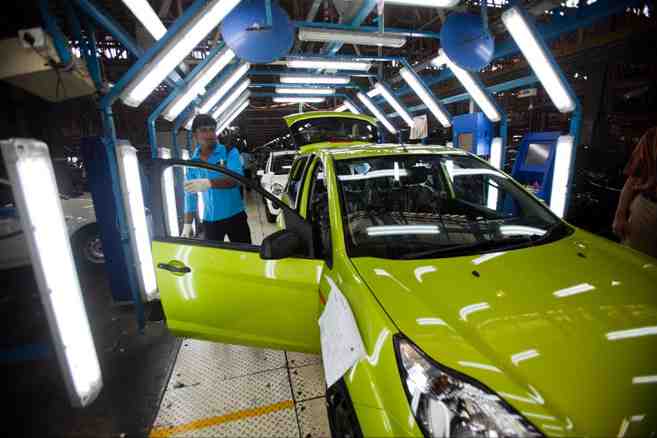
WSJ story on “new Detroit” arising in Chennai, a major metro in India’s south.  Hyundai, Ford, Nissan/Renault, Mercedes are all there, cranking vehicles.

They are spending billions of dollars to make Chennai one of the world’s biggest hubs of small cars for export as well as for increasingly affluent Indians. Soon, the city will turn out cloe to 1.5 million autos a year, more than any one U.S. state made last year.

Car-parts suppliers also are placing big bets on the city, formerly known as Madras . . .

Totally natural:  automobile (French word) begins in Europe, is perfected in mass manufacturing in the US, and now shifts to Asia.

This is simply the successful expansion of globalization, and we all win when there are more consumers with more income to spend.

India’s economy grows 9% this year—so very Chinese.

Yes, higher labor costs eventually come to pass here too, but the upward swing in production will be profound and last for quite a stretch.

12:01AM

Chart of the day: China's expected slowing growth

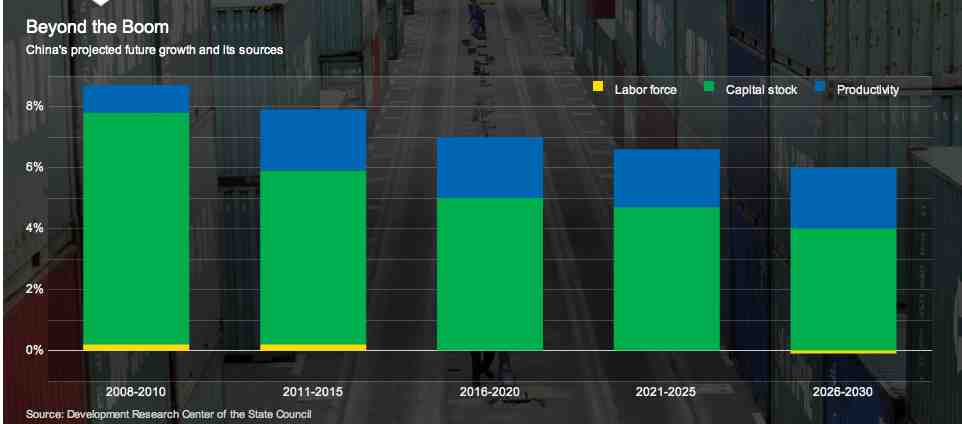
To be filed under “economic reality”:  A WSJ chart that projects likely decline of Chinese GDP growth rate in the years ahead.

Simple enough logic: the bigger the economy, the harder it is to get the same percentage growth. Plus, once all the easy extensive growth achieved, harder to make the intensive growth happen (productivity and innovation versus just building more-more-more!).

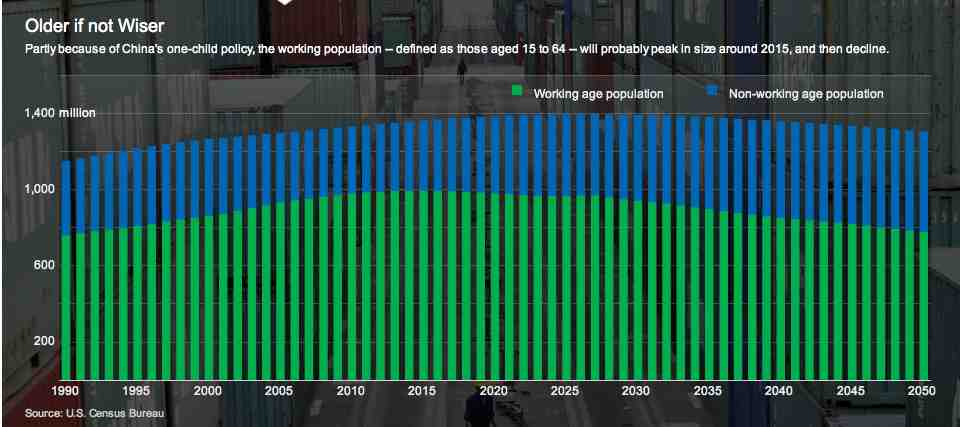
Then there’s the rising cost of labor as the labor pool shrinks relative to the rising dependency ratio (nonworking youth and accumulating pool of elders that will transform China into a civilization that got old before it got rich).

Yes, China will move manufacturing inland and westward to develop its interior (that which isn’t lost to competitors both near and far), but that will degrade the cost advantage further.

Peaking of labor population driven home in accompanying chart on jump page (peaks in 10s and then declines to pre-90s level through 20s, 30s,40s—ad infinitum.

Other jump-page charts show that China is following the same path as Korea and Japan previously—the golden period cannot last forever, because this isn’t a new economic model whatsoever.

12:09AM

Blackwill's tempting case, stated as baldly as possible

FT op-ed by Robert Blackwill, making his case, much like Biden did on Iraq previously, on need to recognize the fake-state reality of Afghanistan and give the south to the Taliban.

I do think Obama will eventually go down this path implicity, making it seem as virtuous as possible.  I also think that all Swat Valley-type offers of enclavism are doomed to fail with radical fundamentalists, who, even if they desist from the connectivity to truer transnational terrorists like al Qaeda, will eventually re-succumb to such temptations.

Then there’s the Michael Gerson argument that says, we’ll doom the trapped women to lives of such depravity (by our standards, thank God!) that we’ll inevitably feel drawn back to the situation on the grounds of human rights.

I would also add that the Taliban will not be satisfied with just the south, nor will their Pakistani minders, so it’s a temporary truce at best, recalling Henry Kissinger’s Nobel Prize-winning negotiation of the ceasefire between North and South Vietnam (there’s a Vietnam analogy to be embraced!). Of course, Kissinger today advocates no such course, despite being quoted here by Blackwill.

No, the current fight isn’t “worth it,” because we fight it overwhelming by ourselves, progressively denuded of small but exhausted allies for whom this is a vague, distant effort.  No local regional powers are involved militarily, for some odd reason, so when all the West’s exhaustion is added up, Blackwill’s even more tired logic rules.

It will not work, but it may cover our escape for a bit.

Enclave deals work when the counterparties are reasonably benign to all encased in their special world—like the Amish.  It will not work with people like the Taliban, because we won’t ultimately be able to stomach our role in enslaving their subjects.

Having said all that, I still believe in the logic of Pashtunistan, even at the cost of Pakistan proper, which could sequentially—and logically—divide into several substates—arguably to the good of the people, the region and the world. I just don’t see it working so long as the Taliban are part of the equation, and I don’t see enough evidence of our ability to de-Taliban the “regular” Pashtun from the nastier dynamic of the hardcore types and their enduring collaboration with al Qaeda.

I just hope the deal falls apart fast enough so we don’t end up re-fighting too much of the same territory.

12:03AM

How video games may save orchestral music 

More on my continuing theme of the elevation of video games to an art from that challenges traditional Hollywood product when it comes to the allegiance of my kids.

When we travel in the car nowadays and the kids plug in their iPods, I find them shuffling more and more musical scores (far more classical than you’d expect) from favorite videogames.

Rob Garner really, really wants a set of timpani.

Garner doesn’t play the drums himself. He’s a graduate student at the University of Maryland, getting a degree in library science, and his instrument is the trumpet.  But Garner is also president of the GSO, a student-run 100-member orchestra that’s been performing several times a year since 2005.

GSO, by the way, stands for Gamer Symphony Orchestra. This group is devoted exclusively to the music of video games.  And timpani could really come in handy when performing some of the themes from the popular game Halo.

These days, a lot of people in the classical music world are worried that kids aren’t connecting with orchestral music. But the music of video games is emerging as one way orchestras may actually be reaching new audiences. It’s certainly proliferating.

Hmmm, and I was so ready to harrumph about kids today!

12:02AM

Deep Reads: "West From Appomattox" (2007)

Great book that a reader recommended during my run-up to writing "Great Powers," and it was a perfect suggestion.

The basic thesis:  Reconstruction wasn't North reconstructing South, but East integrating West--all according to Lincoln's vision, who front-loaded the process as much as possible with the Homestead Act, RR Pacific Act and so on.  He wanted a reconstructed America to be middle-defined--as in, middle America, the middle class, and "men of the West" (which he was). A real eye-opener and beautifully written by Heather Cox Richardson.

I scan through it now and notice the heavy notations I made throughout--always a good sign.

12:01AM

Movie of My Week: Once Upon a Time in America (1984)

When I first heard about Sergio Leone completing his dream project after 12 years of labor, I was ecstatic to see it, being a huge fan of his "dollar" trilogy with Clint Eastwood.  I always found his style so dreamily stylized as to be otherwordly, projecting quintessentially universal stories against iconic American imagery.

The earliest reviews from Europe were fabulous, but then I read about how the film had been altered from its 227-min original form to a much-shorter 139-min version that was chronologically ordered instead of told in flashbacks.  As a result, the film came off rather choppy, skipping from here to there.  I remember thinking it was good, but odd and almost Frankensteinian, like all the good parts were sliced out for a TV audience and you could spot the zippers.  I fell in love with the romantic music, though, and felt like it was a troubled classic that I would someday hope to see in its European version, but being in the before time, the only way you could see that is if you caught it at some art house theater.

The outcome seemed tragic:  Leone was heartbroken--literally, and died soon after.  Enrico Morricone's amazing soundtrack was never registered for Oscar consideration, and so didn't win, despite its "Doctor Zhivago"-level quality.

Then, years later, I finally got ahold of the original cut on VHS and was astounded at how it all worked so beautifully.  I had come across other director cuts, but frankly, the differences in just about all were minor (save Ridley Scott's scotching of the narrative by Decker in "Blade Runner").  But this was an entirely new film. 

Still, the two versions competed in my head.  Until, years again later, I watched the remastered DVD version in my home theater--instead of on a modest TV, and I have to tell you, this is one of the best films ever made. There are scores of fabulous scenes and performances, and the set design is gorgeous.  A long list of great performers:  DeNiro, James Woods, Elizabeth McGovern (in arguably her best role), a young Jennifer Connolly (who sticks in your mind even then), Danny Aiello in a screamer cameo, Joe Pesci, Treat Williams, Tuesday Weld, and so on and so on.

It was the quickest, nearly 4-hour movie I've ever watched, and I would watch it again in a heartbeat.  

Vonne said she thought it was as good as "Godfather," and I put it in the same class.

2:11PM

Another note from fellow adopting parents who ran into our girls in Addis

Just got this note this ayem:

My husband and I visited WACAP house the day we left Ethiopia and met your beautiful girls! They are so precious! Your younger daughter and I played "soccer" for a little while in the courtyard and she could not have been any cuter! I just wanted to drop you a note to let you know that the girls seem to be doing very well.

Very positive to hear.
12:06AM

Wikileaks not so scary, because transparency is--with some restrictions--a good thing for the SysAdmin

WAPO front-page analysis from Greg Jaffe and Peter Finn that does not surprise me:  the Wikileaks trove of raw reports isn’t having any political impact in DC because it’s not having any political impact in the US.  Frankly, it’s another reason why I don’t fear the guerrilla organization:  I don’t believe that more transparency will truly change the public’s perception, so why not play the whole thing on this more transparent plane?

So unprecedented scale and scope, but we haven’t been lied to, and the US military isn’t deluding themselves, and SysAdmin stuff really is nasty and hard—just as much as war in the more traditional forms.  Our adversaries are bastards, and our allies are weak and two-faced . . .

Hey, stop me when I tell you something new.

The only way the Leviathan can live in his world of secrets nowadays is because wars have gotten so fiercely short that they come and go before the transparency can be achieved.  By definition, the SysAdmin’s load is long, horizontal scenario within which pervasive secrecy is impossible, and counterproductive, and . . .

12:05AM

MC Pushkin lives!

Neat WSJ weekend piece on the “surprise” that is Russian rap!

Anybody who’s traveled this world in the last decade can attest to how pervasively rap/hip hop have spread, with even greater impact, I would argue, than rock ‘n roll in decades previous.

Rock was more about cutting loose, but rap and hip hop tend to have a more critical tone regarding the powers that be, and since the main purveyors tend to come from underprivileged urban youth, that’s a more potent signaling function in this day of superempowered individuals pissed off enough to turn to terror.  Not to insinuate a link—anything but, just a powerful association (both terror and jihadism tap into a lot of the same anger and pool of individuals).  

But my sense has always been that rap and hip hop are more of a venting than a mobilization—by far.  Also more of a stirring for progressive political action, so by and large a very positive impact and, in many ways, a counterbalancing medium.

From the story:

To the surprise of many, Russian rap has emerged as an outlet for social protest, with rappers producing songs on such hot-button issues as drugs, police brutality and the immense power of the Kremlin-backed elite.  Although most mainstream, TV-friendly rappers stick to familiar topics, like bling and babes, the Internet has fueled the growth of a vibrant rap underground with socially  conscious songs too provocative for the state-dominated media.

Not all that unfamiliar, yes?  And hardly that much of a surprise for a Russian society that has loved its dissident poets over the centuries, going all the way to Pushkin.

12:04AM

BP perturbed, oil industry not so much

FT story on how the oil industry has resigned itself to tougher drilling rules from the US.  So while BP mournfully proclaims that the Deepwater Horizon disaster will change the industry forever, most companies are saying only that the US’s looser rule set is now being tightened up to global standards, and that none of the changes will particularly prevent future accidents.

How so?  BP simply ignored a bunch of industry best practices on Deepwater, so a wake-up call for them but not for others, who refuse to take such risks. 

And yeah, outside the US, most national regulators are buying that story from the oil industry, so no great copycat stampede globally for moratoriums on drilling.  Instead, the big rule-set reset is mostly limited to US-based drilling, “where the industry had for decades resisted tougher rules”—apparently with great success.

So, as far as System Perturbations goes, this one seems limited—for now—to the politically entity in question.

12:03AM

GameStop, our favorite stop for games, gets come competition

Bloomberg Businessweek blurb on how GameStop, the fast-growing retail chain that sells entertainment software (games of all sorts—new and used and traded in), will have new challengers in the field as Best Buy seeks a beachhead in the trade-in trade and game makers look for more digital deliver a la Xbox.

Why this interests me:  my kids are incredibly loyal customers of GameStop, as are my wife and I.  Why?  No matter what gear or games we buy, they will take it back in trade for store credit, plus the sales people are incredibly knowledgeable on the games themselves, making them a seriously helpful resource.  In short, they treat us all very nicely every time we walk through the door, and I’m guessing that Best Buy, with its big box mentality (in contrast, GameStop stores are akin to neighborhood video stores in the late 80s and early 90s), will have a very hard time making the same level of personalized service work. 

Hell, at our preferred GameStop, everybody knows our names, and goes out of their way to make sure we’re happy as all get out before we leave (as well as signed up for all desired new-release dates).  Service-wise, the place is just as sharp in customer service as the fabulous Mandarin Oriental hotel in DC.  It’s that good.

So I’m pulling for GameStop, even as I knew this day would come.

My only complaint with GameStop:  they used to do trade-ins on DVDs too.