Buy Tom's Books
  • Great Powers: America and the World After Bush
    Great Powers: America and the World After Bush
    by Thomas P.M. Barnett
  • Blueprint for Action: A Future Worth Creating
    Blueprint for Action: A Future Worth Creating
    by Thomas P.M. Barnett
  • The Pentagon's New Map: War and Peace in the Twenty-first Century
    The Pentagon's New Map: War and Peace in the Twenty-first Century
    by Thomas P.M. Barnett
  • Romanian and East German Policies in the Third World: Comparing the Strategies of Ceausescu and Honecker
    Romanian and East German Policies in the Third World: Comparing the Strategies of Ceausescu and Honecker
    by Thomas P.M. Barnett
  • The Emily Updates (Vol. 1): One Year in the Life of the Girl Who Lived (The Emily Updates (Vols. 1-5))
    The Emily Updates (Vol. 1): One Year in the Life of the Girl Who Lived (The Emily Updates (Vols. 1-5))
    by Vonne M. Meussling-Barnett, Thomas P.M. Barnett
  • The Emily Updates (Vol. 2): One Year in the Life of the Girl Who Lived (The Emily Updates (Vols. 1-5))
    The Emily Updates (Vol. 2): One Year in the Life of the Girl Who Lived (The Emily Updates (Vols. 1-5))
    by Thomas P.M. Barnett, Vonne M. Meussling-Barnett
  • The Emily Updates (Vol. 3): One Year in the Life of the Girl Who Lived (The Emily Updates (Vols. 1-5))
    The Emily Updates (Vol. 3): One Year in the Life of the Girl Who Lived (The Emily Updates (Vols. 1-5))
    by Thomas P.M. Barnett, Vonne M. Meussling-Barnett
  • The Emily Updates (Vol. 4): One Year in the Life of the Girl Who Lived (The Emily Updates (Vols. 1-5))
    The Emily Updates (Vol. 4): One Year in the Life of the Girl Who Lived (The Emily Updates (Vols. 1-5))
    by Thomas P.M. Barnett, Vonne M. Meussling-Barnett
  • The Emily Updates (Vol. 5): One Year in the Life of the Girl Who Lived (The Emily Updates (Vols. 1-5))
    The Emily Updates (Vol. 5): One Year in the Life of the Girl Who Lived (The Emily Updates (Vols. 1-5))
    by Vonne M. Meussling-Barnett, Thomas P.M. Barnett, Emily V. Barnett
Search the Site
Powered by Squarespace
Monthly Archives
12:03AM

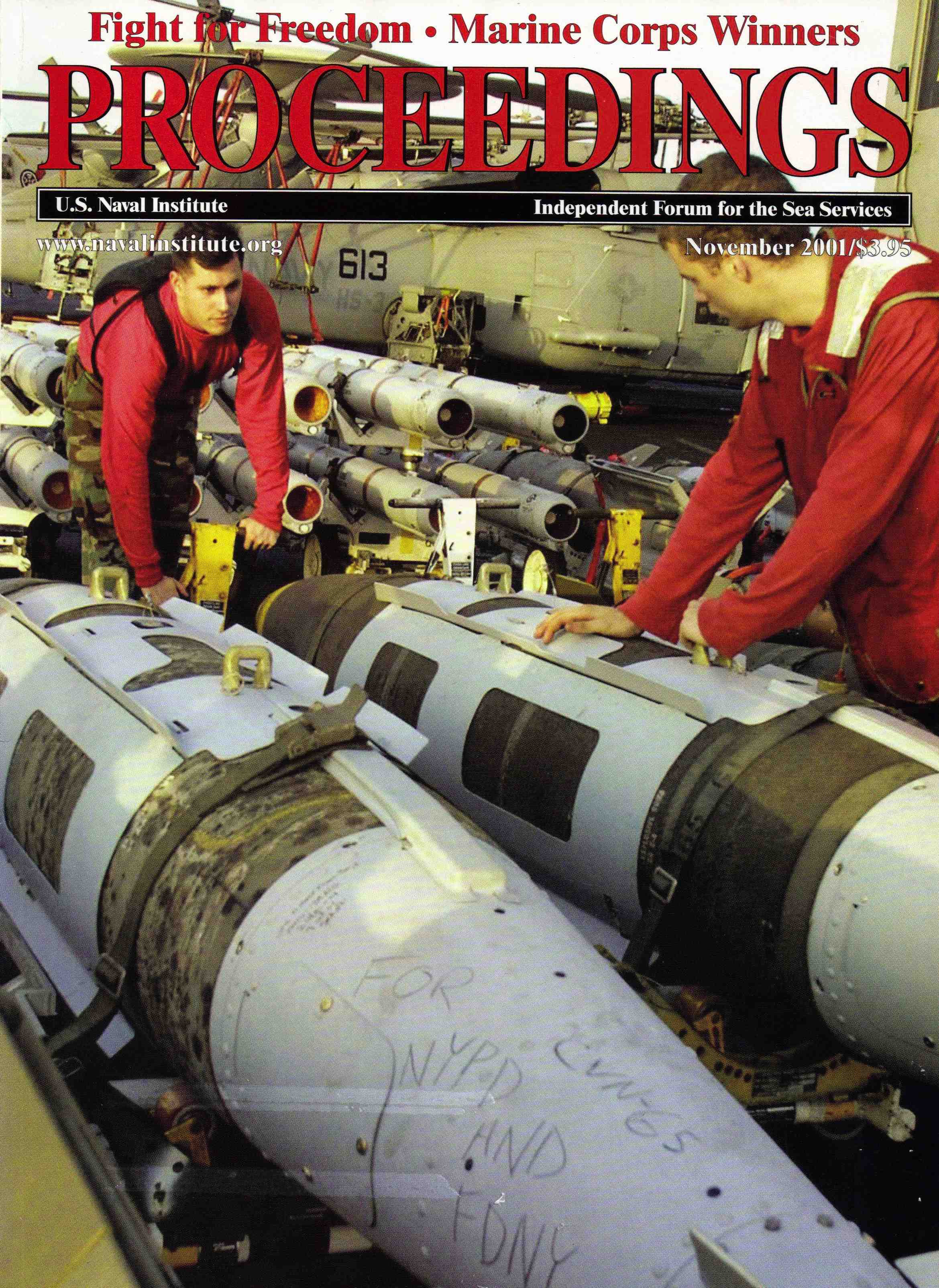
Blast from my past: U.S. Naval Institute Author of the Year (2002)

Dr. Thomas Barnett named Proceedings 'Author of the Year'

By Lt. David Ausiello

Copyright: The Newport Navalog (5 April 2002)


Newport, R.I., April 3, 2002 -- If you are looking for Tom Barnett on a Saturday afternoon this summer, you may not have to look any further than Second Beach.  Chances are you will find him there, showing his 7 year-old son, Kevin, the fine art of boogie-boarding.  Locating him during the week, however, could prove to be a little more difficult.  You could try his office at the Naval War College, where he is a Senior Strategic Researcher in the Decision Strategies Department.  Then again, you could look in Washington D.C., where he works as an assistant to Retired Vice Adm. Arthur Cebrowski in the Office of Force Transformation.  If you still haven't been able to track him down, try calling him on one of the two cell phones he keeps firmly attached to his belt.  One organization that undoubtedly possesses one of these numbers, is the U.S. Naval Institute.  For the past nine years, Tom Barnett has been writing articles for their Annapolis-based magazine, Proceedings, and on April 3rd of this year, he was honored as their 'Author of the Year' for 2001.


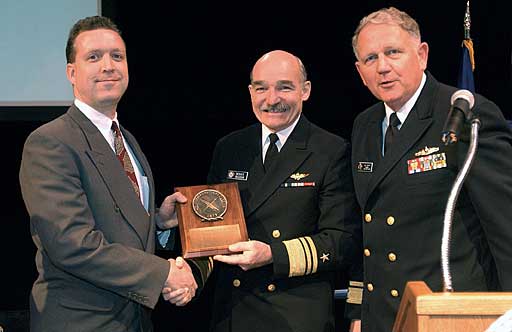
Vice Adm. Dennis V. McGinn (center), Deputy Chief of Naval Operations for Warfare Requirements and Programs presents Prof. Tom Barnett (left) with the Naval Institute's 'Author of the Year' award as Rear Adm. Rodney P. Rempt (right), Naval War College President looks on during a ceremony in Annapolis, MD.

Although a contributor to Proceedings for close to a decade, Barnett readily admits that his production for the magazine increased dramatically in 2001.

"I began pitching articles (to the Naval Institute) in February about the post cold war era, and then again last summer after I returned from India's International Fleet Review.  By the fall, they were calling me.  It's become a relationship where they trust what I write." 

In the early part of 2001, Barnett was in the midst of a two-year project centered on security issues in the new globalization era.  This endeavor took him up and down the East Coast, but mainly he found himself speaking to audiences at the two centers of security and globalization in America: The Pentagon and The World Trade Center.  Ironically, he was scheduled to brief in the Navy's Command Center Sept. 18th, which was completely destroyed exactly one week earlier.  On Sept. 25th, Barnett was scheduled to meet with members of Cantor-Fitzgerald for a briefing on the 105th floor of World Trade Center Tower One.  Obviously, neither meeting took place as scheduled, and since Sept. 11th, Barnett's focus has gone through a serious transformation.

One of the first calls Barnett received after Sept. 11th was from Proceedings editor, Fred Rainbow. 

"We were on deadline on Sept. 11th for the October issue.  We decided to make room for some thoughtful reflections on different aspects related to the attacks," said Rainbow.  "We called six people, gave them 24 hours to write 1,000 words…Professor Barnett was one of those authors we called and he produced."

Barnett, who worked closely with many members of Cantor-Fitzgerald who perished on Sept. 11th, describes writing about the effects of the attack as a "cathartic" experience.

"Personally, it felt like such an amazing attack on the work that I had been doing.  Sept. 11th in general ended the project I was working on because so many lives were lost.  The project was kind of shot out from under me."

According to Barnett, a major issue raised by Sept. 11th revolves around the nature of combat in the present day.

"Is it a uni-polar moment and are we just waiting for a great power to rise up in a traditional way, or do we find ourselves going down a dramatically different path where there are those who can accept globalization versus those who can not?  It puts the whole context of naval power in a different light.  What was a post cold-war era starts to look, all of a sudden, very dramatically like a globalization era," said Barnett.

One of Barnett's current positions is as an assistant to his previous boss, Retired Vice Adm. Arthur Cebrowski.  Cebrowski was appointed by Secretary of Defense Donald H. Rumsfeld this past November to be the Director of Force Transformation for the Department of Defense.

According to Barnett, his relationship with Cebrowski, who retired from the U.S. Navy in October 2001 after serving as the president of the Naval War College in Newport, R.I., got off to an awkward start.  Just prior to his arrival at the Naval War College, Barnett authored an article for Proceedings entitled, "The Seven Deadly Sins of Network Centric Warfare."  Cebrowski has been called the "father of network-centric warfare" for helping to initiate the concept that has become one of the centerpieces of the Defense Department's transformation planning.

"My article definitely could have been interpreted as being openly critical of Network Centric Warfare.  (Adm. Cebrowski's) article was quite historic and sometimes I see mine paired with it as a sort of counter-position.  It got the idea started that we were at odds," said Barnett.  Cebrowski's article, "Network-Centric Warfare: Its Origin and Future," appeared in the January 1998 issue of Proceedings, and was co-authored by John J. Garstka.

"Proceedings did a lot of good by publishing articles about Network Centric Warfare because it recognized it as a serious, debatable issue…and a healthy debate enabled the best ideas about Network Centric Warfare to rise," continued Barnett.

One of the first projects Barnett and his boss, Cebrowski, were involved with was Y2K.  And even though Y2K did not materialize into a catastrophic global event, the results of their research were extremely prophetic.

"We predicted a lot of things about what a negative Y2K situation could be and it is interesting to look at those predictions and see how much of the reality of Sept. 11th and its aftermath we captured," said Barnett.

Barnett describes his position (Assistant for Strategic Futures) within the Department of Defense as one in which he is responsible for helping bring a larger context to the debate of the "direction, content and pace" of transformation.

As for the future of the Navy, Barnett sees the service defining itself less in terms of what we have to do to defeat other naval forces, but more in terms of what our capability to control the seas gives to us.

"No other country is trying to control the ocean anymore, it is ours.  So the starting position (of thought) is, because we control the oceans, what can we do?"

According to Barnett, the nature of the transformation is evident in our current war on terrorism because the Navy has been called upon to do "new and unusual things to support operations on land."

For someone who obviously possesses 'Washington Insider' knowledge, Barnett claims life in Newport has given him the "best of both worlds."  After spending 14 consecutive years in big cities, the last 8 in the beltway, Barnett was "burned out" and anxious to escape the "allergies of Washington."  In Newport, he has found a different pace of life and an opportunity to spend more time with his family.  He and his wife Vonne have three children, Emily, 10, Kevin, 7, and Jerome, 2.

Describing himself as a "triple threat," Barnett acknowledges the Naval War College has enabled him to concentrate on three different professional areas.  Specifically, in Newport, Barnett has found time to pursue entrepreneurial interests while still concentrating on his main work in both public policy and national security research.

"Just like Harvard, to my great delight, the package exists at the Naval War College to fulfill yourself professionally."

Barnett also said both Rear Adm. Rodney P. Rempt, President of the Naval War College Rempt, and Rear Adm. Barbara McGann, Provost of the Naval War College, have kept the organization extremely relevant and have enabled the staff to come to Newport and be really ambitious.

In comparing life in Newport to his previous assignments, Barnett offered, "There is a great appreciation here, like anywhere, for delivering content on time.  However, if at 4 o'clock on a Wednesday afternoon in July, I have had enough for the day, you can find me on the beach boogie-boarding with my son."

As for being named 'Author of the Year,' Barnett is extremely grateful to the U.S. Naval Institute, and he indicated his relationship with Proceedings will continue.

"There are a lot of big issues on the table now, and it's a fun time to be writing."

A link to Barnett's Proceedings articles can be found at the following website: www.nwc.navy.mil/newrulesets.

12:02AM

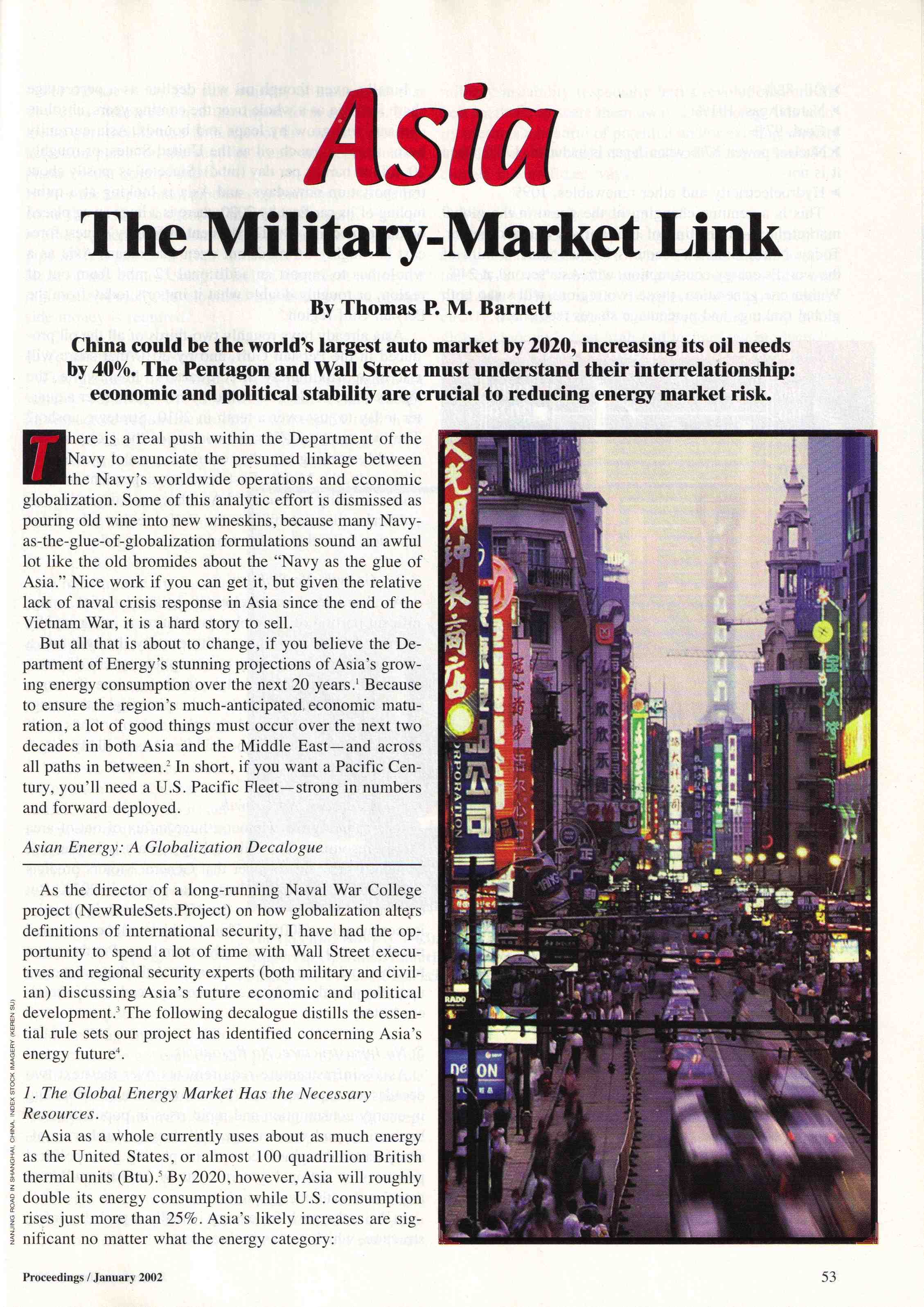
Blast from my past: "Asia: The Military-Market Link" (2002)

Asia: The Military-Market Link


by

Thomas P.M. Barnett


China could be the world's largest auto market by 2020, increasing its oil needs by 40%.  The Pentagon and Wall Street must understand their interrelationship: economic and political stability are crucial to reducing energy market risk.


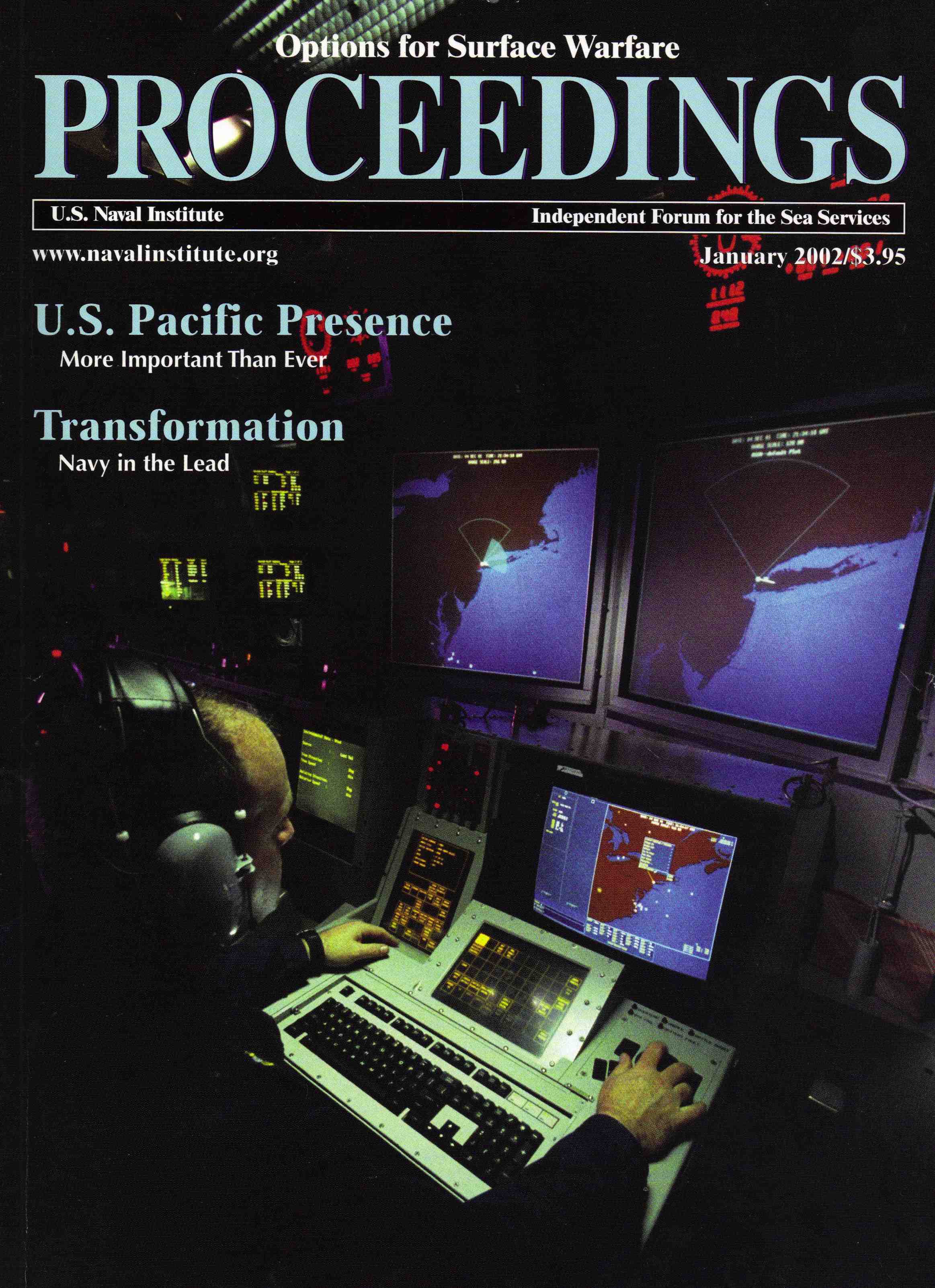
COPYRIGHT: The U.S. Naval Institute, 2002 (January  issue, pp. 53-56); reprinted with permission


There is a real push within the Department of the Navy to enunciate the presumed linkage between the Navy’s worldwide operations and economic globalization. Some of this analytic effort is dismissed as pouring old wine into new wineskins, because many Navy-as-the-glue-of-globalization formulations sound an awful lot like the old bromides about the “Navy as the glue of Asia.” Nice work if you can get it, but given the relative lack of naval crisis response in Asia since the end of the Vietnam War, it is a hard story to sell.

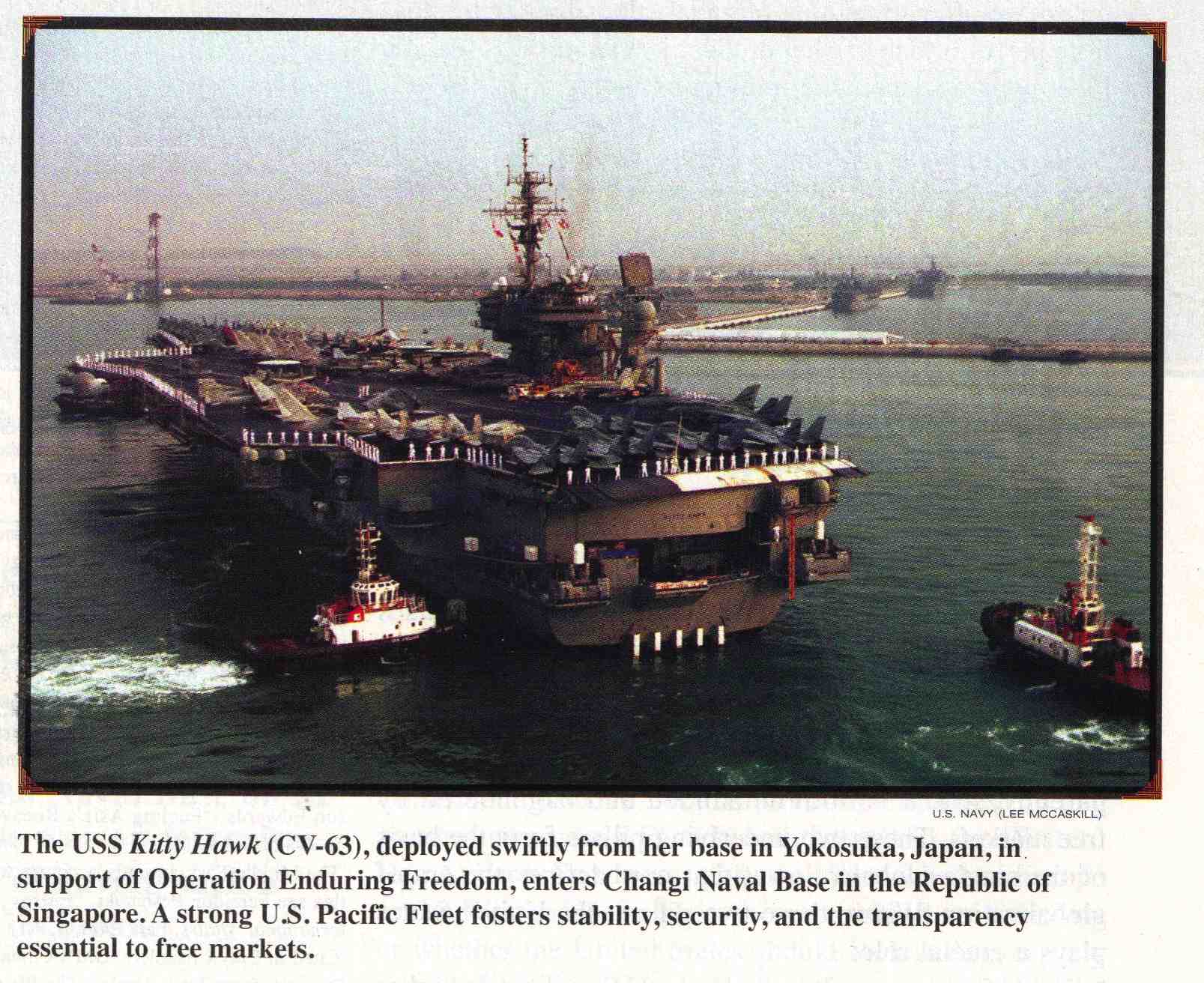
But all that is about to change, if you believe the Department of Energy’s stunning projections of Asia’s growing energy consumption over the next 20 years.1 Because to ensure the region’s much-anticipated economic maturation, a lot of good things must occur over the next two decades in both Asia and the Middle East—and across all paths in between.2 In short, if you want a Pacific Century, you’ll need a U.S. Pacific Fleet—strong in numbers and forward deployed.

Asian Energy: A Globalization Decalogue

As the director of a long-running Naval War College project (NewRuleSets.Project) on how globalization alters definitions of international security, I have had the opportunity to spend a lot of time with Wall Street executives and regional security experts (both military and civilian) discussing Asia’s future economic and political development.3 The following decalogue distills the essential rule sets our project has identified concerning Asia’s energy future.4

1. The Global Energy Market Has the Necessary Resources.

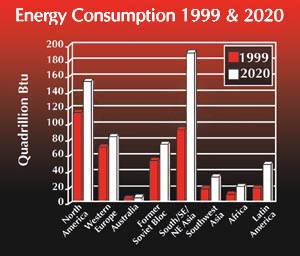
Asia as a whole currently uses about as much energy as the United States, or almost 100 quadrillion British thermal units (Btu).5 By 2020, however, Asia will roughly double its energy consumption while U.S. consumption rises just more than 25%. Asia’s likely increases are significant no matter what the energy category:

  • Oil, 88%
  • Natural gas, 191%
  • Coal, 97%
  • Nuclear power, 87% when Japan is included, 178% when it is not
  • Hydroelectricity and other renewables, 109%.

This is a genuine changing of the guard in the global marketplace—a shifting of the world’s demand center. Today, North America accounts for just under a third of the world’s energy consumption, with Asia second at 24%. Within one generation, those two regions will swap both global rankings and percentage shares (see chart).


The good news is that there’s plenty of fossil fuel to go around. Confirmed oil reserves have jumped almost two-thirds over the past 20 years, according to the Department of Energy, while natural gas reserves have roughly doubled. Our best estimates on coal say we have enough for the next two centuries. So supply is not the issue, and neither is demand, leaving only the question of moving the energy from those who have it to those who need it—and therein lies the rub. 

2. But No Stability, No Market.

Asia comes close to self-sufficiency only in coal, with Australia, China, India, and Indonesia the big producers. All told, Asia self-supplies on coal to the tune of 97%, a standard it will maintain through 2020. That is important, because virtually all of the global growth in coal use over the next generation will happen in Asia, mostly in China and India.

Natural gas is a far different story. In 2001 Asia used around 10 trillion cubic feet, with Japan, South Korea, and Taiwan representing the lion’s share of consumption. The trick is this: Asia’s demand for natural gas will skyrocket to perhaps 25 trillion cubic feet by 2020, with the vast bulk of the increase occurring outside of that trio. So if those three countries already buy what’s available in-region, that means the rest of Asia will have to go elsewhere—namely, the former Soviet Union (Russia, with 33% of the world total) and the Middle East (Iran, with 16%).

Finally, even though oil will decline as a percentage share for Asia as a whole over the coming years, absolute demand will grow by leaps and bounds. Asia currently burns about as much oil as the United States, or roughly 20 million barrels per day (mbd). Since oil is mostly about transportation nowadays, and Asia is looking at a quintupling of its car fleet by 2020, there is a huge swag placed on this projection. The Department of Energy’s latest forecast is roughly 36 mbd, but even that means Asia as a whole has to import an additional 12 mbd from out of region, or roughly double what it imports today from the Persian Gulf region.6

Asia already buys roughly two-thirds of all the oil produced in the Persian Gulf, and by 2010 that share will rise to approximately three-quarters.7 Meanwhile, the West’s share of Gulf oil will drop from just under a quarter today to just over a tenth in 2010. Strategic upshot? The two most anti-Western corners of the globe are inexorably coming together over energy and money. Increasingly, the Middle East becomes dependent on economic stability in Asia, and Asia becomes dependent on political-military stability in the Gulf. If either side of that equation fails, the energy market is put at risk.

3. No Growth, No Stability. 

As a middle class develops in Asian countries, a significant portion of the global population is being rapidly promoted from an 18th- or 19th-century lifestyle into a 20th- or even 21st-century consumption pattern. If international investors decide to take it all away one afternoon in a flurry of currency attacks and capital flight, the struggling segment of the population that suddenly finds itself expelled from the would-be middle class is likely to get awfully upset.

4. No Resources, No Growth. 

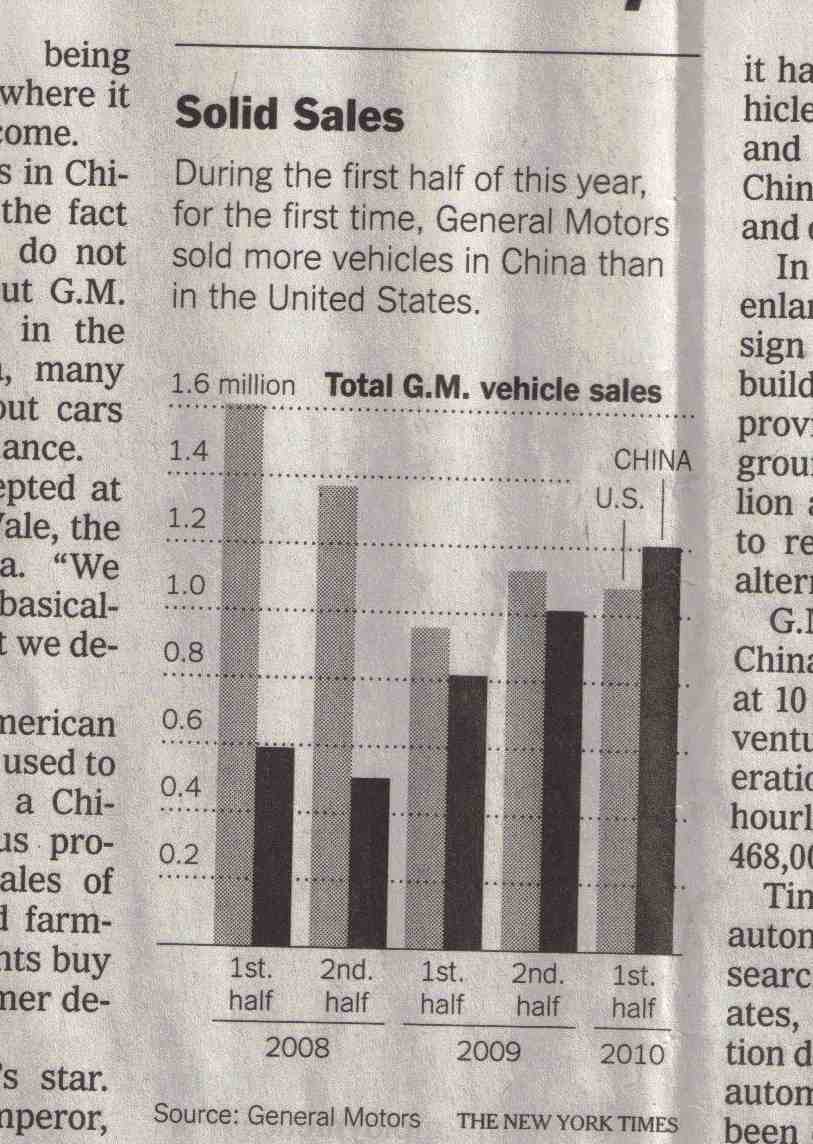
Asia cannot grow without a huge influx of out-of-area energy resources. The quintupling of cars is impressive enough, when you consider that General Motors predicts China will be the world’s largest car market in 2020.8 But even more stunning will be the 250% increase in electricity consumption (300% in China), which will be generated mostly by coal and, increasingly, natural gas. Put those two together and we are talking about an Asia that must open up to the outside world to a degree unprecedented in modern history.

5. No Infrastructure, No Resources. 

Asia’s infrastructure requirements over the next two decades are unprecedented. The combination of a doubling in energy consumption and rapid rises in population, urbanization, and water usage will damage further an already battered regional ecosystem, placing great political pressures on national governments to limit the pollution associated with energy production.

In Asia, the push for energy is really a push for infrastructure, which comes in three forms:

  • For the near term, the vast majority of natural gas that flows into Asia will arrive in a liquid form on ships. That means port facilities on both ends of the conduit, plus liquefaction plants on the supplier’s end and regasification plants on the buyer’s end.
  • Over the longer haul, pipelines by both land and sea become the answer to meeting the rising demand.
  • Finally, there is the domestic infrastructure required to pipe all that gas to the final consumers.

None of this comes cheaply, and as the recent history of regional electricity development makes clear, lots of outside money is required.9

6. No Money, No Infrastructure.

Foreign direct investment (FDI) is the most significant scenario variable for Asia’s energy future. Asia’s energy infrastructure requirements easily will top $1 trillion by 2020, according to many estimates. Such numbers overwhelm the region’s ability to self-finance, and that means Asia will have to open up its energy generation and distribution markets to far more joint or foreign ownership. If it seems inevitable that Asia must turn to the former Soviet Union and the Middle East for energy in the coming decades, it is just as inevitable that it must turn to the West for the money to finance this trade.

7. No Rules, No Money.

Many on Wall Street voice the opinion that Asia has not sufficiently cleaned up its act as a result of the 1997–1998 financial crisis, referring primarily to internationally accepted accounting practices in the financial and corporate sectors.10 Another problem with Asia’s energy investment climate is the current mix of private-sector investments and public-sector decision making. In most Asian economies, the government still plays far too large a role as far as Western financiers are concerned. As long as rule sets lag behind, the rise of private-sector market makers is delayed, for firm rules of play are required before deregulation of state-run energy markets can proceed.

8. No Security, No Rules.

Foreign direct investment does not occur in a vacuum. Long-term certainty is the greatest attraction a country can offer to outside investors, whereas war and political-military instability (especially leftist revolutions) are the best methods to scare them away. Developing Asia readily presents a handful of potential and/or existing security trouble spots that could negatively affect the region’s FDI climate in significant ways.

9. No Leviathan, No Security.

Many international experts agree that Asia’s current security situation belongs to what Thomas Friedman calls the “olive tree” world, where backward tribes fight over little bits of land, while rising economic powerhouses clearly join the “Lexus” world, producing many of the global economy’s best high-end technology products.11

In this region there remains a viable long-term market for the services of an outside Leviathan—namely, the United States. The United States enjoys healthier security relationships with virtually every Asian government than any two governments there enjoy with one another. While it is easy to deride the notion of a “four-star foreign policy,” there is little doubt that the commander-in-chief of U.S. Pacific Command plays a unique role in working the security arrangements that underpin the region’s strong record of structural stability over the past quarter century.12 Our forward presence both reassures local governments and obviates their need for larger military hedges. Our presence is a moneymaker on two fronts: they spend less on defense and more on development (the ultimate defense), and FDI is encouraged, however subtly.

10. No U.S. Navy, No Leviathan.

The U.S. government—and the U.S. Navy in particular—faces a far more complex strategic environment in the 21st century than it did during the Cold War, whether or not it yet realizes the change: our national security interests in the Persian Gulf, while increasingly important for the global economy, no longer hold the same immediate importance to our national economy. In effect, U.S. naval presence in Asia is becoming far less an expression of our nation’s forward presence than an “exporting” of security to the global marketplace. In that regard, we truly do move into the Leviathan category, for the “product” we provide is increasingly a collective good less directly tied to our particularistic national interests and far more intimately wrapped up with our global responsibilities.

And in the end, this is a pretty good deal. We trade little pieces of paper (our currency, in the form of a trade deficit) for Asia’s amazing array of products and services. We are smart enough to know this is a patently unfair deal unless we offer something of great value along with those little pieces of paper. That product is a strong U.S. Pacific Fleet, which squares the transaction nicely.

Understanding the Military-Market Connection

The collapse of the Soviet bloc and its long-standing challenge of the Western economic rule set made possible a global rule set for how military power buttresses and enables economic growth and stability. For the first time in human history we have a true global military Leviathan in the form of the U.S. military, and no peer competitor in sight—not even a coherent alternative economic philosophy (although bin Laden’s anti-Westernization resonates with those who fear globalization as a form of forced Americanization). This unparalleled moment in global history both allows and compels the United States to better understand the national security-market nexus.

How do we define this yin-yang relationship between business and the military? First we speak of stability, which flows from national security, and then we speak of transparency, which is both demanded and engendered by free markets. These two underlying pillars form the basis of the single global rule set that now defines the era of globalization. Within those two pillars, the United States plays a crucial role:

  • The U.S. government, through the U.S. military, supplies the lion’s share of system stability through its Leviathan-like status as the world’s sole military superpower.
  • U.S. financial markets, which lead the way in fostering the emergence of a global equities market, play the leading role in spreading the gospel of transparency—any country’s best defense against the sort of financial currency crises that have erupted periodically over the past decade (Mexico 1994, Asia 1997, Russia 1998, Brazil 1999, Turkey 2001).

It therefore is essential that the Pentagon and Wall Street come to better understand their interrelationships across the global economy. Uncovering and better understanding this fundamental relationship is especially important because the vast majority of the time the security and financial communities operate in oblivious indifference to one another. Ultimately, however, the global economy operates on trust, which is based on certainty, which in turn comes from the effective processing of risk.

In the end, the national security and financial establishments are in the same fundamental business: the effective processing of international risk. Invariably, these two problem sets merge in the historical process that is economic globalization. Understanding the military-market connection isn’t just good business, it’s good national security strategy. Bin Laden understood this connection when he selected the World Trade Center and the Pentagon for his targets. We ignore his logic at our peril.

1. See the Energy Information Administration’s International Energy Outlook 2001, DOE/EIA-0484(2001), March 2001, found at www.eia.doe.gov/oiaf/ieo/index.html.

2. For the purposes of this article I define Asia as extending from Afghanistan to Japan, but not including Australia and New Zealand (Oceania), although I identify Australia as an in-region supplier of energy because of its proximity.

3. The NewRuleSets.Project is a multiyear research effort designed to explore how globalization and the rise of the new economy are altering the basic “rules of the road” in the international security environment, with special reference to how these changes may redefine the U.S. Navy’s historical role as security enabler of U.S. commercial network ties with the world. The project is hosted by the online securities broker-dealer firm eSpeed (an affiliate of Cantor Fitzgerald LP) and involves personnel from the Decision Strategies Department of the Center for Naval Warfare Studies. Adm. William Flanagan, USN (Ret.), and Dr. Philip Ginsberg, of Cantor Fitzgerald (senior managing director and executive vice president, respectively), serve as informal advisors to the project, actively participating in all planning and design. The first three joint Wall Street-Naval War College workshops in the series involved energy, foreign direct investment, and the environment in Asia. Follow-on events are planned for food and water, information technology, and human capital. All research products relating to this effort are found at www.nwc.navy.mil/newrulesets. 

4. All the energy data presented in the decalogue, unless otherwise specified, comes from the Department of Energy’s International Energy Outlook 2001.

5. A good rule of thumb for thinking about quadrillion Btu is that you can take the annual number for a region, divide it by two, and get the rough equivalent in millions of barrels of oil per day the region would need to burn if it was achieving that entire energy amount by oil alone. For example, North America used 116 quadrillion Btu in 1999, which would equate to 58 million barrels of oil per day (mbd) if that entire amount was achieved by oil alone. For point of comparison, the United States currently uses about 20 mbd, importing roughly half that number. 

6. For an excellent exploration of this, see Daniel Yergin, Dennis Eklof, and Jefferson Edwards, “Fueling Asia’s Recovery,” Foreign Affairs, March/April 1998, pp. 34–50. 

7. The Middle East currently accounts for roughly 90% of all Asian oil imports; on this see Fereidun Fesharaki, “Energy and Asian Security Nexus,” Journal of International Affairs, Fall 1999, p. 97.

8. Cited in Clay Chandler, “GM’s China Bet Hits Snag: WTO (Car Shoppers Await Discount from Trade Deal),” The Washington Post, 10 May 2000, p. E1.

9. See “Foreign Investment in the Electricity Sectors of Asia and South America,” International Energy Outlook 2000, pp. 120–21. 

10. On this, see Andreas Kluth, “A Survey of Asian Business: In Praise of Rules,” The Economist, 7 April 2001, pp. 1–18 (insert).

11. Thomas Friedman, The Lexus and the Olive Tree: Understanding Globalization (New York: Farrar Strauss Giroux, 1999).

12. For an excellent exploration of this concept, see Dana Priest, “A Four-Star Foreign Policy? U.S. Commanders Wield Rising Clout, Autonomy,” The Washington Post, 28 September 2000, p. A1. See also the second and third articles in the series (29–30 September). 

Dr. Barnett is a professor at the U.S. Naval War College, currently serving as the Assistant for Strategic Futures in the Office of Force Transformation within the Office of the Secretary of Defense. 

12:01AM

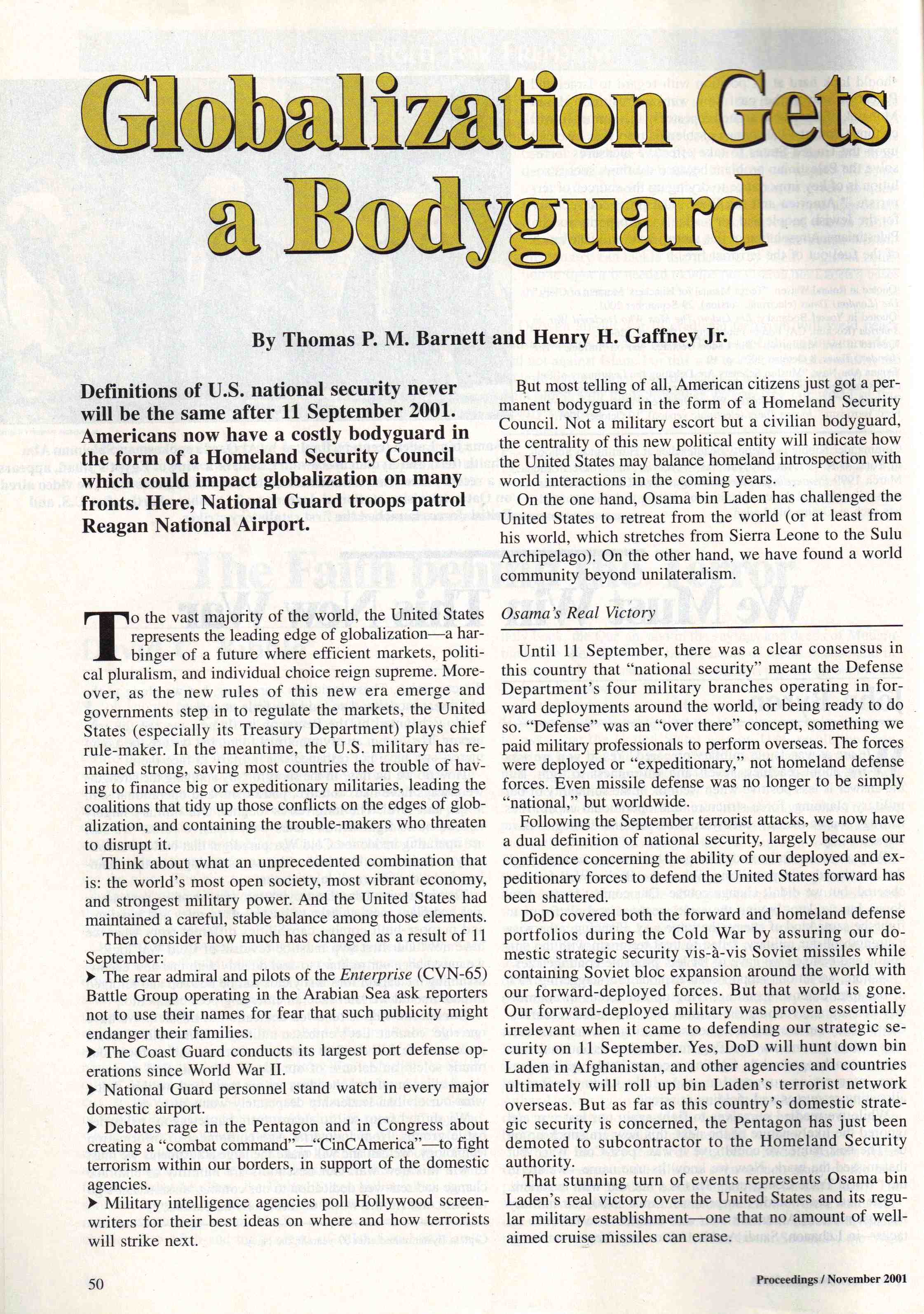
Blast from my past: "Globalization Gets a Bodyguard" (2001)

Globalization Gets a Bodyguard


by


Thomas P.M. Barnett and Henry H. Gaffney, Jr.


Definitions of U.S. national security never will be the same after 11 September 2001.  Americans now have a costly bodyguard in the form of a Homeland Security Council which could impact globalization on many fronts.


COPYRIGHT: The U.S. Naval Institute, 2001 (November  issue, pp. 50-53); reprinted with permission


To the vast majority of the world, the United States represents the leading edge of globalization—a harbinger of a future where efficient markets, political pluralism, and individual choice reign supreme. Moreover, as the new rules of this new era emerge and governments step in to regulate the markets, the United States (especially its Treasury Department) plays chief rule-maker. In the meantime, the U.S. military has remained strong, saving most countries the trouble of having to finance big or expeditionary militaries, leading the coalitions that tidy up those conflicts on the edges of globalization, and containing the trouble-makers who threaten to disrupt it.

Think about what an unprecedented combination that is: the world’s most open society, most vibrant economy, and strongest military power. And the United States had maintained a careful, stable balance among those elements.

Then consider how much has changed as a result of 11 September:

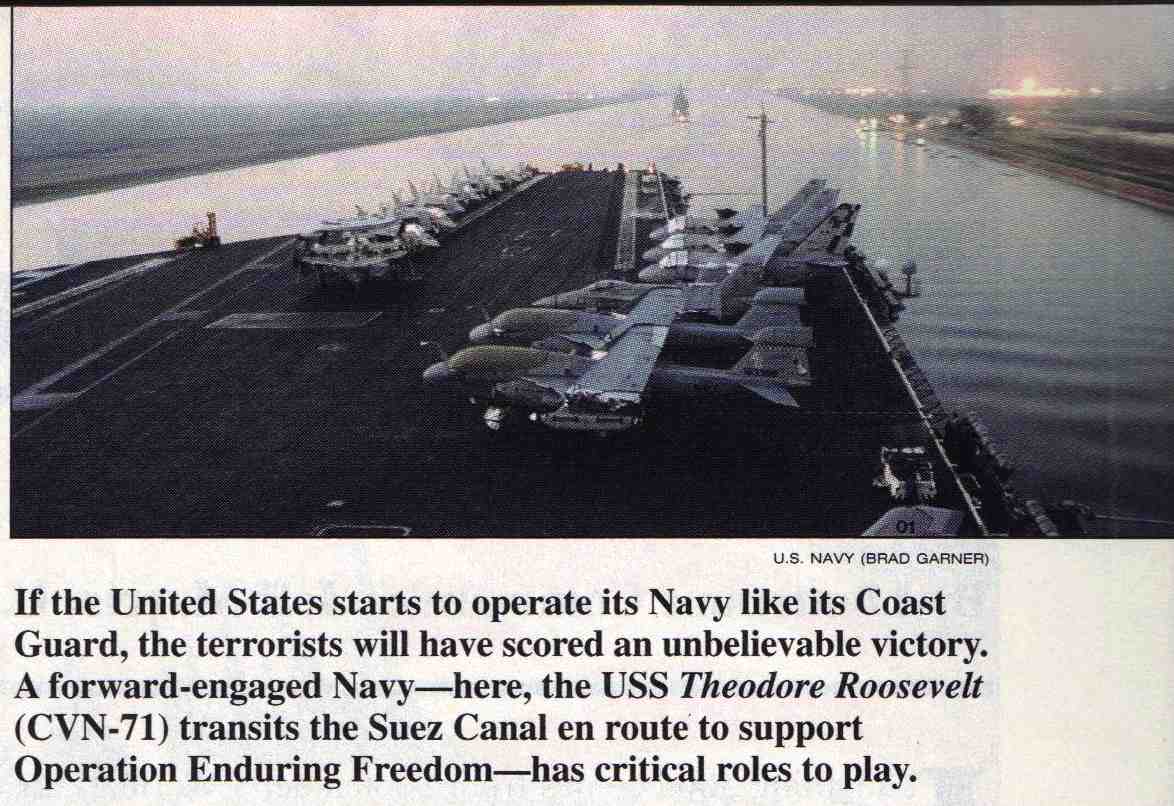
  • The rear admiral and pilots of the Enterprise (CVN-65) Battle Group operating in the Arabian Sea ask reporters not to use their names for fear that such publicity might endanger their families.
  • The Coast Guard conducts its largest port defense operations since World War II.
  • National Guard personnel stand watch in every major domestic airport.
  • Debates rage in the Pentagon and in Congress about creating a “combat command”—“CinCAmerica”—to fight terrorism within our borders, in  support of the domestic agencies.
  • Military intelligence agencies poll Hollywood screenwriters for their best ideas on where and how terrorists will strike next.

But most telling of all, American citizens just got a permanent bodyguard in the form of a Homeland Security Council. Not a military escort but a civilian bodyguard, the centrality of this new political entity will indicate how the United States may balance homeland introspection with world interactions in the coming years.

On the one hand, Osama bin Laden has challenged the United States to retreat from the world (or at least from his world, which stretches from Sierra Leone to the Sulu Archipelago). On the other hand, we have found a world community beyond unilateralism.

Osama's Real Victory

Until 11 September, there was a clear consensus in this country that “national security” meant the Defense Department’s four military branches operating in forward deployments around the world, or being ready to do so. “Defense” was an “over there” concept, something we paid military professionals to perform overseas. The forces were deployed or “expeditionary,” not homeland defense forces. Even missile defense was no longer to be simply “national,” but worldwide.

Following the September terrorist attacks, we now have a dual definition of national security, largely because our confidence concerning the ability of our deployed and expeditionary forces to defend the United States forward has been shattered.

DoD covered both the forward and homeland defense portfolios during the Cold War by assuring our domestic strategic security vis-à-vis Soviet missiles while containing Soviet bloc expansion around the world with our forward-deployed forces. But that world is gone. Our forward-deployed military was proven essentially irrelevant when it came to defending our strategic security on 11 September. Yes, DoD will hunt down bin Laden in Afghanistan, and other agencies and countries ultimately will roll up bin Laden’s terrorist network overseas. But as far as this country’s domestic strategic security is concerned, the Pentagon has just been demoted to subcontractor to the Homeland Security authority.

That stunning turn of events represents Osama bin Laden’s real victory over the United States and its regular military establishment—one that no amount of well-aimed cruise missiles can erase.

Downstream Effects from 9/11

As anyone in the private security business will tell you, bodyguards cost plenty. As a cost of doing the nation’s business, this charge will be too large for state and local governments to absorb, signaling an expansion of federal power and spending not seen since Franklin Roosevelt declared, “The only thing we have to fear is fear itself.”

Homeland security will grow—as a concept, strategy, bureaucracy, and budget—in direct proportion to our society’s ballooning fear concerning terrorism. George W. Bush cannot win this “new war”—or a second term—merely by producing bin Laden’s head. He can only prevail in this strategic struggle by restoring Americans’ sense of personal security.

Up to now, Americans have largely looked after themselves for personal security, augmenting our reasonably robust local police structure by shelling out their own dollars for personal weapons, home-security systems, gated communities, and the like. But again, bin Laden’s stunning strike has merged definitions of strategic and personal security, and that conflation will long be felt in the Congress’s willingness to redirect federal discretionary spending toward restoring our collective personal security and away from all this international engagement we had become accustomed to during the Cold War and in the decade after it.

When President Bush announced the homeland security entity, it was first described as just an “office,” but soon we learned it would grow into a “council” on a par with the National Security Council. How much more authority might it gain, and what budgetary resources will it command?

Clearly this will be an event-driven process largely beyond DoD’s control. Another 5,000 dead, say, in Chicago or Los Angeles, and we shortly will have a Homeland Security Agency or even a Department that absorbs command of elements of DoD—an interior ministry like many other countries have.

After 11 September, this pathway is conceivable, and in many ways, it may be inevitable given the opportunities for terrorists to infiltrate the United States in this globalization era. At the very least, it is a greater long-term likelihood than Governor Tom Ridge ending up as just another “drug czar.” That is because our continued consumption of narcotics threatens no one in the world except ourselves, whereas the terrorists want to kill Americans to drive us out of the huge Islamic world they dream of someday running like the Taliban’s Afghanistan.

In short, our collective determination to not let “them”—the terrorists—change our way of life is met with their equal determination to not let “us”—American-led globalization—destroy their way of life. That is why this war may well rival or exceed the length of our Cold War standoff with the Soviets. Terrorism has been around for a long time and has excelled at dispatching monarchs, but the world neither has seen anything on the scale of 11 September, nor have the opportunities to slip in and out of countries been so easy since the 18th century.

Assuming that this conflict will drag on year after year, it is inevitable that the federal homeland security effort will demand a larger share of the federal discretionary budget. At first, this trend will plunge the U.S. Government back into the universe of deficit spending. DoD will benefit substantially from the generalized boost in “security” spending in 9/11’s immediate aftermath, but that plus-up likely will be short-lived, meaning a couple of years.

Now, and continuing to the 2004 presidential election, we likely are to face an economy experiencing nowhere near the record growth rates of the booming 1990s. Say goodbye to the record revenue flows and say hello to the additional costs—both real and opportunity—associated with all this expanded internal security and the consequent restrictions on international traffic entering the United States. Meanwhile the nation will be growing older, as the leading edge of the boomer generation hits the 60-year mark, leading to a further squeeze on the discretionary budget in favor of mandatory social security programs.

After the campaign in Afghanistan is over, whenever that happens, DoD’s budget inevitably will be squeezed. In a three-way race among taking care of elders (who vote), taking care of our personal and domestic security, and resuming the task of maintaining regional stability somewhere “over there,” guess which funding stream gets squeezed the tightest?

The Vision Thing

Many in the national security community who declare that we just experienced another Pearl Harbor likewise assume that the American public inevitably will remain wedded to the notion that this country must stay forward engaged militarily—no matter what the relative cost. That is a huge assumption worth examining.

First, we tend to idealize the “greatest generation’s” selfless willingness to endure the privations and sacrifices of World War II—especially on the home front.

  • It was fairly easy to demonize our enemies in that declared war, for those national regimes were truly demonic. We have a much finer line to tread in this virtual “war” against nonstate actors, for no other reason than to avoid the appearance of a generalized “clash of civilizations” with Islam itself, something bin Laden obviously seeks to promote.
  • Americans knew it was an us-or-them fight; either our country would prevail or we would have found ourselves largely isolated in a fascist-dominated world. Radical Islam offers no realistic world view. It basically just wants the West—and especially U.S. forces—out of the Middle East.
  • World War II lasted a mere four years as far as the United States was concerned. This “war” is likely to drag on far longer. As both the United Kingdom and Israel have shown in recent decades, it is possible to live with ongoing terrorist challenges, but the societal tensions are dramatic and costly. None of this increased domestic security is going to be cheaply achieved and maintained.

Second, since the end of the Cold War, the American public and their representatives in Congress have been clear that they are uncomfortable with the role of global policeman. Some claimed that it was a more dangerous world after the Cold War, and that we had to police it since no one else was going to. They did not have in mind fighting a war like the Soviets did in Afghanistan. It was more like containing the rogues, making a few interventions in internal conflicts once truces had been arranged, and the occasional show of force off Taiwan.

Now, if forward presence and interventions become identified with retaliation by terrorists that results in periodic civilian casualties numbering in the thousands, we should expect strong domestic opposition to emerge and force a debate about the role of the U.S. military in regulating the international security environment. Yes, our collective sense of revenge/justice will propel us sufficiently along to eliminate bin Laden and roll up his al Qaeda network, but there is no guarantee that Americans will remain united beyond that discrete goal.

Third, we just endured a direct attack against our homeland in which roughly as many people died as in the bloodiest day of our nation’s history—the Civil War’s Battle of Antietam. The Bush administration did not panic, but slowly and patiently formed an international coalition and planned carefully prior to beginning military strikes. But think about what that says about what a complex world in which we live.

Bin Laden just killed 5,000 of ours and other countries’ citizens, but our retaliation and our capturing of bin Laden and tracking down his cells in 60 countries mean we have to go out there and do it. We can not do all that from the sea and Whiteman Air Force Base. Bin Laden may have struck us, but a lot of the advanced countries, and Russia and China too, could be struck next. All the countries benefiting from globalization are in this together.  This is a complex international security environment where unilateralism simply does not work.

Fourth, there will be no unlimited pie for “national security,” especially as the mounting deficit is recognized, so any rise in resource requirements for Homeland Security will inevitably eat into the Pentagon’s budget. Less money means either fewer operations, less purchases, or smaller force structure, or diversion of force structure (military personnel) to homeland defense. In any case, U.S military capabilities would be spread more thinly, assuming Americans still think we should be policing the world.

We will need to take some different perspectives on what we thought were going to be threats to our interests. Some interests may not seem so vital anymore, some relationships not worth pursuing to the same degree. But this is not because of the thinness of the forces—they will still be the strongest, most capable forces in the world. It is because of the new perspective of what is most important to the American people.

Finally, there are the dilemmas posed to the Navy itself. The Navy may be tempted in the coming months and years to prove how useful it is in homeland security, just as it was in jumping on the national missile defense bandwagon. Homeland defense in U.S. coastal waters is the job of the U.S. Coast Guard, and it may well benefit from some of the resources diverted from DoD. The U.S. Navy probably does not want to lower its technological sights, but then these roles are not its choice, but the nation’s.

The United States has kept a global navy of great capability, and this has permitted most other countries in the world to concentrate on their “coast guard” navies. If the United States starts operating its navy like a coast guard, we abdicate our role as the world’s navy, and maybe then bin Laden will have succeeded beyond his wildest dreams. Saddam and the Iranians would be happy too.

But we do not need to do that. Under any conditions, the United States has much more navy than needed for homeland defense. The U.S. Navy has a critical role in the Persian Gulf and in adjacent waters. It also has a highly symbolic role in maintaining East Asian stability. And we have this broader coalition that we have rediscovered, of which navy-to-navy cooperation plays an important part. There is no reason for the United States to retreat from the world now.

Whither Transformation?

Before 11 September, the strategic debate in defense was between policing the world in the here-and-now and transformation to face an unknown peer competitor, or simply to take advantage of changing technology. But now, it appears that U.S. forces as they exist—with the addition of C4ISR (command, control, communications, computers, intelligence, surveillance, and reconnaissance) improvements and more precision-guided munitions—are more than adequate for the war against terrorism. More important may be their new roles in homeland versus international defense:

  • The U.S. Army, especially the National Guard and Army Reserve, is taking a big role in homeland defense, and may get to administer the resources for a national missile defense.
  • The Air Force, which had organized well for expeditionary responses (AEFs), takes on more a dual role in continental air defense as well as expeditionary operations.
  • The Marine Corps proposes a super brigade for domestic and overseas antiterrorism operations.
  • With the Coast Guard watching the coasts, the Navy still patrols the Persian Gulf and Asia.

This is not the kind of radical technological transformation most had in mind before 11 September.

The Newer World Order

It is fair to say that when the Bush administration came into power it really did not have a foreign policy, just a firm notion that Clinton’s approach to globalization was far too focused on the broad architecture of free trade.  The anti-Clinton foreign policy basically was a my-way-or-the-highway unilateralism.

In the new administration’s world view, Russia and China were back to being more front-and-center concerns, and India could be a new friend if it signed off on our missile defense. Japan and our European allies were expected to fall in line, even though we were not going to give an inch on things like Kyoto or the World Court. Iran and Iraq were told there was a new sheriff in town, unafraid to crack the whip of tighter sanctions.

That was then, this is now:

  • The other NATO members are ready to defend us!
  • Japan is gearing up to make real military contributions.
  • Moscow is advising us on how to take down Afghanistan.
  • China is openly approving a U.S. military intervention in Asia.
  • India is asking us for help with Kashmiri terrorists.

Do not think for a minute that all this support will not come with price tags, but clearly we are experiencing an historic moment not seen since Iraq invaded Kuwait. So the question for the Bush administration is this: What world architecture are you going to build to consolidate this groundswell of cooperation?

In effect, we will now see how Bush the Younger’s edition of a New World Order might surpass the aborted version of Bush the Elder. There is good reason to believe that this time that wildly ambitious slogan will stick—both in name and substance. All of the world’s great powers understand that a strong antiglobalization backlash is brewing, threatening the long-term growth and prosperity of all. Before 9/11, Seattle Man was this movement’s scariest face, but he looks laughably impotent compared to the still-rippling global economic shock wave bin Laden unleashed with his World Trade Center/Pentagon attacks.

By making it clear that the major powers are not going to stand by idly while terrorists try to sow systemic disruptions, the East and West may come together to discover a sense of global community that proves to be globalization’s version of “soft power.”

The Navy is a versatile tool for assisting in the sort of security networking among great powers that globalization needs now. So while its key task right now is suppressing the Taliban so others can track down bin Laden, the Navy’s longer-term vision must be twofold:

  • Contributing where it can to homeland defense, depending on national decisions on missile defense and the patrolling of coastal waters
  • Containing and suppressing those who would disrupt peace and economic progress—the essence of globalization—forward, especially in the Middle East arc of crisis.

It appears that U.S. naval technological capabilities, as they may be incrementally improved, will be adequate for these tasks. The greater challenges may be to take good care of naval personnel, who may be tasked for long stays in distant waters, maintaining adequate readiness, and keeping numbers of ships instead of striving for the ultimate in technologies.

Dr. Barnett is a professor at the U.S. Naval War College, serving as a senior strategic researcher in the Decision Strategies Department of the Center for Naval Warfare Studies.  Dr. Gaffney is a research manager at The CNA Corporation, serving as Team Leader in the Center for Strategic Studies.

2:15AM

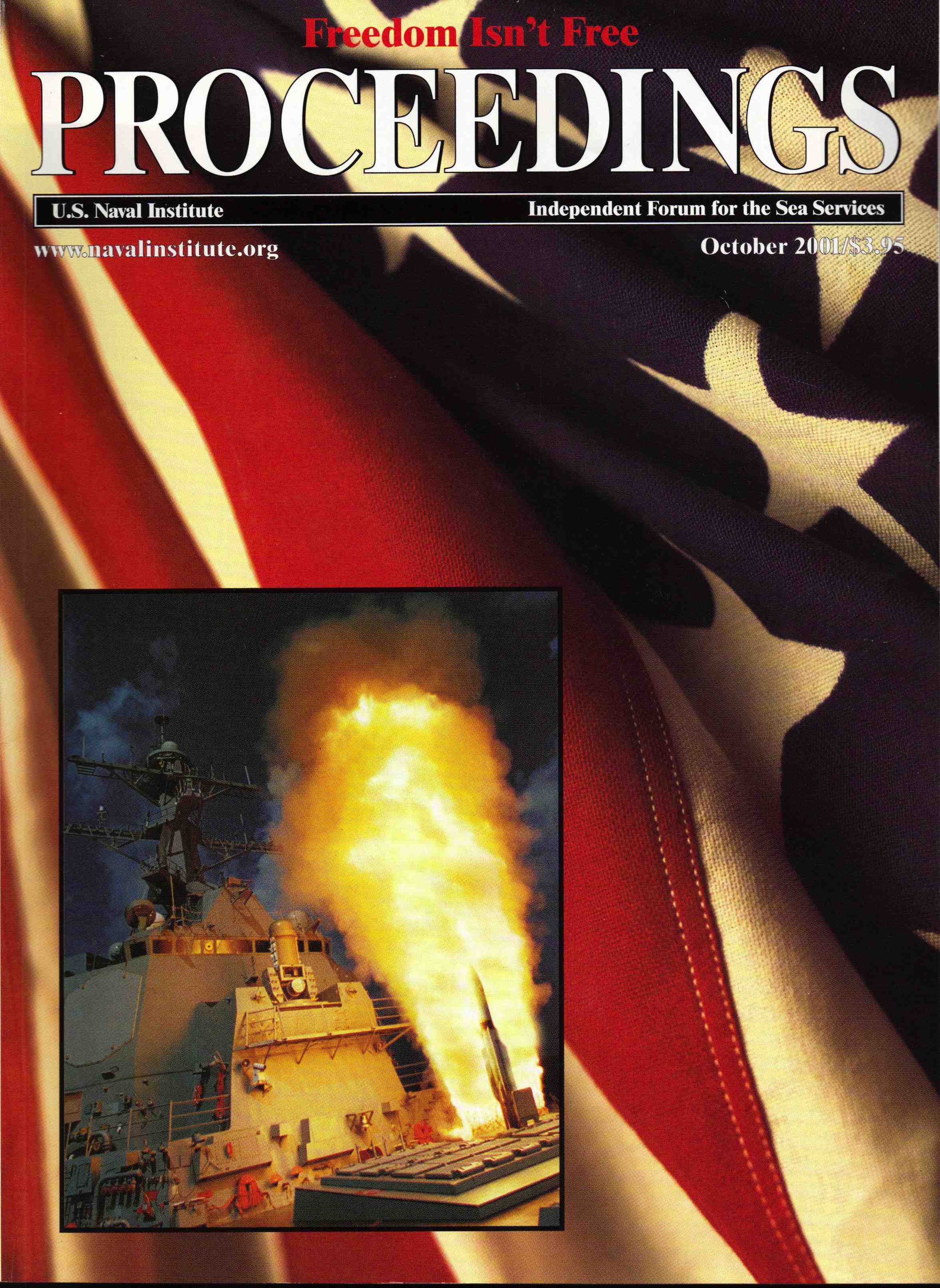
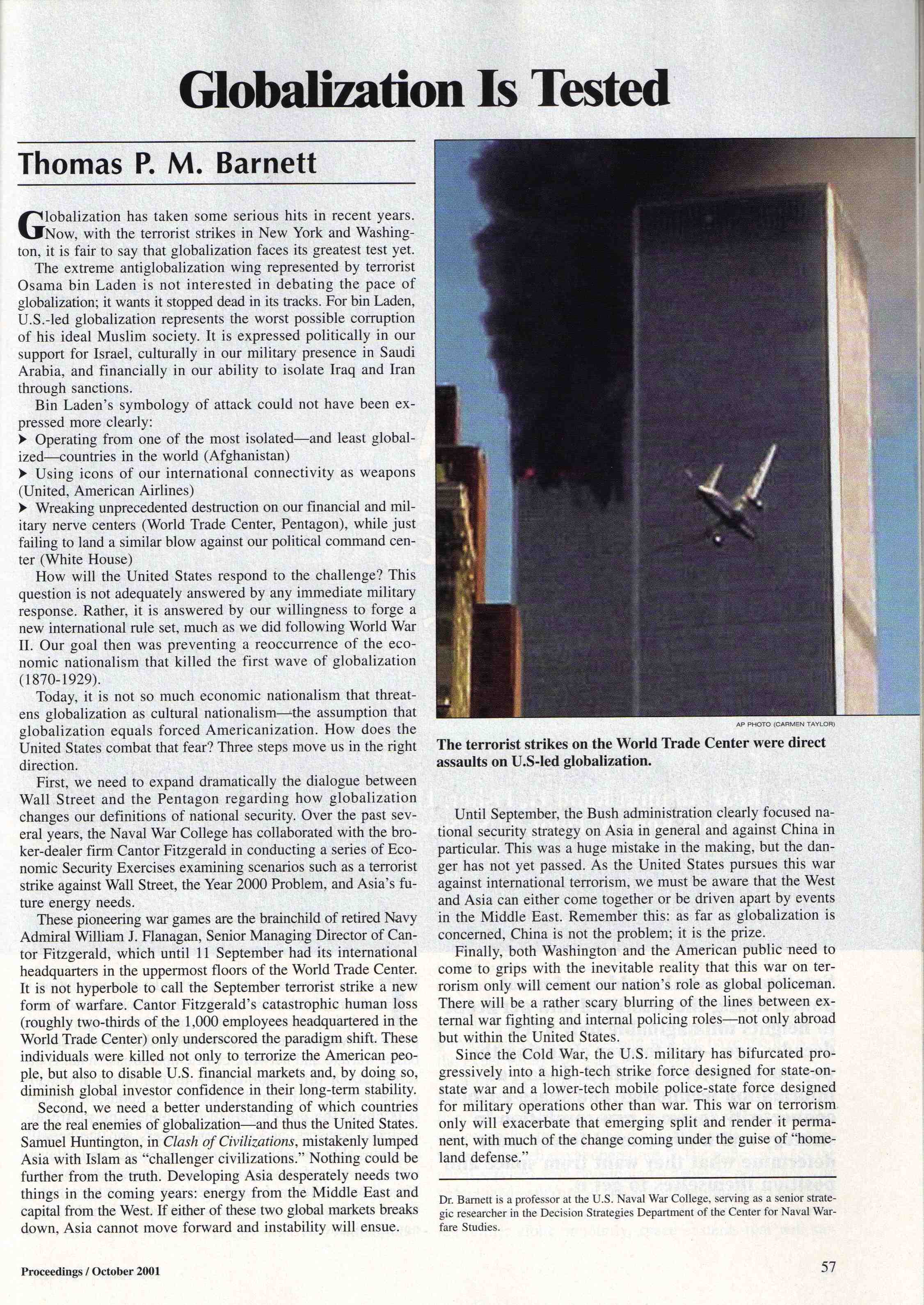
Blast from my past: "Globalization is Tested" (2001)

"Globalization is Tested"


by


Thomas P.M. Barnett


COPYRIGHT: The U.S. Naval Institute, 2001 (October issue, p. 57); reprinted with permission

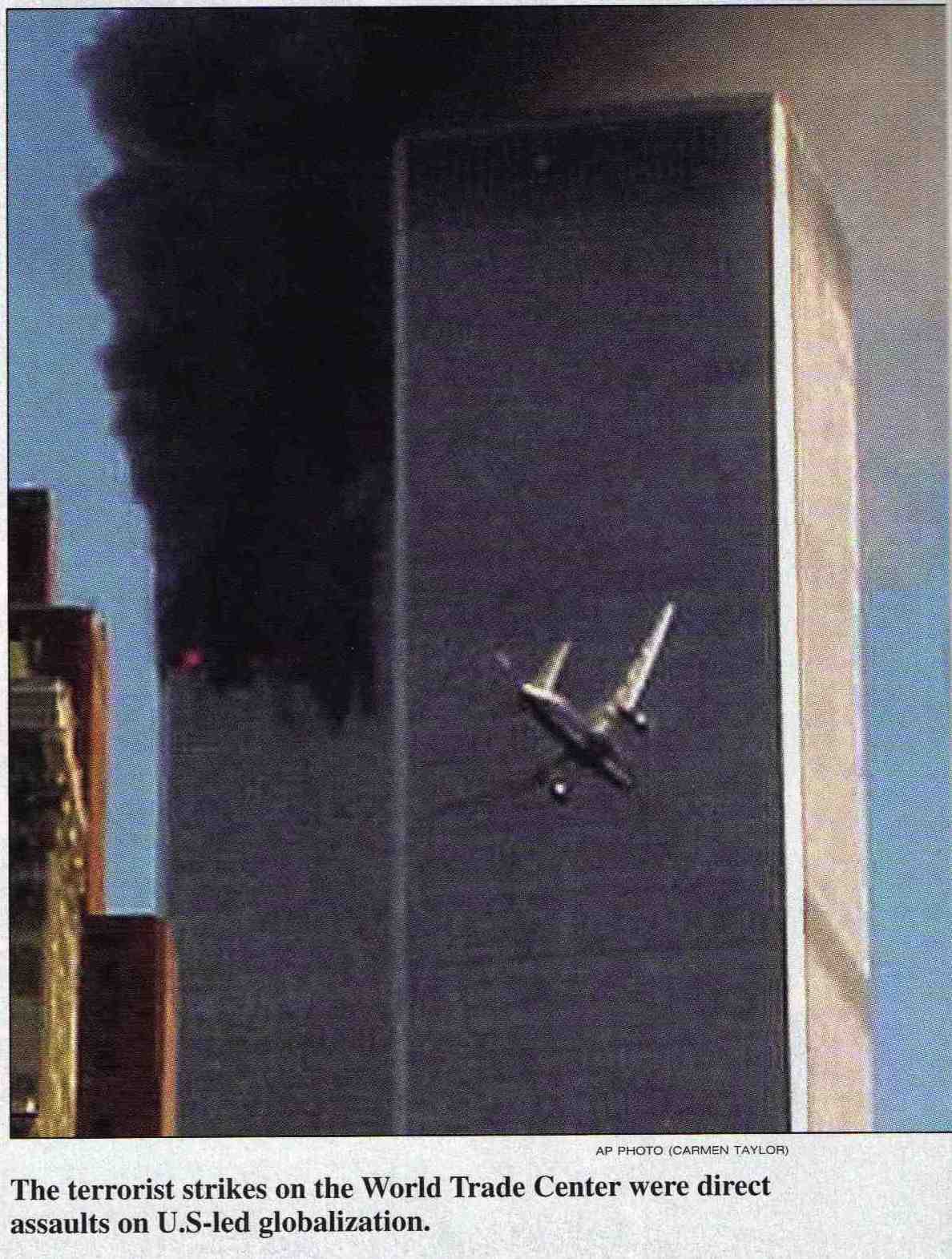
Globalization has taken some serious hits in recent years.  Now, with the terrorist strikes in New York and Washington, it is fair to say that globalization faces its greatest test yet.

The extreme antiglobalization wing represented by terrorist Osama bin Laden is not interested in debating the pace of globalization; it wants it stopped dead in its tracks.  For bin Laden, U.S.-led globalization represents the worst possible corruption of his ideal Muslim society.  It is expressed politically in our support for Israel, culturally in our military presence in Saudi Arabia, and financially in our ability to isolate Iraq and Iran through sanctions.

Bin Laden's symbology of attack could not have been expressed more clearly:

  • Operating from one of the most isolated--and least globalized--countries in the world (Afghanistan)
  • Using icons of our international connectivity as weapons (United, American Airlines)
  • Wreaking unprecedented destruction on our financial and military nerve centers (World Trade Center, Pentagon), while just failing to land a similar blow against our political command center (White House).

How will the United States respond to the challenge?  This question is not adequately answered by any immediate military response.  Rather, it is answered by our willingness to forge a new international rule set, much as we did following World War II. Our goal then was preventing a reoccurrence of the economic nationalism that killed the first wave of globalization (1870-1929).

Today, it is not so much economic nationalism that threatens globalization as cultural nationalism--the assumption that globalization equal forced Americanization.  How does the United States combat that fear? Three steps move us in the right direction.

First, we need to expand dramatically the dialogue between Wall Street and the Pentagon regarding how globalization changes our definitions of national security. Over the past several years, the Naval War College has collaborated with the broker-dealer firm Cantor Fitzgerald in conducting a series of Economic Security Exercises examining scenarios such as a terrorist strike against Wall Street, the Year 2000 Problem, and Asia's future energy needs.

These pioneering wargames are the brainchild of retired Navy Admiral William J. Flanagan, Senior Managing Director of Cantor Fitzgerald, which until 11 September had its international headquarters in the uppermost floors of the World Trade Center. It is not hyperbole to call the September terrorist strike a new form of warfare.  Cantor Fitzgerald's catastrophic human loss (roughly two-thirds of the 1,000 employees headquartered in the World Trade Center) only underscored the paradigm shift.  These individuals were killed not only to terrorize the American people, but also to disable U.S. financial markets and, by doing so, diminish global investor confidence in their long-term stability.

Second, we need a better understanding of which countries are the real enemies of globalization--and thus the United States. Samuel Huntington, in Clash of Civilizations, mistakenly lumped Asia with Islam as "challenger civilizations." Nothing could be further from the truth.  Developing Asia desperately needs two things in the coming years: energy from the Middle East and capital from the West. If either of these two global markets breaks down, Asia cannot move forward and instability will ensue.

Until September, the Bush administration clearly focused national security strategy on Asia in general and China in particular. This was a huge mistake in the making, but the danger has not yet passed. As the United States pursues this war against international terrorism, we must be aware that the West and Asia can either come together or be driven apart by events in the Middle East. Remember this: as far as globalization is concerned, China is not the problem; it is the prize.

Finally, both Washington and the American public need to come to grips with the inevitable reality that this war on terrorism only will cement our nation's role as global policeman.  There will be a rather scary blurring of the lines between external war fighting and internal policing roles--not only abroad but within the United States.

Since the Cold War, the U.S. military has bifurcated progressively into a high-tech strike force designed for state-on-state war and a lower-tech mobile police-state forces designed for military operations other than war. This war on terrorism only will exacerbate that emerging split and render it permanent, with much of the change coming under the guise of "homeland defense."


Dr. Barnett is a professor at the U.S. Naval War College, serving as a senior strategic researcher in the Decision Strategies Department of the Center for Naval Warfare Studies.

12:01AM

Blast from my past: "India's 12 Steps to a World-Class Navy" (2001)

India's 12 Steps to a World-Class Navy

by Thomas P.M. Barnett


The International Fleet Reviews in February showed off its impressive fleet; now the Indian Navy must determine how it wants to use it.


COPYRIGHT: The U.S. Naval Institute, 2001 (July issue, pp. 41-45); reprinted with permission


In February of this year ...  โ€จI had the pleasure of attending the Indian Navy’s first-ever International Fleet Review in Mumbai, where I made a presentation to a symposium audience of 16 chiefs of naval staff and dozens of flag officers from an additional 13 navies. This fleet review, which went by the motto “Bridges of Friendship,” essentially was the Indian Navy’s “coming out” party after many years of building up and modernizing its force structure, mostly through foreign purchases.

You may ask, “Coming out for what?” Frankly, that was the real theme of the high-powered symposium, as well as of numerous discussions I had with Indian flag officers, both active and retired. In many ways, this grand celebration was the swan song for a generation of Indian admirals who propelled this once humble coastal force to its current heights as the world’s fourth-largest navy. Not only do they want the international community to take note and show some respect, but they also are looking for some clear sense of where their Navy fits in this messy post-Cold War security environment.

Future Pathways of the Indian Navy

It is fair to say that every Indian admiral I spoke with represented his own school of thought, but I sensed two broad strategic factions, which I dub the Soviet School and the British School. This division recalls not only the perceived operational disparity between the Eastern and Western fleets (the former long considered the “Russian half” of the Indian Navy; the latter the “British half”) but also the difference between a land-oriented great power’s strategic employment of naval force and that of a sea-oriented one. Not surprisingly, most of the British School admirals I met had studied at the U.S. Naval War College. Conversely, I could discuss my love for Russian poetry—in the original—with those of the Soviet School.

I further subdivide each school into two wings: those admirals who believe the Indian Ocean “belongs” to the Indian Navy (and not to any “meddlesome outsiders,” including the U.S. Navy) and those who believe the Indian Navy “belongs” to something larger—typically, the collective good of global maritime security.

Putting those two axes together, I see four future pathways for the Indian Navy:

  • Minimum-Deterrent Navy (Soviet School/regional focus). This is the weakest long-term outcome because it relegates the Navy to an adjunct to the Army and Air Force in India’s continuing nuclear arms race with Pakistan. This tendency most recently is demonstrated in New Delhi’s declaration to remain “equal” to any Pakistani move to put nuclear missiles on its submarines.[1]  Recalling the Soviet Navy’s bastion strategy, this is a go-nowhere, do-little navy.
  • Sea-Denial Navy (Soviet School/global ambition). This is an anti-China navy that seeks to export an antiaccess strategy to the South China Sea. Like the old Soviet fleet, it focuses on antiship capabilities with an emphasis on attack submarines. In its most aggressive form, it might be construed by some as an anti-U.S. navy in terms of its modest capacity for power projection toward the Persian Gulf. During the fleet review’s grand finale, Indian naval commandos demonstrated their quick-strike skills by planting explosive charges on three mock oil rigs in Mumbai’s Back Bay. They demolished the platforms to the delight of the huge crowds lining the shore, providing the VIP audience of foreign admirals a none too subtle reminder of where India resides, namely, right along the sea route that carries the majority of the world’s energy traffic from the Middle East to developing Asia.
  • Sea Lines of Communication–Stability Navy (British School/regional focus). This is the polar opposite of the sea-denial navy, for it takes as its prime task the preservation of the Indian Ocean as a safe transit for global commerce. This Indian Navy seeks to supplant the U.S. Navy as the region’s sea-based Leviathan, not so much because it wants the United States out, but because India believes this is an appropriate regional security role for it to fill as its economy emerges. Another way to describe this navy is the “Mini-Me Navy,” or the Indian Navy’s regionalized version of the U.S. Navy—same rough spread of capabilities, just one-eighth the size.
  • International Coalition Navy (British school/global ambition). This is the most ambitious navy, for it assumes two key developments: (1) a lessening of the land-based rivalries with Pakistan and China; and (2) a far bigger share of the Indian defense budget going to the navy, which now receives around 15%. In a practical sense, this is a “niche navy,” or India’s version of the current Royal Navy: a pro-international norms force that can deploy with some genuine reach when combined with the U.S. Navy in a multinational naval coalition. On the face of it, some nations might instinctively fear an Indian Navy of such capability, but such a long-term development would signal a secure and confident New Delhi looking to do its part for global security maintenance. As a rule, dangerous powers field large armies and air forces, not large navies.

Which navy India will end up with is anyone’s guess. Based on everything I heard in Mumbai, strong rationales exist within the Indian Navy for each outcome. But clearly, for India to achieve a world-class navy, its leaders have to move beyond viewing the fleet as a supplemental tool in New Delhi’s long-standing rivalries with its neighbors, toward an expansive security vision that takes into account the nation’s global economic status as an emerging information-technology superpower.

A 12-Step Program for the Indian Navy

India’s naval development has progressed to where its leaders need to elevate their vision beyond what the force can provide the country in terms of security to the larger issue of what it can provide the world in terms of stability. I see this as a 12-step program, borrowing liberally from the self-help literature so popular in the United States today. In effect, the senior officers of the Indian Navy need to:

1. Admit they are powerless over the Army and Air Force in determining national security priorities. Over the years India’s best and brightest did not join the Navy; there were a lot more opportunities to launch glorious military careers in the north against either the Pakistanis or the Chinese. But even if the ground pounders rule the military roost, their definition of national security is mostly internalized (what happens here), whereas the naval definition should be almost exclusively externalized (what happens over there). By my scoring, India is not a legitimate great power until it generates a surplus of external security—beyond what it needs to protect the country from outside attack. Once achieved, either New Delhi markets that surplus externally as a collective good or it ends up scaring the hell out of the neighbors. So let the Army and Air Force set India’s national security priorities, but the Navy needs to establish India’s international security priorities because only the Navy can make that sale.

2. Believe that a greater power—globalization—can elevate their force to strategic vision.  As one Indian commander complained, “We are strategic suckers!” What passes for grand strategy in the Indian military is nothing more than “J & K tactics”—India’s long-simmering, high-altitude version of trench/guerrilla warfare with Pakistan over the disputed Jammu and Kashmir region. Nuclearizing the fleet on Karachi’s say-so might seem the prudent tit for tat, but it hardly constitutes a strategic naval vision when the leaders in your industry have long since turned in their tactical nukes and loaded up on precision-guided missiles. Globalization is splintering the concept of national security, generating new markets for both supranational and subnational security, two venues in which naval forces offer unique response attributes. Through its information technology sector, India is becoming a major player in the process of globalization, sporting more millionaires than any country in the world.[2] At some point, it will be asked to give something back, and a visionary internationalist navy will answer the mail nicely—so long as it is good for something other than humping lots of nukes around territorial waters.

3. Make a decision to turn their Navy’s operational focus toward influencing events ashore.  I was both gratified and amazed to hear so many Indian admirals refer to the 1992 white paper, “. . . From the Sea” as a great turning point in naval strategy—gratified because I had a small role in shaping that document, amazed because I always had assumed the Indians looked more to Gorshkov than Mahan. Granted, there was some waxing nostalgic about the “spectacular Soviet Navy,” and more than a few Indian admirals revealed bitterness about Washington’s efforts to “demonize” the Indian Navy because of its old Soviet (and now Russian) ties. But by and large the flags revealed a real admiration for the U.S. Navy’s effort to shift from a blue-water to a littoral focus. Actually, it was almost an envy, simply because the U.S. Navy seems to know what it wants to do once it gains access to “events ashore,” and the Indians have not really made that cognitive leap. They know they want the capability; they just are not sure yet how they would use it. Again, this is because the Indian military acts as though security is something they import, like so many Russian subs, not something they export to the world.

4. Make a searching and fearless inventory of their lack of involvement in recent international coalitions.  In his impressive symposium presentation, retired Indian Navy Rear Admiral K. Raja Menon noted how the Indian Navy has avoided numerous opportunities over the past generation to join multinational maritime coalitions in response to significant regional instabilities (e.g., tanker wars, Iran-Iraq war, Persian Gulf War), even though the Indian Army has long played a significant peacekeeping role in U.N. operations. In short, he argued, the Indian Navy for far too long has pursued an excessively narrow interpretation of the role of navies in regional and international security. As he wryly stated, regional power is a lot like sex appeal: no matter how often India admires itself in the mirror, it isn’t a regional power until outside powers recognize it as such. Or as I would put it, India seems less the regional power precisely because it does not employ its navy in the manner of a sea-based great power. A small power may have regional interests, but only a great power has regional responsibilities.

5. Admit their mistakes in force structure planning.  Despite the scrappy genius of their plug-and-play approach to purchases of foreign platforms and systems, the Indians have not made much of a transition to a post-Cold War naval environment. As some younger officers complained, the Indian Navy still remains far more suited to the sort of open-sea ship battles associated with World War II than to the littoral-focused strategies of network-centric warfare. In a nutshell, the Indian Navy remains an antiship missile in a cruise missile world. It talks a good game on influencing events ashore, but it continues to buy for sea denial. But maybe that is an inevitable outcome from purchasing the bulk of your naval platforms from the world’s great land power.

6. Understand they are a relatively young navy, with the shortcomings that come from a lack of international experience.  I was struck by how many retired Indian flags kept referring to their navy as young, or even adolescent. Despite a naval tradition going back to antiquity, Indian admirals will tell you that their beloved institution still has a lot of growing up to do. In their minds, it takes a century to mature a navy, so February’s grand celebration marked just the rough halfway point to what they dream the Indian Navy is capable of becoming. I could not help but imagine the Indian Navy as a young man who, having been abandoned in his infancy by his father (Royal Navy), was forced to spend his youth with his eccentric aunt (Soviet Navy) but now wants to break out and see the world for himself—or perhaps with his rich, world-wise uncle (U.S. Navy). And if that makes it sound like the Indian Navy has a complex, conflicted, almost love-hate relationship with all three navies, then it is an apt metaphor.

7. Expand their nation’s security paradigm beyond the “sacred soil syndrome.”  This is another golden nugget from Admiral Menon, who describes this “cult of the land forces” as stemming from past wars with China (1962) and Pakistan (1965, 1971). Strangely enough, it is possible to argue that no other state in the world should care either more or less than India about the sanctity of its borders. On one hand, no nation has lost more land since World War II (e.g., Pakistan, Bangladesh). On the other hand, no economy today better demonstrates the “death of distance” associated with information technology—India produces roughly half of the world’s software, literally phoning it in to the rest of the global economy. In New York Times columnist Thomas Friedman’s lexicon, India is at once a leading “lexus” economy (i.e., high-technology producer) and a classic “olive tree” society (i.e., still fighting over seemingly meaningless bits of land).[3] Granted, the sacred soil syndrome is not going to disappear anytime soon, but some strategic balance is needed. And in the military world, such vision can come only from the naval service.

8. Improve their relationships with all small littoral neighbors.  In many ways the Indian Navy would like to supplant the U.S. Navy as the Indian Ocean’s naval, networking Leviathan—the trusted big brother everyone can turn to in moments of trouble. In some ways, this will never happen. By definition, any region’s smaller powers want and need a distant friend who can stand up to the neighborhood bully, and for many small littoral states, India comes closest to fitting that pejorative title. From India’s perspective, they’re damned if they do and damned if they don’t: if they try to act the part of regional hegemon, they will only scare smaller powers into closer reliance on U.S. naval power, and yet in the absence of any productive input, India has a hard time demonstrating to its neighbors that it can play a useful, leading role in enabling regional security. In sum, India possesses too large a navy not to play a bigger stabilizing role in the Indian Ocean—especially as the waterway’s role in world energy transfers increases—but it needs to build relationships of trust with its smaller neighbors slowly over time.

9. Make some amends to regional rivals.  The obvious candidates here are Pakistan and China, neither of which made it to the fleet review, and that’s too bad. Pakistan was not invited, and China refused to come because its ally was excluded. India can build all the “bridges of friendship” it wants across Asia, but so long as those two countries remain quasi enemies or at least heated rivals, it is hard to see India achieving the sort of progressive, stability-enhancing regional role it desires for its growing navy. And again, that’s too bad, for no ocean is in need of strategic stability more than the Indian Ocean, which is arguably the most nuclearized of the seven seas.[4]

10. Make an inventory of the global maritime insecurities they need to play a more prominent role in reducing.  The Indians are fond of pointing out that not only do they sit astride the two most important commercial straits in the world (Hormuz and Malacca), but they also are situated smack dab between two of the most important narcotic centers—the Golden Crescent to the West and the Golden Triangle to the East. Toss in the fact that modern high-seas piracy is especially concentrated in the Indian Ocean and South China Sea, plus all the overlapping sovereignty claims in both, and you have a sizeable security agenda for any would-be regional naval power. And when you get all those houses in order, get ready to tackle environmental damage, rising ocean levels, and altered weather patterns. In sum, India’s growing naval power could be put to good use across a very broad range of regional collective security needs.

11. Seek an expanded navy-to-navy relationship with the world’s sole military superpower.  U.S. naval presence in the Indian Ocean littoral isn’t going away any time soon. There are simply too many states there that want the collective good the U.S. Navy is selling, and it is a trusted brand with a long, solid reputation. If you look at U.S. naval crisis response over the past quarter-century, it is apparent that this area is the Department of Navy’s operational center of gravity. As former Indian foreign secretary J. N. Dixit commented about increased U.S. naval presence in southwest Asia following the Persian Gulf War: “These are the facts of life.” India becomes a genuine naval regional power only in conjunction with the U.S. Navy—not in opposition to it, or even as a marketed alternative. The U.S. Navy is the Microsoft of world navies; it simply sets too many operational standards and protocols to be ignored.

12. Having achieved this awakening from the strategic isolation of the Cold War, carry their new message of internationalism to the world.  This year’s International Fleet Review was a great start. The Indian naval leadership brought me to this star-studded gathering to—as one retired vice admiral put it—“say something about the future to the junior officers in the back of the hall.” But they also brought me to Mumbai, just as they brought all those foreign flag officers, to impress upon me a sense of all they have accomplished in building this navy over the past five decades, and what they hope to do with it in the future. And I did go away impressed, not only with the Indian Navy, but also with the incredible diversity, vibrancy, and ambition that is today’s India.

Why India Matters

As noted diplomat Sashi Tharoor argues, India is probably “the most important country for the future of the world.”[5]  If globalization succeeds in the United States or the European Union, no one will be too surprised. After all, globalization demands less change of these countries than it does of the world around them. And if globalization fails in China or Russia, many likewise will be unsurprised, for it requires much change from both societies—perhaps too much too quickly.

But whether globalization succeeds in India should interest just about everyone around the world. For if globalization can succeed in a democratic society where half the population is illiterate and terribly impoverished, then it can succeed just about anywhere. Conversely, if it can’t succeed in a free-market economy that features the world’s largest pool of information technology workers, then there is little hope for much of the world’s population.

Not too long ago Secretary of Defense Donald Rumsfeld characterized India as a country that is “threatening other people, including the U.S., Western Europe and countries in West Asia.”[6]  In my dealings with Wall Street as part of a Naval War College project on globalization, I have spoken with a number of financial executives about India and its role in the global economy, and naturally I have found quite a different appreciation there.[7] In fact, besides China, there is no country in the world about which there is such a huge gap between how the U.S. security establishment and the U.S. financial establishment view—respectively—the security “threat” and the economic “opportunity.”

India suffers some profound military insecurities—the sort that often derail a society’s best attempts to open itself to the outside world. The Indian Navy is the country’s best near- and long-term instrument for positively asserting itself as a force for both regional and global stability. The Bush administration needs to think seriously about what sort of security relationship it wants with India in the coming years.  Deputy Secretary of State Richard Armitage’s May trip to New Dehli was a huge step in the right direction, signalling an easing of the restrictions on military contacts imposed by the Clinton Administration following India nuclear weapons tests in 1998.  Let’s hope it jump starts a far broader menu of strategic cooperation.


[1] As India’s Defense Ministry spokesman P.K. Bandopadhyay declared, “We are also fully prepared for the deployment of nuclear missiles by them.” See The Associated Press, “Pakistan Planning Fleet With Nuclear Weapons: India Vows to Match Submarine Deployment,” International Herald Tribune, 23 February 2001, p. 1.

[2]  Good estimates vary from 15 to 20 million millionaires. India is estimated to possess a middle class of about 200 million.

[3]  See Friedman’s The Lexus And The Olive Tree: Understanding Globalization (New York: Farrar Strauss Giroux, 1999).

[4]  Among the nuclear powers whose navies ply this ocean are the United States, United Kingdom, France, Russia, China, India, Pakistan, and Israel.

[5]  Sashi Tharoor, India: From Midnight to the Millennium (New York: Harper, 1998 paperback), p. 3. Tharoor actually quotes British historian E. P. Thompson with this phrase.

[6] This quote was run on the front page of The Times of India during the fleet review. See Siddharth Varadarajan, “Stop supply of N-fuel to India, U.S. tells Russia,” The Sunday Times, 18 February 2001, p. 1.

[7] To learn more about the Naval War College’s NewRuleSets.Project and to access its reports, visit us online at <www.nwc.navy.mil/newrulesets>.

Dr. Barnett is a former professor at the U.S. Naval War College, and served as a senior strategic researcher in the Decision Strategies Department of the Center for Naval Warfare Studies. He thanks Professor Bradd Hayes, Professor Hank Kamradt, Rear Admiral Michael McDevitt, USN (ret.), and Dr. Lawrence Modisett for their input to, and feedback on, this article.

12:01AM

Blast from my past: "Top Ten Post-Cold War Myths" (2001)

Top Ten Post-Cold War Myths

by

Thomas P.M. Barnett and Henry H. Gaffney Jr.


As a mobile, sea-based containment force, โ€จthe U.S. Navy will continue to play an โ€จimportant role in the nation's foreign policy, โ€จbut its missions will mirror the clustered responses โ€จin Iraq and Yugoslavia, not the โ€จobsolete two-major-theater-war standard.


COPYRIGHT: The U.S. Naval Institute, 2001 (February issue, pp. 32-38); reprinted with permission


As we begin . . . โ€จa new presidential administration, it is time to look over the recent past to see what we have learned about this new era of globalization.  Americans entered the Clinton administration with a lot of hope about an outside world where so many positives had emerged with the end of the Cold War.  The United States was the sole military superpower; what could go wrong?

Depending on whom you listen to, either a lot or not too much.  Those experts who focus on the global economy see plenty to celebrate, but most who track international security see lots of threatening chaos in the world.  How can these views be so different?  Are there no connections between global economics and security? How can the former flourish if the latter is deteriorating? 

We’ll say it up front: we don’t think international security has worsened over the past eight years.  Instead, we think too many political-military analysts—in an attempt to justify the retention of Cold War forces—have let their vision be clouded by a plethora of post-Cold War myths, the biggest of which is the two-major-theater-war (2-MTW) standard.  It was the best strategy placeholder then-Secretary of Defense Les Aspin could come up with to put a floor on force structure, but 2-MTW doesn’t capture the reality of the globalization era, the migration of conflict to the failing states outside that globalization, and the continued technological advances U.S. forces are introducing, which no other country pursues.  In short, it is not connected to the world at all.

In our decades-long hair-trigger standoff with the Soviets, U.S. strategists became addicted to “vertical” scenarios, meaning surprise situations that unfold with lightning speed in a specific strategic environment that is, by and large, static.  By static, we mean all potential participants are expected to come as they are.  No one is really changed by the scenario, and no evolution is possible in their response.  In this poker game, we expected everyone to play the single hand in question straight up: no bluffing, no hedging, and no changes of heart.  In essence, we had to assume the two main players were rational actors.  The only thing that seemed to change in this static picture was the race to add better technology.  We always feared the Soviets had gotten there first, or were about to—a fear we subsequently transferred to the rogues.

This approach made sense in the Cold War, when we had to make certain gross assumptions about how both Soviet Bloc forces and our NATO allies would behave at the outbreak of World War III, but it just does not apply in the globalization era.  If the last eight years have taught us anything, it is that political-military scenarios in the post-Cold War era will unfold “horizontally.”   Situations will evolve over time with few clear-cut turning points, typically lapsing into a cyclical pattern that nonetheless features dramatic differences with each go-around.  Think of our dealings with Saddam Hussein and Slobodan Milosevic and you’ll get the picture

In horizontal scenarios, everything—and everyone—is free to evolve over time, meaning positions change, allies come and go, and definitions of the “real situation” abound.  In this strategic environment, sizing and preparing one’s forces according to vertical scenarios isn’t just inappropriate; it is dangerous.  It fosters a confidence in packaged solutions employing packaged forces armed with packaged assumptions—the 2-MTW standard in a nutshell—so that anything else you do with the forces reduces your readiness for those 2 MTWs.

Both the 2-MTW standard and the high-tech wannabes, with their nostalgia for "imminent" Soviet breakthroughs, suffer from slavish adherence to a collection of myths concerning the post-Cold War era.  If we are ever going to move beyond their vertical scenarios to a better understanding of where the military fits in the globalization era, these myths must be punctured and discarded.  Our top ten list of myths is:

10. There are far more conflicts and crises in the world after the Cold War! The number inflation on this one is unreal: suddenly every terrorist shoot-out and ten-person liberation movement is a “low intensity conflict.” When we count the significant conflicts and crises of the 1990s and compare them to those of the 1980s, however, we don’t find the stunning increase some analysts do.  In the 1980s, we see one system-threatening conflict (the Iran-Iraq War), and in the 1990s we see two (Desert Storm, the Congo War—the latter a stretch).  In the 1980s, we count 6 significant state-based conflicts and 24 internal conflicts, compared to 7 and 28, respectively, in the 1990s.[1]  In sum, we’re looking at an overall increase of 6 cases, or fewer than one a year.  Worth worrying about?  Yes, since internal warfare these days involves failing states and generates lots of refugees.  But a new world disorder?  Hardly.

What political-military analysts should recognize in globalization is a remaking of the international economic order that rewards the most fit and devastates the least ready—in the same society.  In advanced countries, the resulting conflict will be mostly political, but in some developing societies, these horizontal tensions will turn bloody in scattered instances. If you’re looking for a defining conflict, check out Indonesia’s disintegration following the Asian economic crisis.

9. The Soviet Bloc's collapse unleashed chaos!

The myth is that, with the stabilizing hand of the Soviets removed, conflicts have bloomed across the globe. This issue needs to be divided into its constituent parts: Soviet support to the Third World, Eastern Europe, and the former Soviet republics.  In every instance the balance of the news is positive.

Looking at the old Third World, we view the collapse of Soviet assistance as an absolute good.  Central America is certainly quieter for its absence, as is southern Africa as a whole, though Angola still burns.  In the Middle East, Yemen is reunified, Qaddafi has stopped playing the Arab bad boy (for now), and the PLO lost Moscow's support. Granted, Soviet arms beneficiary Iraq reached a use-it-or-lose-it moment in 1990, and went for broke, but the same cannot be said for Syria.  Afghanistan still stinks as a place to live, and Vietnam still goes its own way, but in sum, it's a pretty good deal for global order.

Some people insist on calling Eastern Europe a security vacuum, but the balance is very positive, with the obvious exception of the former Yugoslavia.  But if Gorbachev had come to us 15 years ago and said he could arrange for the collapse of the Warsaw Pact, the peaceful reunification of Germany, and the absorption of several former satellite states into NATO, but the cost would be a bloody civil war in Yugoslavia . . . well, you get the idea.  Moreover, Balkan experts will tell you that Yugoslavia's demise had nothing to do with the fall of the Soviets.  It was a disaster waiting to happen once Tito passed away.

Finally, when looking at the former Soviet republics, we are sobered by events in Chechnya, the rest of the Caucasus, and Tajikistan, but still view the overall evolution as far more conflict free than anyone could have expected. Remember when we feared Russian invasions of the Baltic republics?  Or Ukraine’s imminent Anschluss with Moscow?  Or a wave of radical Islamic fundamentalism sweeping the “Stans?"  (Okay, we are still watching that one.)    Best yet, whatever violence has occurred here has been left to the Russians to figure out—unlike the Balkans.

8. We are swamped with failed states! 

“Failed states” is another label that’s bandied about far too loosely. Reading some reports, you’d think they were spreading like wildfire across the planet.  But there always have been failed states; we just never called them that.  Instead, we used to call the Somozas and Siad Barrés “valued friend” and “trusted ally,” even as we helped to prop up their flimsy dictatorships.  The Russians had a fancier phrase, “countries of socialist orientation,” but that was just Sovietese for flimsy communist dictatorships.

 What defines a failed state in the globalization era is its failure to attract foreign investment.  When none appears, or the leaderships steals it, the same feeble government that somehow muddled through the Cold War with superpower (or French) help now simply collapses.  In the early 1990s, when the United States led what became U.N.-sanctioned interventions into Somalia and Haiti, there was optimistic talk of a new model—namely, the United Nations serving as midwife to these tortured societies’ slippery transition to stable economies and government.  But the ill-supported United Nations proved a poor substitute for a superpower propping up a government with arms and military training.

Of the 36 countries in which internal conflicts occurred across the 1990s, the United States decided—after much angst—to intervene in only four: Somalia, Haiti, Bosnia, and Kosovo.  So why did the decade seem so chock-full of U.S. interventions?   Those four situations accounted for about half of all naval responses overseas and the bulk of the ship days involved in such operations.[2]  To put it bluntly, advanced countries can safely ignore failed states (except maybe Indonesia), until “those damned Seattle people,” with their silly “values,” embarrass them.

7. Transnational actors are taking over the world! 

This bugaboo must also be disaggregated to make sense of it.  Starting with terrorists, the hype ignores historical data.  According to the State Department’s annual report on terrorism, the phenomenon peaked in the second half of the 1980s, when it averaged 630 international attacks a year.  Then the Soviet Bloc’s support system disappeared and so did much of the terrorism.  Since 1989 terrorists have averaged 382 attacks per year—a 40% drop.[3]

Drug cartels and Mafia syndicates do not seek to disrupt global economic or political stability, but merely to generate profits. In effect, they desire macrostability within and among nation-states in order to create and exploit microinstabilities—i.e., illegal markets. These criminals are not interested in destabilizing or capturing political institutions, but in influencing them for their own ends. Granted, Colombia represents an odd turn, as the Marxist guerrillas there are now dependent on drug proceeds.  But in general, the drug kingpins prefer to stay out of politics.

The same could be said for illegal aliens, who are looking for economic opportunity. Too rapid a migration can destabilize, but immigration is far from out of control in developed countries: seven out of eight immigrants now settled there arrived legally.[4]  As for refugees displaced by conflicts, they are by-products of local chaos, and their "transnational" effects largely are limited to the next country over.

Finally, you have to wonder about the tendency of some national security strategists to lump transnational corporations (TNCs) in with this motley crew.  TNCs not only represent the future of the global economy, they also account for the bulk of our 401ks.  Anyway, it is a myth that TNCs act with indifference to their birth nations: every one has a home base, and almost all members of their boards come from that home.  But the big point to remember is that TNCs invest overwhelmingly in countries where there is firm rule of law.

6. Technology proliferation is out of control! 

This myth is sold in two sizes: rogue states and asymmetrical warriors.  The funny thing is, in both instances, everyone usually ends up talking about the same sorry list of old Soviet-client survivors.

With the rogues, the biggest concern is that they are either buying or selling nuclear and missile technology.  We also worry about them developing chemical and biological weapons, but that is not really high-tech anymore (nor have they made any of it work).  Then again, their missiles aren’t state of the art either, as everything passed around this gang tends to use old Soviet technology.   

Now, many of the “new security” types will try to sell you on the notion that missile proliferation is rampant among unspecified “potential adversaries” (their fear mongering would dissolve if they had to say who), but they’re really stretching here.  Over the past decade more countries have just said no than yes

Again, it is the four rogues who are proliferating (Libya, Iraq, Iran, and North Korea), and none is really doing very well at it.  This quartet lives off of three suppliers who are in it for the bucks—Russia, China, and North Korea.  U.S. diplomats are all over the three suppliers to join the civilized world of functioning economies, leaving it to the Pentagon to keep the pressure on the rogues.  That does not sound like an out-of-control problem to us.

The “asymmetrical warriors” or “potential adversaries” are implied to exist in vast numbers, although few, if any, have ever been spotted in the wild.  Nonetheless, we are told that all they need nowadays is a credit card and Internet access and voila—almost any dangerous technology can be picked up on e-Bay!  This is the “silver bullet” concept taken to extremes: these warriors are presumed to deftly deny our access to conflicts by negating our high-tech advantage with their Radio Shack stuff.  Meanwhile, we spend on military research and development alone more than what the rogues spend on their entire militaries.

5. China is the new Soviet Union! 

China is not the Soviet Union.  It remains a communist-governed country and retains major elements of a command economy, it mostly decollectivized its agriculture two decades ago and now sports a massive private sector.  This mixed economy makes it unlikely that China will undertake anything like the single-minded military-industrial effort the Soviets made. Moreover, its defense technology is primitive and there are no signs it is embarking on anything like the Soviets’ high-level, concentrated scientific efforts.

China never presumed to offer an alternative world system and has no satellites, although it wants Taiwan back.  Other than that myopic focus, it is fair to say that its relations with other Asian states are still evolving.  China doesn’t aspire to conquer its neighbors and doesn’t pretend to spread communism, but it still worries about Western nations encroaching from the sea, as they did in the 19th century.

We kid ourselves when we cast China as this century’s Soviet menace.  China desperately needs our direct investment for its skyrocketing energy requirements and our market for its low-tech exports.  

4. Speed is everything in crisis response!

This concept is ingrained in our psyche because of our Cold War fears and the experience of Desert Shield. We have become addicted to speed of response because we are a reactive nation and have a long way to travel to any conflict.  But here is where the world’s sole military superpower may be underestimating its power. 

First, as the world’s Leviathan, what we bring to the table is not so much speed as the inevitability of our punishing power.  The speed demons will counter that we have to rush in precisely because our foe will deny us the access we need to bring all that power to bear.  This is an argument that strings a lot of little fears together into one big phobia:

  • The Air Force fears we will be denied access to bases by cowed allies—an improbable scenario if we’re coming to defend them.
  • The Marines fear we will have no choice but to perform forcible-entry amphibious landings because we don’t have any allies at all—cowering or not (tell that to the South Koreans).
  • The Navy fears it won’t be able to operate in the close-in littoral in a timely manner and without losses, and will thus lose out to . . . the U.S. Air Force. 

Two underlying realities render this debate moot: First, we are living in an age of horizontal scenarios where nothing really comes out of the blue anymore. If we don’t see the crisis coming, it is because we choose not to pay attention.  Second, other than the unlikely cases involving extensive direct attacks on the United States, we are stuck with only surprise attacks by Iraq and North Korea (even China issued the required Notices to Mariners before testing missiles over Taiwanese waters in 1996). Sure, there could be other surprises, but none so system threatening.

Simply put, outside of Iraq or North Korea, administrations no longer have the writ to commit this country to large-scale violence without some sort of debate. The Cold War featured stand-offs with the Soviets (e.g., Berlin, Cuba) where the President was pretty much on his own, but those days—and that dire strategic environment—are long gone.

3. We cannot handle all these simultaneous crises!

At first glance, the Navy looks mighty busy across the 1990s, meaning three to five simultaneous naval responses across multiple theaters for much of the decade.  Look deeper and you see a different picture: lengthy strings of sequential operations clustered around just Iraq, Somalia, Haiti, and Yugoslavia.  Using traditional counting methods, these four situations account for roughly half of all naval responses in the decade.  Almost all the rest were noncombatant evacuations or responses to natural disasters, except for brief shows of force off Taiwan and Korea.

How we interpret the strategic environment determines how we prepare to meet its challenges, and clearly, these “response clusters” represent serious change.  During the Cold War we contained the Soviet Union along the entire breadth of Eurasia, concentrating our permanently stationed forces at such key points as the Fulda Gap and the Korean demilitarized zone.  Meanwhile, the U.S. Navy balanced the Soviet Navy in the Mediterranean, Gulf, and Western Pacific. But the bipolar age, with its unified containment strategy, yielded to a more scattered and shifting sort of containment in the 1990s.  In effect, we think the Somalia, Yugoslavia, Haiti and Iraq represent a new response category: drawn-out minicontainments designed to stabilize individuals regions.

2. We are doing more with less!

Just talking naval forces, ship numbers are down over the 1990s, while responses to situations—measured in the traditional manner—are up.  Behind all this numerology (e.g., a noncombatant evacuation operation counts as much as a Desert Storm), however, lurks a persistent myth: naval forces are therefore grossly underfunded and suffering serious operational strain.  Analysts pushing this argument are simply barking up the wrong tree.

Most of the stress on naval forces comes from the Persian Gulf and our near continuous operations there since 1979.  The Pacific, meanwhile, has been quiet—in terms of responses to situations—for the last quarter century.  Both the Mediterranean and the Caribbean were reasonably busy in the 1990s, but like the Gulf, the bulk of the activity involved one lengthy situation each (Yugoslavia and Haiti).  The numerologists see response totals as way up, but in reality the Navy spent the 1990s focused on just those four big situations. And it was not alone: Navy-only responses dropped from 74% in the 1970s to 35% in the 1990s, the rest being joint or combined.

Amazingly, despite being tied down in the Gulf and working the rest of the world with fewer ships, the U.S. Navy is breaking neither operational nor personnel tempo.  All of the responses are being conducted by regularly deploying ships (Desert Storm is the great exception). Ship schedules are definitely disrupted and some port calls missed.  Speed of advance for some transits has been accelerated, but turnaround ratios for carriers have lengthened.  In sum, we have not needed to deploy ships ahead of schedule, nor are we short a carrier when we really need one. 

In sum, the U.S. military is handling the current response load with dexterity, with the exception of high-demand/low-density assets (e.g., Navy EA-6Bs, Army civil affairs specialists).  But that particular problem only highlights the illogic of centering all our strategic planning on the abstraction known as the 2-MTW standard.

1. All we can plan for is complete uncertainty!

Trying to capture global change by looking at U.S. military history is like looking through the wrong end of a telescope: our interventions are but a thin slice of a much larger reality, most of which is wrapped up in globalization.  Moreover, the military deals mostly with the seamy underbelly of an otherwise pretty good world, which gives it a peculiar perspective.  The biggest global events of the past eight years were the explosive rise of the Internet and international financial flows, the Asian economic crisis, and last year’s Y2K drill, none of which involved the defense community in any significant way.  Instead, the military got stuck largely with watching the store on Iraq, Somalia, Haiti, and Yugoslavia—the losers of the world.

Some like to describe the 1990s as a time of chaos, identifying uncertainty as our new foe. Many take the Clinton administration to task for merely reacting to events and having no coherent foreign policy, as if that were different from previous administrations.  But anyone who lived through the tense and constant confrontations with the Soviet Union should be grateful for this sort of “uncertainty.” 

When we look over these years, we detect a clear routinization of what used to be legitimately described as crisis response, not some growth of uncertainty.  For the Navy, its presence in the Gulf has become routine. Its drug patrols has become routine.  Its presence in the Western Pacific is stabilizing as far as everyone but the Chinese are concerned, but this has practically nothing to do with “responses” since the end of the Vietnam War—thus it is routine.  Even last decade’s clustered responses in the eastern Mediterranean assumed a familiar routine, dragging on for years until Milosevic finally fell.  As for Africa, we have seen this nation and its leadership shy away, passing up lots of opportunities to intervene.

But was there any grand strategy that linked together all these choices? Not really.  And maybe that’s what irks us political-military strategists most: as this circus parade known as globalization winds it ways around the planet, the military is mostly left to clean up what the elephants of the advanced world would just as soon leave behind and forget.   As such, we think it is relatively easy to predict what the U.S. military will be called upon to do over the next ten years: several of these minicontainments plus the usual scattering of minor responses.   


Moving Naval Strategic Planning Beyond Mythology 

The world is not a more dangerous place after the Cold War.  Chaos, it turns out, is not as fungible as we once thought, and uncertainty, like all politics, is local.  But adjusting to this brave new world does not necessarily equate to a reduced role for the military in U.S. foreign policy, especially naval forces.  Rather, it means we now have a broader and more flexible basis on which to plan.  The new national military strategy clearly lies somewhere between our recent extremes—neither matching the Soviet Union nor policing the Soviet-less world.

Finding that middle ground means moving away from the abstractions embodied in the 2-MTW standard.  Simply put, we have gathered enough data points across the 1990s to plot out this decade’s navy, if not the navy after next:  

  • It is a naval force that lives in, and deals with, the present world, one that is always likely to afford the United States several opportunities for lengthy, minicontainment operations.  We will not address all of them, but pick and choose as we see fit, with the key determining factor being that situation’s potential disruption of the global economy.
  • This force is comfortable with uncertainty, because these response clusters will come and go, meaning multiple operational centers of gravity that shift with time.
  • This force plays an important, if largely background role in enabling globalization’s continued advance, especially in developing Asia, by embodying the closest thing the world has to a true Leviathan—the undeterrable, always familiar military giant.
  • This navy lacks any real peers and hence can confidently plan for the future, which means staying just enough ahead on technology to discourage the rest of the world from trying to keep up.
  • Above all, this naval service should take good care of its ships, aircraft and people, without using them up and exhausting itself.  Outside the Persian Gulf, the world does not need it that much, and when it does, we will have warning time.      

The Navy has moved far enough beyond the Cold War to understand its “new” role in international stability.  If it seems familiar, it is because the base of our operations has remained essentially unchanged, even as the superstructure of the Cold War’s bipolarity came and went.  The U.S. Navy works the watery seam that both divides and links the planet’s northern and southern economic zones.  As these huge civilizations and individual societies bump against one another in the tectonic inevitability that is economic globalization, U.S. naval forces will play an important stabilizing role within this country’s overall foreign policy—that of a mobile, sea-based containment force. 

Response clusters such as Iraq and Yugoslavia will remain a stubborn facet of the future international security environment, representing the essence of the naval forces’ mission.  As such, it is time to end our dependency on abstract planning measures such as the 2-MTW standard, come to grips with the world as we have come to know it, and do right by our sailors and Marines. 


[1] The 1980s conflicts (31) are Guatemala, El Salvador, Nicaragua, Panama, Colombia, Peru, Grenada, Falklands, Northern Ireland, Poland, Turkey-Kurds, Nagorno-Karabakh, Western Sahara, Libya, Sudan, Chad, Ethiopia, Uganda, Angola, Mozambique, Lebanon, Syria, Israel, Iran-Iraq, Sri Lanka, Burma, Afghanistan, Kashmir, Cambodia, Philippines, and China-Vietnam.  The 1990s conflicts (37) are Mexico (Chiapas), Guatemala, El Salvador, Colombia, Peru-Ecuador, Peru, Haiti, Northern Ireland, Former Yugoslavia, Turkey-Kurds, Georgia, Chechnya, Nagorno-Karabakh, Algeria, Chad, Sierra Leone, Sudan, Liberia, Zaire, Somalia, Ethiopia-Eritrea, Burundi, Rwanda, Angola, Mozambique, Lebanon-Israel, Yemen, Iraq, Tajikistan, Sri Lanka, Afghanistan, Kashmir, Cambodia, Burma, China-Taiwan, Indonesia, and East Timor.

[2] Somalia accounted for seven responses, Haiti for six, Bosnia/Kosovo for 12 and Iraq for 13.  That’s 38 total, or almost half of the decade’s total of 81 naval responses.

[3] Find this report at <www.state.gov/www/global/terrorism/1999report>.

[4] Demetrios G. Papademetriou, “Migration: Think Again,” Foreign Policy, no. 109 (Winter 1997-98), p. 16.


Dr. Barnett is a professor at the U.S. Naval War College, serving as a senior strategic researcher in the Decision Strategies Department of the Center for Naval Warfare Studies.  Dr. Gaffney is a research manager at The CNA Corporation, serving as Team Leader in the Center for Strategic Studies.  Professor Bradd C. Hayes provided valuable feedback.

12:01AM

Blast from my past: "Force Structure Will Change" (2000)

Force Structure Will Change

by

Thomas P.M. Barnett and Henry H. Gaffney, Jr.


COPYRIGHT: The U.S. Naval Institute, 2000 (October issue, pp. 30-34); reprinted with permission


Each service stands to win—or lose— โ€จdepending on what national security visions โ€จthe new administration embraces.  โ€จSystem visions favor air forces; โ€จnation-state visions favor naval forces; โ€จsubnational visions favor ground forces

In January 1993, we wrote an article in Proceedings about the election-year debate on foreign policy and its implications for U.S. Navy force structure planning.[1]  The piece later was cited as one of the journal’s best during its 125th anniversary celebration.  Emboldened by such recognition, we decided to update our analysis to see what the Clinton years have accomplished in shaping the major arguments about what sort of crises and enemies we should focus on—and plan U.S. force structure around.

This endeavor might strike some as quixotic (Clinton had no foreign policy and the world is thus a mess!), but we think the debate has faded into an inertia favoring the status quo of incremental modernization, albeit more by trial and error than by grand strategy.  In addition, we think this election’s non-debate on foreign policy demonstrates just how comfortable the public has become with a consensus that the United States is neither the global policeman nor a 911 force—that the U.S. military rather should be a selective enforcer of “mini-containment strategies” against regional troublemakers.

What does that mean for force structure planning?

  • Despite calls for full-speed ahead on a revolution in military affairs (RMA), the “creeping incrementalism” approach to modernization is not going away soon.
  • The defense budget definitely has a floor, and a yet-to-be-determined ceiling not far above it, and this means stable service shares, which also means each service “transforms” within its own resources.

  • The Navy and Marine Corps keep the general course established back in 1992 in “. . . From the Sea”—a warfighting-focused, forward-deployed swarming force that sacrifices some numbers and technology to maintain its day-to-day readiness for quick crisis response.

Incrementalism in the Defense of Force Structure Is No Vice

Wistful Cold War memories have left many U.S. military experts and strategists yearning to continue technological revolutions.  They are alarmed by what has happened in the world in the 1990s, sensing great international disorder combined with confusion in U.S. foreign policy.  The real history is far more benign:

  • Bush and his wise men ably wage the Persian Gulf War, leading many to hail a new form of high-tech war.  The administration’s real accomplishments, however, are forming the coalition that fought the war and masterfully riding along with the Soviet Bloc’s dissolution.  The New World Order really is about the North’s advanced countries cooperating in new ways, with the losers of the world relabeled as “rogues.”  Bush and Cheney start the proportional, incremental shrinkage of the Cold War force, and Desert Storm buttresses the Powell Doctrine’s “overwhelming force” concept.  Then Somalia beckons . . ..
  • Clinton I interprets Bush’s New World Order too expansively, and plunges into humanitarian interventions where our national interests seem nil.  Instead of focusing on defense relations with allies, his administration plays ambulance to the Third World, turning the doctrinal spotlight on military operations other than war.  Aspin tries to set a floor on force structure in the Bottom-Up Review, but the maintenance costs associated with Cold War readiness standards create a squeeze, especially on procurement.
  • Clinton II backs off from the Southern Strategy.  So it is a reluctant “yes” to the Balkans but a quiet “no” to Africa.  The Defense Department refocuses on the fault lines between North and South, and, by playing firewall, settles down to a series of mini-containments that necklace the planet—Cold Warrior reborn as Rogue Warrior.  Aspin’s force levels nearly are reaffirmed in the Quadrennial Defense Review, and the rising costs of sustaining that military squeeze both modernization and force structure.

Across all three periods, each service seeks to adapt itself to the changing security market, though largely through repackaging its product in new “expeditionary” wrappers.  But through it all, each buys—in ever-smaller numbers—those platforms and systems deemed essential to a “full-service” force, meaning one simultaneously:

  • Warfighting oriented (ready for two major theater wars)
  • Globally engaged and military-operations-other-than-war capable
  • High-tech.

As the decade ends, the Pentagon budget features:

  • A fairly static top line, as the deficit is cured and surpluses arrive
  • Rock-solid service shares
  • Continued force structure shrinkage as platform prices and support costs rise. 

In short, despite the hullabaloo about “the” RMA, the supposed brilliance of those “asymmetrical warriors,” and something called network-centric operations, incrementalism still rules force planning.  In addition, if you ask the services what their number one priority is, it’s always personnel and their care.

What might be the alternatives?  We see three competing national security visions, each with a geostrategic focus that favors one service marginally over time.

I. It's the Great Powers, Stupid! 

Those who view the world more as a complex system of security relationships focus on:

  • How the advanced countries get along
  • Number of “poles” in play (uni-, bi-, or multipolar)
  • Whether Russia and China really can be brought into this playpen. 

Geostrategists worry about the big pieces and let everything else fall in line.  Sure, the G-7 runs the economic side of the house, but presidents must lead in these all-important dyad relationships, and they think Clinton played “trade president” to distraction.   This is the cry of George W. Bush’s “Vulcans,” where everything old is to be renewed again—except arms control.  Pointing to proliferation of missile technology that clearly bears the imprint of our old Communist foes, they call for national missile defense, promising (wink, nudge) to protect allies as well.

This camp sees the main foreign policy task of the next decade being the processing of Russia and China into the great power fold on our terms—meaning they learn to play by our rules.  Once the North is in order, the South should fall in line, especially since the rogues would not have anyone of consequence to supply them in their nefarious activities.  However, there is a danger in getting too explicit with Moscow and Beijing about “acceptable behavior.”  While ostensibly trying to consolidate the community of advanced countries, we may end up casting Russia and China into the gap as globalization’s bad boys.

II. Mind the Gap! 

Those who view the world more as an economic system focus on:

  • Troublemakers (rogues) who challenge the status quo
  • Regional balances of power that might disrupt economic flows
  • Other regional disruptions that affect the global economy (e.g., a failing Indonesia).

These risk analysts treat every region with sensitivity for its unique vulnerabilities but calculate U.S. interests primarily along financial lines.  Some countries count in the globally networked economy and others do not.  Instability involving the former must be contained, but that involving the latter can be routinely ignored or treated with palliative measures.

This is the réaleconomik of the second Clinton administration after Somalia.  A successor Gore administration probably would take the same approach.  In this vision, rogues are something for the military to take care of while the rest of the government attends to domestic and international economic affairs.  Countries that disregard markets, such as Iraq and Serbia, will always represent either potential economic disruptions or something to be contained.  So when it comes to missile schemes, there is more support for theater defense than national defense.

This camp sees the main foreign policy task of the next decade being the effective management of the economic and technological gaps dividing North and South.  You keep the North’s economic expansion on track by making sure nothing—and no one—in the South messes it up.  When situations down there get really ugly, you do what you have to, but you avoid serious involvement unless key economic fault lines are involved.  This group also will agonize more about human tragedies in failing states, but they will use U.S. military forces only as catalysts to mobilize other nations’ forces.

III. Leave No Failed State Behind!

Those who view the world as a collection of “tribes” focus on:

  • Rising anti-Westernism and the specter of “clashing civilizations,” with key disruptive agents being terrorists and drug traffickers
  • Commodity-dependent economies withering away in globalization’s harshly competitive environment
  • Societies under siege from destructive transnational forces (e.g., narcotics, AIDS, pollution, climate change). 

These social activists believe that the United States needs to care far more about the world’s “backward” economies, where most of the planet’s births and violent deaths will occur.  Forget your pork barrel Star Wars, and shift funds to something more useful!

It is the cry of Seattle Man, and it finds occasional, if sometimes ironic resonance in the campaigns of Pat Buchanan and Ralph Nader.   Antiglobalization types feel pain erupting all over the world from predatory free-trade practices that expose Old Economy sheep to New Economy wolves.  They have seen the enemy and “they is us!”—the International Monetary Fund, World Bank, and World Trade Organization.  This unlikely coalition sees the adaptation of the global to the local—not vice versa—as the next's decade's main foreign policy task.  The South needs help now, and if it does not get it, it will bring its pain to us—one way or another.  Slowing down globalization’s march also will give much-needed breathing space to the New Economy’s “losers” in the North (e.g., low-tech labor).

Three Visions, Three Militaries

So to sum up the three competing political visions, either the United States concentrates on:

  • The North’s advanced-power relationships—system-level vision
  • The troubled “arc of instability” between North and South—the unruly nation-state level vision
  • The South’s chronic pain—subnational-level vision. 

Admittedly, these are ideal representations that, while reflecting the general thrusts of various elite groups in the United States, offer few firm predictions as to how any one administration would behave once in office.  Anyway, reality usually occupies the mushy middle, where ideal types are rarely to be found. The base case always is continued incrementalism.  Still, it is useful to track how such visions would logically skew force structures to favor one service over another, for it is through such what-iffing that we learn to be careful—lest we get what we wish for.

System visions favor air forces.  The system vision employs the longest, over-the-horizon perspective.  It is concerned with maintaining the United States’ high-tech lead, and that emphasis naturally favors the Air Force as the Future Force.  This approach merges air, space, and cyberspace into a seamless whole, with the operational paradigm being that of system administrator—less warfighting Leviathan and more air traffic controller.  Interventions increasingly are virtualized: we enable or manipulate the combat expectations of others (both allies and foes), but go out of our way to avoid real in-theater presence.  This is the Kosovo air campaign taken to its logical extreme, with force structure planning emphasizing effects-based weapons, stand-off delivery, and networking capabilities.

In this vision, the United States seeks a future of niched advanced-country militaries that play “spokes” to our “hub” (i.e., we worry about major security disruptions and they take the lead on local ones).  The information umbrella replaces the nuclear one, and a Northern Hemispheric Security Zone finally realizes the Vancouver-to-Vladivostok dream of the Baker-Shevardnadze era.  Once joined in interlocking fashion, the North’s countries (United States, other NATO, Japan, Russia, and eventually China and maybe even India) effectively criminalize warfare in the South, policing all such outbreaks as simply “illegal” in the globalized economy.  This is the mergers and acquisition approach to international security—we effectively buy out our competition over time.

Nation-state visions favor naval forces.  The nation-state vision addresses the actual and potential messes created by an Iraq or other unruly state at the North-South boundary, along which much of the advanced world’s lines of communication lie.  It is concerned with maintaining the United States’ capacity to project power rapidly around the world, possibly in a unilateral fashion.  That emphasis naturally favors the Navy and Marine Corps as the Response Force.  This approach blends responses to rogue states and their putative antiaccess/asymmetrical strategies into a littoral strategy, with the operational paradigm being that of the SWAT team.  Coalitions serve as window-dressing during conflicts, but later as an important source of stay-behind, on-the-ground, peace enforcers.  Interventions are increasingly routinized and drawn out into lengthy, sequential containment operations.

This is the Iraqi containment process taken to its logical extreme, with force structure planning emphasizing platform survivability, the capacity for loitering and constant surveillance, and the day-to-day application of discrete force at will—thus to contain any and all challengers to the North’s growing Zone of Peace.  Meanwhile, the South’s Zone of Conflict is largely tolerated because it lies outside the pale of globalization’s New Economy.  In the lexicon of Thomas Friedman, the United States concentrates on making sure the “Lexus” world keeps functioning smoothly, applying military power in those few areas of the “Olive Tree” world where local instability might cross the gap.[2]  This is the outsourcing approach to international security—we do what we do best (high-end, rapid power projection) and then subcontract follow-on operations to local firms.

Subnational visions favor ground forces.  The subnational vision has the shortest and most real-time perspective of never-ending messes that lie outside the community of advanced countries.  It is concerned almost exclusively with keeping the violence “over there,” while adopting the emergency room credo of “treat ’em and street ’em.”  There is no sense of eventual rehabilitation, just a desire to stay on top of the flow by keeping sufficient numbers of boots on the ground, an emphasis that naturally favors the Army and National Guard as the Constabulary Forces.  This approach merges military operations other than war, cooperation with nongovernmental organizations and private voluntary organizations, and U.N.-sponsored peacekeeping coalitions into one big sloppy whole.  All interventions are quagmires on some level, because we always are treating chronic cases.  This is the Haiti humanitarian operation taken to its logical extreme, with force improvements emphasizing logistics, infrastructure restoration capacity, and nonlethal technologies.

In this vision, the United States seeks to prevent a future known as The Coming Chaos, where the South’s bad neighborhoods simply swell beyond capacity and eventually pour into the North’s great gated community.[3]  Some inevitabilities along this path are:

  • The development of regional police forces leading to an eventual global one, probably sponsored by the advanced nations cooperating in the United Nations
  • The increasing use of mercenaries or contract military personnel in peacekeeping operations
  • The evolution of U.S. ground forces toward greater reliance on reserves. 

This is the privatization or divestiture approach to international security: we effectively spin off the military-operations-other-than-war portfolio from the Defense Department, with the Army’s constabulary forces as catalysts for multinational interventions that limit our involvement.

What Really Matters to Key Constituents 

How does the United States choose among these alternatives, if it decides to choose at all? We have talked mostly about the services, because they have to build and manage the forces, but there are many other players: the Office of the Secretary of Defense (OSD), unified commanders, the defense industry, Congress, and the American public.  Practically none of these voices, however, is really engaged in the outside (i.e., economic) world or thinks in grand strategic terms.  They are fundamentally domestic or inwardly looking constituents.

Across the Clinton years, OSD has been scared away from having a focused strategic outlook.  Thus, it has let all strategies bloom in a crowded seedbed, with none emerging to full stature.  In addition, OSD suffers from an internal clash between the acquisition types, who—in cahoots with defense industry—want all the great new technologies, and the bean counters, who struggle with the services in balancing programs under the flattened top line.  In all, OSD is torn among all three visions.

The unified commanders have been searching for a post-Cold War role.  Recently they have begun presenting engagement in a diplomatic vein to justify maintenance of last year’s forces.  The problem is, they don’t know whether to engage more with new states or with old friends.  Distant from Washington, they cling to the past—stridently asking to keep the forces they used to have.  They are torn between the national and subnational visions, not quite knowing which gives them a better play in the game.

For defense industries, survival is most important.  Yet they fight for a limited pot.  They still are the source of innovation in technology, so they naturally favor the system vision.

The Hill thinks about people, bases, and the defense industry—all domestic concerns.  As deliberative bodies of elected representatives, they do not have “strategic vision.”  They repeatedly make clear that “perfect readiness is never having to use the forces overseas.”  They are constrained between the administration’s budget submission and their own budget committees.  If they had a choice, they would buy the system vision, for it means high technology and no messy international involvements.  The marginal upward changes they make to budgets are mostly in this direction, when they are not otherwise concerned with military pay and benefits.

The public is relatively indifferent to these debates.  They are torn between pride in technology and humanitarian concerns about the South.  This leaves them relatively indifferent to the state-level, mind-the-gap, vision.

What This Suggests for Naval Force Structure Planning

The defense community concerned with these debates is a very narrow group, not well connected to the public—and they are split in all three directions.  There is a great opportunity for leadership to clarify direction, but at the same time, there is no clear pressure from the external environment as to what the choice might be.

We know there are constraints that, until broken, mean all strategies cannot be serviced.  These constraints include:

  • The top-line defense budget—the prospective (and dubious) federal surpluses all have been allocated by the candidates, with very little additional for defense
  • The legacy forces and the personnel that operate them—one of the United States’ great strengths, but a force that constrains innovation and change
  • Presence commitments abroad—for the time being, the United States will station nearly 100,000 military personnel in both Europe and East Asia, with maybe 25,000 containing Iraq
  • Service shares—in the absence of clear strategic choice, they remain the same. 

As noted, the domestic drivers currently are stronger than the international ones.  Oddly enough, the domestic constituents do not line up strongly on the vision favoring naval forces, even though they enjoy a slight advantage in budget shares.

Naval forces, then, will end up hedging against several strategies—within the cited constraints.  They cannot afford the forces they have right now, much less to recapitalize them at the pace and to the extent they want.  They may well have to give up a little on both input (less of the most advanced technology) and output (more shrinkage in force structure), but this still leaves them in a great position to support the mind-the-gap vision as the United States’ premier Response Force.


[1] Thomas P. M. Barnett and Henry H. Gaffney, “It’s Going to Be a Bumpy Ride,” U.S. Naval Institute Proceedings, January 1993, pp. 23-26.

[2] See Thomas L. Friedman, The Lexus and the Olive Tree: Understanding Globalization (New York: Farrar Straus Giroux, 1999). 

[3] Read anything by Robert Kaplan and you’ll get the general picture.  See The Coming Anarchy: Shattering the Dreams of the Post Cold War (New York: Random House, 2000); or his The Ends of the Earth : From Togo to Turkmenistan, from Iran to Cambodia, a Journey to the Frontiers of Anarchy (New York: Vintage Books, 1997).


Dr. Barnett is a professor at the U.S. Naval War College, serving as a senior strategic researcher in the Decision Strategies Department of the Center for Naval Warfare Studies.  Dr. Gaffney is a research manager at The CNA Corporation, serving as Team Leader in the Center for Strategic Studies.  They would like to thank Professor Bradd C. Hayes for his feedback on an earlier draft of this essay.


10:21PM

Mac help request

Have service call scheduled tomorrow afternoon, but the problem is stunningly simple, if only I knew how to fix.

Family's iMac downstairs:  old wireless keyboard dies, and in the shuffle, the Mac gets rebooted and stuck at log-in screen.  Replacement keyboard in hand, but can't get it to link, bluetooth-wise to Mac and without it, cannot get past log-in screen.

Everywhere I look in help and online, I get instructions on how to fix the keyboard connection--but only if you're past the log in.

So the question is:  how to log-in absent keyboard so I can get to screens I know well and get the keyboard discovered and linked up?

Any help appreciated--but fast!

9:54PM

Taking a break from blogging

Got too many things going on right now, work-wise and family-wise, and feel frustrated about my inability to find time to get old pages recreated.

As such, I am going to resist blogging stories for a while, and instead use my non-working hours to chill a bit, get ready to send off my daughter to college, try to attend every possible cross country practice with my sons (one student coaching, one competing), get the house ready for the girls, and try to get the old site's pages rebuilt by the end of August.

I just feel the need to spend as much time as possible outside the workday with my family.

1:11AM

The definitive analysis of Tony Soprano's death at the end of the infamous smash-cut finale

I have long clinged to the hope that David Chase's "smash-cut" (technical term for the harsh cut-to-black with no sound) ending was meant to be an ambiguous conclusion that let every viewer walk away with their own interpretation.  Mine, being a Tony fan, was that Chase was telling us it could always happen at any minute and MAYBE it happened then . . .  but, mebbe not!

Well, after the finale, I let it rest, and then I spent last year and the beginning of this year watching the entire boxed set, and as I perused the final season, I was struck by the Bobby Bacala's response to Tony on the subject of getting whacked (when they were fishing on the boat):

“Our line of work, it’s always out there. You probably don’t even hear it when it happens right?”

Then there's that Private Ryan-like loss-of-sound bit when Sil is talking to a prostitute at a table in an Italian restaurant and suddenly he's sprayed with blood, and he's confused, and then the audience point-of-view is re-established and we suddenly realize that a shooter is dispatching the other guy.

The loss of sound . . . you never see it coming . . . the smash-cut.

And so my 15-year-old son Kevin watches a few episodes of the first season (he's already confirmed, so he's in charge of his own soul now), and, being an Internet/videogame kid, he starts searching the web for cheat sheets and backgrounds and good sites to explain the story-behind-the-story.

And then he starts assaulting me, day after day, week after week, with a slew of interpretive theories about the history of the series (which he's just about finished) and how Chase lays it all out for the viewer and the ending is crystal clear--not vague, not open to interpretation, but oh-so-very Chase.

And then he makes me watch the last scene one more time with him online, giving me the detailed explanation, and then he makes me read chunks of this site:  

The Sopranos: Definitive Explanation of “The END”

Do not go there unless you want to know the end--definitively.  If you harbor any hopes or interpretations or personal philosophies . . . don't go there.

Because it is brutally thorough in its research and logic.

And I am cruuuuuushed!

Kevin plans to go into law enforcement.  He is RELENTLESS!

12:10AM

Joining the WEF's Network of Global Agenda Councils

Got an invitation to become “a Member of the Network of Global Agenda Councils” run by the World Economic Forum.

Each of our Councils, comprised of 15 to 20 Members, serves as an informal advisory board to the World Economic Forum and, through the Forum, to the international community.  The Councils represent the world’s foremost integrated “intelligence” network of innovative thinking and idea exchange on global issues.  Established two years ago, the Network of Global Agenda Councils has already demonstrated its importance as a much needed catalyst for improved global cooperation on key issues.

There is a total of 72 Global Agenda Councils with about 1600 total people involved globally:  14  industry ones, 10 regional ones, 13 policy and institutional, 17 risks and opportunities, and 18 drivers and trends.

I am guessing I’m in the Geopolitical Risk one (risks and opportunities), because I’m pretty sure that Ian Bremmer of Eurasia Group is co-chairing that one.

Anyway, I’m supposed to tout the Council’s work in blog posts, op-eds, speeches, etc., and since I engage in a wide variety of such things, let this be the First Official Brag!

One step closer to the Illuminati . . . (hope I spelled it right)

12:09AM

The Af-Pak trade pact--45 years in the negotiating!

Score two for Hillary in July: the proposed internationalization of a legal process to resolve South China Sea claims and then this Pakistan-Afghanistan trade deal.

The United States had prodded the two countries to sign the accord, calculating that it would bolster the Afghan economy by expanding its trade routes and curbing rampant smuggling. The pact could cover a multitude of trade and transit issues, ranging from import duties to port access. Example of progress: killing the requirement to reload all Afghan exports at Pakistan’s border instead of at some downstream port.

The two countries have been working on the deal since . . . oh, when did it start?  Oh right, 1965!

I’m happy to say I lived long enough (born 1962) to see this day come.

12:08AM

Policing the web: brain burnout for the cops

Interesting NYT story on the mental health toll suffered by people who work for screening companies and monitor the web for depraved content.

Reminds me of that old University of Wisconsin study that my brother participated in when he was a student:  shown loads of graphic and nasty stuff over a lengthy period, he increasingly expressed more ambivalence about it—the toll deadening his normal sense of revulsion.

That profound desensitizing exacts its pound of mental flesh.  In one company, 50 workers review 20m photos a week!  The effect is compared to battle fatigue.

12:07AM

Evangelicals join Obama on immigration

NYT front-pager on Obama winning help from the evangelical community on the issue of immigration reform.

God bless ’em.

The founder of Liberty Counsel, Mathew D. Staver:

I am a Christian and I am a conservative and I am a Republican, in that order.  There is very little I agree with regarding President Barack Obama.  On the other hand, I’, not going to let politicized rhetoric or party affiliation trump my values, and if he’s right on this issue, I will support him on this issue.

Why the support?

As another evangelical pastor put it:

Hispanics are religious, family-oriented, pro-life, entrepreneurial.  They are hard-wired social conservatives, unless they’re driven away.

Hispanics are estimated to be 70% Catholic and 15% evangelical.

12:06AM

Pakistan: a taxing issue of a more prosaic sort

Depressing NYT front-pager on how the rich-poor divide in Pakistan is made to order by self-serving politicians who give themselves 100% tax breaks.  It is a system in which the poor subsidize the rich, or, as one retired gov worker put it, “This is a system of the elite, by the elite and for the elite.”

Fewer than 2% of Pakistanis pay income tax.  The rules say, if you make over $3500, you pay something, but few do.

One angry politicians says we should stop bailing out Pakistan’s government with aid and force it to start truly self-financing itself.  Last year Congress pledged another $8B over five years.

12:05AM

Desilu = 20th century, Desi Hits! = 21st

Anjula Acharia-Bath, CEO of Desi Hits!

WSJ story on new record label focused on promoting Indian music.

Jai Ho!

Actually, my favorite recent Indian piece was that long soaring one that fronted Spike Lee’s “Inside Man.”

Legendary Jimmy Iovine supports Desi Hits!, which started in 2007 and is now coming under the larger umbrella of Universal.

The label is expected to blend Indian music with hip hop—naturally.

12:04AM

Asia's genius: Keynesism with a piggy bank

FT op-ed in which David Pilling reports that Asia’s Keynesians “take pride in prudence.”

It is an oddly hypocritical logic that Pilling gets around to critiquing:

Chinese officials talk scornfully about US consumers’ proclivity to buy now and figure out the consequences later. Through this prism, the made-in-America crisis is seen as a modern morality tale in which reckless governments and citizens got their comeuppance.

As Pilling points out halfway in the piece, Asian governments have opened their fiscal sluices with a gusto in response to the crisis, remembering that they did too little during the Asian flu of 1997 (on advice of the IMF). In the end, the collective Asian stimulus probably outpaced the West’s.  Of course, the big difference was that they were spending now money and we were spending tomorrow money (I will gladly pay you across the rest of my life for a stimulus package today!).

The hypocrisy I see:  Asia’s miracle (and China’s especially) does not happen without our spending spree of the last couple of decades.  Plus, China in particular ignores plenty of rising “debts” in its system, like the piling up of elders and environmental damage.

12:03AM

Online advertising in China takes off

Okay, make that a triple Sunday dip on Chart of the Day.

WSJ chart showing the skyrocketing growth in online advertising spending in China:  nowhere in 2000 and closing in on $3b this year. China’s total ad market is just above $20B and growing at a 14% clip. Online growing a bit faster at 25%.

Result? 

The world’s largest advertising companies want to conquer a presence in a burgeoning territory:  online-ad buying in China.

12:02AM

GM: reversal of fortune

Double-dipping on Charts of the Day because this one so stark and such a stunning fast transition from one familiar reality to an unprecedented one.

In the first half of 2008, GM sells 2.5X more cars in the US than in China, and in the first half of 2010, sales in China top those of the US, which have declined while China’s shot up.

Buicks rule in China.  Why?  The article notes that China’s last emperor really dug them.  Plus, they’re considered a sign of arriving, money-wise, in China, just like they used to be here, before they became “your Dad’s car.”

And yeah, my Dad loved Buicks.  I turned Japanese and have stuck with Hondas.

12:01AM

The supercentenarians!

A pair of WSJ chairs on the rising number of 100-years-plus Americans (climbing steadily from 50k to 65k over the decade) and the number of 110-plus people in 13 Old Core countries (78 hardy souls!).

Accompanying story on how scientists study “the supercentenarians,” which sounds like “a Quinn Martin production”!

“Supercentenarians—away!” Our hero exclaims, before falling out of his wheelchair.

One super-psyched scientist called them “the crème de la crème”—a bit too graphic for me.  I don’t want to know what things may be oozing out at that age.