Buy Tom's Books
  • Great Powers: America and the World After Bush
    Great Powers: America and the World After Bush
    by Thomas P.M. Barnett
  • Blueprint for Action: A Future Worth Creating
    Blueprint for Action: A Future Worth Creating
    by Thomas P.M. Barnett
  • The Pentagon's New Map: War and Peace in the Twenty-first Century
    The Pentagon's New Map: War and Peace in the Twenty-first Century
    by Thomas P.M. Barnett
  • Romanian and East German Policies in the Third World: Comparing the Strategies of Ceausescu and Honecker
    Romanian and East German Policies in the Third World: Comparing the Strategies of Ceausescu and Honecker
    by Thomas P.M. Barnett
  • The Emily Updates (Vol. 1): One Year in the Life of the Girl Who Lived (The Emily Updates (Vols. 1-5))
    The Emily Updates (Vol. 1): One Year in the Life of the Girl Who Lived (The Emily Updates (Vols. 1-5))
    by Vonne M. Meussling-Barnett, Thomas P.M. Barnett
  • The Emily Updates (Vol. 2): One Year in the Life of the Girl Who Lived (The Emily Updates (Vols. 1-5))
    The Emily Updates (Vol. 2): One Year in the Life of the Girl Who Lived (The Emily Updates (Vols. 1-5))
    by Thomas P.M. Barnett, Vonne M. Meussling-Barnett
  • The Emily Updates (Vol. 3): One Year in the Life of the Girl Who Lived (The Emily Updates (Vols. 1-5))
    The Emily Updates (Vol. 3): One Year in the Life of the Girl Who Lived (The Emily Updates (Vols. 1-5))
    by Thomas P.M. Barnett, Vonne M. Meussling-Barnett
  • The Emily Updates (Vol. 4): One Year in the Life of the Girl Who Lived (The Emily Updates (Vols. 1-5))
    The Emily Updates (Vol. 4): One Year in the Life of the Girl Who Lived (The Emily Updates (Vols. 1-5))
    by Thomas P.M. Barnett, Vonne M. Meussling-Barnett
  • The Emily Updates (Vol. 5): One Year in the Life of the Girl Who Lived (The Emily Updates (Vols. 1-5))
    The Emily Updates (Vol. 5): One Year in the Life of the Girl Who Lived (The Emily Updates (Vols. 1-5))
    by Vonne M. Meussling-Barnett, Thomas P.M. Barnett, Emily V. Barnett
Search the Site
Powered by Squarespace
Monthly Archives
12:08AM

Malaysia continues to play lead goose on Islamic finance

Bloomberg Businessweek blurb on how Malaysia still rules in Islamic finance, an old theme of mine that runs all the way back to PNM.

The market, which came out of nowhere about a decade ago, is slated to be worth $1.6T by 2012.  Islamic finance simply gets around the Koranic restrictions on interest by designating acceptable sources as the equivalent provider of interest payments.  For example, an Islamic bond pays holders a share of the issuer's profits rather than interest.

While a host of Persian Gulf powers angle to dominate the market there, the real action, says the mag, is in East Asia, where Malaysia and Indonesia use such approaches to attract foreign direct investment.  A big advantage for Malaysia:

Malaysia last year introduced an online trading platform for murabahah transactions, in which banks and companies buy and sell commodities based on a price that includes an agreed-upon profit margin that complies with shariah principles.

Moves such as these have given Malaysia a far deeper and more liquid bond market than its rivals.

Good stuff that shows that the "clash," such as it is, lies within civilizations and not between them.

12:07AM

It would seem that nothing is realistically priced in China

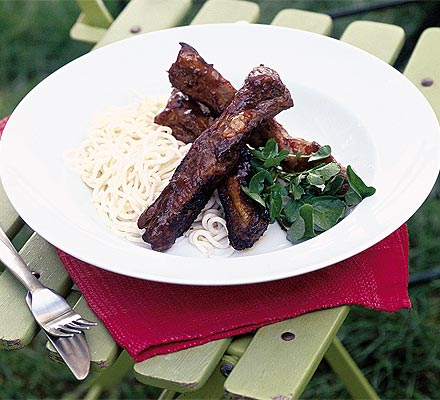
Interesting Bloomberg Businessweek blurb that says most Chinese prices are false ("What's a pork rib really cost in China?"), meaning most people pay more for things--especially food--than the officially-listed prices would have you believe.

Officially, China's consumer price index rose 3.3% in July.  I mean, how can an economy grow 10% and wages go up an average of 8% and consumer goods go up only 3-4%?  With so many rural folk moving to the city, and the second-tier cities taking off, all signs point to rising costs across the board, and yet China's stats remain unusually flat.

The always-solid Michael Pettis says the real inflation rate is more like 6%.

Point being:  either the Chinese government is clueless or is simply ignoring the problem.  Either way, not a good sign, because when inflation saps wage growth in China, social unrest tends to follow.

More than a few experts say China simply likes to repress numbers on inflation and unemployment--no matter what the circumstances.  So expectations are that China's inflation rate--officially--is already set at 3% for the year.

What this suggests to me:  far too much of the Chinese miracle is based on false data, because there exists system-wide pressure to hit certain numbers--with 8% growth being the magic talisman.


12:06AM

New banking rules underwhelm--by default

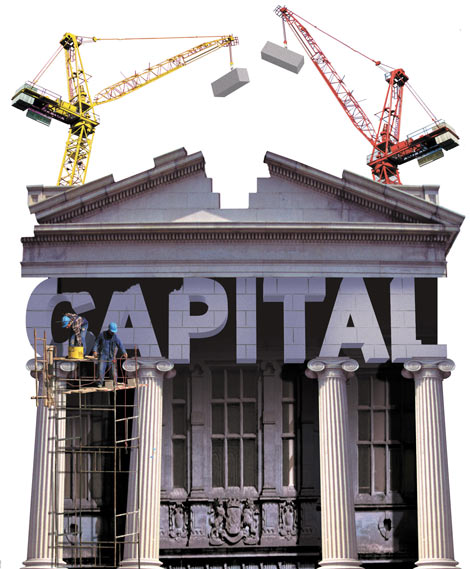
FT full-page analysis on new banking rules out of Basel, to be known as Basel III (the third great rule-set to emerge over the years).

The main changes:

. . . tightens the definition of what banks can count as highest-quality "tier one capital"--the main assets they hold to protect against losses.  It also requires lenders to hold liquid assets sufficient to see them through a 30-day crisis and sets a global "leverage ratio" to limit overall bank borrowing.

Why many experts are underwhelmed:  on every point, the initial draft of new rules was more stringent, only to be watered down after heavy lobbying by big banks.

But the FT says, on the basis of a quiet survey of the regulators themselves, that the real reason why the rules were watered down was fear of sabotaging the weak recovery--not the lobbying of banks. The initial draft, say the regulators, simply created too much fear across the industry.  The original liquidity rule, for example, was considered exorbitant.  As one regulator put it, "There isn't enough stable funding in the world to meet the requirements."

My take-away:  the global financial system remains too heterogeneous for a tough new blanket of rules.  We have varying levels of maturity across the board--as in, so many frontier economies, so few rules that everyone can follow to the same degree.

The financial crisis hit the system too early for such tough, across-the-board regulations, and so we await the Great Rebalancing (which no one is quite sure how to achieve without great trade protectionism on the part of the debtor states) for such rules to emerge.  Until then, we have too many differing economies trying to do too many different things for uniform rules to emerge.

12:05AM

The non-reciprocity of trade with China frustrates India's outsourcing biz

FT story on the consistent issue with China:  it wants into your markets but ultimately shuts you of its own.  

So China pushes India to let telecom equipment giant Huawei into its big market and yet Indian outsourcers are largely shut out of what should be the lucrative Chinese market.  The frustration leads the Indian industry to speak more of Latin America as the future booming market rather than China, which, like Japan, remains difficult to penetrate.  

With Japan, Indian outsourcers detect a "lack of urgency to innovate," whereas in China, the biggest hurdle is the language barrier for an industry that thrives largely on using English--along with the usual complaints about dealing with state-influenced enterprises.

So India's commerce ministry is pushing China to open up more in this industry.  

Western companies that have done well in China's service sector say you have to indigenize the workforce to succeed, something Indian outsourcing companies are apparently less willing to do.

What I see here: The world's two biggest rising economies are so amazingly different in structure and temperament, and yet everybody, including top players on both sides, are determined to foster more linkages out of the fear that zero-sum competition between them would ruin both.

I know a lot of experts spot a ton of friction in this relationship; I'm just amazed at how much effort is being made on both sides to smooth things over wherever possible.  I mean, compared to part periods where rising rivals endured such dynamics, this thing has gone amazingly smoothly to date.

12:04AM

Climate change and the scientific community: "hemorrhaging trust and respect"

As we are treated to stories of Bjorn Lomborg's alleged flip on climate change (sorry, but nothing I read to date sounds like that, especially in the wordage he's using; rather, I see him shading a less antagonistic stance toward potential impact studies), the FT full-page "analysis" reminds us of the great uncertainty surrounding climate science.

The eight great uncertainties listed here are:

  1. range of likely temperature rises
  2. timescale
  3. hurricanes
  4. regions
  5. rainfall
  6. methane release
  7. Antarctica v Arctic impacts
  8. clouds

Then there's the bias tendency of pro-climate change scientists, who see only normal variation in cold snaps but "proof" of global warming in every hotspot (a goofy tendency mirrored by the anti-global warming camp--but then again, no one holds them to any great standard of trust).

The FT ends with the usual Economist-like fear:  all this uncertainty will preclude action until it's too late.  But I'm more impressed with the logic that says, we're more likely to screw things up by responding quickly and drastically.  

Toward that end, Lomborg's persistent call for lots more R&D on the subject still strikes me as eminently sensible.

12:03AM

Cybersecurity: the paradigm shifts

Intel wants to be inside of everything, so sayeth Bloomberg Businessweek.  The PC market for chips is only so big and it's slowing, which the market for embedded chips, while smaller for now, will grow dramatically.

So Intel's purchase of MacAfee, the software security firm, is viewed as a shot across the IT's industry's bow, suggesting that cybersecurity concerns are going to move far beyond the world of computers and the internet to something far more pervasive. Thus devices with embedded chips will need embedded software on those chips and embedded security software within that software. 

How you think of cybersecurity in terms of firewalls in such a world is beyond me.  Cisco speaks more and more of "borderless security"--a trend that I think favors the horizontal systems of the world (like the United States) far more than the vertical ones (like China).  I mean, how can a society with low social trust prevail in such a world?

12:02AM

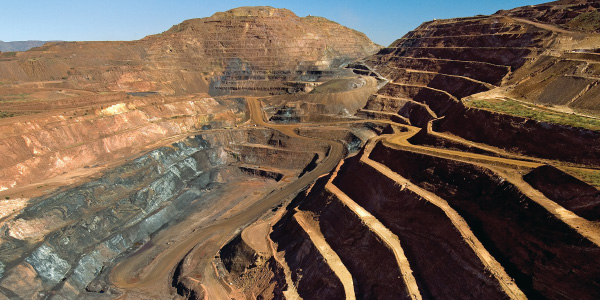
Australia for sale? The next generation of resource-driven fears

Provocative Bloomberg Businessweek piece entitled, "The deal is simple.  Australia gets money, China gets Australia."  Then the subtitle:  "How's that supposed to make a country feel?"

The stunning factoid:  China's exports, imports and investment annually add 3,400 Australian dollars' worth of value to each household in the country.

Chinese resource investment comes in three main forms: In the year leading up to July 2009, Australia saw A$42.4 billion in export demand, A$3 billion of direct investment in Australian companies, and more than A$4.9 billion in other project financing.

Naturally, the direct investment is the most politically charged. Australia's government, for example, wants no Chinese investment to total more than 49% of a company.  99% of China's investments to date have been in the resources industry.

China's hunger for Australian resources has aggravated the deepest divisions in Australian society over population size, immigration rates, taxation, and infrastructure. Bob Kinnaird, formerly of the Department of Immigration and Citizenship and now a private consultant, warns: "The huge growth of the Chinese presence in Australia, through the mining boom, students, tourism, and permanent migration, has been mismanaged to an incredible degree. The industries involved have urged extraordinary growth, but there hasn't been the infrastructure support to cope with it, and the result is that large numbers of Australians in the cities are worried that while the economic indicators are going one way, their real living standards feel like they are going the other."

Public opinion reflects this ambivalence. In new polling conducted by the Lowy Institute for International Policy, an Australian think tank, 73 percent of Australians say Chinese economic growth has been positive, but 57 percent say there is now too much Chinese investment. Economic power has brought fear, too: 46 percent believe China will pose a military threat within the next 20 years.

If China's eliciting this sort of response from an advanced, democratic country, you know that it'll be replicated elsewhere. The fundamental fear is the mismatch in political systems:  if it was the US making such inroads, you'd see the same concerns but far less fear.  There is simply a distinct fear of colonization with the Chinese, because they have an authoritarian government.  It feels like a mismatch:  "our companies" as counterparties to China's government--the real power behind every national company.  I suppose similarly arranged authoritarian regimes in developing countries might not exhibit the same concerns, but even there, the scale issue must be intimidating--as in, China is so big and we're so small in comparison.

Likewise, if China just bought instead of exhibiting this strong desire to own--resources in the ground, stakes in the processing companies, and the transpo infrastructure in between those resource locations and Chinese markets--then maybe these transactions wouldn't elicit such fears.  But China being China, I don't see either dynamic lessening whatsoever in the near term, meaning angst over China's penetration of resource providers' economies will only grow, and thus inevitably create backpressure of the most nationalistic sort.

I imagine Chinese nationalism will likewise rise as a result, but where will it go?  China has neither the gear nor the political will to--as some Chinese nationalists fancifully put it--take what they need from the world.  And, after a while, global sentiment is sure to turn against the apparent Chinese greed, even as it benefits resource providers.  There will arise this sense of China looting the planet while exhibiting all manner of monopsonistic behaviors (a monopsony is where one buyer dominates a market). Eventually, China all by itself will come off not unlike the West on oil in the 1960s-1970s: producer backlashes will label it a destroyer of national wealth because it'll want to consume everything a country can provide it while paying rock-bottom prices.

So one to watch, this bilateral dynamic, simply because I think it'll provide an early glimpse of dynamics we'll see repeated--time and again--around the planet.  China can mitigate such fears by becoming more democratic and giving off the vibe that's its government's behavior can be modified both from within and without, but I see the looming backpressure making such an evolution less likely in the near term, so things are likely to get very nasty before they get better.  Increasingly, the world will grow to mistrust a China it does not feel it can influence its behavior, and that mistrust will close a lot of doors in China's face, making them all the more determined to own resources in the ground.

The Chinese seem to think they can finesse all this with their cash and promises of non-interference, but that seems decidedly naive.  This is not a world exhibiting more trust in governments, as globalization's super-empowerment of individuals makes everybody more wary of turning their future over to bureaucrats--no matter where they hail from.

To me, this is but another reason why the "Chinese century" will be very short indeed.  While the single-party state model is fine for catching up, it comes with inherent self-limitations for the far more intensive growth required for racing ahead.  China, for all its green investments and fine talk, inevitably symbolizes an unsustainable global future far more than the United States allegedly does.

12:01AM

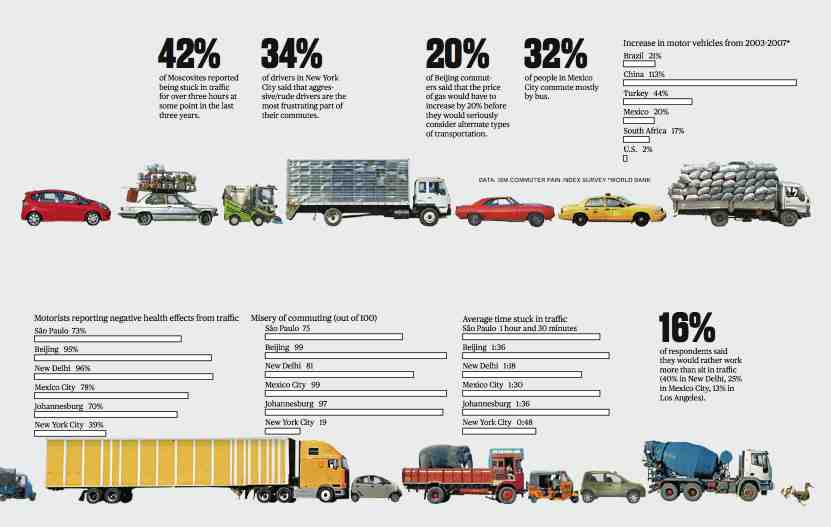
Chart of the day: Worst traffic woes found mostly in New Core economies

Bloomberg Businessweek blurb on global traffic (image blow-up below).

The numbers suggest a profound shifting of woes from Old Core to New.

The US adds 2% more cars from 2003 to 2007, while China adds 113%, for example, so the traffic-suffering indices presented here show America's worst case, NYC, coming nowhere near the complaint level of your average New Core capital, whose woes are only going to get dramatically worse in coming years.

10:00AM

WPR's The New Rules: For U.S. After Iraq, History Once Again Awaits


America has entered a new phase in its Iraq operations, one that represents the end of the “lost war” to many, the non-combat continuation of nation-building to others, and a vague sense of a never-ending global security commitment to just about everyone.  Americans, who crave clear definitions of success or failure, aren’t sure what to make of this turning point, especially since for many, their attention has already shifted to the Afghanistan-Pakistan region. Meanwhile, some pundits sound the alarm with cries of “permanent war,” even though we haven’t officially declared war on anybody since 1943. As for the rest of the planet, humanity currently enjoys the most systematically peaceful period in its recorded history.

Read the entire column at World Politics Review.

12:01AM

Have a nice Labor Day

We were blessed to have our entire family together for the first time this weekend, and eldest Emily came home from college and met her new sisters, Metsu and Abby  

Eight is enough!  I say.

But I don't expect Vonne to give up the fight for Child #7 easily.

So my labors will never end . . ..

12:04AM

Perfectly fine to arm up the Sunnis

WSJ front-pager on US selling $30B worth of F-15s to the Saudis, albeit lacking features that Israel opposes.

I'm not a fan of Saudi Arabia, even as I wish King Abdullah (and his reforms) a much longer life, but frankly, I'd sell the Saudis whatever they want in whatever amounts they want, because, once Iran gets the bomb, the Saudis will be sorely tempted to follow suit.  So the more cool we keep them in the short run, the better.

The Saudis are never going to attack Israel and wouldn't find any utility in letting others do the same.  They've grown beyond such dynamics, so why not arm them and everybody else in the region to the teeth, so as to make clear to Tehran how they gain nothing in military influence by achieving the bomb.

I still await the argument that proves how nukes ever got anybody anything--other than safe harbor from attack by other great powers.  About the best case you can make is that Ike signaled his willingness to go all the way on Korea, convincing the Soviet bloc to avoid escalation.  But even there, you're talking about a bad thing being prevented more than any victory won or influence cemented. 

All Iran does by getting the bomb is to make itself Israel's strategic equal in the region, logically triggering bilateral talks once the brinkmanship gets tiresome (less for them than for interested great powers).  To the extent that Turkey and the Saudis step into that dynamic on their own, I see less danger in proliferation and more safety in a truly regional strategic security architecture.

But meanwhile, we balance appropriately.

12:03AM

Chart of the Day: the much hyped Chinese lead on green technology investment

Bloomberg Businessweek story about America "sitting out the race" on green technology, noting that a lot of American venture capitalists are putting there money into China, where the market seems more "secure."

This is why:

If America had air like that, we'd have a bigger market.  If we had China's skyrocketing oil and electricity demand, things would be different too, but, frankly, I wouldn't want either.

China's combination of cheap labor and extreme need will make it hard for America to match, especially with a Congress that seems incapable of moving on such issues.  Will China get all these investments right?  Not by a long shot, but I expect a lot of pundits on our side to look at China's mad dash with a lot of envy.  China is expected to spent close to a trillion dollars over the next decade, which I would consider to be a pretty good use for its money.

No question we want to reduce our trade imbalance with China and boost our exports in general, but again, it gets awfully hard to compete with the sort of necessity China is facing, and all that cash, and all that cheap labor.

12:02AM

Deep Reads: "John Adams" (2001)

Pretty easy choice.  After reading "Truman," I knew I had to read this finally, especially as I liked the HBO miniseries so much.

McCullough does such a great job of according Adams his rightful place in American history. More than any man, he's behind the Declaration of Independence, even if Jefferson gets the credit for penning the text.

I'm only about a quarter through, and I keep the book by my bed for nights when I have trouble falling asleep, which means I treat it like an old friend.

My favorite bits all have to do with Adams' worrying about whether his life will have meaning and how he deals with his insecurities--very humanizing.

I wasn't ecstatic about Paul Giamatti being picked to play him, because Giamatti, while a great actor, doesn't exactly scream out New Englander.  But I loved David Morse as George Washington, a guy who deserves a serious HBO treatment all the more.

The Adams family has long been a quiet obsession of mine, along with Vonne, because we lived in Quincy for a couple of years and Vonne worked in Braintree, where Adams was born and lived. So we're very familiar with all the historical sites.

12:01AM

Movie(s) of my Week: "Paprika" (2006)

Was really sad to read of Satoshi Kon's passing at 46 from cancer. He was a fabulous anime director, really on par with Hayao Miyazaki.

To note his death, we all watched what we consider to be his masterpiece, "Paprika," which despite the title and slightly goofy tone, is actually on par with "Inception."  Emily, home from college, made the selection, because this is one of her top-3 anime classics.

Paprika (above) is the dream avatar of a scientist who co-invented a machine that allows doctors entry into a person's dreams for the purposes of therapy.  The movie has more amazing visual sequences than just about any anime film you can name, as well as my favorite combo of opening song and credits ever (only Spike Lee's "Inside Man" compares).  If you like anime, you have to know Kon.  

After starting with Hiroyuki Kitakubo's "Rojin Z" as an animator, Kon was able to complete only four films.  

Paprika is the trippiest and most engrossing.  It was also Kon's last completed film.

His first film is a bit rough:  a scary Hitchcock/ DePalma sort of obsessive stalking film that features a brutal rape. It's called "Perfect Blue."  Not for everybody.

Then came my second favorite, "Millenium Actress," which has a Bertolucci quality to it. It is a paean to Japanese film.

Kon's third movie is my least favorite, "Tokyo Godfathers," loosely based on a John Ford western.  It was his most romantic film, whereas the others all had sentiment but a sharp edge.  

Kon was working on a final film when he died.  It's called "Dream Machine" and it's described as a "road film for robots."

Crushing to think the guy would have likely made another ten or so films.  A serious loss to the industry.

12:06AM

When Petraeus's push comes to Obama's shove

Ahmed Rashid piece in FT.  Naturally, he argues for a negotiated endgame that includes the Taliban.  So Petraeus is seen as a dangerous man:

For weeks there has been a spectre haunting European corridors of power.  That spectre is David Petraeus.  Since he stepped in last month as head of combined US and Nato forces in Afghanistan, many European governments have feared the US general would try and extend the time and scope of the military surge to give US forces a better chance of winning over the Pashtun population in the south and delivering a knock-out blow to the Taliban.

This is exactly what he is signalling . . .

What I hear again and again in many circles:  the realist Petraeus is prepping the political battlefield with the idealist Obama, with the hard news to be delivered after the November election. Suitably chastened by a new GOP House, Petraeus will be a hard man to turn down--without empowering him as a possible 2012 opponent.

I still consider Petraeus more of a 2016 possibility, but I would drop my support for Obama in a heartbeat if this scenario came to pass. 

Don't get me wrong:  I see Obama as the avatar of a slew of philosopher-kings we're likely to elect over the next couple of decades.  I just Petraeus being a more full-up package, with my dream ticket complete with Bloomberg as Veep.

Do I expect Petraeus would do anything to serve his own political interests before that of his command? Absolutely not.  He's not that dumb.

But the Obama White House?  

Hmmm.  It's one thing to seek such power; quite another to lose it.

12:05AM

The slow conversion of the Chinese yuan

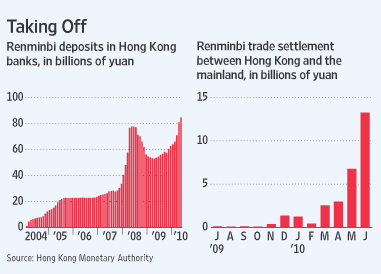
First off is a WSJ column by Peter Stein (The view from Hong Kong) that notes that city-state's emerging role as proving ground for how Chinese currency will be traded outside the mainland, as banks there are starting to lend yuan to one another and offering hedging services.

What started this was a June agreement between HK and China on "removing certain limits on usage of China's yuan within Hong Kong."

The result:

In the past, businesses were mostly confined to opening yuan accounts for trade-settlement purposes; now, accounts can be opened for any purpose.  Businesses and individuals alike now can transfer yuan freely between accounts.  Banks also can help businesses convert yuan without restriction.

While the HK dollar (pegged to our own) remains the official currency, yuan is now "sloshing around the savings accounts of Hong Kong banks in bigger and bigger sums."

All of this is practice for how everybody around the world will someday soon use the yuan, with hedging services being the ability to bet on the yuan's direction.  This shift will correct a weird anomaly:  China conducting all its trade in dollars, euros and yen.  

Expect half of China's Gap trade to be done in yuan within a few years, predicts the piece.  As one HSBC banker puts it, "I think this whole process is going to develop faster than most people expect."

That was early August. 

Then in late August the FT runs a front-pager declaring that "a number of the world's biggest banks have launched international roadshows promoting to corporate customers the use of the renminbi [another word for the yuan; renminbi is to sterling (currency name) what yuan (denominating units) is to the pound], instead of the dollar, for trade deals with China."

What this says:  big global banks want to profit "from what is expected to be a rapidly growing line of business in the future."

Finally, an FT editorial puts it this way:

Dominance of the global economy, Beijing believes, goes hand-in-and with dominance of the global monetary system.

Measures to internationalise the renminbi are nothing new. Hong Kong banks have offered offshore renminbi accounts for more than six years, and currency swap agreements with foreign central banks have been in place since 2000. But they have accelerated in recent months . . . 

These are, however, only small steps. Whether China will be able to stomach the rest of the renminbi’s journey to reserve currency status is far from clear.

A reserve renminbi would have to be fully convertible, on the capital account as well as the current account. But this would imply opening up China to the whims of global capital – precisely what it has been protecting itself against (as its huge foreign exchange reserves attest). Freer capital flows may also prove destabilising for domestic banks, creating liquidity bubbles in good times and choking off the credit supply as conditions deteriorate. No longer would the banking sector be an effective instrument of macroeconomic policy, as it has been during the crisis with its government-induced lending sprees. It would be a source of, and not a remedy to, increasing economic volatility.

Even less palatable for the government is the prospect of losing control over the renminbi. Maintaining a currency peg in the face of massive capital inflows is extremely difficult . . .

China will become the world’s largest economy in the next few decades. It is natural that the renminbi eventually attains reserve currency status. China should not push this process forward prematurely, lest it destabilises its economy. But the sooner it starts the domestic reforms that will prepare it for such a shift, the easier it will find its new international role.

Like most things with China, we'd like it to go faster, to even the playing field more.  But as the FT points out, for China to remain stable, such an evolution needs to be that--an evolution.

But you have to see all this as positive:  China opens itself up more and more to profound market forces, but admittedly at a pace whereby the Communist Party hopes to retain power ad infinitum--even as everybody in that system knows this to be impossible.

How so?  Show me a developed country of any size that isn't a democracy.  Yes, you can show me a city-state or two, or a decent-size rich state like Saudi Arabia.  But I'm talking about development--not just wealth, and not some puny emirate ruled over by an potentate or tiny technocratic elite.

12:04AM

Africa as the next BRIC in the wall

FT op-ed by Jim O'Neill, chief economist of Goldman Sachs.

He says he is being asked whether his BRICs concept should recognize South Africa as the little "s."

He then notes that two of the "next 11" (another Goldman term) hail from Africa:  Nigeria and Egypt.

So he explores the notion that Africa as a whole becomes a BRIC-level entity.

So O'Neill adds up the 11 biggest African economies and projects to 2050, saying a $13T economy is there for the making, leaving the African brick bigger than either Brazil or Russia in that timeframe, but not as big as India or China.  Nearly half of that imagined GDP would come from Nigeria and Egypt, with South Africa naturally serving as globalization's gateway to the southern cone.

Piece ends with the usual bits about what needs improving for the scenario to unfold.

What's interesting, of course, is that we're even having this conversation about African pillars.

Another good reason why I say globalization is an amazing collective good.

12:03AM

Why "the coming war with Japan" isn't coming

Referencing George Friedman's 1991 book, and the notion he still peddles in The Next 100 Years about the U.S. and Japan squaring off in a "war of the worlds" space battle that involves secret moon bases right out of James Bond.

This is James Fallows in front-of-mag bit in The Atlantic.

He returns to an old neighborhood of his and "finds an inward-looking country that has lost its ambition."

I have heard this refrain from a number of Japanologists.  The kids there are zoning out the world.

Is it a wealthy place?  Definitely.  But a self-satisfied one too, facing an extreme demographic decline (getting smaller and older at a stunning pace).

An interesting example of the turn inward:

The Japanese youths, scientists, and businesspeople of the 1980s, like their Chinese and Korean counterparts today, were bursting to use their country's success as a platform to engage the rest of the world, by traveling, investing, studying.  As The Washington Post recently pointed out, only half as many Japanese students are now enrolled at U.S. colleges as 10 years ago--the opposite of the trend in almost every other nation.  The tight job market has discouraged students from doing anything as "risky" as spending time outside the Japanese school system.  The elbows-out cockiness of the Japan I remember caused its frictions.  But I miss its eagerness for a new version of itself.

What happens when your population shrinks by half over a half century?

You don't become more ambitious, or war-like.

12:02AM

Brief Reminder: The GWOT meets Kenneth Waltz  

Pretty self-explanatory.  Not sure why it's in B&W.  Think we used it in an Office of Force Transformation pub.

So I expect it's from 2002, because Afghanistan is in there but no Iraq.

GWOT is old Bush-Cheney term:  Global War on Terror (pronounced GEE-wot).  

The Kenneth Waltz reference in the title is due to my use of his three-images perspective (system, state, individual).

TNN = TransNational Networks

SEI = Super-Empowered Individual (Thomas Friedman's term)

12:01AM

Blast from my past: "The Country To Watch: Egypt" (2006)


[No. 042] The Country To Watch: Egypt

by Thomas P.M. Barnett


"The Esquire 100," Esquire, October 2006, p. 177.


Bush should have co-opted Ahmadinejad, not cornered him. His proxy war with Israel only strengthens him. Meanwhile, "moderate" Arab dictators like Mubarek see their lives flashing before them.

Let me give you the four scariest words I can't pronounce in Arabic: Egypt after Hosni Mubarak.

Osama picked the time (9/11), and Bush picked the venue (Iraq), but this fight between radical Islam and globalization's integrating forces was preordained the day Deng Xiaoping set in motion China's economic rise almost three decades ago. You can't rapidly add billions of new capitalists to the global economy and pretend the Islamic Middle East will remain queerly disconnected forever, somehow fire-walled from that borglike assimilation.

And so, while resistance may be ultimately futile, it will be bloody as hell in the meantime, with Cairo--not Tehran--likely to become the next big flash point in this Long War.

Mubarak's "emergency rule" dictatorship is deep into its third decade, making him one of Egypt's most durable pharaohs. His succession plan is clear: Son Gamal tries to replicate Beijing's model of economic reform, forestalling political reform.

In other words, connect to the global economy to avoid connecting to your own people: bread before circuses, my friends.

The problem? Another political force is connecting to the restive Egyptian people, and it's the Muslim Brotherhood, otherwise known as Al Qaeda 1.0. By hardwiring themselves into the goodwill of the masses through highly effective social-welfare nets, the Brotherhood is retracing the electoral pathway to power blazed by Hamas in Palestine and Hezbollah in Lebanon: hearts and minds first, blood and guts later.

So it's basically a race: Gamal's quest for foreign direct investment and the jobs it generates versus the Brotherhood's quest for the political support of average Egyptians tired of lives led in quiet desperation.

Who will win? I'm betting another "olive tree" fight breaks out long before any Egyptian "Lexus" goes to market. Gamal's economic reforms are slowly working, but it's likely a case of too little too late.

If the Muslim Brotherhood were to achieve power in Egypt, Israel's demise would once again become the overt unifying principle for governments in the region. That would mean, by George, that all Bush's Big Bang really accomplished was to return the Middle East to 1973.

So much for all those Nobels.

The difference this time? It still may be our blood, but it's mostly Asia's oil (and gas) now. You pit East versus West in a flat world, and you've just made Osama the fulcrum for a new cold war.

Sound incredible? It isn't, because the more likely scenario is that Mubarak the Elder dies before Mubarak the Younger can turn himself into Egypt's Deng Xiaoping, yielding a Tiananmen Souk that lights up the country pronto with the Brotherhood's prodding. And since these students will be hoisting pictures of Osama instead of a makeshift Goddess of Democracy, Bush's successor is likely to find himself (or herself) facing an unbelievably bad choice in the largest Arab country.

Would America intervene militarily to preserve Gamal's faltering rule, making good on all the strategic promises implied by the $50 billion in aid to Egyptian regimes since 1975? Or would we throw up our hands at that point, write Tel Aviv a blank check, and hope that this twenty-first-century Masada can hold out in a Middle East where Iran has the bomb?

Let me tell you something you don't want to hear: The smart money inside the Pentagon is betting any future president will choose to draw the next line in the sand at the Nile's banks rather than alongside Israel's security fences going up in Gaza and the West Bank.

And once we cross that Rubicon into Africa . . . buddy, there ain't no turning back in this Long War.

And success in the Long War (so named by the generals) will not be signaled by less violence but by a geographic shift in its center of gravity. Drive Al Qaeda & Co. out of the Middle East and it will be forced into its current strategic rear of choice--Africa.

Africa is where Al Qaeda hides its money, guns, recruits, training camps--and its future. Africa will be the last great stand in this Long War, where all those impossibly straight borders once drawn by colonial masters will inevitably be made squiggly again by globalization's cultural reformatting process.

Now this fight heads south . . . and yes, the Long War will be even uglier there.