Buy Tom's Books
  • Great Powers: America and the World After Bush
    Great Powers: America and the World After Bush
    by Thomas P.M. Barnett
  • Blueprint for Action: A Future Worth Creating
    Blueprint for Action: A Future Worth Creating
    by Thomas P.M. Barnett
  • The Pentagon's New Map: War and Peace in the Twenty-first Century
    The Pentagon's New Map: War and Peace in the Twenty-first Century
    by Thomas P.M. Barnett
  • Romanian and East German Policies in the Third World: Comparing the Strategies of Ceausescu and Honecker
    Romanian and East German Policies in the Third World: Comparing the Strategies of Ceausescu and Honecker
    by Thomas P.M. Barnett
  • The Emily Updates (Vol. 1): One Year in the Life of the Girl Who Lived (The Emily Updates (Vols. 1-5))
    The Emily Updates (Vol. 1): One Year in the Life of the Girl Who Lived (The Emily Updates (Vols. 1-5))
    by Vonne M. Meussling-Barnett, Thomas P.M. Barnett
  • The Emily Updates (Vol. 2): One Year in the Life of the Girl Who Lived (The Emily Updates (Vols. 1-5))
    The Emily Updates (Vol. 2): One Year in the Life of the Girl Who Lived (The Emily Updates (Vols. 1-5))
    by Thomas P.M. Barnett, Vonne M. Meussling-Barnett
  • The Emily Updates (Vol. 3): One Year in the Life of the Girl Who Lived (The Emily Updates (Vols. 1-5))
    The Emily Updates (Vol. 3): One Year in the Life of the Girl Who Lived (The Emily Updates (Vols. 1-5))
    by Thomas P.M. Barnett, Vonne M. Meussling-Barnett
  • The Emily Updates (Vol. 4): One Year in the Life of the Girl Who Lived (The Emily Updates (Vols. 1-5))
    The Emily Updates (Vol. 4): One Year in the Life of the Girl Who Lived (The Emily Updates (Vols. 1-5))
    by Thomas P.M. Barnett, Vonne M. Meussling-Barnett
  • The Emily Updates (Vol. 5): One Year in the Life of the Girl Who Lived (The Emily Updates (Vols. 1-5))
    The Emily Updates (Vol. 5): One Year in the Life of the Girl Who Lived (The Emily Updates (Vols. 1-5))
    by Vonne M. Meussling-Barnett, Thomas P.M. Barnett, Emily V. Barnett
Search the Site
Powered by Squarespace
Monthly Archives
12:08AM

Nuclear domino effect: history says otherwise

Foreign Affairs piece by way of WPR's Media Roundup.

The key bit from Johan Bergenas' solid piece:

But there's one problem with this "nuclear domino" scenario: the historical record does not support it. Since the dawn of the nuclear age, many have feared rapid and widespread nuclear proliferation; 65 years later, only nine countries have developed nuclear weapons. Nearly 20 years elapsed between the emergence of the first nuclear state, the United States, in 1945, and the fifth, China, in 1964.

The next 40 years gave birth to only five additional nuclear countries: India, Israel, South Africa, Pakistan, and North Korea. South Africa voluntarily disarmed in the 1990s, as did Belarus, Kazakhstan, and Ukraine following the dissolution of the Soviet Union. After Israel developed a nuclear weapons capability in the late 1960s, no regional nuclear chain reaction followed, even though the country is surrounded by rivals. Nor was there even a two-country nuclear arms race in the region.

Similarly, it has now been four years since North Korea became a nuclear weapons state, yet South Korea and Japan have not followed suit, despite the fact that they have a latent nuclear weapons capability -- access to the fissile material necessary for nuclear weapons. These countries' decisions to not go nuclear are largely thanks to extensive U.S. efforts to dissuade them.

When he turns to the Middle East, I think his numbers are optimistic: he says Iran may be 1-3 years away but everybody else in 10-15.  I give both the Saudis and Turks more credit than that.

But his logic--often echoed here--is hard to dismiss.  The hype on nuclear proliferation has been amazingly consistent across my nearly five decades of living--and amazingly and consistently wrong.

12:07AM

Is Afghanistan worth it?

Bret Stephens column in WSJ by way of WPR's Media Roundup.

Solid piece that made me covetous of its argument the moment I read it.  Nicely done.

The guy navigates some dicey terrain:

It's never easy to point out that, in the scale of American military sacrifice, Afghanistan does not figure large. But acknowledging a historical fact does nothing to belittle the cost the war has exacted on America's soldiers and their families: It merely offers some mental ballast to offset the swelling panic. What does belittle the sacrifice—both for those who have fallen and those who fight—is to suggest that the war is nothing but a misbegotten errand in a godforsaken land.

And then lays down the conservative case with great intelligence:

For conservatives in particular, the answer ought to entail notions of consistency and responsibility. Consistency, in the sense of supporting a counterinsurgency strategy for Afghanistan similar to the one conservatives urged (and that worked) for Iraq after the abject failure of the "light footprint" approach advocated by Joe Biden. Responsibility, in the sense of keeping faith with those to whom we make commitments.

This is not just a moral argument: The U.S. cannot remain a superpower if the suspicion takes root that we are a feckless nation that can be stampeded into surrender by a domestic caucus of defeatists. Allies or would-be allies will make their own calculations and hedge their bets. Why should we be surprised that this is precisely what Pakistan has done vis-a-vis the Taliban? It's not as if the U.S. hasn't abandoned that corner of the world before to its furies.

How a feckless America is perceived by its friends is equally material to how we are perceived by our enemies. In his 1996 fatwa declaring war on the U.S., Osama bin Laden took note of American withdrawals from Beirut in 1983 and Mogadishu a decade later. "When tens of your soldiers were killed in minor battles and one American pilot was dragged through the streets . . . you withdrew, the extent of your impotence and weakness became very clear." Is it the new conservative wisdom to prove bin Laden's point (one that the hard men in Tehran undoubtedly share), only on a vastly greater scale?

Nor does it seem especially conservative to subscribe to the non sequitur that because Hamid Karzai is not George Washington our efforts in Afghanistan will be of no avail. Utopia is a liberal temptation; conservatism is comfortable with the good enough. In Afghanistan that would mean a run-of-the-mill Third World country that can fend for itself, menaces nobody and is an updated version of what the country was in the 1960s. That's a reminder that Afghan history does not ineluctably condemn it to chaos or fanaticism. It's also a reminder that the measure of success in Afghanistan isn't whether we create a new Switzerland, but whether we avoid another South Vietnam.

Nothing to add, save that I admire the logic and the writing.

12:06AM

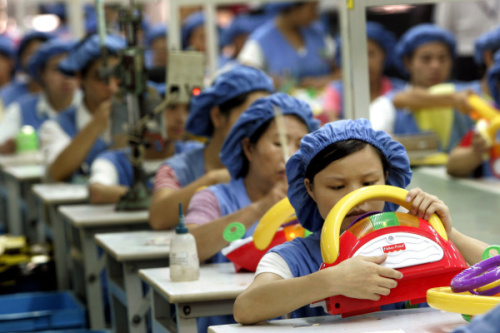
China: Will fail, but too big to let fail

image here

Guardian op-ed by way of WPR's Media Roundup.  Fascinating piece.

Very sensible run down to start off:

There is no question that China's growth has been anything short of exceptional. However, that success may have run its course. China will have to rise again in order to rebalance growth while reducing inequality and environmental degradation. The plight of 1.6 billion people depends on it, and the entire world economy. The global community should do all it can to help China succeed.

Like Japan, South Korea, and others before, China has deployed a hybrid mix of state and market-led forces to globalise its economy over the past 30 years. Like its East Asian predecessors the Chinese miracle has been built on exports to the west. The results have been unprecedented, with a growth rate of approximately 10% that has lifted 566 million people over the $1.08 "extreme poverty" threshold set by the World Bank.

Yet the Chinese model is not sustainable in the long run. It has created severe inequalities and environmental degradation and has contributed to the global imbalances that were at the root of the financial crisis. There is an across the board consensus that China needs to diversify demand toward its domestic market.

Yilmaz Akyuz, chief economist of the South Centre, estimates that close to 60% of China's imports are used in the export sector and only 15% of imports are for domestic consumption. 

All sensibly rendered, especially noting the non-uniquenes of the China model.

But here's where Chinese incrementalism cannot be condemned:

The west can't have its cake and eat it too. The west can't tell China to increase domestic demand and rebalance its economy through domestic consumption (without increasing carbon dioxide emissions), and at the same time shun China's incremental approach to to monetary policy, strikes and wage increases, policies for financial stability, and green industrial innovation. China should be enabled to succeed. A country of 1.6 billion people that is now one of the only rudders working in the global economy is too big to fail.

So an argument for focusing on direction over degree--as in, is China slowly moving in the right direction?  And not obsessing too much over speed.

Why?  Simply put, no one wants to own the problem of a ship-wrecked Chinese economy.

Excellent, intelligent piece.


12:05AM

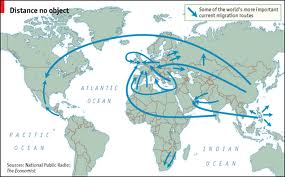
Global economic crisis' impact on people flow? Doom-sayers repudiated yet again

  Economist chart

WPR piece on global economic crisis' impact on immigration (slight reduction) and remittances (even slighter).

The opening:

Over the last three decades, international migration has become an important part of the world economy, providing vital labor for industrial countries. Migration has also become a major resource for origin countries, helping to lift millions of people out of poverty and contributing to national income and development finance. The global economic crisis (GEC), which led to massive declines in investment and production all over the world, was widely expected to also lead to a fall in migration. Analysts also expected that many migrants would return to their homelands, and that worker remittances would decline. Although the current fragmentary data means that any assessment must be seen as provisional, some general trends have emerged three years into the crisis. These suggest that in some areas, the effects of the GEC on migration were not as severe as expected, while in others they defied expectations.

Solid piece worth reading.

Bottom line:  alleged deglobalization or immigration "U turn" is completely unsupported by facts.

12:04AM

Experts on civilian surge in Afghanistan: dial down the fire hose of money

Christian Science Monitor op-ed via WPR's Media Roundup.  Makes basic argument that we're spending too much too fast in order to show too many results, instead of thinking in terms of sustainability.

You know that USAID isn't given to such splurge spending, so it's the political masters on top who want their election-defining results pronto.

Yet another example of the bureaucratic dangers of assigning a deadline.

Great piece with solid reportage.

12:03AM

Trends in American warfare: more treasure, less blood

NYT chart by way of WPR Media Roundup.

Charts speak for themselves.  Warfare is less burdensome to the US population and economy, even as the per soldier price tag grows, along with overall cost relative to the size of theater (WWII was BIG!).

But that trend is about as surprising as the one concerning higher insurance totals for natural disasters. Simply put, we live more technologized lives and value life more completely now than in the past--and we're willing to pay for those biases.

But I will stick to an old premise of mine:  if we had outsourced the complete rebuild of Iraq to the Chinese, it would have been far cheap and worked far better.

But we don't own that level of realism yet--at least not regarding the postwar.

12:02AM

The environmental cost of natural gas fraccing

Solid NYT piece that shows we're just beginning the Erin Brockovitch-style fights over the environmental impact of natural gas fracturing methods.  

I expect the news will get worse before it gets better, but that it'll be a good process of discovery that forces more careful extraction techniques and technologies.

So, bring on the lawyers, say I.

12:01AM

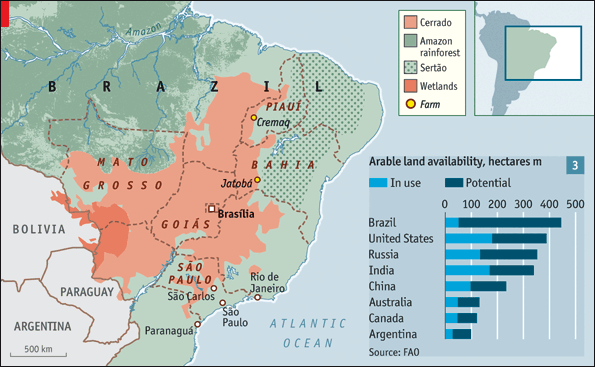
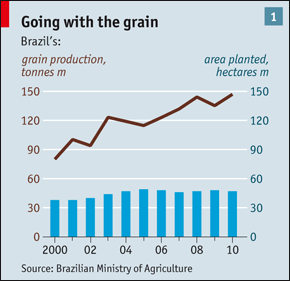
Charts of the day: Brazil as rising ag superpower

Economist briefing:  Two compelling take-aways are that Brazil has more potentially farm-able land than anybody in the world and that it's successfully raising its productivity on the land it's using.


12:10AM

An insider's account of what Africom is all about

Robert Moeller, who was Africom's original #2 as it was being set up, and oversaw its initial period of operation as its first deputy for operations, writes the "truth about Africom" in Foreign Policy (hat tip to WPR's Media Round-up).  In my mind, Africom is the most SysAdmin commands by far, and its operational philosophy will eventually penetrate the other regional combatant commands.

Of course, the subtitle must exclaim, "we're not trying to take over Africa!" because everybody thinks we can pull it off with 10,000 troops or so, but after that crushing that silly straw man, the piece settles into a no-hype description of the new command, with some dissembling required.

Here are the five main points:

Lesson 1: Africom does not create policy.

Lesson 2: Africom must work hand in hand with the diplomatic corps.

Lesson 3: Keep our footprint in Africa limited.

Lesson 4: Africom is most effective when it listens to the concerns of its African partners.

Lesson 5: Don't expect instant results.

The dissembling part is when Moeller attacks the big footprint argument by stating emphatically that Africom has no plans to create an HQ on the continent--as if that defines the footprint. No mention is made of the Contingency Operating Locations (COLs) or mini-bases that characterize Africom's avatar, Combined Joint Task Force-Horn of Africa.

But overall, a great piece.  It shows that America's national security establishment is both serious about shrinking the Gap in Africa and capable of doing it far more cheaply than Iraq and Afghanistan suggested.

I interviewed Moeller in the Pentagon for my "The Americans Have Landed" article for Esquire back in 2007.

12:09AM

A safer, nicer Africa? Rising incomes drives the process


Christian Science Monitor op-ed via WPR's Media Round-Up.

I just liked this reminder of the true facts on the ground:

In the past four years of the Global Peace Index, run by the Institute of Economics and Peace, Africa emerges as the most progressive region in terms of peacefulness. This is not the say it is the most peaceful; it isn’t. But, from a low base, the region is moving toward peace at a much faster pace than any other region as the number and intensity of conflicts decrease, military expenditure is reduced, and access to small arms is lessened.

Africa’s progress underscores the profound link between peace and prosperity. Indeed, a the continent’s peacefulness increases, its GDP growth is now the highest since the 1960s, when many African nations achieved independence. In another hopeful sign, child mortality has been dropping by 2 percent per year for the past decade.

As for the conventional wisdom that says we're living in the most war-filled era in human history and that globalization serves only to make the poor poorer, Africa' path reminds us that such notions are complete bullshit.

12:08AM

Stealing from Africa: China's aggressive pursuit of Global Fund health grants

Foreign Policy piece, by way of WPR's Media Roundup, that rightfully accuses China of stealing from Peter (Africa) to pay Paul (it's own interior rural poor) in its aggressive pursuit and winning of "Global Fund to fight AIDS, tuberculosis and  malaria" health grants to the tune of $1B.

Chow points out that China has donated only $16m to the fund over 8 years, compared to $5.5B by the U.S. 

Particularly egregious:  $149m in health grants to battle malaria, when last year China suffered 38 deaths from that disease.

Meanwhile, a lot of African countries with far worse health burdens are getting crumbs compared to China, which ranks #4 in the world for Global Fund grants.

No one says China still doesn't have issues, but with $2.5T in money from the West already in terms of trade-surplus-generated reserve currency holdings, it's hard to argue that China should still be shoving aside more worthy African recipients.

12:07AM

The big-war fantasy that is the Taiwan scenario

fantasy image here

Great piece by Keith Richburg in WAPO.

The start:

China considers Taiwan a renegade province and keeps more than 1,000 missiles pointed at the island. Taiwan stockpiles American weapons to defend itself. And the standoff remains the longest-running irritant in Washington's relations with Beijing.

But the unresolved rivalry across the narrow Taiwan Strait masks a different reality on the ground. In many ways -- economics, culture, family ties -- China and Taiwan are rapidly becoming closely intertwined, making the chances of a military confrontation seem increasingly remote.

More than a million Taiwanese now live in China full time -- about half of them in the Shanghai area -- running factories, starting restaurants, attending universities, buying property.

There are 270 regularly scheduled flights each week between Chinese and Taiwanese cities, and they are almost always fully booked. The number of weekly flights is set to grow to more than 400 in a few weeks.

Many Taiwanese living in China are too young to have known China as a hostile neighbor; rather, they see a vast marketplace.

"I could see it was happening around me, people were moving to China," said Tingting Yang, 39, who came to Shanghai from Taipei seven years ago and runs a public relations company. "They don't need to do anything militarily. Taiwan is already close to China. And getting closer."

They gave me a rifle, but I invaded with a briefcase instead:

Taiwanese men speak of the irony of being taught during military service to see China as the enemy. "We were trained to land in China on a marine landing craft with rifles and tanks," said Martin Liou, 51, who was an officer in the Taiwanese army and later set up Amway's warehouse and factory network in China. "Instead of a rifle, I came with a briefcase."

The soft-power kill moves head at full speed:

Taiwanese culture has also invaded mainland China, from soap operas to the accent and slang being mimicked by teenage girls in Shanghai.

The wave goes the other way, as well, though it is more limited. Chinese are increasingly traveling as tourists to Taiwan -- 800,000 of them so far this year. For now, they must go with organized tours, but later this year, the rules will allow individual travel.

While tension still exists at the level of nation-states, it's basically lost at the individual level:

"The two governments have their political concerns, their sense of pride," Liou said. "But we regular people, we want to make friends, make money, we want to see each other."

"If China leaves Taiwan alone, if they are patient, sooner or later, it's going to be unified," he said.

This scenario bleeds plausibility, but it's what the USN-USAF AirSea Battle lives and breathes on.

12:06AM

The "escape from New York" approach to failed states

Fareed Zakaria remains in full mea culpa mode over Iraq and Afghanistan.  In this WAPO op-ed (via WPR's Media Roundup), he embraces the notion of putting a fence around failed states and sending in the drones only when absolutely needed:

What to do in Somalia? In a thoughtful report, Bronwyn Bruton of the Council on Foreign Relations makes the case for "constructive disengagement." The idea is to watch the situation carefully for signs of real global terrorism -- which so far are limited. Al-Shabab's "links" with al-Qaeda seem to be mostly rhetoric on both sides. But if they become real and deadly, be willing to strike. This would not be so difficult. Somalia has no mountains or jungles, making it relatively hospitable for counterterrorism operations. Just be careful not to become a player in the country's internal political dynamics. "We have a limited capacity to influence events in Somalia, to influence them positively," says Bruton. "But we have an almost unlimited capacity to make a mess of things."

The horrific cynicism on display here is disheartening, but it reflects Zakaria's odd take on nation-building.  For a guy who crystalized the argument about not trying to bring democracy too early to underdeveloped states, he uses the straw-man about either fast-forwarding political modernization (impossible) or pulling back similarly in Afghanistan.  All I can say in response is, Why must the choice be defined in such binary form?  And why put this down solely to "American imperialism"?  In a world where the "rest" are rising, why is our strategic imagination so limited re: potential allies or alternative nation-building approaches?

It's weird, but Zakaria isn't even staying true to his own ideas and observations.  Watching him embrace this kind of self-defeating thought makes me think he's caved in to the conventional wisdom of this administration.  Here I think his journalism is limiting his analysis, meaning his need to maintain access has put him into pandering mode.

And that's too bad.  His voice is too important to waste on a TV show or even this administration.

12:05AM

Ag "wars"! (fought with money and lawyers--damn it all!)

Target acquired!

FT full-page analysis on how economic (more calories) and demographic (more mouths) pressure on ag production is leading to an M&A fight over PotashCorp--the fertilizer giant.  The UN now predicts a 70% increase in food consumption by 2050.  

Mining giant BHP Billiton is making a hostile bid for the Canadian firm, prompting talk of a counterbid by a Chinese national company, presumably because China fears a loss of access down the road.  The fertilzer industry in general is experiencing heightened mergers and acquisitions deals (like the expected merger of two giant Russian fertilizer firms).  Potash, a key fertilizer component, has seen its per ton price rise from $150 to $1,100 over the past half-decade, leading more nations to view the drab component as being on par with oil--a as in, a strategic asset.

Another example of how China's appetites and resulting connectivity are racing ahead of its political-military ability to defend them.  Some look at that and see the rise of Chinese military power as the solution, but as I've explained many times, I don't think the Chinese political system could withstand an aggressive era of overseas wars--even to protect "vital interests." That vision just doesn't jibe with a nation of only-child "little emperors."

Alternative?  China better have a lot of military allies around the world to help it deal with the fact that it's becoming the more resource-dependent--and thus vulnerable--economy in the world.

12:04AM

Japanese employers have a counteroffer to Beijing

WSJ story in which Japan is basically saying to China, if you want us to stay, you have to make your legal system more transparent and your business rules more robust.  

Lately, as a result of worker unrest against Japanese factories in China, Beijing has been lecturing the Japanese on the need to pay its workers better wages.  So apparently the Japanese have decided to return the lecturing favor.

In effect, this is Japan joining the growing chorus of Western businesses complaining about China's increasingly hostile investment and business environment--a big sign, in my mind.

12:03AM

The narrowing definition of success in China

Newsweek blurb noting how China's top schools increasingly draw overwhelmingly from the urban elite.

Insider estimates on Tsinghua and Peking U (the MIT and Harvard of China's universities, respectively) say that only about 1% of the students hail from rural areas, which is amazing considering that close to half of the population live there.  That kind of set-up means somebody like me (hailing from Boscobel, population 2,200 and decidedly rural) never gets into a Harvard (where some local snobs asked me, upon my arrival, how long I'd been in the country).  

This doesn't mean rural kids don't get into universities, just that they're overwhelming restricted to the lesser schools.  In the past, standardized tests meant a certain portion of rural kids got into top universities, but today a lot of other attributes are considered--like foreign language skills, which favor the urban elites.

Bottom line:  the party elite will increasingly grow out of touch with the common man if this educational trend continues.

12:02AM

Cybersecurity as a way to revitalize the US-Japan alliance

FT op-ed by John Alkire, managing director of Morgan Stanley Japan.

Basic argument:  we share a common enemy in China's persistent and pervasive cyber snooping and industrial theft.  Recently, US and Japanese officials agreed to stop cyber-snooping on each other and cooperate on cyber-security--basically the cyber equivalent of a traditional military alliance.  Alkire even goes so far as to say we should stand up a joint cyber-security facility on Okinawa to finesse the continuing tension over the US marine base there.

So yeah, little to no chance of us every landing Marines in China, but cyber-security "forces"?  There you have my attention.

12:01AM

Chart of the day: China as the world's biggest navy

Economist story on defense spending in a time of austerity. 

Unsurprisingly, the focus is on how the West keeps reducing its platform numbers because of its addiction to speed, stealth and other forms of high technology (i.e., every platform costs so much more to build over time, that we can afford far fewer of them).  Poster child right now is the F-22, whose production runs for the US ends at 187 units instead of the originally planned 750.

But what do commanders in the field want?  Helicopters and drones--not F-22s.  So why worry about the numbers?

Well, on the naval side, we can now say that China's Peoples Liberation Army Navy is the world's biggest fleet of major combatants, even though nobody would seriously suggest that the PLAN comes anywhere near our overall naval combat capability nor global reach.

So how impressed should we be?

The only question that matters, in my mind, is whether or not China is building a force that counters our capacity to shape the global security environment.  That's not simply a numbers game, but a willingness-to-use mindset, which I don't see China possessing now, or in the future so long as the Party rules. Why? If you use forces, you will lose forces, and China's single-party state can't afford such losses of face.

If you think major naval battles are in the offing, then you're spooked by China's PLAN build-out, but I myself don't see the larger nuclear correlation of forces impacted by this whatsoever, so China's numerical superiority impresses no more than the old Sov version did.  We dare not go to the mattresses over anything important because we know how that will end.  China may still dream of Taiwan in these terms, but America does not.

Hence, the only military developments that impress me are those that involve bolstering China's ability to do counterinsurgency and nation-building, and I see none in the offing or on the horizon.  Instead, China mindlessly apes America's past in its military build-up, as though it's more interested in appearances than global capabilities, and more interested in narrow sea denial than expansive sea control.

I'd be more impressed with a PLAN that eschewed classic major combatants and went in for vast fleets of unmanned vehicles, because I don't see countering traditional naval capabilities to be all that hard--or all that expensive.

What the system really needs right now is more Somali-like pirates the world over to encourage more navy-to-navy collaboration like the Somali version has.

In the end, it's not a matter of who has more ships, but whose ships are most welcomed around the world.

9:25AM

The Politics Blog: Meet the World's Next 28-Year-Old Dictator

The most exclusive party on the planet this week won't take place on some former senate candidate's yacht or even in a celebrity's backyard. It will take place — well no one knows where it's going to be, really, except somewhere in North Korea. What is for sure — and what everyone beyond diplomatic circles should know full well — is that the impending conference of the Workers' Party, which is supposed to happen every five years but has taken thirty in this kind of upside-down country, will have implications the world over. Dangerous ones.

Read the entire entry at Esquire's Politics Blog

12:09AM

The clash of the titans, according to The Economist

Economist editorial and briefing on the Indian-Chinese economic rivalry.

Unlike the rising tandem of Japan and Germany a century ago, India and China are akin to entire civilizations and not mere nation-states.  They are also overwhelming poor, despite the booming economies.

And yet, how these two handle their twin rise will likely determine, says The Economist, whether or not great-power warfare returns to the scene.

Neither seems comfortable in their skin, says the editorial.

China, for example, gets resentment whenever it's told it needs to do more for the world.  And yet, how not to involve the world's most populous state, biggest exporter, biggest car market, biggest carbon emitter and biggest consumer of energy?

India's paranoia tends to run toward the Chinese directly:  they see China, at every possible point, trying to undermine its rise by locking in resources the world over, keeping it from a permanent UN Security Council seat, challenging its desired naval supremacy in the Indian Ocean, and the like.  Then, of course, the last time they fought, in the early 1960s high up in the Himalayans, India fared badly. 

From the outside, the Indians seem the better Western partner: its interests do not threaten the West and its long-term prospects seem brighter than China's (would you rather lose 100m workers by 2050 or add 300m?).

For now, only the hyper-nationalists on both sides dream of war between these two rising giants.  Trade, meanwhile, has increased 230-fold since 1990 to a rough $60B this year (although decidedly favoring the Chinese, who, like in so many bilateral relationships, import raw materials from India while sending back finished goods).  The leadership on both sides seems keenly aware that any fight between the two would likely derail both nation's rise.  Still, both are nuclear powers and, between them, have 4m men in uniform, and share a disputed 4,000km border that includes the restive Tibet.  But no confirmed shots in anger since 1967.

China's hubris of recent years has been expressed in its quiet but aggressive development of infrastructure along the disputed line, to include the permanent stationing of a lot more troops.  India pledges to match that effort.

And yet, this is the system America created:  an international liberal trade order that's easy to join and hard to dominate or overthrow, so if India and China continue to rise peacefully, despite all the trappings of power that would suggest the high probability of conflict, then our system is much to be credited, because we're doing what the British colonial order was never able to accomplish--peacefully integrate rising great powers.

My take remains the same: if you get Chinese partnership, it's hard for India to remain outside the larger, resulting process, but if you try the same with India, you get a far more stubborn China. And yet, a certain amount of hedging is called for until China becomes something far more pluralistic in its politics. Simply put, we don't fear rising democracies, only rising authoritarian states.