Buy Tom's Books
  • Great Powers: America and the World After Bush
    Great Powers: America and the World After Bush
    by Thomas P.M. Barnett
  • Blueprint for Action: A Future Worth Creating
    Blueprint for Action: A Future Worth Creating
    by Thomas P.M. Barnett
  • The Pentagon's New Map: War and Peace in the Twenty-first Century
    The Pentagon's New Map: War and Peace in the Twenty-first Century
    by Thomas P.M. Barnett
  • Romanian and East German Policies in the Third World: Comparing the Strategies of Ceausescu and Honecker
    Romanian and East German Policies in the Third World: Comparing the Strategies of Ceausescu and Honecker
    by Thomas P.M. Barnett
  • The Emily Updates (Vol. 1): One Year in the Life of the Girl Who Lived (The Emily Updates (Vols. 1-5))
    The Emily Updates (Vol. 1): One Year in the Life of the Girl Who Lived (The Emily Updates (Vols. 1-5))
    by Vonne M. Meussling-Barnett, Thomas P.M. Barnett
  • The Emily Updates (Vol. 2): One Year in the Life of the Girl Who Lived (The Emily Updates (Vols. 1-5))
    The Emily Updates (Vol. 2): One Year in the Life of the Girl Who Lived (The Emily Updates (Vols. 1-5))
    by Thomas P.M. Barnett, Vonne M. Meussling-Barnett
  • The Emily Updates (Vol. 3): One Year in the Life of the Girl Who Lived (The Emily Updates (Vols. 1-5))
    The Emily Updates (Vol. 3): One Year in the Life of the Girl Who Lived (The Emily Updates (Vols. 1-5))
    by Thomas P.M. Barnett, Vonne M. Meussling-Barnett
  • The Emily Updates (Vol. 4): One Year in the Life of the Girl Who Lived (The Emily Updates (Vols. 1-5))
    The Emily Updates (Vol. 4): One Year in the Life of the Girl Who Lived (The Emily Updates (Vols. 1-5))
    by Thomas P.M. Barnett, Vonne M. Meussling-Barnett
  • The Emily Updates (Vol. 5): One Year in the Life of the Girl Who Lived (The Emily Updates (Vols. 1-5))
    The Emily Updates (Vol. 5): One Year in the Life of the Girl Who Lived (The Emily Updates (Vols. 1-5))
    by Vonne M. Meussling-Barnett, Thomas P.M. Barnett, Emily V. Barnett
Search the Site
Powered by Squarespace
Monthly Archives
9:41AM

America's renewal: the consensus path

Review of cluster of books about America's renewal (a buzz topic) in FT:


  • "The Next American Economy," by William Holstein
  • "The Comeback," by Gary Shapiro
  • "Make It In America," by Andrew Liveris, and 
  • "Advantage," by Adam Segal.


Ed Crooks, the reviewer, boils them down to the following consensus:


  • Improve public education,
  • Develop alternatives to oil,
  • Simplify the tax system,
  • Strengthen broadband connections,
  • Rebuild infrastructure, and
  • Keep immigration open.


Not rocket science.  Besides the new bit on oil (which makes sense environmentally but does not for all the usual let's-avoid-wars-nonsense), all are very "American System"-like, meaning they're tricks we've used throughout our history - going all the way back to Hamilton and Clay.  Always the focus on widespread education, keeping government from becoming too onerous, infrastructure and comms to unite a growing continental economy, and let newcomers in.

This is basically who we are and have been.  Getting good again is just becoming ourselves again.


12:00AM

Esquire's Politics Blog: Obama's Libya Speech, Decoded

Okay, we're familiar with the Obama drill on Libya to date: 1) Write political checks with your mouth that you have no intention of cashing with your military. 2) Keep acting like it's no big thing to your presidency, because you're a busy leader, and let the French take this bit in their mouth for once. 3) When all the ducks (UN, NATO, Arab League) are lined up, commit only the minimum of cutting-edge military assets to make this work, emphasizing no boots on the ground and absolutely no sense of responsibility for the aftermath — besides the usual superpower tithing. So yeah, a responsibility to protect, just no responsibility to pay the Bush-Cheney standard of 90-percent of blood and treasure.

Now for the official sales pitch to the American people, line-by-line:

I want to begin by paying tribute to our men and women in uniform...

Translation: Although every president starts out every war address like this, I'm a Democrat, and so I especially need to do this.

Read the entire 3,500 word post at Esquire's The Politics Blog.


10:46AM

Turkey - Re-Rise of the Ottoman Empire?

One of the most interesting things we do in Wikistrat is Scenario Planning. Through the use of live collaborative simulations, our analysts and subscribers alike engage in the mapping of scenarios, country interests and policy options on a given issue. We ran such drills on Egypt (The Egypt War Room) and on the "Sudden death of Kim Jong Il".

Our current Simulation is on Turkey, and deals with its political and economic rise in the Middle East, its implications and potential pathways. So far several interesting scenarios were mapped, as well as interests and policy objectives for major regional and global powers affected by Turkey's Rise.


Essentially we ask - Will Turkey's rise continue? Will its relations with the West deteriorate given its "Shift eastward"? And- How should the US, the EU, Israel, Iran and the KSA react?

Below is the introduction to the drill, written by Dr. Barnett, and some of the scenarios written by Wikistrat's subscribers and analysts collaboratively. The simulation is still running, so more to expect. If you wish to participate in this simulation and our upcoming exciting simulations, you can subscribe here.

----

Introduction:

Turkey's rise is real and based on both its economic trajectory (stunning quadrupling of per capita GDP across last decade) and its economic vulnerabilities (resource-dependent, deeply embedded in global production chains), meaning Ankara networks aggressively throughout the surrounding regions because it has to.  

In many ways, far more than responsibility-averse China and alliance-averse India, Turkey is the true US-like (as in, turn of 20th century) rising power of this globalization era, meaning the natural bridge-builder and peace-maker that sticks its nose nearly everywhere - often to welcoming effect.  In many ways, Turkey outperforms the foreign policies of both the EU and the US in the Middle East and Central Asia, while - in effect - extending their interests.  

Despite this truth, both Europe and the US fret that Turkey's more independently-minded foreign policy of the past years means it is "turning away from the West." It's not.  If anything, Turkey is simply turning toward everybody else on the West's behalf. Turkey's sudden emergence as diplomatic whirlwind under Prime Minister Recep Tayyip Erdogan and Foreign Minister Ahmet Davutoglu is on par with China's sudden reappearance on the global stage with Deng Xiaoping in the late 1970s/early 1980s.


Some of the Scenarios proposed and their summaries:

  1. Continued Rise and "Shift back Westward" - This scenario, written by Proffessor Robert Edwin Kelly (Author of the excellent Asian Security Blog, where he also elaborated on this scenario), argues that "Turkey's rise will continue as it shifts away from Iran, strengthening relations with US, Europe and Israel." Read More at Professor Kelly's blog to get a deeper insight.
  2. Continued Rise and "Shift Eastward" - Led by Mark Safranski of the Zenpundit Blog, this strategy argues that "Turkey's rise continues, as it develops friendlier ties with anti-Western local regimes (e.g., Syria, Iran), as well as Eastern powers (India, China) that are moving toward closer relations with the Persian Gulf energy powers". Along with contributors Thomas Barnett, Thomas Wade and Daniel Florian, the various aspects of the scenario were mapped - its outline, regional implications, global implications, opportunities, risks and probability.
  3. Turkey's Rise Slows - Suggested by Milena Rodban of the Cosmpoloitan Intellectual, this strategy's summary argues: "Vulnerable to the consequences of the political turmoil in the region, Turkey's rise is likely to slow in the near term. The future of Turkey's rise will be determined by how well its government and central bank can weather the storm of lost FDI, high oil prices, and the specter of inflation".
  4. Last Middle East Power Standing - An interesting strategy that exemplified the "go wild" nature of such drills, which serve as important brainstorming technique. This strategy's summary describes "An R&D long shot (in this scenario, Polywell fusion) pays off and the ME region hits the end of the oil age like a DUI hits the median. Turkey picks up the pieces as the biggest regional power that has a diversified society capable of thriving in the new environment"


Join Wikistrat

10:02AM

WPR Feature: Managing Global Supply Chains a Key U.S. Advantage

co-authored with Stephen F. DeAngelis

While many in the West fret over the challenge of "rebalancing" the global economy after the recent global financial crisis, several trends suggest that the field of supply chain management could offer a key advantage for an America eager to double its exports by 2014. On the surface, supply chain management might not sound too sexy, but understand this: In today's globalization, neither companies nor countries compete -- supply chains do. Companies like Wal-Mart have known this for some time. Thus, positioning America to be the world's pre-eminent provider of secure, transparent and efficient supply chains will ensure that our economy masters globalization's competitive landscape in the fullest sense. 

Read the entire column at World Politics Review.

See also Steve's broader post on transforming global supply chains.

10:41AM

How far this goes and what really matters

Obama remains smart not to commit too many resource or the appellation "America's war" to Libya, given everything else he has in play right now.

Easy thing to do to prioritize thinking:  Ask yourself what history will judge him on in 20 years.  

Now allowing globalization to head into a massive second dip is #1, hence not all Shiia aspirants to democracy are equal - right now. There he can push the Saudis to push the rest, but there isn't much else he can do.  Qatar and Bahrain, with their military installations, fall inside this notion.  The Carter Doctrine still makes sense, even if the only threat is Iran.

Egypt's evolution will come second, given its importance to the Sunni Arab world.  There he gets more than a passing grade - H.W. Bush-style - for not screwing it up.

Third comes managing Iran's achievement of nukes, which I describe in that manner because I think it is inevitable, given their needs and desires and our stand-off with them.  I see none of that changing any time soon, but we can hope.

Fourth would be to get Syria to fall next, because that would represent major rollback on Iran's influence, would lighten our load in Lebanon, and - by extension - would chill Israel considerably.  Plus, once Syria really in trouble/falls, then the whole contagion feels that much closer to resumption in Iran itself.

Unfortunately, Libya ranks about fifth - above Tunisia but nothing else on the list.  So our two carriers stay in the Arabian Sea and we do the Leviathan-lite in Libya.

And those are more than defensible choices.

So, again, for a prez given to reading histories of his predecessors, Obama offers us a Balkans-like role for US in Libya, and plays it very Baker-Bush on the 2.0/Facebooks.

Napoleon Bonaparte once said, "Never interrupt your enemy when he is making a mistake."  Plenty of enemies out there making plenty of mistakes and suffering serious losses.

10:23AM

Charts of the day: The decline of state capitalism . . . in China!

From an Economist feature on rising entrepreneurship in China and how its "economic dynamism owes much to those outside the government's embrace."

More than twice as many enterprises since 2000, but the number of state-owned ones barely rises while the non-state number goes up more like 8-fold.  State-held assets less than 50%, with profits and sales less than 30 percent.  

Point:  the rise of state capitalism can be overstated.  China isn't succeeding through state capitalism, but despite its lingering presence.

12:01AM

Bit o' transcript from my appearance on Hewitt Monday/quote in Politico

Found on a conservative blog:

“Well, you know, at first I was highly critical of kind of the foot dragging from the White House, but over time I think the negotiating ploy here is proving to be fairly… I mean I would say it’s brilliant. I mean I was surprised when the line was 'we won’t do anything unless the U.N. Security Council does something,' and NATO, and then NATO pointed to the Arab League and the African Union… you know, at that point you thought, 'wow, this is the lowest common denominator for strategic decision making – we’re never going to get anything on this basis.'

“But the foot dragging, I think, by Obama was purposeful. I think he really wanted an up-front approval by every relevant stakeholder to elicit and reveal a global demand for us to come in there and do what we can only… only we can do. And I think in that way he kind of launders our motives effectively through others, and the way that it should be when it is, in reality, a global demand that we come in and do something for the system that everybody wants done.

“So I’m… if there’s an Obama Doctrine I think that’s it. I think it’s sort of the polar opposite of the 'I’m going to do what I’m going to do' Bush model. And I think it’s more 'I’m not going to do anything unless I get up front approval and my responsibilities are limited and I’m going to incrementally negotiate every step along the way to make sure that I never get ahead of the global community on this one.'

“And to the extent that he can pull it off, I mean, that would be a heck of a model, if he can really do it, especially if we don’t have a big, you know, kind of, America hogs up the reconstruction process post-Gaddafi, God willing. That would be just a tremendous model, and in a way a triangulation between the Clintonian and of naïve expectations of handing-off to the U.N. and the Bush, kind of, you know too primacy oriented. It would be a nice balancing of those two and maybe the [inaudible] we’ve been looking for.”

Glenn Thrush piece in Politico called "In search of the Obama Doctrine."

Yet this is no blanket doctrine: Neither Obama nor anyone else in his administration has so much as whispered about a military response to the brutal crackdowns that are also taking place in Bahrain, Yemen, Syria and Iran.

“We’re going to go after dictators who are vulnerable, not countries with nuclear weapons or Iran with a population of 70 million,” says Thomas P.M. Barnett, a former Defense Department official who is now an analyst with WikiStrat, an international consulting firm.

“But,” pointing to Libya, “a country with 5, 6, 7 million people, all clustered on the coast in a few cities? Sure. Why not?”

11:03AM

The larger WPR special feature: The DNA of Global Power

Find it here for sale.
Nostalgic for me to appear with Professor Nye.  He was on my PhD committee with Adam Ulam and Houchang Chehabi.


10:35AM

The neocons own no ideological monopoly on the use of force - or regime change

Bret Stephens in the WSJ brags that "we're (almost) all neocons now," reflecting the silly conceit of that crowd that any use of force or any encouragement of regime change justifies their entire dogma. This is like declaring that all American unionists in the 1930s were puppets of Stalin. The belief in the utility of one common aspect (the worker) does not imply belief in the entire misbegotten ideology (Stalinism).

The neocons were, and remain, about so much more than just the use of force or the concept of regime change, two means used by every president of recent decades.  They were about primacy. They were about using force to maintain US primacy.  The goal of primacy?  More primacy.

Their ideology, as a means of expressing what has been the US grand strategy, with one notable lapse, since the turn of the 20th century (Open Door), is inherently anti-American.  It takes the exceptionalism argument to extreme lengths.  It places little to no faith in waiting on economics to determine politics.  But, again, at the end of the day, it demands that the US remain the prime power in the system - ad infinitum.  So it fundamentally rejects the outcome of the Open Door grand strategic impulse, which is peacefully rising great powers all over the map.  

Also, because it demands primacy, it demands unilateralism in decision-making (not seen in Libya) and requires near-monopolistic ownership of the resulting situation.  The US owns Afghanistan, not NATO, and it has sought to limit the ability of neighboring powers (Iran, India, Turkey, China, Russia) to influence the evolution there. Same story in Iraq, where we obsess over Iranian influence and worry over the Turks - and the Chinese as they move in.  In short, we still run both situations in far too much of a neocon fashion - Obama included.  So there the charge lingers.

But not on Libya.  Not by a long shot.

The neocons hated the Balkans show, and hated Clinton's takedown of Milosevic.  This resembles that far more than Iraq, which was run incredibly badly primarily to avoid the perception of a repeat of the Balkans.  And we paid plenty in blood and treasure - unnecessarily - for that ideological vanity.

Stephens would do better than to offer such a weak defense of a very discredited ideology.

12:01AM

WPR Feature: Demand as Power in a Resilient Global Order

One of the most revealing features of today's international system is that only two nations, America and China, possess sufficient power to truly disrupt it -- either directly, through the application of military force, or indirectly, by unleashing an uncontainable economic crisis. In fact, to truly derail globalization in its current trajectory, the two would need to act in concert, either by fighting each other directly or experiencing simultaneous economic collapses. Short of those two scenarios, modern globalization remains highly resilient to shocks of all sorts. That resilience is the only power that really matters in this world. It defines our global present, and it enables a global future worth attaining.

Read the entire feature at World Politics Review.

10:23AM

Esquire's Politics Blog: Battle: The Real Obama Doctrine Emerges

In 2008, Barack Obama ran against the Bush Doctrine of pre-emptive, unilateralist war. His presidency, he assured us, would be different. And once he took office, it certainly was. One "apology tour" and Nobel Peace Prize later, the Obama Doctrine, such as it was, consisted of telling everyone and anyone that America was winding up its wars, pulling down its military tents, and going home — where it was going to be "renewed," "rebuilt" and so on. His National Security Strategy said it all: "Building at home, shaping abroad." Spot the focus; spot the window dressing. "Shaping" is a military term of art referring to anything other than actual warfare.

It was awfully darn close to Barack Obama promising never to do another Iraq, another Afghanistan — another anything.

And now we're bombing Libya.

So what happened?

Read the entire post at Esquire's The Politics Blog.

4:39PM

On Hugh Hewitt tonight

I can never figure out if I'm truly live or being taped.   I just know they're calling me around 5:30pm EST.

Can't link to the audio, because it's now behind a pay firewall.

12:01PM

Calling on Top Military Academies, Graduate Schools and Think Tanks 

Please read below PR calling on members at Military Academies and Think Tanks as well as Graduate Students in top schools to participate at 2011 Grand Strategy Competition


---

For Immediate Release

Media Contact:                                                                               

Milena Rodban    Phone: 410-929-5262   Email: milena@wikistrat.com           


WIKISTRAT ISSUES A CHALLENGE: “MAP A FUTURE WORTH CREATING”

--INTERNATIONAL GRAND STRATEGY COMPETITION DRAWS TEAMS FROM LEADING UNIVERSITIES--


(Washington, D.C. - March 21, 2011) Against the backdrop of dramatic political developments around the world, Wikistrat’s International Grand Strategy Competition, the first wiki based competition of its kind, is drawing intense interest from teams at leading universities and think tanks eager to demonstrate their analytical prowess by mapping the future.   

Wikistrat, which is already leading a revolution in geopolitical analysis and forecasting, is now applying its interactive model toward a revolution in grand strategic planning. Wikistrat currently provides businesses with the ability to interact with its innovative system to create scenarios, pathways and shocks-to-the-system, and explore them alongside the world's leading strategic thinkers. Now the firm is issuing a challenge to graduate students and emerging experts in the foreign affairs field who are anxious to put their skills and knowledge to the test to analyze and forecast highly relevant issues including the 2.0 revolutions, global economic rebalancing, oil interdependency, nuclear proliferation, and the implications of China's rise.

Managed by former Pentagon strategist and Wikistrat Chief Analyst Dr. Thomas Barnett, the month long competition, starting June 1st, will provide participants with the opportunity to test their skills with global counterparts and network within the community of experts while competing for a $10,000 prize.  According to Dr. Barnett, however, the benefits of participation far outweigh the prize: Wikistrat and I are very excited to pool this much young talent in the same cyberspace. You are going to experience what the educational system won’t provide you and what your career will do its best to deny you – the consistent opportunity to think systematically about the future by thinking synergistically across a wide number of domains.  Given globalization’s fast pace of expansion and exponential complexity, these skills will be in higher demand than ever in the years and decades ahead.”

Participants will test their skills, network with other emerging experts in a collaborative environment and showcase their analytical talents before an audience of corporate observers seeking to recruit up and coming talent. These unique opportunities are attracting accomplished students like Zach Miller and Elizabeth Betterbed, who previously graduated first in their class at Williams College and West Point, respectively. Both are excited to represent Oxford University during the competition.  “Given the complex strategic challenges that exist in the world today, the Wikistrat Grand Strategy Competition represents a unique opportunity to apply our academic work to practical situations with potentially important, real-world implications,” says Miller, who will lead the Oxford team.

“As self-aggrandizing as it sounds, we are coming together to map a future worth creating by developing our own myths about its best and worst unfolding pathways.  Like most things in life, you only get what you give. So bring it all,” advises Dr. Barnett.

The challenge has been issued and dozens of teams from leading universities and think tanks are ready to show the world what they can do. Will you join them? Register your team and find out more at http://www.wikistrat.com/competition.


ABOUT WIKISTRAT

Wikistrat stands at the interface between business and geopolitics. Wikistrat’s geopolitical analysis subscription service tracks the advance of globalization and enables clients to access a unique strategic model, analytical methodology and interactive client delivery services. Interacting with the Wikistrat system allows subscribers to create own scenarios, pathways and shocks-to-the-system, and explore them alongside the world’s leading strategic thinkers.

Media Contact:                                                                                

Milena Rodban                                                                                                                    FOR IMMEDIATE RELEASE

Phone: 410-929-5262

Email: milena@wikistrat.com                      


WIKISTRAT ISSUES A CHALLENGE: “MAP A FUTURE WORTH CREATING”

--INTERNATIONAL GRAND STRATEGY COMPETITION DRAWS TEAMS FROM LEADING UNIVERSITIES--


(Washington, D.C. - March 21, 2011) Against the backdrop of dramatic political developments around the world, Wikistrat’s International Grand Strategy Competition, the first wiki based competition of its kind, is drawing intense interest from teams at leading universities and think tanks eager to demonstrate their analytical prowess by mapping the future.   


                Wikistrat, which is already leading a revolution in geopolitical analysis and forecasting, is now applying its interactive model toward a revolution in grand strategic planning. Wikistrat currently provides businesses with the ability to interact with its innovative system to create scenarios, pathways and shocks-to-the-system, and explore them alongside the world's leading strategic thinkers. Now the firm is issuing a challenge to graduate students and emerging experts in the foreign affairs field who are anxious to put their skills and knowledge to the test to analyze and forecast highly relevant issues including the 2.0 revolutions, global economic rebalancing, oil interdependency, nuclear proliferation, and the implications of China's rise.  


Managed by former Pentagon strategist and Wikistrat Chief Analyst Dr. Thomas Barnett, the month long competition, starting June 1st, will provide participants with the opportunity to test their skills with global counterparts and network within the community of experts while competing for a $10,000 prize.  According to Dr. Barnett, however, the benefits of participation far outweigh the prize: Wikistrat and I are very excited to pool this much young talent in the same cyberspace. You are going to experience what the educational system won’t provide you and what your career will do its best to deny you – the consistent opportunity to think systematically about the future by thinking synergistically across a wide number of domains.  Given globalization’s fast pace of expansion and exponential complexity, these skills will be in higher demand than ever in the years and decades ahead.”


Participants will test their skills, network with other emerging experts in a collaborative environment and showcase their analytical talents before an audience of corporate observers seeking to recruit up and coming talent. These unique opportunities are attracting accomplished students like Zach Miller and Elizabeth Betterbed, who previously graduated first in their class at Williams College and West Point, respectively. Both are excited to represent Oxford University during the competition.  “Given the complex strategic challenges that exist in the world today, the Wikistrat Grand Strategy Competition represents a unique opportunity to apply our academic work to practical situations with potentially important, real-world implications,” says Miller, who will lead the Oxford team.


 “As self-aggrandizing as it sounds, we are coming together to map a future worth creating by developing our own myths about its best and worst unfolding pathways.  Like most things in life, you only get what you give.  So bring it all,” advises Dr. Barnett.


The challenge has been issued and dozens of teams from leading universities and think tanks are ready to show the world what they can do. Will you join them? Register your team and find out more at http://www.wikistrat.com/competition.


ABOUT WIKISTRAT

Wikistrat stands at the interface between business and geopolitics. Wikistrat’s geopolitical analysis subscription service tracks the advance of globalization and enables clients to access a unique strategic model, analytical methodology and interactive client delivery services. Interacting with the Wikistrat system allows subscribers to create own scenarios, pathways and shocks-to-the-system, and explore them alongside the world’s leading strategic thinkers.


###

10:00AM

WPR's The New Rules: Nuclear Deterrence Ain't Broke, So Don't Fix It

For decades now, strategic experts have predicted that our world was on the verge of a break-out in nuclear proliferation that would see us grappling with two- or three-dozen nuclear powers. Indeed, the inexorable spread of nuclear weapons is the closest thing to an unassailable canon in the field of international relations, as one cannot possibly employ the term "nuclear proliferation" without preceding it with the modifier "increasing." This unshakeable belief, wholly unsupported by any actual evidence, drives many Cold War-era "wise men" to argue that mutually assured destruction (MAD) and strategic deterrence in general are obsolete and therefore immoral in the post-Cold War era.

Read the entire column at World Politics Review.

12:01AM

Chart of the Day: Why China's size matters in globalization

All that connectivity buys you a whole lot of constraints - on both sides.  But that's the essence of my rule-set logic.  Too bad our mil-mil can't keep pace.

10:48AM

France engages, Qaddafi plows on

Sarkozy just on CNN confirming that French jets are engaged over Libya as Qaddafi's forces enter Benghazi.

This mustering seems to come just in time or just too late, as clearly now, Qaddafi's "cease-fire" was a time-gaining ploy. 

Sarkozy's statement left open the possibility that Qaddafi can negotiate his departure (turning the clock back a bit), but one assumes the colonel ain't interested at this point, thinking he can finish the job and then go into Saddam-like lockdown (a decent bet on his part).

Actually, his ploy on the cease-fire helps a bit.  Moves things along at a time when additional foot-dragging was possible.

12:01AM

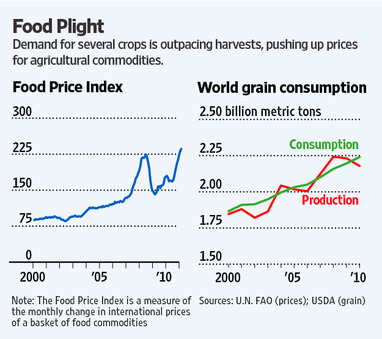
Chart of the Day: World grain consumption

WSJ from early March.  

Good example of the impact of the rising global middle class.

Also tells you something about the timing of the 2.0/Facebook Revolutions in food-dependent Arab world.

3:28PM

Obama: no American SysAdmin boots on the ground! (amended)

So he tells congressional leaders in Situation Room meeting, according to CNN just now.  Of course, sometimes certain US types show up very quietly on-site and nobody counts their boots, but we get the basic point.

Still, you have to wonder, why Mr.-All-Options-on-the-Table needs to flinch, pre-emptively, in such an obvious manner before even starting operations. Why signal that lack of intent up front? What does that buy you exactly from your opponent? Especially when it so clearly marks you as afraid of your own public?  It really makes you wonder about the quality of advice President Obama receives. It just comes off as so . . . I dunno . . . European, when Europe (at least parts of it) are acting more like America used to (making you wonder if Obama's purposefully suppression of US leadership really changes anything or just shifts the leadership impulse back to Europe's France--the one country there with an ambition to lead).

This is fine and dandy and I generally approve of the division of labor.  The more the "international community" picks up the SysAdmin work, the easier for the US Leviathan to works its magic.

Think back to the Balkans:  we did it mostly through the air and put forth only a small fraction of the eventual boots. But this time, given our current load and recent history, perfectly appropriate to line up others for the follow-through.  An excellent solution.  The Leviathan intervention will happen time and again, but Iraq-the-US-hogs-the-SysAdmin-show phenom never needs repeating.

But make no mistake, really no Leviathan action without us and our willingness to participate, and that's real leadership worth maintaining, because the entire system benefits whenever we can collectively muster norm enforcement.

No, we won't get it everywhere (across Gap) and we certainly don't need it everywhere (i.e., Core).  But when the opportunity is there, and the demand is there, and you are a difference maker on supply provision, you have to step up enough to enable the response.

Already we get a sense that Qaddafi's "cease fire" will be selective, but at least now we've entered into a serious negotiating stance.  This is all very positive.

3:18PM

New twist on interview (the cat stays in the picture!)

A while back, ZDF, or the German public TV network (largest in Europe), asks to do an interview for a 9/11 tenth anniversary documentary.  They say they'll have a crew in the US and would I be in Washington about now.  I say, possible but who knows.

A couple of weeks ago, they check back in and say they'll fly into Indy and shoot wherever I want.  Crew is coming back from West Coast (Rumsfeld) and going to NYC, so they'll drop by for a few hours.

So they come today (producer, camera guys for two shots) and we set up in my living room, and here's the twist: the correspondent interviewer asks me questions from Frankfurt via Skype via my laptop.  We prop the laptop on a chair, using my kids giant foam alphabet letter squares to get him about head height, and he conducts the interview just off camera--virtually. 

Bit weird, but it worked well.

Docu will be show early Sept in Europe.  I should get a DVD and book copy (reminder to self!).

Only problem was one of our Siberian cats strolling around, tail provocatively high, issuing one look-at-me! meow during an answer.  Enya may or may not make the final cut.

10:03AM

Libya declares cease-fire within hours of UN resolution on No-Fly-Zone

Shows you what a little flash of the Leviathan can do. [Later found not to be enough, but at least the conversation started for real.]

“We decided on an immediate cease-fire and on an immediate stop to all military operations,” Libyan foreign Minister Musa Kusa told reporters in the capital. He said Libya “takes great interest in protecting all civilians and protecting human rights,” adding that the government would also protect foreigners and foreign assets in the country.

Libya “accepts that it is obliged to accept the U.N. resolution,” Kusa said in explaining the decision to declare a cease-fire.

Yeah, right.  Libya simply knows what the US Leviathan is capable of. This isn't about WWIII, so no Hitler comparisons please; this is about managing the system and taking advantage of opportunities when they stare you in the face.  It's also about responding to an Arab League, and frankly the entire UNSC, that realizes they want this nut gone--finally.  And when you have all that demand in the system and do nothing about it, you look weak--not Hitler 1938 weak, because this is not a hysteric conversation, thank you.  Just weak. Leadership is an asset to be maintained, not a responsibility to run away from.  It has value.  We like to use it when it's appropriate.  It must be kept up.  Allies in Asia do want us to seem credible vis-a-vis China, and the majority of Arabs do prefer pax Americana to G-Zero. 

Slate says Hillary was the decider who convinced a recalcitrant Obama by going around his too cautious advisers/bodyguards/whatever.  He picked them because they reflect his thinking.  Thank God he also picked her.

I voted for Hillary in 2008, and would gladly do so again.