Buy Tom's Books
  • Great Powers: America and the World After Bush
    Great Powers: America and the World After Bush
    by Thomas P.M. Barnett
  • Blueprint for Action: A Future Worth Creating
    Blueprint for Action: A Future Worth Creating
    by Thomas P.M. Barnett
  • The Pentagon's New Map: War and Peace in the Twenty-first Century
    The Pentagon's New Map: War and Peace in the Twenty-first Century
    by Thomas P.M. Barnett
  • Romanian and East German Policies in the Third World: Comparing the Strategies of Ceausescu and Honecker
    Romanian and East German Policies in the Third World: Comparing the Strategies of Ceausescu and Honecker
    by Thomas P.M. Barnett
  • The Emily Updates (Vol. 1): One Year in the Life of the Girl Who Lived (The Emily Updates (Vols. 1-5))
    The Emily Updates (Vol. 1): One Year in the Life of the Girl Who Lived (The Emily Updates (Vols. 1-5))
    by Vonne M. Meussling-Barnett, Thomas P.M. Barnett
  • The Emily Updates (Vol. 2): One Year in the Life of the Girl Who Lived (The Emily Updates (Vols. 1-5))
    The Emily Updates (Vol. 2): One Year in the Life of the Girl Who Lived (The Emily Updates (Vols. 1-5))
    by Thomas P.M. Barnett, Vonne M. Meussling-Barnett
  • The Emily Updates (Vol. 3): One Year in the Life of the Girl Who Lived (The Emily Updates (Vols. 1-5))
    The Emily Updates (Vol. 3): One Year in the Life of the Girl Who Lived (The Emily Updates (Vols. 1-5))
    by Thomas P.M. Barnett, Vonne M. Meussling-Barnett
  • The Emily Updates (Vol. 4): One Year in the Life of the Girl Who Lived (The Emily Updates (Vols. 1-5))
    The Emily Updates (Vol. 4): One Year in the Life of the Girl Who Lived (The Emily Updates (Vols. 1-5))
    by Thomas P.M. Barnett, Vonne M. Meussling-Barnett
  • The Emily Updates (Vol. 5): One Year in the Life of the Girl Who Lived (The Emily Updates (Vols. 1-5))
    The Emily Updates (Vol. 5): One Year in the Life of the Girl Who Lived (The Emily Updates (Vols. 1-5))
    by Vonne M. Meussling-Barnett, Thomas P.M. Barnett, Emily V. Barnett
Search the Site
Powered by Squarespace
Monthly Archives
12:01AM

China spends more on security inside China than defense outside

Crouching dragon, rolling SegwayPic here

FT story a while back, noting that Chinese internal security spending now bigger - at least officially - than defense.  Of course, both numbers are probably underreported, just equally so.

Source was new budget released by China, saying public security will now cost 624B RMB and defense 602B RMB.

In the US federal budget, I would say defense outweighs "security" by more than 2-1.

You want to know why China can never be a true superpower without being democratic?  Good example, there.

8:29PM

Kicking off the A-to-Z rule set on processing politically bankrupt states


UK and France led the way, US votes yes, and rest of non-Western great powers all abstain {correction: Germany abstained, Russia voted yes}.

Still, you take it.  Let's hope it's not too late and Obama pulls out a win here.

A reminder of how I've described the ideal A-to-Z process, from Blueprint (lifting from the glossary page on this site):

  • UN Security Council indicts
  • G-20, acting as functioning executive, unleashes the Leviathan and finances reconstruction
  • Leviathan intervenes
  • SysAdmin stabilizes and begins nation-building
  • International Reconstruction Fund oversees rebuild
  • International Criminal Court adjudicates identified war criminals
  •  

    I  know, I know.  We were never going to do this - ever again!  But the point was always that we didn't need to do it alone, and if Obama's intransigence or strategic patience or whatever got it done right this time, then I eat my criticism of him, because the larger good here is worth pursuing.  That's why Russia and China abstained.

    11:20AM

    CoreGap 11.08 released - Obamaโ€™s โ€œChinese menuโ€ of Past Presidential Doctrines

    Wikistrat has released edition 11.08 of the CoreGap Bulletin.

    This CoreGap edition features, among others:

    • Obama’s “Chinese menu” of Past Presidential Doctrines
    • Disaster in Japan and instability in Gulf likely alter global energy landscape
    • China steps on growth brake, hunkers down on potential domestic unrest
    • Mexico, at wit’s end over blood-soaked drug war, pushes US for relief
    • Egypt’s political change agenda proceeds, but tougher economic reform awaits

    The entire bulletin is available for subscribers. Over the upcoming week we will release analysis from the bulletin to our Geopolitical Analysis section of the Wikistrat website, first being "Terra Incognita: Obama’s “Chinese menu” of Past Presidential Doctrines"

    To say that President Barack Obama’s foreign policy plate is full right now is a vast understatement, and it couldn’t come at a worse time for a leader who needs to revive his own economy before trying to resuscitate others (e.g., Tunisia, Egypt, South Sudan, Ivory Coast – eventually Libya?).  Faced with the reality that America’s huge debt overhang condemns it to sub-par growth for many years, Washington enters a lengthy period of “intervention fatigue” that – like everything else, according to the Democrats – can still be blamed on George W. Bush.

    It is estimated that 30 percent of the current US federal deficit was set in motion by the Bush administration and another 30 percent by Obama trying to correct those mistakes.  But the biggest problem remains the 40 percent triggered by entitlements growth – the simple aging of America.  With China now applying the brakes, Japan suddenly and sensationally damaged by mega-disaster, Europe still processing sovereign bankruptcies, and Arab unrest pushing up the price of oil, there appears no obvious “cavalry” riding to the global economy’s rescue.  It would seem that America’s “circle the wagons” mentality has gone global, as every beleaguered leadership now looks out for itself.

    Read the full piece here

    More about Wikistrat's Subscription can be found here

    To say that President Barack Obama’s foreign policy plate is full right now is a vast understatement, and it couldn’t come at a worse time for a leader who needs to revive his own economy before trying to resuscitate others (e.g., Tunisia, Egypt, South Sudan, Ivory Coast – eventually Libya?). Faced with the reality that America’s huge debt overhang condemns it to sub-par growth for many years, Washington enters a lengthy period of “intervention fatigue” that – like everything else, according to the Democrats – can still be blamed on George W. Bush.
    12:01AM

    Tossing in the towel on Libya

    Asked recent by a commenter what I would imagine a decent effort in Libya would entail, I now turn to Max Boot's piece yesterday in the WSJ entitled, "It's not too late to save libya."

    The guts of the military explanation:

    The Pentagon, from Defense Secretary Robert Gates on down, has reacted as if this would be a military operation on the order of D-Day. In reality, it would not be hard to ground Gadhafi's decrepit air force.

    The job could probably be performed with just one American ship—the aircraft carrier USS Enterprise, now in the Red Sea, which has 34 F/A-18F Super Hornets and 10 F/A-18C Hornets along with a full complement of electronic-warfare aircraft. The Enterprise strike group could also unleash a devastating array of Tomahawk cruise missiles.

    And the Enterprise would not have to fight alone. It could easily be joined by numerous American, British and French aircraft flying out of Aviano and other NATO bases in Italy. A forward operations base could be established at the Gamal Abdul el-Nasser airfield, one of Libya's major air force bases (built by the British), which is located south of Tobruk and has already been captured by the rebels.

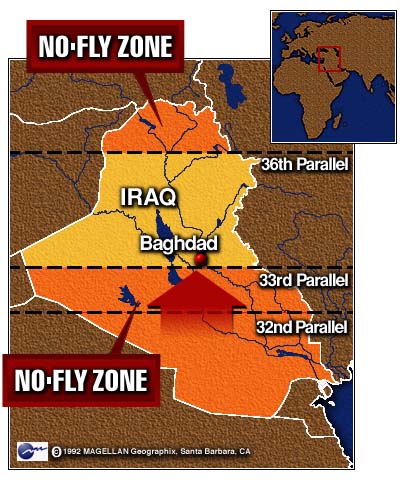
    As the enforcement of no-fly zones over Bosnia and Iraq should have proved, the risks of such an operation are minimal—especially if we first neutralize Gadhafi's air defenses.

    By itself, a no-fly zone might not be enough to topple Gadhafi. At the very least, however, it would dishearten Gadhafi's supporters and buy time for the rebels. We could further tilt the balance in their favor by bombing Gadhafi's installations and troops.

    It may also be necessary to send arms and Special Forces trainers to support the rebels. Without committing any combat troops of our own, we could deliver the same kind of potent combined-arms punch that drove the Serbs out of Kosovo when NATO aircraft supported ground operations by the Kosovo Liberation Army.

    That's pretty much what I was thinking of.  I just don't know enough operationally to express as well as Boot does here.

    Per the WSJ editorial on the preceding page, we are seeing how much "Arabs love the pax Americana."  I remember during Abu Ghraib and everything else hearing about how America's standing in the region would take "decades" to resurrect.  You knew that was bulls@&t then.  When the right circumstances hit the right fan, the Arab League wants our no-fly-zone, even if Turkey's Erdogan is being too egotistical to admit it.

    But of course, we now bow to the "international community," Obama's pet phrase decoded as, "I'm with chickens@$t!"  Just some leadership here would be nice.

    Niall Ferguson, in Newsweek, quotes some senior WH aide as saying, "[The President] keeps reminding us that the best revolutions are completely organic."

    Ferguson thereupon blows that idiotic reading of history out of the water.  Good God, take a peak at the American Revolution, why don't you?

    It scares me to think Obama really views history that naively.  Ferguson goes on to make a truly sophisticated argument on the Helsinki Accords killing the Soviet Union (whip communism . . . eventually, Jerry!).  Great point.  Revolutions that succeed without outside help are rare.

    But hey, now Washington seems to have bought into the Beijing Consensus when it comes to non-interference.  I'm sure the view on this new world order is great from Benghazi.

    10:24AM

    Chart(s) of the Day: Re-imagining China as countries/US states

    Per the popular US map that shows similar country GDPs, The Economist (by way of Robert Jordan Prescott) generates one for China.

    Then there's Nicholas Vardy's version in his "Global Guru" newsletter (by way of Dan Hare). 

    Which does up China with comparable US states.

    Both designed to help you realize how big China is becoming in economic output.

    10:35AM

    Chart of the day: The heartbeat of the global economy

    Instability in the Middle East tracks very tightly to global oil price shocks (displayed here as percentage changes over the years), and the "past five global recessions have all followed sharp jumps in the oil price," according to the FT, from whence this chart comes.

    It almost looks like a heartbeat, does it not (?), the odd thing being how it always seems to settle back into a stable pattern of relatively small price changes.

    But I think that ends with the sustained demand growth in the East.  I think the upward pressure only grows and we thus get a new normal of consistently rising prices once this current instability settles out.

    Truth of the situation:  The world pays one way or the other.  It either pays by intervening or it sits back and pays because the instability plays out longer.  But the world pays.

    [Apologies for the sloppy wording in the first draft (pointed out by a commenter who needs to offer up a better fake name if he wants to be posted).  I am working monster hours right now and so I tend to shortchange the blog a bit, dashing through posts. But, with 8 mouths to feed, I am happy to be working so much.]

    9:31AM

    WPR's The New Rules: Obama Abdicating U.S. Leadership in Libya

    If President Barack Obama's handling of the events in Libya exemplifies his own definition of a "post-American world," then we have moved past a G-Zero reality, which is how Nouriel Roubini and Ian Bremmer described a G-20 that can't agree on how to rebalance global power, and into what I would describe as the "G-Less-Than-Zero" world, where America purposefully abdicates its global leadership role.

    Read the entire column at World Politics Review.

    12:03PM

    Blast from my Past: The New Map Game (2005)

    Event was held in the spring of 2005.  Jeff Cares' firm, Alidade, in Newport, ran the game with me as head judge.

    Four teams (US as Old Core rep, China as New Core rep, Brazil as Seam State and Iran as Gap), and we had about 12-15 players on each team (the people who signed up for the event)  Jim Fallows came and observed the China team throughout.

    We had a dinner the night of day one, where I did my big PNM brief.  Then full day of play, where I previewed Blueprint at the end.  Then half-day the final day, where Steve DeAngelis and I did a combo from the stage discussing the emerging partnership between the New Rule Sets Project and Enterra Solutions.  Months later Steve bought my company and me along with it.

    The game itself extended about a decade or so into the future, with various moves every X years.

    I wrapped things up with comments on day three.  The Alphachimp guys were drawing throughout.  Here's the one they drew for my closing comments:

    Thinking of my ongoing criticism of Obama:  we came out of the exercise saying we wanted something that's Carter-like but with Reagan's backbone (I had mentioned Reagan, but the artist put down Dole), or a Republican Carter administration.  Interesting to consider now with Obama:  just a bit more Reagan and he'd probably be about right for the times.  The other big lesson:  China refused to get in a war with the US - no matter the scenarios we threw at the China team.  It was one of my many data points that said, China will disappoint at a near-peer competitor--as far as the Pentagon is concerned.

    Odd tidbit:  years later we find out that one of the participants is one of those sleeper Russian agents finally unearthed and sent back home a while back.

    The New Map Game site is still up and have all these drawings, links to press stories, gamebook and final report.

    Click here to download the final report.

    1:30PM

    Appearance on "The Alyona Show"


    Where I blew it:  I moved around too much.  I have a terribly hard time holding still, because the more still I am, the more boring I am, and the more I move, the better I sound--but don't look.  I also got too close at points, letting my chin get covered by byline and making me too big relative to her in the 2-shot look.  Next time I will hang a cut-out over the screen so I know where my head should be.  Beware the big head!

    It is a conundrum.

    Other thing:  I have a clip-on mike that I could have and should have used!  Could have lit myself better too. Next time I will do better.

    I had spent a good chunk of time just beforehand spreading mulch outside--hence the raccoon-like lower eyelids.

    I will say, though, so much nicer just to do from office as opposed to the 2-3 hour effort to go all the way downtown, etc.  that part I simply love.

    3:57PM

    Going on RT's The Alyona Show tonight (6:30ish)

    RT stands for Russia Today.   I am very familiar with the station, as I've watched it at length during stints in DC, where it is broadcast.

    It is, shall we say, an acquired taste, but Alyona's show is the most interesting, so I'll be on to talk about China primarily, the trigger being, I am certain, Clapper's testimony yesterday.

    We'll see where it goes and how I like it.

    Another reason I say yes:  always wanted to try Skype live on TV from home office, so this is first.

    11:03AM

    Realizing our hand in Libya


    Austin Bay on Strategy Page (by way of Craig Nordin) a couple days back talking about covert action.

    I don't know Bay personally, but he always impresses with his just-aggressive-enough logic that you always want him in the discussion, and I believe his thinking here is especially welcome.

    Everybody keeps saying, No-Fly-Zone equals act of war, but that's a red herring.  It is a clear abrogation of sovereignty in this age, but it does not signal a classic state-on-state war dynamic, where the "act of war" logic is appropriate.  No one thought we were at war with Saddam across the 1990s when we NFZ'd both north and south, and this is an entirely feasible route for us to go here, one that's short of serious intervention (and all that entails) and beyond just sitting on our hands or taking in refugees.

    But here's Bay's point that really struck me, because it's why I'm writing my WPR column for Monday on having exactly the same feeling in my own head these past few days:  We are letting a winning hand go to waste here.

    Bay:

    Here's a clue: 2011 finds America representing history's winners at the strategic, long-term level. The demands for freedom in the streets of Tunis and Cairo echo the U.S. Declaration of Independence. Ironically, 2011 also finds an American government that is tactically alienated from these energized democratic forces because it is convinced of America's past agency in what its left-wing academic gurus call imperialism, racism, reactionary-ism, et cetera. For these toffs, the hint of U.S. involvement in an event taints its historical purity, or some equivalent balderdash.

    But the world isn't a faculty lounge. In Libya, as President Obama mulls, Gadhafi's air force mauls.

    We only get so many opportunities to lead, and this is one of them.  So this is where Obama has to decide if he really is, as the Right contends, born and bred for a "post-American world" or whether his definition of renewal allows for a reversal of that perception.  I find the whole PAW concept (less Zakaria's actual book but how the notion is employed) to be the most insidious form of self-defeatism, and entirely inappropriate for the age we're in.  Even the "risers," when you examine where they're at and what they need, don't really welcome this notion in reality--just in anticipation.  Unless Obama can start articulating something post-"post-American world," I would have to argue that we'd be better off with somebody else come 2012, just like I did with Bush in 2004 (and yes, I am concluding that, in this era, we cannot afford 2-term presidents).  I just don't think the world can afford 4 more years of such non-leadership.  We need something short of Bush but above what Obama is mustering right now.

    9:26AM

    Esquire's Politics Blog: Battle: Libya? How the Pentagon Cured America's War Itch

    Before and after President Obama decided to be "very unambiguous" about why Muammar Qaddafi should step down, a lot of people were reading way too much into his defense secretary's comments above, made at West Point as part of a legacy tour that just happened to fall in the middle of a civil war. Was this some pre-emptive kind of door-slamming on the prospect of U.S. military intervention in Libya and whatever follow-on "Facebook revolutions" are to come? Not really. As MacArthur himself — a serious headcase if there ever was one — discovered with Truman, only the commander-in-chief makes those calls. The rest of us are just advisers, onlookers, and ne'er-do-wells.

    And don't read too much into Hillary Clinton's own Libya whopper on Tuesday — "this doesn't come from some Western power or some Gulf country saying this is what you should do, this is how you should live" — because there's a lot more going on here than no-fly zones. As the world awaits our next move in the Middle East's power struggle, an intense battle is unfolding within the national-security establishment back home: The "future of the force," as insiders here in Washington and around the Pentagon like to call it, hangs in the balance. And Robert Gates, having already advertised that the United States of America had reached its limits and now poised for his final power play, knows how to counter better than anyone in the president's ear.

    Can we interpret the Gates comments — made on his way out the door and protecting his tenuous small-war legacy every step of the way — as a repudiation of Bush and Cheney's long-war logic? Again, not really. (And please take note that almost all of the proposals out there for "surgical" this-and-that in Libya comes closer to Rumsfeld's vilified light-and-fast mentality than anything approaching a mass land force occupation.)

    Does the Defense Department suddenly want to walk away from this "era of persistent conflict," as Gates likes to call it? No. (He's fully supports Obama's our-badassess-versus-their-badasses approach to counter-terrorism, swapping out Bush's bring-'em-on bravado for remorseless killing drones).

    Is the U.S. military, as Gates said in the West Point speech, an "institution transformed by war" to the point of tamping down any possible major land war in Asia? Only insofar as we're keeping counterinsurgency alive and the troops safe. (Remember the last time we ditched that plan?)

    But in staring down the Obama administration's wave of withdrawal from the world — the "post-American world" vibe that has we'll-be-number-one-again pundits like Tom Friedman and Fareed Zakaria headed straight for Qadaffi's bookshelf — Bob Gates swims against it. While managing two wars, he got fed up with trading future combat casualties in imaginary wars with China against today's very real ones, so you'll have to excuse him for sounding such somber notes. And God bless him for that, because it took a while to get here.

    Read the entire post at Esquire's The Politics Blog.

    10:41AM

    WPR piece on Indian strategist's take on China-US "term sheet" effort

    Piece by Saurav Jha in World Politics Review on piece K. Subhramanyam wrote on the term sheet just before he died.

    I excerpt the parts that included by rebuttals, which I gave Saurav via emails.

    With Indian newspapers still carrying obituaries of the country's strategic doyen, K. Subhramanyam, who passed away in February after almost a half-century at the forefront of New Delhi's strategic debates, it is worth considering the object of Subhramanyam's concern during his final days: the implications for India of a proposed U.S.-China grand strategy agreement hammered out by a group of policy experts in Washington and Beijing. The document proposed a series of strategic compromises between China and the U.S., including a massive Chinese investment in the U.S. economy in return for an informal nonaggression pact, particularly with regard to the U.S. military's posture toward China in Taiwan. Indian analysts led by the late Subhramanyam, however, saw the proposal as a ploy by the Chinese to "use the U.S. to attain hegemonic power in Asia."

    In the proposal, Subhramanyam heard echoes of the Nixon-Deng compact, born out of the expediency of the Cold War. That agreement saw the United States push huge sums of commercial technology investment into China, ultimately followed by the outsourcing of mass manufacturing. Now, by contrast, it is high technology that would be transferred to China in return for the $1 trillion that Beijing would invest in the U.S. private sector. Over time, these transfers would enable China to leverage its demographic advantages to become the world's dominant economy.

    However, Thomas P.M. Barnett, one of the proposal's architects, rejected the significance of China's advantage in absolute demographic numbers. "The volume of bodies no longer determines strength in this world, especially when hundreds of millions of [those bodies] are impoverished, as they are today and will remain for decades in China," said Barnett. "It is much smarter to consider age." As Barnett explained, both China and the United States currently have a median age of 36. But with China aging four times as quickly as the U.S., its median age will hit 48 in 2050, while the U.S. will only have reached 39 . . . 

    Subhramanyam highlighted the fact that, despite spelling out agreements on Taiwan and Iran, the strategic proposal is completely silent on Pakistan and its nuclear and missile-technology relationship with China. He questioned whether that amounted to conceding Pakistan and South Asia to the Chinese sphere of influence. Barnett disputes that interpretation. "The proposal wasn't meant to be universally inclusive," he says, "but to reference only those issues that created deep strategic mistrust between the U.S. and China. [For the U.S.], Pakistan doesn't qualify, for obvious reasons" . . . 

    The timing of the strategic proposal was also suspect in Subhramanyam's eyes, who felt that its release just after Obama's visit to India was an attempt by Beijing to tempt Washington away from New Delhi with the offer of a major U.S economic bailout. His prescription was for India to move more quickly on forging closer ties with the U.S. and for proponents of nonalignment in India to reconsider their stand. 

    Clearly, despite the world's shift toward multipolarity, the remaining superpower is still highly sought after by the most dynamic new poles, located on either side of the Himalayas. And the fact that an unofficial backchannel proposal attracted the attention of such a heavyweight as Subhramanyam reflects the stakes involved.

    The China-India rivalry throughout Asia is obviously operative and growing, with Pakistan a key potential flashpoint.

    One scenario that lightens this:  once US out of Afghanistan, US attention will shift to containing Pakistan and its many instabilities.  This may become the common goal around which new understandings are possible among Washington, Beijing and New Delhi.

    10:23PM

    The war of attrition in Libya

    Watching the news, if this goes down and Qaddafi survives, we will have so much blood on our hands.  

    At its most basic:  very evil leader, people putting it on the line, and we stand by on a very vulnerable regime. This is a 6-7m population, all along the coast. This isn't Iran - not even close.

    Don't care about the framework (NATO, UN, whatever), because, in the end, it'll be us that leads the way.

    I'm with Ajami on this one:  a "moment of reckoning for the Obama administration."  Pledging humanitarian aid won't be enough.  Obama will regret this like Clinton regretted Rwanda. Time for Mrs. Clinton to earn her spurs.

    We let this go down and we'll be hated anyway, and we hate ourselves for letting it happen. So what is the big difference?  There will be no working with the guy after this anyway, so what is the downside?  The Saudis hate him, because of the hit he tried on Abdullah.

    We recognize the rebels.  We supply them.  We drone and fly aircraft in order to make it impossible for Qaddafi to win.  We tell the Russians and Chinese this presents zero precedent for anything involving them.

    We simply do what's right.

    I realize it's no easy call for Obama, but at some point you need to move away from what you can't live with and toward something you can stand.  Qaddafi, if he wins, will go on killing and torturing for a very long time.

    Just about everybody needs outside help in these things.  We did.

    10:49AM

    Grand Strategy Competition - Wikistrat

    Wikistrat is gearing up for an exciting International Grand Strategy Competition.

    Select teams representing leading academic institutions from around the world are invited to participate in the first ever wiki-based grand strategy competition. Managed by Dr. Thomas PM Barnett, this competition will provide participants with the opportunity to test their skills with global counterparts and network within that community. Participants can demonstrate their capacity for strategic thought to agencies, institutions and firms seeking to recruit up-and-coming analytic talent.

    We are currently reviewing applications by groups representing top Universities and Think Tanks worldwide. There are still open spots available for this exciting event.

    To nominate a team, or to see if you institute has been invited, contact us HERE.

    Participation is free, and winner team will get a $10,000 prize.

    Some of the issues we will cover in the Competition include (Download the full PDF OUTLINE:

    1. Global Energy Security

    2. Global Economic “Rebalancing” Process

    3. Salafi Jihadist Terrorism 

    4. Inevitable Sino-American Special Relationship

    5. Southwest Asia Nuclear Proliferation

    Some of the Scenarios explored will include:

    1. Major Biological Terror Attack

    2. “2.0 Revolutions” in Arab World

    3. + Additional Surprise Shocks

    10:43AM

    WPR's The New Rules: Leadership Fatigue Puts U.S., and Globalization, at Crossroads

    Events in Libya are a further reminder for Americans that we stand at a crossroads in our continuing evolution as the world's sole full-service superpower. Unfortunately, we are increasingly seeking change without cost, and shirking from risk because we are tired of the responsibility. We don't know who we are anymore, and our president is a big part of that problem. Instead of leading us, he explains to us. Barack Obama would have us believe that he is practicing strategic patience. But many experts and ordinary citizens alike have concluded that he is actually beset by strategic incoherence -- in effect, a man overmatched by the job. 

    Read the entire column at World Politics Review.

    12:01AM

    Which is it, Economist? 6B more people in 30 years or 2B in 40?

    Saw this ad and it jumped out at me?

    6 billion more people in 30 years!

    Nobody is predicting that level of growth anymore.  Virtually all the smart money says we're 6.7-8 now and we'll top out at roughly 9.2-3 around 2050, meaning we add 2.5B over 40 years.

    Then I see the special report that the mag just puts out on ag:  it says we're almost 7B and we're going to add 2b more by 2050.

    That, my friends, is one helluva delta.

    True numbers on urbanization, though, say we go from about 1/2 urban now to more like 70% by 2050.  You can find all this on our "urbanization shift" page at Wikistrat.  You run those numbers and you get roughly 3B new urbanites by 2050, or 75m a year added, on average, for 40 years.

    12:01AM

    Quoted in Reuters piece on Qaddafi

    Ever get the feeling that, if Hugh Hefner was a Middle Eastern dictator, he'd be Qaddafi?  Right down to his hundreds of buxom young babe bodyguards?

    Piece by Peter Apps entitled, "Could Libya war crimes talk just entrench Gaddafi?"

    My bit near end:

      Others say that -- like the threat of economic sanctions or military action -- at the end of the day the prosecution threat may simply become another diplomatic bargaining chip.  

       "A war crimes indictment demonstrates the resolve of the international community," said Thomas Barnett, chief analyst of political risk consultancy Wikistrat. "To the extent that it pushes an embattled leader into a corner, it can likewise be retracted as part of the collective bargaining for an acceptable exit scenario for the leader, his family and top associates." 

    Covered this subject, naturally, in this week's CoreGap Bulletin.

    9:20AM

    Plopping a $1B bet on China getting old

    Altered photo found here.

    FT story from last month on Fortress Investment planning to raise $1bn fund to invest in housing for China's growing elder population. Fund is US-based and operates the largest senior independent living facilities in NorthAm.

    Piece references the 4-2-1 problem (four grandparents, two parents, and one child to rue them all!).

    Today 155m of 1.3b are over 65.  Add 100m by 2020.  

    Focus will be on major cities with the funds to support development.

    Interesting.

    1:05PM

    Wikistrat's Middle East Monitor (#3)

    We're excited to announce the launch of Wikistrat's Middle East Monitor for February 2011, which can be viewed in entirety by clicking here.

    Summary

    The Mid­dle East and North Africa is again a pro­foundly dif­fer­ent place than it was in De­cem­ber 2010 or even in Jan­u­ary 2011. The biggest de­vel­op­ment is the down­fall of Egypt­ian Pres­i­dent Hosni Mubarak as a re­sult of the up­ris­ing in Tunisia that brought down Pres­i­dent Ben Ali. As a pop­u­la­tion with over 80 mil­lion peo­ple and a major strate­gic power, the suc­cess of the up­ris­ing ex­po­nen­tially in­creases the mo­men­tum of pro­test­ers in the re­gion that has ex­isted since Tunisia’s Jas­mine Rev­o­lu­tion.

    Major un­rest has struck al­most every sin­gle coun­try in the Mid­dle East and it has spread as far as China, Al­ba­nia, Be­larus and Venezuela. The gov­ern­ments in the re­gion are now en­gaged in a del­i­cate bal­anc­ing act of of­fer­ing major con­ces­sions while at times or­der­ing se­cu­rity forces to use vi­o­lence to dis­perse es­ca­lat­ing demon­stra­tions. Every gov­ern­ment is closely watch­ing de­vel­op­ments in the en­tire re­gion to de­ter­mine their own course of ac­tion. Coun­tries like Bahrain and Yemen have of­fered major con­ces­sions, in­clud­ing eco­nomic aid pack­ages and more po­lit­i­cal free­dom, while the Libyan gov­ern­ment has cho­sen to use an in­cred­i­ble amount of vi­o­lence. The fate of these gov­ern­ments will de­ter­mine what the lead­ers in the re­gion de­cide are the best ways to stay in power.

    Wikistrat Bottom Lines

    Go!Opportunities

    • The overall demand for liberalization can open the door to Foreign Direct Investment as economic openness is demanded and governments resort to economic reforms to reduce internal stresses.
    • The demand for political liberalization can permit a better flow of information and ideas, allowing for a proliferation of voices and opinions.
    • Western support for those demanding reforms can decrease hostility, particularly towards the U.S., over the perception that it is not committed to human rights and has imperialistic motivations.

    Stop!Risks

    • Islamists like the Muslim Brotherhood could come to power because of the desire for a greater role for Islam in public life, their superior organization and in some cases, a desire for some elements of governance based on Sharia law.
    • Anarchy could result as protesters clash with security forces. This can lead to instability that negatively affects world markets and potentially result in the damaging of oil facilities.
    • The increased power of the populations could result in foreign policies more hostile to the West and more favorable to Iran.

    Warning!Dependencies

    • The appeal of the Islamist parties and political figures. It is possible that the population will not feel the Islamist candidates are qualified to improve the economy or carry out reform or may simply question their agenda once campaigning is underway.
    • The loyalty of the security forces. This is an important factor as they are the ones given the responsibility to ensure the survival of the governments, but they may defect if ordered to become violent.
    • The unity of the opposition. Division can weaken the opposition and strengthen the government and lead to dysfunction during a power vacuum.

     Click here to download the summary as a PDF document. Subscribers can download this entire edition in PDF or view on our interactive wiki.