Buy Tom's Books
  • Great Powers: America and the World After Bush
    Great Powers: America and the World After Bush
    by Thomas P.M. Barnett
  • Blueprint for Action: A Future Worth Creating
    Blueprint for Action: A Future Worth Creating
    by Thomas P.M. Barnett
  • The Pentagon's New Map: War and Peace in the Twenty-first Century
    The Pentagon's New Map: War and Peace in the Twenty-first Century
    by Thomas P.M. Barnett
  • Romanian and East German Policies in the Third World: Comparing the Strategies of Ceausescu and Honecker
    Romanian and East German Policies in the Third World: Comparing the Strategies of Ceausescu and Honecker
    by Thomas P.M. Barnett
  • The Emily Updates (Vol. 1): One Year in the Life of the Girl Who Lived (The Emily Updates (Vols. 1-5))
    The Emily Updates (Vol. 1): One Year in the Life of the Girl Who Lived (The Emily Updates (Vols. 1-5))
    by Vonne M. Meussling-Barnett, Thomas P.M. Barnett
  • The Emily Updates (Vol. 2): One Year in the Life of the Girl Who Lived (The Emily Updates (Vols. 1-5))
    The Emily Updates (Vol. 2): One Year in the Life of the Girl Who Lived (The Emily Updates (Vols. 1-5))
    by Thomas P.M. Barnett, Vonne M. Meussling-Barnett
  • The Emily Updates (Vol. 3): One Year in the Life of the Girl Who Lived (The Emily Updates (Vols. 1-5))
    The Emily Updates (Vol. 3): One Year in the Life of the Girl Who Lived (The Emily Updates (Vols. 1-5))
    by Thomas P.M. Barnett, Vonne M. Meussling-Barnett
  • The Emily Updates (Vol. 4): One Year in the Life of the Girl Who Lived (The Emily Updates (Vols. 1-5))
    The Emily Updates (Vol. 4): One Year in the Life of the Girl Who Lived (The Emily Updates (Vols. 1-5))
    by Thomas P.M. Barnett, Vonne M. Meussling-Barnett
  • The Emily Updates (Vol. 5): One Year in the Life of the Girl Who Lived (The Emily Updates (Vols. 1-5))
    The Emily Updates (Vol. 5): One Year in the Life of the Girl Who Lived (The Emily Updates (Vols. 1-5))
    by Vonne M. Meussling-Barnett, Thomas P.M. Barnett, Emily V. Barnett
Search the Site
Powered by Squarespace
Monthly Archives
8:13AM

WSJ: "The Chinese want our nuts." Roast 'em if you got 'em!

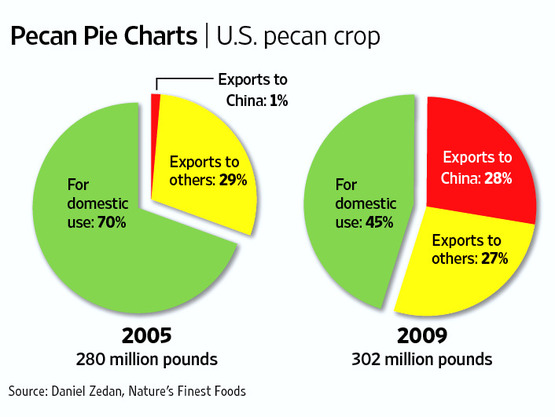
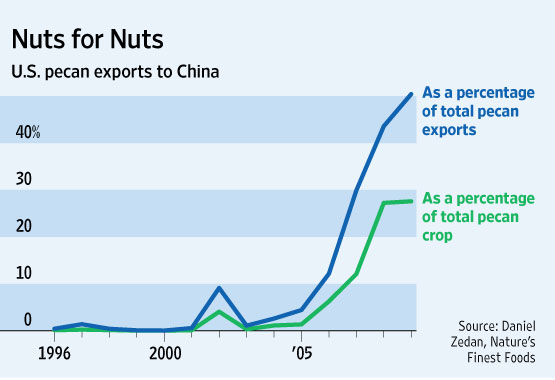
Sometimes China feels like a nut (2009), sometimes it doesn't (2005).  But when it does and that nut is the pecan, then an entire US industry changes - overnight.

Pecans are very American, the WSJ piece begins, as the pecan is the state nut of Arkansas, Alabama and Texas. Since forever, the price of pecans has followed the usual ag pattern of boom-and-bust. That all changed a few years back when the Chinese and their burgeoning middle class entered the picture.

Why do the Chinese get so turned on to pecans?  Advertising. Retired Chinese woman:  "We used to eat only walnuts, and then we saw on TV that pecans are more nutritious than walnuts." 

And an industry is reshaped.

The underlying dynamic that will increasingly knit the two nations together:

Nearly $1 of every $5 China spent on U.S. items last year went to buy food of some sort, $16.6 billion worth, according to the U.S. Department of Commerce. U.S. exports of goods of all sorts to China more than doubled between 2005 and 2010. Exports of crops and processed foods—soybeans, dairy, rice, fruit juice—more than tripled. Exports of pecans rose more than 20-fold.

Naturally, fears arose in the industry - or at least among its middlemen.  Check this out:

American shellers complained that selling so many premium pecans to China—the Chinese want the biggest, best nuts—would undermine both the domestic market and export markets in Europe. So they held back orders. China responded by going directly to growers. As Texas A&M pecan expert Jose Pena puts it: "It's kind of hard to tell a grower not to sell to the highest bidder."

There is a larger lesson in there:  US could use a new partner but prefers the seemingly safe "known known" of Europe.  Then China comes along and upsets the dynamics, but still the industry's insiders say, we must stick with what we know.  China goes directly to suppliers, and this is a bit threatening, but who can argue with sales?

Same is true for a lot of what America seeks to do in the Gap/developing world.  We assume our only allies are our old allies.  China shows up and creates all this positive change, but we find it upsetting and have a hard time interacting with them on the subject, preferring our known knowns from Europe. But the path ahead is clear enough:  the market has shifted and we've got some new friends - if we choose to get past the fear and recognize them as such.

This has been my underlying logic going back to "Blueprint for Action" (2005, but started briefing in late 2003). "Implausible!" and even "impossible" in the pol-mil realm, because we prefer the enemy image (AirSea Battle Concept), but the solution for our having too few resources to throw against too many fake states undergoing remapping in the Gap is clear enough: you ally yourself with the great demand producer in the system right now.

10:06AM

WPR's The New Rules: Strategic Balancing vs. Global Development

The World Bank's 2011 World Development Report is out, and this year's version highlights the interplay between "conflict, security, and development." That's a welcome theme to someone who's spent the last decade describing how globalization's spreading connectivity and rules have rendered certain regions stable, while their absence has condemned others to perpetual strife. But although the growing international awareness of these crosscutting issues is long overdue, the report ultimately disappoints by focusing only on the available tools with which great powers might collaborate on these stubborn problems, while ignoring the motivations that prevent them from doing so. 

Read the entire column at World Politics Review.

11:10AM

Quoted in Time magazine article on US defense budget

Very sharp article by Mark Thompson.

The opening:

On a damp, gray morning in late February, Navy admirals, U.S. Congress members and top officials of the nation's biggest shipyard gathered in Norfolk, Va., to watch a computerized torch carve bevels into a slab of steel as thick as your fist.

The occasion: the ceremonial cutting of the first piece of a $15 billion aircraft carrier slated to weigh anchor in 2020. That ship — still unnamed — will follow the just-as-costly Gerald R. Ford, now 20% built and due to set sail in 2015.

Meanwhile, on the other side of the world, China is putting the final touches on a new class of DF-21 missiles expressly designed to sink the Ford and its sister ship as well as their 5,000-person crews. China's missiles, which will likely cost about $10 million each, could keep the Navy's carriers so far away from Taiwan that the short-range aircraft they bear would be useless in any conflict over the tiny island's fate.

Aircraft carriers, born in the years before World War II, are increasingly obsolete platforms of war. They feature expensive manned aircraft in an age when budgets are being squeezed and less expensive drones are taking over. While the U.S. and its allies flew hundreds of attack missions against targets in coastal Libya last month, cruise missiles delivered much of the punch, and U.S. carriers were notable only for their absence. Yet the Navy, backed by the Pentagon and Congress, continues to churn them out as if it were still 1942.

"It's just tradition, the industrial base and some other old and musty arguments" that keep the shipyards building them, says Thomas Barnett, a former Pentagon deep thinker and now chief strategist at Wikistrat, a geopolitical-analysis firm. "We should scale back our carrier design to something much cheaper and simpler. Think of mother ships launching waves of cheap drones — that would actually be more frightening and intimidating." Even Defense Secretary Robert Gates warned last year of "the growing antiship capabilities of adversaries" before asking what in Navy circles had long been the unaskable question. "Do we really need 11 carrier strike groups for another 30 years when no other country has more than one?"

Across Washington, all sorts of people are starting to ask the unthinkable questions about long-sacred military budgets . . .

Our conversation was mostly about carriers.  I'm not the great hardware man, but I know enough that we're continuing to buy in the very-few-and-ridiculously-expensive mode rather than the many-and-the-cheap mode that's clearly emerging in cutting-edge technologies.  I know also that we're deeply impressed with China's efforts to catch-up on that same track, which, of course, is truly meaningful if you believe major conventional war with China is in the offing.  I do not, and so I find that spending on both sides to be largely a waste, less so for us because we seek to keep high the threshold to great-power war and that's a good thing. Problem is, we teach China the same path and now we're increasingly locked into this idiotic arms race that serves neither of our actual national security interests and actually denies us the cooperation that would enable both to accomplish more in the global security arena at less cost.

But why save money - and the world, when we can waste it in large amounts?  We're stuck in our QWERTY pathway because it's what we know and love, and it's what our Congress loves to buy.  And so China follows us stupidly down that rabbit hole, and we both dream of future missile wars over no-man's lands, while the reality of globalization's rapid expansion stares us in the face in Africa and the Middle East and we're largely irrelevant to the process because we continue to buy billion-dollar platforms to tackle $100 enemies.

This is my favorite part of the piece, worth getting into the blog for later use:

We are spending more on the military than we did during the Cold War, when U.S. and NATO troops stared across Germany's Fulda Gap at a real super-power foe with real tanks and thousands of nuclear weapons aimed at U.S. cities. In fact, the U.S. spends about as much on its military as the rest of the world combined.

And yet we feel less secure. We've waged war nonstop for nearly a decade in Afghanistan — at a cost of nearly a half-trillion dollars — against a foe with no army, no navy and no air force. Back home, we are more hunkered down and buttoned up than ever as political figures (and eager defense contractors) have sounded a theme of constant vigilance against terrorists who have successfully struck only once. Partly as a consequence, we are an increasingly muscle-bound nation: we send $1 billion destroyers, with crews of 300 each, to handle five Somali pirates in a fiberglass skiff.

While the U.S.'s military spending has jumped from $1,500 per capita in 1998 to $2,700 in 2008, its NATO allies have been spending $500 per person over the same span. As long as the U.S. is overspending on its defense, it lets its allies skimp on theirs and instead pour the savings into infrastructure, education and health care. So even as U.S. taxpayers fret about their health care costs, their tax dollars are paying for a military that is subsidizing the health care of their European allies.

Not only is our government becoming an insurance company with an army (some DC wag's great line), but we're enabling others to do the same while they cut down their own army.

And yes, China is headed on the same path.  It dreams of a moment in the sun, but it will be cruelly brief and then the realities of accelerated aging and global security vulnerabilities sets in, and then all this arms build-up over Taiwan and the island chains will seem like so much nonsense.  But, most definitely, the PLA has a few good years of stupid, uncontrolled spending ahead of them, and it will act like any bureaucracy in that mode:  it will waste money catching up somewhat to America's Leviathan force, and when it gets close enough to matter, Beijing will realize it was all a colossal waste of time and money that bought them nothing, because they will never pull that trigger, and even giving the impression that they will triggers a counter-balancing across the region that America is only too happy to provide in terms of arms sales.

Pointless, pointless, pointless.

Meanwhile, globalization moves on, creating the real global security landscape out there.

I say, thank God our budget mess arrived earlier than theirs, because it will force the logical change earlier than theirs.  We will be renewed; they will drop off a demographic cliff - and globalization will move on.

Mentioned in the piece one more time:

But $1 trillion in cuts wouldn't really be as drastic as it sounds — or as the military's no-surrender defenders insist. Such a trim would still leave the Pentagon fatter than it was before 9/11. Besides, there are vast depots of weapons that are ready for the surplus pile. The number of aircraft carriers could be cut from 11 to eight, and perhaps all could be scuttled in favor of Barnett's drone carriers. The annual purchase of two $3 billion attack submarines to maintain a 48-sub fleet as far as the periscope can see also could be scaled back. The $383 billion F-35 program really isn't required when U.S. warplanes remain the world's best and can be retooled with new engines and electronics to keep them that way. Reagan-era missile defenses and the nuclear arsenal are largely Cold War relics with little relevance today. Altogether, Congress could save close to $500 billion by smartly scaling back procurement over the next decade.

It's a bold and intelligent argument from Thompson, and I really think this is one of the best pieces of his that I've ever read.  It comes very close to opinion journalism - but at its best.  These are fair questions, and he poses them well.

Plus, I just like the phrase, "Barnett's drone carriers."

10:47AM

As the acrimonious debate gets even nastier, a stern warning from the IMF

Interesting to track this debate, as there seems to be three camps: one that thinks Obama is a terrible leader and that the GOP proposals are worth considering (WSJ), one that thinks he's the man and the GOP proposals amount to "sadism" (see Esquire's The Politics Blog in a virtuoso display of ad hominem attacks- and no, I am most definitely not part of that "Collective" and wish the writers there would simply identify themselves) and then there's the tiny apparent middle that wants serious action and hopes some actual negotiations come about, but since our adjectives and adverbs lacks the same hyperbole as the extremes, if we open our mouths we are ridiculed for not condemning the "obvious" threat to humanity/decency on this one.

So much for post-partisanship.  The politicians and punditry seem as out of control as ever.

Meanwhile, the IMF, in which we own the most votes, says we lack a "credible strategy" to stabilize our public debt, noting that we're the only major economy that is increasing its budget deficit when its growth is sufficient to start decreasing its debt accumulation.  And as it looks, we'll be the only advanced country, along with messed-up Japan, still increasing our public debt come 2016.

The IMF says we're less than halfway there on both the cuts and the tax increases needed.  Conveniently, we have two parties deeply committed to preventing both solutions but no leadership among the collective able to forge the combined solution.

We can get away with this for a while, but it is a selfish track that will increasingly engender blowback from the world - as it should.  We're behaving and speaking like children, and it's embarrassing to be an American these days.

1:00PM

CoreGap 11.10 Released - How the Frugal Superpower Navigates Democracyโ€™s Latest Wave

 Wikistrat has released edition 11.10 of the CoreGap Bulletin.

This CoreGap edition features, among others:

  • Terra Incognita - How the Frugal Superpower Navigates Democracy’s Latest Wave
  • Syrian Domino Displaying the Usual Dynamics, but West Hesitant
  • China’s Democracy Crackdown Goes from Preventative to Pre-emptive
  • Bold Republican Budget Proposal Sets Tone for US Presidential Campaign
  • World’s Scientific Production Grows, Becomes Increasingly non-Western

And much more...

The entire bulletin is available for subscribers. Over the upcoming week we will release analysis from the bulletin to our Geopolitical Analysis section of the Wikistrat website, first being "Terra Incognita: How the Frugal Superpower Navigates Democracy’s Latest Wave"

In the rush to define President Barack Obama’s “doctrine” following his decision to lead NATO’s initial no-fly-zone operations in Libya, experts have latched onto every detail’s possible meaning.  But in the end, it’s easier to say what his strategy is not than what it is.  While frustrating, such ambiguity makes sense for a cost-conscious superpower navigating what is arguably democracy’s emerging 4th great wave (see Samuel Huntington re: 1-3).

The Obama rule set clearly lacks rigidity.  It does not promise responses everywhere, but more like anywhere it can get away with them.  In application it is opportunistic: Obama sees a chance to finally put the US on the right side of history across the Arab world, and he intends on picking his targets carefully – and in logical sequence.  So old friend Hosni Mubarak is just that – until he isn’t.  And now the same switcheroo occurs with Ali Abdullah Saleh in Yemen.  Expect similar small talk about closet “reformer” Bashar al-Assad to disappear the instant conditions appear ripe in Syria.

Read the full piece here

More about Wikistrat's Subscription can be found here

To say that President Barack Obama’s foreign policy plate is full right now is a vast understatement, and it couldn’t come at a worse time for a leader who needs to revive his own economy before trying to resuscitate others (e.g., Tunisia, Egypt, South Sudan, Ivory Coast – eventually Libya?). Faced with the reality that America’s huge debt overhang condemns it to sub-par growth for many years, Washington enters a lengthy period of “intervention fatigue” that – like everything else, according to the Democrats – can still be blamed on George W. Bush.
11:28AM

The Gap is full of fake states, aka Yugoslavias

Thomas Friedman piece in NYT yesterday called "Pray.  Hope.  Prepare."

The gist:

That is to say, in Europe, when the iron fist of communism was removed, the big, largely homogenous states, with traditions of civil society, were able to move relatively quickly and stably to more self-government — except Yugoslavia, a multiethnic, multireligious country that exploded into pieces.

In the Arab world, almost all these countries are Yugoslavia-like assemblages of ethnic, religious and tribal groups put together by colonial powers — except Egypt, Tunisia and Morocco, which have big homogeneous majorities. So when you take the lid off these countries, you potentially unleash not civil society but civil war.

So he ends the piece by saying pray for Germany (homogeneous state revolutions), hope for South Africa (where past grievances are more peacefully dealt with), and prepare for Yugoslavias (more "Pentagon's New Map" material).

The Gap is full of Yugoslavias and not so many Germanys.  How many South Africas we can manage is the challenge, but one thing is for sure:  our current system of ad hoc responses only serves us so well.  While too many in the Pentagon still dream of fabulous high-tech stand-off wars with the Chinese, the future is full of Yugoslavias.

Globalization, meanwhile, continues to advance, and when it hits these fake states, it unleashes decades or even centuries of pent-up grievances.  The results will include plenty of civil wars, which in turn will birth more and more states.  These states will need to be bundled up into larger economic unions as part of their integration process--and for their survival. Eventually, there will be a "united states of everywhere."  That is the globalization replication process we unleashed, and it is the most potent marketizing/remapping process yet seen in the age of capitalism, so much so now that it advances with little to no effort on our part, as the impetus for its advance comes--ironically enough--from those ultra-conservative Chinese capitalists.

But China won't step into that fray unless forced to by our withdrawal from the world, now set somewhat in motion by the fiscal crisis long brewed by our decades-long deal with the world (you grow via export growth, we absorb that growth, you plow your winnings into our debt markets and accept a dollar-denominated financial order, and we fund and provide a Leviathan to manage global security).  We are victims of our own success, but we haven't raised our replacements.  We may take delight in France's recent muscular behavior, but it will not last. The burden must shift Eastward and Southward because that is where the money is (East) and that is where the action and thus incentives are (South).  So, from here on out, we manage the world through more small nudges, eschewing the big bets that no one else is game to join in on.

This is the "end of empire" to some, but to me, it's just the next logical evolution, success being harder than failure because it demands more changes from you and denies you obvious enemies.  

So there's no hoping or praying about it.  We know what lies ahead:  the hardest leftover work created by Europe's disastrous colonial orders of the 19th century.  You may imagine that reality, combined with growing multipolarism, creates a rerun of 19th-century balance of power, but you'd be wrong.  No one is really stepping up for any such competition and no one really seeks such control.  In truth, everybody would just as soon go back to the sole-policeman model, because that was easier on them and provided more certainty.  Now, responsibility is more dispersed but willpower is evaporating across the board, despite this glorious spurt from Europe.  

But, of course, there is no future reality to be found there.  So we enjoy it while we can, because the big adjustments and accommodations with the real risers like China, India, Turkey, Brazil, Indonesia - even Iran, those are yet to come.  So the near-term is more Yugoslavias, but few takers.

The pessimist in me says we enter a long period of let-it-burn tragedies, until the A-to-Z rule set for processing politically bankrupt states truly emerges.  But that's how things usually work out in this world:  you ignore the pain--until you can't.

12:02AM

WPR's The New Rules: U.S. Global Role Depends on Hard Fiscal Choices

Much of the global perception of America's long-term decline as the world's sole surviving superpower is in fact driven by our fiscal decline. That's why I was disturbed to hear Democrats so quickly dismiss GOP Sen. Paul Ryan's bold, if flawed, federal budget proposal on the grounds that it would "end Medicare as we know it."  Frankly, arresting our decline means ending a lot of things "as we know them." That's simply what being on an unsustainable path forces you to do.

Read the entire column at World Politics Review.

4:18AM

Syrian Regime Stability in Question - New Simulation at Wikistrat

"Over the long-term, the current structure of the regime is not sustainable. It will need massive reforms to improve the economy and to give representation to its restive minorities and the majority Sunni population. The government’s best prospect is for a flow of investment from the West or neighbors in the region to bring in enough revenue to alleviate domestic pressure. The uprisings in the region are emboldening the domestic opposition and will quicken the trend towards liberalization. The regime will have to play a delicate balancing act of incremental liberalization while preserving its ability to prevent the flow of information and attempts to organize by its opponents. The regime appears to have calculated that the widespread use of violence is an acceptable and credible strategy to achieve its stabilization."   From Wikistrat's "Syrian Regime Stability" Simulation

Wikistrat is launching yet another simulation in a series of collaborative simulations. Following the "Turkey's Rise" and "Death of Kim Jong Il" simulations, we are now exploring the various scenarios, impacts and policy options given the sensitive situation in Syria.

Some of the questions we ask ourselves in this interactive experience are:

  • How will the protests expected unfold? What would be the Tipping Point?
  • What would be the implications of a failure to remove Assad from office?
  • How can this affect the Radical Axis (Iran, North Korea) vs. the Moderate Axis?
  • What does instability in Syria mean for Israel?
  • How should the US respond to the current events in Syria?
  • Should the Arab World stand by president Assad, or support the protesters?

If you are a topic expert on Syria and wish to participate, contact us here.

Scenarios Explored:

To begin with, 5 generic scenarios, looking at how the protests may unfold, were mapped and are being developed by the expert community. More scenarios will be added as the simulation grows. Each scenario is examined through its regional and global implications, the risks and opportunities it possesses and its assessed probability. Analysts then shift to checking how the events impact the interests of various powers (US, Israel, Iran, Lebanon and more), and what policy options these actors can adopt to tackle the developments in Syria.

  1. Assad Survives and Quells Dissent - The Assad regime finds itself in a stronger position after violently crushing the uprising. The most influential activists are silenced through various means and the regime is able to identify its opponents and learn how to combat their strategies as a result of this victory. The opposition is demoralized and fractured and some opt to join the government as a minority voice following minor political reforms. The Muslim Brotherhood decides to officially endorse the Assad regime as an ally in the fight against the West.
  2. Assad Survives but is Unstable - Assad’s military stays intact and the uprising ultimately is contained and recedes. Visible signs of dissent remain but the opposition is unable to pose an organized, nationwide challenge to the regime. Assad changes his tone to sound more liberal and institutes minor economic and political reforms. The opposition vows to fight on but the West believes that they will not be successful for the foreseeable future absent a dramatic development. The West eliminates support the opposition as a viable policy option.
  3. Assad Survives Through Iranian Intervention - Iranian forces secure Assad's regime, while strengthening its grip on Syria. A brief civil war breaks out but is quickly ended through the deployment of Iranian Revolutionary Guards personnel and terrorists from Hezbollah and Hamas. The IRGC openly operates in Syria and becomes more intimately involved in the operations of the security services and government agencies. A series of agreements making Syria essentially a military base for Iran are signed and the West concludes that luring Syria away from Iran is no longer a viable policy option.
  4. Regime Change Brings Moderates to Power - Assad's regime does not survive the uprising, and is replaced by Moderates. The Assad regime is removed through a popular uprising and/or military coup. The opposition forces declare victory and the secular democratic opposition comes to the forefront of the transitional government. The Muslim Brotherhood performs well in the parliamentary elections but is a minority. The new government vows to bring Syria closer to the West and institute vast reforms.
  5. Regime Change Brings Muslim Brotherhood to Power - Assad's regime does not survive the uprising, and is replaced by Muslim Brotherhood leading the parliament. A series of defections from Assad’s government, including the military and intelligence services, leads to a civil war similar to the one in Libya. The Assad regime is removed from power and the Muslim Brotherhood declares victory. The Brotherhood and other Islamist parties hold a majority in the new parliament after elections are held and oversee the writing of a new constitution which makes Islam the primary source of legislation. The new government says it will maintain close ties to Iran and will continue to support Hamas and Hezbollah.


12:51AM

Movie of My Week: "The Ten Commandments" (1956)

An all-time favorite, I always watched it every year as a kid when it came on TV, usually making it to  . . . oh, maybe the 6th or 7th.

I remember getting the VCR tape in the late 1980s and just going wild with it, watching it over and over.  I love De Mille's staging of scenes. The guy could wring every little bit of drama out of a moment, and the script really is a thing of beauty, despite the occasional 1950s Cold War pontificating.  Plus, my God!  Anne Baxter and Yul Brenner and Vincent Price and Edward G. Robinson, often together in bunches on screen!  With Heston at his finest to boot.  Really an amazing Hollywood spectacle.

When I wrote my Diss, I would pop the tape in every morning and just let it play.  I have probably "watched" it a couple of hundred times and know the script pretty much by heart.

So imagine how excited I was to get the Blu Ray.  Now, I'd seen cleaned-up versions before, and I watched the widescreen version in my home theater, so I knew all the side bits that had been lost in all my previous 4x3 viewings (I saw it once in a movie theater on a Saturday afternoon with my sister Mary in Boscobel WI in the mid 1970s).

But I have to say, the Blu Ray is unreal.  The sets pop out like never before and the costumes are unbelievable. You can see every stitch. I also noticed things in the background I simply never could make out before.  Very cool and often breathtaking in its scope. Plus, somehow they fit it to the 16:9 without seeming to lose anything, and so the you-are-there feeling (my home theater screen goes about 100 inches) was fabulous.    I was mesmerized and it made me happy to think of how many other great films out there will be so rediscovered thanks to Hi-Def.

11:22AM

Great Zakaria piece on Ryan budget proposal

This column by Zakaria expresses exactly what I was trying to get at when I tweeted earlier in the week that Dems were too reflexively dismissing the proposal as evil.

The great opening:

It was fateful that Paul Ryan released his budget plan the same week Barack Obama launched his re-election campaign — because we will now see what matters most to Obama.

The President has talked passionately and consistently about the need to tackle the country's problems, act like grownups, do the hard things and win the future. But he has also skipped every opportunity to say how he'd tackle the gigantic problem of entitlements. Ryan's plan is deeply flawed, but it is courageous. It should prompt the President to say, in effect, "You're right about the problem. You're wrong about the solution. And here's how I would accomplish the same goal by more humane and responsible means." That would be the beginning of a great national conversation.

He then goes into the problems with Ryan's proposal, which are significant, but listen up to the larger logic:

So why do I applaud the Ryan plan? Because it is a serious effort to tackle entitlement programs, even though any discussion of cuts in these programs — which are inevitable and unavoidable — could be political suicide. If Democrats don't like his budget ideas, they should propose their own — presumably without tax cuts and with stronger protections for Medicare and Medicaid and deeper reductions in defense spending. But they, too, must face up to the fiscal reality. The Government Accountability Office concludes that America faces a "fiscal gap" of $99.4 trillion over the next 75 years, which would mean we would have to increase taxes by 50% or reduce spending by 35% simply to stop accumulating more debt. Medicare, Medicaid and Social Security will together make up 50% of the federal budget by 2021.

Zakaria ends by saying Obama can do the obvious thing and just gin up the attack ads, or he can actually lead.

I go back and forth on the man.  I don't like the caretaker vibe he gives off at times, but then I like his rightsizing of the job at certain moments - like the way he handled Libya in the end (a negotiating process I did not enjoy, and yet, I had to admire the outcome).

But the budget thing, because of the commitments he's made, defines his presidency by far.  Iraq and Afghanistan were, quite frankly, already on a trajectory before he showed up.  You can say the financial/fiscal crises were too, but I liked the choices he made there.  It's just that those choices pushed us all down the path toward some tough decisions we had long put off and felt we could still put off.  Now those decisions seem definitive concerning our future leadership of this world.  We can continue to feed this global narrative of our decline, or we can seek to arrest it.

11:17AM

Eurasia Group's Ian Bremmer and David Gordon cite top geo-pol risks for 2011

David Gordon is an old friend, who, as the National Intelligence Officer for economics and globalization in the National Intelligence Council, came to most of my wargames at the Naval War College and World Trade Center in NYC.  He later became Vice Chair of the NIC and then head of policy and planning at State in the final Bush years (when diplomacy made quite the comeback).  One of the smartest guys I know and just a great guy all around.  After Bush ended, he left government and went to direct research at Ian Bremmer's Eurasia Group, which specializes in political risk consulting.

Ian, you know from his books ("J Curve," "Fat Tail," "End of the Free Market"), all of which have made it into my own books or columns.  Ian and I did a back-and-forth on his "The Call" blog at Foreign Policy regarding the last one.  Ian is deservedly recognized as THE political risk guru out there (he often writes with Nouriel Roubini) and he's done an amazing job of building up Eurasia Group from nothing in just over a dozen years.  Having worked with Steve DeAngelis is building up Enterra Solutions over the past 6 years, I truly appreciate what that takes.  

I've been working for Dave and Ian since January as a consultant on a project for the government that's been a lot of fun and there are others in the hopper, so this is turning out to be a nice working relationship in addition to my other affiliations.  I've missed working for the USG these past few years, so it's been great to get back to that sort of analysis.

The top ten risks cited will also sound familiar enough to readers of this blog.  Here's the opening, plus the list as links to the report:

The risks that exercise us most usually center on a country, an issue, an event. We worry over political chaos before or after an election, a coup in a fragile regime, or military conflict with a rogue nation. But for the first time since we've been writing, the political risk environment is much broader this year. It's the change in the world order itself that gives us most cause for concern.

Two years after the financial crisis, there's a strong argument to be made for optimism. The American economy is poised for (at least modest) growth and emerging markets are still churning ahead. By that logic, it's high time for governments, captains of industry, banks, and citizens to get back to business. Time to leave behind record gold prices and put the trillions of dollars sitting on the sidelines back to work.

But that conclusion implies a level of confidence, if not quite comfort, with where the world is headed. Whatever your expected shape of economic recovery—a U-curve, V-curve, L-curve, or something else—we're entering an entirely new world order. That means new ways for states to relate with one another both politically and economically. It means new areas of conflict. 2011 looks to be the year that our understanding of how the world works becomes out of date.

This is scary not because it's incomprehensible but because the scale of change is so great that it becomes difficult to manage. Few of us have experienced a transition of this scope. Following the collapse of the Soviet Union two decades ago, it was fashionable, briefly, to herald a new world order. The pronouncements were premature. Soviet collapse remade the global security balance, but its economic impact was considerably more modest. The advanced industrialized economies had ruled the global economic system; the end of the cold war meant a move from the G7 to the "G7 plus one." Globalization sped up a bit, the West had new countries to invest in (at least for a while), and some of the old ones (Germany) got stronger. "Plus one" didn't imply a new world order.

That's not true today. After the financial crisis, the G7 was replaced by the G20. This change brought no challenge to America's global military supremacy. But the rules of the economic road are a different story and the new geopolitical order is shaped not by a military balance but by an economic one. This new world order marks the end of a decades-long agreement on how the global economy should function. This is world-changing indeed, because the dominant economic trend of the last half century, globalization, now faces a direct challenge from geopolitics.


The rise of this new order will have a profound impact on nearly all of the world's big-picture, long-term trends. A lack of coordinated governance on key economic issues will become entrenched and give rise to lasting international conflict. States and corporations will become more closely aligned in both developed and developing states. Most significantly, we'll see a shift in the highest levels of global conflict to the region where globalization and geopolitics collide with greatest force: for the past twenty years, the sharpest geopolitical tensions were to be found in the Middle East; we'll now see a decisive and long-term shift of those tensions to Asia.

All the risks we're looking at in 2011—conflict from the North Korean succession process, the unwillingness of China to budge under international pressure, the lack of political and economic coordination in Europe, currency controls intensifying global economic misalignment, the geopolitics of cybersecurity—are intensified by this transition to a new world order. The red herrings on our list avoid risk in spite of it.

Surprisingly, and despite all the anxiety these changes have created, there's no name for this new era. We propose the G-Zero. This is the lens through which we'll understand global events in the coming years. It's our top risk for 2011.

THE RISKS

1 The G-Zero
2 Europe
3 Cybersecurity and geopolitics
4 China
5 North Korea
6 Capital controls
7 US gridlock
8 Pakistan
9 Mexico
10 Emerging markets
*Red herrings

Being Mr. Counterintuitive, I like the "red herrings" the best. They are Iran, Turkey, Sudan and Nigeria. I like the optimism on each.

12:01AM

China's search for a grand strategy: look no further

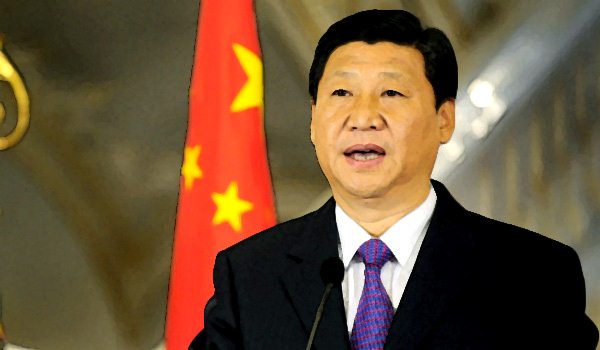
Xi Jinping

Interesting piece in Foreign Affairs by Wang Jisi, Dean of the School of International Studies at Peking University and a key adviser to President Hu Jintao: "China's Search for a Grand Strategy."

Summary: With China's clout growing, the international community needs to better understand China's strategic thinking. But China's core interests are to promote its sovereignty, security, and development simultaneously -- a difficult basis for devising a foreign policy.

John Milligan-Whyte posted our grand strategy "term sheet" details in the comment section of the piece on the FA site.

We had tried to meet with Wang Jisi in December, but didnt' break through.  Clearly though, he's on the same wavelength in terms of searching for a grand strategic approach for China that puts it in a better relationship with the US.

As for the summary statement that promoting sovereignty, security and development simultaneously is a difficult basis for devising a foreign policy, I consider that an odd excuse. Countries combine those desires all the time in crafting a foreign policy.  What's so unique about China's attempt? Read into the text and you'll see:  the fear that internal unrest will trigger external meddling that attempts regime change.  Sounds like Libya, yes?  

Clearly, Jisi wrote his piece long before the Facebook Revs, but China's behavior since confirms this deep fear. China's fears in this regard are its Achilles heel.  Its history says that whenever China fears for its internal stability, it becomes very conservative and timid in its foreign policy.  These fears also why a new relationship with the US must be built, one that allows China the confidence to move ahead with political reforms without fear of external meddling.  

The system simply can't withstand a China implosion now, but it definitely desires - across the board - serious movement on political reform within China.  No one wants the push to come to shove, but the truth is, it has to happen sometime.  But as long as the US-China relationship contains such profound strategic distrust, it's far less likely too.  Sadly, strategic distrust of China on the US side contributes to our own inability to make necessary internal changes.

In the long run, we all know the US and China will run this world more than any other two states. The great third will be India. Nobody else will compare.

The realist realizes this and moves forward to shape the relationship toward what it needs to be.  The paranoid types on both sides stick with the status quo, piling up strategic weaponry in a hair-trigger deterrence mode. Our grand strategy term sheet seeks to break that logjam and force a new conversation, one less constrained by "separate tracks" US logic that condemns us to marginal progress.

Here's a harsh truth: the delta between our growing network-economic connectivity and our lagging pol-mil connectivity will be erased, one way or the other, in the future. We can see it evaporate in conflicts or we can see it retroactively boosted in response to them. Or we can act preventively, but not with the combined containment/outreach package we currently pursue. That is designed, almost cynically, for failure. It suggests that we will simultaneously seek China's cooperation and its internal regime change. So long as we imply the latter - however subtly, the trust will never develop and then we won't have the relationship we truly need when those domestic reforms are finally triggered, one way or the other, by the Chinese people themselves - on their schedule.

If President Obama truly believes in the "organic" revolution, he needs to do more to lay the groundwork for the strategic trust that allows America to be part of that inevitably and hopefully incremental process, because our current stance hinders those developments - to our and the world's disadvantage.

Hu is done, as his farewell DC tour in January indicated.  This is now all about making something happen with Xi Jinping (pictured above), who is a careful enough fellow in his own right, but not the constrained thinker Hu was/is.

8:51PM

Question on iPhone

Spent evening putting hoist system in garage for canoe.  Real effort with 16-foot ceilings, but worth it.  Six-to-one pulley system truly ingenious.

Anyway . . .

Finally got iPhone.  Have Mac desktops at home and now three laptops, but have resisted on phone until Verizon carried it.  Now if the NFL will just move beyond that satellite provider and sell games directly over cable . . . 

Got Elago covers, which are very thin, but wondering now about protector for screens (we got three in all for all but our collegiate, who does not want to change).  Kevin is adamant about screen coverage to protect from scratches.

My questions are:


  1. Does one really need a screen protector?
  2. Which are the best?


12:01AM

Question from Oxford student (and Wikistrat grand strategy competitor) on starting out in the field

I'm a first year graduate student at Oxford studying Economic and Social History--a program that applies different social scientific frameworks to the study of history. I'm very interested in geopolitical analysis, and, as the first of my degree's two years draws to a close, I'm beginning to start looking at what might come next.

Zach Miller, head of the Oxford team competing in the Wikistrat grand strategy competition.

As Wikistrat starts collecting college/think thank teams for its grand strategy competition in June, certain requests come my way in terms of career advice.  So here's my take on the general query above.

I can only advise on the basis of my experience, because I've made no study of the question.  So naturally I'm going to be biased toward certain means and ends.  I will also try to genericize this answer so it's not specifically just about US tracks.

In general, I advocate getting a PhD before leaving, and I don't advocate taking time off along the way.  Why? Every bit of time off the academic track raises the possibility of never finishing, which happens to all sorts of people for all sorts of good reasons, the primary ones being marriage followed by kids and a decent enough living in a good job that you figure, "I really don't need to bother with the PhD."  Later on, though, most people still regret this decision and wish they could have found (or still find) the time, but it's just too hard. Personally, I know I never would have gone back to finish, even though I suspect I might have been able to finish the dissertation on the side while working early in my career. It just would have been a killer on my marriage and made me a wholly absent husband (rehabbing that house was truly fun) and father (who wants to miss their first-born's life-and-death struggle with advanced cancer?) at a time when I would have regretted just as much as missing the PhD opportunity, so I'm glad I sequenced it.

If you can stay and get it done, it's so much faster and you get the experience in full, plus you get the side experience of teaching, which is great for teaching you basic skills of explanation and grading conceptual presentations.  You also learn confidence in getting up in front of audiences.  Overall, very much worth the effort.

But, if you're like me, you'll also need to work several other jobs while you finish the PhD (I was also a super for a large apartment building), and the juggling there is also worth mastering, because if you end up like I have, working out of my home office for a wide variety of organizations, you'll come close to having the same life dynamics.

I was able to get this process done during the first few years of my marriage (1-4), while my wife did her early career work (although she could have gone on in a vein similar to me and we could have pulled that off as well).  Between us, living cheaply with no kids, we had plenty of disposable income, so we did a lot of fun things together that not only solidified the marriage, but smoothed the intense time of my writing a dissertation.  It meant we put off kids until year 6, but we found that worthwhile to do too, so that our marriage was well-established by the time we started a family and I was completely done with school.  Side issues, it may seem, but being unhappy in your life isn't worth a career track.

The two primary reasons to get the PhD are:

  1. You've got the union card, meaning you have the adjunct teaching option that much more easily obtained - if desired, and there may be some point where you actually want to go academic, like I did at the Naval War College - point being there are no glass ceilings to be confronted once you have the union card; and,
  2. It's just a great experience to write a book-length defensible piece of analytic worth.  You will never get this duo of deeds in any other setting professionally.  You can seek near-equivalents, but nothing quite like it, and I just think it's incredibly worthwhile to have that all under your belt before starting out.

After that, I think it's important to go to a good "finishing school," or a place of high analytic rigor that teaches you professional research and writing and presentational skills - before you do anything else.  These skills in the real world are far different from those taught in academia, which really only prepares you to be an academic in terms of practical skills.  

Private consulting firms can do this, but you really want to go a top one where there's tons of established talent, otherwise, you can easily end up being the "talent" yourself in a small shop, and there you will scramble to lead work without any real apprenticeship, so learning will be lost or achieved only under the most painful circumstances (shoulda, coulda, woulda).

My first job was with a very small shop and they were using my name and degree to try and win contracts, which was a sign of their small and desperate status.  I was immediately thrust into work of a highly detailed and technical nature and I had no idea what I was doing.  Two weeks in, a better offer came from a major analytic firm that worked for the navy and Marine Corps, and I jumped ship instantly, realizing the "finishing school" opportunity that was lacking in my small "beltway bandit" shop.

You can find such apprenticeships in think tanks, government research arms, etc.  You just want to avoid the busy-work places that use up all your time in process (I wouldn't recommend the legislature right out for that reason) - if you want to build that intellectual infrastructure in your head.  Fine to jump into process-heavy things later, but I suggest 4-6 years in a place like I described, learning the basics of professional research.

Once you've done that, then it's all a question of what you want to do and whom you want to do it with.  You can go ideological with a think thank or go functional with foreign policy, foreign aid or defense.  Personally, I think the latter two are more complex and unique and thus require the more direct experience.  I think the foreign policy/State stuff can be picked up by moderate exposure, but the aid/defense stuff is more technically inaccessible from the outside, so some inside time is useful.  

So that's what I did:  working mostly directly with the military, and spending several years working with USAID.  I always had interactions with State but I never put in the time there as either a direct hire or contractor.  But if you want the 3D perspective, which I think is key, then you want to hit as many of those as possible, prioritizing the complex defense, then aid, then diplomacy.  I think another reason why I felt most comfortable going light on diplomacy was that I was a political science major, so I had the most academic standing in that general field.  So I guess I would say mix and match as per your academic trajectory.

Another reason why I focused on defense (which, frankly, surprised me afterwards because I had no intention of doing so while in school): most development is done by the private sector, so the aid stuff teaches you about failed/failing states but doesn't teach you all that much about what works outside that troubled realm. But defense, especially that practiced by the US, is truly unique, so understanding that reality helps a lot on the geostrategic thinking. A lot of experts think they can learn that from a distance, but I say no. Some direct exposure is required because it's a very closed - and close - tribe (which is why I don't necessarily advocate direct service in uniform, because a lot of minds never escape that thinking even as a few do so spectacularly - so again, know yourself).

Once I had those experiences in hand, I felt like I knew the government scene, but I felt rather slow on globalization-the-economic process.  Yes, I had taken plenty of economics in college and grad school; I just didn't know business.

I have described my career journey as figuring out the world through the New York Times (my international relations PhD/academic experience) first, then figuring out Washington (via the Post) next (my time at Center for Naval Analyses), and then figuring out Wall Street/business through picking up the WS Journal/Financial Times/Economist and my time working with Cantor Fitzgerald (bond broker-dealer) while at the Naval War College and then my stint in Enterra Solutions since 2005.  I had read all these papers all along; I just didn't "get" them in full until I has the associated experience to go with them, so it was my MSM equivalent of diplomacy (NYT), defense (WAPO) and development (WSJ/FT/Economist).

By the time I had gone through my stint in the Pentagon following 9/11, I was finally - at just over age 40 - operating at my full powers.  I fully expected it would take that long, and never worried about keeping pace with others who did things earlier.  I really wanted to do the apprenticeship route sufficiently so that when I really broke out my big ideas, they were truly big and representative of my journey versus stuff I just dreamed up and hoped would establish me.  In John Boyd terms, I wanted to "do" before I took on the "be," and in truth, I am still focused on the "do" versus "be" and may very well end up sticking with the former my entire life, because I just so like the evolution mentally versus the "job," which I tend to fear for its numbing requirements. I also now realize I will only sacrifice so much for the "guru" track, in part because I find the media work such a creativity killer and I know that limits my reach. But you have to go with what makes you feel most creative, in my opinion, because, at the end of the day, that's all you've got. Jobs and profile come and go with tastes and forces beyond your control, but your creativity is THE asset worth protecting within your career. The global financial crisis actually helped me in this regard, by cutting back the speaking opportunities and forcing me back to more consulting/analysis, which I am finding tremendously renewing and easier on my family life - just when I needed it - because the travel is less hectic and I avoid being too much in broadcast mode. Not that I don't still love the speaking, because that is a favorite career addiction of mine and I'm gearing up right now for a slew of speeches in late April though early June. I just like this new balance better and - again - it came just in time family-wise.

But that's just me.  Like my post to the OH student, I came to realize that I live for the ideas and the analysis more than the decision-making power.  That may be because I'm the 8th of 9 kids and I wasn't raised to be the #1 son/daughter with "responsibility."  But it's also why I'm so creative, something that's always created a certain amount of friction for me. 

[Having said that, realize that everybody has their definitions of what constitutes "do" versus "be."  It just depends on what you consider the "doing."]

Some of the best advice I ever got was from a legend in the technical means field by the name of Gary Federici. Gary was genius level on the subject of bureaucracies and struggles within them, and he was an eminent producer talent, meaning he knew how to assemble minds and exploit them.  He told me early in my career that I was an amazingly creative thinker and that most people in most organizations would hate me for that ability, primarily because of its disruptive potential.  So he advised me to chart a fairly self-reliant and independent course, because if I hoped organizations would elevate and reward me on that basis, I would end up a bitter old man.  Gary was absolutely right, which is why I've spent my years since associating myself with Gary-type people - the more the better.  My motto is the old Roman proverb:  the slave with many masters is a free man.

So that's my basic advice on career tracking, with the following amendments:

  • Never turn down a speaking opportunity.
  • Always volunteer to be the main writer, because the power of the first draft, as I like to call it, is about 80 percent of the final product.  Plus, just like with speaking, you only get better by doing.
  • Always associate yourself with editors, because they are your best route to becoming a good writer, other than reading other good writers and practicing a lot yourself.
  • Don't repeat your work if you can help it.  If you want to think horizontally, then it must be new frontiers all the time - or as much of the time as possible.
  • Associate with mentors who recognize your best skills, and avoid those who want to work on your weaknesses.  Spending a life working on weaknesses is a loser track.  Spending a life working on your strengths is a way to be magnificently happy - meaning successful in the way you like being successful versus somebody else's definition.
  • Get good agents (and I use that term loosely) for all the skills you suck at.  I have multiple and they all make me who I am. They are worth the money you pay them.
  • Get married and have kids and put your family first, because you will likely live a very long life and this career will end, and when it does, and you're old, you will learn this truth: nobody ever lies on their death bed saying, I wish I accomplished more. They all say, I wish I treated my loved ones better.  My wife puts it this way: Do not treat strangers better than your family. People who become addicted to their careers typically do that, and it leaves them standing alone in the end, and no career and no accomplishments are worth that tragedy, because you only have one life to live.

But again, my advice is for someone like me.  I hate creative repetition in my work, but I love and am almost Zen-like in my desire to experience repetition in my personal life.  So I accept a certain lone-wolf reality in my career as the price for my being an idea hamster, and I balance by having a very stable home life.  I will take my kids, in succession, to many Packer games where it's just me and that kid on the long trek to Green Bay. None of them care about football.  They want the same experience with me that I had going to baseball doubleheaders with my Dad at Milwaukee County Stadium (the Brewers).  I work primarily to get the money that allows my home life to proceed as I believe it should.  I live in a place like Indy for the same reasons (crappy for my career, great for my kids and family).  Everybody makes choices and lives with the consequences.  The only good career is one that reflects those choices and self-awareness.  Otherwise you're 49, living in a condo in Reston, driving that red Miata convertible, hitting on interns half your age, and seeing your kids every other weekend. To me, that's hell on earth. To others, it's the reality they bumped into unconsciously as a result of being un-self-aware in their careers and just doing what was expected of them instead of what they truly desired.  

But again, it all depends on what you fear/love more: I have zero fear of career disruption, and frankly enjoy the scary prospect of regular reinvention and lateral moves into entirely new circumstances. Other people think that's hell on earth, and will do whatever - personally - to keep the "career" on track. Me? I would -and routinely do - sacrifice career to keep the family as stable as possible (and to enable our continued growth in new kids , because that fulfills my spouse's life desire and I find it natural enough [coming as 8 of 9] and likewise useful in improving my thinking over time by exposing me to all sorts of unexpected things, like raising strong African-American women - not something I had put down on my bucket list per se!). [Note also my statement to the OH student: If you want to be a futurist in your thinking, you need to have kids - however achieved, because you need that forced life extension beyond your selfish self.] I would experience such a profound sense of failure if my family broke up, but I experience zero sense of failure over career troubles/challenges. Again, a lot of people in this world are the other way around nowadays, going through spouses and families. It's just about what you value. I simply know I could not be creative if my life was a mess. To be creative, I need to be in a very special place - what I define as "life safe." But "career safe"? I have no idea what that is because I've never achieved it or - as I now realize - sought it.

[And I will tell you that that last bit was very hard for me to achieve in self-awareness, because I am my mother's child and she grew up with a father like me and found it extremely upsetting because he was a highly creative, boisterous, addictive type who lived with very little career stability even as he provided good home stability despite his wife (my grandmother) dying while my mom was a teenager. So my mom, naturally, has spent her life with me preaching the exact opposite of the career I've chosen. All of my six siblings have lived careers primarily spent with big companies/government agencies, suffering the usual tumults there but never being the spread-out, highly independent actor I have been since '05, which she thinks is pretty nutty.]

In the end, being a strong thinker in the vein described here requires a tremendous amount of self-awareness, and you can't get that if you lose yourself in a career. You need a certain distance from life, however achieved, to obtain the clarity of view. To me, that's a better life but hardly the only life. It's "better" because it fits me, and it yields the career I find most exciting, coupled with the personal freedom I deem most crucial.

Also realize that I will answer this question differently in ten years.  Maybe I make the f@#k-you money by then because my wife and I can only adopt so many kids before our age cancels us out (then again, she is already talking foster kids for the follow-on), and say the right candidate comes along (admittedly, he or she will more likely be Republican than Democrat, despite my voting habits) and I decide I want to retake the DC plunge. If I did, it would be a predictable-enough one:  the 20-month stint before I must return home to prevent my family from imploding. Then again, there are so many fascinating business opportunities out there in emerging and frontier economies, that I might find the true "grand strategic" opportunities more there than in government (my current sense).  Point being, my life rationalizations are always subject to review.

12:45AM

Wikistrat Middle East Monitor, March 2011

We're excited to announce the launch of Wikistrat's Middle East Monitor for March 2011, which can be viewed in entirety by clicking here.

Summary

The U.N.-authorized intervention in Libya appears to have monopolized the attention of the world media, but the Middle East is a region in flux undergoing rapid changes. As stated in the previous bulletins, the region is a significantly different place with each passing month. The sparking of an uprising in Syria is equally as important as the conflict in Libya, if not more so. The Yemeni government teeters on the edge of conflict and the Saudi and possible Iranian intervention in Bahrain are defining moments in the Arab Spring, as the revolutions are increasingly referred to.

The conflicts in the Middle East were largely internal in nature until March, as this month saw the entry of foreign intervention in several places. Libya is the most obvious example, with a U.N.-backed coalition (and possibly Al-Qaeda) backing the rebels and Muammar Qaddafi being supported by Syria, Belarus and possibly Algeria and others. Saudi and Emirati forces entered Bahrain to support the Royal Family and Iranian ayatollahs are reportedly registering volunteers to wage war on the Bahraini government. Hamas and Palestinian Islamic Jihad have also begun launching attacks on Israel, likely with the intent of fomenting a conflict to stabilize their own rule and that of Bashar Assad in Syria.

These trends indicate that, as has been the case since January, the Middle East will look quite different in April than it did in March. The uprisings are spreading and outside powers are playing a greater role in these internal struggles. The attacks on Israel, the largest since 2009, indicate that Iran, Syria and their terrorist allies believe a confrontation is in their interest.


Wikistrat Bottom Lines

Go!Opportunities

  • The uprising in Syria puts the Baathist regime in a weak and frightened position, making it increasingly susceptible to outside pressure. The West can leverage this instability to try to force behavioral changes or even foment regime change.
  • The West, especially the U.S., has a rare chance to counter the image that its foreign policy is based on imperialism through supporting compliant tyrants.
  • The pressure on the Arab regimes can be utilized to force oppressive governments that are Western allies into implementing changes to appease the population and open the door to globalization that can result in positive changes over the long-term.

Stop!Risks

  • The temptation is high for Iran, Syria and their extremist allies to intervene on the side of forces fighting pro-American Arab governments and to confront Israel to cure their own ills.
  • The West risks further alienating the Arab populations and inadvertently assisting anti-American extremist forces by not taking a strong stand in support of the demands of the protesters.
  • The West also faces the risk of being seen as an unreliable ally, therefore undermining relations with governments with poor human rights records and potentially pushing them to look for new allies on the world stage.

Warning!Dependencies

  • The sensitivity of the populations to the use of violence by the government. It can either cause a popular backlash or successfully disperse a large crowd and intimidate the opposition.
  • The willingness of security forces to use violence. Orders to carry out shootings can cause defections among government personnel and dramatically weaken the regime.
  • The desire of outside powers to intervene in the affairs of other countries and provoke conflict with the ruling governments for strategic advantage.

Join Wikistrat to get access to more reports and live simulations. Our next simulation - on Syria's Stability - will be launched soon and will include the examination of various scenarios and policy options conducted live on our wiki. Click here to learn more on Wikistrat subscriptions.

10:31AM

WPR's The New Rules: The State Strikes Back

The rampant globalization meme of the 1990s was that the state would wither away, leaving nonstate actors to rule -- or ruin -- the world. The terror attacks of Sept. 11 seemed to confirm this notion, triggering all manner of academic fantasies that a proliferation of super-empowered individuals would overwhelm the world's declining and failing states. But when globalization's alleged coup de grâce arrived in the form of the 2008 global financial crisis, not only did the world not slide into widespread conflict, as so many anti-globalization hysterics predicted, but the state made quite the comeback.

Read the entire column at World Politics Review.

11:43AM

Questions from OH college student

Questions from Ohio college student late last week.  Figured I'd post my answers:

How did you translate a career from being a Cold War analyst to an idea generator?  

I didn't really.  I wasn't really ever a "Cold War analyst," despite my training.  In truth, I would have been magnificently unhappy if I had stayed a classic academic or become an intell analyst - or if the Cold War hadn't ended. I just have no staying power on subjects, defined by me as working a particular field for years and years as many people do.  It just would have driven me insane. The longer I get trapped in one subject, the more depressed I become. I truly get off on drawing linkages between things versus cracking nuts on any one subject.

I realized that fairly early in my career:  I greatly preferred a wholly new topic to doing the same thing over again, and that doesn't exactly help with career advancement in any normal sense.  You tend to work your way out of every career track out there, and you typically risk the appellation "superficial."

The upside of being a natural horizontal thinker (across domains, versus drilling down in one) is, your work and subject matters are always fresh, because whatever the combination you're plumbing, there doesn't tend to be a whole lot of conventional wisdom on the subject. So the key thing is, you have to like operating on the frontier of thinking.

The reality of that desire, I have found, is that you'll have a hard time surviving on a single job (mentally you won't like it) and you'll limit your recognition to a certain extent, because you'll never be "the person" on a particular subject.  That means, you'll need multiple affiliations (see my nav bar at right) and you'll typically operate with very little secure income flow.  That's an eat-what-you-kill, no safety net lifestyle that some like but most abhor.  One thing to do as grad student, another to do as father-of-X, because in latter instance, you have to maintain a substantial network to line up all the work necessary to generate sufficient income (but that's good for generating new ideas too).

But here's the beauty, because you truly live and die in this mode based on your ability to generate new ideas and innovative analysis, you've created a life path that highly incentivizes you to be the kind of thinker you enjoy being.  Or as my Dad often put it, making your natural hobby you career and getting paid for it.  It's also allowed me to work out of my home since 2005, meaning, when I'm not on the road, I am fully accessible to my kids.  Again, for some, that's a nightmare (constant interruptions, irregular working hours, etc.), but to me, it's everything I loved about grad school (about a dozen balls in the air at any one time) and everything I hated about regular work in an office (show up 0800, leave 1700, commuting both ways).  I tend to work a big week (60-80 hours), but I work around my kids' lives, and since interacting with them is such a great source of idea generation as well (how can you be a futurist without having kids?), that's professional perk.

So here's the odd part:  to be a creative thinker, I find, you have to be highly disciplined in your work life, allowing you to have a dozen or so bosses who constantly prod you from different angles.  Right now I am working on a solid dozen subject matters - a very disparate collection.  But I love that, and it feeds the beast.

Horizontal thinkers tend to be (my experience) fairly rare relative to drill-down artists (normal expertise), so a loner's mentality is good, and you need a lot of self-confidence about working on your own but meshing your material with others (you are always part of a net, or have editors, etc.).  It's not for everybody, and it's a choice that keeps you on the fringes of most things (you're not a joiner, per se), but you have to know what you like and what your personality is.

This path just makes me very happy and I can't imagine doing it any other way.  I have nightmares of the single job in the single office with the single boss.


Is there any advice you have for students who are interested in making a serious difference in the world?  

I always say, learn as many languages as possible.  Don't have to be good at any of them, but just the process of studying them enough to gain accessibility to the mindset.  That's a skill I use every day, and it allows me quick access to domains for the purposes of cross-linking analyses.  

By "languages," I don't just mean actual languages, but also subject-matter languages.  I love to take on a new subject just to learn the language and the logic and all the terms.

That's an inherent skill set for thinking laterally/horizontally, and since you will be changing subject matters constantly, the key is to develop your preferred tool kit of analytic approaches.  There is no set way to do this, in my mind, you just want to consciously collect great analytic tricks, maneuvers, procedures as you go along. I probably have about three dozen that I use over and over again in all sorts of subject areas, because I've come to trust them in terms of the revealed output.  So you think of them as tracking tricks, like stuff I always do when I'm canoeing a new river.  Not the fastest route, but one that rewards you in the accumulation of impressions that lead to analysis.  Being observant is everything.  Analytically, my whole life feels like one big deja vu, meaning I am constantly saying to myself, "I think I've spotted this dynamic somewhere else before."

So again, variety over drill down, and academically, that probably requires a big mushy soft science field that allows you a ton of freedom.  That's why I did political science.  Exceedingly hard to foster horizontal thinking in a technical field until later in your career.  I just know personally I never would have survived that journey.


How did you develop your philosophies?

By constantly seeking out the most interesting and fear-filled work I could find, subjects where, by most accounts I had no business trying to forge new thinking (Isn't there somebody more established who can crank out an answer we all know and love - in advance?).  If I don't feel over my head on some level, I don't like the work as a rule, unless the balancing factor is some insane ambition or unusually deep-in-the-future scope that allows a whacked amount of freedom in approach.  One of those three factors needs to be in place.

Besides that, I think it's key to expose yourself to a wide array of thinking, steering clear of most of the work in your own field (I find reading political science to be a "little mind killer," because after a while, you're so read into the conventional wisdom you can't say or write anything else).  Collect great nuggets as you go along (I will read entire books for the right paragraph that I will - from that point on - carry at the tip of my tongue) and likewise collect clear images of what-must-happen-in-the-global-future so that you can explore the tectonic interfaces between these large forces to understand how things likely unfold for regions, states, individuals. It's like carrying this "Inception"-level complex narrative in your head at all times, and you're constantly engaging in script changes, but because you're always focused on the linkages (both present and downstream) you find the notion of "black swans" a bit silly - like a middle-age crisis.  You know where you are in time, and you are always working your set of expectations regarding future sequencing of change, so "bolts from the blue" are just little scenario inserts that spice up the narrative but don't knock you off your contemplation of the whole.

Also key is patience.  If you need to be right tonight, or in the next 5-minute TV segment, then you don't want to do this, because you will constantly be backtracking.  A good long-term thinker is a terrible pundit, because he or she doesn't have a new mania every other week.  The upside is that you're not always freaking out, the downside is that the mass media loves experts who freak out, because they provide rich content ("This is possibly the worst thing that has ever happened to the X!").  So you have to be comfortable with the ups-and-downs of real-world events, which shift from one mania (victory!) to the next (stalemate!  defeat!).  My favorite bit on this is Zhou Enlai being asked about the French Revolution and answering, "It's too early to tell."  If you need climaxes to move on, you can't do this.  Handling ambiguity well and enjoying anticipation more than completion are job requirements.


Will you be doing any presentations in Ohio?

No, but you can come see me in Johnstown PA on the morning of the 10th of May.  It's an open to the public event.  From organizer J. Stewart Ross:

The Greater Johnstown Chapter of the National Contract Management Association (NCMA) is excited to announce that we will host Dr. Thomas P.M. Barnett on Tuesday, May 10th for his talk "Strategy of the 21st Century in Transition." The meeting will be at the Holiday Inn—Downtown Johnstown at 8a and is open to the public. Dr. Barnett is a leading national security expert and the New York Times bestselling author of The Pentagon’s New Map, Blueprint for Action and his newest book which debuted on 2/5/09, Great Powers: America and the World after Bush. Dr. Barnett is a nationally known public speaker who has been profiled on the front page of the Wall Street Journal. He is in high demand within government circles as a forecaster of global conflict and an expert of military transformation, as well as within corporate circles as a management consultant and conference presenter on issues relating to international security and economic globalization. Registration is required. Additional details will be provided in the near future. Contact me or see the link below for more details if you are interested.

PDF for registration

11:20AM

Finally bought the boat


Finally bought a canoe.  Family vacation at Lake Superior this July and 25th wedding anniversary get-away to Caribbean with spouse had me thinking about getting certified for scuba (sunken ships diving in Superior, usual stuff in Caribbean), but my ENT talked me out of it.  Half-a-dozen inner-ear surgeries, to include three rebuilt ear-drums (hard to accomplish with just two ears) kinda ruled me out.  So we'll stick to snorkeling (much cheaper, BTW) and, in my despair, I finally bought a boat - of the sort I am most familiar.  We always had a canoe in my family, so as a kid, I would explore local rivers with a friend for hours on end - just disappearing for the bulk of the day.

So, when I investigated what's out there, I decided to go with this slightly stripped down version of Mad River Canoe's Adventure series that is sold at Dicks for a good price (about $250 less).  Unlike most canoes, which stretch pretty wide (40 inches or so, this thing comes in just less than 35 inches (see a review here, where I got the pix).  The hull if very kayak-like, with flat surfaces that break every six or so inches.  That, plus the narrow width, makes it seem very unstable at first glance, but it isn't.  Jerkier at times, but when it slips to the side, it tends to stop when the first above-water panel hits the water.

The tradeoff on the width and hull design is that this thing moves in the water more like a kayak than a canoe, meaning it goes fast!  Since I don't fish and mostly like to explore, this is ideal, even as it takes some discipline with my kids.

Took it out yesterday with sons on White River inside Indianapolis.  Today we hit a local county park lake with my eldest daughter and our two new additions.

Anyway, shouldn't cause me any more surgeries and I do love being on rivers.


9:17AM

Arming the Libyan rebels

NYT coverage of the debate in Washington about whether or not to arm the rebels.

Right up to this point, everything I've ever come across or anyone I've ever spoken with has said there are only trace amounts of al-Qaeda affiliated elements in Libya.  Now, of all a sudden, people are talking like maybe it's majority AQ, which strikes me as nonsense. Piece here quotes Mr. Terror Blurb himself, Bruce Reidel, saying it could be 2% or 80% - we don't know.  Frankly, again, slapping that level of SWAG on our understanding seems silly.

We know this:  plenty of Libyans showed up as fly-in jihadists in Iraq during the civil war period there, meaning they mixed it up with AQ then.  Does that make them AQ forever?  It certainly makes them opportunists.  All it really tells me is that there's an underemployed class of young men in Libya who, in the absence of other opportunities, will go where the fight is.  Nothing unique there.  

There's also al-Qaeda in the Islamic Maghreb (AQIM), but that group has frankly struggled to be taken seriously as a force, as it's mostly a relabeling of an existing group that was going nowhere (bigger the territory in the title, more likely, in my mind, that it's not exactly succeeding anywhere). Up to now, no one has portrayed that group as Libyan-centric.  Yes, they will show up, but that's standard.  The reality, as noted in the piece, is that you have to train on what you provide, so we'll have people on the ground (besides the CIA already there).  If things go really sour, then we burn that bridge when we come to it.  But this is not a logical showstopper.  A Libyan long divided in two and suffering civil conflict will do the same - or far better - for AQIM than a concerted arms push to dethrone the guy.  So, again, factor them in as the cost of doing any sort of business here, but do not elevate them into the decision-tilting bogeyman, because they're not, and speculating in the press doesn't make them so.

So telling me that there are "flickers" (ADM Stavridis' term) doesn't exactly make me hesitate all that much. And raising the specter of Bin Laden in Afghanistan in the 1980s likewise doesn't do a whole lot, because it's not like that experience changed his goals or hatreds one bit in the end (Run the counterfactual and we don't supply the mujuahideen.  Is Bin Laden now our friend and non-terrorist?).  What arms his early AQ people obtained from us were also not exactly used against us, and given all the other arms we sell in this world (half the world's total), citing this "into the hands of AQ" danger is likewise a bit much.  AQ doesn't have a hard time buying small arms.

I'm not saying that all the usual dangers do not apply, because they most certainly do.  I'm just saying that layering on this additional fear factor about "arming al-Qaeda" is a red herring and - by all accounts until suddenly this week - an uninformed one.  I'm prepared to have my mind changed, but let's see the evidence of AQ running that rebel show.  If Mr. Reidel wants to propose an 80% infiltration of the rebel ranks, he should back it up or stop throwing unsubstantiated fears out there.

12:01AM

How Russia will matter beyond energy and minerals

From WSJ blurb "How to Bet the Farm on Mother Russia" (23 March 2011).

Besides being impressed with EU wheat production (they grow wheat like we grow corn), the point is how low Russia's yields remain.  You combine that with all the fallow fields (one-third) and unused arable land, and Russia's upside is considerable - if it gets the foreign investment.

Blurb is about Russian company hoping to get investment.  The company, Rusagro, wants to modernize old collective farms and buy up new land previously given to rural dwellers who aren't using it for agriculture (but might like the money). 

Big hold up on investment is the climate - as in, business climate.