Buy Tom's Books
  • Great Powers: America and the World After Bush
    Great Powers: America and the World After Bush
    by Thomas P.M. Barnett
  • Blueprint for Action: A Future Worth Creating
    Blueprint for Action: A Future Worth Creating
    by Thomas P.M. Barnett
  • The Pentagon's New Map: War and Peace in the Twenty-first Century
    The Pentagon's New Map: War and Peace in the Twenty-first Century
    by Thomas P.M. Barnett
  • Romanian and East German Policies in the Third World: Comparing the Strategies of Ceausescu and Honecker
    Romanian and East German Policies in the Third World: Comparing the Strategies of Ceausescu and Honecker
    by Thomas P.M. Barnett
  • The Emily Updates (Vol. 1): One Year in the Life of the Girl Who Lived (The Emily Updates (Vols. 1-5))
    The Emily Updates (Vol. 1): One Year in the Life of the Girl Who Lived (The Emily Updates (Vols. 1-5))
    by Vonne M. Meussling-Barnett, Thomas P.M. Barnett
  • The Emily Updates (Vol. 2): One Year in the Life of the Girl Who Lived (The Emily Updates (Vols. 1-5))
    The Emily Updates (Vol. 2): One Year in the Life of the Girl Who Lived (The Emily Updates (Vols. 1-5))
    by Thomas P.M. Barnett, Vonne M. Meussling-Barnett
  • The Emily Updates (Vol. 3): One Year in the Life of the Girl Who Lived (The Emily Updates (Vols. 1-5))
    The Emily Updates (Vol. 3): One Year in the Life of the Girl Who Lived (The Emily Updates (Vols. 1-5))
    by Thomas P.M. Barnett, Vonne M. Meussling-Barnett
  • The Emily Updates (Vol. 4): One Year in the Life of the Girl Who Lived (The Emily Updates (Vols. 1-5))
    The Emily Updates (Vol. 4): One Year in the Life of the Girl Who Lived (The Emily Updates (Vols. 1-5))
    by Thomas P.M. Barnett, Vonne M. Meussling-Barnett
  • The Emily Updates (Vol. 5): One Year in the Life of the Girl Who Lived (The Emily Updates (Vols. 1-5))
    The Emily Updates (Vol. 5): One Year in the Life of the Girl Who Lived (The Emily Updates (Vols. 1-5))
    by Vonne M. Meussling-Barnett, Thomas P.M. Barnett, Emily V. Barnett
Search the Site
Powered by Squarespace
Monthly Archives
5:01PM

Wikistrat Middle East Monitor, April 2011

We're excited to announce the launch of Wikistrat's Middle East Monitor for April 2011, which can be viewed in its entirety here.


Summary

The biggest changes in April came in Syria, Yemen and the Palestinian Territories. These changes do not decisively shift the balance of power in the region but are important developments that could lead to different strategic situations.

The Friday protests in Syria escalate each week, as does the violence. This is not a decisive change from the previous month but shows that there is a strong destabilizing trend in Syria. The uprising has only strengthened in the wake of violent suppression. There are now clashes between soldiers in the 5th Division in Daraa who have refused orders to shoot civilians, and the 4th Division, led by Maher Assad, the brother of President Bashar Assad. This could portend a division in the military and security forces.

President Saleh and the opposition parties have agreed to a deal where he would step down within 30 days and then elections would be scheduled. Large-scale violence has continued despite this settlement and it is still possible that Saleh will find a pretext to try to justify a reneging on the agreement. The Gulf Cooperation Council’s intervention in pressuring Saleh to step down is an important development as it shows there are limits to which the Gulf governments are willing to stand by each other in the wake of popular unrest and human rights abuses.

The reconciliation between Hamas and Fatah towards the end of the month is another significant development. It could bolster the Palestinian Authority’s campaign to gain U.N. and international recognition for Palestine as an independent state. The cessation of hostilities between Hamas and Fatah is a dangerous development for Israel, as it means that the Palestinian Authority will not be fully committed to fighting the terrorist group’s operations.


Wikistrat Bottom Lines

Go!Opportunities

  • The uprising in Syria presents two opportunities for the West: Firstly, it weakens the Assad regime and raises the possibility that it will be overthrown, which would lead to a major strategic shift. Secondly, the violence puts tremendous pressure on the international community including the Arab world to punish the Syrian government. The Assad regime may survive but will be in a much weakened and cautious state.
  • The potential for Iran to exploit unrest in the Arab world, along with its pursuit of nuclear weapons and support of terrorism, could make it more likely that Arab states will support tougher sanctions and other measures against the Iranian government.
  • The Arab Spring forces the Arab governments and the Iranian regime to focus on internal matters rather than external enemies like the U.S. and Israel. The governments may try to instigate an international crisis, seeking strategic advantages or political stability, but their populations are blaming their rulers for their unsatisfactory conditions and not foreign actors.

Stop!Risks

  • There is potential for civil war or sectarian violence in Syria, as the regime’s Alawite militia appears loyal. The Alawite minority could also fear a post-Assad Syria, allowing the regime to raise recruits. Any terrorists or Iranian Revolutionary Guards personnel harbored by the Assad regime should also be expected to fight on the regime’s behalf, including against defected military personnel.
  • The Iranian regime may seek to solve its political troubles by engaging in foreign conflict, or may simply intervene in Bahrain as a strategic move. Hardline Iranian officials are now openly calling for intervention.
  • The reconciliation between Hamas and Fatah, though it is unlikely to last, could give Hamas a greater ability to operate. The terrorist group has engaged in increased amount of terrorist attacks against Israel in the past two months.

Warning!Dependencies

  • The willingness of the Syrian military to follow orders to massacre civilians. This will be the most important factor in judging the future of the revolution in Syria and whether it will be defeated, civil war will ensue or if the Assad regime will fall.
  • The calculations of the Iranian government regarding Bahrain. It is not a vital interest of Iran that the Bahraini government fall or that Saudi forces be forced to leave, but these are certainly goals. It is difficult to judge whether the exceptionally-heated rhetoric coming from Iran indicates an actual desire to become deeply involved and if so, what the limits to this intervention would be.
  • The limits to which the coalition in Libya is willing to assist the rebels, such as through arms, greater action against Qaddafi or even through the deployment of ground forces.

Join Wikistrat to get access to more reports and live simulations. Click here to learn more on Wikistrat subscriptions.

1:05PM

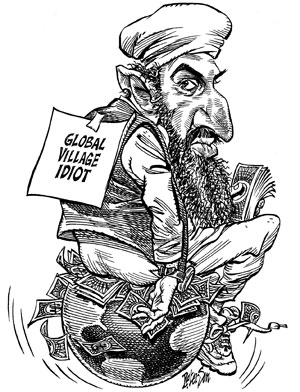
The Politics Blog: "Life After the Bin Laden Kill: What Now?"


You can take down the wanted posters and run through the streets all you want, but the Osama bin Laden assassination leaves many essential questions unanswered. From Pakistan to China and the Pentagon to the 2012 polls, here's where we stand.

  • So who runs Al Qaeda next?
  • Will Al Qaeda retaliate?
  • Isn't Pakistan is the real battleground — not Afghanistan?
  • Is the Great Hunt finally over?
  • Did Obama just get tough on terror for 2012?

Read the entire post at Esquire's The Politics Blog.

10:42AM

WPR's The New Rules: Glass Half Full on Obama's New National Security Team

President Barack Obama reshuffled his national security team last week, and the reviews were overwhelmingly positive. The White House proclaimed that this was the "strongest possible team," leaving unanswered the question, "Toward what end?" Obama's choices represent the continued reduction of the role of security as an administration priority. That fits into his determined strategy to reduce America's overseas military commitments amid the country's ongoing fiscal distress. Obama foresees a smaller, increasingly background role for U.S. security in the world, and these selections feed that pattern.

Read the entire column at World Politics Review.

12:06AM

Beijing seeks bigger role throughout Asia, making all nervous

WSJ story:  Vice Premier and future premier Li Keqiang in Beijing says the China-Australia needs to move beyond stuff to shared efforts at R&D.  Article also says China eyeing developed countries as they need infrastructure and China has built up tremendous resources on that score.

But all this push scares as well:  FT story on Indonesian private equity firm head decrying growing Chinese investment (China had just agreed to fund about $4b in infrastructure there):

Our state is in the hands of the Chinese and the Koreans.  We allow the foreigners to rape and pillage us.

Get used to the "ugly Chinese."  The soft sell/"charm offensive" is over and China will end up paying for the end of that honeymoon.

12:01AM

Nobody who matters really wants a weak US

Argument from Lee Kuan Yew that fits with everything I've come across in recent work for the USG: those who understand how this world got built are not eager to see the US retreat from its power and influence in continuing to undergird its further development.

LKY:

The world has developed because of the stability America established . . . If that stability is rocked, we are going to have a different situation.

Singapore's old leader (now officially "mentor" to the government) shows how the strong man leaves behind the right sort of system:  he builds it up and then retreats to the background, like Deng Xiaoping and plays mentor.  America, to a certain extent, faces the same evolution.  It's just that we're so given to fits of pique - as in, we're either all-in or all-out.

But the real message here:  it's okay to retreat a bit from the world if the outcome is regeneration.

On the US and China in special interview with WSJ:

Mr. Lee said he thinks a "challenge may come gradually from China," but he doubts China and the U.S. will come into serious conflict anytime soon.  China needs American markets, American investments and American technology, and won't want to "upset the apple cart," he said.

My addendum: and when they may care to, it will be too late, as they'll hit those various walls (demographics, environmental and social decrepitude, resource dependencies, defensiveness and - ultimately - the strong impulse toward democracy) I described last Jan in Esquire.

In the end, says LKY:

I believe the Americans will always have the advantage because of their all-embracive society, and the English language that makes it easy to attract foreign talent.

One of the smartest guys of the 20th century, who blesses us with his wisdom in the 21st.  I rarely disagree with the man, he is so sensible.

5:51PM

New brief great, but problems with presentation

Keynoted this morning in San Diego at Hilton:  North American Electrical Distributors association.  Thursday I spoke in St. Charles IL to Illinois police and firefighter pension managers group.  In both instances, the brief got slower and slower the deeper I went in, meaning slower response to RFID clicker.  All transparent to audience, but it unnerves me to have any uncertainty in my clicking.

Now, when I run the files on my new MacBookPro, it runs like a charm, but when I'm hooked to a monitor, it's like this build-up occurs and there' more latency with each click.  In both briefs it sort of peaked on this one slide that's actually pretty tame, but I'm really confused by the issue.

How can the Mac be just fine clicking through in SlideShow without a monitor feed, and then get slower when connected?

Talked to Mac and they suggested I set up special user account, transfer the file there, and then work PPT in isolation there.  Trick is, to really test it, I need to work it with a projector.  Option is to buy VGA cord and do it with home theater, which is what I probably do.  Other option is to kill the super-sexy and complex new transitions I use in PPT 2011.

The experiments continue.  Advice welcomed.

Meanwhile, I am getting truly psyched about the new brief.  Second time about 75% better than first. Starting to reach my magic zone.  Just need to get my clicking confidence back.

10:36AM

Does Asia stall or fulfill the dream of the Pacific century?

Warnings from officials at the Asian Development Bank (Reuters by way of Stewart Ross):

Home to 3.3 billion people, Asia has led the global economy in recent years, and the rise of China and India has lifted the region's profile and influence in world markets.

But the region also has nearly 2 billion people living on less than $2 a day, including in China and India, who are most at risk from sharp rises in food and fuel prices this year.

"Sure we have had a tremendous growth story, incomes have increased, and Asia has a lot to be proud of," ADB Managing Director General Rajat Nag told Reuters.

"But you also 700 million people without access to clean water, you have 1.7 billion people without access to sanitation, you've got maternal mortality which is high, you've got child malnutrition," he said.

Around 3,000 people will gather in Hanoi for the May 3-6 meeting, and the ADB, charged with fighting poverty in Asia and the Pacific, will push the case for the region to face up to its responsibilities.

The message, Nag said, was clear: "Your rise is not preordained; it is plausible, but you've got to earn it."

"You've got to make some policy decisions now to reduce inequity, increase the basic education, address issues of governance and corruption, show leadership, have strong regional integration if you are going to avoid the middle-income trap."

That trap, where per capita income levels rise to about $7,000-10,000 and then stall, had afflicted countries in Latin America and the Philippines in Asia, he said.

By avoiding the trap, Asia would account for half of world output by 2050, from 27 percent now, with per capita income of about $39,000, in purchasing power parity terms, and billions lifted out of poverty, an ADB-commissioned study found.

"If on the other hand you get caught in the middle-income trap, the per capita income will only be about half, about $20,000 per capita, and Asia's output will account for about 32 percent," Nag said. "So the potential loss is huge."

When I talk about the big shift from extensive growth (more stuff) to intensive growth (more innovation), this is really what I'm describing.  You accomplish the basic stuff with a segment of your economy (i.e., there are still plenty of rural poor) and then it's a question of whether you can take it to the next level by cleaning up a lot of bad practices you've still got or accumulated in the process of development.  That's the progressive-era point that America hit in the late 1800s, and either you muscle past that or you get stuck.  

Essential to the process:  democracy that allows the effective articulation of society's demands for improvements, a professional civil service that reduces the corruption factor, rise of an environmental movement, effective taxation to raise funds for the public-goods improvements needed for those who aren't moving ahead, sound public education, good rules to attract investment beyond the early basics (commodities, cheap manufacturing, etc.)

All of this is to say:  there is no "Asian way" that circumvents these problems, and please, don't toss Singapore in my face, because city-states are not countries.  They will need to travel the same progressive territory that the West once did - and they will end up in the same place.  

Good news for Asia:  outside of China, Japan, Australia/NZ and South Korea, the rest of the place is just hitting its demographic dividend - that sweet spot of about 25 years in the transition from high fertility/mortality to low fertility/mortality.  One has to take advantage to make as much advance proceed as possible during this window, otherwise you run into the Chinese get-old-before-you-get-rich problem.

1:07PM

A grain of salt please on the Assassin's Mace

Nice reporting by Paul Roberts at ThreatPost (Kaspersky Lab Security News Service, HT to Dave Emery) of some analysis of China's own cybersecurity amidst all this talk in Washington that the PLA is readying its killer opening "Assassin's Mace" blow in any fight over Taiwan or thereabouts.  It opens nicely:

The official line in Washington D.C. is that there's a new Cold War brewing, with an ascendant China in the place of the old Soviet Union, and cyberspace as the new theater of war. But work done by an independent security researcher suggests that the Chinese government is woefully unprepared to fend off cyber attacks on its own infrastructure.

The gist that follows:

For the last 18 months, Dillon Beresford, a security researcher with testing firm NSS Labs and divorced father of one, has spent up to seven hours a day of his spare time crawling the networks of China's state and provincial governments, as well as stealthier networks belonging to the PLA and the country's top universities. Armed with free tools like Metasploit and Netcat, as well as Google Translate, he's pulled back the curtains on the state of cyber security in China. What he's discovered may come as a surprise to many U.S. policymakers and Pentagon officials. 

Dillon BeresfordContrary to the image of China as a nearly invincible cyber powerhouse, Beresford says in an interview with Threatpost Editor Paul Roberts, that the fast-growing nation suffers from woeful cyber security practices at home that leave, literally, thousands of networks and databases vulnerable to even trivial, remote attacks. Beresford, whopublicized holes in domestic Chinese SCADA systems in September, 2010, said the country's aggressive cyber offense abroad, he said, is in stark contrast to an almost total lack of basic cyber defense at home that has left both classified and unclassified government networks vulnerable to attack and compromise. 

Great post (really an interview with Beresford) and worth reading in full.

I have had some very smart people in DC warn me ominously about all of China's continuing military advances and I'm buying almost none of it.  I see them putting up a Potemkin village of a defense designed, as Beresford suggests, to hide great weaknesses.  It is a lot of wasted effort because the US has no intention of doing anything other than to scare China (deterrence), which makes China's showy counter-efforts to do the same all the more pointless.

As if there's nothing else to be done in this world that the planet's two biggest and highly interdependent economies insist on pursuing this asinine sideshow!

This is business as usual in the PNT, which hopefully Panetta disciplines better than Gates did.  On the Chinese side, it's poorly supervised generals with too much money on their hands.  The fiscal pain will solve the issue on our side, and the right crisis will inevitably reveal China's misaligned military - as in, not appropriate to their actual emerging global security needs.  They remain in fighting-the-last-war mode - a good indication of their complete lack of recent operations that matter whatsoever (thus no learning).  Let them field their carrier design alongside their new carrier-killer missile and think themselves so clever.  I find most of it pathetically unimaginative and unbefitting their rise.  They desperately need better military leadership on top.

5:01PM

CoreGap 11.11 Released - What to Do With Despots Who Fight to the Bitter End?

Wikistrat has released edition 11.11 of the CoreGap Bulletin.

This CoreGap edition features, among others:

  • Terra Incognita - What to Do With Despots Who Fight to the Bitter End?
  • Bahrain Repression Indicates Just How Scared of Iran the Saudis Truly Are
  • IMF and Standard & Poors Both Issue Warnings on Unprecedented US Debt
  • As Libyan Stalemate Looms, NATO Increases Involvement
  • South Africa Formally Joins BRIC Group, Signaling China’s Dominance

And much more...

The entire bulletin is available for subscribers. Over the upcoming week we will release analysis from the bulletin to our free Geopolitical Analysis section of the Wikistrat website, first being "Terra Incognita - What to Do With Despots Who Fight to the Bitter End?"

Whether or not the planet’s ongoing wave of political revolt ultimately earns the moniker, the “fourth great wave of democratization,” intervening great powers ponder the question of what to do with leaders who are deposed or in extreme jeopardy. The realist is more willing to cut a deal for immunity, so long as a quick departure is achieved and bloodshed subsequently ended.  The idealist tends to be uncompromising, demanding a trial suitable for the “many crimes” committed by the despot over the years – or perhaps just the preceding few weeks.  In truth, there are no easy answers – just historical precedents that rarely translate across political border.
One thing seems clear:  if the leader and his family are not hurried out of the country, eventually the rebels or revolutionaries get around to levying their charges.  On this score, one has to wonder if it would not have been better for the US and Saudi Arabia to have whisked the Mubarak family from Egypt.  Now facing charges that conceivably result in death penalties, the fate of father Hosni and son Gamal has to weigh heavily elsewhere in the region, where historically most leaders are either killed or die in office. Already we see similar dynamics at work.

Read the full piece here

More about Wikistrat's Subscription can be found here

To say that President Barack Obama’s foreign policy plate is full right now is a vast understatement, and it couldn’t come at a worse time for a leader who needs to revive his own economy before trying to resuscitate others (e.g., Tunisia, Egypt, South Sudan, Ivory Coast – eventually Libya?). Faced with the reality that America’s huge debt overhang condemns it to sub-par growth for many years, Washington enters a lengthy period of “intervention fatigue” that – like everything else, according to the Democrats – can still be blamed on George W. Bush.
12:01AM

Nestle gets in on the feast

FT story on a "bolt-on deal" for Nestle:

Nestlé underlined its determination to expand in fast-growing emerging markets with the acquisition of a majority stake in one of China’s best-known regional foods groups.

Nestlé said the deal to buy 60 per cent of family-owned Yinlu Foods Group would spearhead its push into products geared to local tastes. Yinlu, which has had a long association with Nestlé as a co-manufacturer of ready-to-drink Nescafé instant coffee, makes ready-to-drink peanut milk and ready-to-eat canned rice porridge.

No price for Yinlu, which is based in China’s south-east Fujian province, was revealed. Analysts’ estimates for the value of the stake in Yinlu, which has annual sales of about SFr750m ($835m), ranged between SFr540m and SFr1bn.

The deal will deepen Nestlé’s penetration in China, where the Swiss group is already known for its international Nescafé, Maggi and Kit Kat brands, as well as some products sold only domestically.

Paul Bulcke, Nestlé’s chief executive, said the deal “demonstrates our long-term investment in China and our commitment to further developing local brands.”

Analysts said the transaction was another example of multinationals keen to grow in China trying to make or acquire products to suit local consumer tastes.

Nestle is an interesting company, what with the move into pharmanutricals (pharma inserted into foods to make therapy and eating one--sounds weird but it has huge applications in developing regions where nutrients are hard to get, as are drugs) and its aggressive push onto the table of the emerging global middle class.

Nestle has been in China for 20 years and employs 14,000 workers there in 23 factories, but it still feels the need to make buys like this to take full advantage of the growth of the middle class, which likes to eat better, use more electrical appliances, drive cars - for the first time, etc.

I always like to keep an eye on these guys.They think ahead nicely, which is why Nestle is the world's biggest food company. Started in 1867 by Henri Nestle in Switzerland. He makes the first milk food for a baby and uses it to save his neighbor's child. Nestle is also one of the most boycotted companies in the world. Why? Food is a very touchy subject - as are babies.

9:05AM

Being the global demand center has its perks

FT story on how "China influence on design growing fast."

Fundamental tenant of my vision since the late 1990s:  when the global demand center shifts in an industry, everything changes for that industry.  Now, it's Chinese tastes and desires that shape design, not so much the American consumer.   Yes, some customization by market, but the underlying dynamics shift.

At the Shanghai car show that opens today, General Motors and PSA Peugeot Citroën will both launch global models for the first time in China, a symbol of how the car industry’s centre of gravity continues to shift to the mainland, the largest car market.

But it is not just about launching the new-generation Chevrolet Malibu or Citroën DS-5 first in China, to attract more Chinese buyers.

The shift goes both ways.

When GM on Monday unveiled its Buick Envision SUV concept car, it revealed a car designed in China, for the world.

Chinese tastes are increasingly influencing the design of cars driven not just in China, but around the world.

China is having the greatest influence on luxury cars.

Demand for premium cars is soaring in China, making it crucial for luxury carmakers to satisfy them first.

When Mercedes-Benz set out to design a new S-Class luxury saloon, to hit showrooms in 2014, Daimler flew 100 Chinese consumers to customer clinics in Germany and the US to ensure they had input in the car’s design.

But the Chinese car boom is shaping the look of some mass-market cars too.

When General Motors designed its LaCrosse saloon, the brand, which is popular in China, devised a roomy and plush rear seat of the kind that Chinese owners – many of whom have chauffeurs – prefer.


“It’s a natural extension of the size and importance of the China market,” Kevin Wale, head of GM in China, says.

Ed Welburn, GM head of global design, says: “The trends here in China are having an influence on the design of our brands, but it is not a case of China dictating what cars are driven in Detroit.

“The influence is more subtle.”

Mr Welburn says one of the reasons Buick has become so successful in China – where owning a Buick is a status symbol – is that its fluid lines are more oriental in feel than the angular shapes of some other global auto models.

“China connected with Buick in a very positive way because . . . Buicks have a lot of flow in their design and Chinese artwork and calligraphy have a lot of flow,” he says.

“I’ve encouraged the design team here to . . . continue to play that up, and they have used that aesthetic in every detail [of the Envision SUV concept car], to give the same kind of feeling you get with a jade sculpture.”

Mike Dunne of Dunne & Co, an Asian motor industry consultancy, says: “Five years ago, no one would have imagined that China would have surpassed the US as the largest market.

“But now it’s natural that these cars are being developed for Chinese customers and sold globally.

This is such an amazing change in just a decade, but it signals globalization's immense power.  It is evidence such as this that always makes me laugh when people posit globalization's retreat because of this or that policy in the West, or the dividing up of the internet, etc.  There are some profound forces at work here and they mostly have to do with greed for a better life.  It's a demand function - not a supply one.

8:53AM

Paging Commissioner Roosevelt

I will admit that I wasn't that happy to hear the court ruling in favor of the players.  My small-town team, the Packers, need the owners to do fairly well, otherwise, like the Marines and their persistent bureaucratic fears of extinction, may face too tough a financial road.  The owners, who don't want to make public their finances, always use the Packers' data as proxy.  As a public corporation, the Packers are required to release the info.  Simply put, the Packers have progressively suffered under the Collective Bargaining Agreement, and either they get more revenue or their outlook is bleak.

But I suppose any movement is good movement at this point.  

The citation here is a WSJ op-ed about when Teddy Roosevelt stepped in and helped mediate a summit of sports luminaries who were considering banning football because of a death in play.  Teddy naturally saw a boys2men process in football and inserted himself like it was the Russo-Japanese war all over again, inviting the game's big shots for a summit at the White House.  As there, he dictated no demands.  He just pushed hard for agreement.

Today, of course, everything goes to the courts, which is its own progress and frustration.

I just feel a special concern for the Packers and - by extension - the League because of my grandfather's role in keeping the Packers alive and in Green Bay.

*                                   *                            *

Yesterday I got the results of my biopsy at the dentist: what was discovered on the underside of my tongue was just scar tissue from a scraggly back tooth pushed up because there isn't enough room on my right side. The dentist and I had agreed to crown that tooth no matter the outcome of the biopsy, so I was there yesterday for that procedure when the news came in.

Crown hurt less than having a piece of my tongue sliced away!


8:55AM

WPR's The New Rules: Long-Term U.S. Presence in Afghanistan a Mistake

The Obama administration has begun talks with Afghanistan designed to quell the Karzai government's fears about being abandoned by the West come 2014. Those talks are said to involve negotiations for long-term basing of U.S. troops involved in training Afghan security forces and supporting future counterterrorism operations. This can be seen as a realistic course of action, given our continuing lack of success in nation-building there, as well as our inability -- although perhaps unwillingness is a better term -- to erect some regional security architecture that might replace our presence. But there are good reasons to question this course.

Read the entire column at World Politics Review.

5:01PM

International Grand Strategy Competition - Last Week to Sign Up

As Wikistrat International Grand Strategy Competition is getting closer, more analysts representing leading universities and research institutes are coming on board. For all of you who still don't know what it's all about - have a look here. The first ever collaborative Grand Strategy Competition will take place online throughout June with select teams competing for the $10,000 prize.

This week is the last opportunity to sign up. The best teams will join an exclusive group of teams representing top institutes such as Georgetown University, CSIS, New York University, Columbia University CSIS, the Institute for World Politics, NATO's Atlantic Treaty Association and many more...

If you wish to join - Apply now.

2:52PM

Unbelievably nice new feature on PPT 2011

New feature allows you to visualize and access any and all layers in a slide.  For most people, not necessary, but I often have 60-100 layers in one slide, so accessing something for editing can be a nightmare (literally pulling aside all the layers to find the one way down you're looking for).  Now I can just bring to front, fix, and then stick back wherever I want, as the animation order in unaffected.

Brilliant!

10:53AM

Saleh agrees to step down in Yemen - we think

Good and smart deal, if it holds.  Immunity for himself and family.  In the grand scheme of things, this is a good give on the part of the opposition.  From the WAPO story:

Under a proposal by neighboring Arab states, Saleh would resign from office 30 days after a formal agreement has been signed. If Saleh, a vital U.S. counterterrorism ally, keeps his pledge, it would mark a rare negotiated transfer of power in a region where autocrats are increasingly resisting calls for their ouster by using violence and repression to suppress populist rebellions that are transforming the Middle East and North Africa.

Complaints from HR groups and youth movement reps, but getting him gone without substantially more violence is more important than prosecuting him for several dozen deaths.

The world should take note WRT Egypt, where Mubarak and family face a host of charges, and Libya, where negotiating the ultimate departure of the Qaddafis will invariably involve compromise.  I believe in the whole "truth commission" approach, but I think the information itself is more important than the defendants - especially in the Middle East where a zero-sum political mindset prevails.  You want to create a culture in which former leaders do okay, so better to establish the precedent - even at a loss - with current ones rather than make an example out of them.  Yes, exile them, but if we want to keep the ball rolling on this, better not to present the targeted leader with too dire a choice.

10:07AM

Waiting on a biopsy, working on the brief

Saw the dentist on Monday and ended up having a impromptu biopsy collection for the possibility of oral cancer. Don't figure the odds to be high, and yet it has preyed on my mind for the week - in part because they cut something out and damn it!  All of a sudden you've got this wound that hurts like hell and is a constant reminder of the biopsy in progress.

The danger of my position right now is that if I don't work, the money doesn't flow.  That's the inherent vulnerability of the sole proprietor, no matter how many clients he has.  It most definitely gets me thinking about 8 mouths to feed as the one provider.

Fortunately, I have good healthcare through my continuing tie to Enterra, but like too many families in this country, I can easily scenarioize a financial collapse if the right person is hit with a medical calamity - namely, me.

Yes, I have good long-term disability, but frankly, that is always life support after you've taken the X-month hit of lost income and the policy finally kicks in.  It's designed to prevent bankruptcy but not much else.  I am life insured to a very high degree, but millions don't replace a father, so there's comfort there but not the sort you want in the here and now.

I'm not complaining so much about my personal economy right now, because it's good.  It's just that realization that if I were to disappear from my work engagements, clients won't pay for non-work.  I'm not at the full-time position, like at the Naval War College, where I could slide by for quite some time, doing the minimum to keep collecting the paycheck.  We eat what I kill and what I kill is a based on momentum.  Take me out of circulation for 12-18 months while I fight something and where are we?

It's not an abstract thought for me.  I remember going through my first-born's cancer.  It was all-consuming for both Vonne and I.  I could barely perform at work for almost two years.  Luckily, I was well-established enough that I skimmed by during that period.  I just don't have that construct now.  What I do isn't rewarded by the one position.  Like a lot of professionals I have to create my own network of work, making me the weak link - or more specifically my health.

Again, odds are low for me on this one.  I don't smoke, chew or pursue cigars.  I do have structural teeth issues from so-so orthodontics in my youth that I will probably end up correcting the harder way now.

The weird thing is, about 80 percent of my health issues in my life have occurred in maybe a ten-square-inch chunk on the right side of my head (ears, sinus, lymphs, teeth, eyes), with the original structural cause being that I'm systematically small on my right side, compared to my left.  It's a tiny difference; it's just systematic. A real medical expert can spot it by looking at my face.  It's about a one-in-one-thousand condition that's benign in general, and yet it creates these structural stress points on my right side.  I was simply born this way.  My lopsidedness has defined me, right down to my cock-eyed optimism (one eye being higher than the other)!  It reminds me of reading about the Apollo program (book I'm finishing now) where the original design flaws, made years earlier, combine with a host of small issues to create the one catastrophe at the worst time. The human body is an amazingly complex thing, with supreme powers of adaptation (like me squeezing my right eye for decades to achieve 20/20 vision before I got prisms).  But it all catches up to you in the end and the cascade eventually swarms you.  All you really have is the choice of how you define yourself - functioning or not?

And there we're talking the mysterious world of mental health, where I do find myself feeling glad that I have plenty of reasons to stay focused.  Emily, my eldest and 17-year-cancer survivor, came home last night from college and my house of eight felt so familiar - right out of my childhood (we were a family of nine).  I realize I've spent almost five decades recreating my youth and now that I have it, I would like to keep that achievement for a while, knowing that loss and additions are to come but treasuring the configuration right now - a sort of golden moment poised between what you know and what you anticipate, like getting to know all these wonderful people in their adult lives.  I would trade my entire career for ten minutes of that future; it's the only story that really interests me - along with the evolution of my marriage (coming up on 25 years this June & 29 years together).

I also fear that if there's something bad, I'll end losing something - like maybe my sense of taste. Then I realize all the major adjustments I've made over my life - stuff that other people would find amazing from their perspective (even as, of course, I'd find the same to be true about them).  Again, human will is amazing.  I recently achieved my life-long dream of being able to sleep with my mouth closed. It only took 48 years and about ten surgeries, none of which were performed for that reason and yet, I am given this small-but-significant gift in reply for the efforts, and I treasure the ability - the sense of peace I achieve by this act. And again, we lose everything over time.  It's just so great when you win one.

And so I feel a bit frozen: it's just that lull between somebody cutting something out of your body and awaiting the verdict. Issue is real enough, and I have a ready excuse of a recent trauma.  I just don't have any frame of reference to judge my story versus what may come back from the lab.  I just know that if it's bad, our entire collective existence pivots on a dime.

Again, been there and done that, and I wrote the book (which Vonne and I are talking to my agency now about serializing as eBooks).  In the end, we all go through it.  The question is only timing and circumstances.

But it does remind you of the refrain, "At least you've got your health," as well as the larger reality of the shift in risk from groups to individuals that has unfolded for most Americans these past several decades. A lot of us, whether we realize it or not, are "sole proprietors."

Something to get off my chest, I guess.  You tell yourself you're not going to worry, but when you're somebody who makes a living imagining unfolding futures that are both good and bad, your mind wanders.  So I write it here and it's gone from my head, and I can work done today instead of being trapped in this thought.

Meanwhile, I retool the brief for a six-pack of talks I'll be giving in IL, CA, PA, PA, VA and GA over the next six weeks. It just felt right to revamp.  You keep the core slides you cannot live without, but you have this sense that what people will want to hear right now is X, and so you build in that direction, the excitement being you are performing, for the first time, new slides.  Some of the slides I've had in mind for years, others came on lately.  But the look and feel will be decidedly different.  Office 2011 for Macs has some capabilities I've been waiting on for a while.  Naturally, I am already stressing this machine by asking the program to work on the edge of its capabilities.

But what else is new?

9:51AM

The inevitable escalation is Qaddafi's

Excellent instincts by Obama, as he senses the kill.  Rebels get their first substantial breakthrough in the West, so it's time to pile on--bootless-style.

Best part:  it eliminates all the nonsense we've heard about "never again."  The demand out there remains. What needed to change was our response. We are doing just enough to take advantage of the opportunity and keep the ultimate victory belonging to the Libyan tribes themselves. The SysAdmin never needed to be Powell's twins of: 1) overriding power; and 2) owning the aftermath all by ourselves.  That logic is dead and buried--and thank God Powell said no to SECDEF because he couldn't take Armitage along.  This is much more in line with the pre-Bush or Clintonian level of commitment:  yes, you are vilified when it fails or takes too long, but those costs are acceptable compared to the all-or-nothing mindset of the primacistic neocons, who, in their serious hubris, thought Washington was in charge rather than globalization.  If all we get from the Facebook Revs is clearing the deck in North Africa, that will be fantastic--and a serious legacy for Obama in the same manner as Eastern Europe was for George H.W. Bush.  It's all nicely opportunistic and going with the major flows of the age, and that is how it should be.

This sort of response sends a lot more signal than the heavy hardware or brigades.  It says America will continue to fight as it always has: by generating more stuff than you can possibly imagine.  The old model was big stuff.  The new model is small and disposable and unmanned stuff.  It comes with willpower attached.  It's staying power is its dwell time.

China thinks it has a grip on the future with a carrier killer, but it's protecting itself from the 20th century. The name of the game going forward is what it has been these past two decades:  globalization's advance, the remapping of fake states, the liberation of people long oppressed by their conditions and cruel leaders, and the new matrixing of supply chains and labor pools as this magnificent process continues to unfold.

We remain the world's most comfortably revisionist power, and that it what separates us--and has always separated us--from everybody else who pretends to similar global influence.  We just have needed to update the toolkit.

What escalation remains is Qaddafi's as he considers exit strategies.  He should take the money and the freedom, otherwise he will be made THE example.

9:40AM

Failed states keep neighborhoods bad, allowing AQ sanctuary, while rising states allow connections, but it's civil strife that remains AQ's bread-and-butter dynamic

Trio of articles worth differentiating in their meaning. First via Chris Ridlon and other pair from WPR's Media Roundup today.

Underlying question is, Which states do we care about in the Gap?

Some argue that failed states are THE threat. The Patrick piece is clear enough on the record and it's right out of PNM: Yes, at any one time there are several dozen failed states, but, on average, only about a half-dozen fall into the transnational terrorism pool. Why? Only so many in the al-Qaeda network worth mentioning.  

The same dynamic was true in the 1990s, or what I cited in PNM: Usually about three-dozen failures out there, and, on average, the US gets involved in some short-to-medium duration intervention in about a half-dozen each year, mostly on humanitarian grounds.

Why tend to these states?  They are the crack house on the inner-city block:  they bring everybody down to their level on trust, criminality, bad investment climate, and the like.  Regions hook up to the Core in clumps, not individually.  A critical mass of improvement is needed in a region, and failed states prevent that critical mass.  They do, therefore, create conditions that encourage backwardness, disconnectedness, corrupt, smuggling, and civil strife.  These are where AQ do their real business.  Yes, we are concerned about their ability to strike inside the Core, but these are episodes and nothing more.  There is no real struggle to be had there, just good police work. The real struggles are in the Gap.  And so we deal with failed states when they get above the crap-line, otherwise we mostly ignore and hope they eventually present something the Chinese want so they'll come in and rehab the place a bit, like they did in Sudan.  I know, I know. China in Sudan is evil, except Sudan is much better now and the only big delta in experience is Chinese investment and purchasing of oil.  And China has gone along with the divorce - a very good precedent.

Patrick is also right that AQ prefers up-and-comers, or states with just enough connectivity and technology and corruption to give them access to the Core.  Pakistan is perfect in this regard, much better than Afghanistan (my column Monday).  Under the right conditions, we need to worry far more about Pakistan than Afghanistan, which is a solution for locals.  

But as the Yemen article shows, a certain amount of strife is necessary for a semi-connected state (Yemen is valuable for its close location in the Persian peninsula) to be truly useful.  If the state comes together and gets itself a decent government, then the Core security aid will flow and AQ will have its moments but no great advantage.

Better, as the third article suggests, to work a true civil war, where, in the heat of battle, sides get less picky about their allies.

It's been my argument for a while now (meaning about a decade), that AQ is doomed in the Middle East due to demographics - or the middle-aging of the youth bulge. That forces revolutionary change and job creation, because the alternative is too scary for the world, especially with the coming nuclearization of the PG.  In that overall dynamic, AQ becomes an element but a small player. It needs to go "back in time" a bit, like any revolutionary group that is seeing its moment pass (think Lenin looking at Germany and then recognizing the opportunity in Russia).

As the Middle East middle-ages, AQ goes to either Central Asia or Africa.  I say Africa, because in Central Asia, there are too many great powers willing to kill and repress to keep it out (actually, all of them).  In reality, that was the dynamic that led to the creation of the Shanghai Cooperation Organisation.

Africa, by way of contrast, is a looser and easier place to infiltrate.  Fortunately, for us, most of the Islam there is relatively mellow and not easily whipped into AQ shape, and yet, AQ must try, because here is the last gasp. What Africa provides is huge churn, a lot of globalization remapping and plenty of opportunities for civil strife - like Libya.  Central Asia will be a backwater by comparison.

No, I'm not worried about Africa.  Many great things happening there, but with the good comes the bad and the processing must occur along the way.  But not any "WWIII" or "perpetual war" or any of that nonsense. It's just what is left over with globalization's continued advance.

11:17AM

State capitalism's real weakness: an inability to control the economy

Interesting piece in the WSJ on China's inability to control inflation, which is really taking off.  Food, for example, is 10% higher than this time last year (which is nothing compared to gas in the US).

Basics of the piece notes that China's Central Bank must kowtow to the Party's wishes, and the Party tends to be captive to the interests of the exporters and "free-spending local governments," both of whom feel they've got their marching orders too regarding growth.

So you basically have China's Bernanke going around begging for help and not really participating in the top decision-making meetings, most of which occur in the ten-person State Council headed by Premier Wen or the nine-person Politburo Standing Committee headed by GenSec Hu.  While the PBOC (People's Bank of China) would prefer to push harder on inflation, the party and government fear triggering a downturn.  Two different views, of course, point being that the political overwhelms the economic logic - the main point of Ian Bremmer's book, "End of the Free Market."

Watching a political system refuse to deal with economic reality doesn't exactly mark China's state capitalism as superior - just differently incentivized.  We don't have the same fears of social unrest over economics here that they do.

This is fundamentally why China is a lot farther away from creating an international reserve currency than imagined.  To have one is to send more capital abroad than you take in (giving others to hold in reserve) and China will simply have a devil of a time reorienting from their Japan-plus growth model of publicly-enabled investment and export-driven growth, in large part for the same dynamics cited here:  the Party and Government are too influenced by industrial concerns.

The beautiful irony here persists:  China is more the Marxist ideal of capitalism run amok than America is today - by a ways.  It's also far more indicative of industrialists/financiers having taken over the government, in that Marxian fear, than America is today as well.  Again, you have to go back to the late 19th-century US history to find similarities that hold true.

Larger point:  state capitalism remains - at best - an evolutionary precursor to our mix of big firms/small firms (see Baumol Et. al, "Good Capitalism, Bad Capitalism").