Buy Tom's Books
  • Great Powers: America and the World After Bush
    Great Powers: America and the World After Bush
    by Thomas P.M. Barnett
  • Blueprint for Action: A Future Worth Creating
    Blueprint for Action: A Future Worth Creating
    by Thomas P.M. Barnett
  • The Pentagon's New Map: War and Peace in the Twenty-first Century
    The Pentagon's New Map: War and Peace in the Twenty-first Century
    by Thomas P.M. Barnett
  • Romanian and East German Policies in the Third World: Comparing the Strategies of Ceausescu and Honecker
    Romanian and East German Policies in the Third World: Comparing the Strategies of Ceausescu and Honecker
    by Thomas P.M. Barnett
  • The Emily Updates (Vol. 1): One Year in the Life of the Girl Who Lived (The Emily Updates (Vols. 1-5))
    The Emily Updates (Vol. 1): One Year in the Life of the Girl Who Lived (The Emily Updates (Vols. 1-5))
    by Vonne M. Meussling-Barnett, Thomas P.M. Barnett
  • The Emily Updates (Vol. 2): One Year in the Life of the Girl Who Lived (The Emily Updates (Vols. 1-5))
    The Emily Updates (Vol. 2): One Year in the Life of the Girl Who Lived (The Emily Updates (Vols. 1-5))
    by Thomas P.M. Barnett, Vonne M. Meussling-Barnett
  • The Emily Updates (Vol. 3): One Year in the Life of the Girl Who Lived (The Emily Updates (Vols. 1-5))
    The Emily Updates (Vol. 3): One Year in the Life of the Girl Who Lived (The Emily Updates (Vols. 1-5))
    by Thomas P.M. Barnett, Vonne M. Meussling-Barnett
  • The Emily Updates (Vol. 4): One Year in the Life of the Girl Who Lived (The Emily Updates (Vols. 1-5))
    The Emily Updates (Vol. 4): One Year in the Life of the Girl Who Lived (The Emily Updates (Vols. 1-5))
    by Thomas P.M. Barnett, Vonne M. Meussling-Barnett
  • The Emily Updates (Vol. 5): One Year in the Life of the Girl Who Lived (The Emily Updates (Vols. 1-5))
    The Emily Updates (Vol. 5): One Year in the Life of the Girl Who Lived (The Emily Updates (Vols. 1-5))
    by Vonne M. Meussling-Barnett, Thomas P.M. Barnett, Emily V. Barnett
Search the Site
Powered by Squarespace
Monthly Archives
10:03AM

WPR's The New Rules: Obama's Israel-Palestine Red Herring

Much of the reaction to President Barack Obama's speech on U.S. Middle East policy last Thursday focused on his reference to Israel's pre-1967 borders as the basis for a future two-state solution with Palestine. But Obama's speech was far more focused on long-term realities, suggesting that he is not really willing to push for some historic Israeli-Palestinian peace plan against the background of the Arab Spring. In fact, it's fair to wonder why he chose to expend any of his political capital on this deadlocked issue, especially since he had to know that Israeli Prime Minister Benjamin Netanyahu would reject the 1967 boundaries proposal as a starting point for negotiations, as Netanyahu had already protested that point's inclusion in the speech prior to its delivery.

Read the entire column at World Politics Review.

1:35PM

"Emily Updates" begins eBook production

I am in the process of working out the details with my literary agency, Zachary Shuster Harmsworth, to publish the "Emily Updates," our (Vonne and I) real-time diary of our first-born's battle with cancer as a three-year-old in the mid-1990s, as a eBook serial this summer.  We're looking at four volumes, roughly 50,000 words each, released sequentially as eBooks via Barnes and Noble and Amazon.

Today I turned in the edit of Volume 1, which encompasses the discovery/diagnosis (chapter 1), the long initial hospital stint (chapter 2) and then, after a time jump, the start of the weekly updates six months into her chemo protocol.  The rest of the updates take the reader through the end of her treatment 14 months later.

I'll be doing the same light edit of the rest of the 150,000 words of text over the next couple of weeks.  I am enjoying the process immensely and remain very proud of the work.  The original e-diary (really a blog before there were blogs) came to 400,000 words.  I spent 1996-1998 editing that down to 200,000, and that's the version I'm editing now.  That version was online from 1998-2004.

This collaboration with Zachary Shuster Harmsworth will be an experiment for both of us - a first-time event. But I wanted to explore doing eBooks, and I think this is the perfect venue and the perfect time to finally put this out.  It is especially joyous for me to work the text with Em herself home from her first year of college!

Today I edited a bit where my 1995 Tom was dreaming of watching an older Emily pull away from the pack at the 2.5-mile mark in the road race, as well as stun the audience with her brilliant comment during the competition.  I have since witnessed both events:  Emily winning her division in a 5k race at the Naval War College sometime in the early 2000s (the trophy is upstairs); and Emily helping her constitutional team take first honors in a state competition in Indianapolis as a HS frosh (I was in the audience when she pulled out the constitutional case that was the lever civil rights lawyers used to start overturning a certain class of discriminatory laws in the South (interstate commerce clause, if I remember)).

Anyway, it was just so amazing to see the words on the screen - dreams that have literally come true since then I penned them in pure aspiration 16 years ago.

More news on this project to follow, but for now the plan is to get all four volumes out as eBooks this summer. Reason for my personal push is that I begin discussions on a new professional book in the fall with 1-2 potential collaborators.  Pretty excited about that too, so want this out of the way.  Scrambling on the edit now because of the Wikistrat grand strategy coming up, where I'll be judging 200,000 words of submissions (minimal) every week for four weeks running.  I take grading very seriously, so I expect that effort to be consuming.

11:06AM

The food-land equation

From Jason Clay, World Wildlife Fund in a NYT debate on population:

We currently use 33 percent of the Earth's surface for food.  As 25 percent isn't usable (deserts, cities, roads) and 12 percent is set aside for national parks and the like, we continue to expand the food production frontier each year.  At the current rate of habitat loss, after 40 years, we will have "eaten" nearly all the remaining natural habitat on the planet.  Whatever is sustainable with 7 billion people will not be with 10 billion.

So you add up 33 + 12 + 25 and you're talking 30 percent of the surface that theoretically gets exploited. Population growth (we hit 7 billion around Halloween) to come by 2050 (40 years) is approximately 2.5 (not 3 to make 10B), but let's take the three and say we'll have 40% more people.  

Honestly, considering how low yields are in most ag environments around the world, the notion that we can't support 40 percent more if we boost current land yields and get access to good land freed up by global warming/climate change (unmentionable to any WWF because of the species loss that will necessarily occur) is a huge supposition, given recent history.   For example, America now produces 50% more corn on the same land as it did in 2000.  Remember the corn fields you ran through as a kid.  Impossible today!  Why?  Dense rows of plants.

Clay then goes on to sound ominous notes about food production in 2100 due to per capita (he has to switch his argument there because the pop growth will level off and end mid-century) and he comes up with this meaningless stat that we'll "need to produce an amount of food that is 2.5 times the amount that all human societies have produces in the last 8,000 years."  That one is a pure scare tactic.  Human population was negligible until about 200 years ago and hunter-gathering was the prime route for a major portion of that sub-billion population, so stacking up the previous 7,800 years of ag production is a goofy standard.  Almost as unintelligent as saying we've got more humans alive today than have ever lived!

I do like the stats on the land use, so I blog to remember.

10:20AM

Can we now please end the rare earths fear-fest?

The hand-wringing on this one has been so boring.  The world allows China to become the near monopolistic supplier of rare earths because nobody apparently wants to spend the money and suffer the environmental hassles of keeping their own mines open.  Then China, as it moves into higher-end production modes, starts, with its usual backward attitude, to obsess over the security of supplies.  Export controls are discussed and then implemented.  Then the West is shocked - shocked! - to discover this huge vulnerability only a couple of decades in the slo-mo making, and op-eds are cranked ad nauseum about this significant national security threat.

Predictably, Congress blows hard on the subject, and voila!  The owner of the once-booming US mine is now seeking investments for "secure" supplies.   Rest assured this is happening pretty much anywhere else in the world where not-so rare earths are actually found.   Crisis averted!  Whew!

Now, pontificating types are opining that rare earths symbolize America finally waking up to being "disemboweled" by China and India all these years and finally starting to take back those jobs!

It is all good theater, and Molycorp Minerals should clean up on their US mine, but historic turning point it is not.  It's just another example of rising demand creating temporary scarcity and clever people cleaning up on that basis, with their local congressman as front-man.  God bless them.  But spare me the larger meaning.

8:46AM

The rise of the rural market

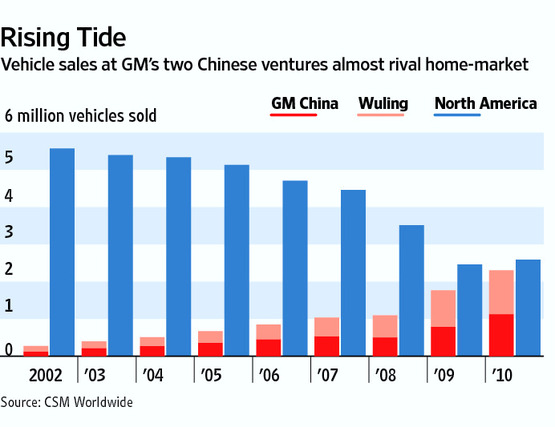
WSJ story on GM betting big on China's rural market and FT story on Lenovo planning to use the selling expertise it gained there to penetrate similar bottom-of-the-pyramid markets in Indonesia, Brazil, Mexico, India and Turkey.  

Per the chart above, you can see GM's logic plainly:  China is already a market roughly equal to its US share.

Per both, you begin to understand the logic that says, To sell globally is to succeed first in China.  Why?  It's not just the market size, but the BOTP experience gained.  Thus the larger logic of allying with Chinese firms as they go global.  Master the one, progress to them all.

The rise of the global middle class necessitates being able to sell in the rural market, because that's where a good chunk are located amidst all the urbanization between now and 2050 (we basically double the number of urbanites globally from 3.3B to 6.6B).  In marketing terms, this is Leninist-Maoist:  Go back in time and catch your target in their pre-branded state!

First car and PC sale is like first vote as adult:  brand affiliation is often set for life, so the effort is more than worthwhile for a GM and Lenovo.

4:28PM

Esquire's The Politics Blog: Obama's Middle East Speech Text, Decoded Line-by-Line

Expectations couldn't have been lower for President Obama's Middle East speech on Thursday, and yet it was a work of "realist" beauty that recognized: a) how little influence America actually has over these types of events, and b) where we stand at the beginning of what is likely to be a long process of political upheaval and — hopefully — economic reform that addresses the underlying issues driving the entire region. Yes, Obama took a pass on Palestine and Israel (his historic referencing of Israel's pre-'67 borders is the Mideast equivalent of a "world without nuclear weapons"), but he's got several touch points in the coming days (the Netanyahu meeting, another speech, Netanyahu's speech to Congress) with which to address that, so this was more of a broad-strokes laying out as to what America stands for, and what it's willing to do amidst its current fiscal realities. And — again — it was a great mix of stated idealism, expressed in long-haul terms, and political pragmatism that recognizes the here-and-now realities that must temper any sense of America coming to anybody else's immediate rescue.

Obama's was a well-crafted message — one that reassured both the world and Americans that this administration knows its limits and its responsibilities to history. It was, in a word, presidential.

And now, so you don't have to sit through it again, a little deconstruction of the most compelling sections excerpted (from the prepared remarks) at length....

Read the entire post at Esquire's The Politics Blog.


12:03AM

How the Muslim Brotherhood in Egypt cracks under pressure - naturally

This is pretty much how I always expect it to go in these situations:  the long-oppressed opposition party finally has its chance at the brass ring and - booyah! - it starts fracturing over how to do it.  This is usually how the single party - realized or just self-actualizing - falls apart.  It's how I would see the Cuban Communist Party falling apart after the Castros depart. ["Falling apart" here also meaning birthing new parties.]

WSJ story on leader of one of the more moderate factions within the Egyptian Muslim Brotherhood deciding to break from the party and declare his own presidential campaign.  "More moderate" is defined as:

. . . a positive relationship with the West, more rights for women and religious minorities, and democratic reform within the party's top-down leadership structure.

But here's the real rub:  Abdel Moneim Aboul Fotouh and his faction believe the MB must split into two groups -a political party and a religious organization with attendant charities.

Since Dr. Fotouh, 59 years old, is effectively breaking the MB's promise not to field a candidate, many in the group are calling for him to resign because the group won't support his candidacy.

Despite the fears triggered by his announcement, I think this is a good thing.  If we want the Nelson Mandela-like figure, he will necessarily be of the group and simultaneously above the group.  The MB is the most organized party, so it's not odd that compelling figures will arise from it, but they need to do so as Fotouh seems to be doing, by forging a special, above-it-all path.

Obviously, a very early reading, but that's my suspicion.  The MB was the ONLY party to turn to - in opposition - under Mubarak, but now that he's gone, factions not only emerge but they break off and form new parties.

But no, I don't expect Egypt to pick some perfectly secularly leader.  I think that's unrealistic and - in some way - unwise.  But they do need the above-the-party-type figure, and maybe this guy is it.

Yes, I know I will be immediately bombarded by THE quote or action from Fotouh's past, but none of that will impress me.  The only thing that will count is what he does now.  Mandela was a figurehead for a Soviet-sponsored national liberation movement in my PhD diss - totally on the OTHER side.  Then the ANC got its chance, and Mandela made the most of it, and South Africa is South Africa today and Mandela is a near saint.

If you want the Egyptian Mandela, this IS the most logical source-path.

6:01AM

Time's Battleland: If issued, Libyan ICC arrest warrants would continue "perfect" Africa record for court

After many weeks of speculation and veiled threats-by-extension from Western government leaders, the prosecutor of the International Criminal Court announced on Monday that he is seeking arrest warrants for Muammar Qaddafi, his son Seif al-Islam Qaddafi and his brother-in-law Abdullah al-Sanousi for systematically targeting citizens in Libya's ongoing protests and civil strife. Libya isn't a signatory to the ICC treaty, and prosecutor Luis Moreno-Ocampo declared that the Libyan people should take it upon themselves to make the arrests, if warrants are granted. Moreno-Ocampo said he had enough evidence to go to trial immediately, just another sign that the Qaddafi clan has crossed a line that disallows their staying in power - as far as the West is concerned.

Read the entire post at Time's Battleland.

11:09AM

WPR's The New Rules: Four Options for Redefining the Long War

There is a profound sense of completion to be found in America's elimination of Osama bin Laden, and the circumstances surrounding his death certainly fit this frontier nation's historical habit of mounting major military operations to capture or kill super-empowered bad actors. Operation Geronimo, like most notable U.S. overseas interventions of the past quarter-century, boiled down to eliminating the one man we absolutely felt we needed to get to declare victory. Now we have the opportunity to redefine this "long war" to America's most immediate advantage. I spot four basic options, each with their own attractions and distractions.

Read the entire column at World Politics Review.

6:52AM

Syrian Regime Stability Simulation โ€“ Update and Intermediary Summary


What began as a small protest in the small country of Tunisia, the Arab Spring erupted, transforming the political landscape throughout the Middle East and North Africa.  People yearning for better opportunities and political freedom began protests throughout the region.  Egyptian dictator Hosni Mubarak, in power for thirty years, resigned his position under intense pressure, while Libyan dictator Muammar Gaddafi, in power for forty years, clings to power following a NATO airpower-backed rebellion. Bahrain and Yemen also endure protests that endanger their political leadership.  Another country, with a long history of brutal crackdowns against its citizens, with deep-rooted repression from a powerful security apparatus, and a key player in the Middle East peace process, begins to see cracks in its domination from small pockets of protest inspired by the events in region – Syria.

Wikistrat’s Syrian Regime Stability simulation analyzes the uprising in Syria using Wikistrat’s unique platform.  Wikistrat’s analysts and subscribers, led by Chief Analyst Thomas PM Barnett, collaborate online to examine the Syrian Regime’s stability and its effects on key themes.  How will a change in Syria’s Regime affect regional stability including Syria’s relationship with Israel and Saudi Arabia?  How will Syria’s relationship with Iran change and how will it affect the region?  Will terrorist organizations Hamas and Hezbollah benefit from changes in Syria’s government?  Will Kurds rise up against the Syrian Regime or other sectarian violence ensue? 

By incorporating possible scenarios, impacts on the countries involved in the region and diverse policy options for these countries, Wikistrat simulations give its analytic community a continually evolving up-to-date model of the geopolitical reality, rather than a static document.


Some of the Scenarios Proposed and their summaries:

(Scenarios plotted by Ryan Mauro, strategic analyst with Wikistrat and author of worldthreats.com)


1) Assad Survives and Quells Dissent – The Assad regime finds itself in a stronger position after violently crushing the uprising. The most influential activists are silenced through various means and the regime is able to identify its opponents and learn how to combat their strategies as a result of this victory. The opposition is demoralized and fractured while some opt to join the government as a minority voice following minor political reforms. The Muslim Brotherhood decides to officially endorse the Assad regime as an ally in the fight against the West.

Suggested by Trevor Westra, of theolog.ca, on the probability of this scenario occurring, “The plausibility of Assad emerging from the current crisis, with his leadership intact, depends heavily on the continued allegiance of the army…His commanders, most of whom are Alawite loyalists, appear firm in their support.” 


2) Assad Survives but is Unstable – Assad adopts a more-liberal tone and institutes minor economic and political reforms. His military stays intact. Visible signs of dissent remain, but the uprising ultimately recedes because its participants cannot organize a formidable opposition movement nationwide. As a result, the West no longer views their support of the opposition as a viable policy option.

A risk of this scenario by Nick Ottens, of www.atlanticsentinel.com, states, “If unrest persists…the burden of unemployment and further undermining the regime’s legitimacy even in the eyes of people who might have a vested interest in its survival.”


3) Assad Survives Through Iranian Intervention – Iranian forces secure Assad's regime, while strengthening its grip on Syria. A brief civil war breaks out but is quickly ended through the deployment of Iranian Revolutionary Guards personnel and terrorists from Hezbollah and Hamas. The IRGC openly operates in Syria and becomes more intimately involved in the operations of the security services and government agencies. A series of agreements making Syria essentially a military base for Iran are signed and the West concludes that luring Syria away from Iran is no longer a viable policy option.

Comments from Mark Safranski, of zenpundit.com, include, “I have great difficulty imagining Israel and the United States tolerating, say, 25,000 – 50,0000 IRGC in combined arms units operating in Syria on behalf and in conjunction with the Syrian Army, slaughtering thousands of Syrians.”


4) Regime Change Brings Moderates to PowerAssad's regime does not survive the uprising, and is replaced by Moderates. The Assad regime is removed through a popular uprising and/or military coup. The opposition forces declare victory and the secular democratic opposition comes to the forefront of the transitional government. The Muslim Brotherhood performs well in the parliamentary elections but is a minority. The new government vows to bring Syria closer to the West and institute vast reforms. 

This scenario is summarized by Andrew Eccleston of the American Military University as, “A perfect storm of Iranian miscalculation and division within the ranks of the Muslim Brotherhood brings a moderate regime to power in Syria.”


5) Regime Change Brings Muslim Brotherhood into power: Assad's regime does not survive the uprising, and is replaced by Muslim Brotherhood leading the parliament. A series of defections from Assad’s government, including the military and intelligence services, leads to a civil war similar to the one in Libya. The Assad regime is removed from power and the Muslim Brotherhood declares victory. The Brotherhood and other Islamist parties hold a majority in the new parliament after elections are held and oversee the writing of a new constitution which makes Islam the primary source of legislation. The new government says it will maintain close ties to Iran and will continue to support Hamas and Hezbollah.

Professor Robert Edwin Kelly, of asiansecurityblog, also contributed to this simulation as to whether the United States should abstain from taking action in Syria. “[T]he ‘responsibility to protect’ (R2P) threshold must stay somewhat high, otherwise the West could get chain-ganged into multiple human rights interventions that will increasingly look to Arab audiences like neo-imperialism.”


To Join Wikistrat's Simulation and Interactive Wiki - click here


12:56PM

Mystery Scene mag story on Mom's reference works


Just wanted to capture it for my records.  From Winter issue of mag.

12:02AM

Spoke at bankers professional training seminar in ATL

Actually termed an "economic and strategy seminar" for bankers in the fixed income capital markets.  Morgan Keegan puts on a number of these events around the country each year - all part of the professional training required by the various industries they service.  I spoke last summer at the MK event in upstate NY for pension managers, so this was my second go-around with them.

Over a hundred in the audience, and I got the tough slot:  4pm and I'm the only thing standing between a group that's been going from early in the morning and the end-of-training mixer.

This time I went with the Mac suggestion of creating a separate, cootie-free user account on the laptop and running the brief off the shared hard drive as a way of isolating the program and seeing if that made a difference on latency and/or the crash I suffered in Johnstown (first ever during a talk).

It worked beautifully.  No latency whatsoever and I got through the entire brief for the second time.

With nothing to occupy my mind WRT the slides, I was able to give the best performance yet of the new brief. Probably not all that different, as far as the audience is concerned, from the prior three.  It just was more mentally relaxing because I got in that unconscious groove when the humor starts spontaneously appearing.

Nice dinner at "Bones" later that night in Atlanta.

The brief now seems set:

  • Opening with "map";
  • Flow of people, ending with Middle East projection;
  • Flow of money, ending with Asia projection;
  • Flow of energy, ending with Africa projection;
  • Flow of food, ending with Western Hemisphere projection; and
  • Flow of security, ending with tripolar projection (US, China, India).

Each flow has me presenting, in yin-yang combination, something we must accept and something we will fight/struggle with.  The regionals are presented as evolutions that reflect the interplay. Full-up, it runs 75 mins, which is what I did at MK. Q&A happened in the mixer, which is always nice because then you really have time to get to know people and their concerns.  Plus, a martini is really nice after the energy output!

The brief is now loaded so that, no matter how much time I have, I cover things in the order I want, so more important/topical up front, degrading as you go back.   If I don't finish, I still feel like I gave everything I could/should in the time allotted.  Naturally, I could easily break out additional slides to make them a full-day teaching seminar - and any length in between, which is how I like it.  It's also easily updated for topicality. Sad to cut some favorite slides, as so little remains of the original "Great Powers" brief now, but time marches on and one needs to stay abreast with the audience.  What I have now is arguably the most easily accessible brief yet for none-Pol/Mil types.

My speeches this May have constituted a Packer victory lap:  IL with the cops and firemen (NFC championship v. Bears), Johnstown PA (right next to the Steelers) and now Atlanta (NFC divisional).  

Great off-season!

5:05AM

Wikistrat Competition Featured in Reuters

As our wiki grows, with the competitors reading and debating grand strategy, Wikistrat was featured in Reuters's piece by Peter Apps titled: "As China Rises, 'Grand Strategy' talk back in style".

Some relevant excerpts:

When Israeli-based political risk consultancy Wikistrat launched a month-long online grand strategy competition between universities, military colleges and similar institutions around the world, it was taken aback by the level of interest.

The contest, which begins this month, will cover the next two decades of global history with teams representing roughly a dozen countries needing to form alliances and adapt to shocks such as revolutions and conflicts.

"I really think it's caught the spirit of the moment," says Wikistrat CEO Joel Zamel. "There is much more interest in a kind of 'grand strategy' approach.

"We've had much more interest from around the world than we expected -- Indian universities will be representing India, Israeli universities Israel, Singaporean Singapore, Japanese Japan, U.S. schools the U.S.. We've had to keep adding countries."

...

"The war on terror really pushed grand strategy to one side, but as that seems to be winding down there is much more focus on it," said Robert Farley, professor of international relations at the University of Kentucky.

"Students know they will need it in their careers, whether in public service or the private sector. We've recently failed students for failing to be able to answer questions on the rise of China, for example."


Read the full piece here

12:01AM

Just how scared Beijing is becoming over inflation

FT story on the big fine the Chinese gov levied on consumer products company Unilever for publicly announcing that it planned to lift prices.  Apparently some consumers rushed into stores and bought up stuff in anticipation of the price hike, spooking the authorities.  So they slapped a $300,000 fine on the company.

FT:  "The move by the National Development and Reform Commission, China's economic planning agency, will heighten concern among foreign and domestic companies that they may not be able to pass rising costs on to consumers."

Nervous in government service.

12:00PM

CoreGap 11.12 Released - At the Time of his Demise, OBL was OBE


Wikistrat has released edition 11.12 of the CoreGap Bulletin.

This CoreGap edition features, among others:

  • Terra Incognita 11.12 - At the Time of his Demise, OBL was OBE
  • Bin Laden Killing Comes at Pivotal Moment in US Operations in Afghanistan
  • Pakistan’s Longtime Duplicity Comes to Fore with Bin Laden Operation
  • Latest Census in China Triggers Fears of Demographic Decline
  • African Development Bank Group Details Rise of Middle Class There

And much more...

The entire bulletin is available for subscribers. Over the upcoming week we will release analysis from the bulletin to our free Geopolitical Analysis section of the Wikistrat website, first being "Terra Incognita - At the Time of his Demise, OBL was OBE"


It would seem that reports of Osama Bin Laden’s leadership of al-Qaeda these past few years were greatly exaggerated.  By the time the equally shadowy SEAL Team 6 put that bullet through his brain, the great man was living in a million-dollar “cave” whose primary purpose was to keep him decidedly off grid – out of reach and out of touch.  But Osama Bin Laden was overtaken by events a long time ago.

Globalization was more concept than reality a decade ago. “Rising” China? The muffled sound of a train gaining speed in the distance.  One could imagine globalization’s easy reversal thanks to the right bomb exploded in the right place at the right time. Vladimir Lenin, the most pragmatic of revolutionaries, referred to such wishful thinking as “left-wing deviationism – an infantile disorder.” Bin Laden had it bad. 

Pulling off one of the greatest lucky shots in history (both barrels, mind you), Bin Laden sent the West spinning into an orgy of new rules, wild spending, and poorly thought-out postwars (the initial takedowns were works of real artistry). Proving beyond all doubt that we live in a world in which super-empowered individuals can engineer vertical shocks of the highest order, he nonetheless succumbed to the most prosaic of horizontal scenarios – the methodical manhunt that only a vast national security bureaucracy can mount. “Operation Geronimo” was aptly named:  the mythical warrior reduced to a legend’s lonely death.

Read the full piece here

More about Wikistrat's Subscription can be found here

To say that President Barack Obama’s foreign policy plate is full right now is a vast understatement, and it couldn’t come at a worse time for a leader who needs to revive his own economy before trying to resuscitate others (e.g., Tunisia, Egypt, South Sudan, Ivory Coast – eventually Libya?). Faced with the reality that America’s huge debt overhang condemns it to sub-par growth for many years, Washington enters a lengthy period of “intervention fatigue” that – like everything else, according to the Democrats – can still be blamed on George W. Bush.
11:24AM

Time's Battleland: "Pakistan: indispensable to US security?"

I am amazed at how quickly the Obama administration is going out of its way to assure everyone that we're sticking with Pakistan for the long haul no matter what. No discussion and little explanation, it's just assumed that Pakistan becomes the new indispensable partner that anchors US national security, even as every day reveals some new aspect where we clearly don't trust the government, military or secret police whatsoever.

Read the entire post at Time's Battleland blog.

10:23AM

Local press coverage of Johnstown talk

The story from the Johnstown Tribune-Democrat:

China’s economy faces hurdles, author says

By Bernie Hornick

China’s expected rise to pre-eminence this century should be short-lived, one geostrategist and futurist told a Johnstown business audience Tuesday.

That’s because many of the seeds of China’s descent already have been sown, argued Thomas P.M. Barnett, a New York Times bestselling author.

Barnett ticked off a list of problems the Chinese face, everything from air and water pollution to over-reliance on foreign oil and an aging population.

All of these factors will serve as brakes to the Chinese economic engine, he said.

“China’s going to hit the wall,” Barnett said.

He foresees a triumvirate of world powers in the decades ahead: The U.S., China and India.

Barnett was optimistic about America in the 21st century.

“We tend to revive ourselves on a regular basis,” he said, adding there’s no telling what will serve as the spark.

In what best can be described as a two-hour master’s class lecture, Barnett whizzed through a PowerPoint presentation outlining his views on “flows” worldwide. Those flows include immigration, water and food resources, oil supplies, population and military conflict.

The U.S. errs, Barnett told members of the National Contract Management Association, when it plans militarily for a confrontation with China – what he calls “the big war market.”

Rather than building big-platform merchandise, such as aircraft carriers, Barnett argues that the defense apparatus would be better served by building the “many and cheap and disposable,” such as drone aircraft.

On the business side, Barnett said the growth of the middle class worldwide will be a continuing trend.

The pyramid-shape of income distribution in the Third World will yield to a diamond shape.

That burgeoning middle class will create nations that not only are more economically stable but also more supportive of democracy.

American companies must enter U.S.-Sino business partnerships to be successful on the mainland.

“You’re going to see this pattern replicated time and again,” he said. U.S. companies are going to have to cut the Chinese in on the business action in their backyard.

About 75 people attended Tuesday’s breakfast at the Holiday Inn-downtown.

Barnett’s books include “The Pentagon’s New Map: War and Peace in the Twenty-first Century” and “Great Powers: America and the World After Bush.”

12:01AM

Chart of the day: A global middle class drinks coffee

FT story on how producing countries (mostly Gap) and emerging markets (mostly New Core) are driving an expansion in coffee consumption globally.  

Coffee demand globally is described by one expert as being at a "turning point":

Demand in western Europe and the US is nearing a plateau, while consumption in emerging markets is rising strongly, particularly in coffee-producing countries.

Brazil is considered the exemplar of the trend, and as readers of this blog will note, I've posted in the past about its rapidly expanding middle class and the stunning growth in food consumption there (both more volume and moving up the caloric chain).

Tea is kind of weird:  both high- and low-brow, meaning the rich love their tea and the poor depend on it in much of the world. But the middle class likes its coffee - its stimulus package every ayem.

Good news for producers.

11:23PM

NAED conference highlights

I get a brief mention and some video:

10:40PM

World Have Your Say podcast (BBC World Service)

Find it here.  It will be available for seven days.

On with Elizabeth Economy and Joel Kotkin, two superb thinkers.