Buy Tom's Books
  • Great Powers: America and the World After Bush
    Great Powers: America and the World After Bush
    by Thomas P.M. Barnett
  • Blueprint for Action: A Future Worth Creating
    Blueprint for Action: A Future Worth Creating
    by Thomas P.M. Barnett
  • The Pentagon's New Map: War and Peace in the Twenty-first Century
    The Pentagon's New Map: War and Peace in the Twenty-first Century
    by Thomas P.M. Barnett
  • Romanian and East German Policies in the Third World: Comparing the Strategies of Ceausescu and Honecker
    Romanian and East German Policies in the Third World: Comparing the Strategies of Ceausescu and Honecker
    by Thomas P.M. Barnett
  • The Emily Updates (Vol. 1): One Year in the Life of the Girl Who Lived (The Emily Updates (Vols. 1-5))
    The Emily Updates (Vol. 1): One Year in the Life of the Girl Who Lived (The Emily Updates (Vols. 1-5))
    by Vonne M. Meussling-Barnett, Thomas P.M. Barnett
  • The Emily Updates (Vol. 2): One Year in the Life of the Girl Who Lived (The Emily Updates (Vols. 1-5))
    The Emily Updates (Vol. 2): One Year in the Life of the Girl Who Lived (The Emily Updates (Vols. 1-5))
    by Thomas P.M. Barnett, Vonne M. Meussling-Barnett
  • The Emily Updates (Vol. 3): One Year in the Life of the Girl Who Lived (The Emily Updates (Vols. 1-5))
    The Emily Updates (Vol. 3): One Year in the Life of the Girl Who Lived (The Emily Updates (Vols. 1-5))
    by Thomas P.M. Barnett, Vonne M. Meussling-Barnett
  • The Emily Updates (Vol. 4): One Year in the Life of the Girl Who Lived (The Emily Updates (Vols. 1-5))
    The Emily Updates (Vol. 4): One Year in the Life of the Girl Who Lived (The Emily Updates (Vols. 1-5))
    by Thomas P.M. Barnett, Vonne M. Meussling-Barnett
  • The Emily Updates (Vol. 5): One Year in the Life of the Girl Who Lived (The Emily Updates (Vols. 1-5))
    The Emily Updates (Vol. 5): One Year in the Life of the Girl Who Lived (The Emily Updates (Vols. 1-5))
    by Vonne M. Meussling-Barnett, Thomas P.M. Barnett, Emily V. Barnett
Search the Site
Powered by Squarespace
Monthly Archives
10:04AM

Time's Battleland: An explosive glimpse of the future of the long war in Africa

The militant Islamic group of north Nigeria, known as Boko Harum, takes credit for the deadly car-bomb attack on a police station in the capital city of Abuja yesterday.

You might not think of West Africa as a likely site for radical Muslim violence, but the map on the left, which I use in my current "global futures" brief, may clear things up a bit when you hear about this, the recent north-south election standoff in Ivory Coast, or al-Shabaab violence extending over to Uganda.

Read more at Time's Battleland blog.

9:27AM

Time's Battleland: Globalization at the barrel of a gun

Careful where you aim that weapon, buddy!

That phrase, with its powerful imagery, was often tossed at me following the publication of my 2004 book, The Pentagon's New Map. In it, I argued that globalization's expansion was, and would continue to be, the primary cause of unrest and conflict in the world, as connectivity - in all its forms - extended itself into the non-integrated regions and triggered rising expectations (as in, "If the Indians and Chinese are getting richer, then why do we continue to submit to this incompetent government that keeps us unduly disconnected from all that opportunity?").

Read the entire post at Time's Battleland.

8:59AM

Some serious heavyweights join Wikistrat's global lineup of strategists

I've spent much of August now making pitches to analysts/thinkers/strategists I deeply respect, asking them to join Wikistrat's community of strategists.

And I've got to tell you, we've got some real stars coming our way:  Dmitri Trenin from Carnegie Moscow, Daniel Pipes from the Middle East Forum, Robert Kaplan from the Center for a New American Security, and Michael Scheuer of "Imperial Hubris" fame. From the blogging world we've attracted Lexington Green of Chicago Boyz, Mr. "Anglosphere" James Bennett, James Joyner from Outside the Beltway and this blog's "neighbor" ZenPundit. We're also signing up a number of World Politics Review writers like Frida Ghitis and editor-in-chief Judah Grunstein.

The invites keep going out and the acceptances keep rolling in. If you think joining up is for you, please contact me and let's discuss.

Wikistrat is offering various levels of belonging. Most of the heavyweights will be employed primarily on simulations for clients - the crowdsouring effect. The more junior ones will spend much of their time building up the GLOMOD, or Global Model that undergirds the simulations, but also getting in on those when it makes sense.

Exciting stuff!

As I tell these people, we know we're carving out some new territory here, but anybody who looks ahead realizes that analysis in the 21st century won't be done solely in a BOGGSAT (bunch of guys and gals sitting around a table) manner. With a world increasingly tackling its entertainment in a distributed, massively multiplayer online way, some portion of analysis naturally gravitates in the same direction - already embodied in the blogosphere itself. 

So our point is, why not harness all that effort into something larger and more coherent. Instead of you, the client, visiting 40 blogs of China experts, why not have those 40 come together in TEAP mode (throw everyone at the problem) and work your China issue for you. And don't just have them discuss and then mush together their competing perspectives in the summary report. Instead, have those ideas compete on the Wiki in the form of scenarios - ones that illuminate the "black swans" you've never considered, etc.

I really think this is going to be an historic capability here, and I can't tell you how excited we are to attract such serious talent.

1:21PM

Time's Battleland: Global arms exports track global economy's double dip

Couldn't afford the upkeep, so it's yours now, kid!

It's interesting to think back to the start of the global economic crisis, when there were a lot of assumptions voiced about how a rising quotient of international tension would inevitably morph into more conflicts and thus more traditionally focused defense spending – i.e., great powers hedging against one another versus, say, non-state actors or state failure. If we were on the verge of the second Great Depression, then certainly we'd find ourselves in a 1930s-like march toward significant great-power struggles, yes? With the Arab Spring providing the tinder for a great-power free-for-all?

So what have we found so far?  

Read the entire post at Time's Battleland.

9:37AM

WPR's The New Rules: The Race for Global Leadership in the Age of Anger 

Ian Bremmer, the founder and head of Eurasia Group (for which I work as an analyst), has argued that we are living in a "G-Zero" world, or one in which there is no genuine great-power leadership. From the perspective of political science, it is hard to disagree, as anyone reading a newspaper these days can attest. Still, the historian in me says this situation cannot last for too long. My reasoning here has nothing to do with the global correlation of military force, since thanks to globalization's emerging middle class, "butter" will inevitably emerge as the winner over "guns." 

Read the entire column at World Politics Review.

10:57AM

Chart of the Day: Perot sold that story too

Now let me first say that I hunger for serious competition to Obama.  If he gets back in, I want it to be a tough fight because, otherwise, his first-term arrogance will return unabated.

Let me also say that, as a rule, I think second terms are disasters. I have always favored a single six versus 2x4=8.  I haven't lived through a second term yet that I wouldn't have traded in for the 2nd election competition. I just see scandals and drift and lots of lesser talent creeping in for no good effect.

So I want Perry to be real, because Romney ain't doing it for anybody except Peggy Noonan.  And while I respect her considerable political instincts, I remain unsold (even though his campaign book cited me very favorably), primarily because I'm unsure he can win and - again - I want a real election and not some disappointing recrowning for a weak first term. If Obama is to win, I want him to earn it this time rather than have it somewhat handed to him by a weak opponent.

And so far, Perry is looking like an un-self-aware Romney.  Romney may flip a bit to win the nomination, but he at least knows who he is. Perry is for HPV vaccination so long as his friend says so, but then the religious right get on him and he flips like a pancake for no more reason, it seems, than his initial decision.

Now, he's selling the Texas miracle like H. Ross Perot sold his buffalo-tinged, I-made-my-own-fortune story, except Perot and EDS got fat mostly through gov contracts and Perry's jobs miracle seems similarly fueled:

Texas Gov. Rick Perry has leapfrogged to the top tier of Republican presidential candidates largely on the strength of one compelling fact: During more than a decade as governor, his state created more than 1 million jobs, while the nation as a whole lost 1.4 million jobs.

Perry says the “Texas miracle” rests on conservative pillars that he would bring to the White House: minimal regulation and government, low taxes and a determination to limit the reach of Uncle Sam.

What he does not say is that much of that job growth has come because of government, not in spite of it.

With a young and fast-growing population, a large and expanding military presence and an influx of federal stimulus money, the number of government jobs in Texas has grown at more than double the rate of private-sector employment during Perry’s tenure.

This guy needs to figure out if he's real or just enough of a snow job to sell in Texas.  If he is real (the other numbers are undeniably un-shabby), then he needs to start acting real, meaning acknowledging truths and acknowledging that what goes on in Texas is indicative of just about nothing in this country (Anybody else getting a one-fifth increase in gov jobs? Because those can go away too.).

So yeah, make your sale on your record, but make it honestly and show me some realistic translation to the real world known as the US outside of Texas. Indiana, for example, has a serious governor with a serious record and a serious capacity for telling the truth - Mitch Daniels.  I don't like everything he does, but at least our finances aren't a disaster amidst all the ongoing difficulty, and that counts plenty.

Perry is coming off, so far, too slick and too political.  I am not sensing the "real deal" dynamics in his presentation to date.  Some of that may be how the press is working him over, the usual rumor mills from enemies, etc., but the guy needs to get a grip before he gets himself defined down dramatically.  Maybe that's inevitable and there ain't no there there (all hat,no cattle, in TX terms), but mebbe it ain't.

It just doesn't feel like it's working so far, because I smell a Perot, and I don't want any cartoon character running for POTUS.

12:01AM

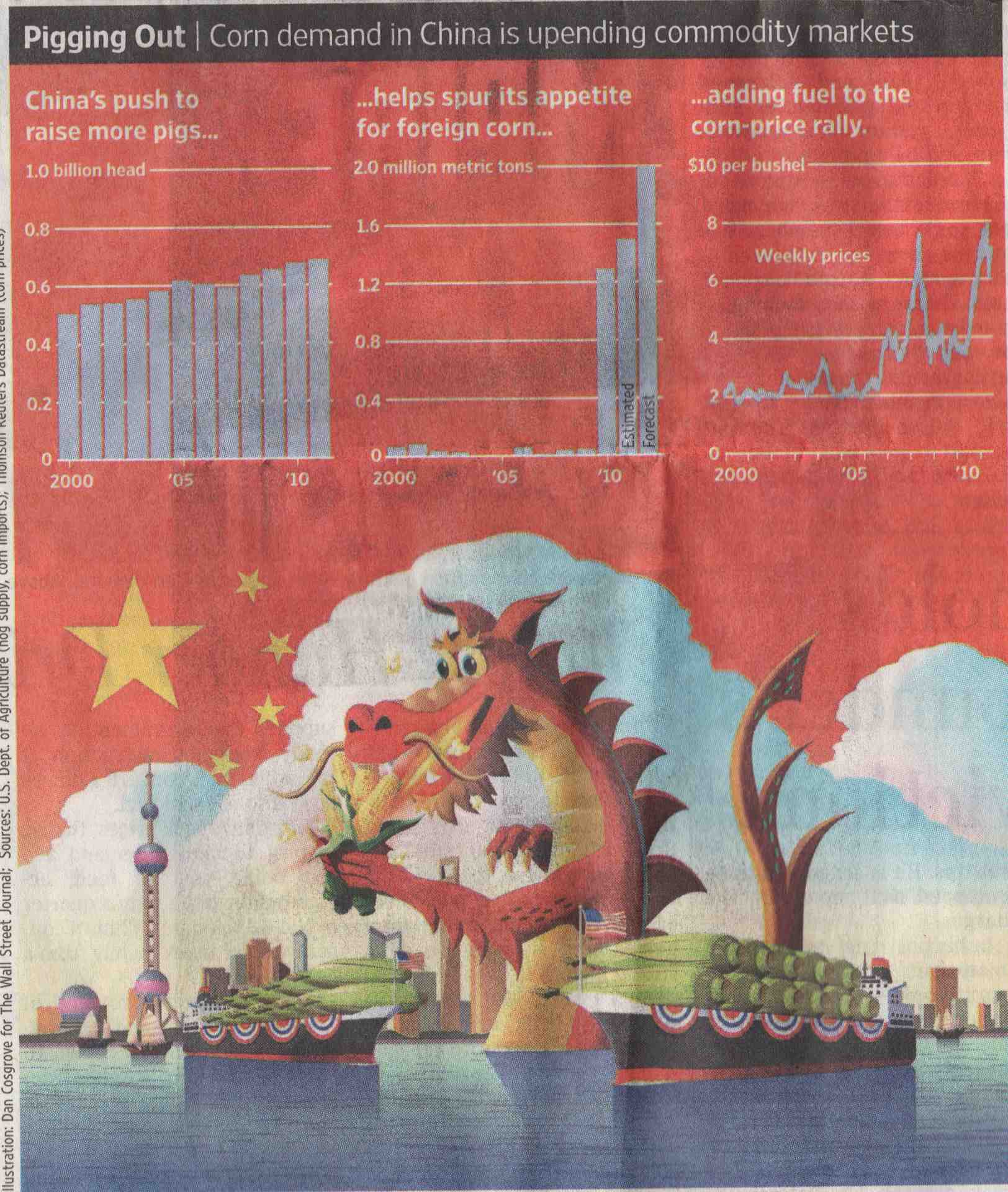
Chart of the Day: The Dragon Eats Corn

WSJ story.

This is, of course, big news to those of us who own farmland in the Midwest (I do by extension through my wife), because China is already buying up all the soybeans (or so it would seem), and now they're moving in corn in such a big - and I believe, a permanent - way, that a state like Indiana, where damn near everything is corn or soybeans, is feeling pretty good.

Our acreage, BTW, is in NW Ohio - basically the farm my wife grew up on (her share).

With China sucking up this corn and the rest of the world's demand rising as well, it almost strikes me as criminally stupid, in a strategic sense, to continue with the economic farce that is corn ethanol.  I've seen estimates where one-third of our crop (!) is destroyed in this manner - and I do consider it "destruction" is a world where 1B are too fat and 1B are malnutritioned (Soylent Green anyone?).

Mini rant for the day. Up to Lambeau tonight to see Pack v Cards in preseason.  Taking the Mei Mei.

10:44AM

Chart of the Day: Chinese students continue to flood US schools

An interesting trend amidst the general deterioration of relations (of course, officially, everything is wonderful), and reflective of a growing middle class in China able to pay for overseas education.

But it also shows that far-sighted Chinese prefer the sort of "questioning"/critical thinking education that the US offers over the more rote version offered at home.  Last time I was in China, I heard that directly from college execs: they feared they just weren't developing the students the country needed.

Of course, that sort of academia would be harder to control, so China effectively outsources the function.  That does delay the eventual impact of making so many critical thinkers happen - but that's all.

Remember how the Middle East starting pushing so many young people into college across the last decade.  Yes, it kept off the streets for a while, but when they got back on the streets, my, were their expectations then even more "unreasonable."  The Arab Spring is a direct result of that.

11:09AM

Mr. Dalit Comes to Class

FT story on new Bollywood film depicting "untouchables" and the discrimination they suffer. The film is already banned in three Indian states out of fear of inciting social unrest.

Ask yourself, what period of US history does this remind you of?

Fair dynamic comparison, although here the pushback comes more from dalit politicians and those in favor of their rights.  Why? Film focuses on quota system for dalits/untouchables set up at time of independence. Upper castes say film makes them look bad, but dalits say film denigrates positive impact of quota system - aka, India's version of affirmative action. 

What I remember from visiting India: it seemed like the taller you were and lighter your skin, the more likely you were more powerful and thus from a higher class.  Conversely, lower caste people seemed shorter (poorer diet) and darker.  So when I mixed with elites, I looked them in the eye, but when I moved among ordinary people, I felt like a frickin' giant. The dichotomy rather stunned me.

If you mention that observation, you tend to get a strong response from Indians who find any comparison to racism in the West to be completely offbase. I'm not sure what you call it, but it strikes me as a deep legacy of discrimination based on birth (meaning you can't change who you are no matter what, which smacks of that "one drop of blood" logic) and thus is reasonably compared to racism elsewhere in the world, despite its "sophisticated" and multivariate application.

Point of post: rising India, like rising China, is racing through a lot of history and "phases" that US went through a much more leisurely pace.  That's incredibly hard but facinating to watch.

Blurb on film only hints at controversy (from Rotten Tomatoes), but understand that Prabhakar has a special space for dalits in his school and that Kumar, who is in love with Prabhakar's daughter, is himself a dalit. This is classic Bollywood (father-daughter conflict over undesirable match) with the twist that here the father is the perceived liberal:

Aarakshan is the story of Prabhakar Anand (Amitabh Bachchan), the legendary idealistic principal of a college that he has single-handedly turned into the state's best. It is the story of his loyal disciple, Deepak Kumar (Saif Ali Khan) who will do anything for his Sir. Of Deepak's love for Prabhakar's daughter, Poorbi (Deepika Padukone), of his friendship with Sushant (Prateik). It is the story of their love, their lively friendship, their zest for life, and of their dreams for the future. Centered on one of the most controversial issues of recent years, with the Supreme Court's order on reservation, the story suddenly becomes a rollercoaster ride of high drama, conflict, and rebellion, which tests their love and friendship for one another, and their loyalty to Prabhakar Anand.

Film is already in US, probably because Bachchan is the Cary Grant of Indian cinema. Done about 300k, so art-house limited.

Be interested if anyone has seen it and can provide impressions.

12:44PM

Time's Battleland: Our silent partner everywhere we intervene - China

Soon to be re-joined by their Chinese comrades!

That's how I like to describe it. Whether we like it or not - much less admit it, every time we show up somewhere in tumult, the Chinese are already there or soon to show up. They will be making the big investments (like that $3-4B on a copper mine in Afghanistan) and they will be winning the big extractive contracts (like with both the Kurdish Regional Government and Baghdad in Iraq). Paraphrasing Buckaroo Banzai, "No matter where we go, there they are." You can call it free-riding and label it clever competition, but it's more complimentary than we in the West care to admit, because after the bombs stop, somebody has to rebuild and who are more incentivized than those resource-ravenous Chinese?

Read the entire post at Time's Battleland blog.

9:34AM

WPR's The New Rules: Debunking the 'Russia Threat' Hype 

When the Berlin Wall fell in 1989, I was completing my doctoral dissertation on Warsaw Pact-Third World relations. I immediately understood that my time in Soviet studies was done. Why? Because I knew that Russia was full of brilliant political scientists who, once free to pursue their craft free of ideological constraints, would do a better job explaining things there than outsiders could. 

The generation of Russian scholars that emerged in the post-Soviet era proved me right, and none has consistently impressed more than Dmitri Trenin, who heads up the Moscow office of the Carnegie Endowment for International Peace . . . 

Read the entire column at World Politics Review.

10:31AM

Movie of my Week: "Source Code" (2011)

A real patische of a movie but so very well executed and engaging stars all around.  Any movie with Michelle Monaghan and Vera Farmiga is o-tay by me.  Good vehicle for Jake Gyllenhaal, who needed a win after that Persian mess, and Jeffrey Wright is always a joy to watch on screen.

Tight script that feels like a Philip K. Dick novella, with echoes of "Avatar" and even "Groundhog Day" in the humor.  Bit of "Manchurian Candidate" to boot.  Rod Serling would have approved.

A mere 90 minutes, but when you want that shorter movie and a lot of entertainment for your time, a great choice.  Chicago also looks pretty enough. 

11:50AM

Chart of the day: Filling in the gaps on emerging economies = economic dynamic of century

It is THE amazing achievement of US grand strategy that we've created the conditions by which the chart of the direct left unfolds. If ANYBODY tells you that globalization is bad or unfair or says similar things about US "empire" since WWII, then simply show them the slide on the left, because it knocks those lies right out of the ballpark.

Or to be more succinct: the US-created and -enabled globalization process never replicated the dynamics of colonialism - i.e., kept the poor down. It did the exact opposite. The rest is just whiny bullshit propagated by little minds who refuse to accept it. We built a world order that enabled the rise of a global middle class, which means near-universal democracy is in the works (there will remain bedroom communities for the nonviolent rejectionists - we'll just ask them to put orange reflector signs on their buggies).

Further down, you see the legacy gaps in capabilities that will be invariably filled in over the coming 2-3 decades. That's when the resource constraints push the world into resource utilization of an entirely different caliber, but that too will be a good thing.

10:57AM

Our fiscal failure eventually achieves the global rebalancing sought

FT op-ed by former senior Chinese central bank official.

The big lesson of the past few weeks, he says, is that China must end its dependency on the dollar.

China has run a current account surplus and a capital account surplus almost uninterruptedly for more than two decades. Inevitably this has led to an accumulation of foreign reserves. It is clear, however, that running these surpluses persistently is not in China’s best interests. A developing country, with per capita income ranking below the 100th in the world, lending to the world’s richest country for decades is not reasonable. Even worse is the fact that, as one of the largest foreign direct investment-absorbing countries in the world, China essentially lends money it borrowed at a high cost back to its creditors, by buying US Treasuries, rather than importing goods and services.

Internationalizing the yuan, stimulus packages, letting it rise slowly, bundling up all those bucks in sovereign wealth funds - nothing has really stopped the preciptious accumulation because the government remains committted to keeping the yuan low, seeing in inflation an unacceptable risk.

But by staying so married to the dollar, it runs the same risk extended, as the US will inevitably inflate its way out of a certain amount of its unsustainable debt.

As Yongding puts it, "The longer it continues, the more violent and destructive the final adjustment will be."

Of course, the same holds for the US in this game of chicken.

11:21AM

How to sell to old people

Economist article on how Japan is learning to do this, and we watch Japan because it's farthest along in this demographic aging process:

Ueshima never explicitly describes itself as a coffee shop for the elderly. But it targets them relentlessly—and stealthily. Stealthily, because the last thing septuagenarians want to hear is that their favourite coffee shop is a nursing home in disguise.

Japan is greying fast: already a fifth of its people are over 65. And the “silver generation” has gold to spare. The incomes of middle-class working folk have declined in the past decade, but seniors are sitting on a vast pile of savings. Almost a third of the nation’s household wealth, some ¥450 trillion ($5.8 trillion), is in the hands of those aged 70 and older (see chart). In the West, the elderly pinch pennies, but Japan’s seniors pay extra . . . 

Many firms tailor their services to silver shoppers without letting on, explains a marketing specialist .  . . But inside there are chairs for weary shoppers. Signs are in large fonts. Many salespeople are in their 50s and 60s, since elderly customers trust such people more than whippersnappers. The food hall promotes good old-fashioned Japanese noodles more than newfangled foreign muck.

The shelves are lower, so older people can reach them. (Because of wartime food shortages, the elderly are much shorter than their juniors in Japan.) Loyalty cards at Keio award points not according to what you buy, but according to how often you visit. “Seniors have a lot of time on their hands,” the marketer explains.

Marketing to the elderly is tricky. The direct approach—say, calling your product “the soap for the over-70s”—does not work. And traditional advertising fails. “You can’t use TV adverts: they forget them,” groans the 30-something executive. “We show it again and again and again—and they still can’t recall it,” he sighs. Word-of-mouth is the only way.

Fascinating stuff.  It'll be interesting to see how this translates to the US environment.

12:38PM

Leading indicator of India eventually surpassing China as globalization's factory floor

Fabulous Economist story entitled, "India's Guangdong."

Short explanation from me b/c fighting ear infection:

Demographic dividend huge in India, and will stretch deep into mid-century.  China's, by comparison, had heyday from 1980-2010 and now starts slow decline.  China, for example, loses about 1/3 of labor entering workforce over next decade - decline finally set in motion by one-child policy.  India surpasses China in labor around 2030, and has 50% more by 2050.  SE Asia on similar trajectory.

All comes to say: China, as it moves up value chain (all those Foxconn robots!), exports jobs to India and SE Asia - inevitably.  Good and bad thing for China, just like it's been good and bad for US last 30 years.

As I watch this, I keep saying to myself: where is the leading indicator of how India actually gets around to seriously industrializing?

That's why this article so cool:  says Gujarat is the state to watch.  It's India's Guangdong.

So stay tuned.

10:32AM

Time's Battleland: Cyberwar fears: disaggregating the threat

Is that China over there, stealing everything?

My man Mark Thompson puts up a cheeky post yesterday that I most heartily approved of. In it he speaks of cyberwar worrywarts and rightly fears that, as the terror war recedes in some priority, new little piggies approach the DoD trough. And as these cyberwar advocates find such a prime target in China, I would note that their efforts merge with those of the big-war crowd that also hopes to regain ascendancy - despite the overall budget crunch.

Now, Mark gets immediately taken to task by none other the great Bruce Sterling over at Wired (HT, Craig Nordin) . . .

Read the entire post at Time's Battleland.

10:56AM

WPR's The New Rules: U.S. Must Get Back in Touch With Its True Exceptionalism

This month's debt-ceiling deal in Washington did little to quell the growing chorus of complaints around the world concerning America's continued inability to live within its means. As those complaints invariably translate into corporate hedging, government self-defense strategies, credit rating drops -- Standard and Poor's is already in the bag -- and market short-selling, the U.S. will most assuredly be made to feel the world's mounting angst. This is both right and good, even as it is unlikely to change our path anytime soon: Until some internal political rebalancing occurs, America will invariably stick to its current cluster of painfully outdated strategic assumptions.

Read the entire column at World Politics Review.

11:26AM

Rogoff's "second great contraction" and why I'm mad as hell at Washington

Got this by way of Thomas Friedman's Sunday NYT column, which is pretty good (for a blog post!), but the direct source approach is much better. Still, Friedman's upcoming book on fixing America couldn't be better timed, so expect another mega-bestseller there.

Rogoff's point is simple but very revealing: we've all known this crisis to be a financial one versus the usual biz cycle.  Recovering from biz-cycle contractions is historically a quick affair, but recovering from a financial crisis is typically more the 5-7 years horizontal scenario. Rogoff's key insight is to state the obvious (for most of us consumers): the "recovery" of the business cycle has already arrived and it changed nothing for most people, because the hangover is a long-term credit contraction - i.e., the huge deleveraging.

Many commentators have argued that fiscal stimulus has largely failed not because it was misguided but because it was not large enough to fight a “great recession.” But in a “great contraction,” problem No. 1 is too much debt. If governments that retain strong credit ratings are to spend scarce resources effectively, the most effective approach is to catalyze debt workouts and reductions.

Governments, for example, could facilitate the writedown of mortgages in exchange for a share of any future home-price appreciation. An analogous approach can be done for countries. For instance, rich countries’ voters in Europe could perhaps be persuaded to engage in a much larger bailout for Greece (one actually big enough to work), in exchange for higher payments in 10 to 15 years if Greek growth outperforms.

Is there any alternative to years of political gyrations and indecision?

I have argued that the only practical way to shorten the coming period of deleveraging and slow growth would be a sustained burst of moderate inflation, say, 4 per cent to 6 per cent for several years. Of course, inflation is an unfair and arbitrary transfer of income from savers to debtors. But such a transfer is the most direct approach to faster recovery. Eventually, it will take place one way or another, as Europe is painfully learning.

I feel this personally in spades: built a nice big house in 05-06 at the height of the bubble (of course, I walked away from the old house with an inflated sum, so no complaints), so the house is priced in that way - as is my mortgage.  At the time, no problem, because I'm getting paid in a bubblicious way.

Then the crisis.  All of a sudden everyone says my labor is worth a whole lot less.  Still love me and the work, just want to pay a lot less.  Everybody is doing this, except my mortgage holder.  He wants that to stay the same.

I'm lucky. Despite losing a ton of income over the past three years, I've scrambled and replaced the vast majority.  I have to work three times as hard for 5 times as many customers, but I'm managing because I'm not reliant on any one job and I'm willing to hustle.

So I do the right thing and don't strategically default on a mortgage, which is tempting, not because I can't pay it because I can - and am. It's tempting because, geez, why should I pay off this debt honorably across this long crunch while so many others get help or simply run away?  Because when I do, I subsidize all their behavior.  If I strategically default, I suffer some serious inconveniences, but I can put us in a rental tomorrow for a fraction of what I'm paying on my mortgage.  You hear these tales all the time, but usually from couples with few or no kids, because making that sort of move would be a mega-bitch for a family of 8.

But I built a big house (six kids, go figure) and I'm above the usual government help parameters, so - again - I do the right thing but feel mightily screwed by the turn of events.  I keep wondering, where's my haircut - you know, the one everybody else seems to be receiving?

Worse, I have a White House that claims I'm the problem because I don't pay enough taxes and so it wants to soak me because that's an evil state of affairs.  Funny thing is, I pay the Fed a whopping sum every year - about three times as much as my dad ever made in a year while he supported us seven kids.  So naturally, when more than one out of every three dollars I make goes to the government, I feel like I'm supporting all sorts of programs for the needy, plus I'm doing the right thing by the mortgage, plus I keep up my charity donations, plus I pay 3 private grade school tuitions (saving the public schools) and two public college tuitions (eldest daughter and wife).  I don't ask for any hand-outs from the government.  Hell, I fund them and am glad to do so.  But then I'm told I'm the reason why the government is so in debt (not enough taxes from the "rich") and yet I'm the dupe who continues honoring that mortgage from another era while paying for the bail-outs of those who can't. And you know, I don't feel like I'm the problem - or evil for doing all that.

In short, I'm doing everything I can to help this economy. I'm working my ass off, I'm honoring all long-term debts and keeping myself out of any short-term credit. But you know what that takes in this economy?  It means I am as stingy as possible on consumer spending. It means I put off business investments for as long as possible.  It means I've got nothing for venturing investments.  It means I'm more incentivized than ever to stuff as much into retirement funds to avoid the tax man.  It means I will vote for anybody who seems to spell reasonable restraint and relief - and that sure as s--t ain't Obama.

I'm not a Tea Partier.  I'm very middle-of-the-road: a conservative Democrat on domestic and a liberal Republican on foreign. I crave compromises in Washington because our political elite's inability to make those deals happen reasonably means I compromise across the board.  They do nothing to lift the economy out of its doldrums and I reciprocate. Everything I read from them says, "Screw you" and I can't help wishing them the same.

There's your national angst in a nutshell. I've been laid off.  I've had my salary cut plenty of times. I've been asked to work twice as much for half as much money. I've seen hours slashed. I've had to arrange my own health insurance for the first time in my career.  Moreover, virtually every risk I once shared with employers has, over the years, shifted to me as an individual. As somebody who studies globalization, I've learned to accept that tough reality, because the economic models we relied upon before globalization went big time are now unsustainable.  I don't regret that transformation, because it's part of the globalization process that's lifted hundreds of millions out of poverty globally. But it does mean this country needs to retool most of how it's dealt with economic "losers" and those made vulnerable by these changes. But Washington seems clueless in this regard, with everybody holding firm when a bit more imagination is needed (my column tomorrow).

So yeah, as a small businessman (Barnett Consulting), I've had it all across my various endeavors across this Second Great Contraction - sometimes voluntarily but oftentimes not. Everybody has had to tightened up dramatically - that's the basic inescapable reality in this business environment.

Yes, I've been lucky because I never had all my eggs in any one basket, but I survive only because I've refused to lay down. I lose one job (and I've lost several since 2008), I go out and immediately get two or three more - because that's the terrible math.

So - again- I do the right thing. I honor all my obligations and simply work that much harder. But no, I have no optimism about the future of our economy right now. I don't how I could. I know what I know about globalization and America's long-term strengths, but I look at Washington and I see clueless politicians with no business experience spending all their time trying to tear each other down and I wonder why I must suffer these fools.

I don't have any choice.  We made the "mistake" of having three kids.  We made the "mistake" of adopting three needy kids from around the world (there are worse ways to spend your money, but it's essentially my helping the world without the same tax breaks as when I give to international charity X). I built that nice house (which I love, BTW) in a nice school district (so I don't pay tuition to my son's excellent public HS, which I support with property taxes, even as I privately fund his show choir's appearance at the London Olympics next summer because that's what excellent public HS's do - damn it!).  Frankly, I am very happy with my family's existence here in Indy, which is a state that's cheap but well run (and yes, I would have liked to see Mitch Daniels run).  

But I am plenty angry about the economy and the place it has put me in. I am forced to scramble non-stop.  I hustle like a maniac. I am full of angst and it's mostly about debt (what I honor while others do not, and what I work like a demon to avoid, but honestly, what's the value of a stellar credit rating at this point - except to subsidize others?).  I pay huge taxes and am denied any haircut-like relief on my mortgage - when everything else I see in this economy has been negotiated downward to account for the new reality (I know, because I've done it myself with all sorts of counterparties).  

But most of all, I f--king hate the government right now for being such incompetent boobs.  I would be happy to see them all lose in 2012 - and will vote that way.

12:05PM

Chinese labor: the only way "up"

Economist story posted today.

The reality of moving on up:

WITH more than 1m workers, Foxconn may be China’s largest private employer. The secretive electronics giant is renowned for taking designs from Western firms, such as Apple, and using cheap labour to crank them out in huge quantities. But its fantastically successful business model seems to have run its course.

At a closed retreat in late July, Terry Gou, the chief executive of the Taiwanese-owned company (which is also known as Hon Hai), unveiled a plan to hire 1m robots by 2013. In a public statement, Foxconn talked about moving its human workers “higher up the value chain” and into sexy fields such as research. But at least some will surely lose their jobs.

FT said earlier (8/2) that workers' pay is expected to rise 20-30% a year!  It rose 30-40% last year.  That makes robots look a lot better. So did the worker suicides and labor unrest that set those pay raises in motion last year.

But here's the trickier point the Economist makes:  Foxconn isn't known for handling complex technology; it's known for throwing labor efficiently at assembly tasks, so plenty of risk there too.

All this is to say, as China ages demographically and seeks to move up that value chain, it'll get magnificently harder to make sufficient numbers of jobs appear every year.

There is no "miracle" in catching up to the West.  It's been done repeatedly by Asian economies.  The miracle comes in staying on top - much less vaulting ahead.

Yes, China will have a bigger aggregrate economy than the US at some point.  With four times the people this is only natural and desirable. But China will be saddled with a massive welfare state eventually, and this story explains some of the reasons why.  

Remember that:  This is not a new form of capitalism here - nor an improved one.  It's a recognized model for catching up that doesn't really have a clue about what to do once that's achieved - the damaged environment being hidden problem #1.

The rest is hype.