Buy Tom's Books
  • Great Powers: America and the World After Bush
    Great Powers: America and the World After Bush
    by Thomas P.M. Barnett
  • Blueprint for Action: A Future Worth Creating
    Blueprint for Action: A Future Worth Creating
    by Thomas P.M. Barnett
  • The Pentagon's New Map: War and Peace in the Twenty-first Century
    The Pentagon's New Map: War and Peace in the Twenty-first Century
    by Thomas P.M. Barnett
  • Romanian and East German Policies in the Third World: Comparing the Strategies of Ceausescu and Honecker
    Romanian and East German Policies in the Third World: Comparing the Strategies of Ceausescu and Honecker
    by Thomas P.M. Barnett
  • The Emily Updates (Vol. 1): One Year in the Life of the Girl Who Lived (The Emily Updates (Vols. 1-5))
    The Emily Updates (Vol. 1): One Year in the Life of the Girl Who Lived (The Emily Updates (Vols. 1-5))
    by Vonne M. Meussling-Barnett, Thomas P.M. Barnett
  • The Emily Updates (Vol. 2): One Year in the Life of the Girl Who Lived (The Emily Updates (Vols. 1-5))
    The Emily Updates (Vol. 2): One Year in the Life of the Girl Who Lived (The Emily Updates (Vols. 1-5))
    by Thomas P.M. Barnett, Vonne M. Meussling-Barnett
  • The Emily Updates (Vol. 3): One Year in the Life of the Girl Who Lived (The Emily Updates (Vols. 1-5))
    The Emily Updates (Vol. 3): One Year in the Life of the Girl Who Lived (The Emily Updates (Vols. 1-5))
    by Thomas P.M. Barnett, Vonne M. Meussling-Barnett
  • The Emily Updates (Vol. 4): One Year in the Life of the Girl Who Lived (The Emily Updates (Vols. 1-5))
    The Emily Updates (Vol. 4): One Year in the Life of the Girl Who Lived (The Emily Updates (Vols. 1-5))
    by Thomas P.M. Barnett, Vonne M. Meussling-Barnett
  • The Emily Updates (Vol. 5): One Year in the Life of the Girl Who Lived (The Emily Updates (Vols. 1-5))
    The Emily Updates (Vol. 5): One Year in the Life of the Girl Who Lived (The Emily Updates (Vols. 1-5))
    by Vonne M. Meussling-Barnett, Thomas P.M. Barnett, Emily V. Barnett
Search the Site
Powered by Squarespace
Monthly Archives
12:04PM

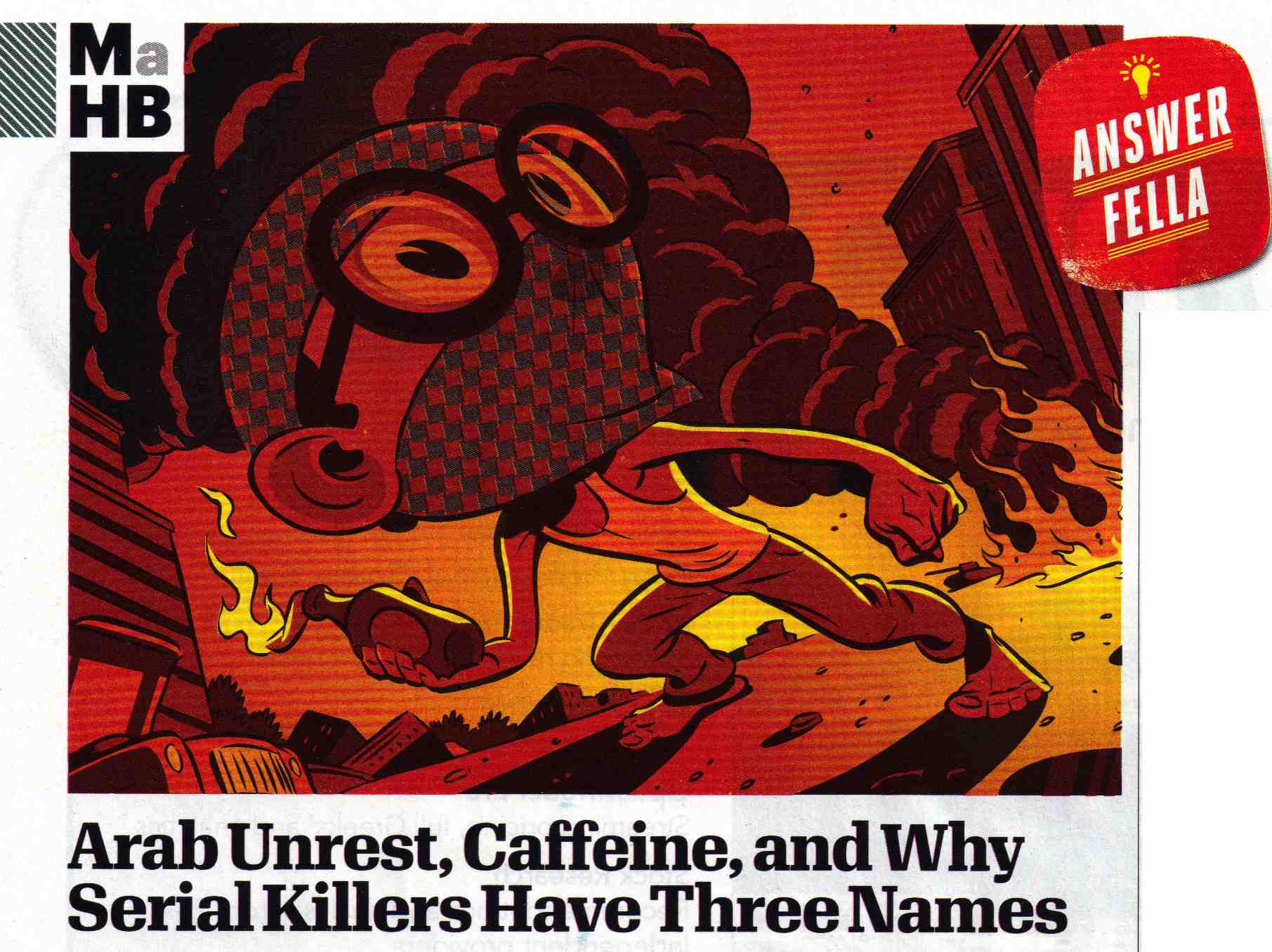
On "Arab unrest" in Esquire's "Answer Fella" column

August 2011 issue, the question being:

Are all these uprisings in Muslim countries a good or bad thing?

Response starts with bit from Fareed Zakaria and then Hani Bawardi, a U Michigan assistant prof, then turns to me (based on phone interview I gave A.J. Jacobs a while back.

As for the bumpy road ahead, take it from the Rihanna of realpolitik, Esquire's own Thomas P.M. Barnett, perhaps the planet's wisest geostrategist: "It's like passing a kidney stone: It's going to be a painful process, but the sooner you start, the sooner you get it over with. I don't think it damages the U.S. interests at all; that's just a lot of stale assumptions. Would you rather solve the problem or continue with the difficulty? This incentivizes a lot more people to get off their asses and get a lot more involved.

(The "P.M.," by the way, is Tom's homage to the late, great Pigmeat Markham.)

Clearly, Jacobs took the most visceral bit, but I stick with my larger point: nobody is happy with the status quo in the Arab world, even as we got used to our dictators and Israel preferred their stable cohort of regional enemies (and yes, everybody would rather fight than switch, as the old cig advertisement goes).  We all know it has to change and we've all complained toward that end.  But now that we have something big in motion, we fret about losing our "stable" past (much like we idiotically pined for the "stability" of the Cold War). Sure, it will be messy and it will seem like we're "losing," but better to process the pain and get that stone out!

All the expert analysis of how this is turning against America is premature nonsense, like calling the game on the first play from scrimmage.  Think Zhou Enlai talking about the French Revolution and simply relax.  Getting all sphincter-like in the early going blinds us to the real flexibility we have here, as does the equally idiotic finger-pointing.

The pathways here are clear: either the Middle East opens up and that connectivity serves our interests, or it closes off and the world is forced to rethink its dependency on the region's resources.  Either way is good for us. The only variables are pain level and time, but progress is assured for the system as a whole.

Same can be said for Libya and Syria: more short-term pain the better.  Whatever emerges, no matter how long it takes, will either open those countries up (good for us) or shut them down severely (also good if the bad leadership remains).  All the junk about US "standing" and "interests" (almost always a bullshit term) is meaningless.  Think global and long term.  We are winning.  Our exception continues to become the norm. Nobody else leads this process like we do.

All the rest is the usual name-calling.  Go volunteer at a charity if you want everybody to like you.

12:01AM

Media & web mentions/coverage of recent Wikistrat International Grand Strategy Competition

Rounding up for the record the various sorts of coverage Wikistrat enjoyed over the course of the competition, I wanted to highlight the following:

Brian Hasbrouck over at Political Risk Explored wrote up his impressions of the first week, when - unsurprising to me as Head Judge - he cited the eventual winner Claremont Graduate University's entries as being the most impressive and eye-popping.  CGU played Pakistan 1.

One participant, Timothy Nunan, wrote a nice bit about how the game play allowed a bigger input role for those players with a more historical bent: 

While I’m normally not so big of a fan of “strategic studies” and much of the direction of the discipline of international relations, I find the collaborative aspect of the Wiki tremendously useful, and it’s certainly more interactive and a richer learning experience to have content up online instantly, rather than the turnaround time associated with sending out drafts of papers. Moreover, I feel that policy planning exercises tend to demand a deeper knowledge of history and national trajectories than what you’ll usually find in political science departments, with their quant-heavy focus, today. Certainly, your overall level of analysis can be more superficial than you might like it, but I find it a fun exercise to collaborate with others (something that takes place less frequently than it should in the academy), to try to show that historians, or more precisely people with a historical training, can have really intelligent stuff to add to foreign policy conversations . . .

Denise Magill at the Virtual Roundtable (a site that devotes a lot of attention to wikis), asked a question right out of my wrap-up analysis: "Would you pay $10,000 for your company's next big idea?" In effect, the grand strategy competition was an advertisement to governments about the validity of crowdsourcing new thinking on national policies, but the same holds true for corporations, and I'm not just talking about fishing for big new ideas.  Say you've got this initiative you're considering for emerging market X or developing region Y, but you need somebody to spin out all the possible permutations so you can iron out as many uncertainties in your approach as possible before committing resources.  Why not take $10k of what you're spending on traditional consulting and tap a truly wide network of experts with varying degrees of geographic and intellectual connectivity to the subject matter? Yes, you go to the deep subject matter experts for the guts of your thinking, but how to game out the surprises and the "inconceivables" that invariably pop up? On that score, you gain real safety in numbers - the wiki way.

Dave Algoso, a veteran international developmental aid professional, wrote a nice post that explored the whole vertical-versus-horizontal scenarios distinction. As a rule, professionals tend to obsess over the vertical "shocks," because such black swan events are so analytically sexy, but most of the resulting change actually comes in the low-and-slow horizontal ripples that emanate from such system perturbations.  Algoso sees Wikistrat's approach ably tapping into that more integrated perspective:

Wikistrat is attempting to operationalize this analytical framework. The knowledge and skills necessary to explore the effects are spread across disciplines throughout an organization. Attempts to bring interdisciplincary teams together can be effective, but are susceptible to inefficiencies. We also know that contextual knowledge is vitally important in development. A platform like Wikistrat may enable strategic planners to bring all this knowledge together in an effective way. If it does that, we may see much more effective interventions and better strategy coordination in the future.

Frankly, as Head Judge I saw that this was the hardest thing to get across to most participants: encouraging them to think about downstream consequences that arise from some catalytic event. Often it's not the direct linkage that is fruitfully explored, but rather the seemingly disconnected bit that suddenly looms with new strength as a result of the shock's impact on competing issues.  

Great example from the competition: when the "big one" (however defined) hits China and reorders a lot of the world's assumptions about that growth trajectory, arguably the most compelling shift will be the default rise of India to the top of the global ascendancy narrative. In that dynamic, the more disconnected India is from the triggering problem, the better.

Another eye-opener I cited from the competition: when big shocks to traditional oil-producing regions suddenly catapult the Arctic into the world's consciousness as the next great frontier on energy. Yes, it's been there in the background for years now, but eventually something comes along that gives it global urgency. That's an "inconceivable" (Arctic top Persian Gulf in focus?) that you can count on, the question being, What event triggers that shift in perception and who's best positioned to take advantage?

Institute of World Politics' competition participants

The Institute of World Politics issued a nice press release highlighting their two teams' efforts (as Turkey and Brazil). What was really great to hear was that the competition mirrored simulations run in several of the Institute's courses (Public Diplomacy and Political Warfare, Counterinsurgency, and National Security Policy Process). Participating students felt they were well prepared - and they were. Both teams finished in the Top 12 overall. Some nifty quotes:

The IWP teams are working hard, and gaining valuable experience through their extracurricular efforts.  Vilen Khlgatyan, an IWP student who has been working on articles about Turkey's regional future, has found that, "This competition has helped me further ingrain the idea that all facets of statecraft should be considered, as well as the many possible outcomes" . . . 

And recent graduate Gabriella Gervasio observes, "The Wikistrat exercise is truly the perfect ending to my education here at IWP.  It requires knowledge, expertise, and proper use of the elements of statecraft." 

This is exactly the sort of experience we sought to create: a leveraging of the most exciting and collaborative stuff going on in universities - just blown up to a far larger scale.  I mean, why shouldn't these institutions compete in the strategic realm just like they do in sports?

An Israeli newswire account on the competition had a similarly gratifying pair of participant quotes:

"The entire competition has been one of the most exciting intellectual exercises for me in a long time," said Roman Muzalevsky, the leader of the team from Yale, when reflecting on his experience over the course of the Competition. "I am certain I have learned more from this experience than the vast majority of classrooms I have ever been in," added Andrew Eccleston, a member of the team from the American Military University. While the prize was a strong incentive, most participants felt the experience of applying their theoretical knowledge and using Wikistrat’s innovative model was the real reward. 

I think the real excitement came in the act of competing. It's one thing to crank a paper and get a good grade, and I made that effort by giving each team's sixteen entries an initial grade where, quite frankly, I judged them strictly on how many boxes they checked and how well they checked them - relative to other teams from that country (when applicable). At first, like in any course, the grades were lower because the content was weaker, and I struggled a bit not to grade too harshly. But the longer the competition went and the vast majority figured out "the ropes," it got a lot harder for me not to give everybody solid initial grades. Near the end, I was searching for ways to nick points here and there: that's how consistently solid everyone was becoming.

But if all we had done was that, we wouldn't have elevated the play - or excitement.  It would have been collaborative, yes, but not truly competitive. So the first straight-up grade was like your initial pool grade: it determined which tier of competition you'd ultimately be ranked within. All the super top grades went into the same bin, for example, and then it became the top China entry versus the top Pakistan entry versus . . .. So yeah, you might get an initial grade of 95, but then the question became, could that grade hold up when rank-ordered against the other 95s?  In the end, then, your overall grade reflected your team's consistent effort to outwork, out-think and out-strategize everybody else - just like in the real world. And I think it was that definitive outcome that really fired the competitive juices.

Find a nice bit here from the University of Sussex celebrating how well their fielded team played North Korea - which they did.  I was surprised by how imaginative the team was with a country that seemingly has so little wiggle room.  But that is one of the joys of a strategic planning exercise like this.  As one Sussex player put it: 

North Korea is a Cold War legacy in the 21st century, and it was stimulating imagining the future of this isolated country in a globalising world.

Naturally, top bragging rights went to the overall winner, Claremont Graduate University, and the university was justifiably proud about its winning team:

Comprising CGU's team were: Benjamin Acosta, PhD student in comparative politics and cultural studies; Steven Childs, PhD candidate in world and comparative politics; Sean Gera, PhD student in world politics; Byron Ramirez, PhD student in political science and economics; and Piotr Zagorowski, PhD student in world politics.

The team bested rivals from the University of Oxford, University of Cambridge, Georgetown University, Ohio State University, Yale University, New York University and other top schools.

Childs said the CGU team's victory is a testament to the university's emphasis on transdisciplinary education and the political methods courses found in SPE’s [School of Politics and Economics] curriculum.  Rather than examine the issues in isolation, the CGU team tackled the challenges of the contest with a broad range of thought and academic expertise.

"This emphasizes the strength in CGU's approach to education," Childs said. "I'm really proud of our team."

Here's another nice press piece on Ramirez alone.

It was a joy to grade CGU's work, but what really won it for them was their innate ability to follow the directions to the letter. They really plumbed the depths of each assignment, whether it was figuring out Pakistan's national interests, or casting a regional trajectory, or running down the horizontal scenarios from a series of vertical shocks. They really explored each analytic assignment to the fullest and stayed on topic throughout - an extraordinary display of discipline that was reflected in their high-content/low-fat output.

And that's a great take-away from the competition: it's easy to assume that the interdisciplinary approach necessarily results in tons of excess and unhelpful verbiage, because it so often does - when not properly channeled. But what the CGU did was simply wonderful: clear and concise cross-linking of subject areas that won the team the top ranking in "use of the wiki," which I thought was highly emblematic of their overall win.

On a side note, I thought it was cool of U. Kentucky's Robert Farley (fellow - and well respected - World Politics Review columnist) to note how well Wikistrat's platform played on Apple's iPad, which the U.of K. team used in its performance as Japan 1 team.  Being so on-top-of-things ("research, remaining connected with the rest of the team, and monitoring the competition") was crucial for the Patterson School of Diplomacy crew, because the other Japan team (played by actual Japanese) had to drop out due to a real-world political crisis back home. That left the Patterson team somewhat "orphaned," meaning they needed to compare themselves more vigorously with other country teams to make sure they were pushing the envelope sufficiently. Based on that sort of extra effort, I awarded the Kentucky team the prize for being the best "single."

Like I've noted previously, the competition was a great source of new ideas. Nick Ottens over at Atlantic Sentinel generated a trio of posts concerning three of the best:

And, of course, I myself pillaged what I could for two Time Battleland posts ("Why US Withdrawal from Afghanistan Would Stabilize Pakistan" and "Russia Will Someday Be Forced to Outsource its Security"). I also bagged a World Politics Review column out of the highly innovative (and #2 finisher overall) Oxford team that played European Union 2 ("A Post-NATO Europe Should Look East").  History Guy Tom Wade did similarly with his post on Global Cities, and this site's original webmaster Critt Jarvis posited an even bolder extrapolation to planning "model cities" in Honduras using the Wikistrat many-brains-tackling-the-problem approach.

All good stuff that I thought was worth recompiling here, but what really sticks in my mind coming out of the competition was how so many of the student-participants - even the ones that didn't necessarily win anything - walked away with such a nice impression of Wikistrat as a place to ply their craft.  As one relatively experienced participant put it in a follow-up debrief: 

Wikistrat, its strengths and flaws notwithstanding, is the most realistic depiction of strategic analysis in the intelligence community.

As someone who has evaluated big command post exercises in various military commands (PACOM, SOUTHCOM, etc.), that's a great compliment to receive, so I take my hat off to everyone who participated and especially to the Wikistrat team that managed the competition throughout.  As proof-of-concept experiments go, this was fantastically gratifying.

12:01AM

My thoughts on the new Wikistrat model

First off, one thing you have to understand with start-ups is that they morph.  Counting two other firms I'm currently involved in, Wikistrat is the eighth start-up that I either worked for or started myself.  And I'm proud to say that all of them are still running - save for the NewRuleSets.Project that was bought up by Enterra Solutions.  So change is inevitable.

When I first linked up with Joel Zamel, he and his compadres were mostly about selling the technology platform, which was cool enough, but the work didn't meet their personal ambitions. So we link up and I'm brought in primarily to start populating the global model (I pen almost a book's worth of material and, on that basis, radically revamp my current speech/brief) and write a biweekly globalization review (CoreGap Bulletin) designed to pull readers into becoming subscribers/authors in the Wikistrat universe.  I liked doing both, but I liked working the global model a whole lot better, because I learned big stuff - big time, and I greatly enjoyed the discipline the system forced upon me (evidenced in the all the new material for the brief).  So, on that score, I was sold and said so many times here in the blog.

Regarding the CoreGap Bulletin, it was fun to write and I enjoyed getting up to speed on the production of digital video shorts, but it seemed like a lot of effort compared to the payoff I/we got from my working on the model, and it wasn't generating the draw for analysts that we wanted.  The first small simulations did better, but we still weren't getting a critical mass participation we were looking for - nor the proof-of-concept on large-scale play.  Looming over all this frustration was the sense that we weren't sufficiently exploiting our best stuff: the analysis that came from expanding the global model and the simulations themselves. So why go on processing global news when we had the means to generate truly differentiated analysis within the Wikistrat universe itself?

So I went back and forth with Joel and the guys and eventually they hatched the idea of the grand strategy competition. The notion was simple: the global model was mature enough to constitute a serious backdrop for a massive play stretched over weeks.  Instead of small numbers of hand-selected types, we'd go for creating a critical mass number whose very size would generate the group dynamics we kept aiming for.  Plus, the game itself would become its own recruitment tool, so we get the double-whammy of proving out the "massively multiplayer consultancy" model while stocking up (in effect, interviewing-by-play) on solid young bloods.

So here we are now with the new package:  rather than the smaller network that expertly works the wiki environment, we go for a much larger network that learns with and grows the global model as we pursue simulations on behalf of interested clients.  Instead of staying lean and mean and trying to grow in that tightly organic sense, we stock up on bodies, ideas, material and price everything out - in all directions - on a discrete basis, thereby avoiding the classic start-up conundrum of "do I get the work first and scramble for bodies or stockpile bodies and then scramble for work?"

So here's my personal thumbnail versions of the rationales that we've settled on in this next iteration of the company:

We run the show like one of those big aggregating sites that pool all the photos shot by professionals (Getty, Reuters, etc.) and then spool them out to buyers: the more you put in, and the more that stuff gets picked up, the more you earn.  You don't try to go for paying people by the "job" so much as by the ideas, which get competitively marketed to buyers.  This way you don't build up unsustainable labor costs but if anybody strikes gold (brings in the right client, produces the right material that attracts the same, etc.), they're immediately tied into direct compensation.  Everybody is directly incentivized. Nobody is ripping off anybody else, and worst case in the meantime, we're still building a great global community of strategists who - at the very least - educate each other and network.

From the perspective of the analyst, we say: you like to do this sort of thing anyway, and many of you already give it away on blogs, so why not pool all the nuggets and market them collectively, and let your bits and pieces earn you bucks here and there.  It's the same effort you're already making; just make some money and network more explicity in the process.  Plus, we've given you - the independent operator working for yourself - a place to bring this or that piece of work you might not be able to handle on your own (so you can't take advantage of the opportunity or connection).

Thinking back over my career, I've always welcomed that sort of stuff when it has - from time to time - popped up.  I consider it sharpening-the-blade activity and I love to share just about everything I generate.  Frankly, this is the same logic I'm applying to "The Emily Updates":  why bother with the big book route when I can sell discretely and directly myself over the web?

Beyond the earning potential, there's the simple reality of more formally and fruitfully connecting up with those of your own kind.  Most of us strategic planners and thinkers live in a professional world of "others," where, quite frankly, we're the odd lot. This model allows us to connect to one another and interact however much we see fit to pursue.  Again, blade-sharpening and useful and . . . fun, when it comes down to it.  Dogs like to play with other dogs - plain and simple.

Exercises fit into the blade-sharpening notion as well. Hell, that's why the military does them. Most professionals don't get that much chance to pursue this sort of thing, buried as they constantly are in producing the plan/report/review/etc.  The simulations simply organize the building up of the global model (GloMod, as I call it), which is the intellectual backdrop for the overall interaction - the Wikipedia-meets-Facebook dynamic.

When all the previous aspects come together in an actual opportunity to advise, via the massively multiplayer consultancy, then so much the better, because the more gigs means the more eyes, and the more eyes means more money for the analysts' whose material attracts those eyes.  

All in all, it strikes me as a wonderfully virtuous circle: stuff I want to do anyway, in a cool environment, with people I want to interact with professionally.  We organize our activities in exciting ways (simulations) that are either bespoke efforts done directly for clients or are used to generate material that clients can explore and exploit on their own.  Worst case: the effort builds up the model that much more, and the blade-sharpening aspects are only that much more heightened as a result.

Again, at the end of the day, it's all stuff I want to do anyway for professional standing. I can do it all by my lonesome in a blog, or even group blog and compete on that level, or I can replace those efforts (or even just compliment them) with something that's more collectively focused so as to generate side income-generating opportunities.  As an analyst, my risk is minimal - as in, you only get what you give, while the upsides are solid and potentially quite empowering.

Most of us analysts fall into this category: we've got all sorts of things going at any one time.  We don't need any single one of them to be THE thing, but we like having several be money-making, career-enhancing in that ramping-up manner (starting small and building).  I think the new Wikistrat model falls into that category: cool association, good skills build-up/maintenance, great networking, solid learning, fun environment, and - through the power of the collective - great opportunities to do big things for big customers, operating at a large scale level of interaction that we typically only get in short bursts in our careers but individually crave on an ongoing basis.

Wikistrat becomes that ongoing basis - the professional association that pays it backward to the members themselves.

12:00AM

Middle East Monitor, July 2011

We're excited to announce the launch of Wikistrat's Middle East Monitor for July 2011, which can be viewed in its entirety here.

Summary

The uprising in Syria remained the crisis of the most strategic importance this month. The number of protesters is higher than ever, despite the widespread use of violence by the regime to crush the demonstrations. Significantly, the protests continue to grow despite Iranian assistance to the Assad regime, which includes electronic monitoring equipment that was used to undermine Iran’s Green Revolution.

The methods successfully employed by the Iranian regime in 2009 have failed in Syria today, which is a testament to the strength of the uprising. If the Assad regime has employed all of the advice offered by Iran, then it is out of options to use against the demonstrators. Its strategy will be to hope that severe repression and sieges of hotspots will stamp out the revolution over time. Preventing a serious split within the military ranks, particularly among the Allawite officers and generals, will be critical to the success of this strategy.

In Libya, the rebels are making advances in the mountainous area in the western part of the country, and have encircled the oil-rich city of Brega in the east. There is talk of allowing Qaddafi to stay in Libya if he gives up power, but representatives of his regime discount this possibility. He is intent on fighting the rebels to a stalemate that allows him to control an enclave and declare victory, and until impending defeat becomes apparent to him, this will not change. The murder of rebel commander Abdel Fattah Younes and the subsequent vows of retribution by his tribe is a serious blow to the rebel cause, as it threatens to undermine Western confidence in the rebels. It is critical that the rebels present a united front, and clashes between rival factions and tribes do not erupt.

Overall, talk of the Arab Spring’s demise is very premature. The rebels are making concrete advances in Libya, the revolution in Syria is strengthening, Yemeni President Saleh has yet to return to his country, and Morocco’s successful referendum on constitutional changes show the movement represents a dynamic shift. The Arab Spring is not a short-lived period of instability, and serious changes to the region’s power structures are underway.


Wikistrat Bottom Lines

Go!Opportunities

  • The decline of protests in Morocco after the referendum on modifications to the constitution enables the West to point to a government that successfully responded to the Arab Spring. This will help persuade pro-Western, undemocratic regimes that reforms will improve their stability.
  • The positive reception in Hama, Syria to the visit by the U.S. and French ambassadors shows that the protest movements are eager for Western support.
  • The delay of the elections in Tunisia and Egypt until October is a recognition that the non-Islamist parties need more time to organize. It is very questionable whether this still permits enough time to allow the non-Islamists to effectively compete, but the problem is understood and being addressed.

Stop!Risks

  • Turkey’s decision to recognize the Libyan rebels as the official government of that country and threats to intervene in Syria benefit the West in the short-term, but Turkey remains governed by an Islamist party. The increasingly assertive role of Turkey in the region may not always be in the best interests of the West.
  • Western support for protesters could result in an expectation of strong intervention on their side. If assistance does not follow and the protesters are victimized on a large scale, it could result in disillusionment with the West and play into the hands of the Islamists.
  • Setbacks in Libya, such as the assassination of the top rebel commander, will undermine Western support for the intervention; support that is already dwindling. The rebels are making advances, but are still heavily dependent upon outside support.

Warning!Dependencies

  • The potential continuing of mass protests in Morocco. The opposition says that the constitutional amendments do not go far enough, but the number of protests has sharply declined since the referendum. If massive protests erupt again and the opposition cannot be appeased, other governments will be less likely to implement reforms to try to satisfy their opponents.
  • The strength of the public’s desire for quick elections vs. the strength of the public’s fear of an Islamist electoral victory.


1:10PM

Time's Battleland: Might al-Zawahiri's al-Qa'ida come to view future nuclear power Iran as THE perfect sanctuary?

This post was co-generated with Michael S. Smith II of the strategic advisory firm Kronos

As al-Qa'ida leaders the world over signal their intent to stay the course — challenging assumptions that the integrity of their network has been perhaps irreversibly jeopardized by the death of bin Laden — national security managers must remain focused on denying its core leaders a safe base of operations. Meanwhile, due to growing ties between al-Qa'ida's regional network and defense officials in Iran, the strategic dimension of the West's counter-terrorism efforts is likely to grow significantly in the years ahead. Unless Washington is prepared to confront Iran directly on this issue, al-Qa'ida may logically seek to achieve an untouchable strategic sanctuary within a nuclearized Iran.

Read the entire post at Time's Battleland blog.


10:33AM

WPR's The New Rules: U.S. Counterterror Stance Ain't Broke, So Don't Fix It  

Despite the rush right now to declare important milestones or turning points in the fight against terrorism, the best handle we can get on the situation seems to be that al-Qaida is near dead, but its franchises have quite a bit of life in them. The implied situational uncertainty is to be expected following Osama Bin Laden's assassination, as he was our familiar "handle" on the issue for more than a decade. But although it is normal that we now seek a new, widely accepted paradigm, it is also misguided: In global terms we are, for lack of a better term, in a good place right now on terrorism, meaning we don't need to unduly demote or elevate it in our collective threat priorities. Instead, we need to recognize the "sine wave" we're riding right now and seek no profound rebalancing in our security capabilities -- other than to continue protecting the "small wars" assets that we spent the last decade redeveloping.

Read the entire column at World Politics Review.

11:06PM

Landed publicist for "The Emily Updates" - now with new subtitle

While still working out the arrangements with my literary agency (Zachary Shuster Harmsworth) since this is a proof-of-concept effort for them, I did manage to land my publicist from "The New Map" series, Steve Oppenheim (Oppenheim Communications, based in Manhattan). It will be a first-time process for Steve too, doing a straight eBook with no hard-copy version, but both of us agree that we like the non-rush of trying to make all the PR happen in a two-week period.

Steve is a great guy and I deeply enjoyed working with him on the three previous books, plus we feel honored he likes the material enough - and believes in it enough - to go down this new path with Vonne, Emily and I.

Other positive news: looks like Esquire will give us a nice plug in the magazine.

Vonne, Emily and I, having all three spent the last couple of weeks taking notes on the first four volumes, held a production meeting today in my office to pitch our ideas to each other concerning the fifth volume retrospective. Emily is working about 15 themes, while Vonne has 18 in hand. Me? I have 26 pages of notes. Between us I am certain we have the 50,000 words for the volume.  No doubts about my ability to write on demand, and Vonne is highly incentivized to finish before she starts a Masters in Social Work program at IUPUI (Indiana U/Purdue U @ Indianapolis - home to the oldest MSW program in the country). Em, of course, must finish up before heading back to IU in Bloomington for her sophomore year. Vonne has been writing for a bit now, and Em I know can crank, since she routinely generates fan fiction pieces in the tens-of-thousands range.

The goal is to have the first draft done in 2-3 weeks and a final draft by the end of August or mid-September at the latest.  We then get the four volumes back from Ebook Architects (in their various file formats) NLT mid-September to make the 9/19 publication of the first volume on the major sites (Amazon, B&N, iBookstore). I'm hoping to have the fifth volume polished by Labor Day so I can spend the rest of my free time in September blowing up the Emily Updates site-within-this-site (photos, videos, etc.)

All an experiment for me, but a fun one.

On the subtitle: just enough pushback from the agency on linking "three-year-old" with "cancer" that I rethought the approach. "The Girl Who Lived" has been a theme of ours for years, as Emily has long identified with the Harry Potter character's backstory (near-death experience as toddler, the telltale scars, the questions, and the weird fame within our circles for something she barely remembers . . . oh, and the ever-present fear of the return of the disease that no one likes to mention! Is it still inside her on some hidden level?). I wanted to keep "One Year in the Life" bit because of my years of working Aleksandr Solzhenitsyn's many books, and we thought the two riffs went well together. The Emily Updates are full of fan-fictiony-like references to books and films; it's just who we are - a family of fanboys and fangirls.

So it stays "The Emily Updates" because that's what I called all the weekly summary emails I sent out (numbering them as well), and we say "One Year in the Life" because we're not asking you to read the life story of a 19-year-old, just about this one amazing year (actually about 14 months but basically her third year of life), and we wanted to put out there in the title that she is "The Girl Who Lived" so as to not scare people off too much. This was a crucible experience but one that our family, our marriage and our child patient survived. We figure the three themes (The Emily Updates seems to be a diary, One Year in the Life says this was some extraordinary period, and The Girl Who Lived dispels any cliffhanger fears while insinuating that, like Harry Potter, Emily survived a very deadly set of circumstances/events) and the picture will convey the right mix of themes.

The covers as I've put them together now:


Why the black and red motif? You can't tell from the black and white photo, but she was wearing a red shirt over her Spandage vest (which is why her neck looks kinda fuzzy), plus her hat was blood red with black trim. So when I see that picture (we just refound the black-and-white negative in the memorabilia box we unpacked and perused today), I see red and black - simple as that.

10:23AM

Esquire's Politics Blog: How We Talk War When We Talk With China Now

Admiral Mike Mullen, outgoing Chairman of the Joint Chiefs of Staff, sounded a worried note in his New York Times op-ed on Tuesday on the state of Chinese-American military relations. It was a typically one-sided presentation of the situation: those spying, secretive, bullying, and increasingly well-armed Chinese versus a U.S. that's only trying to keep the regional peace... while selling arms at a record pace to every neighboring state, conducting joint naval exercises right off China's coast, and, you know, openly planning to bomb the breadth and length of the Middle Kingdom.

Details!

Read the entire post at Esquire's The Politics Blog.

12:01AM

Becoming a Wikistrat Analyst

As we grow our community of strategic thinkers, Wikistrat is now accepting applications from candidate analysts. If you are an established or emerging geopolitical expert, policy advisor or risk consultant, you may be qualified for a position within our community.

The Wikistrat community is composed of different ranks - Experts, Senior Analysts, Contributing Analysts and Researchers. Members of the community get access to the Wikistrat private wiki and exclusive network, and will participate in exciting geopolitical simulations. Analysts are able to build their names and receive royalties and other financial rewards based on their contributions.

Find out more and apply at www.wikistrat.com/analysts/


12:01AM

Internship Opportunities at Wikistrat

Wikistrat is recruiting new Interns!

Wikistrat Interns undergo an unpaid training program and upon completion qualify for a position as researcher within Wikistrat’s online analytic community. Researchers are able to earn financial rewards at Wikistrat, and be promoted to Contributing Analyst rank.

Interns play an active role within the Wikistrat community:  interacting with top analysts, helping to write concise reports and analysis on topics of their expertise, contributing to the theoretical knowledge base of Wikistrat , and integrating their work across a unique Web 2.0 platform. Work from home in your own time.  All Wikistrat work is conducted online.

For more information visit our website or download our Internship Program PDF.


Internship Rewards

  1. Points determine how highly an analyst is ranked in the community based on their contributions and may result in potential prize earnings.
  2. Learn alongside the world’s best analysts.
  3. Analyst Training Program: become a Wikistrat Researcher at the end of the internship.
  4. Access to Wikistrat’s subscription service.
  5. Promotion opportunities to become a contributing analyst and earn royalties.


12:01AM

A Global Marketplace of Geopolitical Analysis and Forecasting

Wikistrat is happy to launch the new design for its website - with exciting offerings for analysts, clients, interns and partners. Feel free to browse the pages and get a glimpse of what we see as the future of geopolitical analysis - a strategic community of analysts working collaboratively to analyze and forecast globalization and the impact of geopolitics on global markets.

With hundreds of analysts collaborating and competing for prestige, intellectual and financial rewards, we expect this community to yield strategic insights and ideas you will not be able to find anywhere else. By providing governments and corporations with real time analysis, Wikistrat is able to provide clear-cut answers to the complexities of today's geopolitical challenges.


In the upcoming days we will add new sections to the website, including a space with free geopolitical analysis, providing insights into the various simulations conducted in our wiki-based community.

Click here to enter the new website.

12:01AM

Wikistrat Grand Strategy Competition - Summary and Conclusions

With Wikistrat’s International Grand Strategy Competition now complete, I wanted to take this opportunity to sum up what I think unfolded over the month-long contest.  As head judge, I am uniquely suited for the task, because I’m fairly certain that I’m the one person who perused every line of every entry of every team every week.  To give you some sense of that effort:  roughly 30 teams cranked, on average, 7,500-8,000 words per week.  That’s close to a million words in all!

We're not going to pretend that every word entered was golden.  The purpose of the competition was to elicit ideas in aggregate - not to collectively produce the one "perfect" document (i.e., the bureaucratic approach).  In mass harvesting exercises such as these - no matter the level of expertise involved - there is a certain amount of chaff.  By design, participants are put through a variety of methodological paces that force them to winnow their ideas down to their essentials.  So while the journey matters plenty, it's the destination that we collectively seek: those nuggets of strategic insight that arise from the focused and repetitive interplay of so many minds tackling the same subjects from a variety of angles.  For it is amidst that maelstrom of intellectual activity that a variety of competing perspectives are collaboratively blended into foreign policy visions worthy of the label "grand strategy."

We achieved that goal in spades, meaning there was than enough “wheat” to be found throughout the entries, which got better and better with each passing week.  Besides telling us that collaborative competition works, the continuous uptick in performance also proved the validity of the “massively multiplayer consultancy” model, which is what we believe Wikistrat can offer as a result of its ongoing efforts to build an online community of strategists from across the globe – the Facebook-meets-Wikipedia dynamic.

If, for example, you’re a client interested in having dozens/hundreds/thousands of strategic thinkers chase down a problem, query or brainstorm for you, then Wikistrat can mobilize them en masse for a X-week-long collaborative competition not all that unlike what we just did in this contest.  We’d simply tailor the parameters and the participants.  But the key thing is, your desired effort would now involve a true “wisdom of the crowd” dynamic, with the crowd in this instance being a vetted group of strategic thinkers collaboratively competing to come up with the best answer.

Why we think that’s a better route:  In today’s complex world, we’re certain that companies and governments will benefit deeply from such intellectual exposure.  No, we don’t think this completely replaces in-house studies or working with contractors, because they’ll always be those needed deep dives on specific issues.  Plus you simply can’t outsource your strategic thought processes in every instance.  But there will also increasingly be the need to tap into far wider pools of thinking, or ones that explore issues more “horizontally” (i.e., plumbing the cross-domain connections) than “vertically” – especially when you’re talking strategic planning on an international scale.  In a black-swan world, you can never ask too many “what if” questions, or have too many bright minds coming up with possible answers.

We also think the competition proved itself as a useful method for attracting and identifying talent within our burgeoning online community of strategists.  There are literally thousands upon thousands of professional, apprentice (like our grad students) and avocational strategists out there on the Web generating useful analysis, and, in a disconnected sense, you could say they’re all collaboratively competing for our attention with their blogs, sites, etc. 

But when Wikistrat pulls them into an online venue explicitly designed to foster that collaborative competition – directly, then we turbo-charge the dynamic by concentrating it to an unprecedented degree.  The International Grand Strategy Competition was a brilliant demonstration of that potential: no established “stars” among the 200-plus individual team members, and yet collectively they pushed each other to generate a constant flow of innovative strategic ideas.  And the longer the competition went on, the higher the flow and quality of those ideas – innovation feeding off innovation.

Frankly, it got hard to grade it all, because on an individual basis, everything started trending up toward “A’s.”  But just as designed and encouraged in this competition, the collective grading came down to a rank ordering, meaning there could be only one #1, one #2, etc. with regard to every assigned task.  And no, the same few teams didn’t win each ranking, as ten different teams each scored one of the sixteen #1 rankings – with only three teams scoring multiple wins. 

But the best part was this: whenever the top effort was so identified, you could readily see its impact on the next week’s play, as other teams started copying the techniques, reach of vision, etc., that earned that one team such high recognition previously.  That meant the “bar” rose rapidly throughout the competition, with the most ambitious teams clearly seeking to out-innovate the established leaders, which is why there was so much movement in the overall rankings week by week.  You can see the proof on the team entries: the longer the competition went on, the more the most innovative teams had their ideas cited by others, because to not do so risked being left behind in the expanding dialogue.

To say that it was exciting to witness is an understatement, and let me tell you why: I taught an experimental course at the Naval War College in 2003, while I was writing The Pentagon’s New Map.  In the elective, which attracted an unusual percentage of that class’s top students, I taught the officers how to generate competing scenarios using an X-Y axis approach (two questions yielding four boxes).  To be honest, going into the class I had no idea if you could develop the skill, even as I knew it was easy to teach the procedure. But we kept at it, week after week, just repeating the effort on new subjects, levels of analysis and regions.  At first, the generated scenarios were just awful, and I spent a lot of time offering constructive criticism, but over time they got better and once they did, the confidence level of the students rose and – sure enough – in the last few weeks of class they performed most of the critiques themselves in a peer-to-peer fashion, while I merely pushed them toward more elaborately scaled efforts.

Well, I witnessed the same dynamic unfolding in the competition, and it was a thing of beauty: the more teams and analysts became aware of each other’s work, the more they effectively critiqued it – in a peer-to-peer fashion – by co-opting some aspect and expanding it further in their own efforts.   And with the expanding complexity built into the competition’s design, I – the head judge – found myself “stealing” what I could for Time Battleland posts and my World Politics Review column.

As they say, talent imitates but genius steals!  ;<)

The teams themselves can track their own progress by the numbers of eye-popping interjections I left in my grading notes (later distributed to the competitors).  Simply put, the “wow’s” began piling up exponentially with each passing week, and – just like in my experimental War College class – my initial feelings of despair (“Maybe you just can’t teach this stuff?”) invariably gave way to serious respect for what the next generation has to offer.

It is my sincere hope that those competitors who were energized by the competition will seek to maintain an affiliation with Wikistrat, because as we move forward with our massively multiplayer consultancy, we think we’ll be able to offer them the kick-ass combination of an online community where they can “sharpen the blade” while simultaneously selling their best ideas – collaboratively and competitively – to a host of global corporations and government agencies eager to explore globalization, in all its current and future complexity, for strategic planning purposes.

Looking forward,

Thomas P.M. Barnett

10:05AM

WPR's The New Rules: The New World Order-After-Next

There is no faster route to second-tier great power status than for an actual or aspiring superpower to fight a crippling conflict with another country from those same ranks. Moreover, if history is any guide, the glass ceiling that results is a permanent one: This was the fate of imperial Britain, imperial Japan and Germany -- both imperial and Nazi -- in the first half of the 20th century, and the same was true for Soviet Russia in the second half of the century, despite Moscow's conflict with the West being a cold one. The lesson is an important one for Washington, Beijing and New Delhi to keep in mind in the years ahead, given that the two most likely dyads for major war in the 21st century are America-China and China-India. 

Read the entire column at World Politics Review.

12:01AM

Tentative publishing dates for the eBook serial "The Emily Updates: A Year in the Life of a Three-Year-Old Battling Cancer"

Wanted to lay down my marker on The Emily Updates eBook serial, so I set up a page on the site.  Have started registering myself and Vonne as authors on various selling sites (Amazon, B&N, etc.) in anticipation of getting the eBook files back from the US company that is currently architecting them in all of the major formats (this is being arranged by my literary agency Zachary Shuster Harmsworth in a first-ever move by the firm).

For now, it seems like I can't reserve a space at Amazon for pre-orders, because you can't formalize the page until you upload the book file.  I'm expecting to get the files back mid-September, so we target 19 Sept for the first volume, with the other four coming in a sequence of three-week intervals, finishing in mid-December. Emily, Vonne and I are writing the retrospective Vol. V this summer.  It's a family affair.

So for now, we just have this starter page that I will expand over the coming weeks.

The Emily Updates: A Year in the Life of a Three-Year-Old Battling Cancer

by THOMAS P.M. BARNETT,  with VONNE M. MEUSSLING-BARNETT


A five-volume eBook serial to be published in all major venues (Amazon's Kindle, Barnes & Noble's Nook, Apple's iBookstore, etc.) starting in late September 2011.

Tentative publishing schedule (subject to change):

  • 19 September 2011 (Vol. I: 52,000 words)
  • 10 October 2011 (Vol. II: 57,000)
  • 31 October 2011 (Vol. III; 48,000)
  • 21 November 2011 (Vol. IV: 50,000)
  • 12 December 2011 (Vol. V: estimated 50,000).

All books will be priced @ $2.99.


PRODUCT DESCRIPTION:

Seventeen years ago, authors Tom and Vonne Barnett were suddenly confronted with every parent’s worst medical “bolt from the blue”: their only child, 30-month-old Emily, was diagnosed with an advanced – meaning metastasized – pediatric cancer. At the time, the thirtysomething couple were living in northern Virginia.

What followed was the defining crisis of their union: an intense 20-month battle to keep their first-born alive. About six months into the struggle, Tom started writing a weekly update on Emily’s progress (or lack thereof) for interested parties. Vonne contributed to this blog-like diary, and it was sent out by email, fax and regular mail to several hundred relatives and friends who spontaneously organized themselves into their family’s extended support network. Over time, the couple came to view the updates as something more important: a real-time memoir that would someday prove crucial to Emily’s understanding of how she became whom Tom and Vonne hoped she would become. 

The journey from blog diary to this eBook serial is worth recounting. The original diary ran about 400,000 words, or somewhere in the range of an 800-page book. In the late 1990s, Tom edited the text down to approximately 200,000 words and posted the 45 updates online at a website he created specifically for that purpose. Having received a lot of positive feedback from readers, they sought publication as a regular book, but then fate intervened in the form of a new job for Tom in Rhode Island and the project was – pun intended – shelved. 

But the recent meteoric rise of eBooks has convinced Tom and Vonne that now is the time to give publication another try (Vonne, for example, is a Kindle fanatic!). After all, the Emily Updates basically constituted a blog before there were blogs, so eBooks struck the authors as an entirely appropriate venue for the material, especially since they’re interested in making it easily available and they know - from first-hand experience - how parents and relatives of patients experiencing medical crises typically turn to the Internet to locate sources of information, comfort and inspiration in their time of need. 

What you now have the privilege to read in this series of eBooks are the original weekly updates as Tom wrote them – with Vonne’s continuous inputs – across all of 1995 and into early 1996, a period encompassing the last 14 months of Emily’s treatment protocol. Those 45 updates constitute Chapters 3 through 9 in the series: Chapter 3, which concludes with the birth of their second child, in included in this volume; Chapters 4 and 5, which cover the difficult summer of 1995, make up Volume II; Chapters 6 and 7, which chronicle the family's final push on the chemotherapy, fill out Volume III; and Chapters 8 and 9, which encompass the post-treatment diagnostics – and Make-a-Wish trip to Disney World, constitute Volume IV. 

The first two chapters presented in this Volume I are actually recreations of the events surrounding the initial diagnoses (Chapter 1) and the beginning of in-hospital treatment (Chapter 2) in July of 1994. Tom put these diary-like remembrances together in June of 1995 to mark the one-year anniversary of the diagnosis, and they are based on the voluminous medical records from that time period.

The authors haven’t made an effort to “improve” the updates from today’s perspective. Tom and Vonne now claim to be wiser on a host of subjects that arise in this family memoir, but a lot of that wisdom stems directly from these experiences, so they felt it made most sense to share them with you, the reader, in this unaltered format.

The concluding fifth volume in the series is written from today's perspective, to include that of a grown-up Emily - the girl who lived!

If this series of eBooks helps you better understand an analogous past experience or ongoing crisis in your life, then Tom, Vonne and Emily have accomplished what they set out to do by sharing their intense story.

12:01AM

Best Countries and Region Played - Wikistrat Grand Strategy Competition

Best Countries Played

The 30+ teams in Wikistrat's Grand Strategy Competition were divided so they represent a total of 13 countries: The United States, China, India, Brazil, Russia, South Africa, the European Union, Pakistan, Iran, Israel, Japan, Turkey and North Korea.

In this format, each team competed both against the teams representing the same country (US Team 1 vs. US Team 2 and 3), and then in a crossways comparison against teams from other countries (determining, for example, how well does the Chinese strategy match the country's objectives compared to the way the Indian strategy matched the Indian objectives).

3 countries stood out as the best played countries:

Japan (played by the following Teams)

  • University of Kentucky Team

European Union

  • Oxford University Team
  • Atlantic Treaty Association (NATO) Team

India

  • Institute for Peace and Conflict Studies (IPCS) Team
  • Ohio State University Team
  • Indian Institute of Technology Team


Best Region Played

Of the five regions played, Wikistrat judges determined that South-Asia region was the best played region in the competition.

South Asia region was composed of the following teams:

  • Yale University Team
  • Claremont Graduate University Team
  • Institute for Peace and Conflict Studies (IPCS) Team
  • Ohio State University Team
  • Indian Institute of Technology Team


Congratulations to all participants!


12:01AM

Top 5 Finalists in Wikistrat's Grand Strategy Competition

Most Resilient Grand Strategy Award Winner

In this post we wish to recognize some of the best teams which participated at Wikistrat's Grand Strategy Competition that took place throughout June. In a very close race with winning-team Claremont Graduate University was the Oxford Team, which finished in the 2nd and highly respected place.

In addition to finishing at the second place, Oxford students won the "Most Resilient Grand Strategy Award" for their impressive Grand Strategy, playing the European Union. Their work was noted by Thomas PM Barnett is his WPR Column, and by the Atlantic Sentinel here and here.

With 4 overall #1 ranking (across 16 tasks), Oxford team has made a tremendous effort and deserve every recognition. Well done!

Top 5 Teams

The third most prestigious prize - Creative Strategic Thinkers Team - was awarded to the School of Oriental and African Studies (CISD), playing China.

The full top 5 finalists are:

  1. Claremont Graduate University Team
  2. Oxford University Team
  3. The School of Oriental and African Studies Team
  4. Cambridge (CISA) Team
  5. Ohio State University Team

Individual Awards

In the competition we have witnessed dozens of proactive strategic thinkers, eager to collaborate, research and contribute. If we could, we would mention many of them here as they truly are promising emerging strategic thinkers.

We would like to pay special recognition to the winners of the Most Active Participants awards. These individuals were the most active, collaborative and wiki-savvy participants:

  • Heloise Crowther (Sussex Team)
  • Roman Muzalevsky (Yale Team)
  • Teale Phelps Bondaroff (Cambridge Team)


Congratulations to all winning teams and individuals!


12:01AM

Wikistrat Grand Strategy Competition - Announcing the Winning Team

With the Grand Strategy Competition coming to an end, it is time to announce the Winning Team. Of the 30+ participating teams from all around the world, we are happy to announce the Claremont Graduate University Team as the winner of Wikistrat's 2011 Grand Strategy Competition!

CGU's PhD-students demonstrated impressive analytic capabilities and continued to propose creative and provocative ideas throughout the competition, making a collaborative effort and effective use of the wiki. Using unique methodologies, CGU members constantly fed other competitors with new ways to look at geopolitical challenges, and instigated further discussions.

Playing the role of Pakistan, CGU's PhD-students were able to beat some of the world's best institutions, and won special recognition in a Time Battland post by Dr. Thomas P.M. Barnett. To get a glimpse of their work, check out their assessment of Pakistan's National Trajectory.

In addition to winning the $10,000 prize and the prestige that comes with it, the CGU team has gained important hands-on experience in strategic planning and collaborative analysis. We hope these skills, knowledge and relationships created during the competition will continue to benefit all participants in the future, as the Wikistrat community of strategic thinkers grows.

Congratulations Claremont Team!

12:01AM

Wikistrat Grand Strategy Competition - Week 4 Greatest Hits

Well, the Wikistrat International Grand Strategy Competition finished July 3rd, and in that last week our roughly 30 teams had their grand strategies (crafted in Week 3) subjected to a quartet of global shocks (crippling terror strike in Saudi Arabia, an Arab Spring 2.0 in Central Asia, a massive tsunami disaster along China’s coast, and a worldwide downing of the Internet during a technology upgrade).  The teams’ assignments were to analyze the impact of the crises on their countries’ strategic interests and then evaluate their national grand strategies’ resilience in the face of these upheavals.  Continuing in my role as head judge, I wanted to cite the most provocative takeaways from this last week in the competition.

1) What a game-changer the Great Game could become (Brazil 1/Institute of World Politics 2 & South Africa 1/The Interdisciplinary Center )

Think about it: the radical Salafist impulse currently struggles to remain relevant amidst the Arab Spring and the demographics in the Middle East don’t favor it over the long haul, meaning it logically migrates either southwest into Africa or northeast into Central Asia – two regions full of colonial-era fake states ripe for the sort of disintegrating civil strife that the movement feeds on. With Africa booming economically while Central Asia lags behind, odds favor the latter scenario. If and when such a wave of political instability happens (either positively or negatively), three of the five BRICS (Russia, India, China) will inevitably be sucked into the maelstrom, diverting their strategic attention and sucking up resources.  So who looks stable and even more attractive (e.g., energy, minerals, agriculture) by comparison?  Brazil and South Africa.

2) Does the War on Terror invariably get replaced by a War on iTerror? (China 3/School of Oriental and African Studies-U of London & United States 2/Georgetown University)

With the growth of all things Web/digital/geolocational, the world is clearly headed toward a long string of escalating crises as we work our way through all the weaknesses/vulnerabilities/dangers of the attendant networks.  Likewise, as nations gear up their governmental cyber warfare capabilities, it’s natural for the long war against violent extremism to migrate more to that realm.  Whatever the trigger, it’s not hard to imagine the next big conflict paradigm being a “war on iTerror,” where all the usual non-state actor and government interests/activities become as blurred as they’ve long been in the more kinetic realm.  Even more so than in traditional terrorism, any efforts made to bolster a nation’s cyber security can be justified by all manner of traditional economic competitiveness reasons (not to mention the usual authoritarian desires regarding control over the domestic political landscape). Plus, it’s cheaper than nation-building in failed states and fits the West’s growing impulse to pull back and heal itself while acknowledging that some parts of the world are just destined to “burn.”

3) And when the right worldwide cyber crisis comes, does it make everybody want to work together (Y2K-after-next) or does it accelerate the balkanization of the Web? (India 3/Ohio State University, European Union 2/Oxford & United States 3/Johns Hopkins University)

When that long predicted “cyber Pearl Harbor” or “digital 9/11” finally hits (or something close enough simply earns the label), it could be a great turning point in modern globalization’s history.  Do we get the big multilateral cooperation response (OSU’s WEBretton Woods System)?  Or just enough great-power cooperation to set in motion similar efforts in other “global commons” (Oxford)?  Or do we witness a worldwide competition among states to see which can lock down their “national Internets” more securely (Johns Hopkins)?  As with the many predictive models created in anticipation of the Y2K event, much would seem to depend on how homogenous and widespread the suffering: Are we drawn together as nations or does the differential send each scrambling down its own, beggar-their-neighbor’s-network path?

4) In a world of persistent and pervasive revolutions, Iran’s stagnant version actually has a reasonably bright future, assuming the regime can keep a grip on its own people (Iran 1 / JHU @ Bologna & Iran 2/University of Cambridge)

Both Iran teams’ grand strategies were rather unabashedly aggressive regarding the nation’s quest for regional hegemony, and when subjected to the various shocks, both of them came through rather swimmingly.  Yes, there is a lot wrong with Iran, and there’s plenty of reason to expect China to pick Riyadh over Tehran, leaving the latter to quasi-alliance with India over the long run.  But with India seeming the safer “rising” bet – again, over the long haul, and key China-Saudi conduit Pakistan looking so fragile right now (and don’t forget the Arab Spring lapping up on Saudi peninsula), there’s plenty of reason to expect the Iranians to constitute a powerful force in all directions (e.g., Persian Gulf, Caspian, Central Asia) in the decades ahead – especially when their nuclear capability is finally locked in and recognized internationally as such.

5) Why a similarly stubborn – but far more withdrawn – North Korea might similarly hold on, despite many predictions regarding its demise. (North Korea 1/UK Defence Forum & North Korea 2/University of Sussex)

Think about it, say our two NorKo teams:  so long as Pyongyang doesn’t cross Beijing’s red line, the more powerful China becomes, the less likely it feels compelled to “fix” the DPRK on the West’s timetable.  Conversely, if China suffers some big, back-tracking disaster (like the one posited in Week 4), then it’s even less likely to want to acquiesce to the West’s desires – for fear of looking weak.  Either way, North Korea and its $6T of mineral reserves is sitting . . . ugly all right – but stable when it comes to its primary patron. 

6) An “Arab Spring 2.0” for Central Asia isn’t all that bold a prediction.  After all, Central Asia is the last remaining region that’s uniformly authoritarian, so of course the next great wave of democratization happens there – eventually (Pakistan 1/Claremont Graduate University)

And oddly enough, for the Claremont team, if it comes suitably far enough down the road for Pakistan’s own stabilization process to have unfolded (i.e., a decade or more from now), then it represents a serious opportunity for the nation – especially if a joint Chinese-Pakistani effort to stabilize Afghanistan in the wake of the Western pullout succeeds.  Under such scenarios, Pakistan would be well positioned to become China’s preferred model of development for the region (i.e., moderate and sustainable Islamic identity, strong military role, just democratic enough to avoid brittleness, and a deep appreciation of China’s benevolent patronage). 

7) With Russia’s long southern exposure, it makes sense for Moscow to strengthen its connections to the West – er, North! (Russia 2/New York University)

It was interesting to note that all four of the vertical shocks seemed to re-emphasize the utility of Moscow’s recent – and renewed – westward turn under Dmitry Medvedev.  Whether or not this shift survives the return of Vladimir Putin, over the long haul, it simply makes sense for a Russia with so many rising powers along its southern rim.  If its long-time effort to recast NATO or expand it with a Eurasia-wide replacement doesn’t work, then the opening of the Arctic is probably Moscow’s best opportunity to forge a new and positive identity – the northern brand.

8) With the demography-equals-destiny dynamics well underway, and China unlikely to forever avoid an economic crisis, will that crisis’s primary historical purpose be to declare the onset of the “rising India” era? (Turkey 3/Institute of World Politics 1 & India 1/ Indian Institute of Technology)

It’s not just a parlor game notion, for that moment will eventually arrive.  The better question is, How ready for it will India be?  And if it’s uncomfortable with going it alone, how far should it pursue strategic alliance with fellow democracies Brazil and South Africa in anticipation of that opportunity?  As a follow on, one could likewise wonder how China handles that moment – i.e., when it realizes that the Chinese Century isn’t as long as promised?

9) If the future is all about resilience and handling black-swan events, then reports of a post-American world may be greatly exaggerated. (United States 1/American Military University, United States 2/Georgetown University & United States 3/Johns Hopkins University)

There is the persistent myth that democracies respond weakly to crises while authoritarian regimes handle them with strength.  Yes, more horizontal polities tend to obsess over vertical shocks (witness America’s stubborn search for the next “Pearl Harbor”), but the truth is, they handle better well as truly distributed systems.  Simply put, there is no head to cut off.  While vertical polities (authoritarian systems) are well equipped to run to ground the low-and-slow horizontal scenarios (e.g., hunting down every prominent member of political movement X), it’s the vertical shocks that often expose their brittleness, because how can a bunch of guys sitting around a table possibly prepare for every contingency?  It’s a familiar point: democracies love to advertize their weaknesses while authoritarian regimes are great at hiding theirs – until the right crisis comes along and reveals that – yet again – the vaunted emperor has no clothes.  As globalization spreads and consolidates, it still pays to bet on the distributed systems.


8:46AM

WPR's The New Rules: After Iraq and Afghanistan, Time to End the War on Drugs

Americans today are enjoying the most peaceful period, on a per capita basis, in human history, with virtually all of the remaining mass violence in the system occurring not between organized militaries, but rather sub- and transnationally -- that is, within nation-states and across their borders. The frequency, length and lethality of conflicts are all down from Cold War highs, despite the growth in both numbers of countries and world population. Nonetheless, most Americans continue to have extremely misdirected fears and impressions regarding the global security landscape. We see a world of wars and believe them all to be of our creating, when in fact it is globalization's initially destabilizing advance that creates the vast bulk of the civil strife into which our military forces are drawn -- to the tune of well more than 150 crisis responses since Cold War's end.

Read the entire column at World Politics Review.

10:16AM

Movie of My Week: "Click" (2006)

Listened to it in the car with the kids on this vacation trip, probably making that about 25 times for me.

And I never get tired of it.  To me, this is right up there with the Ramis-Murray "Groundhog Day" opus, with the added bonus of a great turn by Christopher Walken in a supporting role.

Yes, some usual gross Adam Sandler humor (excellent, really), but some classic life lessons - especially for anybody like myself who, both professionally and personally, lives a life of great anticipation.  Just jumping to the good parts ruins all that.

Case in point: it is fascinating for me to look at Metsu and Abebu and Vonne Mei and Jerry on this trip and wonder what they'll all be like as adults.  But what's the rush? The real enjoyment in that future world must be based on knowing them all along the way - putting in the hours, days, weeks, months and years as parents. There is no genuine payoff without putting in the effort.

All you have in this world is time and the opportunity to help others. The rest is all transitory and illusory.