Buy Tom's Books
  • Great Powers: America and the World After Bush
    Great Powers: America and the World After Bush
    by Thomas P.M. Barnett
  • Blueprint for Action: A Future Worth Creating
    Blueprint for Action: A Future Worth Creating
    by Thomas P.M. Barnett
  • The Pentagon's New Map: War and Peace in the Twenty-first Century
    The Pentagon's New Map: War and Peace in the Twenty-first Century
    by Thomas P.M. Barnett
  • Romanian and East German Policies in the Third World: Comparing the Strategies of Ceausescu and Honecker
    Romanian and East German Policies in the Third World: Comparing the Strategies of Ceausescu and Honecker
    by Thomas P.M. Barnett
  • The Emily Updates (Vol. 1): One Year in the Life of the Girl Who Lived (The Emily Updates (Vols. 1-5))
    The Emily Updates (Vol. 1): One Year in the Life of the Girl Who Lived (The Emily Updates (Vols. 1-5))
    by Vonne M. Meussling-Barnett, Thomas P.M. Barnett
  • The Emily Updates (Vol. 2): One Year in the Life of the Girl Who Lived (The Emily Updates (Vols. 1-5))
    The Emily Updates (Vol. 2): One Year in the Life of the Girl Who Lived (The Emily Updates (Vols. 1-5))
    by Thomas P.M. Barnett, Vonne M. Meussling-Barnett
  • The Emily Updates (Vol. 3): One Year in the Life of the Girl Who Lived (The Emily Updates (Vols. 1-5))
    The Emily Updates (Vol. 3): One Year in the Life of the Girl Who Lived (The Emily Updates (Vols. 1-5))
    by Thomas P.M. Barnett, Vonne M. Meussling-Barnett
  • The Emily Updates (Vol. 4): One Year in the Life of the Girl Who Lived (The Emily Updates (Vols. 1-5))
    The Emily Updates (Vol. 4): One Year in the Life of the Girl Who Lived (The Emily Updates (Vols. 1-5))
    by Thomas P.M. Barnett, Vonne M. Meussling-Barnett
  • The Emily Updates (Vol. 5): One Year in the Life of the Girl Who Lived (The Emily Updates (Vols. 1-5))
    The Emily Updates (Vol. 5): One Year in the Life of the Girl Who Lived (The Emily Updates (Vols. 1-5))
    by Vonne M. Meussling-Barnett, Thomas P.M. Barnett, Emily V. Barnett
Search the Site
Powered by Squarespace
Monthly Archives
12:01AM

India matches China's $3B investment in copper by investing $14B in iron ore

WSJ story from 30 Nov.

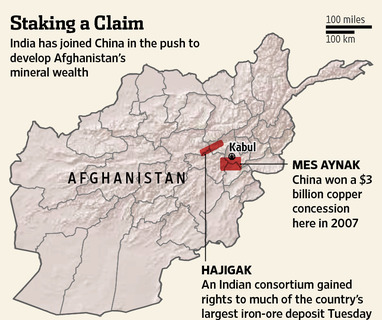
India consortium of firms makes winning $14B investment bid on Afghanistan's largest iron-ore deposit, called by experts the crown "jewel" of the country's estimated $1T in minerals.

Supposed to take five years to get mine up and running.  Canadian firm got the fifth block, as the Indian crew won the other four.

This award comes just a couple months after New Delhi and Kabul signed a strategic cooperation agreement.

Article makes the usual noises about Pakistan getting unnerved, but I think this is great - and totally natural. China and India making big investments and ultimately owning the security responsibility surrounding those investments.

To date, China's done nothing with the Aynak copper site, it is reported, due to security concerns.  Chinese companies now projecting a 2014 start date.  

Bet that gets moved up once NATO troops move out sooner.

9:51AM

Putin's woes are worth suffering

Putin's United Russia party carried a supermajority in 2007.  Now, in recent Duma elections it looks like it'll come up short of a majority - maybe 48%.

No, it won't stop Putin from winning the presidency - by any means necessary.  But it will mean he won't have a rubber-stamp parliament, which will prove wonderfully frustrating for Caponesque ruling style.

I have few illusions about what that means in real terms.  Putin will simply rule by decree and ignore the parliament, which will be a center of genuine gravity for a growing opposition to his political delusions of grandeur.

I had wanted Putin to abstain from this egomaniacal choice, but size matters and we're talking one towering behemoth.

But, in the end, I think this will be a good thing for Russia - the pol who stupidly and stubbornly outstays his welcome. That choice will trigger the evolution that's much needed there, and the world won't suffer anything of importance out of Russia in the meantime.

Russia can once again be an important country, but Putin's inability to move anything there in the direction of the future means the country will remain on the sidelines for the near-term.

9:07AM

WPR's The New Rules: U.S. Clutching for Straws With Energy Independence

The United States is on the verge of an industrial renaissance, according to energy experts enthusiastic about technological advances surrounding the “fracking” of shale gas and the processing of “tight oil.” America is sitting on a century-worth of natural gas, and the Western hemisphere boasts five times the reserves in unconventional oil as the Middle East claims in the conventional category. Suddenly, all our fears of resource wars with China and never-ending quagmires in Southwest Asia seem to melt away, heralding with great certainty another American century based on the promise of energy independence. As “deus ex machina” moments go, this one arrives just in time for a nation magnificently down on its luck and itself.

Read the entire column at World Politics Review.

12:01AM

Concluding my year with the Center for America-China Partnership

Set this up with John Milligan-Whyte and Dai Min of the center last year while I was in Beijing with them selling the "grand bargain" term sheet that I've discussed plenty of times over the months since. It was a fascinating collaboration and I enjoyed fulfilling my one-year "adjunct" stint at the Center.

I wish John and Dai Min the best in their continuing efforts to improve US-China relations. Unfortunately, my increased participation in, and workload at, Wikistrat simply doesn't allow me to sign up for another year.

Then again, having Wikistrat take off is a very good thing.

12:01AM

Gone to MetLife, hopefully to see Packer's 12th win

I hate playing a desperate team at their home, but brother had ticket (upper level, first row, midfield, Packers' side!) and Wikistrat had business meetings in Manhattan the following day.  So flying into Newark in the ayem to meet up with bro and hopefully notch the 12th win.

Should be good game.  Hoping it's not too cold!


POSTSCRIPT:

Got into my hotel in midtown around 1pm and then ran about 15 blocks to pick up some antibiotics for a sinus infection I realized just this morning that I had.  Nice doc in Indy called it into local CVS.  Just got it at end of virus my kids gave me over Turkey Day weekend.  Caught it early enough so don't feel too bad.  Anyway, to meet my sked I ran about 20 blocks to Penn.

Met my brother at the station and took Amtrak to Secacus, and then a special train to Meadowlands. Then short walk to stadium, which is pretty cool throughout.

Loved our seat in top realm - but first row, above 45 yard line, Packer side, so we saw the game just like on TV (always weird to view DVR later at different angle).

Food pretty good, but beer way expensive: 11:50 for Bass or Stella.

Plenty of Packer fans, but what was great was the game itself. Very exciting right to the end. Talked with my son Jerome by cell about 20 times during the game as he watched at home.  His judgments: Finley drops too many balls, Rodgers holds onto the ball in the pocket too long, and our inside linebackers need to cover passes over the middle better.

Pretty much sums it up, but 12-0 is otay. Actually we're now 18-0, the second longest streak in NFL history (mark shared with handful of teams).  Only left to surpass: Patriots at 21-0.  We'd do that, theoretically, on New Years against the Lions.

I have seen one-third of this streak to date: Falcons and Bears last season in playoffs, then Broncos, Bucs, Lions and Giants this year.

What i will say about MetLife: more urinals in a men's bathroom than I've ever seen, so I didn't miss a single play.

Same trains back to island afterward and I'm feeling awfully beat.

12:02AM

Getting seriously efficient on water use

USA Today story on San Antonio: exhibit A for those that assume we cannot do better on efficient use of resources.

In mid 1990s, city was slapped with restriction of use of aquifier due to endangered species (rare blind salamander).  Instead of looking for new sources, the city went big on cutting use (recycling, more efficient toilets pushed throughout city, etc.).

City now uses the same amount of water it used in 1984, even though population is two-thirds larger. Citizens average about 2/3rd the national average water use.

All of this is crucial given Texas' long and harsh drought - a harbinger of things to come with climate change.

Mayor: "We practice [conservation] religiously.  It's part and parcel of being a San Antonian."

Impressive.

12:01AM

Esquire's Politics Blog: So, How's That Egyptian Revolution Coming Along?


Egypt has just concluded voting for its new parliament — the first round, anyway — with surprisingly large turnouts and little-to-no serious violence. And that should make us all pretty happy, right? Alas, there's a lot of angst out there in the mainstream media and the blogosphere on all the issues that get lumped together in the big, mournful vibe of who killed the revolution? As usual, America's incredible impatience with progress, along with our unrealistic expectations about "new faces" dominating political outcomes, are fueling this growing sense of pessimism. But, in truth, the revolution is going along just fine.

Herewith, some whining you'll be hearing in the coming days — and the truth behind it....

Read the entire post at Esquire's The Politics Blog.

10:32AM

Quoted in Reuters piece on Syria & great powers

Quoted in Reuters piece about Russia bolstering its naval presence in the Eastern Med while making strong noises about no Western intervention into Syria.

The bits:

As Syria's uprising escalates into outright civil war and begins to drag in other states, it risks fuelling not only wider regional confrontation but also growing antagonism between the world's great powers . . .

That in itself could mark the beginning of a long, bloody, open-ended civil war. And speculation about foreign military intervention could even spark a Cold War-style face-off between Russia and the United States.

Analysts and foreign governments have long said they believed Iran was providing military and logistics support to Damascus, and some now suspect the opposition too is now receiving foreign weapons.

That, many analysts fear, risks further fuelling the growing regional confrontation between Tehran and its local enemies, particularly the Gulf states and emerging heavyweight Turkey. . .

My quote comes at the end.

"The problem with conflict in Syria is that it is much harder to contain than what we saw in Libya," said Anthony Skinner, Middle East analyst for UK-based consultancy Maplecroft.

"It has much wider regional implications that have largely been ignored. It feeds into what is already happening in the Gulf, as well as elsewhere" 

. . . 

"The Russians are signaling that on Syria, it is not a situation where they will publicly protest but quietly and privately acquiesce," says Nikolas Gvsodev, professor of national security studies at the US Naval War College.

"The danger is that it is not clear what they are prepared to do to stop open intervention."

. . .

"I think the Russians really were spooked by what happened in Libya and are determined to see that nothing like that happens again," said Nigel Inkster, a former deputy chief of Britain's Secret Intelligence Service (MI6) and now director of transnational threats and political risk at London's International Institute for Strategic Studies.

"In that they are joined by China and most of... the BRICs... (However) since there is clearly no appetite for a military intervention in Syria, the Russian navy's journey looks likely to be wasted."

. . . 

"What you're seeing in the Middle East with the withdrawal of the U.S. from Iraq is Iran moving into an increasingly stronger position," said Reva Bhalla, director of analysis at U.S. private intelligence company Stratfor.

"If Assad survives in Syria, he will also be increasingly isolated and dependent on the Iranians, which will reinforce existing regional fears of Iran's growing influence."

Further stoking events, many believe, is a much wider tussle for power as the realization dawns that some two centuries of regional dominance by outside powers - first colonial Britain and France, then the U.S. - may be drawing to a close.

"We shouldn't be surprised that the Russians - in addition to the Turks and Iranians - feel like they've got an opportunity to expand their political-military influence in the eastern Mediterranean," said Thomas Barnett, U.S.-based chief strategist at consultancy Wikistrat.

"Nature abhors vacuums and so do rising great powers."

Personally, I think Russia has decided it must be present on Syria, lest it allow the entire Arab Spring to pass without so much as a howdy-do.  I think Moscow has some ambitions to re-establish itself in the region, but that the main show remains the Saudis and Iran, with the second bill being Turkey and Iran - the rivalry that I think overtakes all under the right crisis conditions.

8:44AM

Connecting Africa's middle to the coast

Nifty WSJ piece from the 21st.

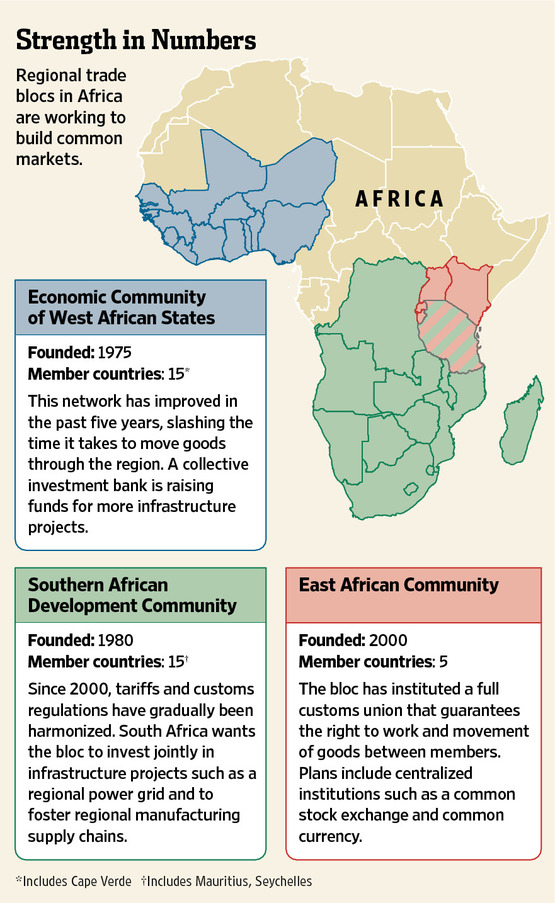
A standard bit in my Wikistrat's "World According to Tom Barnett" brief: the reality that, as globalization penetrates Africa, a certain political fracturing is inevitable (and not necessarily bad if handled well). How it gets handled well: an overarching effort at regional economic integration so that, when such fracturing happens, it doesn't go zero-sum because everyone is sensing the larger economic opportunity.

Historically, African trade goes like a pin-wheel: lines connecting the middle to the coast. But the colonial set-up of so many states (Africa has more states per square mile than any other continent) creates all these interior situations that are not economically sustainable - thus the connection imperative.

Economic communities meet that challenge, although some serious gaps remain: would be nice to see West package extend southward a bit; need something in Horn eventually, and I suspect it's an expanded EAC; and there's nothing really up top, but there the Arab Spring opens up possibilities considerably.

Right now Wikistrat is running an internal training simulation for the younger analysts that puts me in Yoda mode: Hmmm. Good she will be. The analysis is strong with that one.

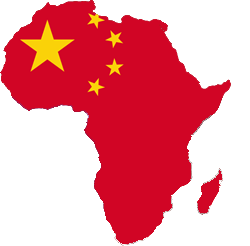
The simulation is entitled, "China as Africa's De Facto World Bank." We planned it merely as a training tool, plus a way to - as always - build up the GLOMOD (our online Global Model of globalization made up of all these hundreds of scenario pages). Naturally, working out a few new wrinkles in the established simulation methodology, because we always want to be evolving through experimentation on the edge (new twists, new features, new modules, etc.). I honestly didn't have big expectations for the output, but the padawans, as always, surprise me with their inventiveness.  In the end, they may push us to productize the material. At the very least, they have me thinking that my next strategy book should be a crowdsourced effort throught Wikistrat itself (the next step up from thanking a hundred or more bloggers in "Great Powers"), because just like the International Grand Strategy Competition, this China-Africa sim is generating cool ideas that deserve a wider platform.

10:23AM

Chart of the Day: Being Gay in Core v. Gap

NYT story from October about new gay rights in Portugal.

Map caught my eye for obvious reasons.  Quick crude overlay of Core-Gap divide shows you want to be gay in the Core - not the Gap.  

Not true in every single instance, but as a rule . . ..

Wherever you still are cranking babies as a means of survival, you will look down on gays.  Almost all of your survival rules - like religion - will tell you to do so.  But once industrialization and connectivity kick in, then you start to value them for the diversity they bring - especially in key globalized industries (yes, gays tend to concentrate somewhat in certain industries, but so do heterosexual men and women, so there!).

But the more basic point: when you connect you have to go with the acceptance of others, because you value the ties and the business more than your precious identity. Plus, you probably also see more of the world and get over yourself.

9:44AM

WPR's New Rules: U.S.-China Relations Need Leadership, not Anachronisms

It is hard to think of a period in the past five decades in which this country was more painfully bereft of national leadership than it currently finds itself. On one side we have an increasingly isolated president who, as Edward Luce opined recently, “prefers to campaign than govern.” On the other is a House-controlling GOP that, in the words of Thomas Friedman, “has gone nuts.” What’s more, the highly negative campaign that 2012 is shaping up to be will secure no governing mandate for the eventual winner, meaning that things are likely to get far worse.

Read the entire column at World Politics Review.

9:25AM

Emily Updates, Vol. 4, available online

Find the Kindle version here.

Find the Nook version here.

Find the iBook version here.

To remind on the series:

Seventeen years ago, authors Tom and Vonne Barnett were suddenly confronted with every parent’s worst medical “bolt from the blue”: their only child, 30-month-old Emily, was diagnosed with an advanced – meaning metastasized – pediatric cancer. At the time, the thirty-something couple was living in northern Virginia. 

What followed was the defining crisis of their now 25-year union: an intense 20-month battle to keep their first-born alive. About six months into the struggle, Tom started writing a weekly update on Emily’s progress (or lack thereof) for interested parties. Vonne contributed to this blog-like diary, and it was sent out by email, fax and regular mail to several hundred relatives and friends who spontaneously organized themselves into their family’s extended support network. Over time, the couple came to view the updates as something more important: a real-time memoir that would someday prove crucial to Emily’s understanding of how she became whom Tom and Vonne hoped she would become. 

The journey from blog diary to this eBook serial is worth recounting. The original diary ran about 400,000 words, or somewhere in the range of an 800-page book. In the late 1990s, Tom edited the text down to approximately 200,000 words and posted the 45 updates online at a website he created specifically for that purpose. Having received a lot of positive feedback from readers, they sought publication as a regular book, but then fate intervened in the form of a new job for Tom in Rhode Island and the project was – pun intended – shelved. 

But the recent meteoric rise of eBooks has convinced Tom and Vonne that now is the time to give publication another try (Vonne, for example, is a Kindle fanatic!). After all, the Emily Updates basically constituted a blog before there were blogs, so eBooks struck the authors as an entirely appropriate venue for the material, especially since they’re interested in making it easily available and they know - from first-hand experience - how parents and relatives of patients experiencing medical crises typically turn to the Internet to locate sources of information, comfort and inspiration in their time of need. 

What you now have the privilege to read in this series of eBooks are the original weekly updates as Tom wrote them – with Vonne’s continuous inputs – across all of 1995 and into early 1996, a period encompassing the last 14 months of Emily’s treatment protocol. Those 45 updates constitute Chapters 3 through 9 in the series: Chapter 3, which concludes with the birth of their second child, in included in this volume; Chapters 4 and 5, which cover the difficult summer of 1995, make up Volume II; Chapters 6 and 7, which chronicle the family's final push on the chemotherapy, fill out Volume III; and Chapters 8 and 9, which encompass the post-treatment diagnostics – and Make-a-Wish trip to Disney World, constitute Volume IV. 

The first two chapters presented in this Volume I are actually recreations of the events surrounding the initial diagnoses (Chapter 1) and the beginning of in-hospital treatment (Chapter 2) in July of 1994. Tom put these diary-like remembrances together in June of 1995 to mark the one-year anniversary of the diagnosis, and they are based on the voluminous medical records from that time period. 

The concluding fifth volume in the series is written from today's perspective, to include that of a grown-up Emily - the girl who lived!

The authors haven’t made an effort to “improve” the updates from today’s perspective. Tom and Vonne now claim to be wiser on a host of subjects that arise in this family memoir, but a lot of that wisdom stems directly from these experiences, so they felt it made most sense to share them with you, the reader, in this unaltered format. 

If this eBook serial helps you better understand an analogous past experience or ongoing crisis in your life, then Tom, Vonne and Emily have accomplished what they set out to do by sharing their intense story.

Fifth and final volume will appear 12 December.

Happy Thanksgiving to all.  Look for us at the Pack-Lions game!  It'll be Joel Zamel and I and my six kids.

7:17AM

Another prominent crowd sourcing effort: competitive but not collaborative

Chicago Tribune story about prominent economists from around country linking up on one site (U Chicago biz school) to post competing answers to a weekly posted policy question.  Site then polls the other economists and you get an agree/disagree/undecided number.

Another nice example of crowdsourcing, but one that highlights the Wikistrat difference: instead of just holding up the challenge in front of the mob and asking the crowd to yell out its answers, Wikistrat asks the crowd to work together, on the wiki, to strategize pathways, outcomes, options and impacts. It's that nonstop dialogue and debate in real-time that makes us different: not just a concentration of opinions but their collaborative interplay.

Still, another interesting example of thinkers reaching for something similar.

10:37AM

WPR's The New Rules: U.S. Must Engage With World Beyond Security Threats

Thanks to the terrorist attacks of Sept. 11 and the two wars they spawned, it seemed like the near entirety of President George W. Bush’s two terms in office were characterized by efforts to define, harness and exploit fear. Despite living in the most peaceful, prosperous and predictable period in world history, Americans became convinced that they faced an unending era of war, impoverishment and chaos. That muddled mindset put us painfully out of touch with the rest of the planet.

Read the entire column at World Politics Review.

1:11PM

Gone to Lambeau with sons

Bucs at noon tomorrow.

6:58AM

NPR's All Things Considered: My appearance yesterday on US-China relations

The segment:

Analyst Spells Out U.S. Interests In Pacific Rim

November 17, 2011

President Obama used his trip to the Pacific Rim this week to announce plans for a new American military base in Darwin, Australia. The move changes the stance of U.S. forces in the region — countering the growing strength and presence of China's military. Guy Raz talks with Thomas P. M. Barnett, chief analyst for Wikistrat, a consultancy that provides geopolitical analysis. He's also executive vice president of the Center for America-China Partnership.

Download this: http://thomaspmbarnett.squarespace.com/storage/20111117_atc_15.mp3 or go here to find the NPR/ATC page.


2:21PM

Going on NPR's All Things Considered today

As Chief Analyst, Wikistrat, to talk about the recent deal/decision to put 2,500 US troops in Australia.

I have no landline, and NPR no fan of skype for whatever reason. We talk drive to WFYI downtown, but I don't have a car (son and wife own those rights on our two vehicles), so I couldn't manage studio effort (and frankly would have turned them down at this point).

Enter an iPhone app. NPR, discovering I have an iPhone, says download "Report IT Enterprise Edition." I need to be on wifi (got that at home office) and in airplane mode. You log onto these NPR servers and voila - the desired connection.

Bravo NPR!

Now if we can finish the taping before my son opens the garage door beneath me . . . 

POSTSCRIPT: It happened, but culprit was wife with kids.  Neat thing about taping with NPR, it's no problem. Just stop taping for a bit, and then I abandon office for my master bath (the sanctuary where I do most interviews).

The interview was okay-to-good with Guy Raz, who's always very nice.  I always feel like I underperform while I'm doing it, but then later, when I hear it, I feel much better. You just never get past that initial instinct at self-criticism.

But then the truly interesting techno part: once done taping, I must disconnect via the app from NPR servers. Then I am asked to name the file my iPhone just made locally, recording only my half of the interview. The app does that so you avoid having yourself taped over the wire, so to speak, and instead you get this much higher quality capture that is then uploaded to their servers as a file for their editing.

Clever as hell, huh?

Score again for Steve Jobs and Apple. I get studio quality sound on NPR and I don't have to drive all the way into downtown Indy to do it.

As a result, I head out now to throw some football with son Jerry, who, after years of never understanding football, despite my taking him every year to Lambeau, is suddenly a total leatherhead thanks to Madden 2011. Now we watch games and he bitches about blown coverages, infrequent blitzs and why the Pack doesn't kick onsides more often!

We're going to the Bucs-Pack game on Sunday and then the Pack-Lions game in Detroit on Turkey Day.

7:05AM

Chart of the Day: LATAM doing it right in the Middle


Great and expansive front-page WSJ feature from 15th.

Disappointing to the anti-globalization crowd, but it's been very, very good to LATAM, decreasing its poor and increasing its middle class in a steady fashion since Cold War's end.

A realistic snapshot:

The expanding middle is benefiting from a strong period of economic growth—fueled by high commodity prices in many countries—along with more aggressive social programs with a decided focus on education.

But the advances are still tenuous, and the possibility of a global recession haunts the prospects of los emergentes—the emerging ones—as marketers call the newly minted middle-class members.

Protecting what's gone on there is such a huge - even worldwide - responsibility. Ditto for Africa.

We don't do it out of anything but common sense. Check out the rising demand function:

This is the opportunity we piss away with our insane "war on drugs."

The world is booming and all we see is fear.

12:02AM

Wikistrat's first internal training simulation: China as Africa's de facto World Bank

Wikistrat is a number of things at once.

Wikistrat is a global community of strategic thinkers, and that community needs activities around which to organize itself and mobilize its strengths. Wikistrat is taking on the challenge of sharpening the blades of the world's next generation of grand strategists.

Wikistrat is also a wiki-based model of globalization, in which hundreds and hundreds (soon enough "thousands and thousands") of scenario pages compete to describe its many flows, races, competitions, developments, etc. That monster, called the GLOMOD, must likewise be fed.

These two "base" assets allow us to construct the superstructure that is the world's first massively multiplayer online consultancy (captured in our shorthand equation of Facebook + Wikipedia = MMOC).

So as we continue to lock in foundational clients, we simultaneously conduct our first internal training simulation for interns and researchers only. Like everything we do, we make it a competition with prizes, but the primary purpose is to train up our youngest community members so that, over time, we can include them in simulations for clients, alongside more experienced analysts and our growing bevy of truly world-class strategists.

In NFL terms, this internal simulation is training camp: hard work, but if you're into developing skills and you love the game, this is also a lot of fun.

But it's not just about getting everybody ready for "regular season games." The material produced here gets integrated into the GLOMOD, meaning it enriches the general intellectual backdrop for all the simulations to follow.

This last week has seen a cohort of interns and researchers filling out a variety of pages that explore how a host of national, regional and supranational actors are impacted by China's rising economic role across Africa. Naturally, these are contentious issues, so we discouraged attempts to capture consensus and we've encouraged all such tension to be presented on the page, meaning pros and cons are competitively explored.

This is a tricky skill to impart - collaborative competition, because everybody comes with genuine talent, as well as passion for the material and analytic process. The natural tendency is to fight it out in the comments, when what we want is for them to compete it out on the page.  So we nudge, and we encourage, and we get people to start confidently and compassionately editing each other's work. 

I chose the later adverb with great purpose: writing is one skill, editing is a far trickier one. I have great self-respect as a writer, but I have deeper respect for those who edit me. This did not come easily, but it did come early for me. When I got to the University of Wisconsin in 1980, I simply did not know how to write analytically, but I was lucky to have an older journalism-major sister, Cathie, on campus and willing to work with me on everything I wrote - explaining everything she did as she did it. Cathie was my first great editor, and I've made it my professional creed ever since to consider all editors my most important ally in sharpening my messaging skills.

Now, we have supervising Contributing Analysts wrangling the larger "crowd" in this competition. They do a certain amount of cleaning up, editing, formatting, etc., while coaching participants. But in truth, the players here mostly edit each other in a very direct sense: a position is proposed, and then it "suffers" improvement through direct manipulation or through indirect manipulation - i.e., a countering position is added in competition. So it's not just one voice speaking and the rest carping in the comments, otherwise known as too much of the blogosphere to mention. Rather, it's many hands carving the same statue, save for those Michaelangelos who don't feel their "David" will be found in that particular piece of stone and thus take up chisels elsewhere on the same page or on another page in the wiki.

What this produces is something better than the norm: Don't tell me what's "wrong" with my argument. Tell it better or tell me something better.

This is not how we normally hash things out in the professional community. Oh, we may pass our drafts to trusted friends for comments, or vet it up the chain of command for review, but we don't subject them to anything close to this competitive collaboration, because, quite frankly, that's an intimidating dynamic to many - at least of a certain age and/or disposition.

But Wikistrat is looking for both that dynamic and the accelerated processing made possible by so many brains operating in collaboration - especially across a new generation so given to peer-to-peer dialogue. So it's not just the reach and the breadth that we're selling here, but the speed - with all delivered at prices traditional consultancies will never match.

But to accomplish that, we need to build up that mental Leviathan - that colossus of distributed brainpower, and so we conduct internal training simulations like the one I will continue to monitor in the days and weeks ahead.

And no, it's not a chore whatsoever.  Every time anybody does anything page in this particular wiki (actually, anywhere across the GLOMOD), I get an instant email saying who and what, down to the keystroke. And I gotta tell you, it's a fascinating stream of conscious brain-powering to witness: idea upon idea, layer upon layer, analysts one-upping one another and then being one-upped in return. It's like the GLOMOD is tweeting nonstop, and it has quite an intellectually ferocious personality.

We are building an army. 

 

11:44AM

WPR's The New Rules: How to Stop Worrying and Live with the Iranian Bomb

The International Atomic Energy Agency’s latest report on Iran’s nuclear programsurprised no one, even as it created the usual flurry of op-eds championing preventative “next steps.” As I’ve been saying for the past half-decade, there are none. Once the U.S. went into both Iraq and Afghanistan, the question went from being, “How do we prevent Iran from getting the Bomb?” to “How do we handle Iran’s Bomb?” That shift represents neither defeatism nor appeasement. Rather, it reflects a realistic analysis of America’s strategic options. With that in mind, here are 20 reasons why Iran’s successful pursuit of the Bomb is not the system-changing event so many analysts are keen to portray.

Read the entire column at World Politics Review.