Buy Tom's Books
  • Great Powers: America and the World After Bush
    Great Powers: America and the World After Bush
    by Thomas P.M. Barnett
  • Blueprint for Action: A Future Worth Creating
    Blueprint for Action: A Future Worth Creating
    by Thomas P.M. Barnett
  • The Pentagon's New Map: War and Peace in the Twenty-first Century
    The Pentagon's New Map: War and Peace in the Twenty-first Century
    by Thomas P.M. Barnett
  • Romanian and East German Policies in the Third World: Comparing the Strategies of Ceausescu and Honecker
    Romanian and East German Policies in the Third World: Comparing the Strategies of Ceausescu and Honecker
    by Thomas P.M. Barnett
  • The Emily Updates (Vol. 1): One Year in the Life of the Girl Who Lived (The Emily Updates (Vols. 1-5))
    The Emily Updates (Vol. 1): One Year in the Life of the Girl Who Lived (The Emily Updates (Vols. 1-5))
    by Vonne M. Meussling-Barnett, Thomas P.M. Barnett
  • The Emily Updates (Vol. 2): One Year in the Life of the Girl Who Lived (The Emily Updates (Vols. 1-5))
    The Emily Updates (Vol. 2): One Year in the Life of the Girl Who Lived (The Emily Updates (Vols. 1-5))
    by Thomas P.M. Barnett, Vonne M. Meussling-Barnett
  • The Emily Updates (Vol. 3): One Year in the Life of the Girl Who Lived (The Emily Updates (Vols. 1-5))
    The Emily Updates (Vol. 3): One Year in the Life of the Girl Who Lived (The Emily Updates (Vols. 1-5))
    by Thomas P.M. Barnett, Vonne M. Meussling-Barnett
  • The Emily Updates (Vol. 4): One Year in the Life of the Girl Who Lived (The Emily Updates (Vols. 1-5))
    The Emily Updates (Vol. 4): One Year in the Life of the Girl Who Lived (The Emily Updates (Vols. 1-5))
    by Thomas P.M. Barnett, Vonne M. Meussling-Barnett
  • The Emily Updates (Vol. 5): One Year in the Life of the Girl Who Lived (The Emily Updates (Vols. 1-5))
    The Emily Updates (Vol. 5): One Year in the Life of the Girl Who Lived (The Emily Updates (Vols. 1-5))
    by Vonne M. Meussling-Barnett, Thomas P.M. Barnett, Emily V. Barnett
Search the Site
Powered by Squarespace
Monthly Archives
12:05AM

The revolution in Iran focuses on the big picture

Tehran's latest morality crackdown, according to this NYT piece, focuses on acceptable haircuts, which, according to this chart, all seem right out of 1950s America.

The morality crackdown is a bit harsher this year, but it all strikes me as the usual pathetic attempt to dictate the dumbest little bits of everyday life-- a revolution that's dead when it comes to ideas and vision but has plenty of stupid-ass rules.  Oh so Brehznevian.

The public really hates this sort of stuff, which is why Ahmadinejad routinely claims it's not his fault and distances himself from this crap.

12:04AM

The outdated rule-set that governs the most important trade relationship in the world

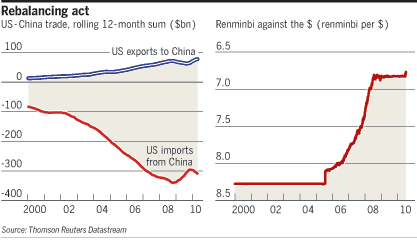
FT "analysis" full-pager on US-China trade by Alan Beattie. Starts by noting China's slight loosening of the yuan's peg and says this won't change the relationship all that much.

Then the key point:

With discontent rising across American business, fuelled by incidents such as the Google China censorship spat, Washington is recognising to its intense frustration that it lacks the instruments to conduct international trade policy in a modern economy.

“China is distorting global trade and investment patterns with a web of state-sponsored industrial policies,” says Jeremie Waterman of the US Chamber of Commerce. “The tools the US government has are inadequate to cope with this interlocking web.”

The old-fashioned architecture of US trade policy largely reflects the metal-bashing economy of the past. It is predicated – as is the focus on the exchange rate – on its manufacturers competing head-on with Chinese companies, particularly in the American market.

The US has a panoply of “trade defence” instruments – antidumping, countervailing duty and safeguard measures – that allow it to block imports it deems unfairly priced, state-subsidised or flooding in too rapidly. One such tool was used in September last year to restrict Chinese tyre imports, provoking a storm of protest from free-traders.

But the goods to which the US applies such measures are mainly basic, low-margin industrial components in which American competitiveness is being eroded against many countries. The list hit with trade defence protection in recent months does not read like a tour of America’s economic future: drill pipe, phosphate salts, coated paper.

Francisco Sánchez, undersecretary for international trade at the Commerce department, notes such products cover less than 3 per cent of US trade with China. Yet because the industries are long established and often have powerful labour unions, they exert disproportionate control over trade policy. When China joined the World Trade Organisation in 2001, the negotiators’ focus was on goods such as these, and particularly the eternally controversial area of garments and textiles.

The problems started after China joined the WTO and the the government protectionists were given more free reign under Hu and Wen, who, when they came to power, saw that few Chinese companies were predominant in the high-tech local markets and wanted to change that.

From the piece:

Beijing says it is merely trying to do what other countries have done – modernise its economy, ascend the value chain and ease away from dependence on foreign companies for investment and technology.

But US companies say “indigenous innovation” goes way beyond familiar problems with software and movie piracy, and amounts to a full-blown system of government manipulation of large swaths of the economy.

Procurement is used to favour Chinese companies. Idiosyncratic technical standards such as a home grown wireless technology – “Wapi” – are given a clear run by denying licensing to more familiar international standards. Information, communication and technology companies complain about restrictions, such as requirements for products to be certified and tested in government laboratories, and for businesses to disclose source code.

Alarm about this is rising to the point where business representatives are increasingly prepared to criticise policy publicly. “We are feeling less and less welcome in China, which is why you are seeing more people speaking out and reconsidering their futures in China,” says John Neuffer of the Information Technology Industry Council.

Last week Jeffrey Immelt, chief executive of GE, expressed his growing concern about Beijing, telling an audience of Italian executives that “I am not sure that in the end they want any of us to win, or any of us to be successful”.

So the question for the US is, How to keep China's markets reasonably open for US company penetration while China seeks to fence those areas off for its own national flagships?--not exactly a new trick, I would add. Our trade instruments don't cover that scenario, the article argues.

How about suing China in the WTO?

But this strategy costs time and effort, and is not a cure-all. After the two or three years it can take to bring and win a case and an appeal, the remedy often comes too late. In the car-parts case, US business experts say, the delay gave Chinese industry more time to develop and American industry to weaken, foiling the goal of allowing US car-parts companies export significant quantities to China. Mr Neuffer notes that dispute settlement is even slower for high-tech industries, where product lifecycles can be less than a year.

In the end, no easy answer avails:

There are no strong rules about promoting competition in markets in WTO agreements. There is an agreement whereby governments commit to put public purchases of goods and services out to international tender but China has never signed.

“Government procurement in China is actually much more important to the American and European economies and companies [than issues such as textiles], but much less effort was put into getting China to join,” Mr Horlick says. China says it will make an offer to sign up this month but appears to have ruled out including regional and local government and state-owned enterprises, thus punching huge holes in any new commitment.

Debbie Stabenow, Democratic senator from Michigan, has proposed a bill that would cut China off from US government procurement if it does not open its own market. But few investors seem to think that would make a tremendous difference. Rules such as the “Buy American” provision already restrict China from bidding for some government contracts, against which Beijing has in turn complained.

So expect this relationship to remain tense as we seek to increase our exports in the face of Chinese efforts to dominate their own domestic market.  It would seem that the only way we're going to correct a trade imbalance with China is to restrict their exports--a tricky path with someone who owns so much of your debt.

12:03AM

A funny thing happened on the way to rising China

pics here

WSJ story on how Russian oil previously thought destined for China is ending up in US oil refineries stretching from Puget Sound down to LA.  Imports have gone from zero to 100k bpd (barrels per day) overnight, leading to downward price pressure in usually high-priced CA.

Experts expect Russia to become a serious source of oil for the US, which seeks to diversify and recover lost flow from declining Mexico.

Soon enough, some of the flow of the multibillion-dollar Eastern Siberia-Pacific Ocean pipeline will be diverted to China in a spur yet to be completed.  By 2013, Russia's flow to China is expected to rival that of Saudi Arabia's, or roughly 1m bpd.

12:02AM

Why Iran meddles in Afghanistan


Very sensible stuff from Hilary Mann Leverett at ForeignPolicy.com by way of Our Man in Kabul.

The first question covers the gist of her logic.

1. In late May, then-top commander General Stanley McChrystal said there is "clear evidence of Iranian activity" in training and providing weaponry to the Taliban in Afghanistan. What are Iran's core interests in Afghanistan, and how have they evolved in the last nine years? How do those complement or work against what the U.S. and NATO are trying to achieve there?

Iran has a strategic stake in Afghanistan that has not changed in the last nine years. Tehran's overriding interest is to prevent Afghanistan (with its long and lawless border with Iran) from being used as a platform from which to attack or undermine the Islamic Republic or to weaken Iran's standing as a regional power. 

To prevent Afghanistan from being used as an anti-Iranian platform, the Islamic Republic has worked, over many years, to form relationships with Afghan players who could keep Iran's Afghan enemies (principally the Taliban but also other anti-Shiite and anti-Persian groups) and their external supporters (principally Saudi Arabia and Pakistan, two of Iran's most important regional antagonists) in check. To this end, Iran has worked to strengthen and unite Afghanistan's Shiite Hazara and other Dari/Persian-speaking communities (which together comprise about 45 percent of the population) as a counterweight to anti-Iranian, pro-Saudi, and pro-Pakistani elements among Afghan Pashtuns (roughly 42 percent of the population). The Hazara and other Dari/Persian-speaking communities were, of course, the core of the Northern Alliance that fought the Taliban during the 1990s, and were supported by India and Russia as well as Iran.[[BREAK]]

In contrast to Iraq, where Shia are a clear majority of the population and Shiite groups linked to Tehran are the most important political forces in the country, Iran knows from bitter experience that the Hazara and the other Dari/Persian-speaking communities provide, at best, inadequate protection for Iranian interests in Afghanistan, because they cannot govern the country in a way that keeps it relatively stable and minimizes Pakistani and Saudi influence. So, alongside its alliances with the Hazara and the other Dari/Persian-speaking groups, Iran has also cultivated ties to some Pashtun elements in Afghanistan and supported the country's Pashtun President, Hamid Karzai.

As part of its cultivation of ties to Pashtun elements, Iran has almost certainly reached out to some Taliban factions. But I would wager a substantial sum that America's "ally" Pakistan is providing vastly more support to the Afghan Taliban than anything the Islamic Republic might be doing. And Tehran remains strongly opposed to the Taliban's resurgence as a major force in Afghan politics, for two reasons. First, the Taliban have traditionally persecuted Iran's Afghan allies -- especially the Shia Hazara -- and have even murdered Iranian diplomats. Second, Tehran sees the Taliban as a pawn for the expansion of Pakistani and Saudi influence in Afghanistan.   

As Tehran pursues this strategy of multiple alliances within Afghanistan, it must also assess the evolving role of the United States there and the implications of the U.S. posture toward Iran for Iran's Afghanistan policy. If the United States and NATO could convince Iran that they want an independent and stable Afghanistan that would be friendly to Iran, then U.S./NATO and Iranian strategies and tactics could complement each other very constructively. (This was very much the case in the months following the September 11, 2001 terrorist attacks in the United States, when I was one of a small number of U.S. officials engaged in ongoing discussions with Iranian counterparts about how to deal with Afghanistan and al-Qaeda, and U.S. and Iranian policies regarding these issues were rather closely coordinated.)

But, if Tehran perceives Washington as hostile to its interests -- which, unfortunately, is currently the case, given the Obama administration's drive to impose sanctions and continued use of covert operations to undermine the Islamic Republic -- then Iranian policymakers will regard the United States, along with America's Pakistani and Saudi allies, as part of the complex of anti-Iranian external players that Iran needs to balance against in Afghanistan. In this context, Iran has a strong interest in preventing U.S. troops in Afghanistan from being used to attack Iran directly, used as covert operatives to undermine the Iranian government, or used to strengthen Iran's regional rivals.

So often I'm sent stuff that says Iran is meddling in Afghanistan and therefore we shouldn't consider cooperating with them. But as I like to note, Af-Pak is Iran's front yard, so meddling is a given.  When you understand how the Iranians are meddling, you see the potential for collaboration. But as Mann Leverett points out, when you chose Pakistan, you un-choose others--and not just India.

12:01AM

Chart of the day: China shoots up ranks of pharma markets

From FT story on how Japanese pharma Eisai has penetrated China's growing market well before its national competitors.

Reason why is that China is rapidly moving up the ranks from 10th place in 2004 to third, after Japan and the US, by 2014.

Usual bottom-of-the-pyramid reality:

Emerging markets, particularly China, are becoming increasingly important for drugmakers, which have to deal with slowing growth at home.

The big driver in China?  The gov's $125B overhaul of the country's weak health system.

2:47PM

In DC next week, looking to connect

I will be in Washington the first half of next week.  Got sort of an extended layover between two speaking events and I'm not particularly tied down, sked-wise.

Since people often ask for available dates, here I am letting you know if you want to set something up.

I am easily reached by email at thomaspmbarnett@mac.com.  Contact me ASAP.

12:11AM

The Embrace::Our African Mother


I was raised

in the great state of Wisconsin in a Scot-Irish-German family that didn’t do hugs.  Every emotion was delivered verbally.  As such, I can recall moments of great love and great pain, but always in the form of words.  I lived this existence until the age of 20, when I met the love of my life who’s still my wife—28 years later.

The hug that changed everything for me was delivered on June 22, 1982.  There was my life before that moment and my life since.  I will never go back.

I was living in Madison, Wisconsin, following my sophomore year in college there.  I had a job cooking pizza at the university’s premier Italian restaurant, called Paisan’s.  After 20 years of pretty much always sleeping with somebody else in the room (I was the sixth of seven brothers), I suddenly found myself living—and sleeping—alone for the first time in my life in an efficiency sublet from my brother James.

I was beyond free in this arrangement:  traveling by Sear’s Free Spirit 10-speed, I worked monster hours, partied to no end, and actively plotted to seduce women in my newfound man cave.  It was my personal summer of love.

Then I met Vonne, an oddly personable waitress at Paisan’s.  She was this gorgeous work of art, with a mind so nimble that I eventually cleaned up my act simply to keep up with her.  She was intense.  A lot of cooks at the restaurant fantasized about her but nobody—including me—could figure how to approach her.  In the end, she approached me.

I was sitting in a circle with friends at my sister Maggie’s legendary annual birthday bash in mid-June.  It was the quiet time after midnight but before the cops showed up, and we were talking movies.  Vonne was on the far side but actively sought out my opinions.  Later, she asked me to walk her to her bike.  On the way there, I realized I could easily marry her.

A week later I summoned up the courage to do something I had never actually done before—successfully.  I asked her out on a date.  We saw “Blade Runner” on our mutual day off, and then spent that evening riding around Madtown, she on her racey Motebecane and me on my Free Spirit, struggling to keep pace.  We made it to my lair around midnight, and I figured I was in like Flynn.

Instead, we sat on my bed and talked all night.  I realized what I was getting into:  she wanted the whole shebang but just didn’t know how to ask for it because life hadn’t led her to believe it was possible, especially with someone of my respectful—when it comes to women, that is—demeanor.

At dawn Vonne said she needed to head to her place to catch some zzz’s before her shift.  I walked Vonne out to her chained bike, and after I pulled off the lock, she suddenly grabbed me and gave me the most intense, heartfelt, soul-transmitting embrace of my life.  I can still recall it in all its heart-pounding glory, it was so shocking in its openness, its longing, and its strength.  I had nothing to say in reply—a first for this Mad’s-snappy-answers-to-stupid-questions maestro.  I just watched Vonne ride off, knowing in my heart that I would love her forever.

I have never felt that crushing emotion since.  I’ve been happily married to Vonne since 1986, fortunate to have married the person I respect most on this planet, so don’t get me wrong:  I don’t recall the moment as an instance of lost youth or anything like that.  It was my own personal “great awakening,” and I’ve been a committed evonnegelical ever since.

So it wasn’t just that I never expected to experience something like that ever again; I simply didn’t want to.  That saddened me some, because there’s nothing like falling in love for the first time.  Hell, it’s why I’ll watch every and any romantic comedy ever made.  We all want to go back to that virginal moment of glorious revelation, to which nothing in this world compares.


Twenty-eight years, 

fifty pounds and an emerging bald spot later, I’ve finally repeated the experienced with a small, thin and incredibly beautiful farm widow from southern Ethiopia, 18 years my junior.  It’s not a midlife crisis and it’s not a pathetic reach for past glory. 

Instead, it’s the collision of tragedy and hope that is an international, transracial adoption.  This widowed farm mother of four has put up her two younger children, girls aged 3 and 4, for adoption by American families through a local orphanage.  Three years after her second husband died from pneumonia just weeks following the birth of her youngest child, this 30-year-old has decided they deserve a better life than she can provide them, given the reality of competing responsibilities (the older kids by a previous husband) and enduring hardship (managing her small hardscrabble farm of banana trees and corn fields).  She’s not looking to marry again; she simply wants them to have more opportunity than she did—and to find those opportunities in America.

Vonne and I had three “biologicals” (Emily, 18, Kevin, 15, and Jerome, 10) before adopting Vonne Mei Ling Barnett from the interior of rural China in 2004.  Having grown up in a farm town myself, whereas Vonne grew up on a working farm in Ohio, we felt a natural kinship with this small-village babe of a mere nine months. 

But our little brown-eyed girl was an anomaly in our white-on-white family, and so we sought, in this allegedly “post-American world,” to make our tribe truly post-Caucasian—a perfectly American quest.

Ruled out from returning to China for a host of unchangeable reasons, we tried Taiwan (too corrupt), Kyrgyzstan (too unstable) and Kazakhstan (too many fetal-alcohol Russians) before finally realizing that our long-imagined ace-in-the-hole, Ethiopia, had silently risen to the top of the pile.  Many American families with Chinese adoptees had already turned in this direction, much like the Middle Kingdom itself is now “invading” Africa with all manner of immigrants, investments and long-term commodity contracts.

As an expert on globalization, the idea of pulling this trigger was highly appealing:  in this era, China is globalization’s primary engine and Africa is its emerging target of intense integration.  What better way to experience this world-transforming phenomenon than to raise glorious daughters of both great civilizations?

And so we applied yet again, submitting our fingerprints and background checks and home visits by prying social workers.  And we waited six months until those frightened eyes stared back at us from the photo, holding their names written in a foreign tongue. 

Bob-tailed Metsewat and shaved-skull Abebu, estimated at four and three years of age, respectively, had been offered to an American family who had requested one or more pre-school children.  When presented with the reality of sibling girls, the parents realized they couldn’t handle the full scope of the challenge and passed.

Next in line, we got the call in late March, at around 5pm.  Minutes later the email arrived with the photo.  We saw the tension and anxiety in the girls’ faces.  They were mere hours past being dropped off by their loving but heartsick mother, and suddenly found themselves among strangers in a major city.

We decided yes two hours later, but waited 48 hours until the formal medical review by an international adoption specialist working remotely out of Seattle came through.  After 60 minutes with him on the phone, we called our agency, WACAP (World Association for Children and Parents), and accepted the referral.


Approximately two months later 

Vonne and I are sitting in a reception room at the Ajuuja orphanage in the city of Awassa, capital of Ethiopia’s southern-most Sidamo region—famous solely for its coffee exports.  After brief remarks in English by the trilingual director, I spot a beaming Metsewat ambling around the corner of the walled-in courtyard, looking expectantly for her “white mother and father,” as she subsequently described us to her birth mom.  Minutes later my youngest child, fuzzy-headed Abebu, is sitting on the floor with me, playing catch with a rubber ball.


But we are not yet the parents of six.  We have traveled the many hours south by vehicle to meet the girls, but still need to return to Addis Ababa for the court adoption proceedings three days later.  Thanks to new rules, we are the first adopting parents to be required to meet the children prior to the hearing and to attend the hearing in person.   Amazingly enough, previous adopting parents had the option of skipping the court date and arriving weeks later for the follow-on US embassy immigrant visa drill, having already been made the child’s (or children’s) legal parents in abstentia.  Due to the cost of two somewhat lengthy stays (not to mention all those airfares), most adopting parents previously took the irreversible plunge without ever laying eyes on their new children.

Vonne and I had welcomed the rule change, because we were going to show up for the court date anyway, figuring it was the best possibility of meeting the birth mother—however emotionally charged that moment might be.  Since grandparents were helping out, the new rules justified the extra costs involved—not that grandmas are especially tough when prospective granddaughters are involved.

So, bidding our new daughters good-bye, we headed back to Addis and prepared for court.  Given preview of likely questions to be posed by the judge, Vonne and I wrote out our answers on stick-em notes and committed them to memory.  Having done this previously, both in Chinese and American courts, we knew emotions would run high and we didn’t want to stammer or seem hesitant in our declarations.  As far as we were concerned, the occasion could not have been more solemn, especially with birth relatives in the room alongside us.

We had little expectation that the mother would appear.  Typically, an older adult relative—a grandfather or uncle—does the deed, especially when great distances are involved.  But we were wrong in this instance.


It's a cool, cloudy morning

on 30 June 2010 and I’m sitting in the off-white waiting room of the Addis district family court, located on the third floor of a non-descript government office building.  Vonne is beside me and we’re both wearing black.  Somebody’s dreams are dying today, and we aim to respect that.

My elbows on my knees, I’m hunched over studying my stick-em notes, slightly annoyed by a fellow adoptive parent’s nervous chatter.  I glance up at Vonne sitting erect beside me, and notice the tears welling up in her eyes.  I’m about to say something rude about that chattering mom when a sudden chill runs up my spine and I straighten up instinctively.  Vonne knows the birth mother is in the room.

I slowly and surreptitiously scan the square room’s walls, going over the couple of dozen black faces attached to lined chairs.  As my gaze terminates on my hard right, I realize she’s maybe 36 inches to my kitty-corner, sitting alongside a slightly older woman and man.  I wonder, are these her relatives or other birth parents in the same boat?.

I steal a quick glance at the young woman and immediately recognize her from the stunning photo presented to us by the Ajuuja orphanage director two days earlier.  She is as strikingly beautiful as her daughters, though I need to see her smile for complete confirmation.

But naturally, none is forthcoming.  Arms and legs crossed, she looks tense and coiled and ready to get this painful event over.

I am humbled by her choice of sacrifice, and go back to staring at my shoes, unsure what to do next.

But long-range planner that I am, I quickly imagine my adult African daughters begging me with all earnestness to divulge any memory I can muster of their birth mother, whom I may never see again once she leaves this room.  I can plan for otherwise but I can assume nothing.

And so my inner journalist kicks in.  I know what to do because I’ve been in these rooms before.  You record everything:  every sound, every smell, every color, every everything.  I turn over my stick-em notes and begin scribbling every impression and detail I can assemble.  When they’re full, I pull out some blank envelopes from my backpack, and when the outside flaps are covered in words, I split them open and do the same with their interiors.  I pursue this effort for 30 minutes, stealing sideways glances at her now and then, grasping for the atmospherics surrounding her emotional turmoil—and my own.

At 1015 a.m., a stern woman emerges from the judge’s chambers and announces, “Ajuuja.”

Our birth mother is up like a shot and strides hurriedly into the room, only to be immediately escorted out by the court official.  It’s not yet her time.  Our eyes lock as she passes by en route to her corner seat.

After the first of three American couples exits into the judge’s chambers, our birth mom realizes that one of the two remaining couples will come to represent her hopes for a better life for her girls.  I can feel her gaze shifting back and forth like a laser beam.

Five minutes later the first couple emerges and the second couple is beckoned to enter.  I slowly turn to face the mother and see the look of recognition in her eyes. 

Now we’re both staring at our feet.

Five minutes more and we three are called in, with our various legal and procedural handlers.  Vonne and I sit to the judge’s right, and the birth mother sits opposite the simple desk that serves as judicial bench.  All eyes are on the judge, who is out of central casting.  A tall, imperious-looking Muslim woman, she is covered from head to toe in black robes, with only her face and hands showing.  She is quite beautiful, as well as intimidating in the way that only judges can be.

Papers are shuffled and the judge looks up with all seriousness to begin questioning the birth mother, who speaks Sidamo but not Amharic, so the Ajuuja orphanage director translates.

It’s all Greek to Vonne and I, but the questions are easy enough to guess.  The first ones are short, and fall into the category of “Do you understand that this proceeding is . . .?” 

The mother answers in mono-syllables, looking the judge in the eye but seeing only her daughters’ future.

The judge’s questions grow longer, and the mother’s answers expand in complexity.  After a total of ten or so queries, the exchange is finished and the judge turns to Vonne and I in concise English.

“Can you supply your passports?"

We do.

“What are the ages of your current children?”

By previous agreement, Vonne answers with suitable precision, matching the judge’s calm and deliberate tone.

“Why are you adopting from Ethiopia?”

My turn, and I explain our desire that our Chinese daughter not remain an anomaly within our family.  I also state that we had always planned to eventually come to Africa, because, as European-descent Americans with an Asian child, Africa was all that remained to complete our microcosm of the global village.  The world now comes to Africa, and we want to be part of that process, helping where we can.

“What preparations have you made for a transracial adoption?”

Vonne describes our training, both mandated and self-directed.

“What have you told your children about this adoption, and how have they responded?”

We both answer, emphasizing our past experience with Vonne Mei and our kids welcoming spirit.

“What have you told your family and how have they responded?”

More of the same from us, noting that we already have African-American relatives.

I sense the judge’s questions are completed.  As she prepares to make a signature, the judge turns with some surprise toward Vonne and asks, “Why are you crying?”

Vonne wipes her eyes and replies, “Because I am so very happy and”—turning to the birth mother and looking her straight in the face—“so very sad.”

Our newest relation stands up quickly and takes several steps toward Vonne, who matches her urgency step for step.  They lock in fierce embrace in the middle of the room, gasping in short bursts as they shower each other’s neck in kisses.

For two minutes, the room responded with respectful silence. 


I recognized the power 

of Vonne’s hug immediately.  What I didn’t anticipate was that, for the first time since that fateful June morning in 1982, I would feel that intense emotional release yet again, but this time from a wiry but strong Ethiopian farm widow in Addis Ababa.

And just like last time, when it was my turn to embrace our mother, I fell in love all over again—to my utter amazement.  I entered that same place, where words have no meaning and love has no boundaries.  In that flash, I felt my life divide yet again between “before” and “after.”

Our mother’s strength was such that she almost pulled me off balance.  As I felt myself tip into her, only to have her stop my momentum with her feral grip, I was whatever she needed me to be.  Our hearts now intertwined, her fears were now my own—her love our shared asset.

As I remained lost in our mother’s arms, Vonne turned to the judge, extending her hand with the words, "Thank you, your honor."

The judge, who later admitted to our WACAP handler that she was deeply moved by our collective show of emotion—for Ethiopians tend toward stoicism in all things, replied with utter conviction, “It is my honor.”

The next hour was a blur:  constant physical contact, more hugs and embraces, an awkward elevator ride and a giddy stroll down the street.  Then, over coffee, a heartfelt conversation of stunning openness:  fears expressed, pain exposed, dreams revealed, promises made.

When our mother smiled, I could see everything that defined Metsewat and Abebu:  the sweetness, the determination, the vast capacity for love.  No boasting was required, nor frankly any translation; we gave our pledges through our hugs, our tears, and our kisses. 

As we pulled away from the café around noon, I shot repeated photos through the van’s window of our mother’s wave, her smile, her absolute sense of relief and deliverance.

I have not been to get that hug out of my mind since.  The experience is permanently fused into my circuitry—for only the second time in my life.  I never dreamed I would ever repeat that sensation or that personal connection, but I will remain eternally grateful to that woman for letting fall in love once more on this Earth.


And I will spend

the rest of my days paying her back for that privilege.

12:10AM

Blackwill, recalling the Iraq debate on same, predicts partitioning of Afghanistan

map here

Per my Esquire Politics Blog post of yesterday, former ambassador to India Robert Blackwill argues in Politico:

The US polity should stop talking about timelines and exit strategies and accept that the Taliban will inevitably control most of its historic stronghold in the Pashtun south . . . But Washington could ensure that north and west Afghanistan do not succumb to jihadi extremism, using US air power and special forces along with the Afghan army and like-minded nations.

Blackwill admits nobody much would like this, meaning both Karzai and Pakistan would resist for obvious reasons (Karzai wants the pretense of ruling over the entirety of Afghanistan and Pakistan wants the Pashtun to recapture the whole and not just the south), but at least it would make explicit the reality that we'll be spending years pounding the south with military strikes in order to keep the al-Qaeda-Taliban nexus in their box.

The value?  Nation-building in the north can work and this way we admit that doing the same in the south cannot, so long as Pakistan seeks "strategic depth" via the Pashtun. In short, we admit Afghanistan is a fake state, but, by doing so, we suggest the same about Pakistan.

Down with the Durand Line!  Long live Pashtunistan!  

12:09AM

Rising India(n)-American politicians

WAPO story on the growth in Indian-American involvement in politics.  The rise of this group has been stunning, but hardly atypical:

The nation's 2.5 million Indian Americans rank among the most highly educated ethnic groups in the United States, according to Census figures, and they have the highest per-capita income.

Although the community leans Democratic, according to a 2009 survey by the Asian American Legal Defense Fund, its wealth has attracted aspiring candidates of both parties.

Individual donors connected to Teppara's council have given hundreds of thousands of dollars to Indian American conservatives and other Republicans, he said. Democratic candidates get financial support through the decade-old Indian American Leadership Initiative. That group has endorsed both congressional and local candidates this year, and late last year it formed a political action committee, which has raised $100,000.

The money "obviously" makes a big difference, said Sanjay Puri, chairman of the nonpartisan US India Political Action Committee, which raised $75,000 in the first quarter of the year and $300,000 in 2008 to support Indian American candidates and others who have pro-India views. "The money is there. The candidates just have to prove that they are credible."

In a word, economic success breeds money breeds influence breeds the ambition to play the political role yourself. This trajectory has been the same, ethnic group after ethnic group, throughout US history.

The Indians have just done it faster, thanks to globalization speeding up the cycle considerably.

Still, stunning to witness.  I remember my first glimpse:  seeing Hindu temples go up in northern VA. I had never a church being built before, because, like most people, I came from a place were churches--seemingly--always were.  I remember thinking to myself then, If they've got money for new churches, then political candidates can't be far behind.  A decade later, they started to win, and just five years after that, we see the wellspring take off.

12:08AM

Turkey: too good for the EU?

NYT story on Turkey's amazing economic ride relative to the EU's troubles:

For decades, Turkey has been told it was not ready to join the European Union — that it was too backward economically to qualify for membership in the now 27-nation club.

That argument may no longer hold.

Today, Turkey is a fast-rising economic power, with a core of internationally competitive companies turning the youthful nation into an entrepreneurial hub, tapping cash-rich export markets in Russia and the Middle East while attracting billions of investment dollars in return.

For many in aging and debt-weary Europe, which will be lucky to eke out a little more than 1 percent growth this year, Turkey’s economic renaissance — last week it reported a stunning 11.4 percent expansion for the first quarter, second only to China — poses a completely new question: who needs the other one more — Europe or Turkey?

“The old powers are losing power, both economically and intellectually,” said Vural Ak, 42, the founder and chief executive of Intercity, the largest car leasing company in Turkey. “And Turkey is now strong enough to stand by itself.”

It is an astonishing transformation for an economy that just 10 years ago had a budget deficit of 16 percent of gross domestic product and inflation of 72 percent. It is one that lies at the root of the rise to power of Prime Minister Recep Tayyip Erdogan, who has combined social conservatism with fiscally cautious economic policies to make his Justice and Development Party, or A.K.P., the most dominant political movement in Turkey since the early days of the republic.

So complete has this evolution been that Turkey is now closer to fulfilling the criteria for adopting the euro — if it ever does get into the European Union — than most of the troubled economies already in the euro zone. It is well under the 60 percent ceiling on government debt (49 percent of G.D.P.) and could well get its annual budget deficit below the 3 percent benchmark next year. That leaves the reduction of inflation, now running at 8 percent, as the only remaining major policy goal.

Here was my crazy prediction in "blogging the future" back in 2005 (Blueprint for Action's afterword):

Turkey's Surprisingly Rapid Entry into EU Signals Europe's Tilt Toward Arab World

My logic?  I expected pain within Europe to rise to the level where taking Turkey in would seem like salvation versus suffering.  I had expected the pain to be social or political unrest; I just didn't imagine the economic causality being so profound.  I also underestimated how far Turkey would come economically in such a short period of time.

In short, I erred in my too heavy social-political pessimism and in my lack of economic optimism--just like Africa.  

O me of too little faith in globalization!

12:07AM

Love--Chinese style

WAPO story on Dating Game-like TV show that has the morality police incensed.  Lady pictured above was an audience fave.

"If You Are the One" is a Chinese television phenomenon, one of many popular matchmaking shows on which young people seek mates amid ribald jokes from the host and occasional racy comments from guests.

Audiences loved all the titillation, until last month -- when Chinese government censors came down hard. After a contestant indicated she was angling for a wealthy man with a flashy car, government nannies ordered all matchmaking shows to cut the sexual innuendo, uphold traditional values and ban any talk of women "gold digging."

The censorship is the latest and most public example of the government's new crackdown on vice and perceived immorality. It comes even as China becomes more freewheeling and open, with people increasingly pushing the boundaries in matters involving taste, sex and money -- and the intersection of the three.

As China moves toward more affluence, it'll get far harder for the government to police this sort of thing. Same thing happened to America in its "rising" 1950s, particularly with cars going mainstream.  And we didn't even have the Internet!

12:06AM

If every Chinese bought just one . . . 

NYT story by Keith Bradsher raising the usual bugaboo about China's middle class dooming the planet to environmental ruin--if it replicates the West's consumption trajectory.

My usual reply is that it cannot, simply because China won't be able to acquire enough energy to power all that growth unless it is channeled differently--i.e., you can't get there from here.

The basics:

Premier Wen Jiabao has promised to use an “iron hand” this summer to make his nation more energy efficient. The central government has ordered cities to close inefficient factories by September, like the vast Guangzhou Steel mill here, where most of the 6,000 workers will be laid off or pushed into early retirement.

Already, in the last three years, China has shut down more than a thousand older coal-fired power plants that used technology of the sort still common in the United States. China has also surpassed the rest of the world as the biggest investor in wind turbines and other clean energy technology. And it has dictated tough new energy standards for lighting and gas mileage for cars.

But even as Beijing imposes the world’s most rigorous national energy campaign, the effort is being overwhelmed by the billionfold demands of Chinese consumers.

Chinese and Western energy experts worry that China’s energy challenge could become the world’s problem — possibly dooming any international efforts to place meaningful limits on global warming.

If China cannot meet its own energy-efficiency targets, the chances of avoiding widespread environmental damage from rising temperatures “are very close to zero,” said Fatih Birol, the chief economist of the International Energy Agency in Paris.

Aspiring to a more Western standard of living, in many cases with the government’s encouragement, China’s population, 1.3 billion strong, is clamoring for more and bigger cars, for electricity-dependent home appliances and for more creature comforts like air-conditioned shopping malls.

As a result, China is actually becoming even less energy efficient. And because most of its energy is still produced by burning fossil fuels, China’s emission of carbon dioxide — a so-called greenhouse gas — is growing worse. This past winter and spring showed the largest six-month increase in tonnage ever by a single country.

I learned this first in my workshops with Cantor Fitzgerald:  with energy use doubling (or more)  across China in a generation's time, it gets awfully hard to shift those percentages of coal versus gas versus renewable, etc. You race like crazy just to stay in place.

In many ways, this is why it's impossible for America to dream of overtaking China on alternative energy: we just don't have the same vast necessity that they face. Simply put, the world needs China to become the global leader in this realm, because nobody but China can afford to make it happen in China.

12:05AM

Dodd-Frank will not lead to global imitations

Economist editorial on the 2,300-page bill.

What it got right was dealing with the fragmented regulatory nature of our financial system.

But the rule-set's global influence will be limited:

At the G20 Mr Obama boasted of “leading by example” on financial reform. In fact, Dodd-Frank is too idiosyncratically American and too incomplete to be a true template for others. And his claim that it would keep a financial crisis like the one the world just went through “from ever happening again” is bound to prove wrong. Yet imperfect though it is, the reform is proof that even a government as fractious as America’s can move with impressive speed when the motivation is there.

Expecting more or better in this age of globalization's rapid expansion is simply unwarranted. We may have birthed the system, but it has grown in complexity and heterogeneity beyond our ability to lead by example in rule-set resets.

12:04AM

Building up cyberwar as this era's equivalent of nuclear war

Economist piece that leverages the salesmanship of Richard Clarke and Mike McConnell, two industry leaders in the great government spending spree unfolding on cybersecurity. McConnell especially likes to compare the effects of full-blown cyberwarfare to a nuclear attack.

Not so, retorts Mr Schmidt [Obama's new cybersecurity czar and former head of security at Microsoft].  There is no cyberwar.  Bruce Schneier, an IT industry security guru, accuses securocrats like Mr Clarke of scaremongering.  Cyberspace will certainly be part of any future war, he says, but an apocalyptic attack on America is both difficult to achieve technically ("movie-script stuff") and implausible except in the context of a real war, in which case the perpetrator is likely to be obvious.

I, as you know, tend toward the skeptic position on this, simply because whenever technology is proposed to rule over all--either positively or negatively, I find that reality is far more complex.

The truth, as The Economist suggests, lies somewhere in between:

By breaking up data and sending it over multiple routes, the internet can survive the loss of large parts of the network. Yet some of the global digital infrastructure is more fragile. More than nine-tenths of internet traffic travels through undersea fibre-optic cables, and these are dangerously bunched up in a few choke-points, for instance around New York, the Red Sea or the Luzon Strait in the Philippines (see map). Internet traffic is directed by just 13 clusters of potentially vulnerable domain-name servers. Other dangers are coming: weakly governed swathes of Africa are being connected up to fibre-optic cables, potentially creating new havens for cyber-criminals. And the spread of mobile internet will bring new means of attack.

Reminds you of any map you've seen here before?

My favorite bit from the piece:

Western spooks think China deploys the most assiduous, and most shameless, cyberspies, but Russian ones are probably more skilled and subtle. Top of the league, say the spooks, are still America’s NSA and Britain’s GCHQ, which may explain why Western countries have until recently been reluctant to complain too loudly about computer snooping.

The usual concluding judgments:

Deterrence in cyber-warfare is more uncertain than, say, in nuclear strategy: there is no mutually assured destruction, the dividing line between criminality and war is blurred and identifying attacking computers, let alone the fingers on the keyboards, is difficult. Retaliation need not be confined to cyberspace; the one system that is certainly not linked to the public internet is America’s nuclear firing chain. Still, the more likely use of cyber-weapons is probably not to bring about electronic apocalypse, but as tools of limited warfare.

Cyber-weapons are most effective in the hands of big states. But because they are cheap, they may be most useful to the comparatively weak. They may well suit terrorists. Fortunately, perhaps, the likes of al-Qaeda have mostly used the internet for propaganda and communication. It may be that jihadists lack the ability to, say, induce a refinery to blow itself up. Or it may be that they prefer the gory theatre of suicide-bombings to the anonymity of computer sabotage—for now.

Like any good horror show, the authors here feel the need to wrap up the subject rather neatly before departing, but not without that ominous seed of doubt being planted just before the credits roll.

My sense remains until proven otherwise: the assumption of escalation dominance lying with cyber attackers is a whopper. We went through the same fears on nukes early on, and the truth worked itself out over time: defense is never all that far behind the offense.

12:03AM

Grove on what it will take to generate new employment in the US

Bloomberg Businessweek piece by Andy Grove, legendary retired CEO of Intel.

Basic point:  tech start-ups can't create enough jobs, as proposed by Thomas Friedman recently in the NYT.  

Reality of the tech world:  for every high-tech job in the US, there are ten connected manufacturing ones in Asia, like all those Foxconn workers cranking out iPods.  Also, over time, it takes a lot more money to create even those high-tech jobs we keep.  An HP could create a job for less than $10k back in the 1950s (when it did its IPO), but a Google today spends roughly $100k per new job.  

Grove:  "The obvious reason:  Companies simply hire fewer employees as more work is done by outside contractors, usually in Asia."  This results in Foxconn employing more people than Apple, Dell, MS, HP, Intel and Sony combined.

The same has happened with alternative energy.  Good example: we stand on the verge of mass production of electric cars and trucks, meaning lithium-ion batteries are to electric vehicles what microprocessors are to computing, but we basically abandoned any attempt to lead the world in that sphere three decades ago when we stopped making consumer electronics devices.  Grove doubts we can ever catch up now.

Groves passionate call is for America to begin once again valuing manufacturing and not simply give into the notion that, so long as we retain the knowledge work, we can stay current.  His point is that there is much innovation to be found in the challenges of manufacturing:

Not only did we lose an untold number of jobs, we broke the chain of experience that is so important in technological evolution.  As happened with batteries, abandoning today's "commodity" manufacturing can lock you out of tomorrow's emerging industry.

His prescription:  "job-centric economics," because "losing the ability to scale will ultimately damage our capacity to innovate." Thus we need to "rebuild our industrial commons" even to point of taxing the offshoring of jobs.

As someone not given to such arguments, I found this powerful in its logic, especially as we consider biotechnology.

12:02AM

When you want SysAdmin bad, you get it bad

NYT story on shabby construction efforts as we drawdown in Iraq:

After two devastating battles between American forces and Sunni insurgents in 2004, this city needed almost everything — new roads, clean water, electricity, health care.

The American reconstruction authorities decided, however, that the first big rebuilding project to win hearts and minds would be a citywide sewage treatment system.

Now, after more than six years of work, $104 million spent, and without having connected a single house, American reconstruction officials have decided to leave the troubled system only partly finished, infuriating many city residents.

The plant is just one of many projects that the United States has decided to scale back on — or in some cases abandon — as American troops who provide security for reconstruction sites prepare to leave in large numbers.

Even some of the projects that will be completed are being finished with such haste, Iraqi officials say, that engineering standards have deteriorated precipitously, putting workers in danger and leaving some of the work at risk of collapse.

The American officials give many reasons for their decisions to scale back or drop some projects before more troops leave, including that they discovered in some cases that the facilities diverged from Iraq’s most pressing needs, or that the initial work — overseen by American contractors and performed by Iraqi workers — was so flawed that problems would take too long to fix.

Reconstruction officials point out that they have completed the vast majority of the $53 billion in projects they planned throughout Iraq, from bridges to honey-bee farms.

And the officials, along with the United States Embassy in Baghdad, say they are aware of only isolated concerns about the quality of reconstruction work now under way in the country, or about projects being left undone.

“I am not aware of the Iraqis having any sort of hard feelings that we will not finish current projects and award projects we said we would,” Col. Dionysios Anninos, head of the Army Corps of Engineers office in Iraq, wrote in an e-mail message. “We will finish strong!”

But some Iraqis have compared the current hurried reconstruction effort to the haphazard American withdrawal from Vietnam in 1975. In Diyala Province, northeast of Baghdad, Iraqi officials said they found that construction standards had slipped so drastically that they ordered an immediate halt to all American-financed projects, even though American inspectors had deemed the work to be adequate.

The Americans had told local authorities they were speeding up projects because a nearby United States Army base was scheduled to close this summer.

Shaymaa Mohammad Ameen, who works with reconstruction officials as a liaison for the Diyala Provincial Council, said American officials frequently threatened to leave when Iraqis questioned engineering standards and brought up other safety issues.

“They constantly tell us that if we do not approve, they can always move the allocated funds to projects in other provinces,” she said.

In Baghdad and Salahuddin Provinces, local officials say Americans have simply walked away from partly completed police stations, schools, government buildings and water projects during the past several months without explanation.

And in Dhi Qar and Babil Provinces, there are complaints that roads and buildings recently completed by the Americans do not meet basic construction standards.

I've said for years, given our mindset toward exiting, and China's mindset for wanting to own resources in the ground, we would have been much better off subcontracting the entire reconstruction effort to the Chinese.

Hard to see how it wouldn't have cost far less and accomplished far more.

Another point I've made in the brief for close to a decade now:  the SysAdmin is necessarily more rest-of-world than just the United States.  We are not good at everything and shouldn't try to be.

12:01AM

Chart of the day: Poverty reduction in Brazil in the age of globalization

Economist story on Dilma Rousseff's apparently successful job to win the presidency in Brazil on Lula's coat-tails.

Taking a lot at the chart, it's easy to see why that strategy should work.

Proof positive:  opening up to markets and globalization can reduce poverty while not increasing income inequality.

Yes, the inequality is still high in Brazil by international standards, but the poor are increasing their income faster than the rich, and that's a success story no matter how you slice it.

The article says, region by region, inequality is also decreasing.  Just over half of Brazilians now sit in the lower-middle class.

2:36PM

The Politics Blog: Seven Things to Remember When We Talk to the Taliban


Is your stomach churning yet? The occasionally salacious but usually accurate Guardian is reporting that Team Obama is signaling that it's ready to negotiate with the Taliban. Through "trusted" intermediaries like the Pakistanis and Saudis, naturally, and via plausibly denied channels, of course, but... really? Is this what a peace-in-your-first-term, Nobel Prize-winning president looks like? If we're going to reconcile ourselves to this kind of indecent proposal — the last one led to the bloody Swat Valley offensive — the U.S. had better not lose site of reality. Here's how. If it's not too late.

Read the entire post at Esquire's The Politics Blog.

12:10AM

WAPO's "Top Secret America"

First chunk of what will clearly be a large series flow of information, and certainly an accompanying book from Dana Priest and William Arkin at the Washington Post.

The general theme is, "Be amazed at how big our secretive defense world is!"  Also, "Look how big it has grown since 9/11!" Finally, "Much of this work is redundant, useless in its overwhelming flow, and no closer to dot-connecting than before 9/11!"

All valid points but all also painfully predictable and well known. So the charges aren't particularly new or revealing, even as the great flow of anecdotes are well designed to make you especially anxious and frustrated.  I would expect tons of air time for the duo, lots of op-eds bemoaning the details revealed, and the usual congressional grumblings.

But not a lot of positive action in reply.

Two bits caught my eye:

The overload of hourly, daily, weekly, monthly and annual reports is actually counterproductive, say people who receive them. Some policymakers and senior officials don't dare delve into the backup clogging their computers. They rely instead on personal briefers, and those briefers usually rely on their own agency's analysis, re-creating the very problem identified as a main cause of the failure to thwart the attacks: a lack of information-sharing.

This is why briefers ruled before 9/11 and it's why they still rule. The flow of info is too great for the system to handle.  So the "just-tell-me-what-I-need-to-know-right-now" principal relies primarily on whomever does the all-purpose daily or weekly brief.

Second, befitting all "electronic-Pearl-Harbor-is-right-around-the-corner" media flow:

And all the major intelligence agencies and at least two major military commands claim a major role in cyber-warfare, the newest and least-defined frontier.

"Frankly, it hasn't been brought together in a unified approach," CIA Director Panetta said of the many agencies now involved in cyber-warfare.

"Cyber is tremendously difficult" to coordinate, said Benjamin A. Powell, who served as general counsel for three directors of national intelligence until he left the government last year. "Sometimes there was an unfortunate attitude of bring your knives, your guns, your fists and be fully prepared to defend your turf." Why? "Because it's funded, it's hot and it's sexy."

This is why the problem, which existed long before 9/11, gets worse inexorably over time:  the latest crisis du jour becomes simply the newest layer of effort added on top of all the rest (in PNM, this was my explanation for how America's "national security interests" mushroom over time).  Nobody and nothing ever get downgraded or truly eliminated because, once created, they take on a life of their own, with all sorts of bureaucrats and contractors protecting their programs.  My favorite example is missile defense, which is now being touted in op-eds as our great response to North Korea and Iran.  Not exactly how it started out, but heh, you work with what life gives you.

I don't mean to pooh-pooh the piece, which is very good and certainly rare enough in these days of tight budgets in the MSM.  I just find the target too easy and too big, and, as I said above, I don't think this kind of reporting stands much chance of having any real impact because the whole long war mindset regarding transnational terrorism is too strong to crack right now, both for legitimate and illegitimate reasons. Everybody will decry all right, but nothing will be done.  Even with the push to cut defense by untold billions over the next X years, a lot of this stuff will remain sacred.

And that's a shame, but the reporting here is all accurate.  It's too big, too redundant, and too useless to justify the resource diversion.  The investment should be in resilience in the face of bad things happening in this complex world, not intelligence fantastically tasked with preventing bad things from happening in the first place.  There's real money to be made in the former, and way too much to be wasted on the latter.

12:09AM

The long hard slog that is China's attempt to placate the Uighurs in Xinjiang

pic here

Pair of FT stories by Kathrin Hille on Xinjiang one year after the outbreak of Uighur riots.

Beijing's response has been two-fold:  install all sorts of officials through Xinjiang and push social programs designed to make the locals feel less squeezed out of economic opportunities by the influx of Han Chinese settlers.  Good example: the government checks all families and if it finds one that has everybody out of work, a job is automatically arranged for one member.  Another:  gov plans to make Kashgar (prominent city) a special economic zone.

Kashgar is sort of a gateway city to Central Asia--part of the old northern Silk Road.

Beijing is now promising "leapfrog development" for the region: per capita GDP raised to the national average by 2015 and more revenues from oil and gas development.  The north side of Xinjiang has done well with O&G, but the south has not benefitted particularly, and that's where the Uighurs are concentrated.

What is this but domestic pre-emptive COIN?

Can Kashgar become a vibrant SEZ?  That would require creating or tapping local markets, and the question is, will Beijing risk all that connectivity with Muslim Central Asia?

You should begin to see the strong overlap of US and Chinese security/economic development interests for Central Asia.  We're there because of 9/11, and the Chinese are increasingly there because of their restive West.