Buy Tom's Books
  • Great Powers: America and the World After Bush
    Great Powers: America and the World After Bush
    by Thomas P.M. Barnett
  • Blueprint for Action: A Future Worth Creating
    Blueprint for Action: A Future Worth Creating
    by Thomas P.M. Barnett
  • The Pentagon's New Map: War and Peace in the Twenty-first Century
    The Pentagon's New Map: War and Peace in the Twenty-first Century
    by Thomas P.M. Barnett
  • Romanian and East German Policies in the Third World: Comparing the Strategies of Ceausescu and Honecker
    Romanian and East German Policies in the Third World: Comparing the Strategies of Ceausescu and Honecker
    by Thomas P.M. Barnett
  • The Emily Updates (Vol. 1): One Year in the Life of the Girl Who Lived (The Emily Updates (Vols. 1-5))
    The Emily Updates (Vol. 1): One Year in the Life of the Girl Who Lived (The Emily Updates (Vols. 1-5))
    by Vonne M. Meussling-Barnett, Thomas P.M. Barnett
  • The Emily Updates (Vol. 2): One Year in the Life of the Girl Who Lived (The Emily Updates (Vols. 1-5))
    The Emily Updates (Vol. 2): One Year in the Life of the Girl Who Lived (The Emily Updates (Vols. 1-5))
    by Thomas P.M. Barnett, Vonne M. Meussling-Barnett
  • The Emily Updates (Vol. 3): One Year in the Life of the Girl Who Lived (The Emily Updates (Vols. 1-5))
    The Emily Updates (Vol. 3): One Year in the Life of the Girl Who Lived (The Emily Updates (Vols. 1-5))
    by Thomas P.M. Barnett, Vonne M. Meussling-Barnett
  • The Emily Updates (Vol. 4): One Year in the Life of the Girl Who Lived (The Emily Updates (Vols. 1-5))
    The Emily Updates (Vol. 4): One Year in the Life of the Girl Who Lived (The Emily Updates (Vols. 1-5))
    by Thomas P.M. Barnett, Vonne M. Meussling-Barnett
  • The Emily Updates (Vol. 5): One Year in the Life of the Girl Who Lived (The Emily Updates (Vols. 1-5))
    The Emily Updates (Vol. 5): One Year in the Life of the Girl Who Lived (The Emily Updates (Vols. 1-5))
    by Vonne M. Meussling-Barnett, Thomas P.M. Barnett, Emily V. Barnett
Search the Site
Powered by Squarespace
Monthly Archives
12:06AM

The best sort of rebalancing

Japan Times story (by way of WPR Media Roundup) on recent global polling re: attitudes toward great powers:

Despite widespread talk of a rising China and an America in decline, the latest BBC World Service poll shows not just strong residual American soft power but actually an increase. At the same time, the data depict a China whose influence is viewed as more negative than positive in an increasing number of countries.

Old truth: when your popularity is high, it's got nowhere to go but down, and vice versa.

More tactical reality:  every day China gets perceived by more of the world as globalization's great purveyor/integrator/action-force.

And with that burgeoning reputation will come a lot of negative feeling--especially so long as China remains a single-party state.  Eventually, the CCP will have to kill the dictatorship to save itself.  Why?  It'll need the capacity to swap out leadership in response to dramatic failure.

And yeah, those failures will come, as will the global blame.

More polling details:

In 2005, 49 percent of people thought that China's influence was mostly positive, 11 points higher than that of the U.S. However, China's numbers have fallen, reaching 34 percent this year, trailing the U.S. by 6 points.

As China's political, economic and military power have grown, global attention has focused on its influence and activities in Asia.

Public sentiment in the region is shifting dramatically. Japan has for many years had a strained relationship with China. While 59 percent of Japanese had a negative view of China in 2009, this number has now fallen dramatically to 38 percent . . . 

But Indians are moving in the other direction. In 2009, Indians leaned toward a positive view of China, 30 percent versus 24 percent, with many declining to state a view. Now, there are more Indians who view China negatively, 38 percent versus 30 percent who have a positive view.

South Koreans are going even further than Indians, with 61 percent viewing China negatively, compared to 50 percent in 2008.

Elsewhere in Asia, Indonesians view China less negatively than before, with 43 percent holding a positive view and 29 percent negative, compared to 37 percent negative previously. And in the Philippines, sentiment has shifted sharply, from 52 percent negative in 2009 to 55 percent positive today.

Why a souring of perceptions in South Korea and India while none in the others?  SK and India see themselves as similarly rising powers, something that Indonesia and the Philippines don't yet do and something Japan has passed on.

12:05AM

I do not see 3D, in its current form, sweeping the TV landscape

Roger Ebert railing against 3D in Newsweek, and I will confess to agreeing with a lot of it.

The biggest gripe for me remains the murkiness of the image ("Have you noticed that 3-D seems a little dim?") and the tunnel vision it creates.  I actually liked "Avatar" better in my home theater (high-def projector) because there was so much more to see.  In the IMAX experience, which I liked plenty, you really find yourself staring at the actors in motion, with the background almost too much to take in.

I'm not arguing against 3-D per se, as I love the immersive quality, but I don't yet see the technology moving beyond the epic-picture requirement, and I really don't see my family donning glasses to watch regular TV.  Now, football (and sports in general)?  Yeah, I could see that, but again, we're talking the epic nature of the subject matter and a willingness on the part of the audience to totally commit to that viewing experience.

Ebert's larger point is that movies fear the Internet and other new challengers (e.g., role-playing games), and whenever Hollywood gets scared, it turns to technology to spice things up (think back to the 50s and the threat of TV).

I will admit that the lure works:  the vast majority of movies I've seen recently have been in Imax and 3D, otherwise I'm usually willing to wait til the DVD. And the kind of movies they're putting into IMAX are the sort that have big global appeal (the blockbuster trend that Hollywood chases right now more than ever), but there are still a ton of movies out there that would not benefit whatsoever from this technology, where it will be--in Ebert's words--a "distraction" from the storytelling, characters, etc. 

And as for TV, there's just little on it that justified the personal commitment to donning the glasses, sitting just so, and tuning out all other stimuli and actions.  With DVRs and series being seen more on DVD than live in some instances, I just don't see that breakthrough happening any time soon--except in the sense of the dedicated home theater, the committed participation by the audience and the right sort of material--all of which are limited to the epic subject matter.

For 3D to work for me as a routine participation in the home, it would have to escape the requirement for glasses and become more like the floating images that Tony Stark (Iron Man) plays and/or works with in his high-tech office.

12:04AM

The G20 can play global executive, but it needs to delegate rule-setting

Good piece by Daniel McDowell at World Politics Review that highlights the natural limits of G20 leadership

When the finance ministers of the G-20 nations met on the sidelines of the annual IMF-World Bank meetings in Washington last weekend, it marked the sixth time they had convened since the fall of 2008. When the G-20 leaders meet this summer in Toronto, the total number of summits held since the global financial crisis erupted will hit double digits. 

And yet, despite early cooperation that addressed the global liquidity shortfall, little substantial progress has been made in the area of international financial regulation. Given the trauma that the entire world economy has suffered, in part due to a lack of such regulation, one would think more headway would have been made by now. A closer look, however, reveals a litany of factors that has created conditions making coordination points incredibly difficult to locate and even trickier to maintain. 

Much like my A-to-Z-Rule-Set-On-Processing-Politically-Bankrupt-States, there's a place for executive level decision-making and another for determining the implementing the new rules.  So, to me, it's logical for the IMF to step up and assist in this manner.  Not a loss or gain of power, but a logical separation.

That's essentially McDowell's excellent advice:

What's needed is an institution with a clear mandate for monitoring and enforcing any agreements reached by the G-20. But creating such an institution from scratch is unlikely given the current distribution of power. The last time major economic institutions were created, the United States had emerged from World War II as a global leader with unparalleled power. Washington led the world in building the Bretton Woods system and was largely able to impose its preferences on weaker powers when there were disagreements. Simply put, coordination is easier when the balance of power so dramatically favors one state. 

Today, conditions are obviously less favorable. While the U.S. remains the pre-eminent economic power, its relative dominance has diminished. And when it comes to the issue of financial regulation, America is sorely lacking in leadership credentials given its starring role in the current crisis. 

Yet, if the prospects for building a new regulatory architecture appear weak, the G-20 could consider widening the mandate of the IMF to include monitoring and enforcement of any regulatory agreements.

The fund has already rebounded over the past two years from near-irrelevance to play a central role in responding to the crisis, including as an important voice on the issue of regulation. Its monitoring capabilities are unparalleled. Lastly, it's available -- and would likely accept the job. 

Agree.

12:03AM

Women in the kingdom: at least the debate is picking up steam

Piece in The Economist is the latest in a recent string of MSM articles about things opening up--ever so slightly--in the Saudi kingdom with the blessing of 85-year-old Abdullah, who is living up to expectations of being a consistent-if-gentle reformer.

Story leads with the apparent survival-in-his-job of Ahmed al-Ghamdi, head of the Mecca vice squad.  He recently came out for the innocent mixing of sexes, a notion that elicited many calls for him to be sacked.  In late April he was, only to have the official state news agency story rescinded two hours later.  So he remains in his post and the debate continues, apparently with some shielding from above.

The telling stat:  60% of college students are women.  For now they're a small bit of the workforce, but it grows with time.  Iran has this "problem" in a much worse fashion.

It's an old story:  educate a man and you've got yourself a productive head of household, but educate a woman and you're got yourself a transformed household.

The Saudi household is being transformed.  The government can pave the way for what must come next, or try to bar the door.  Abdullah sees that but will only rule for X many years longer, thus the great importance of who comes next.

12:02AM

Corruption as a business affair

Schumpeter column in The Economist on business corruption in the world, which is naturally worse in New Core countries like China and worst in Gap countries.

Recent World Bank study says that those who succumb typically end up spending more times negotiating with partners and bureaucrats, so the "efficient grease" theory doesn't hold.

Worse, it is corrupting for all involved.  Many businesspeople compare it to an illicit affair or cheating on their spouses:  once you start the lying, it takes over, especially since once you get the rep, they bribe-demanders just keep on coming.  Pretty soon you are "trapped in a world of secrecy and guilt."

But if you avoid such stuff:

Texaco, an oil giant now subsumed by Chevron, has such an incorruptible reputation that African border guards were said to wave its jeeps through without engaging the ritual shakedown.

So if you don't want to suffer corruption, present yourself as incorruptible.

America used to feel like the Lone Ranger on this one, with its Foreign Corrupt Practices Act.  Legend had it that our businesspeople were disadvantaged.  But 38 countries have now signed the OECD's 1997 anti-corruption convention.

A long-term evolution, no doubt, but moving in the right direction.

12:01AM

Chart of the day: money along the Seam

 (Click to enlarge)


 Interesting to me in that the hotspots seem to line my Core-Gap divide, meaning we're talking New Core an/or Seam States attracting the bulk of this money seeking higher returns.

Also note that recent or ongoing conflict isn't the big deterrent, so former Yugoslav republics and their neighbors do well, as do a number of states in the Middle East.  Frontier integration comes with inevitable levels of social violence.

Gist of article:

Even as investors flee the sovereign debt of developed countries, they are pouring record amounts into the bonds of emerging-market economies.

To me, that's a huge advantage of today's globalization:  money can seek a better alternative--when required--than the West.

2:03PM

Addendum to post on how to help on adoption . . . Gymboree!

Only makes sense to include Gymboree's clothing arm to the list.

Besides my recent corporate speaking gig (with the child development side of the house), Gymboree is a particular favorite of the international adoption community.

To remind:  We will head over to Ethiopia twice, once in June and once in July.  So if you want to get anything to us, it needs to be by the end of May or the end of June.  

See the FAQ page for mailing instructions.


10:44AM

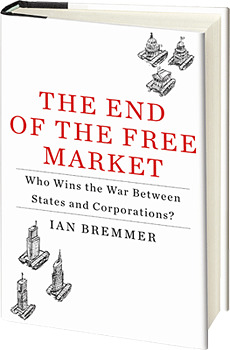
One more go-around with Bremmer on "The End of the Free Market"


Ian comes back (on "The Call") with one more go in the conversation:

Today, a few final words from me on Tom Barnett’s thoughtful response to my book. Tom has argued that the state capitalist phenomenon is not as “unprecedented” as I think it is. He notes that “It’s not like OPEC’s national oil companies or China’s state-owned/-dominated enterprises came out of nowhere—they’ve been there all along.” He’s right about that, of course. OPEC was generating international headlines in the early 1970s. Sovereign wealth funds began appearing in the 1950s. China has had state-owned companies for decades.

In my opinion, the difference is not in the institutions but in their importance for international politics and the global economy. Until the end of the Cold War two decades ago, the isolation of the communist world imposed sharp limits on the global economy’s production capacity, but economic trends within it had little negative impact west of the iron curtain. Today, we’re wired together as never before.

The global economy will depend heavily on China for future growth for years to come. China’s growth has been dependent on exports to its largest trading partners: the European Union, the United States, and Japan. Though China has rebounded strongly from the global slowdown, thanks mainly to a massive state-directed spending spree, the Western financial crisis threw millions of Chinese out of work for some time. Greece’s vulnerability has threatened the cohesion of the entire eurozone.

And we now live in a world in which state-owned companies (which answer to political officials rather than shareholders) own more than three-quarters of the world’s crude oil reserves. With strong economic growth among emerging markets, global demand for oil is on a sharp upward trajectory. That means that state capitalist oil and gas exporters have much more direct impact on our standards of living than at any time in the past. And multinational companies are competing with Chinese state-owned giants armed with political and material support from Beijing in parts of the world where Chinese companies have only recently begun to compete.

State capitalism isn’t new, but it has never been so directly important for how the rest of us live. Throw in historic levels of market turbulence and long-term debt issues in America, Europe and Japan, and I think that we now find ourselves in an extraordinary transitional moment in the history of the global economy.

Reply:  Here's where Ian's argument serves its most useful purpose.  The real threat from state capitalism isthat political self-preservation stands in the way of the technological and market innovation required to meet the resource requirements of this emerging global middle class.  A Chinese economy that underperforms in its shift from extensive to intensive growth is bad news for everybody on the planet, but especially for the average Chinese.  In the end, that's what'll drive the political system to open up:  the fear of underperformance.  So, in the end, it's not about the perceived "superiority" of state capitalism, which neither Ian nor I believe in (or peddle).  Rather, it's about how long the Chinese "Communist" Party can maintain the illusion that the best route forward for the society is an economy that can be more pervasively commanded by the government (prioritizing stability) versus one that's truly liberated and fueled by the innovation of the Chinese people (prioritizing higher growth but accepting more churn).  For now, the balance sits on the side of stability, given all the change churning its way through China right now.  That won't end soon--but soon enough (e.g., the 6th generation of leadership that comes online in 2022 is the one to watch).

I'm betting the greed of the Chinese people for a better life and more wealth will overwhelm the greed of the CCP to maintain a single-party state.  So no idealism on my part:  I simply like the numbers.

Again, Ian's book, on sale today, is called "The End of Free Markets."

12:10AM

Gates stands firm on Navy's self-inflicted budget woes

Dreazen WSJ story.

Gates was fairly explicit in a recent speech about the Navy's continuing penchant for multibillion-dollar platforms being the real cause of its declining numbers, making clear (as Dreazen writes) that "he thought the Navy was buying too many big-ticket items, such as aircraft carriers, while failing to devote enough resources to unmanned submarines and other relatively inexpensive systems."

The Leviathan prefers the few and the expensive, but the SysAdmin demands the many and the cheap.

The numbers stagger:  $3-6B for a destroyer, $7B for a top-line sub, and $11B for a carrier.

Gates:

You don't necessarily need a billion-dollar guided missile destroyer to chase down and deal with a bunch of teenage pirates wielding AK-47s.

Naturally, Gates is accused by industry cheerleaders as "utterly misreading the strategic landscape."

My argument remains the same:  Buy fewer of the biggest platforms but keep the technology advanced and intimidating, accepting that the per-unit cost will suck.  But you will inevitably shift toward the many and cheap and the unmanned if you want to keep playing worldwide.  Violence has migrated downward from the system to states and now primarily to individuals.  So yes, keep a decent hedge against any possible resumption of system-level warfare, but do not pretend that's enough to manage the system.

Nobody forces the Navy to shrink its numbers except the Navy itself.

12:09AM

Got my Chinese-edition copies of "Blueprint for Action"

Twenty copies in the mail, right on the heels of getting 4 copies of the Turkish edition of the same.

In sum, I now have The Pentagon's New Map in Turkish, Chinese and Japanese, and Blueprint for Action in Turkish and Chinese.

Great Powers already sold to the Turks, and I have high hopes a Chinese edition will follow with its usual deliberate speed.

Shots of the Chinese edition of Blueprint:

I showed Vonne Mei a copy last night and she hugged it until she fell asleep with it in her arms.

I will take that as a thumbs-up!

12:08AM

Pass me that hamburger, and my cousin's phone number!


NYT story about how globalization is changing diets in the Persian Gulf and how Qataris' tendency toward tradition (marrying cousins) combine to render the population unusually unhealthy--as in, too heavy, too much diabetes, and too many genetic issues.

Like other oil-rich nations, Qatar has leaped across decades of development in a short time, leaving behind the physically demanding life of the desert for air-conditioned comfort, servants and fast food.

While embracing modern conveniences, however, Qataris have also struggled to protect their cultural identity from the forces of globalization. For many here, that has included continuing the practice of marrying within families, even when it predictably produces genetic disorders, like blindness and various mental disabilities.

“It’s really hard to break traditions,” said Dr. Hatem El-Shanti, a pediatrician and clinical geneticist who runs a genetics testing center in Doha, the capital. “It’s a tradition carried from one generation to the next.”

Qataris live in a nation no larger than the state of Connecticut where they are a minority among the more than a million foreign workers lured here for jobs. But their problems are not unique.

Kuwait, Bahrain, the United Arab Emirates and Saudi Arabia all share similar struggles with obesity, diabetes and genetic disorders, each suffering the side effects of an oil-financed lifestyle and a desire to hold on to traditions.

Yet, even in this neighborhood, Qatar stands out.

You know the old Godfather bit about, "Leave the gun, take the canoli"?

When globalization comes to you town, my advice is, "Forget your cousin, take the spinach salad."

But tradition is a hard habit to break:

For all of these challenges, and for all of its wealth, Qatar has primarily focused on the treatment of diseases rather than on prevention.

Everyone here points to lifestyle and tradition to explain the nation’s health crises. While it was once taboo to talk about the problems involved with marrying relatives, they are now talked about openly. There have been some discussions about premarital genetic screening, or genetic testing done at birth. But the tradition is so strong, no one has raised the prospect of curbing it.

“You can’t tackle the issue,” said Moza al-Malki, a family therapist and writer. “There are some big families, clans, they don’t marry outside the family. They won’t allow it.”

The issue of obesity seems to run into the same wall of tradition, health experts here said.

“If you don’t eat, it’s considered a shame, and if you leave someone’s home without eating it’s a shame,” said Abdulla al-Naimi, 25, who refers to himself as “chubby” but is noticeably overweight. “Half of my family has diabetes,” Mr. Naimi said. “My mother has diabetes. Three cousins younger than me have diabetes. For me, I eat too much and I don’t exercise.”

He is also married to his first cousin.

 Everywhere I have traveled in this world, I find the same attitudes:


  1. Everyone says their culture is based on food; and
  2. Everyone says everybody else's culture is more sex-obsessed than their own.


The inter-marrying thing is tough.  It pretty much has to change from within--as in, grandmas getting too unhappy about their damaged progeny.

On the food front, though, I'd love to America led a positive redefinition.  We need it desperately for ourselves, and we should make money spreading to the world.

12:07AM

First offshore wind farm approved by Fed

Found here

WAPO story:

Ending a nearly decade-long political battle over installing wind turbines in the waters just off Cape Cod, the federal government approved the first offshore wind farm in the United States on Wednesday, a move that could pave the way for significant offshore wind development elsewhere in the nation.

In approving the Cape Wind project, a group of 130 modern windmills in Nantucket Sound that would start generating electricity by the end of 2012, Interior Secretary Ken Salazar said he would "strike the right balance" between energy development and protecting the area. Some opponents of the project said it would endanger the habitat for seabirds; others decried the visual impact of the turbines, as close as five miles from shore.

Cape Wind President Jim Gordon said the "tragedy" of the oil spill in the Gulf of Mexico underscores the problems with traditional energy development.

"It gives the nation pause to reflect on, really, what are our energy choices, and how are we going to live with them?" Gordon told reporters. "Every energy project has some impact. This was never about a choice between Cape Wind or nothing."

Shows you how anybody can cite the Gulf oil spill in their favor.

Of course, the either-or nature of most debates makes little sense.  My argument:  go alternative wherever you can, as every bit helps.

Personally, I love driving by all the windfarms in NW Indiana on my way to Chicago.  I think they're quite beautiful.  They also make me feel like I've actually arrived in a future I imagined as a kid.  And having lived right along the coast in question for many years, I wouldn't have any problem seeing them go in there either.  In fact, I think it would cool as hell to take a boat out there and check them out up close.

NIMBYs will always fight such things, but if you want to lead on such technology, you actually have to employ it.  Unless we want to cede the entire offshore windfarm industry and its technology, we've got to play in this way.

12:06AM

ElBaradei is all but running to replace Mubarak--with something else

Pic found here

A National story by way of WPR's media roundup.

ElBaradei's impact as a spokesman for democracy in Egypt seems to be galvanizing segments of the population, some even toward regular protests (a recent Tweet of mine).

Whether he has the ambition or not, and I think he does, one can imagine that he will be forced by his own success--eventually--to press for the presidency himself (technically, he does not currently meet the requirements for office, but . . .), probably against the son once the old man dies (his 82nd birthday was just spent in suspicious seclusion).

A serious democracy in Egypt, coming on the heels of one developing in Iraq?  That would be a major positive turning point.

So this is one to track--and for the US to support quietly.

12:05AM

The Russia-Ukraine Sevastopol deal, without hyperbole

Nice piece by Richard Weitz at WPR.  Totally lacking in the usual hyperbole.

Some highlights:

Despite the controversy the agreement has provoked in Ukraine, where commentators have debated its constitutionality and economic costs, Western governments have not paid much public attention to the deal. This silence partly reflects a desire not to antagonize the new Ukrainian government or contest Ukrainians' right to determine their foreign policies without outside interference. But it also is due to the perception that the lease extension will not appreciably change the balance of power in the Black Sea region.

During the August 2008 Georgia War, vessels from Russia's Black Sea fleet, based at Sevastopol, deployed along the coast of Georgia's breakaway province of Abkhazia in a belated effort to support Russian military operations. They did not materially affect the course of the war. When NATO ships entered the Black Sea following the conflict to provide humanitarian assistance to the Georgian government, Russian officials accused NATO of covertly re-arming Georgia. Adm. Eduard Baltin, former commander of the Russian Black Sea Fleet, boasted that the Russian Navy could destroy the NATO naval contingent within 20 minutes. But despite the bellicose rhetoric, no such attack occurred, and the Western ships soon departed.

Russia's dominance of the Black Sea is due less to its maritime might than to the Montreux Convention, which severely constrains the presence of extra-regional navies in the Black Sea. Turkey has been very careful to apply these limitations to NATO warships so as not to antagonize Moscow or risk losing the unique privileges that the convention grants Turkey as owner of the Bosporus Straits . . . 

Most importantly, Moscow demonstrated in 2008 that, even with minimal naval and air support, Russian ground forces can overwhelm Georgia's defenses . . .  

At an April 22 news conference in Estonia, NATO Secretary-General Anders Fogh Rasmussen said that Ukraine's decision to extend the lease would not harm its prospect of eventually joining the alliance . . .

On the one hand, Yanukovich had already made clear well before the base deal that he has no intention of joining NATO . . . 

On the other, while the gas subsidies will take effect now, a future Ukrainian government could annul the lease extension before 2017, when the current lease expires. Even after that date, a new government might try to revoke the extension by deeming it unconstitutional or citing other reasons . . 

Furthermore, the Sevastopol energy-for-base arrangement is unlikely to serve as a precedent for similar deals elsewhere. Notwithstanding invitations from Venezuela and other friendly governments to establish bases on their territory, Prime Minister Vladimir Putin described the Ukrainian package as a unique offer designed to restore good relations between two neighboring countries. "We have no need to build military bases around the world," Putin said. "I would ask our [energy] partners not to approach us with similar requests. The Crimea is a special case."

Well put, Richard.

12:04AM

Another shining example of the threat of state capitalism--to its subjects

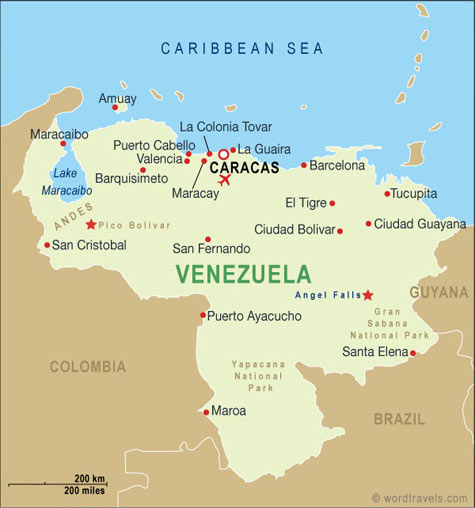
A WAPO story noting the extent of hard times that Chavezism has brought to Venezuela:

Every day for the past three months, government-programmed blackouts have meant the lights flicker and go dark in a city that once bustled with commerce. And Fifth Street, with its auto parts stores and car repair shops, has ground to a halt.

"We just stop," said Jesus Yanis, who paints cars. "We don't work."

Neither does the rest of Venezuela, where a punishing, months-old energy crisis and years of state interventions in the economy are taking a brutal toll on private business. The result is that the economy is flickering and going dark, too, challenging Venezuela's mercurial leader, Hugo Chávez, and his socialist experiment like never before.

No matter that Venezuela is one of the world's great oil powers -- among the top five providers of crude to the United States. Economists say Venezuela is gripped by an economic crisis that has no easy or fast solution, even if sluggish oil production were ramped up and profligate state spending were cut.

Chavez's continues to brag up his "21st-century socialism," but it is simply not delivering the goods, even with the high oil prices of the last few years.

But this is the typical performance of NOCs, or national oil companies:  "The oil industry is pumping 20 percent less crude than in the 1990s and is saddled with debt."

It produces less because it refuses the investment that must accompany the foreign technology, and it's saddled with debt because, in true rentier fashion, the government treats it like a piggy bank--and this little piggy (Chavez) has been greedy.

The more Venezuela is characterized by electricity blackouts, the more it comes to resemble its great model--Cuba. 

12:03AM

North Korea as a Chinese colony? Only so long as the minerals hold out.

Found here

NYT story noting that, in their respective hours of fear (North Korea over looming famine, South Korea of recent naval ship sinking by North Korea), both sides sent their top leader to China recently for reassurance.

On Friday [30 April], President Lee Myung-bak will travel to China under growing pressure at home to make the case for crucial Chinese support for tough international sanctions against North Korea if, as is widely expected, the North is found responsible for the sinking of a South Korean ship. But he is unlikely to win that support, experts say, a reflection of China’s growing role in the Korean Peninsula.

Since taking office in 2008, Mr. Lee has wound down his predecessors’ “sunshine policy” of aid and engagement with the North, heightening Chinese fears of instability and driving the North into China’s economic embrace. Ultimately, that could give Beijing greater leverage in determining the fate of the northern half of the Korean Peninsula, a situation that many South Koreans would consider to be a nightmare.

“China’s influence has become so important that we can almost say that it can now claim the first and last piece of the apple on the Korean Peninsula,” said Lee Byong-chul, a senior fellow at the Institute for Peace and Cooperation in Seoul, using a Korean saying to suggest that China can have whatever it wants.

Even conservatives, who have usually opposed aid to the North, warn of North Korea’s becoming a “Chinese colony” whenever reports circulate of Chinese companies taking over North Korean ports and mines at bargain prices.

All the experts quoted call the "colony" fear overblown, but they're talking about it in a political sense.

In an economic sense, NorKo already is China's colony.  China controls 70% of its trade and is locking in the nation's natural resources in a manner that can only be described a colonial in scope and control.

I do agree with the experts on one thing:  China will do nothing to destabilize the situation--nothing so long as they get their minerals ($6T worth) in return for their meager aid ($3B a year).

12:02AM

What! No naval war over Arctic resources?

Image found here

Moscow Times story:

Russia and Norway have reached an agreement on a long-running border dispute, Norwegian Prime Minister Jens Stoltenberg said Tuesday, in a deal that will provide a framework for how the two countries divvy up the vast energy reserves on the Arctic shelf.

"The decision [we have reached] provides that the disputed territory in the Barents Sea and the Arctic Ocean are divided into two equivalent parts," he said Tuesday at a joint news conference with President Dmitry Medvedev. "The way in which the border line will be drawn satisfies both states."

The agreement will regulate both fishing and drilling on 173,000 square kilometers of the Arctic shelf, which will be divided into two approximately equal parts. Details of the agreement were not disclosed as documents are still being prepared for the final deal.

The scuffles over the countries' Arctic border area have been a sore point in relations for some time. The Norwegian coast guard has detained a number of Russian fishing vessels over the years for various violations. In 2006, Russia temporarily banned the imports of fish from four Norwegian enterprises in what was largely seen as a political move.

Rights to develop the Arctic's vast energy resources have been another sticking point, but in a sign that the two sides may be warming to a more cooperative approach, Medvedev on Monday invited Norway's Statoil to explore the giant Prirazlomnoye oil field in the Barents Sea.

Don't you just hate it when things work out like that?

[thanks to WPR's media roundup]

12:01AM

Chart of the day: China's per $ GDP of electricity usage

Now, we know from history that advanced economies are able to generate one percent of growth in GDP while increasing their energy usage less than one percent (an energy elasticity below 1.0).  Undeveloped economies tend to do it the other way around (taking more than an additional one percent of energy consumption to generate that one percent growth in GDP).  Rising economies are somewhere in between.

This chart measures something similar:  how many kilowatt hours are expended in the generation of a dollar of GDP.

No surprise:  Old Core economies (UK, Japan, US) use the least and New Core ones (Indonesia, Brazil, India) use substantially more.  Presumably, if the chart showed underdeveloped Gap economies, they'd all be clustered at the top, and yet, you'd have to wonder if some of them wouldn't beat China's jump-out-at-you number that's more than double India's (which is almost double America's number).

The giveaway?  Notice how low the taxes are on electricity in China and India, meaning the governments keep it cheap and--thus--consumers treat it as an inexpensive resource.

Two takeaways for me:  1) China is paying too high a price (as is the world WRT CO2 emissions) for its growth; and 2) America could do a lot better too, possibly through higher taxation or other incentives.

4:06PM

When people offer to help on the adoption

Simplest and best route is to offer to buy supplies for the orphanages involved.

My spouse Vonne suggests the following:

The ideal donations are new, long-lasting clothes like Hanna Anderson, sizes 80-140 cm. Lands' End also has long-lasting kids clothes (to be bought in the same size range).   No winter clothes, just the summer variety.

An important donation to improve the medical diagnostic process would be stethoscopes and/or otoscopes like the Littman Master Classic II Stethoscope and the Pro-Fiberoptic LED Otoscope (Amazon links).  

If you want to help us out, the process would be to buy them directly yourself and ship them to us (c/o Barnett Consulting LLC, PO Box 970, Franklin IN 46131). We'd then carry them over in our luggage on either the early-mid June or early-mid July trips, dispensing them to the orphanages via our highly-reputable agency.

I'll put this post on the FAQ page as well.

Thanks to anyone who chooses to pitch in.

2:48PM

Feel like look-and-feel finally set

The tale goes as follows:

I start with the "empire" template (don't even comment on that . . .) and first thing I do is create the banner in PPT, using the map, the two globes figure and my fave portrait of me.  Going back to layout design, I decide for wide main column sided by two nav bars where I'll put all widgets (search, archives, Twitter, etc), and top nav bar under the header.  I saved original banner as tiff file (mistake) and eventually shifted to PNG with help of Bradd Hayes.  Over time I cut the pixel width down to 800, which is max size suggested by Squarespace for any web image.  Original one was 1248, and I think the size was mucking up some presentations for people (hoping that's fixed).  I made everything originally to fit my big iMac screen, but now have it shrunk down to point where it comes up on my 13" MacBook with about 1 inch grey margins on each side.  Looks good also on my smart phone (BB Storm).

When I get banner down to 800px today, it was aligned left on page and looked off-center.  After a support ticket query, I was able to center by maxing the internal pad on the left, and then maxing the border and making both the same color, which I approximated to match the bulk of the landforms in the map on the right.  The border approximated the blue ocean on the globes.

Once I got the basic look and feel of the front page set, I imported the old blog.  By doing so, I automatically created a "journal" (blog) inside the site.  When I started making up new posts within the site, I unthinkingly created a second journal.  I have since merged them so the archives would be whole--and singular.  I did this by reclassifying the 50 or so posts as belonging to the larger, archived blog journal, and then I renamed that "globlogization" (it was originally called "imported-20100505########/"--a truly charming URL).  I have since created two additional "hidden" journals (not appearing on the top navigation bar):  one for my Blueprint for Action htm-pages-turned-now-into-simple-posts and one for my Naval War College project pages-now-being-turned-into-posts.  I will likely create one for media, the New Map book, and ultimately for Vonne's poetry (which I made into a series of hidden pages).  Ultimately, I want as few pages as possible and to put as much as possible in hidden journals.  Size doesn't matter much here (except in pricing) because it's all cloud computing (for example, all of my old images are now stored in this manner).

Style-wise, I did make almost everything too big at first (some complaints), which--again--was superb on my big-screen iMac at home but bad on my small laptop.  Scrunching things down a bunch, I've now decided on 16pt text for the body, 14pt for all links (a compromise, because I'm simultaneously sizing the ones in the navigation bars and the posts' body), 28pt for post titles and most everything else (small stuff on margins) 12 pt.  Only two fonts used:  Times New Roman for titles and section headers and Lucida for everything else.  Putting the banner aside, only five colors are used (besides the background white):  


  1. True black for top nav bar background, Twitter background, day banner background and basic post text
  2. A dark, navy-ish blue for post titles
  3. A slightly purplish blue for all links, date-stamp on posts and sundry post details at bottom, plus all borders and underlines and dark backgrounds
  4. A dark grey (matching for side background panels) for all highlighted (and backgrounded) text.
  5. An off-white for all text that's highlighted by dark backgrounds and for all light backgrounds.


So, basically black, white, grey and blue--sticking with the empire template but altering the colors slightly and then making them uniform throughout (amazing how many little formats you have to alter for true consistency throughout).   So if you forget the extra color in the banner and stipulate that you'll have black and white as basics, the site is really blue and grey, my two favorites colors.

Actually, come to think of it, my entire dress wardrobe (setting aside ties) basically equates to the site's color scheme, right down to the rare use of the tannish brown.

Once I figured out how to do backgrounds for the quoted text, I ditched the terrible idea of italicizing them instead.  I really prefer a light color background, especially when you excerpt at length.

So, that's my story and I'm sticking to it--unless my Aunt Mary still has problems reading the blog on her WebTV, but I'm hoping that's fixed now that I got the banner down to max suggested width.