Buy Tom's Books
  • Great Powers: America and the World After Bush
    Great Powers: America and the World After Bush
    by Thomas P.M. Barnett
  • Blueprint for Action: A Future Worth Creating
    Blueprint for Action: A Future Worth Creating
    by Thomas P.M. Barnett
  • The Pentagon's New Map: War and Peace in the Twenty-first Century
    The Pentagon's New Map: War and Peace in the Twenty-first Century
    by Thomas P.M. Barnett
  • Romanian and East German Policies in the Third World: Comparing the Strategies of Ceausescu and Honecker
    Romanian and East German Policies in the Third World: Comparing the Strategies of Ceausescu and Honecker
    by Thomas P.M. Barnett
  • The Emily Updates (Vol. 1): One Year in the Life of the Girl Who Lived (The Emily Updates (Vols. 1-5))
    The Emily Updates (Vol. 1): One Year in the Life of the Girl Who Lived (The Emily Updates (Vols. 1-5))
    by Vonne M. Meussling-Barnett, Thomas P.M. Barnett
  • The Emily Updates (Vol. 2): One Year in the Life of the Girl Who Lived (The Emily Updates (Vols. 1-5))
    The Emily Updates (Vol. 2): One Year in the Life of the Girl Who Lived (The Emily Updates (Vols. 1-5))
    by Thomas P.M. Barnett, Vonne M. Meussling-Barnett
  • The Emily Updates (Vol. 3): One Year in the Life of the Girl Who Lived (The Emily Updates (Vols. 1-5))
    The Emily Updates (Vol. 3): One Year in the Life of the Girl Who Lived (The Emily Updates (Vols. 1-5))
    by Thomas P.M. Barnett, Vonne M. Meussling-Barnett
  • The Emily Updates (Vol. 4): One Year in the Life of the Girl Who Lived (The Emily Updates (Vols. 1-5))
    The Emily Updates (Vol. 4): One Year in the Life of the Girl Who Lived (The Emily Updates (Vols. 1-5))
    by Thomas P.M. Barnett, Vonne M. Meussling-Barnett
  • The Emily Updates (Vol. 5): One Year in the Life of the Girl Who Lived (The Emily Updates (Vols. 1-5))
    The Emily Updates (Vol. 5): One Year in the Life of the Girl Who Lived (The Emily Updates (Vols. 1-5))
    by Vonne M. Meussling-Barnett, Thomas P.M. Barnett, Emily V. Barnett
Search the Site
Powered by Squarespace
Monthly Archives
10:55PM

A nice description/contextualizing of cloud computing

DECADE OF DISRUPTION: "Birth of a 'cloud' that will never forget," by Richard Waters, Financial Times, 31 December 2009.

The last decade saw the rise of social networking and gadgets galore (a six-fold increase in cellphones from 500M to 3B), but this decade will be even more exciting and transformative thanks to cloud computing, a blanket term that describes the behind-the-scenes computing infrastructure created by the cumulative networking of all these intelligent devices, added by the fact that "it is now easier and cheaper to preserve digital data forever rather than waste time deciding what to delete."

How un-Y2K-ish.

About a decade ago, I imagined--in print--such a future, dubbing it the Evernet (not my coined term).

10:53PM

Kazakhstan staking a claim on uranium supply role

FRONT PAGE: "Kazakhstan claims it has become world's biggest uranium miner: Announcement follows Iran deal allegations," by Isabel Gorst, Financial Times, 31 December 2009.

Kazakhstan now produces about one-third of the world's total, thanks to a crash effort to boost the flow.

Meanwhile, Kazakhstan gets close to inking a deal with Iran on a deal to sell 1,000-plus tons of uranium.

Guess Venezuela can be only so important in Iran's calculations.

Plenty of recent events in Kazakhstan to make us nervous with these twin developments (the former head of the atomic agency is on trial for allegedly stealing state secrets re: uranium).

The big cheese in uranium remains Australia, but it refuses to sell to countries not in the NPT regime (nuclear non-proliferation).

As always, real-world news undercuts the idealistic dream of stopping Iran's reach for the bomb.

With the Green Movement showing such strength, such non-proliferation efforts seem extraneous. A democratic Iran with nuclear capability wouldn't scare us and such a regime might not need to weaponize to feel safe (a la Japan's near-breakout status).

Ah, but nukes are the sum of all fears, so all strategy must be bent to this all-consuming obsession.

I mean, look at all the nuclear death totals since 1945.

10:52PM

Patrimony alive and well in corporations both East and West

COMPANIES|INTERNATIONAL: "Father and son keep the show on the road: One of Comcast's great strengths lies in its never having had to wrestle with succession issues," by Kenneth Li, Financial Times, 31 December 2009.

Kinda weird: when other countries (mostly in the Gap) come up with the traditional idiot/promising (if educated in West) son as the answer to the dying dictator, then we are appalled.

Even as we recently got in the habit of going for a son and wife (nearly) of former presidents.

And yet, nothing makes investors feel more safe than to hear that the CEO of the monster corp is being succeeded by his son.

Gives you a sense of how hard it is to find the right replacement.

10:51PM

Why should China pass for sea lane protection?

DECADE OF DISRUPTION: "China's naval force: Pacific contest grows over rule of waves," by Geoff Dyer, Financial Times, 30 December 2009.

The quote that I used in a recent WPR column (4 Jan):

How this debate [big navy or no] will play out in Beijing remains unclear. There are voices saying that Chinese economic development will be hampered if the country does not invest heavily in naval power.

Others believe, however, that given the huge social challenges facing the country, which has vast numbers of people not far out of poverty, building a large carrier fleet in an unnecessary burden.

"The focus of our foreign policy will be in assisting development, not in signing up to expensive new commitments," says Shi Yinhong, an international relations professor at People's University in Beijing.

Or as another Chinese academic, who asked not be named, says of protecting seaborne trade: "Why should we spend billions of dollars paying for something that is already being paid for?" Largely paid for, he did not need to mention, by the US.

I don't see it as either-or. China will build some naval power quite naturally, but that expense will come under increasing domestic pressure.

10:49PM

Putin, redirecting to hot money, is really complaining about China's currency policy

FRONT PAGE: "Putin warns Russia intends to curb capital inflows that threaten recovery," by Charles Clover, Financial Times, 30 December 2009.

Putin is pissed about the rising value of the ruble and the recent inflow of hot money driving it up.

Still, the great man promises nothing drastic. He's just registering his concern for immediate market impact and signaling he will act.

Brazil has had to do much the same recently on hot money.

All of this is being fueled--to some significant degree--by China's currency manipulation.

10:47PM

Prepare to learn about US-China

ARTICLE: U.S. Deal With Taiwan Has China Retaliating, By KEITH BRADSHER, New York Times, January 30, 2010

A predictable response (e.g., canceling some mil-mil and call our ambassador on the carpet), with the new twist of direct sanctions against U.S. defense firms making the sales (wonder where they got that idea from?).

We knew we'd get this outcome and yet we insisted on going through with the sale.

So we'll have to make do with the retaliation, which is likely--if China gets mad enough--to teach us more about our interdependent relationship than the Chinese.

(Thanks: Joe Canepa)

10:46PM

Afghan security outlook

ARTICLE: Afghanistan to take over own security after five years, By Hamida Ghafour, The National, January 28. 2010

As signs of progress go, not a bad one. I don't get the feeling that anybody at this point fears the timeline notion WRT Afghanization of the security element.

(Via WPR's Media Roundup)

10:38PM

Privatize space

ARTICLE: Obama Plan Privatizes Astronaut Launchings, By KENNETH CHANG, New York Times, January 28, 2010

Interesting: Obama stops NASA's return to the moon and wants to turn to private companies to launch future astronauts into space.

Remembering my column way back when on the subject for Esquire.com, I basically approve of the shift.

3:05AM

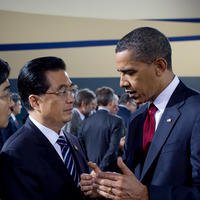
Why China Will Not Bury America

obama_hu1.png

If the 2008 Olympics were China's big coming-out party, and 2009 the year that Beijing merely managed to save global capitalism with its rapid -- and accurate -- stimulus package, then one might assume 2010 holds even better things in store for the People's Republic. After all, just about everybody now recognizes the "superiority" of China's authoritarian capitalism over the West's free market variety.

Continue reading this week's New Rules column at WPR.

11:54PM

We're not slaves to China

ARTICLE: China Leading Global Race to Make Clean Energy, By KEITH BRADSHER, New York Times, January 30, 2010

Bradsher is normally very astute, but this is a downright asinine piece.

The PG ranks fifth as an oil source behind Africa, South America, North America and the US itself. So that "dependency" is a myth.

Worse, pretending China's price advantage in cleaner techs would somehow make us dependent on Beijing's good graces is just goofy. We get pissed at China and guess what? We simply buy elsewhere or build at higher cost, but it'd hardly be the case where China could deny us anything.

This is classic misrepresentation of supply-equaling-power, when, in globalization, demand determines real power.

An oddly subpar piece from a great reporter whom I cannot remember chastising before.

Shows you how bad the MSM bandwagoning is right now on "demon" China, and it is truly pathetic.

Serious analysts DO NOT get caught up in politicized cap like that.

11:50PM

We made our Chinese bed

EDITORIAL: The key to dealing with Iran: Press ties with opposition, Washington Post, January 30, 2010

Imagine how much help we get from the Chinese after the Taiwan arms sale.

You pick your fights, and then you better not bellyache.

11:44PM

Encouraging Afghan news

ARTICLE: Afghan president plans meeting on reintegrating, reconciling with insurgents, By Karen DeYoung, Washington Post, January 29, 2010

The one thing we don't want to see is lack of urgency and drift. The sum of recent reports is greatly encouraging in this regard, especially the aggressive courting of tribal and Taliban leaders who want to come in from the cold.

10:57PM

Dealing with democracy within The Party

LEADERS: "Democracy in China: Control freaks; A growing dilemma for Hu Jintao: how should he deal with democracy inside the Communist Party?" The Economist, 19 December 2009.

ASIA: "Democracy, China and the Communist Party: Big Surprise; Attempts to democratize the Communist Party have failed. Again," The Economist, 19 December 2009.

INTERNATIONAL: China: Official Suggests Tighter Grip, Reuters, December 28, 2009

Experts in the West already speak of "one party, two factions" when referring to the CCP, the basic breakdown conforming to the economic landscape (interior versus coastal).

Just like America, China's "red states" tend to be distant from the shoreline, as Core-v-Gap is always about connectivity and oceans are the original global commercial network (and still the biggest by freight).

Inside the Party, worry abounds. Leaders know that they're losing the young, who only join to check career boxes (thus the decision, years ago, to allow entrepreneurs into the COMMUNIST PARTY--spin, Mao, spin!), and they know that the vast bulk of what the Party does is completely irrelevant to how China the economy and society actually run themselves. When the Party allows cells to form inside private businesses, the ideological battle has been completely lost and the CCP becomes nothing more than a bureaucratic function.

So yeah, a political dictatorship with a guardian military, but not a social or economic one. (And if Iran's Revolutionary Guards had any sense, they'd dial back down to this level and be happy with that level of limited control.)

The big problem? Despite all this change in society and the economy, the Party still operates internally like Mao was still around. Everyone knows this is a huge weakness WRT continued rule. It's just too slow, too deaf and too dumb (you can't run such complexity with BOGSAT-style--as in, a bunch of guys sitting around a table). Cause if it were that simple, then Washington really would rule both America and the world.

Despite the recent retrenchment news coming out of Vietnam, apparently the party's internal efforts at increasing competition have attracted the CCP's look-see. Hu himself has spoke of the need for "inner-party democracy," which is a Ralph Nader nightmare edition whereupon a single party may house factions but feels the need to circumscribe all of their behavior (and yes, I know many critics of our two party system believe it's all a fix over here too). The press have heaped praise on the ideas, but, as The Economist states, we've seen no real efforts from the 4th Gen bunch.

No surprise to me. As I've long stated, these are the homebodies who never traveled abroad for their tertiary education (Cult Rev period). So, nice to see the dawning realization, but this progress awaits the 5th Gen bunch coming online in 2012.

Do I expect that to go smoothly? Yes, because the Party knows its history (two post-Mao transitions result in the Gang of Four and Tiananmen, so Hu's succession will be only the second time it goes smoothly--after his own). So the caution is understandable, even as we logically hope for so much more from the next crew.

Nice point that dovetails with my single-party argument from Great Powers:

Optimists in China have suggested that internal democracy could help the party evolve into something like Japan's Liberal Democratic Party, which ruled for 54 years with only a brief interruption until its defeat this year.

So, most realistically, we must expect the 4th Generation to handpick the 5th and hope the 5th accedes to what I know will be demands from the 6th (targeting 2022) for something more open in terms of internal competition.

Remember the old rule about democracies being stable only after two successful transitions. China gets #2 under its belt in 2012 and then we can and should expect better the next iteration.

The main story makes a dumb point, though, saying that local village experiments in democracy have proceeded nicely but not made the peasants any happier. Well, duh! Democracy below doesn't work in combination with autocracy at the top.

So, rather than look for this thing from below, I'm more in line with the thinking that says this begins as a factional split where both sides agree to compete within the Party. It'll be a long time before anything like direct elections of top officials are trusted with the populace at large, but the underlying economics are driving the factionalism and I put my faith in that--Marxian that I am (though no Leninist: as I believe in the Devil, I just don't care to follow him).

10:52PM

Time for China to grow up

ANALYSIS: China's strident tone raises concerns among Western governments, analysts, By John Pomfret, Washington Post, January 31, 2010

Nice piece from Pomfret that dovetails with my WPR column this week.

10:49PM

Trial shift

ARTICLE: Trial of alleged Sept. 11 conspirators probably won't be held in Lower Manhattan, By Peter Finn, Carrie Johnson and Anne E. Kornblut, Washington Post, January 30, 2010

I think this is smart. I had no trouble with the civilian court venue, but nobody wants anything that complex and tricky right in Manhattan. A venue change to something more remote and controllable--and cheaper--makes a lot of sense.

10:29PM

A very contemplative Wolf on the post-crisis road ahead

COMMENT: "The challenges of managing our post-crisis world," by Martin Wolf, Financial Times, 30 December 2009.

Starts out by talking about his Jewish past and how families on both sides lost damn near everybody in the Holocaust. As such, he defends his strong focus on averting a rerun of the Great Depression last year, saying the world basically succeeded in this effort.

But what are the big tasks ahead?

1) dealing with the balance-sheet recession still ongoing in Old Core West

2) dealing with reality that we substituted public-sector borrowing for the private-sector version in the recovery

3) tackling the still highly imbalanced global trade flows whereupon China, Japan and Germany mostly export and the rest of the Core mostly imports.

4) pushing surplus countries toward needed policy changes, like China's pegged currency, and

5) still working the financial system that contains plenty of toxic assets.

Thus the need to avoid complacency at this juncture.

Naturally, I always listen closely when Wolf speaks.

10:27PM

The part of autocracy that drives Chinese crazy

ARTICLE: Chinese Businesses Resist Eviction by Developers, By ANDREW JACOBS, New York Times, December 30, 2009

You want a sense of what drives most Chinese crazy, as opposed to the lack of democracy inside the Party? It's this kind of stuff, stuffed with all the corruption the system can sustain.

The old Tip O'Neil notion that all politics is really local.

10:25PM

Question of whether or not China will abide by WTO ruling on media

WORLD NEWS: "China Plea Dismissed By WTO," by John W. Miller, Wall Street Journal, 22 December 2009.

WORLD NEWS: "Beijing Preserves Limits on Movies: WTO Ruling Seem Unlikely to Halt China's Strictures on Sales of Imported Media," by Ian Johnson and Loretta Chao, Wall Street Journal, 23 December 2009.

Beijing wants to be able to continue restricting the distro of Hollywood movies and other Western media inside China. The WTO struck that notion down.

China is a huge market, but only allows 20 or so foreign films a year and disallows any music sales over the Internet.

China has a year to comply with the ruling, but is already indicating it might blow it off. And that'll mean retaliation--and justifiably so--from the West.

BTW, friends in China tell me that the Chinese edition of Blueprint for Action hit bookstores last October!

Nice, but the Chinese have to let in other, lesser media too!

10:16PM

Correcting imbalance doesn't mean seeking a perfect balance?  Duh!

OPINION: "The 'Global Imbalances' Myth," by Zachary Karabell, Wall Street Journal, 21 December 2009.

EDITORIAL: "How to rebalance the world economy: the job ahead is to make the global recovery sustainable," Financial Times, 23 December 2009.

Bad logic from Karabell, who, unlike Ferguson, seems unwilling to part with his "Chimerica"-like notion of "superfusion" between the U.S. and Chinese economies. Thus he feels the need to attack the idea of balancing by saying that a perfect balance is unachievable and therefore effort in that direction is pointless--truly doofus logic.

If I have high cholesterol but cannot achieve a perfect average number for my age and size, does that mean I still don't try to lower it?

The tortured logic here extends to trying to prove that the recent financial contagion was completely unrelated to the imbalance--also goofy. The underlying cheapness of money caused the bad behavior, pure and simple. Saying we should have known better is cute, but irrelevant. The incentives were simply perverse and they'll remain as such so long as the imbalance is that profound.

The crux of the crude logic here:

Today's consensus sounds very much like the orthodoxy of yesteryear--let each nation be its own system in equilibrium, interacting with other systems to create one mega-balanced system. Yet such balance has only existed in theory and only ever will.

That is about as pure as straw man as you can construct--truly beautiful and completely irrelevant to the discussion.

Apparently, Karabell is deeply worried the CCP will shift its economy too fast--another spurious, straw-man fear with no basis in observed reality.

Guy really wants to sell his book, which I understand, but this comes close to intellectual prostitution.

I will stick with the FT's logic that "China is too important to continue with its present policy of pegging the renminbi to a weakening dollar."

Is it unfair to ask China to change, asks the FT? Maybe. "But it is the price of having become a huge economic power."

Talk to Spiderman's uncle, Mr. Karabell.*

* 'With great power comes great responsibility.'

12:25PM

Tom around the web

+ zenpundit linked The Zen of COIN.

+ The American Scene linked the TED talk.

+ Munro Ferguson linked The Fallacy of an Increasingly Dangerous World.
+ Drama Forum referred to the Leviathan.
+ Doom Soon disagreed at length with Wal-Mart and Globalization's Next Wave.
+ Booker Rising linked Shocking capitalism! It actually helps after disasters!
+ Ragbag recommended the weblog (and said Tom probably smokes a pipe).