Buy Tom's Books
  • Great Powers: America and the World After Bush
    Great Powers: America and the World After Bush
    by Thomas P.M. Barnett
  • Blueprint for Action: A Future Worth Creating
    Blueprint for Action: A Future Worth Creating
    by Thomas P.M. Barnett
  • The Pentagon's New Map: War and Peace in the Twenty-first Century
    The Pentagon's New Map: War and Peace in the Twenty-first Century
    by Thomas P.M. Barnett
  • Romanian and East German Policies in the Third World: Comparing the Strategies of Ceausescu and Honecker
    Romanian and East German Policies in the Third World: Comparing the Strategies of Ceausescu and Honecker
    by Thomas P.M. Barnett
  • The Emily Updates (Vol. 1): One Year in the Life of the Girl Who Lived (The Emily Updates (Vols. 1-5))
    The Emily Updates (Vol. 1): One Year in the Life of the Girl Who Lived (The Emily Updates (Vols. 1-5))
    by Vonne M. Meussling-Barnett, Thomas P.M. Barnett
  • The Emily Updates (Vol. 2): One Year in the Life of the Girl Who Lived (The Emily Updates (Vols. 1-5))
    The Emily Updates (Vol. 2): One Year in the Life of the Girl Who Lived (The Emily Updates (Vols. 1-5))
    by Thomas P.M. Barnett, Vonne M. Meussling-Barnett
  • The Emily Updates (Vol. 3): One Year in the Life of the Girl Who Lived (The Emily Updates (Vols. 1-5))
    The Emily Updates (Vol. 3): One Year in the Life of the Girl Who Lived (The Emily Updates (Vols. 1-5))
    by Thomas P.M. Barnett, Vonne M. Meussling-Barnett
  • The Emily Updates (Vol. 4): One Year in the Life of the Girl Who Lived (The Emily Updates (Vols. 1-5))
    The Emily Updates (Vol. 4): One Year in the Life of the Girl Who Lived (The Emily Updates (Vols. 1-5))
    by Thomas P.M. Barnett, Vonne M. Meussling-Barnett
  • The Emily Updates (Vol. 5): One Year in the Life of the Girl Who Lived (The Emily Updates (Vols. 1-5))
    The Emily Updates (Vol. 5): One Year in the Life of the Girl Who Lived (The Emily Updates (Vols. 1-5))
    by Vonne M. Meussling-Barnett, Thomas P.M. Barnett, Emily V. Barnett
Search the Site
Powered by Squarespace
Monthly Archives
12:01AM

The "term sheet" roster of dialogue


Some of the organizations we conducted meetings with, focused specifically around the grand strategy "term sheet," as we called it.

I will post a final draft of the term sheet agreement here in conjunction with a second WPR column that recounts the journey and summarizes the feedback/impressions gathered.

Here's the official rundown:

The Proposed China-US Grand Strategy Agreement was drafted by John Milligan-Whyte and Dai Min of the Center for America-China Partnership and Dr. Thomas P.M. Barnett of Wikistrat.

In the past week, we have been meeting series of distinguished individrals and institutions in China to discuss and improve this proposal. They are include but not limited to (in sequence of meetings):

  • President of Shanghai Institutes of International Studies ไธŠๆตทๅ›ฝ้™…ๅ…ณ็ณป็ ”็ฉถ้™ข้™ข้•ฟ
  • Former PRC Minister of Foreign Affairs ๅ‰ไธญๅ›ฝๅค–ไบค้ƒจ้•ฟ
  • Two Former PRC Ambassadors to US and UN ๅ‰ไธญๅ›ฝ้ฉป่”ๅˆๅ›ฝๅคงไฝฟ
  • Former Deputy Chief of the General Staff of People's Liberation Army (PLA) ๅ‰ไธญๅ›ฝไบบๆฐ‘่งฃๆ”พๅ†›ๅ‰ฏๆ€ปๅ‚่ฐ‹้•ฟ
  • Former PLA attache to North Korea and Israel ๅ‰ไธญๅ›ฝ้ฉปๅŒ—ๆœ้ฒœๅ’Œไปฅ่‰ฒๅˆ—ๅคงไฝฟ้ฆ†ๆญฆๅฎ˜
  • Former PRC Vice Minister of Commerce ๅ‰ไธญๅ›ฝๅ•†ไธš้ƒจๅ‰ฏ้ƒจ้•ฟ๏ผŒไธญๅ›ฝๅ›ฝ้™…็ปๆตŽไบคๆตไธญๅฟƒ็ง˜ไนฆ้•ฟ
  • IISS-PSCC - Institute of International Strategic Studies of Central Party School ไธญๅคฎๅ…šๆ กๅ›ฝ้™…ๆˆ˜็•ฅ็ ”็ฉถๆ‰€
  • CCIEE - China Center for Economic Exchange, ไธญๅ›ฝๅ›ฝ้™…็ปๆตŽไบคๆตไธญๅฟƒ
  • CIISS - China Institute For International Strategic Studies, ไธญๅ›ฝๅ›ฝ้™…ๆˆ˜็•ฅๅญฆไผš
  • CFISS - China Foundation for International & Strategic Studies. ไธญๅ›ฝๅ›ฝ้™…ๆˆ˜็•ฅๅŸบ้‡‘ไผš
  • CPIFA - The Chinese People’s Institute of Foreign Affairs ไธญๅ›ฝๅค–ไบคๅญฆไผš
  • The Boao Forum ๅš้ณŒ่ฎบๅ›
  • BFSU - Beijing Foreign Studies University ๅŒ—ไบฌๅค–ๅ›ฝ่ฏญๅคงๅญฆ
  • CICIR - China Institutes of Contemporary International Relations ไธญๅ›ฝ็Žฐไปฃๅ›ฝ้™…ๅ…ณ็ณป็ ”็ฉถ้™ข.

To say the least, the lengthy dialogues in each instance were fascinating.  I learned a ton, because this time, instead of being in book promotion mode, the whole discussion centered around the proposal, which everybody really was thrilled to discuss. They kept saying that this was such a new and innovative way to to something like this, instead of the usual presentation of respective views that get bundled up in these joint statements (something the Chinese take very seriously but I can't say that we do on our side).

Much as in the case of the Russians today, I think China should be putting its own experts up on American TV rather than having their country interpreted by U.S. experts on China.  I think that if this was the case, Americans would view China very differently.  I just don't think the country's real story gets through.


12:01AM

Eurasia Group's David Gordon on Wikileaks threat to corporations

From HBR blog, with Sean West, also from Eurasia Group:

WikiLeaks opens a whole new world of risk for your business. With infoanarchists scrambling to pry loose your secrets and put them on the web — partly just because they can — the danger is mind-boggling.

Forget about worrying that some executive's flip e-mail message will fall into the wrong hands. Now there's a real risk that the entire corporate brain could be exposed, just as the diplomatic brain of the U.S. government has been opened for all to explore.

Read the entire post at Harvard Business Review blog.

Dave is an old friend.  When he was National Intelligence Officer for Economics and Globalization at the National Intelligence Council, he came to most of my Naval War College events and we bonded as similarly minded thinkers.  Dave later went on to be vice chair of the NIC and then head of policy and planning at State for the last stretch of Bush-Cheney.  He's now the head of macro research for Ian Bremmer's fine political risk consultancy, Eurasia Group.

I recently signed on with Eurasia Group as a consultant, in large part because I thought it would be fun to work with Dave again.  He's a rare talent in this world.

Good post.  Eye-opener.


8:08PM

WPR's The New Rules: Qatar World Cup a Return on Investment


The decision by FIFA, soccer's world governing body, to award the 2022 World Cup to Qatar was momentous on many levels, but historic on one key score: Never before has a global sporting event of such stature been awarded to a country so clearly stuck in a "bad neighborhood" like the Persian Gulf, where the potential for large-scale regional war between now and 2022 is far from theoretical. FIFA's decision was bold alright, but it also signals the international community's growing faith in what Gulf Cooperation Council countries like Qatar have achieved in promoting economic and network connectivity with the outside world. You could say that the 2022 World Cup is globalization's way of returning the favor.

Read the entire column at World Politics Review.

8:52PM

Brutal

I blame myself for the post on the playoff tickets! Like a true fan, I live the fantasy that my actions have impact on my team's chances.

7-3!

The worst part is the second concussion this year for Rodgers. He may be the second coming of Steve Young in more ways than one. Simply a very bad decision on his part, which costs us the game and maybe a whole lot more. Aaron has to learn.

For God's sakes!  Make him wear the new special helmet! Honestly, that should be league rule after the first concussion--no choice.

You could not come up with a worse sort of loss for us right now. Amazing to think league's best defense by points won't make playoffs.

But here's how it happens anyway:

  • Can't care anymore about Philly (which goes 11-5 or even 12-4 and gets second seed).  Will worry about Vick later.
  • Don't like our chances with Giants either, who can also go 11-5 with wins over Tavaris Jackson and Redskins at home and maybe help us out by beating Vick at home.  More likely lose to Philly and go 10-6 and we'd win last spot by virtue of direct win over Giants (if so, then we go to St. Louis or Seattle for wildcard game and I like our odds in both, problem being then we meet Falcons next).
  • But since I really want home playoff game for me and missus to attend, I still want NFC North crown, and we get that by losing to Pats (Rodgers maybe out) and winning at home versus Giants and Bears to go 10-6.  Bears lose at MN (Favre back to do us that one last favro!) and beat Jets at home and then lose to us to likewise go 10-6. Then we're tied head-to-head and both have 4-2 divisional records but we win conference at 8-4 to their 7-5.  That gets us division crown and home playoff game, probably against Giants or maybe Bears (which would be sweeter to watch), but more likely Giants because they won head-to-head.
  • To get second seed, we'd need all that plus, Eagles finishing 10-6, which would probably require losses to Dallas (Philly beating them at halftime right now) and at NYG next week. But I suspect Eagles go 3-1 or better.

So we beat the Giants at home and the Saints crush the Rams at St. Louis, and we're still the superior seed, so we go to Philly next while the Saints shock the Falcons in Atlanta! Thus, our win in Philly leaves us as the top seed and we host the Saints in a blizzard at Lambeau, winning a game for the ages.

Then we go to Dallas and play whomever, but hopefully not the Pats, who look very good right now. I think we could take the Steelers.

My God, it all seems so easy when you lay it out like that. All we really need is Favre to sit out Giants and come back to thwart them Bears in the fixed Hump.

IS THAT TOO MUCH TO ASK OF BRETT?

I think not.

Please correct me if I've miscalculated in any way. This is my football fantasy for the next six days, and I need to maintain the self-delusion.

In truth, I have never thought this to be our year. That comes next year, so the Pack can play in Indy in the Super Bowl--20 minutes from my house! But I do want Rodgers to win a playoff game this year, so he has that hunger under his belt next year. Frankly, with our injuries this year, I am grateful that I can still dream this way in mid-December.

3:16AM

What recreates the "Yugosphere"? Not politics but business

Economist piece that highlights the biggest corporate takeover inside the Balkans in recent memory.  A Slovene food brands company (Droga Kolinska) was bought up by a Croatian group. The prize was a collection of brands long recognized across the entirety of the former Yugoslav republic.

The acquisition prompted Croatian commentators to speak of a revived Yugosphere among the seven successor states. The Croatian group's revenue, post-takeover, will now being only one-third concentrated in Croatia, with half coming from the rest of the old republic.  Point being, none of the states are big enough markets for decent-sized companies, but their combined total of 22m is another story.  

So the Economist sees this as part of a larger trend of former regional companies seeking to reestablish themselves--Yugosphere-wide.  Better than that, firms from the richer states (Croatia, Slovenia) are buying or building factories in the poorer ones, taking advantage of cheaper labor and lower taxes.

The wars have been over for about a decade, and the re-integration proceeds.  You really can't label the Balkans as Gap anymore, and I don't.

12:01AM

I've got two playoff tickets for Lambeau in January

Packers just announced that all requests for playoff tickets from both Green and Gold Package ticket holders have been met.  You see, the Packers used to play two games a year at Milwaukee, and when they stopped that in the early 90s, they allowed the Milwaukee season-tix holders to keep their two games, now known as the Gold Package (2nd and 5th home games + one preseason).  Not sure what they'll do when the season get longer.

Anyway, the trick on playoff tix is both pools can apply, meaning 2X capacity.  This year, probably reflecting the bad economy, not as many applied and so everybody getting their requests filled.

Needless to say, this is exciting, but only if the Bears manage to get out of the way before season's end.  We play them at Lambeau for the last game.  We win and the series is even at 1-1, and so is divisional play at 5-1, but we'd beat them on conference play if we both win our remaining intra-conference game (Bears v. Vikes, Pack v. Giants).  Ideally, the Bears would lose to Pats at home, because it'll be tough for us to break that record home streak in Foxboro the next week.  Then, if the Pack takes the Giants (assuming we don't lose to the Lions tomorrow, which can always happen, and Bears take the Jets away), we both enter the last game with identical divisional and conference records and all we have to do is win at home to take the divisional crown and possibly the second seed, since we'd own direct tie-breakers over Philly and Giants, but only if the Eagles manage to lose one more (@ Dallas and NYG and home v. Vikes and Dallas).  Of course, the Bears can win at home v Pats and still lose to Jets, and Packers can drop two of the next three and make the last game possibly meaningless, but there you have it.

Of course, by even broaching any of these scenarios, the Pack is doomed to lose tomorrow and send me into deep depression! 

The tension is unBEARable.

Countering such pessimism, say we get the second seed, and then I'm watching a divisional game vice a wild card game, plus, if the Falcons lose at home, we'd have two seats for the NFC championship!  Stranger things have happened, like the last time we got it by surprise and hosted the Giants, who thereupon beat us (Favre INT in OT) and won the SB.

Needless to say, I'm cheering my lungs out for Brett from here out on (Giants, Bears, Eagles and I don't care about the Lions, except maybe he goes out on nice note).  Go Favre!

1:37AM

China Daily coverage of interview

Think tank offers plan for US-China relations

By Ma Liyao (chinadaily.com.cn)
Updated: 2010-12-08 14:23

BEIJING - The United States and China are at a point to establish a new collaborative relationship to deal with the possible conflicts emerging between the two big economies, which happen to be the world’s two big militaries, said analysts from a US think tank.

"The basic idea is that we need to clear out some of the strategic mistrust …that has at its roots an imbalanced economic relationship that we seek to radically rebalance in a direct way by encouraging investment from China directly into the US economy," Thomas P.M. Barnett said on Monday in an exclusive interview with China Daily.

Barnett, chief analyst at Wikistrat, an Israeli startup company that offers strategy consulting, is in Beijing to promote the “Whyte-Barnett Solution,” a new China-US grand strategy proposal he proposed together with his partner, John Milligan-Whyte and Dai Min, heads of the Center for America-China Partnership, one of the first think tanks to combine US and Chinese perspectives.

The four-page proposal suggests specifically on the investment floor to encourage large Chinese direct investment into the US market.

"I think the key thing is… to suggest to the American public the win-win opportunity here that … Chinese companies going global doesn’t result in a zero-sum outcome for the West," Barnett explained, adding that “it represents a very positive and potentially a very tremendous large-scale infusion of capital into distressed companies in the US and elsewhere.”

He said that he believed China will be interested in that kind of rebalance, getting the “less useful path” of discussion on the value of RMB off the table.

Talking about the recent military tension in northeast Asia, Barnett said that the key and crucial aspect is to increase transparency between the two militaries as much as possible, especially when there has been a lot of concern about China’s military building.

The US held a meeting in Washington on Monday with Japan and the Republic of Korea to discuss the current security situation in the region, without China, Russia and the Democratic People’s Republic of Korea’s attendance, after rejecting China’s proposal of a meeting among the six.

Barnett said that he didn’t see anything wrong with trying to reassure its long-time allies as long as it quickly progresses into Six-Party Talks, but “you have to include China every step of the way.”

"Because if not, you are not increasing the transparency."

Milligan-Whyte, the co-presenter of the strategy proposal, said that the global financial crisis is actually a good opportunity for China and the US to collaborate on a new strategy.

Between 2000, when China enter the WTO, and 2008, when the financial crisis hit the world, the US dollar appreciated about 40 percent. Between 2005 and 2008, Chinese yuan appreciated about 21 percent. But it did not help the trade deficit, which is around $260 billion to $300 billion a year now, said Milligan-Whyte.

"The trade deficit is caused principally because … the United States doesn’t want to sell high technology to China, which China therefore buys from Europe and … elsewhere," he said.

Milligan-Whyte said that he believed the financial crisis is still in its early stages and anytime in the next two years, the market will just freeze up. And the only thing that can prevent that is “this type of breakthrough in US-China relations.”

"You will see the financial crisis will be very hard for 23% of the American homeowners. It’s going to be 50%. Unemployment will be 25% in some places, and over 10% in others. It’s going to be a really terrible situation. That is going to trigger a new deal between China and the US."

Chinese Premier Wen Jiabao said on Sep 23 in New York while meeting US President Barack Obama that China is willing to push a healthy economic cooperation with the US, in hopes that the US would loosen its export restraints on China.

Chinese President Hu Jintao expressed a similar will months later in November while meeting with Obama in Seoul, urging the US to lift its export restraints and give Chinese companies a fair competition environment in the US market.

The Whyte-Barnett Solution is designed as a presidential strategy agreement.

Hu is scheduled to visit the US next year.

Additional repostings of this article:

12:01AM

Op-ed in China Daily: "China, US as strategic collaborators"

China, US as strategic collaborators

by Thomas P.M. Barnett


The word "war" has been appearing increasingly in American debates about China, with the range of potential venues expanding with each new "intractable" issue that arises. Pile enough of these wooden scenarios atop one another, and eventually someone will strike the match. There will always be self-interested parties eager for confrontation, even though the two countries' peoples seek nothing but peaceful coexistence.

Today we share a world more prosperous and more at peace than at any time in human history, so why are we on this undesirable path? Besides the Cold War and the legacy issues retained to this day (Taiwan, the Democratic People's Republic of Korea), there is no historical enmity between our peoples. Since neither situation logically triggers direct military conflict, all of our potential conflicts must be recognized as wars of choice.

An objective examination of globalization's current state and future evolution reveals far more complimentary interests than conflicting ones. As the global financial crisis revealed, China and the United States face shared dangers that must be eliminated - whether we welcome this joint responsibility or not. Neither side's political system presents an ideological threat to the other. Each country's internal structural challenges are its own business or choice, and each will force evolution at a pace its society can handle or demands. Despite these current rumblings, let me tell you why strategic collaboration between China and the US is essential.

In the business world, companies seek partnerships when the proposed relationship is:

  • Critical to a core goal of the enterprise;
  • To exploit a core competency;
  • To effectively counter a competitive threat;
  • To provide flexibility regarding future choices; and
  • To reduce a significant risk.

The US' grand strategy for the past seven decades has been to create the globalization we know today. Our firm belief being that the world is a better and more prosperous place when everybody has an "open door" on trade and investment. This is how the United States of America truly united.

Starting with Deng Xiaoping's historic reform, China integrated its economy with that of the rest of the world, marking the tipping point between an international liberal trade order built on the West and finding completion with the "rest".

But China's participation comes at the cost of a dangerous resource dependency far greater than the US has known. Over time, China's economy will depend ever more on energy and minerals. For now, the US essentially covers that security risk through its global policing role, but that effort is unsustainable. For China to succeed in its core goal of creating a well-off society, globalization must be simultaneously advanced and stabilized.

Sino-US strategic collaboration plays to each nation's current core competencies. China does not have a military with global reach, but the US has one now and it is deeply experienced. Yet the US forces struggle with nation building, while Chinese multinationals clearly excel at creating infrastructure, markets and opportunities for income growth in developing economies. China is also a major contributor of peacekeeping troops to the United Nations.

Today, as the primary face of globalization, the US is targeted by virtually every threat mounted by the enemies of global integration and economic modernization. China has already surpassed the US as globalization's primary integrating force - and inevitably its face too. Irrespective of China's intent, it will become the main target of violent extremists bent on keeping globalization at bay. Today the "long war" belongs to the US; tomorrow it will burden China.

For years I have written of Washington's need to "lock in China at today's prices", meaning the cost of China's cooperation would rise with time. Back then I believed that, without such cooperation, the US' strategic choices would narrow considerably.

That day has arrived, meaning the choice is now China's: lock in US cooperation in safeguarding China's vital global export and supply lines or watch your own strategic choices narrow. Imagine a Middle East regional war years from now that the US chooses not to manage because it's primarily China's energy that's at risk. That burden will be devastating for China.

Thus, Sino-US collaboration on stabilizing less-developed regions mitigates significant strategic risk to both nations. Globalization, buttressed by Sino-US strategic cooperation, cannot possibly fail. But globalization, when divided in spheres of influence, dissolves into zero-sum contests where humanity is the ultimate loser.

About such danger, our collective past speaks clearly to our shared future.

The author is the chief analyst of Wikistrat, an Israeli startup company that offers strategy consulting, and has several books, including Great Powers: America and the World After Bush, to his credit. 

Find the original 12/9 post at China Daily.

COMMENT:  I love the cartoon and will probably have it framed.  I am also getting used to having the word "Israeli" follow my name, which . . . is different.  Actually, I like it in that "I'm Spartacus!" kind of way.  I mean, who doesn't want to be part of an Israeli start-up?

WHERE IT HAS ALREADY BEEN PICKED UP (these being ones my contacts at China Daily found significant):


12:01PM

China Daily interview video re: grand strategy term sheet

12-13 minutes long.  Find it here.

12:01AM

Indian Express on the Sino-American grand-strategy term sheet

Piece by K. Subrahmanyan, a name you might recognize from his frequent publications.

From his Wikipedia entry:

K. Subrahmanyam (Tamil:เฎ•เฎฟเฎฐเฏเฎทเฏเฎฃเฎšเฏเฎตเฎพเฎฎเฎฟ เฎšเฏเฎชเฏเฎชเฎฟเฎฐเฎฎเฎฃเฎฟเฎฏเฎฎเฏ, born 1929) is a prominent international strategic affairs analyst, journalist and former Indian civil servant. Considered a proponent of Realpolitik, Subrahmanyam has long been an influential voice in Indian security affairs. He is most often referred to as the doyen of India's strategic affairs community, and, more contentiously, as the premier ideological champion of India's nuclear deterrent.

Somewhat unsurprisingly, Subrahmanyam takes the "G2" approach, assuming the zero-sum outcome for India and the rest of the world.  Nothing could be further from the truth, but one must expect this sort of response.

The Sino-American relationship is central to globalization's success or failure--hard to deny that.  That relationship is not in good shape right now, for a lot of reasons.  Trying to address that cluster of macro-imbalances is a worthy goal, but such effort does not--on the face of it--automatically insinuate the creation of G2, and when that charge is so reflexively slung, you have to say that it tells us more about the provider of the feedback (as in, this is how this proposal makes me feel!) than the effort itself.

It is certainly in some people's best interests to keep the U.S. and China at odds, but I honestly don't believe that to be the case for India, when the facts and trends are viewed objectively.

From his piece ("The return of G-2"), I limit the exerpts more to his commentary than his recitation of the proposal, which--of course--is a work in progress and is already significantly altered as we receive significant feedback here in Beijing.  Suffice it to say, nobody here in Beijing is interested in "G2," even as they are highly interested in a more productive relationship with the U.S. 

Even as President Obama and Prime Minister Manmohan Singh talked of a 21st century world order based on their shared values as leaders of the world’s two largest democracies, a newspaper run by the Chinese Communist Party published a plan for an alternative world order, based on a mutuality of interests between China and the US. It asserted, though, that the article, in the November 22 edition of People’s Daily Online, represented only the views of the authors — who include John Milligan-Whyte and Dai Min, authors of China and America’s Leadership in Peaceful Coexistence, and Thomas P.M. Barnett, the author of The Pentagon’s New Map, and leading Chinese policy experts.

The article describes the benefits of the grand strategy they propose: “[it] will promote US economic recovery, increase US exports to China, create 12 million US jobs, balance China-US trade as well as reduce US government deficits and debt. Furthermore, it will stabilise the US dollar, global currency and bond markets. It will also enable reform of international institutions, cooperative climate change remediation, international trade, global security breakthroughs . . . 

There is no doubt that while this is not a formal proposal from Chinese official circles; this is kite-flying, to test public reaction in the US. It is possible that the idea is to suggest that the US and China can accommodate each other to mutual benefit — and China shares the US view that a war between two such powers in the 21st century would not make sense. It also holds out certain assurances that China will accommodate the US’s concerns on Southeast Asia as well as on North Korean and Iranian proliferation, provided the US reciprocates on Taiwan, Tibet, Xinjiang, and human rights. The US must also forget down its desire for regime change in North Korea and Iran. And, in return for the US lifting its high-technology trade ban, China will invest $1 trillion in the US, presumably in new technologies, as well as help in balancing trade and enabling the US to manage debt reduction.

But the glaring gap in the proposals is that there is no mention of Pakistani proliferation and Pakistani sponsorship of terrorism. While all the other issues listed by China are important to the US, casualties are being incurred by the US on the Pakistan front, and the US homeland is under threat from Pakistani terrorist organisations that are fielded by the Pakistan army behind the nuclear-missile deterrence shield that China provides to Islamabad. This may have one of two implications: either Pakistan, unlike North Korea and Iran, is not under Chinese influence; or Pakistan, in Chinese strategic interests, is a non-negotiable factor.

There is also no mention of US interests in India — even after the development of the Indo-US strategic partnership. Does this mean that China hopes to wean the US away from its strategic partnership with India, as part of the price for the deal? Or do they hope to frighten India into a non-aligned submission to China’s hegemony over the mainland of Asia (less Asean)?

China’s, and the authors’, value systems are evident from their advocacy that such a Sino-US deal should be outside the purview of the US Congress purview: they say it should be “agreed upon by the presidents of both nations through an ‘executive agreement’ not subject to US Senate ratification.” Surely, now that these ideas have been publicised, the present US president — with two years to go before seeking re-election — will find it difficult to move in this direction, as there will be accusations of his selling out to China.

It is also clear that there are sections in China who are of the view that, just as the US helped China’s rise to second position in the world so that its resources and cheap labour could benefit US multinationals and US consumers — both by way of cheap consumer goods and credit expansion in the US — now the US will help China by releasing high technology, and thereby help themselves, benefiting through job creation and debt reduction. And once China has access to US high-tech, its demographic advantage over the US will ensure it will become the superior knowledge power this century.

A significant number of people in this country imagine that there is an adversarial equation and a conflict of interest between China and the US, and thus, it will benefit India to be non-aligned. This article — published, significantly, on the eve of Prime Minister Wen Jiabao’s visit to India and Pakistan — holds out the possibility that China thinks it is possible to use the US to attain hegemonic power. Let us wake up to reality!

What to say?

First, the non-inclusion of the Pakistan-India dyad hardly amounts to signaling any desire to leverage this relationship to their collective or singular advantage or disadvantage.  It simply reflects the reality that when people on both sides of the Sino-American dialogue speak to its ups and downs, those issues aren't considered central. Important? Sure.  But not central.  No one is saying that Pakistan and/or India constitute the core of what's wrong or going wrong with the Sino-American relationship right now.  Reflective of it, perhaps, but not among its primary causes.

Noting the suggestion that the proposal be done as an executive agreement (longstanding practice of U.S. presidents for such matters) hardly suggests something extra-constitutional or politically devious.  Just the opposite!  It says we see no purpose in suggesting something on the level of a treaty requiring Senate ratification.  None of this is intended as "law of the land"-caliber stuff:  we simply come to certain understandings that allow an economic rebalancing to proceed.  That is classic, within-the-president's-foreign-policy-purview stuff.  Suggesting otherwise is sheer ignorance of how our political system works and has worked for decades. The economic rebalancing itself would need some political direction from above, but it would be overwhelmingly a private-sector-driven affair.  If you're a U.S. business and don't want any investment from Chinese companies, then don't ask for any and none could ever be forced upon you. From the Chinese side, they simply will not enter into alliances or treaties implying any such commitment, so no sense in supposing such grandiose mechanisms are useful here.  

It's as simple as that.  

Yes, you will get some of this, "the Chinese will own America" fear-factor, but if majority ownership is out of the question (and we don't suggest that--just the opposite), then the question becomes, Should Chinese money flowing into America be used to facilitate even more public debt and welfare payments or should it be put to use putting Americans to work?

I honestly believe that it's much easier to argue that China does a great job of destroying America's competitiveness by enabling our addiction to federal debt right now than it does by being stubborn on the renminbi's value. History (especially past history with Japan) tells us that revaluing the RMB will not solve our trade deficit with China.  We also screw ourselves by restricting high-tech exports to China due to military concerns, because they simply turn around and buy the same from the EU (like most such sanction efforts, we only hurt ourselves in this globalized economy, achieving nothing on the security side).  But somehow we've let ourselves be convinced that China's potential military threat outweighs all such considerations--as if Mutual Assured Destruction somehow gets invalidated in the process!  To me, that's just nuts, or--put more prosaically--bad leadership in Washington.

Again, the proposal is driven by a simple logic:  There is a profound imbalance of easily-accessible investment capital in the world system right now.  China's got a ton and America (and Europe) are somewhat starved by comparison and wracking up unsustainable public-sector debt that is already causing default crises in the EU, soon to be followed by some variant at lower levels of US government (cities, states).  You can judge that dynamic from a lot of angles, but just to say, "Ahah!  Now China has the West in its grips!" is rather silly. China presses its temporary advantage too much in the short term and all those trillions can end up being worth nothing.  Business is about parties and counterparties--as in, you need two to tango.  

Judged objectively, China has let in a lot of foreign direct investment over the past two decades, to the point where majority portions of its exports in certain sectors are actually controlled by foreign firms!  Imagine the U.S. putting up with that?

On the other hand, it's clear that the U.S. has shouldered the bulk of the global policing role over the past two decades.

So in both instances, we need something more balanced, more reasonable, and more sustainable.

This proposal simply begs the question:  if such rebalancing is necessary, what would the nature of such transactions look like if they weren't simply conducted according to America's preferred outcomes but actually reflected a compromise between the U.S. way and world vision and the Chinese way and world vision?

I know, I know. This is kowtowing to those communist Chinese! But more seriously, didn't we just try a long stretch of my-way-or-the-highway BS with Bush-Cheney?  And how well did that work?

How anybody can feel threatened by such dialogue is beyond me, given the seriousness of the current imbalances in the world system and how their solution is in everybody's best interest. Again, let's get our inner FDR on and have some faith in who we are and stop being such wimps on dealmaking.  Our inability to motivate ourselves beyond sopho-moronic internal arguments is our greatest weakness right now.  Oooh wee! The GOP just nailed Obama on tax cuts!  So now we get to extend unemployment benefits while refusing to pay for it.  What a fab signal to send the world!

Honestly, the immaturity factor in Washington right now is almost unbearable to witness.  It's just so embarrassing to endure when you travel abroad--especially in China.  How can we be taken seriously when we act this way?  We are just kidding ourselves if we think no one takes note.

India cannot want a U.S. and P.R.C. turning on each other and destroying globalization in coming years, because India cannot possibly prosper in that environment.  You can say, such a bad thing would never happen, but to me, this is a head-in-the-sand sort of optimism.

The Global Financial Crisis does not disappear simply because of the somewhat successful (less in West, more in East) public-sector stimulus push in the initial phase.  Much of the crisis's underlying causes are simply transmuted into the current/looming sovereign debt crises that worry so many leaders and--quite frankly--a decent chunk of the American middle class as captured in the Tea Party anger (which you can ridicule at your own risk, because history says that, when the U.S. middle class ain't happy, ain't nobody gets to be happy in our political system).

You can also say, China is right to lecture America now on its bad economic behavior.  But such lecturing gets both sides--and the world--nowhere.  For China to expect all the adjustment to happen now solely on America's side is unreasonable, just as unreasonable as the U.S. expecting somehow that all the adjustments should be on China's side.

But the dialogue, as it current stands, consists of both sides talking past each other and hoping that--somehow--this all balances out on its own over time.  I think such a mindset it truly naive.  Both sides have plenty of incentives and reasons not to budge, leaving both with increasingly unpleasant tools/weapons for seeking redress.  I think that pathway is a bad one, and so I got together with the Center for America-China Partnership to change the conversation.

Such an attempt can be criticized from numerous angles, and the Indian Express piece offers one such angle. But we've got to get over the fear of exploring real solutions with real compromises and real adjustments on both sides--simply because it will make others around the world nervous.  That would be the opposite of global leadership, which both countries owe the world right now.

Personally, I will always be warned not to get involved in this sort of manner, because it will cost me my credibility as a strategic thinker.  My response to that logic is, What is the use of being a credible strategic thinker if all you do is sit on the sidelines at such moments?  I hope to leave behind six kids who'll need a strong America and stable world to live and work and prosper within.  I see no reason to amass a reputation (such as it is!) that can suffer no risks.  Geez, anybody who knows me knows how much I like being an unreasonable troublemaker!

I have no fear of altering my positions and vision to fit reality as it unfolds.  I marry myself to as few core interest propositions as possible, because the more you accumulate, the more dead your thinking becomes.  I want America at all times to succeed to the best of its ability in prospering and continuing to shape this world for the better.  I think we do that better than anybody, but I also think our approaches have to change when success/failure stare us in the face (usually at the same time, as we now face the great success of our globalization process AND the addiction to cheap money created by the dollar's standing as reserve currency).  I cannot, for example, logically argue for regime-change in NorKo right now like I did in 2004-05.  The system wouldn't handle it well right now, the Sino-American relationship couldn't handle it right now, and there's just bigger fish to fry.  

You see such vaunted and highly-respected figures like Krugman, Tom Friedman, Niall Ferguson and Zakaria expressing extreme alarm on all these same issues, so this is exactly the sort of nexus where strategic thinking that posits win-win scenarios has to be employed.  Just this week on Zakaria's GPS, Ferguson raised the issue of the EU possibly needing a huge flow of Chinese capital down the road.  So this proposal is in the right zip code even as we hammer out its weaknesses with a steady stream of sit-downs with Chinese experts this week in Beijing.

As for personal risks, you've got to get over that stuff (and yourself, quite frankly).  I don't get 50 lives to test out various pathways for useful application of my ideas.  I get this one, and this one has this big issue staring it right in the face right now, and so I participate with likeminded people in China--none of them perfect and all with their biases, but likewise all with their hearts in the right place. I'm still unduly Catholic:  I prefer to sin first and seek forgiveness later.  

I believe in having your own foreign policy and have said so many times on this blog.  This is the point of being in the field in the first place. If I were good at following the command chain, I wouldn't have gotten fired from the Naval War College and I'd probably being living some quiet existence as a CIA analyst (the organization correctly turned me down in 1990 for having the "wrong personality type"!).  

Frankly, this sort of bold scenario work is exactly why I linked up with Wikistrat.  I want nothing better than to undermine conventional thinking at this point in history, because I believe it to be America's worst enemy in these tumultuous, system-shaping times (the second biggest danger being the lack of competent strategic-thinking counterparties around the world because we've so long been the only country blessed with the strategic means to encourage such strategic thought--a situation changing rapidly before our eyes).  

Personally, I think this is the best time to be in this business--the best time since WWII.

8:01AM

A wonderful evening with old friends

I am such a doofus when it comes to remembering names--either of people or places.

I see on the sked today that we're heading over to the China Foundation for International Strategic Studies (CFISS) and I hear from my hosts (Center for America-China Partnership) that it's a military-associated think tank (meaning strong ties and lotsa retired officers) and I never make the connection.

I spoke her once two or so years back.  It was a big presentation and then a big dinner.  I also came back and just had a long afternoon of talks with senior guys.  Then once my good friend from the place met me downtown and introduced me to this famous artist/business guru.

Well, we pull up tonight and I recognize the building, and then recognize the guy waiting for us, and then suddenly I'm shaking all these familiar hands and actually remembering names.  Faces I never forget, because I have a visual memory, so it all just floods back and here's my buddy--and right behind is the artist, and it's all like a homecoming and very nice.

So a long discussion and a great dinner and it was just so great to see everybody.  Just top-flight people and minds, and I was so happy and proud to have made the connection happen for my hosts, because these are excellent people to know.

Trip keeps getting better.

10:00AM

WPR's The New Rules: Globalization, Air Hubs and the City of Tomorrow

H.G. Wells’ futuristic 1933 classic, “The Shape of Things of Come,” predicted a post-apocalyptic world in which humanity’s recovery would depend on the airplane as the primary mechanism for both travel and political rule -- the benevolent “dictatorship of the air.”  The book reflected Wells’ prescient fears of catastrophic world war and his faith in technology’s capacity to tame mankind’s worst instincts.  

A book due out in March entitled, “Aerotropolis: The Way We’ll Live Next,” is the closest thing to a real-world vision to rival that of Wells. The book, written by journalist Greg Lindsay, is based on the visionary ideas of business professor John Kasarda, a latter-day Wells who dreams of building future cities around airports instead of the other way around.

Read the entire column at World Politics Review.

6:05AM

The "five flows" are done at the Wikistrat globalization model

About 15,000 words in all, spread across the original "four flows" from Pentagon's New Map (flow of security, people, money and energy), plus the missing "fifth Beatle" that never was: the planned food & water economic security exercise scheduled for October 2001 atop World Trade Center One (part of my NewRuleSets.Project work with Cantor Fitzgerald during my Naval War College days). 

Going into the effort, I wasn't sure the flows angle would be all that great, after all the effort I put into the major trends work previously (politics, economics, technology, sustainability, demographics and security).  I felt like I'd be slicing the same apples.

I was wrong and they turned out much more interesting than I thought possible.  Chalk that one up to Wikistrat CEO Joel Zamel's strategic eye.

The one that super captured my imagination was the food and water page, which I did completely since landing in Beijing (sort of poetic, given China's expanding appetites!). Truly cool was figuring out my top-ten list of subflows and realizing there are some profound patterns, like virtually all of the world's moveable feast in soybeans being grown in the Western Hemisphere and then two-thirds of that heading over into Asia. I now get Indiana's ag scene a lot better.

Next up? I start into the 14 global shifts listed near the end of Great Powers.

But for now, some Tsingtao!

12:01AM

Movie of My Week: "(500) Days of Summer" (2009)

Just watched at home with most of my kids.

I loved it, even though the nonlinear plot lets you know "this is not a love story."

What struck me:  my courtship of Vonne in the summer of 1982 went a lot like this movie. The difference was, Vonne, while acting like my "Summer," fortunately turned out to be my "Autumn" in terms of outcome, meaning she became the Day 1 that forever-stuck after my 500 days with somebody else.

You'd have to see the movie to understand that statement.

I've always loved Zooey Deschanel and am consistently impressed with Joseph Gordon-Levitt (remember him from "Third Rock from the Sun?") needs to be appreciated in this role as a contrast to his much-more-serious-and-seemingly-older role in "Inception" (which I just watched for the fourth time on the flight over to Beijing!). Both were outstanding.

Only complaint:  I felt the cinematography was kinda blurry--on purpose, and I like things super-crisp on contrast.

7:38PM

What I like about this trip

While I won't be blow-by-blowing this trip like past ones, because it's a more business-oriented trip than previous ones where I was mostly in book-tour-like mode, I did wake up this morning and feel the need to write the following, just because I like sharing when I'm in a good mood.

Every other trip to China I've made in the past (this is the eighth) has seen me scheduled to within an inch of my life -- as in non-stop speaking and meetings and movement.

This time, I finally followed the advice long offered by various hosts over the years:  come and stay for a stretch and take things more slowly.

So here now for four days and looking at another ten days.  Great set up with nice big hotel room that allows me space for doing yoga 1-2 times a day.  Close physical connection to Center for America-China Partnership that allows easy back-and-forthing.  My hosts at the center have set me up with an office where I'm able to stay on top of work and yet easily prepare for and engage in the meetings they have set up.   Instead of the usual exhaustion and feeling of spinning through days, I feel very much at peace and ready to engage people I meet at a level that's very comfortable for both sides.  It's hard to dialogue when you feel out of sorts.  Not impossible, just a lot more effort.  But if you don't need to make such effort, everything unfolds so much more naturally.

Food, as always is great.  I just feel like this is a very privileged trip.  So neat to be so close to Tiananmen Square (my hotel room almost peers down into it!), that it reminds me of staying at the Mandarin and being so close to the National Mall in DC.  You just feel like, wow, what a neat thing to be able to have this experience as part of your career.

I don't think I've ever been so relaxed on a trip--unless it was a vacation.  And here I am getting all sorts of work done (no allergies here means I sleep a lot less than at home) and making all the meetings and getting the exercise in and eating moderately (hard to overeat Chinese food).  Just really nice.  I love waking up at 4am feeling totally refreshed.

I postponed an ear surgery to make this trip happen and it's been entirely worthwhile.  The amazing part is managing to feel so good physically while being on the road overseas and doing so much work.

And I have my hosts to thank for that.  

My one regret:  can't really use my nfl.com account like I do at home, because once I'm overseas, I'm in a different category in their scheme, so I will have to skip using Game Rewind to see the next two Packer games until I'm home again.  Just unwilling to (re)buy access overseas when I've already paid for it at home.  But that will just give me some stuff to catch up on when I recover from ear surgery.

12:01AM

Bhutan's gross national happiness is about to get adjusted

Is that a crane coming out of your head, or are you just happy to see me investing?

WSJ story on little old Bhutan, home of the "gross national happiness" stat, opening itself up to outside investors to jumpstart its embryonic democracy.

Wedged between India and China, just like Nepal, Bhutan was shut out from the world, Shangri-Lala-land-like, until recently.

No tourists allowed until 1970s and no TV even until the late 1990s.  No traffic lights in the capital city of Thimphu (none in my hometown of Boscobel either, when I was a kid there in the 1960s, so I commiserate).  

But you knew something was going to break after the monarch allowed (actually enabled) a peaceful transition to a parliamentary democracy two years ago.

Only 700k people, and the leadership worries that, absent heightened economic connectivity with the outside world, the place won't survive.

So now they want a domestic airline, IT park and billion-dollar education city that draws in Western universities. 

That, my friends, is some ambition.

But you have to worry about the "contact civilization" characteristics.  This is a place where businessmen, we are told, may spend several hours each day in archery competitions with each other.

McKinsey & Co, the US consulting firm, is advising the government, but the opposition leader says he doesn't think the company has a clue about the nation's real worries.  

McKinsey wants the place to go from a few thousand tourists each year to more like a quarter-million.

To be watched . . ..

3:07AM

Tweetless in Beijing

Enjoying my time so far in Beijing, but not expecting to blog any of this or my meetings. 

Will still look to make something happen daily on the blog, but I'm finding Twitter unreachable for me here, and if there is some clever workaround (and I'm sure there are plenty), I'm going to be too busy to find it on this trip.

12:01AM

Keeping the West-to-East shift in perspective

FT full-pager analysis exploring West-to-East economic shift.

First cool point from the charts above:  the rise of the East is merely a resumption of history disrupted by the West's sudden embrace of industrialization and colonialization (the Great Divergence begin in the 19th century healed by the Great Convergence of the 21st century).

Good point raised:  don't conflate China's rise with Asia's, because the latter's been rising - in sequence - for quite some time.  So it's Japan's rise, followed by South Korea's and the other Tigers' rise, now followed by China's rise, to be followed long-term by India's rise (remember, it adds 300m workers through 2050 while China loses 100m).  

Other cool point:  Remember that all this shifting occurs in an expanding pie.  Today the global economy is about $58T.  By the time China catches the U.S. in GDP, we're talking a global GDP more in the $150T range. As the Chairman of the London Stock Exchange (Chris Gibson-Smith) puts it, "And if you can't find your place in a $150,000bn economy, well, shame on you."

His line reminded me of the Dodo birds' taunting chant in one of the "Ice Age" movies:  "And if you're not prepared, well then, doom on you!  Doom On You!  DOOM ON YOU! . . ."

12:01AM

Will we see National Food Companies?

FT story.

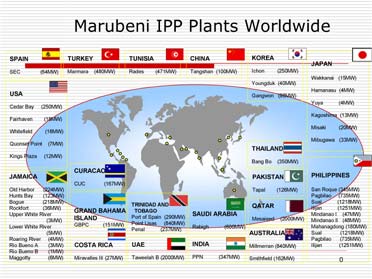
Marubeni is a Japanese trading company. Historically focused on importing energy and raw materials to resource-poor Japan (the map to the right show's the company's global network of independent power producers), Marubeni is also the world's sixth biggest grain trader by volume.  

Marubeni's chief exec just announced that he wants the company to break into the top tier, known as the "ABCD group" (for ADM, Bunge, Cargill, Dreyfus and "lowly" Glencore--which apparently doesn't rank a letter).  Marubeni's grain traffic has doubled in the last five years, so it's no idle boast.

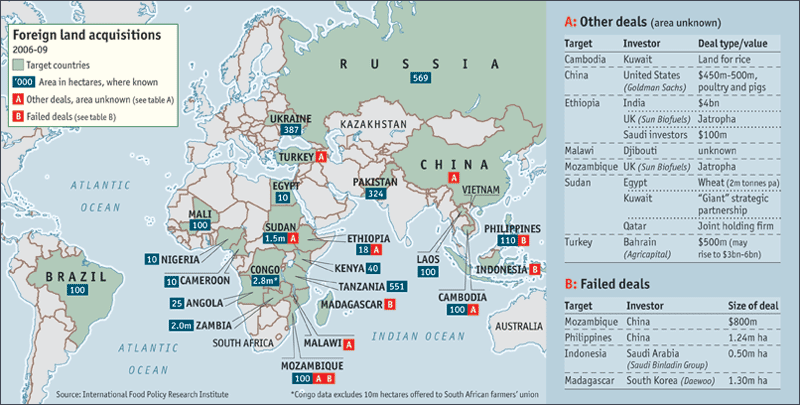
My thought, which I've been toying around with in the Wikistrat global model, is that global ag markets already resemble energy markets in their tightness of supply and volatility of price, so, when you consider that France-sized chunk of arable land that's been taken off the market over the past few years through purchases and leasing, can't we start talking about the rise of National Food Companies, or companies that have, as their guiding logic, the securing of food networks abroad for a primary national customer back home?  

Economist chart found here.

I mean, when China or Saudi Arabia sign these contracts, I gotta bet we're talking investing entities with some serious ties to the government - advertized or not.

Actually, Marubeni's ambition reflects a region-wide focus, since China is already its bigger market.  What's especially interesting about its ambition is how Marubeni uses its grain trade to get into ancillary markets like milling and animal feed processing.  

Just got me thinking . . . 


12:01AM

Esquire's Politics Blog: How the WikiLeaks Cables Reveal Obama's False Utopia

So the Obama administration says America's relations with our allies around the world can survive the latest WikiLeaks dump of U.S. diplomatic cables, and I'm inclined to agree. Truth is, the whole thing reads like a booze-addled Thanksgiving argument spun out of control, and nothing more. So the Middle East's corrupt autocrats hate each other and constantly goad the White House into taking out their garbage — big deal! God only knows the same good ol' boys will be the first to condemn us once things get tough and we choose to act. (To say nothing of Julian Assange's impending lawsuit.) In the meantime, sell the bad guys a few anti-missile defense systems and tell 'em to shut the hell up, because President Obama has one helluva lot more on his plate right now than just Iran, or North Korea, or Pakistan, or... you get the point.

Read the entire post at Esquire's The Politics Blog.