Buy Tom's Books
  • Great Powers: America and the World After Bush
    Great Powers: America and the World After Bush
    by Thomas P.M. Barnett
  • Blueprint for Action: A Future Worth Creating
    Blueprint for Action: A Future Worth Creating
    by Thomas P.M. Barnett
  • The Pentagon's New Map: War and Peace in the Twenty-first Century
    The Pentagon's New Map: War and Peace in the Twenty-first Century
    by Thomas P.M. Barnett
  • Romanian and East German Policies in the Third World: Comparing the Strategies of Ceausescu and Honecker
    Romanian and East German Policies in the Third World: Comparing the Strategies of Ceausescu and Honecker
    by Thomas P.M. Barnett
  • The Emily Updates (Vol. 1): One Year in the Life of the Girl Who Lived (The Emily Updates (Vols. 1-5))
    The Emily Updates (Vol. 1): One Year in the Life of the Girl Who Lived (The Emily Updates (Vols. 1-5))
    by Vonne M. Meussling-Barnett, Thomas P.M. Barnett
  • The Emily Updates (Vol. 2): One Year in the Life of the Girl Who Lived (The Emily Updates (Vols. 1-5))
    The Emily Updates (Vol. 2): One Year in the Life of the Girl Who Lived (The Emily Updates (Vols. 1-5))
    by Thomas P.M. Barnett, Vonne M. Meussling-Barnett
  • The Emily Updates (Vol. 3): One Year in the Life of the Girl Who Lived (The Emily Updates (Vols. 1-5))
    The Emily Updates (Vol. 3): One Year in the Life of the Girl Who Lived (The Emily Updates (Vols. 1-5))
    by Thomas P.M. Barnett, Vonne M. Meussling-Barnett
  • The Emily Updates (Vol. 4): One Year in the Life of the Girl Who Lived (The Emily Updates (Vols. 1-5))
    The Emily Updates (Vol. 4): One Year in the Life of the Girl Who Lived (The Emily Updates (Vols. 1-5))
    by Thomas P.M. Barnett, Vonne M. Meussling-Barnett
  • The Emily Updates (Vol. 5): One Year in the Life of the Girl Who Lived (The Emily Updates (Vols. 1-5))
    The Emily Updates (Vol. 5): One Year in the Life of the Girl Who Lived (The Emily Updates (Vols. 1-5))
    by Vonne M. Meussling-Barnett, Thomas P.M. Barnett, Emily V. Barnett
Search the Site
Powered by Squarespace
Monthly Archives
10:48PM

Forget the pegged renminbi!

COMMENT: "The west is wrong to obsess about the renminbi," by Michael Spence, Financial Times, 21 January 2010.

Do not think of this in a zero-sum, global share sense, says Spence, because "the main issues are growth and the restoration of global demand."

Fair enough.

The U.S. is working on debt now, so it cannot restore global demand like it used to. Meanwhile, the Chinese fill in admirably, but asking them to let their currency appreciate at the same time is too much, too soon.

Plus, the reality is more complex. High personal savings in China reflects the structure of the economy there, with heavy state control of too much income (hence the public retaliates as best it can by hoarding money as a safeguard). That won't change fast and an appreciating currency certainly won't fix it.

Gist: we can't get there (rebalancing globally) from here (currency appreciation for the Chinese).

10:44PM

No Afghan March to the Sea

OP-ED: Empty Skies Over Afghanistan, By LARA M. DADKHAH, New York Times, February 18, 2010

ARTICLE: NATO Airstrike Kills Afghan Civilians, By ROD NORDLAND, New York Times, February 22, 2010

A perfectly logical argument about what it takes to wage real war WRT air cover.

The problem is, we aren't waging "real war" in Afghanistan.

But yes, in its isolated and highly inappropriate logic, this op-ed makes perfect sense.

By accepting that the "population is the prize," you always accept more danger to your own troops. It is inescapable but it can be suitably reduced through increasing your numbers.

And that can only be done by pulling in ever-increasing numbers of allies, not exhausting yourself and the few old allies you have. When you don't succeed on that effort, then yes, it's very tempting to go back to old force-protection arguments and the usual American instincts regarding wars of annihilation.

But Sherman won't do here.

10:42PM

Walls beat the alternative

ARTICLE: With Steel and Asphalt, Bridge Helps Seal Baghdad's Division, By ANTHONY SHADID, New York Times, February 18, 2010

With all of our rightful sense of success regarding the surge, the outcome I expected to happen does seem to have arrived: the success of the surge merely codified the ethnic cleansing that preceded it, locking in, by and large, the victory of the Shiia and helping the Sunni accept that by encouraging some measure of local self-governance.

That we end with walls should not be surprising. We often up with walls in such "divorce" proceedings. Then the trick is simply to figure out how to sit on those walls long enough for the generational change to occur--i.e., the angry and pissed-off generation ages and is replaced by newbies largely unattached to the old conflicts. Given enough time, the walls come down. But enough time is usually 1-2 generations, or 30-40 years.

10:40PM

McChrystal's new COIN

ARTICLE: Afghan Push Went Beyond Traditional Military Goals, By THOM SHANKER, New York Times, February 19, 2010

The best single concise description of what makes this new COIN effort under McChrystal distinctive.

Best chunk is the opening:

Before 10,000 troops marched through central Helmand Province to wrest control of a small Afghan town from a few hundred entrenched Taliban fighters, American officials did something more typical of political than military campaigns: they took some polls.

Perhaps no other feature of the offensive now under way in and around the town, Marja, speaks so clearly to its central characteristic: it is a campaign meant to shift perceptions as much as to alter the military balance, crush an enemy army or seize some vital crossroads.

The polling was aimed at understanding what local residents wanted; how they viewed local security; what they thought of the Americans, the Taliban and the foreign jihadis fighting for local control; and what might give them confidence in the central government in Kabul.

Whatever the limitations of this opinion sampling -- what is the margin of error when there are whole neighborhoods where it is deadly to knock on doors? -- what the commanders learned helped shape the entire campaign. Among other things, those living in the area still harbor some friendly feelings for the Americans, remembering how years ago they built dams in the region, and strongly favor an effort to oust the Taliban.

That gave the military extra confidence as they mounted a counterinsurgency operation that stands out in many ways.

Notably, this was the first time that the Americans took pains to involve the central government of President Hamid Karzai in such a significant operation, let alone a multiphase campaign that included the military, government and economic stability. Aside from contributing thousands of troops, Mr. Karzai and his aides, with significant help from the Americans, basically built a government in waiting. The aim is for the Afghan government to carry out programs in education, health and employment as soon as the area is secured, according to a senior American officer.

The size of the onslaught was a departure from past practice, too. The allied force is so large as to be described by one senior American adviser as "overwhelming to the point of saturation."

And the operation was advertised, almost in neon lights, so far in advance and in such detail that there was none of the element of surprise that combat commanders usually prize.

All of those characteristics are explained by the psychological goal of this campaign, a shift of perceptions among the fence-sitters and the fearful among the Afghan people.

For longtime and careful readers, you'll see this dovetails nicely with a lot of my thinking in that it:

1) shifts the overwhelming force notion of the Powell Doctrine to the post-conflict side (the saturation);

2) isn't stealthy or full of surprise but instead emphasizes inevitability;

3) involves a heavy listening quotient, whether we're talking the locals or the host gov (very "searching," in Easterly's vernacular);

4) the inclusion of economic stability efforts; and

5) the gov-in-a-box/waiting approach.

Tricky stuff? Anything that focuses on changing perspectives/perceptions always is, but this seems the best thought-out effort to date.

Why this evolution? The military has tried a lot of other approaches, so it was only a matter of time and pain before it got to this next iteration.

10:14PM

The un-new normal of cyber vulnerabilities

U.S. NEWS: "Hackers Attack 2,411 Firms: Global Offensive Snagged Corporate, Personal Data; Operation Is Still Running," by Siobhan Gorman, Wall Street Journal, 18 February 2010.

ARTICLE: More than 75,000 computer systems hacked in one of largest cyber attacks, security firm says, By Ellen Nakashima, Washington Post, February 18, 2010

This is an oddly written piece where the protagonist remains completely obscured. We are told of a "coordinated global attack" involving hackers from Europe and China that targeted personal and corporate data, but that's all we hear about the perpetrators, other than that the hackers operated a "command center" in Germany.

The rest of the piece is written in this oddly passive tense: computers were infiltrated, networks were breached, etc. There are hints that this is a vast criminal conspiracy, but the theme is largely left untouched. No mention is made of whether or not government agencies were involved, although several U.S. government agencies were breached (Damn! Now I'm doing it!).

I guess I'm just surprised the WSJ would let a piece slip through that reported such a vast bit of naughtiness and not offer a single tidbit of analysis regarding who might be responsible.

But rest assured, a juicy story like this will trigger all manner of punditry about the coming cyber war that will leave the entire planet devastated and send us all back to the 17th century or worse. These things come in cycles and we're due for one.

The WAPO piece, by contrast, just came out and indicated that the likely culprits were a criminal organization.

3:00PM

More South Africa pix

Added 10 photos sent to us by the conference organizers. Hint: they're the ones with Tom on stage (in the middle).

11:55PM

The straw men of linearity once again defeated re: China!  Rejoice!

COMMENT: "The Chinese tiger shows its claws," by David Shambaugh, Financial Times, 17 February 2010.

Sad day when anybody as smart as Shambaugh gets drafted into this sort of thing: defeating the great straw man that China's embrace of openness must be a linear exercise--as in, always expanding. After all, the guy notes right up front that the usual pattern of fang and shou continues: a mix of opening and closing whereby the one step back is followed by two forward.

Actually, the piece is much better than the predictable lament offered: "Those who have argued that Beijing is moving inexorably towards greater openness are beginning to think again."

Yes, yes, and the big recent snow storms have invalidated global warming.

The best of Shambaugh's "alternative explanations" (something he typically excels at, and does not disappoint here--but only after wading through a lot of prosaic stuff below his usual norm):

One is that a leadership transition is under way in the run-up to the 2012 Party Congress, and that during such periods China becomes more caustic while candidate leaders try to prove their nationalist credentials. A related hypothesis is that China's rulers believe the country is best with numerous socio-economic problems and feel their rule is fragile--thus they divert attention with nationalist rhetoric.

These two explanations fit nicely with what I've heard from Chinese academics during past trips: the coming generation (fifth) of leaders feels very uncertain about its authority, and thus is fishing around for ways to present itself to the public.

Other offers are less compelling: the "realists" have won in Beijing's foreign policy debates (I get no sense of that, as the do-as-little-as-possible types still strike me as predominant) or that the central planners are again in ascendancy thanks to the financial crisis. The one about pandering to young nationalistic netizens rings a bit truer, but it's a subset of the larger argument that the fifth generation doesn't yet know how to present its authority.

I think the fifth generation will usher in a time of serious uncertainty inside China, because they will cover a period of time when it becomes apparent that the old policies of the previous generations (3rd and 4th, who mostly just kept the momentum of Deng's revolution going) are losing their logic and yet the system of rule is incapable of thinking through what must logically come next--a Chinese citizenry increasingly competent enough to start ruling itself more and more politically. The sixth generation, on tap to start in 2022, will face a long-term horizon that will be daunting enough to induce more flexibility--thinking about keeping a lid on China through 2032! But the fifth generation will be torn between thinking "we should be able to keep this political reality undisturbed through our reign" and indulging in "après moi, le deluge" fatalism.

This is why, when asked repeatedly after talks, about my future fears, I always say that it's crucial to get the U.S.-Chinese relationship through the 2010s relatively unscarred. By the time both sides hit the 2020s, I think the maturity in the relationship, combined with generational turnover and a reasonably clear appreciation of the structural tasks ahead (good example: we won't be talking anymore of rising powers, as they will simply be, along with their enlarged global responsibilities), will prove sufficient for any "catastrophes" that either experts can dream up or reality will provide.

11:52PM

The Afghan offensive in context

WORLD NEWS: "Marjah Strategy Approaches Civilian Phase: Police Units Are Deployed and a Civilian Administration Waits to Move In to Restore Kabul's Authority in Taliban Town," by Matthew Rosenberg and Michael M. Phillips, Wall Street Journal, 18 February 2010.

WORLD NEWS: "Afghan Push Has Iraqi Precedent," by Yochi J. Dreazen, Wall Street Journal, 18 February 2010.

Two nicely contextualizing pieces: We're moving out of the easier, more replicable stuff and into the more idiosyncratic, tougher phase (civilian).

What does McChrystal mean when he says, "government-in-a-box"? Same thing DeAngelis and I mean when we say Development-in-a-Box‚Ñ¢.

Simply: a focus on getting thing up and running in a basic counterparty sense, so that when demand for services (or for investment deals, in our sphere) arises, there's competent, in-place counterparties available to conclude transactions.

Yes, you can slap such stuff into place. What the locals end up doing with them is, of course, always a different affair, point being, by definition, any place needing an in-the-box solution is lacking the normal culture associated with it.

So think of it like a video game with lots of failures before success, because, if it were easy, somebody would have gotten there to do it before you, reaping all the rewards. The fact that "they" are not there tells you something about why the place is "failed" in the first place.

So don't be surprised when the oncology ward has a higher death rate than the fertility clinic.

11:50PM

Nagl on the Iraq-Afghan comparison

COMMENT: "Lessons from Iraq can guide the Afghan surge," by John Nagl and Mitchell Reiss, Financial Times, 18 February 2010.

Argument for a bottom-up approach that maximizes local commander's freedom of action to cut idiosyncratic deals as required. A key component: not penalizing according to past actions.

Subtext: get me the human terrain connectivity first--as widely extended as possible, and we'll sweat the conflicting details later.

11:10PM

We have to please India with the Afghan outcome

COMMENT: Don't Look Back, by Steve Coll, The New Yorker, March 1, 2010

Nice piece that provides Ahmed Rashid-level detail on Pakistan's appreciation of, and uses for, the Taliban over the years.

Near the end he references the usual "strategic depth" argument, albeit not using that term:

Unfortunately, the geopolitical incentives that have informed Pakistan's alliance with the Afghan Taliban remain unaltered. Pakistan's generals have retained a bedrock belief that, however unruly and distasteful Islamist militias such as the Taliban may be, they could yet be useful proxies to ward off a perceived existential threat from India. In the Army's view, at least, that threat has not receded. Indo-Pakistani peace negotiations that have been in suspension since the 2008 Mumbai terrorist attack are only just re-starting. Absent a sudden breakthrough that charts the potential for normalizing relations between Pakistan and India--a framework settlement on Kashmir, freer trade, freer borders, and demilitarization--Pakistan's rationale for preserving the Taliban and similar groups is not likely to change.

It's why Coll has, in the past, raised the Kashmir issue as the key to any true stabilization of Afghanistan. Joining him in his logic, it's why I have often previously cited Musharraf's notion of a "soft border" between Pakistan and India (Kashmir) as a reasonable notion also for Pakistan and Afghanistan (WRT the Pashtun).

Whenever things go back and forth like with the current U.S. push in the South, I run all the logic through my head again and come back to these inescapable underlying realities. It's why I've been saying for a long time now that India must be made happy by any outcome in Afghanistan. If New Delhi is not linked in some manner, then the usual Pakistan logic holds regarding the Taliban, and the situation remains unchanged.

(Thanks: Our man in Kabul)

10:59PM

Another expert heard from: the mullahs are out in Iran

OPINION: "Iran's Emerging Military Dictatorship," by Amir Taheri, Wall Street Journal, 16 February 2010.

The Supreme Leader watches the 31st anniversary celebrations on TV rather than make a personal appearance. Told that his life was in danger, Khamenei was as much subject to the Revolutionary Guard's lock-and-key approach as Tehran itself, which, for the first time since the revolution had been transformed into a "sealed citadel with checkpoints at all points of entry."

Taheri makes the larger argument that the theocracy has been evolving into a military dictatorship for about a decade now, with the Revolutionary Guard playing the historic Persian role of the Malmuks, or the mercenaries recruited from the pagan tribes of Central Asia to buttress that civilization's successful Islamic dynasties, except now the military hardliners really run the show.

His bottom line: no chance for compromise on the nuclear issue. I continue to believe that's the case. However, military dictatorships are known to compromise on other issues, so if we stop keeping the nukes issue at the center of everything, I see a hard-line regime emerging that is incorrectly described as either religion-based or irrational, and that sort of regime, much like the late great military-industrial complex that was the USSR, can be simultaneously contained, co-opted and poisoned-through-connectivity on a variety of levels.

My point: the usual dichotomies offered on Iran (grand bargain or immediate military strikes) aren't useful.

10:54PM

The political reality: the incumbent gets the short-term praise and the blame

OPINION: "Joe Biden's Iraq 'Achievement,'" by Omar Fadhil Al-Nidawi and Austin Bay, Wall Street Journal, 18 February 2010.

Perfectly fine carping by Al-Nidawi and Bay, but useless.

The incumbent always reaps what others sow. Just ask Reagan about Carter's defense buildup.

10:18PM

Kynge spots rebalancing within China

THE NEW GLOBAL ECONOMY: "China turns its gaze inward for future growth," by James Kynge, Financial Times, 19 January 2010.

Kynge is a serious China watcher. I used his China Shakes the World book in GP, so I really like the challenge of his column now that I get FT daily.

Gist: coastal China drove its demand for resources in the past, but it's the interior 2nd, 3rd and 4th-tier cities that do today.

Skeptics, Kynge notes, don't believe China's interior can sustain serious demand for any great length of time.

Jury will remain out for a long time, I suspect. But I see a whole lotta rural people in China who still want a better, more urbanized life.

10:14PM

A mining survey

COMPANIES|INTERNATIONAL: "Mining: Rio's iron ore output rises 49%: Miner gains from Chinese demand; Sales surge to record 61m tones," by Peter Smith, Financial Times, 15 January 2010.

CORPORATE NEWS: "Rio Tinto's Iron-Ore Output Tops Its Forecast: Strong Demand From Chinese Steel Manufacturers Is Expected to Contribute to a Price Increase This Year," by Alex Wilson, Wall Street Journal, 15 January 2010.

WORLD NEWS: "Chinese Prosecutors Take Rio Tinto Case," by James T. Areddy and Alex Wilson, Wall Street Journal, 12 January 2010.

COMPANIES & MARKETS: "Big miners shun China during annual talks to set iron or pricing," by Patti Waldmeir, Javier Blas and Peter Smith, Financial Times, 12 January 2010.

MARKETING & INVESTING: "BHP reports shift towards spot pricing for iron ore: Half of customers have made change; Benchmark system is under pressure," by Peter Smith, Financial Times, 21 January 2010.

Post stemming from boning up on my awareness of the mining industry as I prepared to go to Capetown earlier this month.

First off, business is good thanks to China's surging demand, which is triggered by its splurge (stimulus) on public infrastructure building. China now accounts for "more than half of the seaborne market."

Second, relations between Western mining companies (especially Rio Tinto) and China are somewhat tense. Rio had 4 employees arrested last year on allegations of stealing commercial secrets and bribe-taking (presumably to gain more discrete pricing/demand info than the current benchmark system provides) and turned down an offer from Chinalco (huge extractive company) to buy in, instead turning to BHP Billiton (#3 iron-ore exporter after #2 Rio) "to combine their Western Australian iron ore assets into a joint venture production company."

Third, relations are likely to get tenser in coming days/months, because China is being shunned at the annual price-setting talks (a roughly 40-year system where the price is set in a collusionary fashion among major buyers and suppliers for the year--each year), where the big mining companies are working with Japan on a fair price, with the plan being to present that price to China as a take-it-or-leave-it-proposition--pretty ballsy given China's pseudo-monopsonistic position as a buyer. Talks between the mining companies and China re: the 09-10 price broke down last year because China was demanding a discount from the price set with Japan. Spot prices are now sitting about 80% higher than last year's benchmark (and BHP is saying half of its business is now on the spot), and analysts expect this year's number to be at least 20-30% higher. China, in reply, claims it's being gouged, thus the crude pushback (the usual rule by law shenanigans--as in, "I'll take you to court--my court!").

For now, the mining companies plan negotiating talks with China.

10:12PM

The natural contraction after the democratic wave

INTERNATIONAL: "Democracy's decline: Crying for freedom; A disturbing decline in global liberty prompts some hard thinking about what is needed for democracy to prevail," The Economist, 16 January 2010.

The "scary" decline from 2001 to 2009 must be contextualized within the explosion of freedom that occurred across the late 1980s and throughout most of the 1990s. That kind of expansion of networks and associated freedom cannot be expected to continue in a linear fashion. Nothing succeeds like excess, and therefore nothing is more expected than periodic retrenchments.

Meanwhile, I think we're on the verge of serious explosions in freedom and integration in South Asia, the Middle East and Africa.

So yeah, I expect the next wave of democratization to be that much more destabilizing--and good.

10:02PM

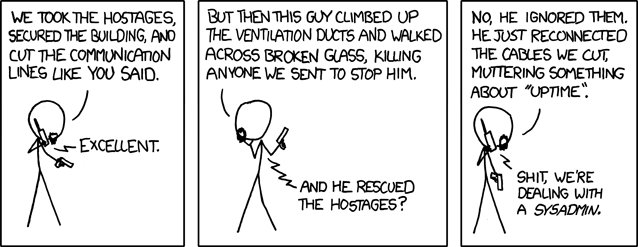
The SysAdmin: Devotion to Duty

From the geniuses at xkcd.

Part of their shtick is the importance of the 'title' text (hover over the cartoon on their site), which in this case is:

The weird sense of duty really good sysadmins have can border on the sociopathic, but it's nice to know that it stands between the forces of darkness and your cat blog's servers.

(Thanks: Mark Davenport)

3:17AM

America's Place in the World

afghan_elders.png

We Americans tend to have an overly inflated sense of our place in this world. If there is an enemy, we must defeat it. If a global challenge looms, we must lead the way forward. When somebody reaches for a weapon, we must strike before they can use it (against us, naturally). And should we fail to do so, we would be to blame for whatever tragedy might result.

Continue reading this week's New Rules column at WPR.

11:43PM

Not all that much to worry about WRT Chindia-the-threat-to-the-West

WORLD NEWS: "India Frets Over Tie to China," by Amol Sharma, Wall Street Journal, 11 February 2010.

Start says it all:

India is trying to rein in its heavy reliance on Chinese equipment and know-how for the ambitious expansion of its power sector.

Imitation is a bitch, ain't it? Like China, India wants its great infrastructure build-out to result in the growth of national flagship companies. This is natural and good.

India seeks to boost electricity by 60% in five years. Chinese companies came from nowhere to supplying about 25% of the equipment and thousands of workers in recent years.

11:38PM

Get used to being post-industrial

OP-ED: An Order of Prosperity, to Go, By W. MICHAEL COX, New York Times, February 17, 2010

Neat little counter-intuitive piece with great, informative chart.

The key bit with regard to Obama's SOTU pledge to double exports:

Editing the president's speeches isn't my job, but the missing words suggest that the White House, like much of the rest of the country, hasn't realized that exports of services are one of America's 21st-century success stories. We still picture exports being loaded on ships or planes, but -- as the accompanying chart based on Commerce Department data shows -- overseas sales are today increasingly delivered in person or sent across the Internet.

Exports of American services have jumped by 84 percent since 2000, while the growth rate among goods was 66 percent. America trails both China and Germany in sales of goods abroad, but ranks No. 1 in global services by a wide margin. And while trade deficits in goods have been enormous -- $840 billion in 2008 -- the country runs a large and growing surplus in services: we exported $144 billion more in services than we imported, dwarfing the surpluses of $75 billion in 2000 and $58 billion in 1992.

Equally important, Commerce Department data show that the United States is a top-notch competitor in many of the high-value-added services that support well-paying jobs.

We are increasingly post-industrial and will continue to move in that direction--get used to it.

(Thanks: Frommer2750)

10:58PM

The Internet as one big cable box

COVER STORY: "Stemming the Tide," by Ted Johnson, Variety, 11-17 January 2010.

Got Variety subscription again and I've dearly missed it. It's a great media resources, especially for tracking global entertainment trends.

This piece caught my eye simply because it stated Hollywood's fear about the possible downfall of net neutrality: their delivery options will be narrowed just like on cable, costing them tons of money.

In short, Content fears Delivery--an old story.