

Buy Tom's Books
  • Great Powers: America and the World After Bush
    Great Powers: America and the World After Bush
    by Thomas P.M. Barnett
  • Blueprint for Action: A Future Worth Creating
    Blueprint for Action: A Future Worth Creating
    by Thomas P.M. Barnett
  • The Pentagon's New Map: War and Peace in the Twenty-first Century
    The Pentagon's New Map: War and Peace in the Twenty-first Century
    by Thomas P.M. Barnett
  • Romanian and East German Policies in the Third World: Comparing the Strategies of Ceausescu and Honecker
    Romanian and East German Policies in the Third World: Comparing the Strategies of Ceausescu and Honecker
    by Thomas P.M. Barnett
  • The Emily Updates (Vol. 1): One Year in the Life of the Girl Who Lived (The Emily Updates (Vols. 1-5))
    The Emily Updates (Vol. 1): One Year in the Life of the Girl Who Lived (The Emily Updates (Vols. 1-5))
    by Vonne M. Meussling-Barnett, Thomas P.M. Barnett
  • The Emily Updates (Vol. 2): One Year in the Life of the Girl Who Lived (The Emily Updates (Vols. 1-5))
    The Emily Updates (Vol. 2): One Year in the Life of the Girl Who Lived (The Emily Updates (Vols. 1-5))
    by Thomas P.M. Barnett, Vonne M. Meussling-Barnett
  • The Emily Updates (Vol. 3): One Year in the Life of the Girl Who Lived (The Emily Updates (Vols. 1-5))
    The Emily Updates (Vol. 3): One Year in the Life of the Girl Who Lived (The Emily Updates (Vols. 1-5))
    by Thomas P.M. Barnett, Vonne M. Meussling-Barnett
  • The Emily Updates (Vol. 4): One Year in the Life of the Girl Who Lived (The Emily Updates (Vols. 1-5))
    The Emily Updates (Vol. 4): One Year in the Life of the Girl Who Lived (The Emily Updates (Vols. 1-5))
    by Thomas P.M. Barnett, Vonne M. Meussling-Barnett
  • The Emily Updates (Vol. 5): One Year in the Life of the Girl Who Lived (The Emily Updates (Vols. 1-5))
    The Emily Updates (Vol. 5): One Year in the Life of the Girl Who Lived (The Emily Updates (Vols. 1-5))
    by Vonne M. Meussling-Barnett, Thomas P.M. Barnett, Emily V. Barnett
Search the Site
Powered by Squarespace
Monthly Archives
12:42AM

Sorry, but I gave at the police station

OP-ED: "To Stop Crime, Share Your Genes," by Michael Seringhaus, New York Times, 14 March 2010.

I do think this is both inevitable and good: a national DNA database. I think the crime deterrence impact here would be substantial, and, quite frankly, welcomed by an at-risk population.

I know that when I was a young professional, it was a relief to cite my clearances as a reason why I could never go back to my college pot-smoking days. I liked that bureaucratic Sword of Damocles hanging above me.

Alas, I don't need any such motivation in my middle years. Today, I seek clarity in all things and at all moments (okay, I like to pound beers at Lambeau, but only through the first quarter). My latest excitement is being off any antibiotics for sinus infections for almost six months and discovering Xyzal, the latest and greatest antihistamine.

But I could see a similar effect on at-risk young men: the fear of your DNA ratting you out.

Yes, yes, the usual Big Brother fears would wig out too many Americans, but admit it, you know this will happen soon enough--and that a level playing field on this score will be very positive for society (the real thrust of this op-ed's logic).
12:42AM

When I filled out the census form

Two things I notice:


  • First time I ever penned in an answer for anything other than "white" (for Vonne Mei, our Chinese daughter), and it made me think who'd I would be penning in next time (2020); and


  • There was a decided effort on the form to get at a more definite capture of who's hispanic or not (an entire section for each person that was clearly designed to capture as many as possible).

12:42AM

The onshoring trend/trickle

MARKETPLACE: "Caterpillar Joins 'Onshoring' Trend," by Kris Maher and Bob Tita, Wall Street Journal 12 March 2010.

Caterpillar is pulling some of its overseas heavy-duty equipment manufacturing back to a new U.S. plant.

This onshoring or reshoring trend is described as stemming largely from the weakened dollar, which makes it costlier to import parts.

A lobbyist for U.S. manufacturers says it's more a "trickle" than a trend, noting that we still offshoring more than onshoring, when everything is added up.

12:41AM

Japan following rising Asia into rising Africa

WORLD NEWS: "Japan groups creep into Africa: Executives may struggled to adjust to local ways of doing business," by Barney Jopson and Mure Dickie, Financial Times, 12 March 2010.

Japan's FDI into Africa is nowhere near China's (roughly $1b compared to $5-6b), but the mirrored upward trend across the last five years is striking.

Japan, it appears, follows the BIC (Brazil, India, China) into Africa in search of minerals and energy, leaving behind the old aid-first model of the Old Core West.

No great surprise that Japan is upgrading its effort: it was the original rising Asian player who obsessed over access to foreign energy and minerals. It just now has some serious private sector competition.

Then there's the desire to sell products to Africa's emerging lower middle class.

Some interesting factoids:


  • China has 47 embassies in Africa while Japan has only 31 (there are 54 countries in total on the continent);


  • China is not 11-12% of Africa's trade with the world, but Japan is 2-3%;


  • Outward FDI stock comparison shows 71% of China's FDI remains in Asia, while virtually the same amount of Japan's stock is found in Europe and America (China's stock in the US is 20% of its total, with Europe a mere 3%).

12:41AM

Chavez's next disaster in Venezuela: running grocery stores

FEATURE: "Cereal Socialism in Venezuela: Support for Chavez depends on subsidized staples for the poor, but state meddling in the food supply means shortages and seizures of private supermarkets," by Geri Smith, Bloomberg BusinessWeek, 22 & 29 March 2010.

The latest sad chapter in Chavez's economic "miracle" that has been socialist planning and takeovers of the private sector: people fighting like animals over food in now-government controlled grocery stores.

It's the usual Hugo tactic: f--k up the industry, cause stunning shortages and skyrocketing prices, and then nationalize scapegoats in retaliation for his own economic stupidity.

As the shortages pile up in sector after sector, Chavez's popular ratings now rest below 50%. Down from 70% just three years ago, when all smart pundits were positing the long age of petrocracies.

12:41AM

Outside the scuffle over currencies, the wider trade war does not materialize

WORLD NEWS: "Wen hits back on exchange rate: Renminbi 'not undervalued'; Premier warns over outside pressure," by Geoff Dyer, Financial Times, 15 March 2010.

MOVING THE MARKET: "Japan Frustrated as Yen Rises: Persistent Strength of the Currency Is Baffling the Country's New Leaders," by Alex Frangos, Andrew Monahan and Michael Casey, Wall Street Journal< 15 March 2010.

LEADERS: "China, America and the yuan: Yuan to stay cool; The best thing American politicians can do to encourage a stronger Chinese currency is keep calm," The Economist< 13 March 2010.

WORLD NEWS: "Skirmishes do not herald declaration of world trade war," by Alan Beattie, Financial Times, 15 March 2010.

China is pissed over America's push on currency valuation and let's us know it.

But stepping back from that particular issue, the bigger picture is that the perceived rising tide of protectionism is so far "routine" by historical standards, meaning everybody is exploiting all allowed loopholes during tough times, but there's been no great reversal of globalization's fundamental free trade rule set--despite all the breathless hype.

Everybody please shelve your pet Archduke Ferdinand scenario.

Even on the bilateral US-China front, according to DC lawyer Gary Horlick, "There seems to be an implicit deal . . . not to start a fight on currencies and to let the lawyers litigate everything else."

Beattie's point: all the WTO-centric activity "might look terrifying, but in reality it is pretty much par for the course."

Great rule-set bit:

Is would be an exaggeration to say every problem in world trade can be improved by throwing lawyers at it. But it is increasingly true litigation is not a nuclear last resort but merely part of the toolkit of managing trade relations. China, which once reacted to every legal challenge as though it were a declaration of war, has got much savvier.

As for Treasury naming China as currency manipulator? Beattie says that resembles the old Robin Williams bit about unarmed British bobbies yelling, "Stop! Or . . . I'll shout stop again!"

Like the Economist implies, maybe discretion is still the better part of valor on currencies. Everybody's is rising relative to the dollar, in large part because of the pegged yuan. When enough of the rest of the world figures this out, if it hasn't already, the pressure on China will balloon. Being so indebted to the Chinese, why not let the ROW manage this one?

12:40AM

Resource wars over oil cancelled! CNOOC simply decides to buy huge stakes the world over, using it's giant pot of money (sigh!)

COMPANIES & MARKETS: "CNOOC in $3bn Bridas deal: China to take 50% stake in Argentine group; Beachhead for entry into Latin America," by Sundeep Tucker and Jude Webber, Financial Times, 15 March 2010.

COMPANIES | INTERNATIONAL: "Drive to tap into China demand spurs energy partnerships: Western energy groups are keen to gain access to a growing market," by Ed Crooks, Financial Times< 15 March 2010.

I know. What sneaky bastards!

CNOOC has got the bucks, and it continues to spend. For every deal that seems to fall through, another one comes through. Funny how money talks.

This deal "will make CNOOC a partner in Britain's BP in Pan American Energy, a joint venture with coveted oil and gas exploration and production activities across Latin America and in which Bridas has a 40 per cent stake.

Worse for the big war crowd dreamers, Western energy companies are flocking to partner with Chinese ones in order to tap into China's rise as the global demand center for oil. This only proves my enduring point: power within globalization is based on demand, not supply. China's skyrocketing oil demand makes it powerful, not weak. It won't have to send the PLA to conquer the Gap. Big Oil will do its mightiest to deliver the Gap unto China, sucking in Western militaries in support the best it can. Ultimately, the PLA will need to pitch in, but this will hardly occur in a zero-sum sense. Protecting JVs with Big Oil will not pit China against America; it will simply co-locate their contingency operating locations.

I know, it sucks.

But somebody please inform the resource-war prophets. They need to publish all their books ASAP!

12:40AM

Transforming the sacred village-based economy in India via the private sector?

BUSINESS: "Agribusiness in India: Green shoots; Private investment is helping India's farmers in a way government support cannot," The Economist, 13 March 2010.

Can you believe that India's #3 in potatoes?

McDonald's is the big reason why.

When McDonald's first entered India in 1996, the food-processing industry was confined largely to ice cream and ketchup.

Now there's a reliable supply chain that goes from farm to boxed frozen fries to franchises.

Ultimate driver? More income means people want less of staples and more variety in caloric intake: grains are still at 64% of farmland, but cereals are increasingly losing out, demand-wise to fruits, veggies, milk, eggs and poultry.

McDonald's just introduced chicken nuggets in India. Watch out!

12:39AM

Putting the poor's money to use

FINANCE AND ECONOMICS: "Savings and the poor: A better mattress; Microfinance focuses on lending. Now the industry is turning to deposits," The Economist< 13 March 2010.

Living on $2 a day is more complex than you think, because the income comes in spurts, like one day you earn a sawbuck and then have to live on it for 9 more days.

So how to make bridge loans happen at non-shark prices?

Microfinance is the trendy answer, but a lot of development advocates want a more balanced approach, meaning savings accounts too.

And the MFIs (microfinance institutions) seem to be responding, especially after the Gates foundation jumped in with some money.

Cellphones will be a huge player in this, as we've already witnessed emerging in Kenya with its M-Pesa system.

The business models emerge! Four of the sweetest words in the language of globalization.

12:18AM

The New Rules: The Jury's Still Out on Iraq War [World Politics Review]

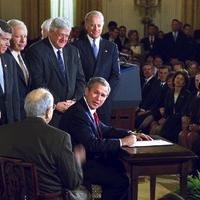
signing.jpgPhoto: President George W. Bush signs the H.J. Resolution 114 authorizing the use of force against Iraq, Oct. 16, 2002 (White House photo by Paul Morse).

When asked for his assessment of the French Revolution's historical impact, Zhou Enlai famously replied, "It is too early to tell." Historians are fond of citing the quotation, but at times ignore its fundamental insight: that they often arrive at their judgment of historical events prematurely. Nowhere does this seem truer than in the case of America's controversial intervention in Iraq.

Continue reading this week's New Rules column at WPR.

12:18AM

The spiral development of East Africa

WORLD NEWS: "Sudan at the crossroads: Japan group eyes pipeline plan; Toyota arm backs $1.5bn oil project; Door open for joint venture with China," by Barney Jopson, Financial Times, 10 March 2010.

Theme of mine for a while, and currently highlighted in a brief slide: as globalization comes to Africa, fracturing weaker fake states (tribal collections slapped together and/or divided by colonial borders given them by Europeans), there is a compelling need to construct/encourage larger economic unions that "radially" (as opposed to radically) connect inner regions to the coast, dividing the continent in pie slices of connectivity.

East Africa is one such logical pie slice, already imagined as an East African Community:

The East African Community (EAC) is the regional intergovernmental organisation of the Republics of Kenya, Uganda, the United Republic of Tanzania, Republic of Rwanda and Republic of Burundi with its headquarters in Arusha, Tanzania.

The story here: China interested in connecting south Sudan oil reserves via pipelines to the Kenyan coast near the old port city of Lamu, which I visited on my Esquire "The Americans Have Landed" story trip.

The alternative is to go with the existing pipeline through the north to the Red Sea Sudanese port city (Port Sudan).

Naturally, if you're looking ahead to a plebiscite next year to decide whether or not to split the country into two, and you, as an outsider, are interested in tapping the south's oil reserves (the bulk are found there--hence, little surprise that the south wants a divorce from the north), then better to see it flow through relatively more stable Kenya than the north, which could easily restart the civil war with the south.

So you got it all here: fake state considering divorce because richer half wants to cut it own deals with the global economy and establish its own more tribally-appropriate nation; outsiders looking to connect amidst this political deconstruction and perhaps doing it in a manner that actually feeds the larger, regional economic scheme.

Fascinating piece to me.

12:17AM

The comprehensive package on Iran

CAPITAL JOURNAL: "An Expert's Long View on Iran," by Gerald F. Seib, Wall Street Journal, 5 March 2010.

WORLD NEWS: "Israeli Faith in Iran's Opposition Gains Favor," by Charles Levinson, Wall Street Journal, 10 March 2010.

Brzezinski's got the right package, meaning the one I have long advocated here:

In an interview, Mr. Brzezinski lays out his formula. Try to stop Iran's nuclear program, and make Tehran pay a price if it keeps pursuing it, but don't count too much on sanctions; offer a robust American defense umbrella to protect friends in the region if Iran crosses the nuclear threshold; give rhetorical support to Iran's opposition while accepting America's limited ability to help it; eschew thought of a pre-emptive attack on Iran's nuclear facilities; and keep talking to Iran.

Perfect sensible mix.

The expectation is likewise sensible:

"This is a country with a growing ubran middle class, a country with fairly high access to higher education, a country where women play a great role in the professions," he says. "So it is a country which I think, basically, objectively is capable of moving the way Turkey has moved." That is, it can evolve into a country where Islam and modernity co-exist, even if somewhat uncomfortably."

Couldn't agree more with the overall assessment. It's why, in my mind, the Turks love the opening they've got, economic connection-wise, through Kurdish Iraq to the Iranian border. They see a market ready to be tapped.

If you scan the political horizon in Israel, you will locate all the same logic in bits and pieces.

There's more rhetorical pants-wetting here in the States than in Israel on this subject. Fortunately, Israel has a defense minister as sensible as our own.

12:17AM

The new map of marijuana decriminalization

FRONT PAGE: "Slowly, limits on pot are fading: States' moves reflect 'new era' of acceptance," by William M. Welch, USA Today, 9 March 2010.

States where med pot and decriminalized laws both enacted: Alaska, Maine.

States where med marijuana law (only) already in place: WA, OR, NV, MI, DC and NJ.

States that allow med pot and have pending bills on taxing and regulating and decriminalizing pot: HI, CA, CO, NM, VT and RI.

States with pending bills on med us, taxing and regulating and decriminalizing: AZ, NE, MO, IA, MN, WI, IL, NH, NY, PA, DE, MD, VA, NC and AL.

Mass decriminalized in 09 and isn't considering a med pot bill.

That leaves only 20 states doing nothing.

So the majority are moving.

12:17AM

An interesting entrant in the SysAdmin Industrial Complex

U.S. NEWS: "In This Afghanistan, Bombs Don't Kill: A Company Uses Hollywood-Style Sets and Special Effects to Help Soldiers Prepare for War; Real Amputees Play Roles," by Yochi J. Dreazen and Jim Carlton, Wall Street Journal, 10 March 2010.

Private sector version of what Indiana's Camp Atterbury (Army Nat Guard) has going on in the nearby Muscatatuck facility (where an old state colony for the "feeble-minded" is recast as a highly sophisticated training ground for urban ops of all flavors).

When I toured Muscatatuck with the commanding general a few weeks back, I asked him about this group outside San Diego that uses Hollywood-style sets and supplied role-players to train soldiers, and he said they collaborate and sometimes import some of this company's stuff for specific exercises.

This is, in aggregate, the institutional force and associated mil-industrial complex responding to the new marketplace and demand for SysAdmin ops.

I always get asked, "Where is there evidence of your vision taking hold?"

And I always answer, "It ain't about the vision, which merely reflects the demand. It's about responding to that demand, and it's happening all over the place."

One man's theory, another man's undeniable historical record finally being addressed systematically.

12:16AM

The Chinese real estate boom turns a corner?

WORLD NEWS: "China's Real-Estate Boom Appears to Cool: Growth in Residential Prices, Sales Volumes Slows, Potentially Easing Pressure on Government to Make Housing Affordable," by Andre Batson, Wall Street Journal, 11 March 2010.

Falling 3-month-moving-average of sales indicates that high prices are stopping buyers from entering an already "frothy market."

The urbanization driver ain't going away any time soon, so the underlying pressure on prices will remain, but this is a good sign.

12:16AM

I owe the bank a million dollars, and its THEIR problem

ARTICLE: "America's Foreign-Owned National Debt: Is It a Threat to the U.S. Economy?" by Bruce Bartlett, Forbes.com, 12 March 2010.

Great piece. I was going to excerpt but I could tell that I would just repost the entire thing in chunks.

Just read and feel sensibly smarter on the subject. Very balanced feel.

Okay, here's the opener:

To keep the Chinese currency from rising against the dollar, which it certainly would in the absence of intervention, the Chinese government uses its currency to buy dollars. This raises the value of the dollar and reduces the value of the Chinese currency on foreign exchange markets. In the process, the Chinese acquire vast amounts of dollars that they must invest in dollar-denominated assets. It suits the Chinese to put most of this money into Treasury securities for the same reason the Arabs did in the 1970s.

In short, the acquisition of Treasury securities by the Chinese is the necessary complement to their trade policy. As long as they insist on holding down the value of their currency to stimulate exports they have no choice but to buy large amounts of Treasury securities. If the Chinese stop doing so then their currency will rise against the dollar, which will make Chinese goods more expensive in terms of dollars and American goods cheaper in terms of Chinese currency.

The rest comes in that easy-to-follow writing.

[Thanks to Patrick O'Connor]

12:15AM

When you buy arable land, you buy water

ARTICLE: "How food and water are driving a 21st-century African land grab,", by John Vidal, Guardian.uk.co, 7 March 2010.

Solid overview piece on what the Economist has called globalization's third great wave of outsourcing and what others call a "land grab" and the "new colonialism."

Who is pursuing all this activity? Rising economies in the Middle East and New Core Asia, not the Old Core West.

Good factoids to take away:


  • Land equal to about two times the size of the UK (close to the size of California) has been acquired/leased or is currently in negotiation


  • About half of Africa's nations are involved, especially famine-suffering Ethiopia


  • That infamous Daewoo (South Korean) deal that fell through in Madagascar would have seen the private conglomerate buy 1/2 of the island's arable land.

[Thanks to Mike Thompson]

12:15AM

Amazon banker: She'll be coming round the mountain when she comes!

ARTICLE: "Ms. Moraes Reaches First-Time Customers With Her ATM on the Amazon", by Paulo Prada, Wall Street Journal, 16 March 2010.

Glorious tale that mixes in-your-face banking, rising disposable income, and a woman providing temporary but physical connectivity via a boat that works the Amazon (not the site, but the actual river!).

I love stories like this.

[Thanks to Terry Collier]

12:15AM

Perestroika wasn't lost; it was ditched as a losing reform of a dead revolution

OP-ED: "Perestroika Lost," by Mikhail Gorbachev, New York Times, 13 March 2010.

The usual self-justification from Gorby. Perestroika was self-consuming. It was never "lost."

Russia's still in search of genuine democracy, which it's never really enjoyed.

Gorby unwittingly help start the dismantling of the old, but his legacy ends there.

[Thanks to Elmer Humes]

12:14AM

China's nagging insecurity

ARTICLE: "Newly powerful China defies Western nations with remarks, policies," by John Pomfret, Washington Post, 15 March 2010.

Telling line: "... the closer China gets to a variety of firsts -- No. 1 exporting nation and even No. 1 economy in the world -- the more its government seems to exhibit a nagging insecurity and opposition to the West."

Do not underestimate China's fear of assuming responsibility for this world: It has so long operated as the put-down underdog that it simply rejects the notion of losing that chip on its shoulder.

Pomfret is always worth reading: none of the hype, all of the analysis you're looking for on China.