Buy Tom's Books
  • Great Powers: America and the World After Bush
    Great Powers: America and the World After Bush
    by Thomas P.M. Barnett
  • Blueprint for Action: A Future Worth Creating
    Blueprint for Action: A Future Worth Creating
    by Thomas P.M. Barnett
  • The Pentagon's New Map: War and Peace in the Twenty-first Century
    The Pentagon's New Map: War and Peace in the Twenty-first Century
    by Thomas P.M. Barnett
  • Romanian and East German Policies in the Third World: Comparing the Strategies of Ceausescu and Honecker
    Romanian and East German Policies in the Third World: Comparing the Strategies of Ceausescu and Honecker
    by Thomas P.M. Barnett
  • The Emily Updates (Vol. 1): One Year in the Life of the Girl Who Lived (The Emily Updates (Vols. 1-5))
    The Emily Updates (Vol. 1): One Year in the Life of the Girl Who Lived (The Emily Updates (Vols. 1-5))
    by Vonne M. Meussling-Barnett, Thomas P.M. Barnett
  • The Emily Updates (Vol. 2): One Year in the Life of the Girl Who Lived (The Emily Updates (Vols. 1-5))
    The Emily Updates (Vol. 2): One Year in the Life of the Girl Who Lived (The Emily Updates (Vols. 1-5))
    by Thomas P.M. Barnett, Vonne M. Meussling-Barnett
  • The Emily Updates (Vol. 3): One Year in the Life of the Girl Who Lived (The Emily Updates (Vols. 1-5))
    The Emily Updates (Vol. 3): One Year in the Life of the Girl Who Lived (The Emily Updates (Vols. 1-5))
    by Thomas P.M. Barnett, Vonne M. Meussling-Barnett
  • The Emily Updates (Vol. 4): One Year in the Life of the Girl Who Lived (The Emily Updates (Vols. 1-5))
    The Emily Updates (Vol. 4): One Year in the Life of the Girl Who Lived (The Emily Updates (Vols. 1-5))
    by Thomas P.M. Barnett, Vonne M. Meussling-Barnett
  • The Emily Updates (Vol. 5): One Year in the Life of the Girl Who Lived (The Emily Updates (Vols. 1-5))
    The Emily Updates (Vol. 5): One Year in the Life of the Girl Who Lived (The Emily Updates (Vols. 1-5))
    by Vonne M. Meussling-Barnett, Thomas P.M. Barnett, Emily V. Barnett
Search the Site
Powered by Squarespace
Monthly Archives
6:27AM

WPR's The New Rules: As Kim Fades, China Cashes Out in North Korea

kimjongil.png

The last few months have witnessed a resurgence in expert chatter on the possible demise of Kim Jong Il's rule in North Korea. Growing evidence of regime frailty has focused attention on potential scenarios of endgame dynamics, most of which feature some combination of Kim striking out against the West, and China being forced to step in to prevent the dreaded refugee flow north. But while the nuclear issue remains a driver of Western policy toward North Korea, China's current focus seems less ideological than predatory. Like a mafia don "busting out" a victimized business partner, Beijing now seems mainly intent on exploiting Kim's distress to empty North Korea of its remaining valuables before the place gets torched.

Read the rest here at World Politics Review.

11:09PM

The IMF ponders what comes next for the global economy

NA-BF535_OUTLOO_NS_20100418175712.gif

THE OUTLOOK: "IMF to Ponder China, Jobs and the U.S.'s Wallet," by Bob Davis, Wall Street Journal, 19 April 2010.

Charts are rather stark: Entire Old Core contracted last year, while BICs powered on--Brazil excepted. This year, all major Old Core economies are back in black, and the New Core trio are firing on all cylinders. But given the previous drop, America's recovery to date ain't so hot, compared to previous rebounds.

Still, when the IMF met last April in DC, everyone assumed the global recession would still be going on at this point. That gloom was unfounded, because the stimulus packages worked (the bigger, the better) and because Old and New Core united in the effort--a truly unappreciated unprecedented event.

Think about it: first big globalization crisis and everyone worked together, despite all this talk of "clash" and competition and risers.

China's ability to redirect inward arrived just in time to rescue the overleveraged American consumer. How's that for structural design?

The biggest question: Will China revalue the yuan so as to signal to the world that it's serious about fundamental economic change?

We are in a long shadow because banking crises, on average, produce nastier falls and weaker recoveries. So unless China shows some respect for all that joblessness in the world, it will buy its own backlash, especially as national governments are forced to start pulling back that money.

11:08PM

Goldman: the feeding frenzy begins

blankfein.jpg

ANALYSIS: "Goldman versus the regulators: Banking; Accused by the Securities and Exchange Commission of misleading investors in subprime securities that turned sour, the world's most powerful investment bank now faces questions that go to the heart of its business model under Lloyd Blankfein," by Patrick Jenkins and Francesco Guerrera, Financial Times, 19 April 2010.

Peanuts, except in terms of reputation:

The immediate financial implications of the SEC's charge are tiny compared with the $13.4bn net profit Goldman made last year--the bank could be slapped with a fine, as well as having to return the money it made on the deal. But the broader damage the affair could wreak is vast. Goldman insiders say they were stunned by the SEC's charges. In a company that built its ethos and pay structure on hiring the best and being the best, the surprise news that Goldman stood accused of securities fraud was a bombshell.

Goldman naturally feels like it's the scalp being offered Congress in Obama's ongoing fight with it over a new regulatory regime.

The key thing to remember: Fabrice Tourre is no "rogue trader," says the FT. Rather, his stuff constitutes the very core of Goldman's biz model: being so "in the flow" that everybody MUST talk to Goldman in order to know the latest news, which Goldman aggregates to the benefit of its investing clients. Based on that rep, the SEC logically argues that Goldman had to know what it was doing and willfully mislead investors.

11:07PM

No data fudging by climate scientists, just raging British egos

Inside every one of these . . .
ScientistsRStoopidMainPageImage02.jpg
... is one of these
buddy-love.jpg
SCIENCE AND TECHNOLOGY: "Climate science and its discontents: A place in the sun; The scientists in 'climategate' did not fudge the data, a report finds," The Economist, 17 April 2010.

The now infamous Climatic Research Unit at the U of East Anglia, they of the hacked emails, have had their research reaffirmed. The inquiry panel said they analysis was not biased or manipulated, no matter how stoopidly these people may communication with, and plot against, each other. No smoking "hockey stick" statistical controversy was found.

The report describes the bunch as "ill-prepared for public attention."

That's a mouthful.

11:06PM

Nice balancing move by Obama re: Afghanistan

ARTICLE: "India's developmental efforts in Afghanistan get US endorsement," by ET Bureau, The Economic Times, 20 April 2010.

America's ambassador to India will travel to Afghanistan to express gratitude for India's $1.3B worth of nation-building efforts, despite intense lobbying by Pakistan to get Washington to reduce India's presence ASAP.

[thanks to Our Man in Kabul]

11:05PM

Keeping cities more concentrated, less sprawling

urban_sprawl.gif

UNITED STATES: "Portland and 'elite cities': The new model; Is Oregon's metropolis a leader among American cities or just strange?" The Economist, 17 April 2010.

Portland, hemmed in by mountains, water and a historical effort to retain "urban-growth boundaries" (preserving farmland), is presented as a model. The concentration of population forces more efficient sharing of resources--especially public transportation.

Reminds me a lot of Boston in that regard, although way too much traffic there. When I lived in on the border with Brookline, I mostly rode a bike and took the T, but my wife needed a car for her job (traveling south shore and Cape).

Point for future: more concentration and less sprawl is desired, energy-wise.

What I remember--distastefully--about Northern Virginia is encapsulated in drawing: you never where you were because it all looked the same--all the time.

11:04PM

Venezuela: China to the rescue!

OB-IE824_venezc_D_20100418092225.jpg

Getty Images
FRONT PAGE: "China's $20 Billion Bolsters Chavez," by Dan Molinski and John Lyons, Wall Street Journal, 19 April 2010.

You just know Chavez wishes it was a bank cheque instead of soft loans. Still, one of China's biggest loans ever. But that's what happens when the former oil exporter suddenly vaults to the ranks of third biggest importer in the world.

With his 25% inflation rate and crumbling infrastructure, Chavez needs any help he can get. He says he will pay it all back in oil.

No skin off our consumers' noses, this Chinese version of dollar diplomacy. China's credits help producers bulk up production, keeping prices lower.

11:03PM

Gaming goes global

when-gaming-goes-global-20100419053847053.jpg

Bioshock 2: Five companies collaborate across four countries spread over three continents

ARTICLE: "When Gaming Goes Global," by Rus McLaughlin, IGN (Imagine Games Network), 19 April 2010.

Just like movie productions, the creation of major games has become an international affair:

A massive sub-industry has materialized specifically to ghostwrite assets on the cheap for nearly every top-tier game you've played in the last four years. You'll find a ton of them in Asian and European countries, but they're dotted all over Africa, South America, Australia, the Caribbean... anywhere tech-savvy populations meet favorable economic climates. You often see multiplayer modes farmed out, but everything, and I mean everything is on the menu. Cutscenes, 3D modeling, textures, lighting effects, keyframe animation, concept art, design work, you name it. And everyone uses them. Even companies like Take-Two, THQ, EA and Ubisoft, all of whom own studios around the world, still have outsourcing managers on staff.

For now, the homogenization effect holds sway, according to the author: too many games have that American flavor.

But if any other media sector is a guide, that will lessen with time, especially given the quintessential "global language" of gaming.

[thanks to Patrick McGrady]

11:02PM

"Live together or die alone"

lost-logo.jpg

ARTICLE: "Fairness is socially-learned, not innate, research suggests," by Elizabeth Weise, USA Today, 18 March 2010.

The gist:

A group of researchers working in 15 different areas across the globe may have answered one of the deeper questions of the human condition -- why are we fair to strangers we'll never see again?

That fairness makes possible the large, interconnected, market-based societies that have grown up mostly in the last 10,000 years.

Two rival theories have been put forward as to why. One suggests that we're fair to strangers because we mistakenly treat them like kin, the other that social conditioning makes us this way.

Writing in today's edition of the journal Science, the researchers present evidence that comes down solidly on the side of social conditioning. They found that people who live in small groups and who grow or catch most of their own food don't really care that much whether they're fair or unfair to strangers, or whether a stranger is punished for being unfair.

People who trade for a larger percentage of their daily food and therefore live in more integrated, larger social groups, are much more likely to be fair to strangers.

Connectivity teaches manners, disconnectedness breeds rudeness toward the Others.

Hmm. Been watching too much "Lost" lately.

[thanks to Andy Barnett]

11:01PM

Our version of China's one-child policy

blackmen-prison-vs-college.png


UNITED STATES: "Sex and the single black woman: How the mass incarceration of black men hurts black women," by Lexington, The Economist, 10 April 2010.

Even if it's not true that more African-American males are in jail than in college, it's clear that, in relative terms, it's slim pickings for your average African-American female in our country.

To wit:

Between the ages of 20 and 29, one black man in nine is behind bars. For black women of the same age, the figure is about one in 150. For obvious reasons, convicts are excluded from the dating pool. And many women also steer clear of ex-cons, which makes a big difference when one young black man in three can expect to be locked up at some point.

So you combine the explosions of drug-related crime, contraception, and job opportunities for women--all since the early 1970s, and you've got a major mismatch in the works.

The research says that a one percentage point increase in incarceration rates for African-American males in a region equates to a 2.4% reduction in marriages among blacks. Is this a symptom or cause? Given how much harsher our drug laws and sentencing are compared to other advanced societies, you'd have to admit more causality than symptology, especially when you spot the same dynamics in lower-class whites--just not as concentrated.

Who loses most? Undereducated black females. Black women marry black men 96% of the time. It's that old Chris Rock bit about black women only finding black men attraction, while black men are--seemingly--less choosy. So what happens is that the least educated/attractive as mates lose out big time to the most educated/attractive.

But because black women go to college at a higher and longer rate than other females, plus are more likely to seek post-education work, they put off their search for available men longer, meaning when they do engage the market, the ratio's is astronomically in the favor of solid black men with good jobs.

Fortunately, we don't need to pack off black women to military forces and start wars with other great powers to "burn off" their excess capacity, as some experts have predicted regarding China's excess male population.

Still, interesting to see how an American population deals with the same issues now being increasingly confronted by Asian males, who, on average, are more willing to cross national lines than African-American women are to cross racial lines when it comes to seeking a mate.

But the underlying logic of the piece seems clear enough: if you want more intact black families, then figure out how to lock up fewer black males.

And that's where the drug decriminalization trends come into play, along with the sad state of public finances across America.

8:39PM

The future is federation: the union of integration above and disintegration below

Green-Bay-Packers-Helmet.jpg

ARTS & LEISURE: "D.I.Y. Culture: The Very Forces of Globalism That Were Expected To Overrun Local Identities Are Helping to Shield Them," by Michael Kimmelman, New York Times, 18 April 2010.

I first realized this back when the Internet allowed me to re-become such an intense Packer fan back in the mid-to-late 1990s. First it was the ability to read the Wisconsin papers' Packer coverage directly, then it was the stunning ability (then) to track games play-by-play while listening to the Packers' games on the radio over the Internet (first through the Packers' site and later through NFL.com). Here I was living out East and yet I could follow the Packers on a daily basis just as if I lived in Wisconsin. So my small-town team not only survived but flourished in this globalizing world because individual-level connectivity to the team was skyrocketing and broadening.

This notion was a staple of "the brief" for years, until I felt like everybody must already know it from their own personal lives. And yet, the myth that globalization destroys local culture remains strong.

The basic lesson I learned with my Packers is the same one cited here: "Technology has given individuals, microcultures and larger groups the means to survive."

The homogenizing/particularizing dichotomy of globalization on culture is not dissimilar to the impacts found in politics: the breaking down of fake states into constituent parts while simultaneously encouraging regional integration.

To me, this is the quintessential structure dynamic of globalization: more freedom below while more integration above. People faint over the notion of a world state, but that misreads the trends completely. We are headed for more forms of federation, not unification. Rather than have some global ID stamped on your forehead, Orwell-style, you're far more likely to have multiple passports.

8:39PM

When the virtual world dominates one's real-world agenda

sk-games-onlinegame_players.jpg


FRONT PAGE: "South Korea orders crackdown on web games access for under-18s: Move follows internet addiction tragedy," by Christian Oliver, Financial Times, 14 April 2010.

The bizarre story here almost overwhelms one's sense of tragedy: a young South Korean couple allows their real-world baby to starve to death while they obsessively tend to a virtual child in an online game.

The situation naturally shocks the country and generates all manner of calls for restrictions on online gaming (like nobody under 18 allowed to play overnight).

South Korea seems to be testing the limits here, as roughly one-third of the total population regularly plays online games. I have to believe the Koreans are world leaders in this regard:

For the majority, computer games are played at home or in South Korea's gloomy "PC rooms" that run 24 hours a day. Psychologists fear some 10 percent of schoolchildren in Asia's fourth biggest economy have show some clinical signs of addiction, becoming disorientated, depressed or angry when denied the opportunity to play.

A few hundred young South Koreans have become professional gamers and have a cult following for their ability to blow up spaceships and slaughter dragons. Game tournaments draw crowds that scream themselves hoarse.

The latest experiment in control is sort of a smoker's patch equivalent, or software that "helps addicts to regulate how much time they spend online."

Any new medium leads to overuse, but it seems clear that South Korea is a lead goose on this phenomenon, and thus bears watching.

8:38PM

Another big-picture piece on China in Africa

china_africa.png


FEATURE: "The Next Empire?" by Howard W. French, The Atlantic, May 2010.

The latest descriptive piece about China's growing presence in Africa, done in travelogue fashion by French, who's always been good on China and published a book on this subject before anyone else (A Continent for the Taking).

French interviews the Zambia-born economist Dambisa Moya, whose book, Dead Aid (2009), famously described the negative impact aid has had on Africa over time (you got to like a book with the chapter title, "The Chinese Are Our Friends," the title of my 2005 piece for Esquire on Sino-American relations).

French paraphrases her with:

Perhaps what Africa needs, she notes, is a reliable commercial partner, not a high-minded scold. And perhaps Africa should take its lessons from a country that has recently pulled itself out of poverty, not countries that have been rich for generations.

Anybody who's seen my brief in the past five years knows that slide, so I couldn't be more in agreement, even as I'm plenty willing to criticize China's obvious mercantilism to date in Africa. The key thing is the sustained demand. The blowback will come locally, and that will force the Chinese to change--to the betterment of both.

So, while it's not ideal, it's the best thing going and certainly the best iteration to date.

The hot-button issue, as French puts it, of China's leasing of ag lands in Africa is the most likely short-term controversy.

Interesting bit:

TO FULLY GRASP China's economic approach in Africa, one must study European imperial history--as Beijing itself has been doing. "Recently, a very interesting Chinese delegation visited Brussels," I was told by Jonathan Holslag, head of research for the Brussels Institute of Contemporary China Studies. "And they asked to see all the old colonial maps of the Congo. These are the only maps that reflect reasonably accurate surveys of Congo's underground, and they want to use them for development plans in Katanga and elsewhere. If you look at Chinese policy documents, it is very obvious that they are focused on opening up the heart of the continent. There is clearly a long-term strategy for doing this, and it seeks to break up the north-south flow of minerals, to build east-west lines that will allow them to bypass South Africa."

This would put China in the business of "radializing" Africa, if I might invent such a term. It's my notion that, as globalization penetrates Africa and remaps a lot of fake states, the larger economic interest toward regional integration must overcome the potential for civil strife, and--to me--that comes most obviously in radially-sliced economic unions that connect Africa's interior to its coasts, and center-east is arguably the most sensible route--especially given Asia's growing draw. My slide describing this has, for obvious reasons, been most in play in terms of my recent changes in the brief.

And yes, I do often think of the symmetry between this growing bond and the fact that we're adopting next from East Africa after doing so previously in China.

[thanks to John Ryan]

8:37PM

What the post-crash America looks like

fabric-flag2.jpg

ECONOMY | RECOVERY: "The Comeback Country: How America Pulled Itself Back From the Brink--And Why It's Destined to Stay on Top," by Daniel Gross, Newsweek, 19 April 2010.

Great summarizing bit:

So what will our new economy look like once the smoke finally clears? There will likely be fewer McMansions with four-car garages and more well-insulated homes, fewer Hummers and more Chevy Volts, less proprietary trading and more productivity-enhancing software, less debt and more capital, more exported goods and less imported energy. Most significant, there will be new commercial infrastructures and industrial ecosystems that incubate and propel growth--much as the Internet did in the 1990s.

A lot of the piece attacks the cyclical doomsaying that afflicts our society/economy/polity. We are always spotting the winning hand in somebody else's hands and denigrating our own capabilities.

The key is our swiftness in response:

The tale of the economy's remarkable turnaround is largely the story of swift reaction, a willingness to write off bad debts and restructure, and an embrace of efficiency--disciplines largely invented in the U.S. and at which it still excels. America still leaders the world in processing failure, at latching on to new innovations quickly and building them to scale quickly and profitably.

I believe this to be true in a pol-mil sense as much as it is in a econ-network sense. We retreated from our failures--real and perceived--in Vietnam and were long self-deterred as a result. But with Iraq and Afghanistan, the failures have beget rapid adaption, certainly never rapid enough for families with loved ones in harm's way, but compared to militaries throughout history (to include our own), the reform of the way we do business has been magnificent and rapid, meaning this time we really did defeat the Vietnam Syndrome.

[thanks to Jarrod Myrick]

8:20PM

China becomes next importer on coal, and reinvigorates entire global coal market as result

2ceca5b6-432a-11df-9046-00144feab49a.JPG.jpeg

From the FT story

COMPANIES | INTERNATIONAL: "Sparks fly as China's hunger for coal grows," by Peter Smith, Financial Times, 9 April 2010.

ANALYSIS: "A market re-emerges (Commodities): As China becomes a net coal importer for the first time, the global industry is enjoying a revival--though decades of neglect could leave it struggling to cope with demand," by Javier Blas, Financial Times, 14 April 2010.

China becomes a net importer of coal in 2009, in part because its needs are skyrocketing in terms of electricity generation and because it has sought to crack down on unsafe mining throughout the country.

But the shift is sudden and almost unreal in its magnitude: from basically breaking even in 2008 to a net importation of more than 100 tonnes million in 2009.

Gives you some perspective on Beijing's decision to play hardball with Rio Tinto, especially when, as the charts above also show, Australia is the clear global leader in exports.

Developing-World-Coal-Use-1989-20081.jpg

And with Asia basically doubling its use of coal over the past decade and projecting even faster growth in coming years on electricity generation, it should come as no surprise that the Chinese have decided not to let their future fate rest in the hands of a small cluster of Australian coal companies.

China became a net importer of oil in the mid-1990s and 15 years later its national oil companies are among the biggest players in the global industry. Hard not to expect something similar in terms of coal.

The impact of rising Asia on the coal industry will be staggering. Seaborne trade will rise to about 1b tonnes come 2015, up from a mere 500m circa 2000.

Oddly enough, despite anticipating this tipping point for years, the coal industry suffers from all manner of current bottlenecks, thanks to years of underinvestment. Naturally, China will seek to rectify that situation as much as necessary on its own.

Again, the projections here signal a huge shift in the global demand center: "Chindia" accounted for 1/5th of coal consumption in 1980. It now takes half and will be consuming two-thirds by 2030.

This huge growth in consumption share is and will be mirrored in the oil industry.

When you see numbers like this, you naturally come to the conclusion, as I have for a while now, that the U.S. and "Chindia" are natural partners in policing and shrinking the Gap; we for pol-mil reasons, they for economic-network reasons.

8:19PM

India working its own Gap with some genuinely serious gains

ARTICLE: "Turnaround of India State Could Serve as a Model," by Lydia Polgreen, New York Times, 11 April 2010.

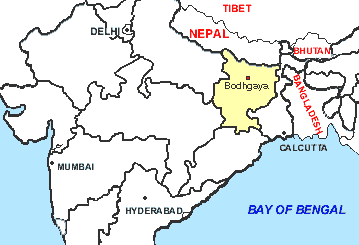
Fascinating tale about how India's third biggest state at 82-83m people experienced an economic turnaround of serious proportions in recent years.

biharstate.gif

The core description:

For decades the sprawling state of Bihar, flat and scorching as a griddle, was something between a punch line and a cautionary tale, the exact opposite of the high-tech, rapidly growing, rising global power India has sought to become.

Criminals could count on the police for protection, not prosecution. Highwaymen ruled the shredded roads and kidnapping was one of the state's most profitable businesses.

Violence raged between Muslims and Hindus, between upper castes and lower castes. Its economy, peopled by impoverished subsistence farmers struggling through alternating floods and droughts, shriveled. Its government, led by politicians who used divisive identity politics to entrench their rule, was so corrupt that it required a newly coined phrase: the Jungle Raj.

The name captured everything that was wrong with the old India -- a combustible mix of crime, corruption and caste politics in a state crucible that stifled economic growth.

So when Bihar announced earlier this year that it had notched an 11 percent average growth rate for the last five years, making it the second fastest-growing economy in the country, the news was greeted as a sign that even India's most intractable corners of backwardness and misery were being transformed.

"If even Bihar can change, then anywhere in India can change," said Shaibal Gupta of the Asian Development Research Institute, an independent think tank here. "With good governance, good policy and law and order anything is possible."

Bihar's turnaround illustrates how a handful of seemingly small changes can yield big results in India's most impoverished and badly governed regions. It also demonstrates how crucial the governments of India's 28 states, many of which are larger than most countries, will be to India's aspirations to superpower status.

Keep this story in mind whenever we discuss the Naxalites and their 6-8k hardcore fighters. They're flipping villages, but globalization is flipping entire--and huge--Indian states.

The key?

Bihar is a textbook case of how leadership determines development.

Some leader create the connectivity-enabling environment and some do not. Those who do not end up fighting insurgencies like the Naxalites.

8:19PM

Appreciating China for what it's done for global capitalism

EDITORIAL: "China must steer--not slow--growth: Economy's expansion is not a problem. Its composition is," Financial Times, 16 April 2010.

China proves government stimulus packages can work--big time. China's recent push basically revived the global economy, safeguarding the planet during the crisis.

This is a huge gift China has given the world, so it should be appreciated for what it is, because the alternative scenario pathway would have been disastrously bad for everybody.

The danger? Too many bad loans happening.

The good news? Most are to state-run enterprises, so we're really taking manageable public debt.

In general, the FT is not too worried about China's recent inflation, especially if the yuan gets a bit revalued.

Conclusion (as always from the FT): China's future must be based on more consumerism, meaning more economic freedom for individuals and households.

Key take-away:

Leaders must also accept the political effects of more empowered consumers. Marxists think politics merely reflects economic forces; China's faux communists may still rather see it the other way around.

Touche!

8:19PM

I'm with the Russians on this one

20071108_27octftt08.jpg


EDITORIAL: "Stopping Missile Defense? The U.S. and Russia can't both be right about the new arms pact," Wall Street Journal, 17-18 April 2010.

Both sides walk away from the recent START pact claiming very different things about America's ability to unilaterally pursue missile defense. Obama says we're completely free to do what we want and the Russians cite the preamble bit noting "the interrelationship between strategic offensive arms and strategic defensive arms."

The WSJ editorial says that reductions in nuclear weapons are okay, but any limits on missile defense are not.

The logic here is weirdly faulty: why reduce weapons so that missile defense can reintroduce the possibility of conventional escalation dominance? Last time anyone checked, that path gets you back to the point where the loser turns to nukes out of desperation, meaning the end result is making nuclear war more likely--not less.

This is where Obama's thinking breaks down in its ahistorical naivete, and the Russians are right to call him on it.

8:18PM

The fastest and most likely route to breaking the magic 50 boundary

five-states-1007-lg.jpg


WEEKEND JOURNAL: "Altered States: The state of Long Island would be bigger than Rhode Island, while the official bird of West Kansas would be the pheasant," by Michael J. Trinklein, Wall Street Journal, 17-18 April 2010.

Guy previously wrote a book about all the "other states that never made it."

Recalling my WPR feature on eventually adding Mexican states (the taboo-breakage occurred when north and south California split) Trinklein argues that the most likely route to adding more stars is for a reconfiguration of existing states, like the northern-most chunk of Wisconsin combining with the Upper Peninsula of Michigan to form the state Superior.

To me, the most likely path remains a N-S California split. Californians--as always--are nutty enough to experiment so.

8:18PM

The world needs--and gets--a strong Turkey

language_turkey-flag.png


FEATURE: "Turkey's Moment: Its Economy Is Hot Again After a Painful 2009, and Some Economists Say it's a Germany in the Making," by Steve Bryant and Ben Holland, Bloomberg BusinessWeek, 25 April 2010.

Nice piece.

The recent political strife isn't damping down international investor interest. Why? They see the economic fundamentals are being too sound (deep manufacturing base and large middle class) and the potential too great to ignore.

Recep Erdogan (current PM) gets most of the credit, along with Kellogg School alum deputy PM, Ali Babacan. Their big steps all sound fairly familiar, given the recent crisis here and debates on how to prevent the next one: reined in gov spending, sold state-owned companies, strengthened financial regulatory agencies, and raised cap requirements for banks.

The duo also pressed for EU membership as a way of forcing all this unpleasant reforms, and now that they've succeeded and the EU remains cool, Turkey seems to care less about it. Trade with the EU and Middle East is booming, and Turkey came through the recent crisis with no IMF help (indeed, Erdogan just paid off the country's remaining IMF loans).

Erdogan is expected to win re-election in 2011. If he does, he becomes the nation's longest-serving premier in over sixty years.

Great to see. The world needs a strong Turkey.